Molecular structure, electric property, and scintillation and quenching of liquid scintillators
Pith reviewed 2026-05-18 21:38 UTC · model grok-4.3
The pith
Polar groups in scintillator molecules raise the dielectric constant and reduce scintillation efficiency through quenching.
A machine-rendered reading of the paper's core claim, the machinery that carries it, and where it could break.
Core claim
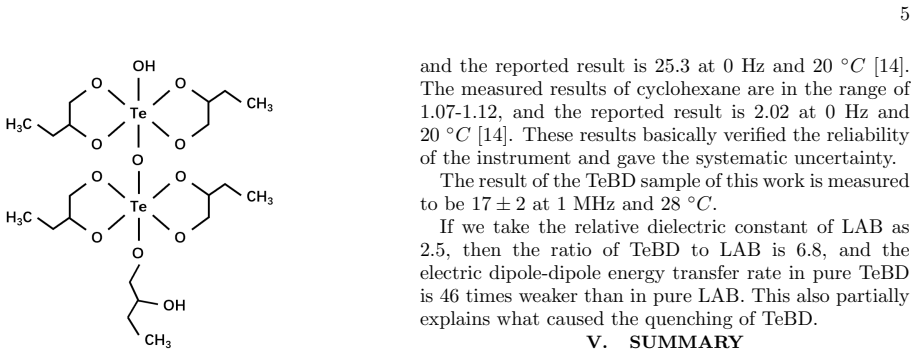
The basic scintillation process in two-component liquid scintillators consists of excitation, ionization, and anion-cation recombination. A molecule's polar group, polarization characteristics, and the corresponding material's dielectric constant correlate with scintillation efficiency. Polar groups and high relative dielectric constant cause quenching and should be avoided in design. In the TeBD liquid scintillator, hydroxyl groups introduce polar structures leading to a measured relative dielectric constant of 16±1, which accounts for part of its quenching.
What carries the argument
Correlation between molecular polar groups, material polarization, and relative dielectric constant that affects the efficiency of anion-cation recombination.
If this is right
- Avoiding polar groups when selecting solvents or solutes will lower quenching and raise light yield.
- Scintillator recipes should target low relative dielectric constants as a design target.
- The hydroxyl groups in TeBD are one source of its observed quenching via the elevated dielectric constant of 16±1.
- Dielectric-constant screening can be used early to discard candidate molecules likely to quench.
Where Pith is reading between the lines
- The same polarity rule could be checked in solid or plastic scintillators that rely on similar excitation-recombination steps.
- Alternative tellurium loading schemes without hydroxyl groups might be developed to recover some of the lost light yield.
- The dielectric constant could serve as a quick lab proxy for quenching risk when screening large libraries of candidate solvents.
Load-bearing premise
The observed correlation between polar groups or high dielectric constant and increased quenching is causal and general enough to guide molecule selection.
What would settle it
Synthesize and test a two-component liquid scintillator that deliberately excludes polar groups and measures a low dielectric constant, then compare its light yield to an otherwise similar mixture that includes polar groups.
Figures


read the original abstract
Liquid scintillators are widely used in particle and nuclear physics. Understanding the scintillation and quenching mechanisms is a fundamental issue in designing a high-light-yield liquid scintillator. In this work, the basic scintillation process for two-component liquid scintillators is discussed, highlighting the processes of excitation, ionization, and anion-cation recombination. A molecule's polar group, polarization characteristics, and the corresponding material's dielectric constant are found to be correlated with a liquid scintillator's scintillation efficiency. Polar groups and high relative dielectric constant (permittivity) can cause quenching and should be avoided. The tellurium loading scheme in the liquid scintillator of the SNO+ experiment, TeBD, is discussed. The hydroxyl groups introduce polar structures in the TeBD, and for the first time, the relative dielectric constant of TeBD is measured to be $16\pm1$. These discussions explain part of the quenching of the TeBD liquid scintillator.
Editorial analysis
A structured set of objections, weighed in public.
Referee Report
Summary. The paper examines the scintillation and quenching mechanisms in two-component liquid scintillators, focusing on the processes of excitation, ionization, and anion-cation recombination. It identifies a correlation between a molecule's polar groups, polarization characteristics, and the material's relative dielectric constant with the scintillation efficiency. Polar groups and high permittivity are suggested to cause quenching. The work discusses the TeBD scintillator for SNO+, reports a measured relative dielectric constant of 16 ± 1, and attributes part of its quenching to hydroxyl groups.
Significance. If the reported correlation holds and is causal, it would provide valuable guidance for optimizing liquid scintillator compositions to maximize light yield by minimizing polar components. The dielectric constant measurement for TeBD is a concrete contribution that could inform explanations for its performance in the SNO+ experiment. However, the overall significance is tempered by the absence of a detailed quantitative link to the recombination dynamics.
major comments (2)
- [Discussion of basic scintillation process] The manuscript describes the excitation-ionization-recombination pathway but does not derive or cite a quantitative relation between the relative dielectric constant ε_r and key parameters such as the Onsager radius or ion-pair escape probability. This link is necessary to support the claim that high ε_r causes quenching via this mechanism.
- [TeBD liquid scintillator section] The explanation of quenching in TeBD relies on the measured ε_r = 16 ± 1 and the presence of hydroxyl groups, but lacks control measurements or analysis to isolate dielectric effects from viscosity, concentration, or specific chemical quenching, undermining the causal attribution.
minor comments (1)
- [Abstract] The abstract states that the correlation 'is found' but the supporting evidence appears to be primarily from prior knowledge and one new measurement; clarifying the source of the general claim would improve clarity.
Simulated Author's Rebuttal
We are grateful to the referee for the detailed and helpful comments on our manuscript. We have prepared the following point-by-point responses to the major comments.
read point-by-point responses
-
Referee: [Discussion of basic scintillation process] The manuscript describes the excitation-ionization-recombination pathway but does not derive or cite a quantitative relation between the relative dielectric constant ε_r and key parameters such as the Onsager radius or ion-pair escape probability. This link is necessary to support the claim that high ε_r causes quenching via this mechanism.
Authors: We thank the referee for highlighting this point. While the manuscript focuses on observed correlations between molecular polarity, dielectric constant, and scintillation efficiency, we agree that referencing the underlying quantitative framework would strengthen the discussion. We will revise the text to include the Onsager radius r_O = e²/(4π ε_0 ε_r kT) and its implication for ion-pair recombination probability, along with appropriate citations to the literature on dielectric effects in liquid scintillators. revision: yes
-
Referee: [TeBD liquid scintillator section] The explanation of quenching in TeBD relies on the measured ε_r = 16 ± 1 and the presence of hydroxyl groups, but lacks control measurements or analysis to isolate dielectric effects from viscosity, concentration, or specific chemical quenching, undermining the causal attribution.
Authors: The referee correctly identifies that the attribution relies on the new dielectric measurement and known properties of hydroxyl groups rather than dedicated controls. We cannot add new experimental data to isolate variables such as viscosity in this revision. We will update the TeBD section to state more explicitly that polar groups and the measured permittivity are proposed as contributing factors to the observed quenching, while acknowledging potential confounding influences from other parameters. revision: partial
Circularity Check
No significant circularity; claims rest on empirical correlations and direct measurement
full rationale
The paper discusses the excitation-ionization-recombination process in liquid scintillators and reports an observed correlation between molecular polar groups, polarization, dielectric constant, and scintillation efficiency. It also presents a new measurement of the relative dielectric constant of TeBD as 16±1 to partially explain observed quenching. No equations derive a quantity from itself by construction, no parameters are fitted to a subset and then relabeled as predictions, and no load-bearing steps reduce to self-citations or ansatzes imported from prior author work. The central claims are framed as empirical findings and qualitative discussion rather than a closed mathematical derivation, making the chain self-contained against external benchmarks.
Axiom & Free-Parameter Ledger
axioms (1)
- domain assumption The basic scintillation process for two-component liquid scintillators involves excitation, ionization, and anion-cation recombination.
Reference graph
Works this paper leans on
-
[1]
5 and 6; one can expect they have similar effects on anions and cations as other alcohol substances
Polar groups in TeBD There are two hydroxyl groups in each TeBD composition, as shown in Fig. 5 and 6; one can expect they have similar effects on anions and cations as other alcohol substances. These polar groups can slow down and prevent some of the anion-cation recombination back to excited states for scintillation and can cause quenching
-
[2]
We first measured the relative dielectric constants of ethanol and cyclohexane at 1 MHz and 28 ◦C
Dielectric constant of TeBD The relative dielectric constant of TeBD of this work was measured with a dielectric constant and dielectric loss testing instrument, mode DHGTJS, produced by Shanghai Donghai Electric CO., LTD. We first measured the relative dielectric constants of ethanol and cyclohexane at 1 MHz and 28 ◦C. The frequency was limited by our in...
- [3]
-
[4]
Metal-loaded organic scintillators for neutrino physics
C. Buck and M. Yeh, Metal-loaded organic scintillators for neutrino physics, J. Phys. G 43, 093001 (2016), arXiv:1608.04897 [physics.ins-det]
work page internal anchor Pith review Pith/arXiv arXiv 2016
- [5]
-
[6]
I. A. Suslov, I. B. Nemchenok, Y. A. Shitov, S. V. Kazartsev, V. V. Belov, and A. D. Bystryakov, Development of a new tellurium loaded liquid scintillator based on linear alkylbenzene, Nucl. Instrum. Meth. A 1040, 167131 (2022)
work page 2022
- [7]
- [8]
-
[9]
Y.-Y. Ding, M.-C. Liu, L.-J. Wen, Y.-X. Li, G.-S. Li, and Z.-Y. Zhang, A novel approach in synthesizing Te-diol compounds for tellurium-loaded liquid scintillator, Nucl. Instrum. Meth. A 1049, 168111 (2023). 6
work page 2023
- [10]
- [11]
-
[12]
F¨ orster, Zwischenmolekulare Energiewanderung und Fluoreszenz, Annalen Phys
T. F¨ orster, Zwischenmolekulare Energiewanderung und Fluoreszenz, Annalen Phys. 437, 55 (1948)
work page 1948
-
[13]
D. L. Dexter, A Theory of Sensitized Luminescence in Solids, J. Chem. Phys. 21, 836–850 (1953)
work page 1953
-
[14]
Masters, Paths to F¨ orster’s resonance energy transfer (FRET) theory, Eur
B. Masters, Paths to F¨ orster’s resonance energy transfer (FRET) theory, Eur. Phys. J. H 39, 87 (2014)
work page 2014
-
[15]
A. O. Allen, Yields of free ions formed in liquids by radiation (1976)
work page 1976
-
[16]
W. E. Haynes, CRC Handbook of Chemistry and Physics (97th ed.) (CRC Press, 2016)
work page 2016
-
[17]
J. Allison et al. , Recent developments in Geant4, Nucl. Instrum. Meth. A 835, 186 (2016)
work page 2016
-
[18]
J. Allison et al. , Geant4 developments and applications, IEEE Trans. Nucl. Sci. 53, 270 (2006)
work page 2006
-
[19]
S. Agostinelli et al. , Geant4 - a simulation toolkit, Nucl. Instrum. Meth. A 506, 250 (2003)
work page 2003
-
[20]
H. N. Tran et al. , Review of chemical models and applications in Geant4-DNA: Report from the ESA BioRad III Project, Med. Phys. 51, 5873 (2024)
work page 2024
-
[21]
S. Incerti et al. , Geant4-DNA example applications for track structure simulations in liquid water: a report from the Geant4-DNA Project, Med. Phys. 45, e722 (2018)
work page 2018
-
[22]
M. A. Bernal et al. , Track structure modeling in liquid water: A review of the Geant4-DNA very low energy extension of the Geant4 Monte Carlo simulation toolkit, Phys. Med. 31, 861 (2015)
work page 2015
-
[23]
S. Incerti et al. , Comparison of Geant4 very low energy cross section models with experimental data in water, Med. Phys. 37, 4692 (2010)
work page 2010
-
[24]
Incerti et al., The Geant4-DNA project, Int
S. Incerti et al., The Geant4-DNA project, Int. J. Model. Simul. Sci. Comput. 1, 157–178 (2010)
work page 2010
-
[25]
G.-A. A. et al. , Evaluated electron scattering cross section dataset for gaseous benzene in the energy range 0.1–1000 eV, Phys. Chem. Chem. Phys.25, 20510 (2023)
work page 2023
-
[26]
A. I. Lozano et al. , Double and triple differential cross sections for single ionization of benzene by electron impact, Int. J. Mol. Sci. 22, 4601 (2021)
work page 2021
-
[27]
M. Li, Z. Guo, M. Yeh, Z. Wang, and S. Chen, Separation of scintillation and Cherenkov lights in linear alkyl benzene, Nucl. Instrum. Meth. A 830, 303 (2016), arXiv:1511.09339 [physics.ins-det]
work page internal anchor Pith review Pith/arXiv arXiv 2016
-
[28]
Z. Guo, M. Yeh, R. Zhang, D.-W. Cao, M. Qi, Z. Wang, and S. Chen, Slow liquid scintillator candidates for MeV-scale neutrino experiments, Astropart. Phys. 109, 33 (2019)
work page 2019
discussion (0)
Sign in with ORCID, Apple, or X to comment. Anyone can read and Pith papers without signing in.