REVIEW 4 major objections 5 minor 3 cited by
X-ray view of a massive node of the Cosmic Web at z=3 II. Discovery of extended X-ray emission around a hyperluminous QSO
T0 review · 4 major / 5 minor · reviewed 2026-08-05 · deepseek-v4-flash
Pith's one-line read Around a z=3.25 quasar, Chandra sees a compact halo of hot gas — the earliest thermal proto-intracluster medium yet detected.
desk verdict A credible, carefully controlled first detection of extended thermal X-ray emission around a z>3 QSO, with virial-scale mass estimates that are clearly model-dependent extrapolations. read the letter →
The pith
A machine-rendered reading of the paper's core claim, the machinery that carries it, and where it could break.
The reading
What carries the argument
Two components carry the argument. First, a classic β-model density profile — ne(r) = ne,0 [1 + (r/rcore)^2]^(−3β/2), the standard power-law-like profile used for cluster gas — is projected from three dimensions onto the sky through an Abel-transform identity, with an explicit proof of the required integral in Appendix C. This converts the spectral normalization measured in the 2″–3″ annulus into a central electron density ne,0, from which gas mass within Rvir, pressure, and cooling times are derived. Second, a joint MCMC fit of four concentric spectra simultaneously models the quasar's power-law PSF contribution and the thermal plasma component, using an exponential prior on β and a log-uni
What would settle it
Take the current ALMA Band 3 data and inject the MCMC posterior β-models: the predicted SZ significance is only (2.6±0.4)σ, so the planned deeper ALMA observations can settle the matter. If a resolved SZ decrement matching the X-ray-derived pressure profile does not appear at roughly 5σ confidence, the hot-gas mass and baryon fraction would have to shrink. A second check is spectral: the 15–30 kpc annulus should show a bremsstrahlung-like tail (CIE plasma at kT≈1.8 keV) rather than a steep power law with photon index Γ≈6, which would indicate inverse Compton radiation.
Extended reading notes
Core claim
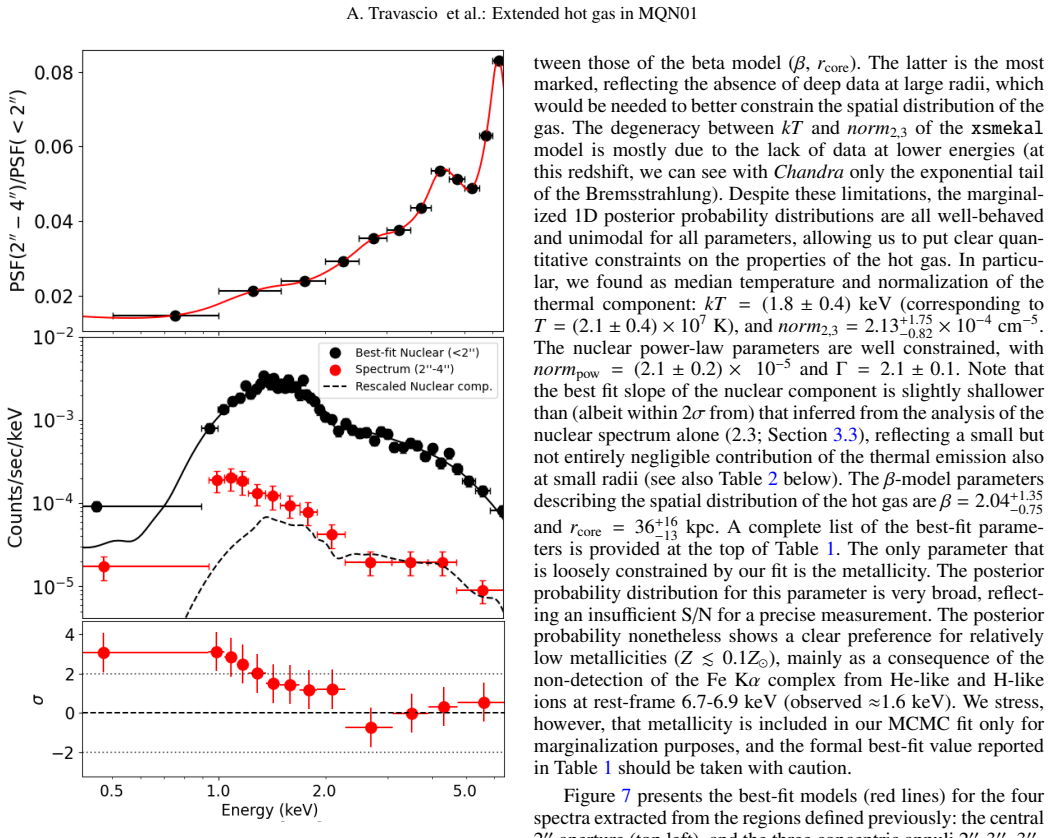
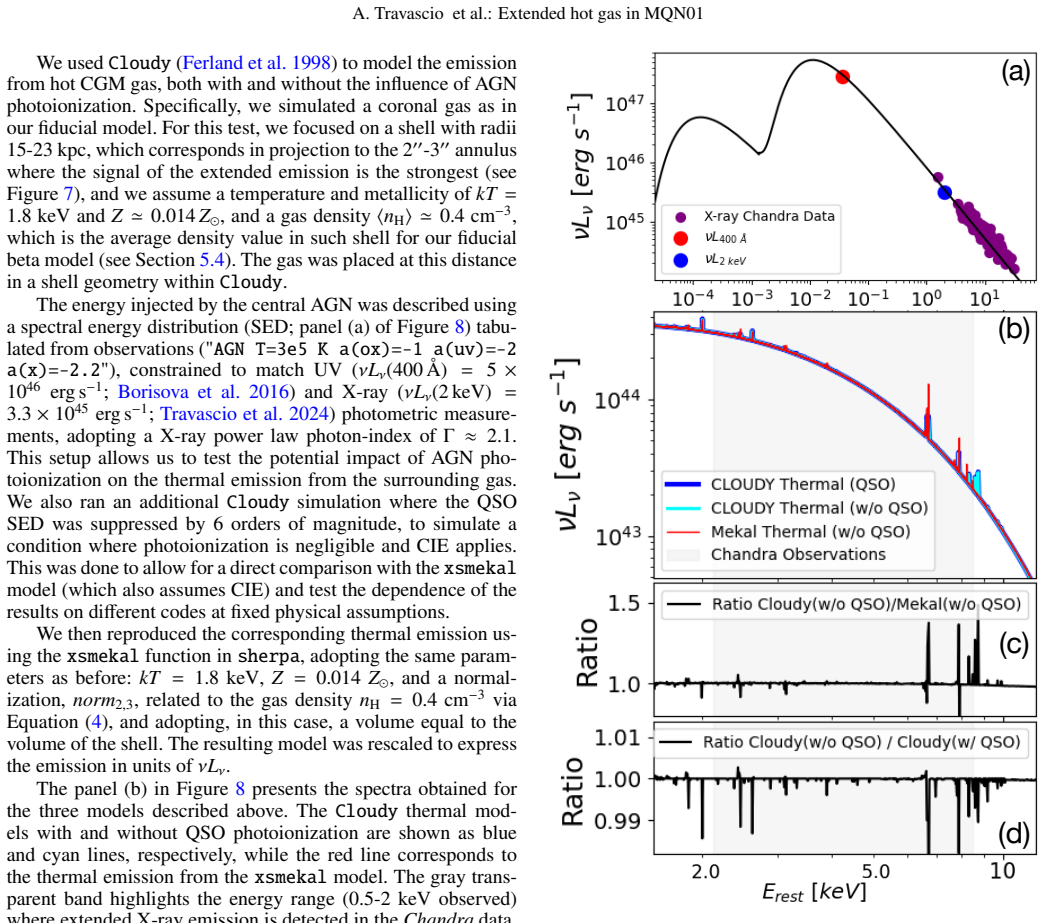
The central claim is that the soft X-ray excess around QSO ID1 in MQN01 is thermal emission from hot plasma, not AGN photoionization, inverse Compton scattering, or Compton up-scattering by a wind. The evidence is a PSF-subtracted radial profile showing ≈66±8 net counts (≈8σ) in the 0.5–2 keV band out to ≈30 kpc, an isotropic residual map, and a spectrum whose excess lies below 2 keV. A joint spatial-spectral MCMC fit with a β-model density profile and an xsmekal CIE plasma gives kT≈1.8±0.4 keV, β≈2.0, rcore≈36 kpc, and a steep, compact gas distribution. Alongside the fit, the paper reports that the inferred virial mass is Mvir≈3×10^13 Msun, the hot gas mass within Rvir≈190 kpc is Mhot≈2.6×1
Load-bearing premise
The mass and baryon-fraction numbers assume the β-model fitted to the single 15–30 kpc annulus keeps holding all the way out to the 190 kpc virial radius; the data themselves say nothing about gas beyond 30 kpc.
Editorial extensions
If this is right
- The hot phase of the circumgalactic medium already exists at z≈3.25, so models of halo formation must produce a virialized, X-ray-emitting gas reservoir this early, not just at lower redshift.
- Roughly half of the halo's cosmic baryon budget sits in the hot phase, meaning baryon censuses of high-redshift protoclusters cannot ignore hot gas even when it is detected only in the inner 30 kpc.
- Hot-gas pressures of order 0.3–0.9 keV cm^-3 can confine the dense cold clumps needed to power giant Lyα nebulae, giving a physical explanation for why such nebulae survive around bright quasars in overdensities.
- Short cooling-to-dynamical times (tcool/tff≈1.9 and tcool/tBV≈1.3 at 15 kpc) put the inner halo near the precipitation threshold, so localized condensation and cold inflow, rather than a global cooling flow, are plausible in this system.
- MQN01 sits well above the local LX–TX relation even after self-similar redshift scaling, indicating that the thermodynamic state of this proto-ICM is not the same as evolved groups and clusters.
Reading between the lines
- If the extrapolated β-model is roughly right, similar compact hot halos around z>3 quasars in overdensities should be common at faint fluxes; a targeted survey of other MQN01-like fields could find them and test whether this is a universal phase or a rare event.
- The steep β≈2 profile is atypical of local clusters; one natural reading is that we are seeing freshly shock-heated core gas before it has relaxed outward, but the paper does not establish that, and unresolved clumping could also steepen the apparent profile.
- The pressure-confinement picture yields a testable prediction: Lyα surface-brightness fluctuations should anticorrelate with hot-gas pressure radius, and deeper X-ray imaging beyond 30 kpc should find a declining pressure that still bounds the clumps.
- If future ALMA SZ data place the gas mass below the X-ray-derived value, the discrepancy would point to clumping or non-equilibrium conditions, and the reported baryon fraction would be an upper limit rather than a measurement.
Editorial analysis
A structured set of objections, weighed in public.
Referee Report
Summary. This paper analyzes 634 ks of Chandra ACIS-I data on the MQN01 protocluster at z=3.25, concentrating on the brightest QSO (ID1). Using simulated PSFs, radial profiles, and PSF subtraction, the authors report ~66 net counts (≈8σ) of extended 0.5–2 keV emission between ~15 and 30 kpc, with upper limits beyond; the emission is isotropic and is not seen around other X-ray AGNs in the field. A joint spectral-spatial MCMC with a β-model plus a nuclear power law yields kT≈1.8 keV, β≈2.0, rcore≈36 kpc, and a thermal normalization, from which they infer ne,0≈0.9 cm^-3, Mvir≈3×10^13 M☉, Rvir≈190 kpc, Mhot(<Rvir)≈2.6×10^12 M☉, fhot≈56% of the cosmic baryon budget, and L≈2.25×10^45 erg/s within 30 kpc. The authors test photoionization, inverse Compton, and Compton up-scattering alternatives, compare with Spiderweb and DIANOGA simulations, and discuss cooling, hydrostatic equilibrium, and pressure confinement of the Lyα-emitting clumps.
Significance. If correct, this is a first detection of hot CGM/proto-ICM thermal emission at z>3 and a valuable multi-phase view of a massive forming halo. The detection methodology is a strength: deep Chandra data, PSF simulations, refined astrometric alignment, and the comparison with the bright AGN ID2 give credibility to the extended soft excess. The analytical projection formula in Appendix C is a useful contribution. However, the headline baryon-budget and gas-mass numbers are not directly measured: they rely on extrapolating a β-model from the 15–30 kpc detection to Rvir≈190 kpc, with a strongly degenerate β–rcore posterior. The paper is therefore scientifically important but needs a substantial reframing of the derived quantities.
major comments (4)
- [§4.1–4.2, Eq. (9)] The direct detection constrains the surface brightness only in the 2″–4″ annulus (15–30 kpc); Figure 9 shows upper limits beyond 30 kpc, and the outer MCMC annulus (5″–8″) is described as below the background level. Equation (9) integrates the β-model to Rvir=190 kpc, while Figure 6 shows a strong β–rcore degeneracy. The median β=2.04, rcore=36 kpc is one of several allowed profiles; β≈1.3, rcore≈50 kpc is also within the posterior and changes Mhot by factors of several. The abstract's fhot≈56% should be presented as a model-dependent extrapolation, not a measurement, and should be accompanied by an exploration of profile families and clumping.
- [§4.2, §5.7] Mvir is derived from kT via the Dekel & Birnboim (2006) virial scaling, and the hydrostatic check in §5.7 gives pressure-gradient/gravity ratios of 0.7–1.3 with broad uncertainties. Because Rvir and Mvir enter Mhot and fhot, the virial assumption is load-bearing. Please propagate an alternative mass calibration (e.g., from the SZ non-detection or from the Lyα velocity field) or add an explicit systematic term; at minimum the text should state that Mvir is not independently confirmed.
- [Abstract, §6, Table 2] The abstract reports a measured L2-10≈2.3×10^45 erg/s within the central 30 kpc, while §6 and Figure 11 use L0.5-2 and quote ≈2.25×10^45 erg/s. Summing the thermal L2-10 entries in Table 2 across the central apertures gives approximately 1.1×10^45 erg/s, not 2.3×10^45. This band confusion directly affects the LX–TX outlier claim and must be corrected and clarified.
- [§4.3, §5.2] The thermal interpretation rests on a soft excess of only ~66 net counts and a power-law alternative with Γ≈6. The fit degeneracies (kT–norm, β–rcore) and unconstrained metallicity are acknowledged, but the luminosity in the inner 2″ region includes an extrapolated thermal fraction (~12%) that depends on the β-model. The quoted Lx values should be reported as 'assuming the fiducial β-model' throughout. The conservative >1 keV spectral fit tests the temperature prior but does not address the spatial-profile extrapolation.
minor comments (5)
- [Eq. (8)] The 'vt' before the square-root factor appears to be a rendering artifact; please replace with the intended mathematical notation.
- [§3.1] Typo: 'signficant' should read 'significant'. Please also check the escaped spacing in words such as 'a ffects' and 'e ffective' in the discussion sections.
- [Eq. (4)] The notation normrin,rout is introduced without a precise statement that it is the xsmekal normalization for the projected annulus; this should be stated explicitly to avoid confusion with the 3D density normalization.
- [Abstract and text] The object is variously called 'MQN01 Cosmic Node', 'MQN01 Cosmic Structure', and 'MQN01 protocluster'. Please unify the terminology.
- [Figure 10] The caption says the shaded region is the 68% confidence interval from Monte Carlo realizations; specify how those realizations sample the MCMC posterior and whether the β-model is fixed.
Circularity Check
No significant circularity: the extended-emission detection and thermal interpretation are data-driven; derived halo properties are model-dependent extrapolations, not circular predictions.
full rationale
The central detection rests on PSF-subtracted radial profiles and a spectral excess (Sects. 3.1 and 3.3), independent of the thermal model. The joint MCMC (Sect. 4.1) fits kT, norm, beta, and rcore simultaneously; the derived Mvir, ne,0, Mhot, and fhot are deterministic transforms of these fitted parameters under explicitly stated assumptions (beta-model, spherical symmetry, virial scaling, fb = 0.15). No target quantity is fed back into the fit, and the model is not calibrated to reproduce Mhot or fhot. The steep beta is not an artifact of the prior: the exponential prior favors beta <~ 1, yet the posterior peaks at beta ~ 2. The beta-rcore degeneracy and the 15-30 kpc to Rvir extrapolation are acknowledged (Sect. 4.1, Fig. 6) and are robustness concerns, not circular reasoning. Self-citations (Travascio et al. 2024 for the source catalog; Pezzulli & Cantalupo 2019 and Cantalupo et al. 2019 for interpretation) provide context and are not used to justify the X-ray detection or to exclude alternatives; even the Abel-transform identity is proved in Appendix C rather than imported from a self-citation. Alternative emission mechanisms (photoionization, inverse Compton, Compton up-scattering) are modeled and disfavored on independent grounds. The SZ non-detection is compared with, not used to set, the model parameters. No uniqueness theorem is invoked. The paper's explicit caveats (Sects. 4.3 and 5.7) show that the derived baryon budget is model-dependent, but not that it is equivalent to its inputs by construction. The result is a legitimate model-based inference from new data, not a circular derivation.
Assumptions & free parameters
free parameters (7)
- kT =
1.8 ± 0.4 keV
- norm2,3 =
2.13(+1.75,-0.82) x 10^-4 cm^-5
- Z =
0.014(+0.083,-0.012) Zsun
- beta =
2.04(+1.35,-0.75)
- rcore =
36(+16,-13) kpc
- normpow =
2.07(+0.15,-0.18) x 10^-5
- Gamma =
2.09 ± 0.07
assumptions (6)
- domain assumption The Chandra PSF model accurately represents the instrument response at ID1; PSF normalization matches counts in the central 2''.
- domain assumption The soft excess is optically thin, collisionally ionized equilibrium plasma (xsmekal).
- domain assumption The gas density follows a spherically symmetric beta model with constant temperature and metallicity.
- domain assumption The halo is virialized; Mvir is derived from kT via the Dekel & Birnboim (2006) scaling relation.
- domain assumption Cosmic baryon fraction fb = Ωb/Ωm = 0.15.
- domain assumption The background is described by a power law plus five Gaussian lines from an off-source region.
Cite this review
Pith. "Pith review of X-ray view of a massive node of the Cosmic Web at z=3 II. Discovery of extended X-ray emission around a hyperluminous QSO." pith.science (2026). https://pith.science/paper/CIPKMNLY
@misc{pith2026250820074,
  author       = {Pith},
  title        = {Pith review of: X-ray view of a massive node of the Cosmic Web at z=3 II. Discovery of extended X-ray emission around a hyperluminous QSO},
  year         = {2026},
  howpublished = {\url{https://pith.science/paper/CIPKMNLY}},
  note         = {Machine review of arXiv:2508.20074}
}
read the original abstract
While the warm, ionized gas in the CGM at z>3 is now routinely observed around bright QSOs in Lya emission, little is known about the CGM hot phase due to its expected faintness in the X-ray band, often referred to as the ICM. Here, we report the analysis of 634 ks of Chandra X-ray observations in the MQN01 Cosmic Node, a region containing one of the brightest Lya nebulae and the largest galaxy overdensity discovered so far at z>3. We detect 66 net counts of X-ray emission in the 0.5-2 keV band extending to at least 30 kpc from the brightest QSO in MQN01. The morphology and spectrum are consistent with thermal emission from hot plasma in CIE. Photoionization is negligible, and IC is disfavored. A joint spatial and spectral MCMC analysis provides consistency with a beta-model with a steep density profile and a gas temperature kT~1.8 keV and virial halo mass Mvir~3e13 Mo. The inferred hot gas mass is Mhot(<Rvir)~2.6e12 Mo, which is ~8.3% of Mvir, or ~56% of the theoretical cosmological baryon budget of the halo. The hot gas also emits an exceptionally high Lx, with a measured L2-10~2.3e45 erg/s within the central 30 kpc. This system is a clear outlier in the Lx-Tx plane, indicating a thermodynamic state distinct from that of evolved lower-redshift hot halos. The cooling time in the inner 15-30 kpc is comparable to the local dynamical time, suggesting that the gas could become locally unstable in the absence of heating or feedback. Moreover, the thermal pressure associated with the detected CGM hot phase is large enough to confine the cold and dense clumps, which are required to reproduce the high Lya emission associated with the inner regions of the MQN01 structure. Although limited to a single system, our results provide unique information on the multi-phase properties of the CGM and a view of the nascent thermal hot gas phase observed in local galaxy clusters.
Figures


Figures from the paper (7 more)





Forward citations
Cited by 3 Pith papers
-
The youth of the intracluster medium. I. A non-parametric characterisation of the gas and electron number density profiles of $z \simeq 2$ protoclusters
At z≈2, Magneticum protoclusters show moderate self-similarity deviations, double-β density profiles, and hot ionised gas dominant only beyond ~0.1–0.5 R500c, with clear mass, merger and AGN trends.
-
An Inverse-Compton-Boosted Cool Core Unifies Perseus's Radio and X-ray Halos
Ancient cosmic ray halos from the central galaxy boost Perseus's cool core via inverse-Compton scattering, simultaneously explaining radio minihalo, giant halo, X-ray properties, and gamma-ray data without re-acceleration.
-
The galaxy-halo connection and the dynamical evolution of a giant disc in a massive node of the Cosmic Web at z~3
The Big Wheel at z~3 has a stellar-to-halo mass ratio of 0.06, higher than expected, implying efficient stellar assembly without major mergers or instabilities.
Reference graph
Works this paper leans on
-
[1]
, " * write output.state after.block = add.period write newline
ENTRY address archiveprefix author booktitle chapter edition editor howpublished institution eprint journal key month note number organization pages publisher school series title type volume year label extra.label sort.label short.list INTEGERS output.state before.all mid.sentence after.sentence after.block FUNCTION init.state.consts #0 'before.all := #1 ...
-
[2]
write newline
" write newline "" before.all 'output.state := FUNCTION n.dashify 't := "" t empty not t #1 #1 substring "-" = t #1 #2 substring "--" = not "--" * t #2 global.max substring 't := t #1 #1 substring "-" = "-" * t #2 global.max substring 't := while if t #1 #1 substring * t #2 global.max substring 't := if while FUNCTION word.in bbl.in " " * FUNCTION format....
-
[3]
& Huertas-Company , M
Andreon , S. & Huertas-Company , M. 2011, A&A, 526, A11
2011
-
[4]
Arnaud , K. A. 1996, in Astronomical Society of the Pacific Conference Series, Vol. 101, Astronomical Data Analysis Software and Systems V, ed. G. H. Jacoby & J. Barnes , 17
1996
-
[5]
J., & Scott , P
Asplund , M., Grevesse , N., Sauval , A. J., & Scott , P. 2009, ARA&A, 47, 481
2009
-
[6]
d., et al
Barret , D., Albouys , V., Herder , J.-W. d., et al. 2023, ExA, 55, 373
2023
-
[7]
2009, MNRAS, 397, 1804
Binney , J., Nipoti , C., & Fraternali , F. 2009, MNRAS, 397, 1804
2009
-
[8]
J., et al
Borisova , E., Cantalupo , S., Lilly , S. J., et al. 2016, , 831, 39
2016
Show all 106 references
-
[9]
N., Mohr , J
Bulbul , E., Chiu , I. N., Mohr , J. J., et al. 2019, ApJ, 871, 50
2019
-
[10]
2010, MNRAS, 403, L16
Cantalupo , S. 2010, MNRAS, 403, L16
2010
-
[11]
J., et al
Cantalupo , S., Pezzulli , G., Lilly , S. J., et al. 2019, , 483, 5188
2019
-
[12]
& Fusco-Femiano , R
Cavaliere , A. & Fusco-Femiano , R. 1976, , 49, 137
1976
-
[13]
Choudhury , P. P. & Sharma , P. 2016, MNRAS, 457, 2554
2016
-
[14]
2011, A&A, 532, A14
Conte , A., de Petris , M., Comis , B., Lamagna , L., & de Gregori , S. 2011, A&A, 532, A14
2011
-
[15]
A., Wyithe , J
Correa , C. A., Wyithe , J. S. B., Schaye , J., & Duffy , A. R. 2015, MNRAS, 452, 1217
2015
-
[16]
C., Gallo , L., & Ross , R
Crummy , J., Fabian , A. C., Gallo , L., & Ross , R. R. 2006, MNRAS, 365, 1067
2006
-
[17]
2024, arXiv, arXiv:2403.12600
Damiano , A., Valentini , M., Borgani , S., et al. 2024, arXiv, arXiv:2403.12600
2024 arXiv
-
[18]
2023, MNRAS, 526, 1850
de Beer , S., Cantalupo , S., Travascio , A., et al. 2023, MNRAS, 526, 1850
2023
-
[19]
& Birnboim , Y
Dekel , A. & Birnboim , Y. 2006, MNRAS, 368, 2
2006
-
[20]
2023, , 615, 809
Di Mascolo , L., Saro , A., Mroczkowski , T., et al. 2023, , 615, 809
2023
-
[21]
2005, MNRAS, 364, 753
Dolag , K., Vazza , F., Brunetti , G., & Tormen , G. 2005, MNRAS, 364, 753
2005
-
[22]
& Voit , G
Donahue , M. & Voit , G. M. 2022, PhR, 973, 1
2022
-
[23]
W., Jin , C., Blaes , O., & Ward , M
Done , C., Davis , S. W., Jin , C., Blaes , O., & Ward , M. 2012, MNRAS, 420, 1848
2012
-
[24]
Dong , R., Rasmussen , J., & Mulchaey , J. S. 2010, ApJ, 712, 883
2010
-
[25]
2013, A&A, 551, A22
Eckert , D., Molendi , S., Vazza , F., Ettori , S., & Paltani , S. 2013, A&A, 551, A22
2013
-
[26]
2015, MNRAS, 447, 2198
Eckert , D., Roncarelli , M., Ettori , S., et al. 2015, MNRAS, 447, 2198
2015
-
[27]
C., Stewart , G
Edge , A. C., Stewart , G. C., & Fabian , A. C. 1992, MNRAS, 258, 177
1992
-
[28]
& Ulmer , M
Ehlert , S. & Ulmer , M. P. 2009, , 503, 35
2009
-
[29]
2025, arXiv e-prints, arXiv:2503.01674
Esposito , M., Borgani , S., Strazzullo , V., et al. 2025, arXiv e-prints, arXiv:2503.01674
2025 arXiv
-
[30]
2013, SSRv, 177, 119
Ettori , S., Donnarumma , A., Pointecouteau , E., et al. 2013, SSRv, 177, 119
2013
-
[31]
2009, A&A, 501, 61
Ettori , S., Morandi , A., Tozzi , P., et al. 2009, A&A, 501, 61
2009
-
[32]
Fabian , A. C. 1994, ARA&A, 32, 277
1994
-
[33]
C., Crawford , C
Fabian , A. C., Crawford , C. S., Ettori , S., & Sanders , J. S. 2001, MNRAS, 322, L11
2001
-
[34]
& Quataert , E
Faucher-Gigu \`e re , C.-A. & Quataert , E. 2012, , 425, 605
2012
-
[35]
J., Korista , K
Ferland , G. J., Korista , K. T., Verner , D. A., et al. 1998, , 110, 761
1998
-
[36]
W., Lang , D., & Goodman , J
Foreman-Mackey , D., Hogg , D. W., Lang , D., & Goodman , J. 2013, PASP, 125, 306
2013
-
[37]
2001, in Society of Photo-Optical Instrumentation Engineers (SPIE) Conference Series, Vol
Freeman , P., Doe , S., & Siemiginowska , A. 2001, in Society of Photo-Optical Instrumentation Engineers (SPIE) Conference Series, Vol. 4477, Astronomical Data Analysis, ed. J.-L. Starck & F. D. Murtagh , 76--87
2001
-
[38]
2024, arXiv, arXiv:2410.03822
Galbiati , M., Cantalupo , S., Steidel , C., et al. 2024, arXiv, arXiv:2410.03822
2024 arXiv
-
[39]
Gaspari , M., Ruszkowski , M., & Oh , S. P. 2013, MNRAS, 432, 3401
2013
-
[40]
D., Burchett , J
Ge , C., Wang , Q. D., Burchett , J. N., et al. 2018, MNRAS, 481, 4111
2018
-
[41]
2007, , 463, 79
Gilli , R., Comastri , A., & Hasinger , G. 2007, , 463, 79
2007
-
[42]
Gnedin , N. Y. & Hollon , N. 2012, ApJS, 202, 13
2012
-
[43]
H., Zaritsky , D., & Zabludoff , A
Gonzalez , A. H., Zaritsky , D., & Zabludoff , A. I. 2007, ApJ, 666, 147
2007
-
[44]
Gradshteyn, I. S. & Ryzhik, I. M. 2007, Table of integrals, series, and products, seventh edn. (Elsevier/Academic Press, Amsterdam), xlviii+1171, translated from the Russian, Translation edited and with a preface by Alan Jeffrey and Daniel Zwillinger, With one CD-ROM (Windows,...
2007
-
[45]
P., Valentini , M., & Dolag , K
Groth , F., Steinwandel , U. P., Valentini , M., & Dolag , K. 2023, MNRAS, 526, 616
2023
-
[46]
2013, ApJS, 208, 19
Hinshaw , G., Larson , D., Komatsu , E., et al. 2013, ApJS, 208, 19
2013
-
[47]
S., Mittal , R., Reiprich , T
Hudson , D. S., Mittal , R., Reiprich , T. H., et al. 2010, A&A, 513, A37
2010
-
[48]
& Forman , W
Jones , C. & Forman , W. 1984, ApJ, 276, 38
1984
-
[49]
1986, MNRAS, 222, 323
Kaiser , N. 1986, MNRAS, 222, 323
1986
-
[50]
2022, , 938, 123
Kooistra , R., Lee , K.-G., & Horowitz , B. 2022, , 938, 123
2022
-
[51]
Kravtsov , A. V. & Borgani , S. 2012, ARA&A, 50, 353
2012
-
[52]
2024, , 682, A186
Lepore , M., Di Mascolo , L., Tozzi , P., et al. 2024, , 682, A186
2024
-
[53]
A., Osterheld , A
Liedahl , D. A., Osterheld , A. L., & Goldstein , W. H. 1995, , 438, L115
1995
-
[54]
2024, A&A, 688, A76
Mastromarino , C., Oppizzi , F., De Luca , F., Bourdin , H., & Mazzotta , P. 2024, A&A, 688, A76
2024
-
[55]
& Williams , R
Mathur , S. & Williams , R. J. 2003, ApJL, 589, L1
2003
-
[56]
J., et al
Mauch , T., Murphy , T., Buttery , H. J., et al. 2003, MNRAS, 342, 1117
2003
-
[57]
J., Giles , P
Maughan , B. J., Giles , P. A., Randall , S. W., Jones , C., & Forman , W. R. 2012, MNRAS, 421, 1583
2012
-
[58]
McCourt , M., Sharma , P., Quataert , E., & Parrish , I. J. 2012, MNRAS, 419, 3319
2012
-
[59]
R., & Tremblay , G
McDonald , M., Gaspari , M., McNamara , B. R., & Tremblay , G. R. 2018, ApJ, 858, 45
2018
-
[60]
Mewe , R., Gronenschild , E. H. B. M., & van den Oord , G. H. J. 1985, , 62, 197
1985
-
[61]
R., & van den Oord , G
Mewe , R., Lemen , J. R., & van den Oord , G. H. J. 1986, , 65, 511
1986
-
[62]
Mirakhor , M. S. & Walker , S. A. 2021, MNRAS, 506, 139
2021
-
[63]
S., Walker , S
Mirakhor , M. S., Walker , S. A., & Runge , J. 2022, MNRAS, 509, 1109
2022
-
[64]
H., & Jaritz , V
Mittal , R., Hicks , A., Reiprich , T. H., & Jaritz , V. 2011, A&A, 532, A133
2011
-
[65]
J., Mathiesen , B., & Evrard , A
Mohr , J. J., Mathiesen , B., & Evrard , A. E. 1999, ApJ, 517, 627
1999
-
[66]
2015, MNRAS, 450, 2261
Morandi , A., Sun , M., Forman , W., & Jones , C. 2015, MNRAS, 450, 2261
2015
-
[67]
& Lau , E
Nagai , D. & Lau , E. T. 2011, ApJL, 731, L10
2011
-
[68]
F., Frenk , C
Navarro , J. F., Frenk , C. S., & White , S. D. M. 1996, ApJ, 462, 563
1996
-
[69]
& Posti , L
Nipoti , C. & Posti , L. 2014, ApJ, 792, 21
2014
-
[70]
B., Mohr , J
O'Hara , T. B., Mohr , J. J., & Sanderson , A. J. R. 2007, arXiv, arXiv:0710.5782
2007 arXiv
-
[71]
A., et al
Paggi , A., Massaro , F., Pe \ n a-Herazo , H. A., et al. 2021, A&A, 647, A79
2021
-
[72]
Peebles , P. J. E. 1980, The large-scale structure of the universe
1980
-
[73]
2024, arXiv e-prints, arXiv:2401.04765
Pensabene , A., Cantalupo , S., Cicone , C., et al. 2024, arXiv e-prints, arXiv:2401.04765
2024 arXiv
-
[74]
& Cantalupo , S
Pezzulli , G. & Cantalupo , S. 2019, , 486, 1489
2019
-
[75]
2017, MNRAS, 467, 311
Pezzulli , G., Fraternali , F., & Binney , J. 2017, MNRAS, 467, 311
2017
-
[76]
C., Husemann , B., Tremblay , G
Powell , M. C., Husemann , B., Tremblay , G. R., et al. 2018, A&A, 618, A27
2018
-
[77]
W., Arnaud , M., Maughan , B
Pratt , G. W., Arnaud , M., Maughan , B. J., & Melin , J. B. 2023, A&A, 669, C2
2023
-
[78]
S., Kara , E
Reynolds , C. S., Kara , E. A., Mushotzky , R. F., et al. 2023, in Society of Photo-Optical Instrumentation Engineers (SPIE) Conference Series, Vol. 12678, UV, X-Ray, and Gamma-Ray Space Instrumentation for Astronomy XXIII, ed. O. H. Siegmund & K. Hoadley , 126781E
2023
-
[79]
2002, , 566, 667
Rosati , P., Tozzi , P., Giacconi , R., et al. 2002, , 566, 667
2002
-
[80]
E., et al
Ruppin , F., McDonald , M., Bleem , L. E., et al. 2021, ApJ, 918, 43
2021
-
[81]
2009, MNRAS, 392, 795
Saro , A., Borgani , S., Tornatore , L., et al. 2009, MNRAS, 392, 795
2009
-
[82]
2000, ApJL, 537, L73
Sato , S., Akimoto , F., Furuzawa , A., et al. 2000, ApJL, 537, L73
2000
-
[83]
Shimakawa , R., Koyama , Y., R \"o ttgering , H. J. A., et al. 2018, , 481, 5630
2018
-
[84]
M., et al
Siemiginowska , A., Burke , D., G \"u nther , H. M., et al. 2024, , 274, 43
2024
-
[85]
M., Lehmer , B
Smail , I., Blundell , K. M., Lehmer , B. D., & Alexander , D. M. 2012, ApJ, 760, 132
2012
-
[86]
A., Holden , B., Rosati , P., et al
Stanford , S. A., Holden , B., Rosati , P., et al. 2001, ApJ, 552, 504
2001
-
[87]
2021, ApJ, 911, 88
Stern , J., Faucher-Gigu \`e re , C.-A., Fielding , D., et al. 2021, ApJ, 911, 88
2021
-
[88]
Sunyaev , R. A. & Zeldovich , Y. B. 1972, CoASP, 4, 173
1972
-
[89]
2022, A&A, 667, A134
Tozzi , P., Gilli , R., Liu , A., et al. 2022, A&A, 667, A134
2022
-
[90]
S., Jee , M
Tozzi , P., Santos , J. S., Jee , M. J., et al. 2015, , 799, 93
2015
-
[91]
2024, arXiv, arXiv:2410.03933
Travascio , A., Cantalupo , S., Tozzi , P., et al. 2024, arXiv, arXiv:2410.03933
2024 arXiv
-
[92]
S., et al
van Marrewijk , J., Di Mascolo , L., Gill , A. S., et al. 2024, , 689, A41
2024
-
[93]
2025, A&A, 695, A204
van Marrewijk , J., Kaasinen , M., Popping , G., et al. 2025, A&A, 695, A204
2025
-
[94]
2013, MNRAS, 429, 799
Vazza , F., Eckert , D., Simionescu , A., Br \"u ggen , M., & Ettori , S. 2013, MNRAS, 429, 799
2013
-
[95]
S., et al
Vikhlinin , A., Markevitch , M., Murray , S. S., et al. 2005, ApJ, 628, 655
2005
-
[96]
M., Donahue , M., Bryan , G
Voit , G. M., Donahue , M., Bryan , G. L., & McDonald , M. 2015, Natur, 519, 203
2015
-
[97]
M., Meece , G., Li , Y., et al
Voit , G. M., Meece , G., Li , Y., et al. 2017, ApJ, 845, 80
2017
-
[98]
& Abel , T
Wang , P. & Abel , T. 2008, , 672, 752
2008
-
[99]
2016, , 828, 56
Wang , T., Elbaz , D., Daddi , E., et al. 2016, , 828, 56
2016
-
[100]
2017, MNRAS, 465, 3291
Weinberger , R., Springel , V., Hernquist , L., et al. 2017, MNRAS, 465, 3291
2017
-
[101]
D., Voit , G
Wibking , B. D., Voit , G. M., & O'Shea , B. W. 2025, MNRAS, 537, 739
2025
-
[102]
W., McNamara , B
Wise , M. W., McNamara , B. R., & Murray , S. S. 2004, ApJ, 601, 184
2004
-
[103]
M., Birkinshaw , M., & Young , A
Worrall , D. M., Birkinshaw , M., & Young , A. J. 2016, MNRAS, 458, 174
2016
-
[104]
& Wu , X.-P
Xue , Y.-J. & Wu , X.-P. 2000, MNRAS, 318, 715
2000
-
[105]
C., Celotti, A., & Jonker, P
Yuan, W., Fabian, A. C., Celotti, A., & Jonker, P. G. 2003, Monthly Notices of the Royal Astronomical Society, 346, L7–L10
2003
-
[106]
& King , A
Zubovas , K. & King , A. 2012, , 745, L34
2012
Reviewed August 5, 2026 · model on record in the stance chip above.
Discussion (0). Sign in to comment.