REVIEW 4 major objections 5 minor 41 references
Global Motion Corresponder for 3D Point-Based Scene Interpolation under Large Motion
T0 review · 4 major / 5 minor · reviewed 2026-08-05 · deepseek-v4-flash
Pith's one-line read GMC learns per-point SE(3) maps into a shared canonical space, making 3D scene interpolation and extrapolation work under large motion.
desk verdict GMC is a genuinely new approach to large-motion 3D scene interpolation with strong qualitative results; the main risk is that its canonical-space alignment relies on heuristics that are not yet stress-tested. read the letter →
The pith
A machine-rendered reading of the paper's core claim, the machinery that carries it, and where it could break.
The reading
What carries the argument
The load-bearing object is the unary potential field F(μ, f̃) = (R, t): an MLP that assigns each 3D Gaussian a rotation R and translation t into a shared canonical space, conditioned on the point's mean position and a four-dimensional PCA projection of its DINO semantic feature. Because a neural network's output is smooth in its input, semantically similar points receive similar transformations — this inductive bias replaces explicit global matching and suppresses the criss-cross correspondences of naive nearest-neighbor search. The canonical space is trained by the bidirectional energy loss of Eq. 5, which minimizes, from both states, a weighted L2 distance over color, feature, and canonica
What would settle it
Take two visually identical objects (same color, shape, DINO features) that swap positions between the two captured states. If GMC tracks each object by appearance rather than physical continuity, interpolation will show them passing through each other or swapping identity, revealing that the 'correspondence' is an appearance-based global match rather than the true motion; conversely, a correct trajectory under swaps would demonstrate genuine motion reasoning. A second check: a checkerboard or repeated-texture plane moving and deforming between states, where an unambiguous ground-truth warp is
Extended reading notes
Core claim
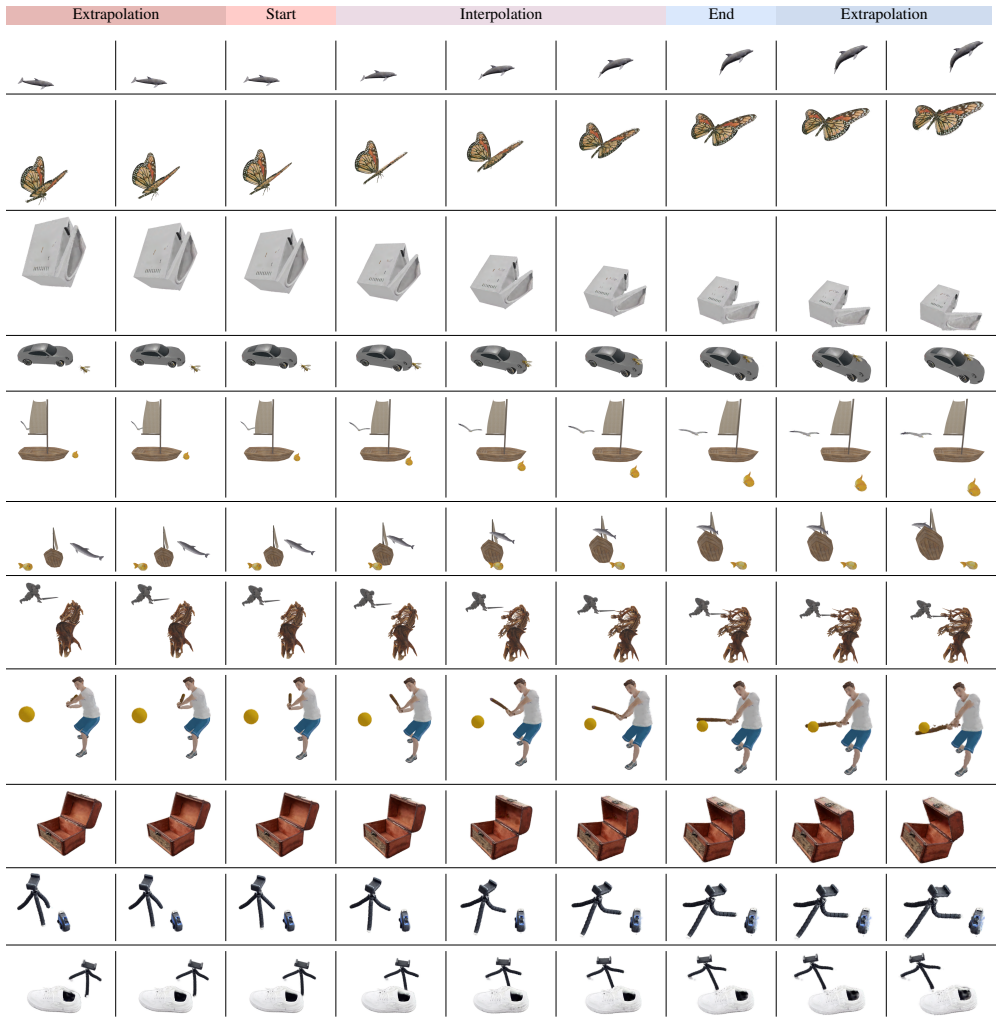
This paper's central claim is that scene interpolation under large motion is equivalent to learning smooth global correspondence between two point-based 3D representations, and that this correspondence should be learned rather than computed by matching. GMC trains two unary potential fields — one per timestep — where each field is an MLP that maps a Gaussian's mean position and its PCA-projected DINO feature to an SE(3) transformation (rotation plus translation). Applying the two fields moves both sets of Gaussians into a shared canonical space in which corresponding points coincide; a bidirectional energy loss then matches every point to a nearest neighbor in the joint space of color, seman
Load-bearing premise
The method rests on the premise that PCA-projected DINO features remain reliable, view-invariant semantic descriptors for the surfaces in both states, and that the bidirectional nearest-neighbor energy lands on a globally consistent matching; if the features are ambiguous on textureless or repetitive surfaces, or the optimization locks onto a wrong but smooth match, the canonical space stays aligned and the interpolation looks smooth while tracking the wrong points.
Editorial extensions
If this is right
- Interpolation between two captured states no longer needs the small-motion assumption, so dynamic scenes can be captured at lower temporal density — the paper shows results with frame gaps of 5 timesteps.
- Extrapolation beyond the captured interval works by continuing the interpolation parameter past t = 1 and below t = 0, producing plausible unseen future and past frames that none of the baselines can produce.
- The same correspondence machinery improves reconstruction under sparse spatial capture: a sparse-view state refines its geometry and appearance by borrowing the other state's information through the rendering loss, reducing floaters and adding detail.
- Small-motion performance is not sacrificed: on the local-motion PAPR scenes, GMC stays competitive with or ahead of the baselines, so the method covers both regimes with one mechanism.
- Because every Gaussian carries an explicit SE(3) transformation, the method outputs dense per-point trajectories, giving it a natural route to tracking and motion editing beyond pure rendering.
Reading between the lines
- A testable prediction the paper does not make: in scenes with two visually identical objects that swap positions, GMC's appearance-weighted energy should track identities by semantic similarity, so the interpolation would show a smooth identity swap rather than the physical motion — a clean probe of whether the correspondence is physical or appearance-based.
- The canonical-space formulation extends naturally to chains of more than two frames: a family of unary fields mapping every frame into one shared space would give multi-frame temporal super-resolution, an application the paper only gestures at with its interpolation-plus-extrapolation demonstrations.
- Because the input features come from DINO, GMC inherits DINO's blind spots: repetitive geometry, mirrors, and textureless regions should produce coherent but potentially wrong matchings; measuring this would require ground-truth trajectories, which the paper notes are absent for large-motion settings.
- The sparse-view refinement result suggests a broader use: canonical alignment could act as a geometric regularizer whenever one state is captured densely and another sparsely, potentially reducing capture cost in dynamic-scene reconstruction pipelines.
Editorial analysis
A structured set of objections, weighed in public.
Referee Report
Summary. The paper proposes GMC, a method for 3D point-based scene interpolation under large motion. Two per-timestep unary potential fields map Gaussian means and PCA-projected DINO features to SE(3) transformations into a shared canonical space (Sec. 3.2). The fields are trained with a bidirectional Chamfer-like energy over color, feature, and canonical position (Eqs. 4–5), a local isometry loss over k-nearest neighbors (Eq. 7), and a joint rendering refinement loss (Eq. 9). Interpolation is performed by SLERP/linear interpolation between the identity and the relative transformation; extrapolation extends this beyond [0,1]. Experiments cover synthetic and real scenes with large and local motion, reporting SI-FID, SI-EMD, and SI-MPED against 4DGS, Deformable 3DGS, Dynamic Gaussian, and PAPR in Motion, plus sparse-view refinement results.
Significance. Removing the small-motion assumption is an important and timely problem for dynamic scene interpolation. The canonical-space SE(3) alignment idea is elegant, the method is clearly specified, and the experiments span a broad set of scenes including real-world captures. The sparse-view refinement result is a useful additional capability. However, the quantitative evidence does not directly measure whether the learned correspondences are semantically correct: the proposed metrics are smoothness proxies derived from start/end states, and the optimization relies on heuristics whose robustness is not demonstrated. If these gaps are addressed, the contribution would be solid and likely of interest to the graphics/vision community.
major comments (4)
- [Sec. 3.3 and Supp. A] The central mechanism is the minimization of Eq. 5 over per-point SE(3) fields. As the authors acknowledge, this objective has a trivial global solution where all Gaussians collapse to one canonical point; dropout on the position input and a Gumbel Perturb-and-MAP strategy are used as heuristics. No convergence analysis, sensitivity study, or failure analysis is provided. The local isometry loss (Eq. 7) constrains only k=256 nearest neighbors, so a folded or partially collapsed embedding could satisfy the loss while giving semantically wrong correspondences for distant points. Because the large-motion claim depends on avoiding such minima, please provide a systematic study of dropout ratio, position scale, and random seeds, and verify on synthetic scenes with known ground-truth motion that the canonical alignment is semantically correct, not merely smooth.
- [Sec. 4.2, Tables 1–3] The evaluation metrics SI-FID, SI-EMD, and SI-MPED are all computed from start/end states and measure smoothness of rendered images and point geometry; they do not measure per-point trajectory or correspondence correctness. For the synthetic Objaverse scenes the true object motions are known or can be rendered from the same assets, so a direct trajectory/correspondence metric should be feasible and should be reported. Without such a metric, the paper's key claim of establishing 'smooth global correspondences' remains unverified. I would like to see quantitative correspondence/trajectory errors on at least the synthetic scenes, or a human-study evaluation of interpolation plausibility.
- [Sec. 4.2, Note about Baselines] The decision to omit results where baselines 'fail to train' is consequential: Tables 1 and 3 contain many dashes for 4DGS and Deformable 3DGS, and the reported averages are computed only over the scenes that did not fail. A method that diverges is still an outcome and should be counted (e.g., as an infinite or worst-case metric value) or reported as a success rate. The current treatment makes the 'significantly outperforms' claim appear stronger than the data support. Please provide a consistent failure-handling protocol and include qualitative instances of baseline failure.
- [Supp. Table 7 and Sec. 4.2] On the local-motion PAPR scenes, the improvement over PAPR in Motion is small and not consistent across scenes or metrics. For example, Crab SI-EMD is 13.26 vs. 9.87, Dolphin SI-EMD is 2.78 vs. 2.17, and Stand SI-MPED is 30.27 vs. 26.72, with several other per-scene values worse than the baseline. The abstract's global 'significantly outperforms existing baselines' should be restricted to the large-motion setting, where the evidence is stronger. Please recalibrate the claim and discuss this limitation.
minor comments (5)
- [Tables 1, 3, 6] Several table cells have missing spaces between numbers, e.g., '154.02288.67' (Table 1 PAPR row), '697.19530.10' (Table 3), and '31.9423.80' (Table 6). Please fix the formatting.
- [Supp. Sec. B] The text uses 'MEPD' in one place ('overall MEPD') while the metric is introduced as 'MPED'. Please make the acronym consistent.
- [Eq. (6)] The notation |µ_i^{(0),t=1} − µ_i^{(0)}| should be clarified as the Euclidean norm, not absolute value.
- [Sec. 3.3 / Supp. A] The Gumbel Perturb-and-MAP strategy is only mentioned in the supplementary material; since it is part of the optimization procedure, it should be described in the main text (or at least referenced in Sec. 3.3) for reproducibility.
- [Sec. 5 / Supp. D] The manuscript would benefit from a limitations paragraph, particularly discussing when DINO features may be ambiguous (textureless or repetitive surfaces) and the computational cost of the k-NN and energy minimization on large point sets.
Circularity Check
No load-bearing circularity: the canonical-space SE(3) fields are optimized with an explicit correspondence energy, and the interpolation metrics are computed post-training rather than used as training losses.
full rationale
The central mechanism (Eqs. 2–6) is a learned mapping: two Unary Potential Fields predict SE(3) transforms into a shared canonical space, and the bidirectional energy loss (Eq. 5) is the training objective that defines correspondence. This is a learnable optimization target, not a rename of the evaluation metric. The interpolation/extrapolation trajectory (Sec. 3.4) is a post-hoc SLERP/linear interpolation of the learned relative transform, so it is not fitted to the interpolated frames. None of SI-FID, SI-EMD, or SI-MPED appears in the loss; the only image supervision is the start/end rendering loss (Eq. 9), and the metrics are computed after training. The paper explicitly notes "we do not have access to a single ground truth trajectory" and therefore evaluates smoothness relative to endpoints; this is an evaluation limitation, not a circular derivation. DINO features are a fixed pretrained descriptor, not derived from the method's own outputs. The local isometry loss is said to be "inspired by prior works [17,20,23]" and the SI-MPED definition "follow[s] PAPR in Motion [20]"; these include self-citations with overlapping authors ([20] and [23]), but they are not load-bearing—the components are implemented and ablated within this paper (Table 4), and no uniqueness claim or hidden premise is imported from those citations. Overall, the claimed prediction (smooth global interpolation/extrapolation) is not equivalent by construction to its inputs; the minor self-citation and evaluation-on-the-same-states caveats are noted but do not constitute circularity.
Assumptions & free parameters
free parameters (5)
- energy weights wc, wf, wmu =
1, 10, 10
- isometry k =
256
- isometry weight alpha =
0 to 10 schedule over 10k iterations
- render weight beta =
1 (dense), 5 (sparse)
- position scale and dropout ratio =
0.1 or 1.0 scale, 0.1 or 0.2 dropout
assumptions (5)
- domain assumption Per-point SE(3) transformations can align corresponding points in a shared canonical space.
- domain assumption PCA-projected DINO features are a reliable semantic descriptor for correspondence under large motion.
- domain assumption Local neighborhoods of points are rigidly preserved under motion.
- ad hoc to paper Bidirectional nearest-neighbor minimization (Eq. 5) yields globally correct correspondences.
- domain assumption Interpolating the relative SE(3) via SLERP and linear translation gives natural motion paths.
Cite this review
Pith. "Pith review of Global Motion Corresponder for 3D Point-Based Scene Interpolation under Large Motion." pith.science (2026). https://pith.science/paper/FVHSFX2S
@misc{pith2026250820136,
  author       = {Pith},
  title        = {Pith review of: Global Motion Corresponder for 3D Point-Based Scene Interpolation under Large Motion},
  year         = {2026},
  howpublished = {\url{https://pith.science/paper/FVHSFX2S}},
  note         = {Machine review of arXiv:2508.20136}
}
read the original abstract
Existing dynamic scene interpolation methods typically assume that the motion between consecutive timesteps is small enough so that displacements can be locally approximated by linear models. In practice, even slight deviations from this small-motion assumption can cause conventional techniques to fail. In this paper, we introduce Global Motion Corresponder (GMC), a novel approach that robustly handles large motion and achieves smooth transitions. GMC learns unary potential fields that predict SE(3) mappings into a shared canonical space, balancing correspondence, spatial and semantic smoothness, and local rigidity. We demonstrate that our method significantly outperforms existing baselines on 3D scene interpolation when the two states undergo large global motions. Furthermore, our method enables extrapolation capabilities where other baseline methods cannot.
Figures


Figures from the paper (8 more)



Reference graph
Works this paper leans on
-
[1]
Zero-shot 3d shape correspon- dence, 2023
Ahmed Abdelreheem, Abdelrahman Eldesokey, Maks Ovs- janikov, and Peter Wonka. Zero-shot 3d shape correspon- dence, 2023. 3
work page 2023
-
[2]
Deep vit features as dense visual descriptors, 2022
Shir Amir, Yossi Gandelsman, Shai Bagon, and Tali Dekel. Deep vit features as dense visual descriptors, 2022. 3
work page 2022
-
[3]
Per-gaussian embedding-based deformation for deformable 3d gaussian splatting, 2024
Jeongmin Bae, Seoha Kim, Youngsik Yun, Hahyun Lee, Gun Bang, and Youngjung Uh. Per-gaussian embedding-based deformation for deformable 3d gaussian splatting, 2024. 2
work page 2024
-
[4]
Emerg- ing properties in self-supervised vision transformers
Mathilde Caron, Hugo Touvron, Ishan Misra, Herv ´e J´egou, Julien Mairal, Piotr Bojanowski, and Armand Joulin. Emerg- ing properties in self-supervised vision transformers. In Pro- ceedings of the International Conference on Computer Vi- sion (ICCV), 2021. 2, 3
work page 2021
-
[5]
Cats: Cost ag- gregation transformers for visual correspondence
Seokju Cho, Sunghwan Hong, Sangryul Jeon, Yunsung Lee, Kwanghoon Sohn, and Seungryong Kim. Cats: Cost ag- gregation transformers for visual correspondence. In Ad- vances in Neural Information Processing Systems , pages 9011–9023. Curran Associates, Inc., 2021. 3
work page 2021
-
[6]
Neural parametric gaussians for monocular non-rigid object reconstruction, 2024
Devikalyan Das, Christopher Wewer, Raza Yunus, Eddy Ilg, and Jan Eric Lenssen. Neural parametric gaussians for monocular non-rigid object reconstruction, 2024. 2
work page 2024
-
[7]
Objaverse: A universe of annotated 3d objects, 2022
Matt Deitke, Dustin Schwenk, Jordi Salvador, Luca Weihs, Oscar Michel, Eli VanderBilt, Ludwig Schmidt, Kiana Ehsani, Aniruddha Kembhavi, and Ali Farhadi. Objaverse: A universe of annotated 3d objects, 2022. 6
work page 2022
-
[8]
An image is worth 16x16 words: Transformers for image recognition at scale, 2021
Alexey Dosovitskiy, Lucas Beyer, Alexander Kolesnikov, Dirk Weissenborn, Xiaohua Zhai, Thomas Unterthiner, Mostafa Dehghani, Matthias Minderer, Georg Heigold, Syl- vain Gelly, Jakob Uszkoreit, and Neil Houlsby. An image is worth 16x16 words: Transformers for image recognition at scale, 2021. 3
work page 2021
Show all 41 references
-
[9]
Duisterhof, Zhao Mandi, Yunchao Yao, Jia- Wei Liu, Jenny Seidenschwarz, Mike Zheng Shou, Deva Ra- manan, Shuran Song, Stan Birchfield, Bowen Wen, and Jef- frey Ichnowski
Bardienus P. Duisterhof, Zhao Mandi, Yunchao Yao, Jia- Wei Liu, Jenny Seidenschwarz, Mike Zheng Shou, Deva Ra- manan, Shuran Song, Stan Birchfield, Bowen Wen, and Jef- frey Ichnowski. Deformgs: Scene flow in highly deformable scenes for deformable object manipulation, 2024. 2
2024
-
[10]
Gans trained by a two time-scale update rule converge to a local nash equilib- rium
Martin Heusel, Hubert Ramsauer, Thomas Unterthiner, Bernhard Nessler, and Sepp Hochreiter. Gans trained by a two time-scale update rule converge to a local nash equilib- rium. In Proceedings of the 31st International Conference on Neural Information Processing Systems , page 6...
-
[11]
Billion- scale similarity search with GPUs
Jeff Johnson, Matthijs Douze, and Herv ´e J ´egou. Billion- scale similarity search with GPUs. IEEE Transactions on Big Data, 7(3):535–547, 2019. 1
2019
-
[12]
3d gaussian splatting for real-time radiance field rendering, 2023
Bernhard Kerbl, Georgios Kopanas, Thomas Leimk ¨uhler, and George Drettakis. 3d gaussian splatting for real-time radiance field rendering, 2023. 1, 2
2023
-
[13]
Adam: A method for stochastic optimization
Diederik Kingma and Jimmy Ba. Adam: A method for stochastic optimization. In International Conference on Learning Representations (ICLR), 2015. 1
2015
-
[14]
Spacetime gaus- sian feature splatting for real-time dynamic view synthesis
Zhan Li, Zhang Chen, Zhong Li, and Yi Xu. Spacetime gaus- sian feature splatting for real-time dynamic view synthesis. arXiv preprint arXiv:2312.16812, 2023. 2
2023 arXiv
-
[15]
Gaussian-flow: 4d reconstruction with dynamic 3d gaus- sian particle
Youtian Lin, Zuozhuo Dai, Siyu Zhu, and Yao Yao. Gaussian-flow: 4d reconstruction with dynamic 3d gaus- sian particle. In Proceedings of the IEEE/CVF Conference on Computer Vision and Pattern Recognition (CVPR), pages 21136–21145, 2024. 2
2024
-
[16]
Pointinet: Point cloud frame interpolation network
Fan Lu, Guang Chen, Sanqing Qu, Zhijun Li, Yinlong Liu, and Alois Knoll. Pointinet: Point cloud frame interpolation network. In Proceedings of the AAAI Conference on Artifi- cial Intelligence, 2021. 2
2021
-
[17]
Dynamic 3d gaussians: Tracking by per- sistent dynamic view synthesis
Jonathon Luiten, Georgios Kopanas, Bastian Leibe, and Deva Ramanan. Dynamic 3d gaussians: Tracking by per- sistent dynamic view synthesis. In 3DV, 2024. 1, 2, 3, 5, 6, 7, 8
2024
-
[18]
Srinivasan, Matthew Tancik, Jonathan T
Ben Mildenhall, Pratul P. Srinivasan, Matthew Tancik, Jonathan T. Barron, Ravi Ramamoorthi, and Ren Ng. Nerf: Representing scenes as neural radiance fields for view syn- thesis, 2020. 2
2020
-
[19]
Papandreou and A
G. Papandreou and A. Yuille. Perturb-and-map random fields: Using discrete optimization to learn and sample from energy models. In Proc. IEEE Int. Conf. on Computer Vision (ICCV), pages 193–200, Barcelona, Spain, 2011. 1
2011
-
[20]
Papr in motion: Seamless point-level 3d scene interpolation
Shichong Peng, Yanshu Zhang, and Ke Li. Papr in motion: Seamless point-level 3d scene interpolation. In IEEE/CVF Conference on Computer Vision and Pattern Recognition (CVPR), 2024. 1, 2, 3, 5, 6, 7, 8
2024
-
[21]
High-resolution image syn- thesis with latent diffusion models, 2022
Robin Rombach, Andreas Blattmann, Dominik Lorenz, Patrick Esser, and Bj¨orn Ommer. High-resolution image syn- thesis with latent diffusion models, 2022. 3
2022
-
[22]
Animating rotation with quaternion curves
Ken Shoemake. Animating rotation with quaternion curves. SIGGRAPH Comput. Graph., 19(3):245–254, 1985. 6
1985
-
[23]
Dynamic gaussian marbles for novel view synthesis of casual monocular videos, 2024
Colton Stearns, Adam Harley, Mikaela Uy, Florian Dubost, Federico Tombari, Gordon Wetzstein, and Leonidas Guibas. Dynamic gaussian marbles for novel view synthesis of casual monocular videos, 2024. 5
2024
-
[24]
Bovik, H.R
Zhou Wang, A.C. Bovik, H.R. Sheikh, and E.P. Simoncelli. Image quality assessment: from error visibility to structural similarity. IEEE Transactions on Image Processing , 13(4): 600–612, 2004. 2
2004
-
[25]
4d gaussian splatting for real-time dynamic scene render- ing
Guanjun Wu, Taoran Yi, Jiemin Fang, Lingxi Xie, Xiaopeng Zhang, Wei Wei, Wenyu Liu, Qi Tian, and Xinggang Wang. 4d gaussian splatting for real-time dynamic scene render- ing. In Proceedings of the IEEE/CVF Conference on Com- puter Vision and Pattern Recognition (CVPR), pages 2...
2024
-
[26]
Street gaussians: Modeling dynamic urban scenes with gaussian splatting
Yunzhi Yan, Haotong Lin, Chenxu Zhou, Weijie Wang, Haiyang Sun, Kun Zhan, Xianpeng Lang, Xiaowei Zhou, and Sida Peng. Street gaussians: Modeling dynamic urban scenes with gaussian splatting. In Computer Vision – ECCV 2024, pages 156–173. 2
2024
-
[27]
Mped: Quantifying point cloud distortion based on multiscale potential energy discrepancy
Qi Yang, Yujie Zhang, Siheng Chen, Yiling Xu, Jun Sun, and Zhan Ma. Mped: Quantifying point cloud distortion based on multiscale potential energy discrepancy. IEEE Transactions on Pattern Analysis and Machine Intelligence , 45(5):6037– 6054, 2023. 7, 1, 3
2023
-
[28]
Deformable 3d gaussians for high-fidelity monocular dynamic scene reconstruction
Ziyi Yang, Xinyu Gao, Wen Zhou, Shaohui Jiao, Yuqing Zhang, and Xiaogang Jin. Deformable 3d gaussians for high-fidelity monocular dynamic scene reconstruction. In 2024 IEEE/CVF Conference on Computer Vision and Pat- tern Recognition (CVPR), pages 20331–20341, 2024. 1, 2, 3, 7, 8
2024
-
[29]
gsplat: An open-source library for Gaussian splatting
Vickie Ye, Ruilong Li, Justin Kerr, Matias Turkulainen, Brent Yi, Zhuoyang Pan, Otto Seiskari, Jianbo Ye, Jeffrey Hu, Matthew Tancik, and Angjoo Kanazawa. gsplat: An open-source library for Gaussian splatting. arXiv preprint arXiv:2409.06765, 2024. 7
2024 arXiv
-
[30]
Idea-net: Dynamic 3d point cloud inter- polation via deep embedding alignment
Yiming Zeng, Yue Qian, Qijian Zhang, Junhui Hou, Yixuan Yuan, and Ying He. Idea-net: Dynamic 3d point cloud inter- polation via deep embedding alignment. In Proceedings of the IEEE/CVF Conference on Computer Vision and Pattern Recognition, 2022. 2
2022
-
[31]
A tale of two features: Stable diffusion complements dino for zero-shot semantic correspondence, 2023
Junyi Zhang, Charles Herrmann, Junhwa Hur, Luisa Pola- nia Cabrera, Varun Jampani, Deqing Sun, and Ming-Hsuan Yang. A tale of two features: Stable diffusion complements dino for zero-shot semantic correspondence, 2023. 3
2023
-
[32]
Efros, Eli Shecht- man, and Oliver Wang
Richard Zhang, Phillip Isola, Alexei A. Efros, Eli Shecht- man, and Oliver Wang. The unreasonable effectiveness of deep features as a perceptual metric. In 2018 IEEE/CVF Conference on Computer Vision and Pattern Recognition , pages 586–595, 2018. 6, 1, 2
2018
-
[33]
Fast- pci: Motion-structure guided fast point cloud frame interpo- lation
Tianyu Zhang, Guocheng Qian, Jin Xie, and Jian Yang. Fast- pci: Motion-structure guided fast point cloud frame interpo- lation. In Proceedings of the European Conference on Com- puter Vision (ECCV), 2024. 2
2024
-
[34]
Papr: Proximity atten- tion point rendering
Yanshu Zhang, Shichong Peng, Seyed Alireza Moazenipourasil, and Ke Li. Papr: Proximity atten- tion point rendering. In Thirty-seventh Conference on Neural Information Processing Systems, 2023. 1
2023
-
[35]
Neuralpci: Spatio-temporal neural field for 3d point cloud multi-frame non-linear interpolation
Zehan Zheng, Danni Wu, Ruisi Lu, Fan Lu, Guang Chen, and Changjun Jiang. Neuralpci: Spatio-temporal neural field for 3d point cloud multi-frame non-linear interpolation. In Proceedings of the IEEE/CVF Conference on Computer Vi- sion and Pattern Recognition (CVPR), 2023. 2
2023
-
[36]
Feature 3dgs: Supercharging 3d gaussian splatting to enable distilled feature fields
Shijie Zhou, Haoran Chang, Sicheng Jiang, Zhiwen Fan, Ze- hao Zhu, Dejia Xu, Pradyumna Chari, Suya You, Zhangyang Wang, and Achuta Kadambi. Feature 3dgs: Supercharging 3d gaussian splatting to enable distilled feature fields. InPro- ceedings of the IEEE/CVF Conference on Compu...
2024
-
[37]
Drivinggaussian: Composite gaussian splatting for surrounding dynamic au- tonomous driving scenes
Xiaoyu Zhou, Zhiwei Lin, Xiaojun Shan, Yongtao Wang, Deqing Sun, and Ming-Hsuan Yang. Drivinggaussian: Composite gaussian splatting for surrounding dynamic au- tonomous driving scenes. In 2024 IEEE/CVF Conference on Computer Vision and Pattern Recognition (CVPR), pages 21634–2...
2024
-
[38]
Removing DINO input can result in implausible in- terpolation ( Ball), wrong global motion interpolation (Boat), or wrong local motion interpolation
-
[39]
Removing position input can result in wrong global matching ( Ball and Car) or wrong local motion in- terpolation (Butterfly)
-
[40]
Removing local isometry loss can result in noisy floaters (Dolphin) or blurry rendering ( Butterfly and Microwave) during the interpolation
-
[41]
Removing local isometry loss can result in noisy render- ing (Ball and Microwave) during the interpolation or suboptimal end status prediction (Butterfly). E. Sparse View Refinement In addition to motion interpolation and extrapolation, GMC can also be used to improve reconstr...
Reviewed August 5, 2026 · model on record in the stance chip above.
Discussion (0). Sign in to comment.