REVIEW 3 major objections 5 minor 59 references
A tale of three cataclysmic variables with distinct superhumps
T0 review · 3 major / 5 minor · reviewed 2026-08-05 · deepseek-v4-flash
Pith's one-line read This paper reports new positive and negative superhump periods in three poorly studied cataclysmic variables, including a possible tilted-disc system and a likely high mass-transfer CV below the period gap.
desk verdict Solid TESS period analysis of three CVs with one over-interpreted precession period; the J0935 and J1100 results are the real meat. read the letter →
The pith
A machine-rendered reading of the paper's core claim, the machinery that carries it, and where it could break.
The reading
What carries the argument
The load-bearing machinery is the superhump beat arithmetic. In a cataclysmic variable, the positive superhump period is the beat between the orbital period and the prograde precession of an eccentric disc, P_SH+^{-1} = P_orb^{-1} - P_prec^{-1}, while the negative superhump period is the beat between the orbital period and the retrograde precession of the nodal line of a tilted disc, P_SH-^{-1} = P_orb^{-1} + P_prec^{-1}. The paper combines continuous 2-minute-cadence TESS photometry, detrending, Lomb-Scargle and Period04 periodograms, a CLEAN power spectrum to guard against window-function aliases, and O-C timing of superhump maxima. These tools let a detected superhump period and a low-fre
What would settle it
A decisive check is to observe J130559 with phase-resolved spectroscopy over a full hypothesized precession cycle and map the motion of the disc's emission regions: if the 0.14517-day modulation does not stay coherent in an uninterrupted run, or the emission regions show no retrograde drift on the ~3.83-day timescale, the negative-superhump and tilted-disc interpretation is not supported.
Extended reading notes
Core claim
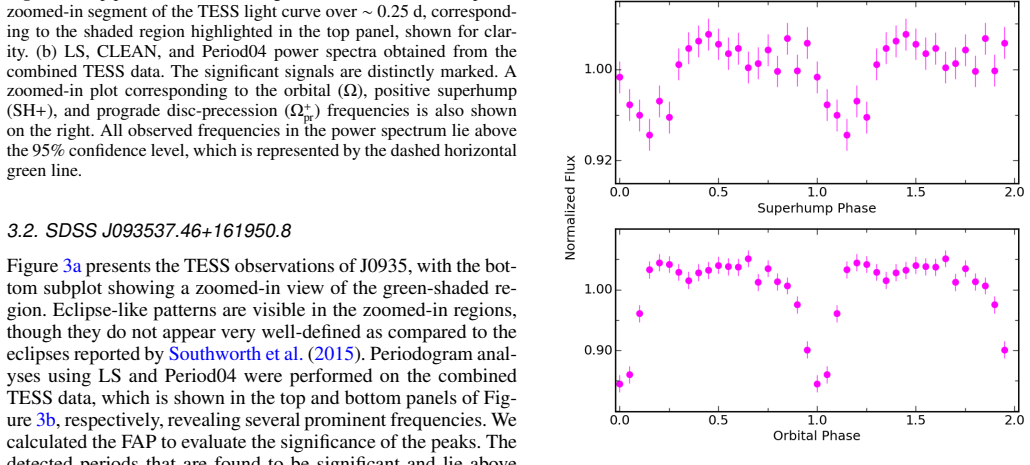
The central discovery is that each of the three CVs displays a distinct type of superhump signal in its TESS light curve, two of them for the first time. J1100 undergoes a superoutburst lasting about 14.5 days; its mean superhump period is 0.06786 days, the period shortens during decline, and the hump profile changes from a single sharp pulse to a double-peaked structure, which the authors interpret as a shrinking disc radius plus periodically variable dissipation at the accretion stream bright spot. J0935, at an orbital period of 0.06406 days, shows a persistent 0.06584-day modulation about 3% longer than the orbit and a 2.36-day low-frequency modulation matching the expected prograde apsid
Load-bearing premise
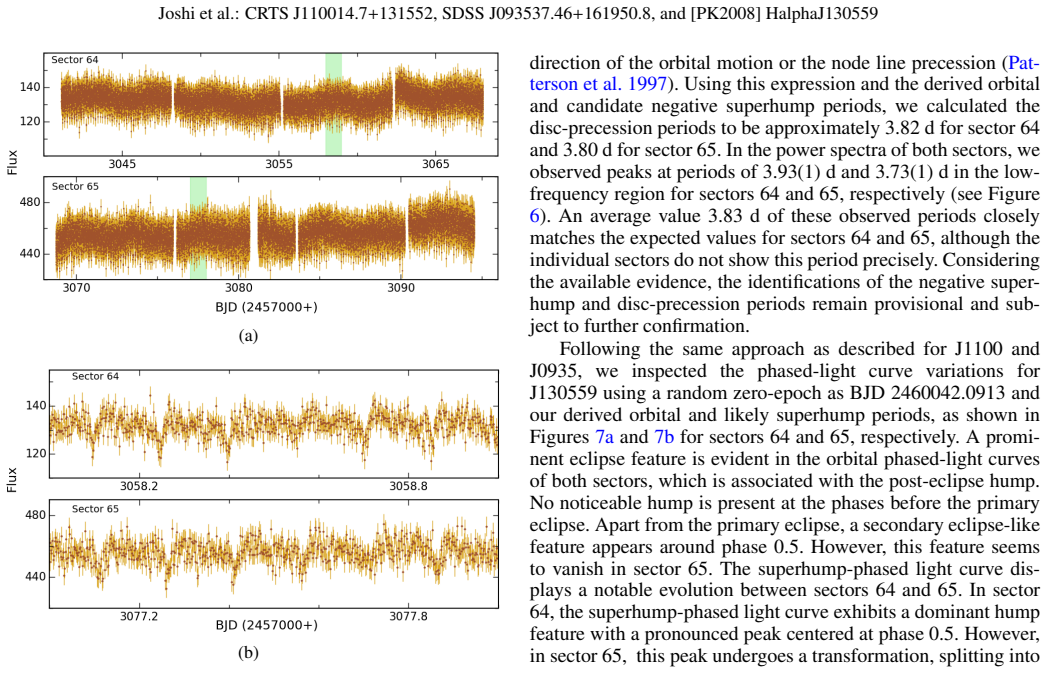
The load-bearing premise for the J130559 result is that the 0.14517-day signal is a true negative superhump and that the two low-frequency peaks, 3.93 and 3.73 days in the two observing sectors, are the same precession period; their average is close to the beat relation, but the two measured values differ by about twenty times their quoted errors, so the match could be coincidence.
Editorial extensions
If this is right
- J1100's superhump period shortening during decline, together with changing hump shape and amplitude, directly supports the prediction of the thermal-tidal instability model that the accretion disc shrinks as a superoutburst fades.
- J0935's persistent positive superhump in a system with no observed outbursts implies that superhump presence alone does not identify an SU UMa dwarf nova; the authors instead place it among high mass-transfer CVs below the period gap.
- If the J130559 identifications hold, the system joins a small list of CVs with simultaneous negative-superhump and disc-precession periods, supporting retrograde precession of a tilted disc over an eccentric-disc explanation.
- The paper's alias explanation of J130559's old 3.928-hour spectroscopic period implies that some published CV orbital periods from short spectroscopic runs may need revision when longer photometric baselines are used.
Reading between the lines
- If J0935 is an intermediate polar, an X-ray light curve should reveal a spin period and sidebands; the absence of such modulations would weaken the magnetic interpretation but not the superhump detection.
- A population-level consequence is that long TESS sectors may reveal persistent superhump signals in many short-period CVs previously considered quiet, making J0935's behavior less rare and shifting classification away from outburst-based labels.
- For J130559, eclipse timings could be re-examined for shifts on the ~3.83-day timescale; if eclipse depth or timing varies with that period, it would provide an independent geometric check of the tilted-disc interpretation.
- The alias correction to J130559's orbital period suggests that systematically rechecking old spectroscopic CV periods against continuous photometry is a cheap way to improve CV period catalogues before future all-sky surveys.
Editorial analysis
A structured set of objections, weighed in public.
Referee Report
Summary. The paper presents TESS photometry of three cataclysmic variables. For CRTS J110014.7+131552, a superoutburst is observed with positive superhumps at a mean period of 0.06786(1) d, and the O-C analysis reveals period and profile evolution during the outburst. For SDSS J093537.46+161950.8, previously undetected signals at 0.06584(2) d and 2.36(2) d are reported and interpreted as a positive superhump and a prograde disc-precession period, respectively; the absence of outbursts and the absolute brightness lead the authors to suggest a high mass-transfer CV below the period gap, possibly a nova-like variable or high-luminosity intermediate polar. For [PK2008] HalphaJ130559, a revised orbital period of 0.15092(1) d is derived, together with candidate negative superhump and retrograde precession periods of 0.14517(3) d and 3.83(1) d, although the latter identifications are explicitly marked as provisional. The overall conclusions are that J1100 is an SU UMa star during superoutburst, J0935 is a newly characterized permanent-superhump system with an unusual classification, and J130559 may host a tilted precessing disc.
Significance. If the results hold, the paper adds three newly characterized CVs to the known sample, with J0935 being particularly interesting as a rare high mass-transfer CV below the period gap showing persistent positive superhumps, and J130559 as a candidate member of the small group of tilted-disc systems. The analysis is strengthened by the use of multiple period-finding methods (LS, Period04, CLEAN), MCMC-based uncertainties, and explicit attention to aliasing in the J130559 orbital-period revision. The J1100 superoutburst data provide a useful, well-sampled example of superhump stage evolution. However, the J130559 precession-period claim rests on a questionable averaging of two inconsistent low-frequency peaks, and the paper's own caveats confirm this weakness. The other two objects are convincingly analyzed.
major comments (3)
- [§3.3, Table 2, Fig. 6] The claimed 3.83 d disc-precession period for J130559 is not actually detected in either TESS sector: sector 64 gives 3.93(1) d and sector 65 gives 3.73(1) d. These differ by 0.20 d, about 20 times the quoted errors, so they cannot both represent a single stable precession period. The authors average them to 3.83 d and then note that this matches the beat-relation expectation (3.82/3.80 d). This is circular: the beat relation is used to justify averaging two mutually inconsistent measurements, and the averaged value is then presented as a detection. The central claim that J130559 shows simultaneous negative superhumps and a retrograde precession period is therefore not established. The authors should either detect the precession frequency in a joint analysis of both sectors with proper window-function handling, or explicitly downgrade the precession period to a tentative, unresolved sign
- [§3.3, Fig. 6] The low-frequency peaks at ~3.9 d and ~3.7 d lie near one-seventh of the ~27 d sector length, a region where red noise and window-function sidelobes are typically strong. The 95% significance level shown is based on a white-noise false-alarm calculation; no test against red noise is presented. The claim that these peaks are 'significant' above the 95% confidence level is not well supported. The authors should assess the significance of these low-frequency peaks using a red-noise model or an empirical significance test based on the data's noise properties, especially because the two sector values are mutually inconsistent.
- [§4.3] In the discussion of J130559, the beat relation is used twice: first to compute the expected precession periods (3.82 d and 3.80 d) from the orbital and negative-superhump periods, and then to argue that the average of the observed low-frequency peaks (3.83 d) 'closely matches' these expected values. This is a self-consistency check, not a detection test, and it gives the appearance of tuning the observed values to the prediction. The authors should rephrase this section to state clearly that the low-frequency peaks are only tentatively associated with precession, and that the principal evidence for a tilted disc is the 4% period deficit of the 0.14517 d signal. The current wording overstates the support provided by the low-frequency peaks.
minor comments (5)
- [§3.1] Typo: 'detrened' should be 'detrended' in the sentence 'from the combined detrened light curve of the TESS data'.
- [§4.3] Double 'the': 'it is expected that the the light distribution in the accretion disc' should read 'the light distribution.'
- [§3.3] The peak near 0.07398 d deviates from the expected second harmonic of the negative superhump (0.07259 d). This deviation is noted but not discussed. A brief comment on whether this could be an alias or a frequency drift would improve the analysis.
- [§4.2] The mass-ratio estimate q~0.128 relies on the Patterson et al. (2005) relation despite the caution about Kato (2022). Since q is later used to argue against SU UMa classification via the 3:1 resonance threshold, the authors should provide a range of q from alternative relations (or a sensitivity test) to show the classification argument is robust.
- [§3.2, Fig. 4] The double-peaked superhump profile is interesting, but the text does not quantify the peak separation or compare it to known similar objects beyond citing Bruch (2023a,b, 2024). A brief quantitative description (phases of maxima and minimum) would help the reader.
Circularity Check
No significant circularity: all claimed periods are independently observed and beat relations are used as consistency checks, not as construction of the results.
full rationale
The paper's central claims rest on direct power-spectrum detections (LS, Period04, CLEAN) of TESS light curves: J1100's 0.06786 d superhump, J0935's 0.06584 d superhump plus a 2.36 d low-frequency peak, and J130559's 0.15092 d orbital period, 0.14517 d candidate negative superhump, and low-frequency peaks at 3.93 and 3.73 d. The beat relations (e.g., P_SH+^-1 = P_Omega^-1 - P_prec^-1 for positive superhumps) are standard definitions applied after the observed periods are already measured; the predicted precession periods are then compared with independently observed low-frequency peaks, so the agreement is a consistency check rather than an identity. For J130559, the reported 3.83 d value is explicitly the arithmetic average of the two sector peaks, not a quantity obtained by solving the beat relation, and the paper transparently lists the individual values in Table 2 and calls the negative-superhump/precession identification 'provisional and subject to further confirmation' (Sect. 3.3) and 'based on purely photometric evidence' (Sect. 4.3). The inconsistency between the 3.93 and 3.73 d sector peaks is a legitimate statistical/correctness concern, but it is not circular because the average is not forced by the beat relation. Mass ratios are derived from external literature calibrations (Patterson et al. 2005; Wood et al. 2009; Knigge et al. 2011), not from fitted parameters of this paper. Self-citations (Rawat et al. 2022; Schmidtobreick et al. 2008, 2015) are contextual examples or supporting precedents and are not load-bearing for any derivation. No equation in the paper defines a claimed result in terms of itself.
Assumptions & free parameters
free parameters (3)
- LOESS smoothing span =
0.01
- CLEAN loop gain and iterations =
0.1, 1000
- Inclination correction for J0935 absolute magnitude =
3-4 mag
assumptions (5)
- domain assumption Superhump periods are the beat between the orbital period and the disc precession period: P_SH+^-1 = P_Omega^-1 - P_prec+^-1 and P_SH-^-1 = P_Omega^-1 + P_prec-^-1.
- domain assumption The thermal-tidal instability (TTI) model explains superoutbursts and superhump period evolution via expansion and shrinking of the accretion disk.
- domain assumption The empirical epsilon-q relations of Patterson et al. (2005) for positive superhumps and Wood et al. (2009) for negative superhumps are valid for estimating mass ratios.
- domain assumption Secondary star masses and evolutionary tracks from Knigge et al. (2011) apply to these systems.
- domain assumption Gaia DR3 distance and photometry provide reliable absolute magnitudes for J0935.
Cite this review
Pith. "Pith review of A tale of three cataclysmic variables with distinct superhumps." pith.science (2026). https://pith.science/paper/LG4IZZ7K
@misc{pith2026250820438,
  author       = {Pith},
  title        = {Pith review of: A tale of three cataclysmic variables with distinct superhumps},
  year         = {2026},
  howpublished = {\url{https://pith.science/paper/LG4IZZ7K}},
  note         = {Machine review of arXiv:2508.20438}
}
read the original abstract
We present the TESS observations of CRTS J110014.7+131552, SDSS J093537.46+161950.8, and [PK2008] HalphaJ130559. Among them, a superoutburst is observed in CRTS J110014.7+131552 which is associated with the precursor outburst, where prominent superhumps are observed during maximum of the outburst with a mean period of 0.06786(1) d. We have observed variations in the superhump period, along with changes in the shape of the light curve profile and the amplitude of the superhumps during different phases of the outburst, indicating disc-radius variation as well as periodically variable dissipation at the accretion stream's bright spot. The data on SDSS J093537.46+161950.8 reveal previously unknown variations modulated with periods 0.06584(2) d and 2.36(2) d, related to the positive superhump and the disc-precession periods, respectively, which can reasonably be interpreted as a result of the prograde rotation of an eccentric accretion disc. Despite its short orbital period, the lack of outburst activity, along with its stable long-term brightness, discovery spectrum, and absolute magnitude suggests that the object might not be an SU UMa type dwarf nova. Instead, it may belong to the group of high mass-transfer CVs below the period gap, either to a rare class of nova-like variables or to the class of high-luminosity IPs, a subclass of magnetic CVs. For [PK2008] HalphaJ130559, a new average orbital period of 0.15092(1) d has been identified. Additionally, this system displays previously undetected average periods of 0.14517(3) d and 3.83(1) d, which can be provisionally identified as negative superhump and disc-precession periods, respectively. If the identified simultaneous signals do indeed reflect negative superhump and disc-precession period variations then their origin may be associated with the retrograde precession of a tilted disc and its interaction with the secondary stream.
Figures


Figures from the paper (5 more)


Reference graph
Works this paper leans on
-
[1]
Abril, J., Schmidtobreick, L., Ederoclite, A., & López-Sanjuan, C. 2020, MN- RAS, 492, L40
work page 2020
-
[2]
Armstrong, E., Patterson, J., Michelsen, E., et al. 2013, MNRAS, 435, 707
work page 2013
-
[3]
Bailer-Jones, C. A. L., Rybizki, J., Fouesneau, M., Demleitner, M., & Andrae, R. 2021, AJ, 161, 147
2021
-
[4]
2019, in American Astronomical So- ciety Meeting Abstracts, V ol
Bellm, E., Kulkarni, S., & Graham, M. 2019, in American Astronomical So- ciety Meeting Abstracts, V ol. 233, American Astronomical Society Meeting Abstracts #233, 363.08
work page 2019
-
[5]
Bonnet-Bidaud, J. M., Motch, C., & Mouchet, M. 1985, A&A, 143, 313
work page 1985
- [6]
-
[7]
Cleveland, W. S. 1979, Journal of the American Statistical Association, 74, 829
work page 1979
-
[8]
M., Riddle, R., et al
Dekany, R., Smith, R. M., Riddle, R., et al. 2020, PASP, 132, 038001
2020
Show all 59 references
-
[9]
J., Djorgovski, S
Drake, A. J., Djorgovski, S. G., Mahabal, A., et al. 2009, ApJ, 696, 870 Gaia Collaboration, Prusti, T., de Bruijne, J. H. J., et al. 2016, A&A, 595, A1 Gaia Collaboration, Vallenari, A., Brown, A. G. A., et al. 2023, A&A, 674, A1
2009
-
[10]
1999, ApJ, 527, L55
Gao, W., Li, Z., Wu, X., Zhang, Z., & Li, Y . 1999, ApJ, 527, L55
1999
-
[11]
J., Kulkarni, S
Graham, M. J., Kulkarni, S. R., Bellm, E. C., et al. 2019, PASP, 131, 078001
2019
-
[12]
K., McAllister, M
Hardy, L. K., McAllister, M. J., Dhillon, V . S., et al. 2017, MNRAS, 465, 4968
2017
-
[13]
R., Patterson, J., & Ringwald, F
Harvey, D., Skillman, D. R., Patterson, J., & Ringwald, F. A. 1995, PASP, 107, 551
1995
-
[14]
2001, Cataclysmic Variable Stars - How and Why They Vary (New York: Springer)
Hellier, C. 2001, Cataclysmic Variable Stars - How and Why They Vary (New York: Springer)
2001
-
[15]
M., Prialnik, D., & Kovetz, A
Hillman, Y ., Shara, M. M., Prialnik, D., & Kovetz, A. 2020, Nature Astronomy, 4, 886
2020
-
[16]
Horne, J. H. & Baliunas, S. L. 1986, ApJ, 302, 757
1986
-
[17]
2021, Observations from the AA VSO International Database, https://www.aavso.org
Kafka, S. 2021, Observations from the AA VSO International Database, https://www.aavso.org
2021
- [18]
-
[19]
2009, PASJ, 61, S395
Kato, T., Imada, A., Uemura, M., et al. 2009, PASJ, 61, S395
2009
-
[20]
2011, ApJS, 194, 28
Knigge, C., Baraffe, I., & Patterson, J. 2011, ApJS, 194, 28
2011
-
[21]
& Breger, M
Lenz, P. & Breger, M. 2004, in IAU Symposium, V ol. 224, The A-Star Puzzle, ed. J. Zverko, J. Ziznovsky, S. J. Adelman, & W. W. Weiss, 786–790
2004
-
[22]
Lomb, N. R. 1976, Ap&SS, 39, 447
1976
-
[23]
Montgomery, M. M. 2009, ApJ, 705, 603
2009
-
[24]
& Pretorius, M
Mukai, K. & Pretorius, M. L. 2023, MNRAS, 523, 3192 Article number, page 9 of 12 A&A proofs: manuscript no. aa53810-25
2023
-
[25]
1974, PASJ, 26, 429
Osaki, Y . 1974, PASJ, 26, 429
1974
-
[26]
1989, PASJ, 41, 1005
Osaki, Y . 1989, PASJ, 41, 1005
1989
-
[27]
1996, PASP, 108, 39
Osaki, Y . 1996, PASP, 108, 39
1996
-
[28]
& Kato, T
Osaki, Y . & Kato, T. 2013, PASJ, 65, 95
2013
-
[29]
& Kato, T
Osaki, Y . & Kato, T. 2014, PASJ, 66, 15
2014
-
[30]
Patterson, J., Jablonski, F., Koen, C., O’Donoghue, D., & Skillman, D. R. 1995, PASP, 107, 1183
1995
-
[31]
A., et al
Patterson, J., Kemp, J., Harvey, D. A., et al. 2005, PASP, 117, 1204
2005
-
[32]
1997, PASP, 109, 468
Patterson, J., Kemp, J., Saad, J., et al. 1997, PASP, 109, 468
1997
-
[33]
R., et al
Patterson, J., Kemp, J., Skillman, D. R., et al. 1998, PASP, 110, 1290
1998
-
[34]
2013, MNRAS, 434, 1902
Patterson, J., Uthas, H., Kemp, J., et al. 2013, MNRAS, 434, 1902
2013
-
[35]
& Warner, B
Patterson, J. & Warner, B. 1998, PASP, 110, 1026
1998
-
[36]
Pearson, K. J. 2006, MNRAS, 371, 235
2006
-
[37]
Pretorius, M. L. & Knigge, C. 2008, MNRAS, 385, 1471
2008
-
[38]
C., Joshi, A., & Yadava, U
Rawat, N., Pandey, J. C., Joshi, A., & Yadava, U. 2022, MNRAS, 512, 6054
2022
-
[39]
R., Winn, J
Ricker, G. R., Winn, J. N., Vanderspek, R., et al. 2015, Journal of Astronomical
2015
-
[40]
H., Lehar, J., & Dreher, J
Roberts, D. H., Lehar, J., & Dreher, J. W. 1987, AJ, 93, 968
1987
-
[41]
Scargle, J. D. 1982, ApJ, 263, 835
1982
-
[42]
2015, in The Golden Age of Cataclysmic Variables and Re- lated Objects - III (Golden2015), 34
Schmidtobreick, L. 2015, in The Golden Age of Cataclysmic Variables and Re- lated Objects - III (Golden2015), 34
2015
-
[43]
2008, MNRAS, 389, 1345
Schmidtobreick, L., Papadaki, C., Tappert, C., & Ederoclite, A. 2008, MNRAS, 389, 1345
2008
-
[44]
& Gilmozzi, R
Selvelli, P. & Gilmozzi, R. 2019, A&A, 622, A186
2019
-
[45]
2020, Acta Astron., 70, 313
Smak, J. 2020, Acta Astron., 70, 313
2020
-
[46]
T., & Copperwheat, C
Southworth, J., Tappert, C., Gänsicke, B. T., & Copperwheat, C. M. 2015, A&A, 573, A61
2015
-
[47]
Stefanov, S. Y . & Stefanov, A. K. 2023, MNRAS, 520, 3355
2023
-
[48]
B., Wood, M
Still, M., Howell, S. B., Wood, M. A., Cannizzo, J. K., & Smale, A. P. 2010, ApJ, 717, L113
2010
-
[49]
2023, MNRAS, 526, 3730
Sun, Q.-B., Qian, S.-B., Zhu, L.-Y ., et al. 2023, MNRAS, 526, 3730
2023
-
[50]
2024, ApJ, 962, 123
Sun, Q.-B., Qian, S.-B., Zhu, L.-Y ., et al. 2024, ApJ, 962, 123
2024
-
[51]
F., Hayden, M., et al
Szkody, P., Anderson, S. F., Hayden, M., et al. 2009, AJ, 137, 4011
2009
-
[52]
2006, AJ, 131, 973
Szkody, P., Henden, A., Agüeros, M., et al. 2006, AJ, 131, 973
2006
-
[53]
Thomas, D. M. & Wood, M. A. 2015, ApJ, 803, 55 V ogt, N. 1974, A&A, 36, 369
2015
-
[54]
1987, MNRAS, 227, 23
Warner, B. 1987, MNRAS, 227, 23
1987
-
[55]
1995, Cataclysmic Variable Stars, Cambridge Astrophysics Series, 28
Warner, B. 1995, Cataclysmic Variable Stars, Cambridge Astrophysics Series, 28
1995
-
[56]
1988, MNRAS, 232, 35
Whitehurst, R. 1988, MNRAS, 232, 35
1988
-
[57]
& King, A
Whitehurst, R. & King, A. 1991, MNRAS, 249, 25
1991
-
[58]
A., Still, M
Wood, M. A., Still, M. D., Howell, S. B., Cannizzo, J. K., & Smale, A. P. 2011, ApJ, 741, 105
2011
-
[59]
A., Thomas, D
Wood, M. A., Thomas, D. M., & Simpson, J. C. 2009, MNRAS, 398, 2110 Article number, page 10 of 12 Joshi et al.: CRTS J110014.7+131552, SDSS J093537.46+161950.8, and [PK2008] HalphaJ130559 Appendix A: Additional Table Table A.1. Observed times of maximum (BJD) and O-C values. B...
2009
Reviewed August 5, 2026 · model on record in the stance chip above.
Discussion (0). Continue with ORCID to comment.