REVIEW 2 major objections 4 minor 22 references
Fourier extension estimates on a strip in $\mathbb{R}^2$
T0 review · 2 major / 4 minor · reviewed 2026-08-15 · deepseek-v4-flash
Pith's one-line read For compact curves and the parabola, the paper determines exactly which exponent pairs make the Fourier extension estimate on a strip hold, and which make the corresponding Radon-transform estimate hold.
desk verdict Solid harmonic analysis with a real new Besicovitch obstruction, but the abstract overclaims and the one step that excludes the diagonal for the parabola is an unproved Perron-tree bound. read the letter →
The pith
A machine-rendered reading of the paper's core claim, the machinery that carries it, and where it could break.
The reading
What carries the argument
The central mechanism is a reduction to one-dimensional oscillatory integrals. After a shear, translation, and parabolic rescaling, the curve is locally the graph of $h$ with $h(0)=h'(0)=0$, and the Radon transform of $|E_\Sigma f|^q$ becomes, in the non-transversal case, the $L^q$ norm of $T f(x)=\int_0^\infty e^{2\pi i x\xi^2}f(\xi)\,d\xi$, with low- and high-frequency parts $T_{\mathrm{low}}$ and $T_{\mathrm{high}}$. The upper bounds for these one-dimensional operators rest on a weighted Fourier transform estimate (Lemma 7): $\int_{\mathbb{R}} |\hat f(x)|^p |x|^{p-2}\,dx \lesssim \|f\|_{L^p}^p$ for $p\in(1,2]$, and on complex interpolation with the two-dimensional restriction theorem. The necessity arguments use localized bump-function examples, dilation symmetry, and averaging over random signs to select favorable superpositions; the transversal parabola exclusion at $p=q\in(2,4]$ uses a Perron-tree construction of a small-area set containing many long thin rectangles, in the style of [1].
What would settle it
Test the Perron-tree lemma directly: for large $J=2^{J_0}$, construct the $J_0$-th iterated set, compute its area, and check whether the rectangles $R(v_j,b_j;c_1/J,c_1J)$ lie in the strip. If the area is not $O(J\log\log J/\log J)$, or if any rectangle leaves the strip, the proof that strip estimate (1.5) fails for $p=q\in(2,4]$ in the transversal parabola case collapses; if the bounds hold, the exclusion is supported.
Extended reading notes
Core claim
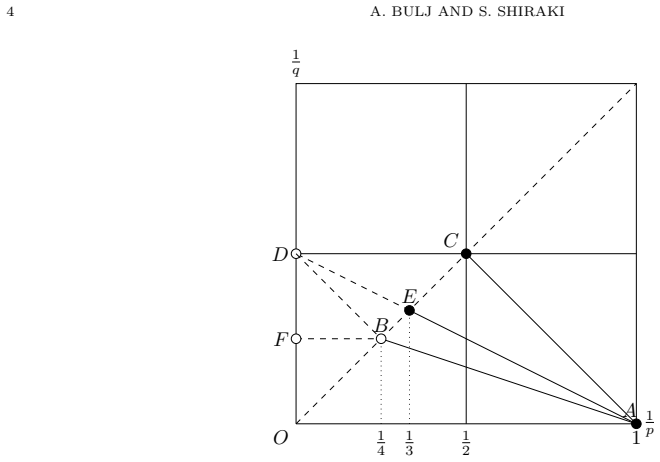
The paper's claim is a characterization, stated as Theorem 3 and Theorem 4. For a compact $C^2$ curve with nonzero curvature, the strip estimate (1.5) and the Radon estimate (1.6) are equivalent: in the transversal case both hold if and only if $1/p+1/q\le 1$ and $q\ge 2$, and in the non-transversal case if and only if $1/p+2/q\le 1$, with the inequality required to be strict when $p>q$. For the parabola, the Radon estimate holds exactly on the line $1/p+1/q=1$ with $p\le q$ in the transversal direction, and on the line $1/p+2/q=1$ with $p\le q$ in the non-transversal direction. The strip estimate for the parabola has a larger admissible region: in the transversal direction it is the region cut by $1/p+3/q\ge 1$ and $1/p+1/q\le 1$, with $p=q$ allowed only at $(2,2)$; in the non-transversal direction, when $p\le q$, it is the region with $1/p+3/q\ge 1$ and $1/p+2/q\le 1$ excluding $(4,4)$, and when $p>q$, it is the region with $1/p+1/q>1/2$ and $1/p+2/q<1$, apart from an undecided interior of the segment $(B,D)$.
Load-bearing premise
The exclusion of strip estimates at $p=q\in(2,4]$ for the transversal parabola rests on an unproved geometric claim: an iterated triangle-splitting construction produces a set of area at most about $J\log\log J/\log J$ that still contains $J$ rectangles of size about $1/J$ by $J$, all lying inside the strip; the paper cites the approach as similar to [1] but does not supply the area bound or the containment proof.
Editorial extensions
If this is right
- For compact curves with nonzero curvature, the line-concentration problem is closed: the strip estimate and the Radon estimate are equivalent and hold on the same explicit $(p,q)$ regions, so no further endpoint work is needed for such curves.
- For the parabola, the Radon estimate is strictly more restrictive than the strip estimate, so concentration of mass on individual lines is controlled on a smaller set of exponent pairs than concentration inside a strip.
- The strip estimate for the parabola fails at $(p,q)=(4,4)$ in the non-transversal case, and the Gaussian test function produces a logarithmic divergence, indicating the failure is quantitative rather than a borderline technicality.
- Because the parabola extension is the Schrödinger propagator, the transversal strip results are $L^p\to L^q$ local smoothing-type estimates on $\mathbb{R}\times I$, giving a complete picture at width 1 in the transversal direction.
- The proof leaves only the interior of the segment $(B,D)$ open for the non-transversal parabola strip estimate; any improvement in the bounds for the high-frequency operator $T_{\mathrm{high}}$ would directly shrink that gap.
Reading between the lines
- The undecided segment $(B,D)$ sits exactly where the paper's interpolation between the low-frequency and high-frequency operators does not overlap; a direct endpoint analysis of $T_{\mathrm{high}}$ is the natural next step, and the logarithmic divergence at $(4,4)$ suggests a log-loss estimate rather than a hard failure near that endpoint.
- The mechanism separating compact curves from the parabola — finitely many versus infinitely many wave packets at the strip's scale — suggests a general principle: translation-invariant noncompact curves should behave like the parabola, with Besicovitch-type obstructions, while curves whose wave-packet family at the strip scale is finite should behave like compact curves.
- Because the obstruction is geometric (packing long thin rectangles inside a strip), the same mechanism should appear in higher dimensions for slabs, with critical exponents governed by the Besicovitch dimension of $k$-plane arrangements; this is a testable extension, not a claim of the paper.
- The fixed unit width of the strip is not an innocent normalization: it sets the scale at which wave packets are counted, so shrinking the width should interpolate continuously between the strip results and the Radon-transform results; verifying this interpolation is a concrete follow-up.
Signed reviews
Editorial analysis
A structured set of objections, weighed in public.
Referee Report
Summary. The paper studies Fourier extension estimates for a curve in R^2 when the domain of integration is a strip, and the related Radon-transform bound. For a compact C^2 curve with nonzero curvature, Theorem 3 claims a full characterization of the pairs (p,q) for both the strip and Radon estimates, split into transversal and non-transversal cases. For the parabola, Theorem 4 claims analogous characterizations, with the notable feature that the strip estimate and the Radon estimate have different ranges, and that the non-transversal strip estimate fails at (p,q)=(4,4). The proofs use one-dimensional oscillatory integral estimates (Propositions 8--10), the Pan--Sampson--Szeptycki weighted Fourier estimate, the two-dimensional restriction theorem, interpolation, and Knapp/Gaussian/Besicovitch-type examples. The abstract states that the pairs (p,q) are characterized for both compact curves and the parabola.
Significance. If fully correct, the paper gives a clean model problem in which the strip geometry changes the admissible range relative to the classical restriction theorem, and it exhibits a Besicovitch-set obstruction for the parabola. The paper is clearly written and contains a number of self-contained technical contributions, such as the elementary proof of the weighted Fourier estimate in Lemma 7 and the detailed oscillatory-integral bounds in Section 3. The authors are also honest about the one unresolved segment in Theorem 4(b). However, the main characterization claim is not yet fully supported: the necessity proof in Section 5.3.4 depends on an unproved Perron-tree geometric lemma, and the statement of Theorem 4(b) explicitly leaves the interior of the segment (B,D) undecided, contradicting the abstract's claim of a complete characterization.
major comments (2)
- [Section 5.3.4] The exclusion of p=q in (2,4] for the transversal parabola strip estimate rests entirely on an unproved geometric assertion. The proof assumes that after J0 iterations of the Perron tree construction applied to the triangle A(0), one obtains a set A^(J0) of area at most J log log J / log J that contains rectangles R(v_j,b_j;c1/J,c1J) for j=J,...,2J-1 and lies inside the strip. No iteration rule, lemma statement, or proof of the area and containment estimates is provided; the text only refers to an approach 'similar to' Beckner--Carbery--Semmes--Soria [1]. This is load-bearing: without |A^(J0)| = o(J), the final inequality J ≲ J^{2/p} |A^(J0)|^{1-2/p} imposes no restriction for p>2, and the claimed if-and-only-if for the transversal parabola strip is unsupported. Please add a complete proof of this geometric lemma or replace the claim with a conditional statement.
- [Theorem 4(b) and Abstract] The abstract claims a characterization of the pairs (p,q) for the parabola, but Theorem 4(b) states that the estimate (1.5) 'does not hold in the complement of the given range except maybe in the interior of the segment (B,D)'. Thus the status of the open segment (B,D) is explicitly left undecided, and the theorem is not a full characterization as stated. The abstract and the theorem statement should be aligned: either the undecided segment must be resolved, or the claims should be weakened to describe the known sufficient and necessary regions separately.
minor comments (4)
- [Section 5.3.4] The rectangle dimensions are written inconsistently: the text refers to rectangles of dimensions c1J by c1/J and then to R(v_j,b_j;c1/J,c1J), and later uses R(v_j,a_j;cj,c/j). Please standardize the order of length and width and replace 'cj' by a constant independent of j if that is what is meant.
- [Section 4.3] After the substitution h(u)=y^2, the displayed integral has the integrand written with 'du', but the variable of integration should be dy; as written, the change of variables is confusing.
- [Section 5.2] The interpolation argument with the restriction theorem is summarized in one sentence, and the notation '□ACDB' is not defined in Figure 1. Please spell out the interpolation pair and the resulting convex hull, including the treatment of endpoints.
- [Section 5.3.6] The change of variables leading from |Ef(x)|^q to the displayed integral is not shown; adding the scaling computation would make the Gaussian counterexample easier to verify.
Circularity Check
No circularity: upper bounds use external restriction and weighted Fourier theorems plus interpolation; lower bounds use independent Knapp, Gaussian, Khintchine, and Besicovitch examples.
full rationale
I walked the paper's derivation chain. The abstract and theorems are presented as characterizations, but none of the claimed implications is obtained by defining a quantity in terms of the target estimate or by renaming a fitted parameter as a prediction. The upper bounds for the compact-curve theorems (Theorem 3) are reduced to the two-dimensional restriction theorem (Theorem 5), the Pan–Sampson–Szeptycki weighted Fourier estimate (Lemma 7), and interpolation, with the key L2 Radon identity reproved in Section 4.2 rather than merely imported. The parabola upper bounds (Theorem 4) are built from Propositions 8–10, whose proofs are self-contained: even where the paper cites Bulj–Kovač [4] for homogeneous-distribution approximations, it immediately says 'we provide a short self-contained proof.' The only self-citations are to Bennett–Nakamura–Shiraki [3] for background L2 identities, and the paper explicitly includes the needed computation. These citations are not load-bearing in the sense of replacing an argument with an assertion. The lower-bound arguments are independent examples: Knapp-type bumps, Gaussian test functions, Khintchine-randomized sums of translates, and a Besicovitch-type construction. The one fragile step is in Section 5.3.4, where the paper asserts that applying 'the J0-th iteration of Perron tree construction applied to the triangle A0' produces a set A^(J0) 'that contains a rectangle R(vj,bj;c1/J,c1J)' and 'has area at most |A^(J0)|≲J loglogJ/logJ.' This is an unproved geometric lemma, borrowed from Beckner–Carbery–Semmes–Soria [1], and it is a genuine missing-support gap for the exclusion of p=q in (2,4] in the transversal parabola case. However, it is not circular: the Perron-tree area bound is an external geometric input, not equivalent to the target extension estimate, and it is not derived from the very inequality being tested. Thus the correct circularity score is 0, with the caveat that the omitted Perron-tree proof should be supplied or given a precise reference for the exact quantitative form used.
Assumptions & free parameters
assumptions (7)
- standard math Two-dimensional restriction theorem for curves with nonzero curvature and for the parabola (Theorem 5)
- standard math Pan-Sampson-Szeptycki weighted Fourier estimate (Lemma 7)
- standard math Hausdorff-Young inequality
- standard math Khintchine inequality
- standard math Smooth approximation of homogeneous distributions from Stein-Weiss [16] and Bulj-Kovac [4]
- domain assumption Perron tree / Besicovitch set construction
- standard math Complex interpolation theorem
Cite this review
Pith. "Pith review of Fourier extension estimates on a strip in $\mathbb{R}^2$." pith.science (2026). https://pith.science/paper/GEQTBWM4
@misc{pith2026250820463,
  author       = {Pith},
  title        = {Pith review of: Fourier extension estimates on a strip in $\mathbbR^2$},
  year         = {2026},
  howpublished = {\url{https://pith.science/paper/GEQTBWM4}},
  note         = {Machine review of arXiv:2508.20463}
}
abstract
Given a smooth curve with nonzero curvature $\Sigma\subset \mathbb{R}^2$, let $E_{\Sigma}$ denote the associated Fourier extension operator. For both general compact curves and the parabola, we characterize the pairs $(p,q)\in [1,\infty]^2$ for which the estimates $\|E_{\Sigma}f\|_{L^q(\Omega)}\leq C\|f\|_{L^p(\Sigma)}$ and $(\mathcal{R}(|E_{\Sigma}f|^{q}))^{\frac{1}{q}}\leq C\|f\|_{L^p(\Sigma)}$ hold, where $\Omega$ is a strip in $\mathbb{R}^2$ and $\mathcal{R}$ denotes the Radon transform. This work continues the study of mass concentration of $x\mapsto E_{\Sigma}f(x)$ near lines in $\mathbb{R}^2$, initiated by Bennett and Nakamura and later extended by Bennett, Nakamura, and the second author, where expressions of the form $(\mathcal{R}(|E_{\Sigma}f|^{2}))^{\frac{1}{2}}$ were studied.
Figures

Reference graph
Works this paper leans on
-
[1]
W. Beckner, A. Carbery, S. Semmes, and F. Soria. A note on restriction of the Fourier transform to spheres. Bull. London Math. Soc., 21(4):394–398, 1989
work page 1989
-
[2]
J. Bennett and S. Nakamura. Tomography bounds for the Fourier extension operator and applications. Math. Ann. , 380:119–159, 2021
work page 2021
-
[3]
J. Bennett, S. Nakamura, and S. Shiraki. Tomographic Fourier extension identities for submanifolds of Rn. Selecta Math., 30:80, 2024
work page 2024
-
[4]
Asymptotic behavior ofLp estimates for a class of multipliers with homogeneous unimodular symbols
Aleksandar Bulj and Vjekoslav Kovaˇ c. Asymptotic behavior ofLp estimates for a class of multipliers with homogeneous unimodular symbols. Trans. Amer. Math. Soc., 376(7):4539–4567, 2023
work page 2023
-
[5]
A counterexample to the Mizohata–Takeuchi conjecture
Hannah Cairo. A counterexample to the Mizohata–Takeuchi conjecture. Available at https://arxiv.org/abs/2502.06137
-
[6]
Inequalities for strongly singular convolution operators
Charles Fefferman. Inequalities for strongly singular convolution operators. Acta Math., 124:9–36, 1970
work page 1970
-
[7]
S. Gan, C. Oh, and S. Wu. A note on local smoothing estimates for fractional Schr¨ odinger equations. J. Funct. Anal. , 283:109558, 2022
work page 2022
-
[8]
C. Gao, J. Li, and L. Wang. A type of oscillatory integral operator and its applications. Math. Z., 302:1551–1584, 2022
work page 2022
Show all 22 references
-
[9]
C. Gao, C. Miao, and J. Zheng. Improved local smoothing estimates for the fractional Schr¨ odinger operator. Bull. Lond. Math. Soc., 54:54–70, 2022
2022
-
[10]
A restriction estimate using polynomial partitioning
Larry Guth. A restriction estimate using polynomial partitioning. J. Amer. Math. Soc. , 29(2):371–413, 2016
2016
-
[11]
Y. Lu. Local smoothing estimates of fractional Schr¨ odinger equations inα-modulation spaces with some applications. J. Evol. Equ., 23:38, 2023
2023
-
[12]
Studia Math., 122(3):201–224, 1997
Yibiao Pan, Gary Sampson, and Pawe lSzeptycki.L2 andLp estimates for oscillatory integrals and their extended domains. Studia Math., 122(3):201–224, 1997
1997
-
[13]
K. M. Rogers. A local smoothing estimate for the Schr¨ odinger equation. Adv. Math., 219:2105–2122, 2008
2008
-
[14]
R. Schippa. On smoothing estimates in modulation spaces and the nonlinear Schr¨ odinger equation with slowly decaying initial data. J. Funct. Anal., 282:109352, 2022
2022
-
[15]
Elias M. Stein. Harmonic analysis: real-variable methods, orthogonality, and oscillatory integrals, volume 43 of Princeton Mathematical Series . Princeton University Press, Princeton, NJ, 1993. With the assistance of Timothy S. Murphy, Monographs in Harmonic Analysis, III
1993
-
[16]
Stein and Guido Weiss
Elias M. Stein and Guido Weiss. Introduction to Fourier analysis on Euclidean spaces . Princeton Mathematical Series, No. 32. Princeton University Press, Princeton, 1971
1971
-
[17]
Lecture notes
Terence Tao. Lecture notes. Available at https://terrytao.wordpress.com/2020/03/29/247b-notes-1-restriction-theory/
2020
-
[18]
The Bochner-Riesz conjecture implies the restriction conjecture
Terence Tao. The Bochner-Riesz conjecture implies the restriction conjecture. Duke Math. J. , 96(2):363–375, 1999
1999
-
[19]
A restriction estimate in R3 using brooms
Hong Wang. A restriction estimate in R3 using brooms. Duke Math. J. , 171(8):1749–1822, 2022
2022
-
[20]
Endpoint estimates for one-dimensional oscillatory integral operators
Lechao Xiao. Endpoint estimates for one-dimensional oscillatory integral operators. Adv. Math., 316:255–291, 2017
2017
-
[21]
A. Zygmund. On Fourier coefficients and transforms of functions of two variables. Studia Math., 50:189–201, 1974
1974
-
[22]
A. Zygmund. Trigonometric series. Vol. I, II. Cambridge Mathematical Library. Cambridge University Press, Cambridge, third edition, 2002. With a foreword by Robert A. Fefferman. Aleksandar Bulj, Department of Mathematics, Faculty of Science, University of Zagreb, Bijeniˇcka ce...
2002
Reviewed August 15, 2026 · model on record in the stance chip above.
Discussion (0). Continue with ORCID to comment.