REVIEW 4 major objections 5 minor 31 references
A two-state generalisation of the strong collision model
T0 review · 4 major / 5 minor · reviewed 2026-08-05 · deepseek-v4-flash
Pith's one-line read A two-state muon relaxation model extracts a 16 mT field in Tb2Sn2O7, ten times smaller than previously assumed.
desk verdict Eq. 10 is wrong as written — f_i must be the transform of e^{-ν t} Pstat_i, not Pstat_i — but the recursion is correct and the model is salvageable; worth refereeing after a fix. read the letter →
The pith
A machine-rendered reading of the paper's core claim, the machinery that carries it, and where it could break.
The reading
What carries the argument
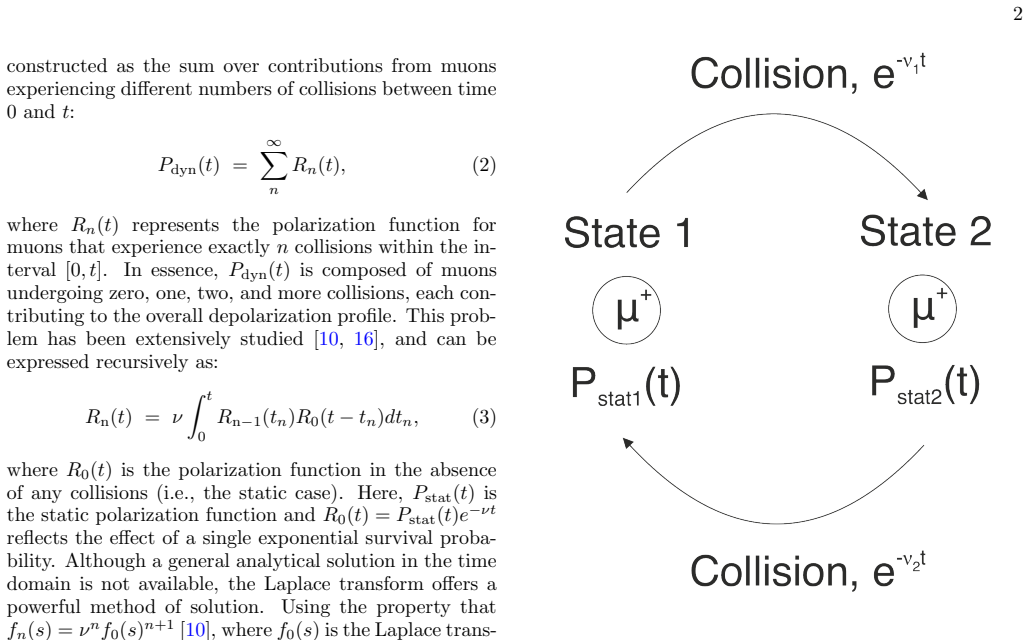
The central object is the renewal equation for the polarization in Laplace space. With f1(s) and f2(s) the Laplace transforms of the two static polarization functions, the denominator 1−ν1ν2 f1(s)f2(s) encodes the infinite sum over alternating collisions, while the numerators account for the muon's starting state and whether it has undergone an even or odd number of switches. In the time domain the equivalent recursion, Eq. (13), builds P_dyn(t) directly from the static functions and the two rates, which is what makes the model usable for fitting muon spin relaxation spectra without knowing the microscopic dynamics beyond the switching rates.
What would settle it
Measure zero-field muon relaxation in a material where the dwell time in each of two magnetic environments is known independently (for example from neutron spectroscopy or NMR), and where the environment is known to switch only on some fraction of collisions; if Eq. (10) fitted to the muon spectrum forces a switching rate inconsistent with the measured dwell times, the every-collision-switch assumption is falsified.
Extended reading notes
Core claim
The paper claims that when a muon's local magnetic environment alternates stochastically between two discrete states, the dynamical polarization is not just a single-state strong-collision average: the Laplace transform is a weighted sum of two renewal series. With f1(s) and f2(s) the Laplace transforms of the two static polarization functions, ν1 and ν2 the state-dependent switching rates, and g the probability of starting in state 1, F(s) = g·f1(s)[1+ν1 f2(s)]/(1−ν1ν2 f1(s)f2(s)) + (1−g)·f2(s)[1+ν2 f1(s)]/(1−ν1ν2 f1(s)f2(s)). This reduces to the known single-state result when the two states are identical and the rates equal. The paper further claims that this two-state dynamics can mimic t
Load-bearing premise
The load-bearing assumption is that every collision switches the muon's local environment to the other state, with exponentially distributed waiting times whose rates depend only on the current state; if collisions can leave the environment unchanged or the waiting-time distribution is not exponential, the fitted rates and field values lose their stated meaning.
Editorial extensions
If this is right
- NK-like zero-field lineshapes can arise from pure dynamics: a system fluctuating between two well-defined local field states can look like one with static disorder, so fitting NK functions alone no longer uniquely implies spatial disorder.
- For Rb2V8O16, the two-state model reproduces the earlier NK fit with a transparent microscopic picture: fluctuation rate ~0.56 µs−1 and two field widths ~1.7 and ~0.5 µs−1, consistent with switching between stronger and weaker magnetization regions or valence fluctuations.
- For Tb2Sn2O7, the two-state model lowers the estimated local field from ~200 mT to ~16 mT while keeping motional narrowing, which if correct changes the picture of spin dynamics in pyrochlores.
- The model gives a concrete language for systems where each fluctuation changes the local field configuration, including low-dimensional magnets, dynamic disorder, and charge-order fluctuations; and it offers a route to separate muon diffusion from intrinsic magnetic fluctuations, since diffusion naturally produces the two-state switching structure.
Reading between the lines
- A testable consequence not pursued in the paper: refit other pyrochlore and frustrated-magnet muon datasets (for example Gd2Ti2O7 and Gd2Sn2O7) with the two-state formula; if the extracted fields systematically come out far below the assumed values, the 200 mT-scale estimates in the literature may need revision.
- The same renewal sum should apply to any relaxation probe with two discrete environments, since the derivation only uses exponential waiting times and state-dependent static relaxation functions; NMR relaxometry and neutron spin echo are natural candidates.
- The extraction of a 16 mT field from a purely exponential spectrum shows the model can be flexible; a decisive test would be an independent measurement of the fluctuation rate (for example by neutron linewidth or ac susceptibility) to see whether it matches the fitted ν.
- The every-collision-switch assumption could be relaxed to a switching probability p per collision; such a three-parameter generalization would interpolate between the nominal strong collision model (p=0) and the two-state model (p=1), providing a nested test of the mechanism.
Signed reviews
Editorial analysis
A structured set of objections, weighed in public.
Referee Report
Summary. The manuscript extends the strong collision model for muon spin relaxation to a two-state renewal process in which every collision transfers the muon's local environment between two distinct configurations, each with its own static polarization function. The central result is an analytic Laplace-space expression, Eq. (10), for arbitrary asymmetric switching rates and an uncertain initial state, plus a time-domain recursion (Eq. 13). The paper shows that the model reproduces Noakes–Kalvius-like lineshapes and fits zero-field data on Rb2V8O16 and Tb2Sn2O7, claiming an order-of-magnitude smaller local field for the latter.
Significance. If fully corrected, the model is a useful extension: it supplies a tractable renewal-theory framework for interpreting μSR spectra where fluctuations switch between discrete environments, and it makes a concrete, falsifiable prediction about Tb2Sn2O7. The model is derived from an explicit stochastic process, and the single-state limit is a natural consistency check. The main strengths are the clear formulation of the alternating-state renewal structure and the numerical recursion. However, the printed analytic formulas must be corrected to include survival factors, and the experimental evidence needs statistical support before the physical claims can be accepted.
major comments (4)
- [Section III, Eqs. (9)–(10)] The central formulas are internally misdefined. The text states that f_i(s) are Laplace transforms of Pstat_i(t), but the renewal terms are S_i(t)=e^{-ν_i t}Pstat_i(t). For the g-start term, R0 has transform f1(s+ν1); R1 has transform ν1 f1(s+ν1) f2(s+ν2); the denominator is 1−ν1ν2 f1(s+ν1) f2(s+ν2). With the printed definition, the exponential survival factors are omitted, and when f1=f2=f and ν1=ν2=ν, Eq. (10) gives f(s)/(1−ν f(s)) instead of f0(s)/(1−ν f0(s)) with f0(s)=f(s+ν) from Eq. (4). Correct the definition to f_i(s)=L[e^{-ν_i t}Pstat_i(t)](s) throughout; otherwise a reader implementing Eq. (10) obtains different dynamics from the time-domain recursion.
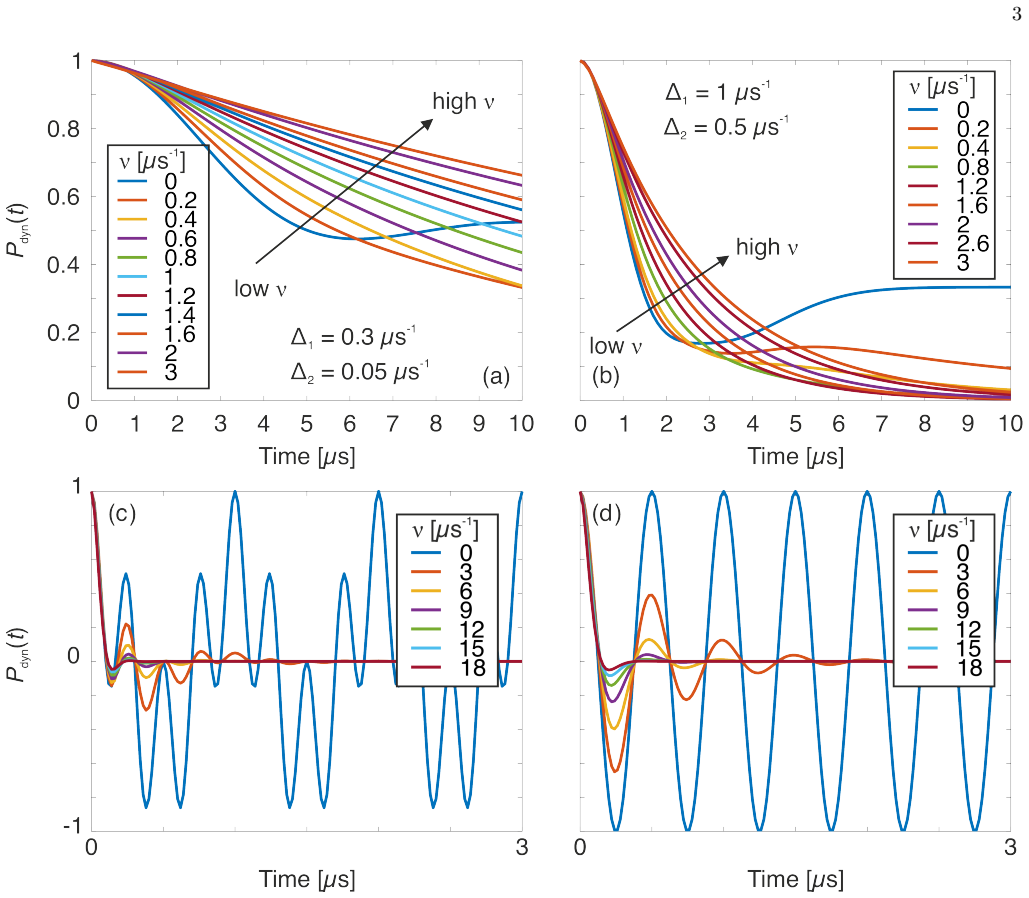
- [Section IV, Eqs. (11)–(13)] The recursion is written for a single rate ν, although Eq. (10) claims to allow ν1≠ν2. For asymmetric rates, one needs two coupled convolutions depending on the initial state; Eq. (13) does not implement the 'more general form' of Eq. (10). The numerical solutions in Fig. 2 appear to use ν1=ν2, so the text should either explicitly restrict the recursion to the symmetric case or supply the two-state recursion. As written, the numerical method is not the inverse of Eq. (10) in the asymmetric regime.
- [Section V, Fig. 3(b), Tb2Sn2O7 fit] The claim of a local field of ~16 mT, an order of magnitude smaller than the previously assumed 200 mT, is not supported by the evidence presented. The fit imposes g=0.5 and B2=−B1, and with γμB/ν≈0.06 the spectrum is deep in the motional-narrowing regime, where the polarization is nearly exponential and B and ν are strongly correlated or unidentifiable. No goodness-of-fit statistic, parameter correlation matrix, or comparison against the 200 mT model is reported. The longitudinal-field decoupling is invoked only qualitatively. A likelihood/sensitivity analysis or a simultaneous fit of the LF data is needed before this conclusion can be drawn.
- [Section V, Fig. 3(a), Rb2V8O16 fit] The two-state model is said to provide an 'equally good fit' to the Noakes–Kalvius function, but no quantitative comparison is given. A visual statement of indistinguishability is insufficient, especially because the two-state model has more free parameters. Report χ², residuals, or an information criterion for both fits, and discuss whether the extracted microscopic parameters are identifiable given the model degeneracy.
minor comments (5)
- [Section III, Eqs. (5)–(7)] The notation is inconsistent: Eqs. (5)–(7) use a single ν for both states, while Eq. (10) introduces ν1 and ν2. State explicitly that Eqs. (5)–(7) are the symmetric case ν1=ν2=ν.
- [Section V] There is a grammatical error: 'These fluctuations violates the core assumption' should be 'violate'.
- [References] Reference [25] is incomplete; it shows only 'M. Isobe et al., .' with no title, journal, volume, or year.
- [Section V, Fig. 3] The experimental data points are shown without error bars, and the NK fit parameters are not listed. Adding error bars and the NK fit parameters would improve the comparison.
- [Section III, Eq. (10)] The weighting factor g is described as the probability of starting in state 1, but the paper does not discuss how g relates to the stationary occupation probabilities implied by ν1 and ν2. A brief comment would prevent confusion.
Circularity Check
No circularity: the two-state Laplace solution is derived from an explicit renewal process, and the experimental applications are fits, not predictions.
full rationale
The central result Eq. (10) is obtained by summing the collision-number contributions defined in Eqs. (5)-(7); it uses as inputs only the static polarization functions Pstat1/Pstat2, the switching rates, and the initial-state weight g. The single-state limit is a stated consistency check rather than a fitted output. The applications in Section V are fits to data (Rb2V8O16 and Tb2Sn2O7) with parameters adjusted to reproduce the spectra; no fitted parameter is relabeled as a prediction. The comparison with the Noakes-Kalvius lineshape is an interpretive correspondence, not a derivation from the fitted NK function. The only self-citation is Ref. [23], the author's thesis, used as the source of the Rb2V8O16 spectrum and its prior NK analysis; this is a data source for a demonstration, not a load-bearing premise of the model derivation. Note, however, a non-circular correctness issue: the paper defines f_i(s)=L[Pstat_i], while the renewal terms require L[e^{-ν_i t}Pstat_i] (i.e., f_i(s+ν_i)); with the printed definition Eq. (10) does not reduce exactly to Eq. (4) and omits survival shifts. This affects correctness, not circularity.
Assumptions & free parameters
free parameters (10)
- Rb2V8O16 amplitude A =
0.214(6)
- Rb2V8O16 fluctuation rate nu =
0.560(65) µs^-1
- Rb2V8O16 field width Delta1 =
1.716(178) µs^-1
- Rb2V8O16 field width Delta2 =
0.491(37) µs^-1
- Rb2V8O16 initial-state weight g =
0.535(78)
- Tb2Sn2O7 amplitude A =
0.182(15)
- Tb2Sn2O7 fluctuation rate nu =
38.91(8.68) µs^-1
- Tb2Sn2O7 local field magnitude B =
16.3(2.9) mT
- Tb2Sn2O7 initial-state weight g =
0.5 (fixed)
- Tb2Sn2O7 field symmetry B2=-B1 =
B2=-B1 (fixed)
assumptions (5)
- domain assumption The local magnetic field fluctuations follow a Gaussian-Markovian process with exponentially distributed waiting times
- ad hoc to paper Each collision transfers the system to the other discrete state with certainty, with no self-transitions
- domain assumption The static polarization functions Pstat1(t) and Pstat2(t) fully describe the two environments
- standard math Standard properties of Laplace transforms and geometric series apply
- domain assumption The reproduced experimental spectra are correct and the fits are statistically valid
Cite this review
Pith. "Pith review of A two-state generalisation of the strong collision model." pith.science (2026). https://pith.science/paper/7UQKHY4L
@misc{pith2026250820727,
  author       = {Pith},
  title        = {Pith review of: A two-state generalisation of the strong collision model},
  year         = {2026},
  howpublished = {\url{https://pith.science/paper/7UQKHY4L}},
  note         = {Machine review of arXiv:2508.20727}
}
read the original abstract
Muon spin relaxation is a powerful technique for probing static and dynamic local magnetic fields. The strong collision model, based on a Gaussian-Markovian process, is commonly used to account for dynamical effects. Yet, it remains limited in describing systems where the local field undergoes discrete state changes. To address this, I introduce a generalized two-state strong collision model that explicitly incorporates transitions between distinct local field environments during fluctuations. This extension allows for a more accurate representation of dynamical effects, particularly in systems where each collision alters the underlying static polarisation function. Analytical and numerical solutions are presented, and the model's applicability is demonstrated and discussed across relevant physical systems -- including low-dimensional magnets, systems with dynamic disorder and ion and muon diffusion. These results offer an enhanced framework for interpreting data in complex materials and extend the method's reach to a broader class of dynamical phenomena in condensed matter physics.
Figures

Reference graph
Works this paper leans on
-
[12]
Stochastic the- ory of spin depolarization of muons diffusing in the pres- ence of traps,
K. W. Kehr, G. Honig, and D. Richter, “Stochastic the- ory of spin depolarization of muons diffusing in the pres- ence of traps,” Zeitschrift f¨ ur Physik B Condensed Matter 32, 49–58 (1978)
work page 1978
-
[1]
Kanetada Nagamine, Introductory muon science (Cam- bridge University Press, 2003)
work page 2003
-
[2]
Adrian D Hillier, Stephen J Blundell, Iain McKenzie, Izumi Umegaki, Lei Shu, Joseph A Wright, Thomas Prokscha, Fabrice Bert, Koichiro Shimomura, Adam Berlie, et al., “Muon spin spectroscopy,” Nature Reviews Methods Primers 2, 4 (2022)
work page 2022
-
[3]
Muon-spin rotation studies of elec- tronic properties of molecular conductors and supercon- ductors,
Stephen J Blundell, “Muon-spin rotation studies of elec- tronic properties of molecular conductors and supercon- ductors,” Chemical reviews 104, 5717–5736 (2004)
work page 2004
-
[4]
David C Walker, Muon and muonium chemistry (Cam- bridge University Press, 1983)
work page 1983
-
[5]
Probing electron transfer in DNA –new life science with muons,
E. Torikai, K. Nagamine, F. L. Pratt, I. Watanabe, Y. Ikedo, H. Urabe, and H. Grimm, “Probing electron transfer in DNA –new life science with muons,” Hyper- fine Interactions 138, 509–513 (2001)
work page 2001
-
[6]
Li dif- fusion in Li xCoO2 probed by muon-spin spectroscopy,
Jun Sugiyama, Kazuhiko Mukai, Yutaka Ikedo, Hiroshi Nozaki, Martin M ˚ ansson, and Isao Watanabe, “Li dif- fusion in Li xCoO2 probed by muon-spin spectroscopy,” Phys. Rev. Lett. 103, 147601 (2009)
work page 2009
-
[7]
Theory of location and associated hyperfine properties of the posi- tive muon in La 2CuO4,
Shukri B Sulaiman, N Sahoo, Sudha Srinivas, F Hagel- berg, TP Das, E Torikai, and K Nagamine, “Theory of location and associated hyperfine properties of the posi- tive muon in La 2CuO4,” Hyperfine interactions 84, 87– 103 (1994)
work page 1994
Show all 31 references
-
[8]
Playing quan- tum hide-and-seek with the muon: localizing muon stop- ping sites,
J S M¨ oller, P Bonf` a, D Ceresoli, F Bernardini, S J Blun- dell, T Lancaster, R De Renzi, N Marzari, I Watanabe, S Sulaiman, and M I Mohamed-Ibrahim, “Playing quan- tum hide-and-seek with the muon: localizing muon stop- ping sites,” Physica Scripta 88, 068510 (2013)
2013
-
[9]
Question of parity conser- vation in weak interactions,
T. D. Lee and C. N. Yang, “Question of parity conser- vation in weak interactions,” Phys. Rev. 104, 254–258 (1956)
1956
-
[10]
Alain Le Yaouanc and Pierre Dalmas De Reotier, Muon spin rotation, relaxation, and resonance: applications to condensed matter, 147 (OUP Oxford, 2011)
2011
-
[11]
Musrfit: A free platform- independent framework for µsr data analysis,
A. Suter and B. M. Wojek, “Musrfit: A free platform- independent framework for µsr data analysis,” Phys. Proc. 30, 69 (2012)
2012
-
[13]
Muon spin relaxation and magnetic susceptibility measurements in the haldane sys- tem (Y 2−xCax)Ba(Ni1−yMgy)O5,
K. Kojima, A. Keren, L. P. Le, G. M. Luke, B. Nachumi, W. D. Wu, Y. J. Uemura, K. Kiyono, S. Miyasaka, H. Takagi, and S. Uchida, “Muon spin relaxation and magnetic susceptibility measurements in the haldane sys- tem (Y 2−xCax)Ba(Ni1−yMgy)O5,” Phys. Rev. Lett. 74, 3471–3474 (1995)
1995
-
[14]
Voigtian kubo-toyabe muon spin relaxation,
MR Crook and R Cywinski, “Voigtian kubo-toyabe muon spin relaxation,” Journal of Physics: Condensed Matter 9, 1149 (1997)
1997
-
[15]
Magnetic ordering and dynamics in the xy pyrochlore antiferromagnet: a muon- spin relaxation study of Er2Ti2O7 and Er2Sn2O7,
J Lago, T Lancaster, S J Blundell, S T Bramwell, F L Pratt, M Shirai, and C Baines, “Magnetic ordering and dynamics in the xy pyrochlore antiferromagnet: a muon- spin relaxation study of Er2Ti2O7 and Er2Sn2O7,” Jour- nal of Physics: Condensed Matter 17, 979 (2005)
2005
-
[16]
Solid state phenomena: as seen by muons, protons, and excited nuclei,
Erik Karlsson, “Solid state phenomena: as seen by muons, protons, and excited nuclei,” (1995)
1995
-
[17]
A stochastic model for low field resonance and relaxation,
R Kubo and T Toyabe, “A stochastic model for low field resonance and relaxation,” Magnetic resonance and re- laxation , 810–823 (1967)
1967
-
[18]
Muon spectroscopy for investigating diffusion in energy stor- age materials,
Innes McClelland, Beth Johnston, Peter J. Baker, Marco Amores, Edmund J. Cussen, and Serena A. Corr, “Muon spectroscopy for investigating diffusion in energy stor- age materials,” Annual Review of Materials Research 50, 371–393 (2020)
2020
-
[19]
Anomalous zero- field muon spin relaxation in highly disordered magnets,
D. R. Noakes and G. M. Kalvius, “Anomalous zero- field muon spin relaxation in highly disordered magnets,” Phys. Rev. B 56, 2352–2355 (1997)
1997
-
[20]
Spin exchange dominated by charge fluctuations of the wigner lattice in the chain cuprate Na5Cu3O6,
Naveed Zafar Ali, Jesko Sirker, J¨ urgen Nuss, Peter Horsch, and Martin Jansen, “Spin exchange dominated by charge fluctuations of the wigner lattice in the chain cuprate Na5Cu3O6,” Phys. Rev. B 84, 035113 (2011)
2011
-
[21]
Electronic structure evolution across the peierls metal- insulator transition in a correlated ferromagnet,
P. A. Bhobe, A. Kumar, M. Taguchi, R. Eguchi, M. Mat- sunami, Y. Takata, A. K. Nandy, P. Mahadevan, D. D. Sarma, A. Neroni, E. S ¸a¸ sıo˘ glu, M. Leˇ zai´ c, M. Oura, Y. Senba, H. Ohashi, K. Ishizaka, M. Okawa, S. Shin, K. Tamasaku, Y. Kohmura, M. Yabashi, T. Ishikawa, K. Hase...
2015
-
[22]
Time-reversal symmetry broken by charge or- der in CsV 3Sb5,
Rustem Khasanov, Debarchan Das, Ritu Gupta, Charles Mielke, Matthias Elender, Qiangwei Yin, Zhijun Tu, Chunsheng Gong, Hechang Lei, Ethan T. Ritz, Rafael M. Fernandes, Turan Birol, Zurab Guguchia, and Hubertus Luetkens, “Time-reversal symmetry broken by charge or- der in CsV 3...
2022
-
[23]
thesis, Kungliga tekniska h¨ ogskolan (2021)
Ola Kenji Forslund, 1D to 3D magnetism in quantum materials: A study by muons, neutrons & x-rays , Ph.D. thesis, Kungliga tekniska h¨ ogskolan (2021)
2021
-
[24]
Spin dy- namics and magnetic order in magnetically frustrated Tb2Sn2O7,
P. Dalmas de R´ eotier, A. Yaouanc, L. Keller, A. Cervel- lino, B. Roessli, C. Baines, A. Forget, C. Vaju, P. C. M. Gubbens, A. Amato, and P. J. C. King, “Spin dy- namics and magnetic order in magnetically frustrated Tb2Sn2O7,” Phys. Rev. Lett. 96, 127202 (2006)
2006
-
[25]
Masahiko Isobe, Shigenori Koishi, Satoshi Yamazaki, Jun-ichi Yamaura, Hirotada Gotou, Takehiko Yagi, and Yutaka Ueda,
-
[26]
A correlation length measured by zero-field muon spin relaxation in disordered magnets,
D R Noakes, “A correlation length measured by zero-field muon spin relaxation in disordered magnets,” Journal of Physics: Condensed Matter 11, 1589 (1999)
1999
-
[27]
Magnetic density of states at low energy in geometrically frustrated systems,
A. Yaouanc, P. Dalmas de R´ eotier, V. Glazkov, C. Marin, P. Bonville, J. A. Hodges, P. C. M. Gubbens, S. Sakarya, and C. Baines, “Magnetic density of states at low energy in geometrically frustrated systems,” Phys. Rev. Lett. 95, 047203 (2005)
2005
-
[28]
Transitions and spin dynamics at very low temperature in the py- rochlores Yb2Ti2O7 and Gd2Sn2O7,
P. Bonville, J. A. Hodges, E. Bertin, J. Ph. Bouchaud, P. Dalmas de R´ eotier, L. P. Regnault, H. M. Rønnow, J. P. Sanchez, S. Sosin, and A. Yaouanc, “Transitions and spin dynamics at very low temperature in the py- rochlores Yb2Ti2O7 and Gd2Sn2O7,” Hyperfine Interac- tions 15...
2004
-
[29]
Muon-spin relax- ation study on Li-and Na-diffusion in solids,
Martin M ˚ ansson and Jun Sugiyama, “Muon-spin relax- ation study on Li-and Na-diffusion in solids,” Physica Scripta 88, 068509 (2013)
2013
-
[30]
Richard J Borg and George Julian Dienes, An introduc- tion to solid state diffusion (Elsevier, 2012)
2012
-
[31]
Lithium diffusion in LiFePO 4 detected with µ±SR,
Jun Sugiyama, Ola Kenji Forslund, Elisabetta Nocerino, Nami Matsubara, Konstantinos Papadopoulos, Yasmine Sassa, Stephen P. Cottrell, Adrian D. Hillier, Katsuhiko Ishida, Martin M ˚ ansson, and Jess H. Brewer, “Lithium diffusion in LiFePO 4 detected with µ±SR,” Phys. Rev. Res....
2020
Reviewed August 5, 2026 · model on record in the stance chip above.
Discussion (0). Continue with ORCID to comment.