REVIEW 3 major objections 5 minor 40 references
Addressing Personalized Bias for Unbiased Learning to Rank
T0 review · 3 major / 5 minor · reviewed 2026-08-05 · deepseek-v4-flash
Pith's one-line read A user-aware inverse-propensity estimator corrects personalized bias in learning to rank from click logs, with proofs of unbiasedness and lower variance.
desk verdict A clean causal refinement of ULTR whose theory holds under the explicit shared-relevance assumption; the main issues are under-advertised scope and a real-world skyline anomaly. read the letter →
The pith
A machine-rendered reading of the paper's core claim, the machinery that carries it, and where it could break.
The reading
Extended reading notes
Core claim
Eq. (9) defines a user-aware estimator with propensity 1/sum_u P(e=1|k(d),u)P(u|q). Theorem 3.1 states it is unbiased for the ideal ranking loss: E_{u,e}[\hat l_{user-aware}(S|q,c)] = l_{ideal}(S|q), provided every relevant document has positive examination probability. Theorem 3.3 states this estimator has lower variance than the straightforward per-user estimator. If correct, existing user-oblivious ULTR methods are biased when users personalize both queries and examination, and the proposed estimator fixes this without per-session variance blowup.
Load-bearing premise
Section 3.1 states 'we follow the conventions in Web search and ULTR to assume that users have the same relevance judgments for given query-document pairs, so r is only affected by x.' The entire ideal-loss definition, the do-calculus derivation, and the unbiasedness proof rely on relevance being user-invariant. If different users judge the same document-query pair differently, the ideal loss is not well-defined and the causal graph acquires a direct u->r path, so the estimator's guarantees no longer hold. This is a domain simplification explicitly acknowledged as future work.
Editorial analysis
A structured set of objections, weighed in public.
Referee Report
Summary. The paper introduces user heterogeneity into unbiased learning-to-rank (ULTR). It augments the standard click-generation causal graph with a user node that affects both query issuance and examination, and argues that existing user-oblivious inverse-propensity-scoring (IPS) estimators are biased because of the additional backdoor path e ← u → q → x → r → c. It proposes a user-aware IPS estimator (Eq. 9) whose propensity is Σ_u P(e=1|k(d),u)P(u|q), proves unbiasedness (Theorem 3.1) under a positive-examination assumption and shared relevance, proves lower variance than a per-user estimator (Theorem 3.3) under a condition relating the query-level propensity to the empirical session average, and reports experiments on two semi-synthetic datasets and a real-world dataset.
Significance. Within its stated scope, the theoretical contribution is valuable: it identifies a realistic failure mode of standard ULTR and provides a simple, computationally cheap correction with a clean proof. The unbiasedness proof is direct, the variance-reduction argument is non-trivial, and the experiments cover oracle-propensity, estimated-propensity, and real-world settings, with code released. The main limitation is that 'personalized' is restricted to query-issuing and examination behavior; personalized relevance judgments are explicitly outside the model. If the empirical anomaly noted below is resolved, this would be a useful contribution to the ULTR literature.
major comments (3)
- [Section 3.1, Eq. (5), Theorem 3.1] The ideal loss, the do-calculus step in Section 3.3, and the unbiasedness proof all assume that relevance r(d) has no user index. If relevance judgments vary by user, Eq. (5) is no longer a well-defined target, and the causal graph acquires a direct u→r edge, leaving the backdoor path e←u→r→c open; the equality P(c=1|do(e=1),x)=P(c=1|e=1,x) and the cancellation in Theorem 3.1 then fail. The paper acknowledges this in Section 3.1 and the conclusion, but the abstract and title claim a more general solution to 'personalized bias.' Please move this scope restriction to the front and adjust the abstract/introduction claims accordingly.
- [Theorem 3.3 and footnote 6] The lower-variance guarantee is conditional on the inequality Σ_u P(e|k,u)P(u|q) ≥ (1/|N_q|) Σ_{(c,u)∈N_q} P(e|k,u). This is not an innocuous condition; it is automatic only when P(u|q) is the empirical user frequency computed from the same sessions, in which case it holds with equality. The theorem statement should present this condition explicitly rather than in a footnote, and the variance derivation should clarify that P(u|q) is treated as known, so estimation error in P(u|q) is not included. As stated, the 'lower variance' result is conditional, not unconditional.
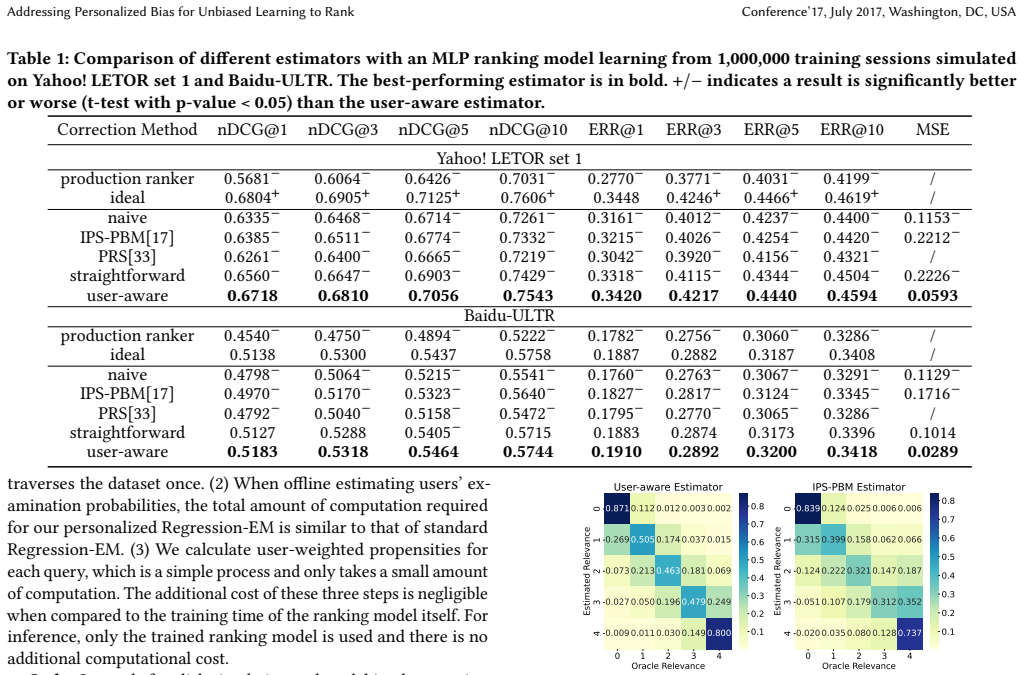
- [Table 1 (Baidu-ULTR block)] The user-aware estimator exceeds the 'ideal' skyline on Baidu-ULTR at nDCG@1 (0.5183 vs 0.5138), nDCG@3 (0.5318 vs 0.5300), and nDCG@5 (0.5464 vs 0.5437). Since the ideal model is trained on 100% relevance annotations and is described as an upper bound, this is inconsistent with standard expectations and suggests a setup or evaluation issue (e.g., test-label noise, model selection, or a mismatch between the training objective and the evaluation metric). Please explain or correct the experimental protocol.
minor comments (5)
- [Eq. (7)] The user-oblivious IPS-PBM propensity is written as Σ_u P(e|k,u)P(u). If the logged corpus is generated by users with different query distributions, the correct marginal is P(e|k)=Σ_u P(e|k,u)P(u|k), not P(u). Please clarify or correct the display.
- [Section 3.3] The derivation replaces P(u|x=x0) with P(u|q) in the denominator. This step should be justified from the causal graph (e.g., u ⊥ d | q and x=(q,d)); otherwise the notation is ambiguous.
- [Theorem 3.1 proof] The expectation E_{u,e} should be defined explicitly over the session-generation process (u ~ P(u|q), e ~ P(e|k,u)) to avoid ambiguity about which distribution is being averaged.
- [Section 4, Eq. (13)] The training loss uses graded labels 0.25·y(d), while the theoretical estimator is developed for binary relevance r(d). Please explain how the inverse-propensity weights are applied to the listwise softmax loss and how the binary-relevance theory connects to the graded-label experiments.
- [Throughout] Minor typographical issues: in the Theorem 3.3 proof, 'P(e(d) = 1|k(d, u′)' is missing a closing parenthesis; Section 4.3 has 'when|U| = 5' with missing spacing. Please proofread the equations.
Circularity Check
No significant circularity: unbiasedness and variance-reduction follow from the explicit causal assumptions and a genuine inequality; self-citations are minor and non-load-bearing, and the shared-relevance assumption is a scope condition, not a circular step.
full rationale
Verdict: no significant circularity (score 2, reflecting only non-load-bearing self-citations). The derivation chain is self-contained. Eq. (9)'s estimator is constructed from the do-calculus identification P(r=1|x_0)=P(c=1,x_0)/[sum_u P(e=1|k(d),u)P(u|q)] in Section 3.3, and Theorem 3.1's unbiasedness is verified by explicit cancellation: E[e(d)] = sum_u P(e=1|k,u)P(u|q) under the per-user PBM, so the inverse-propensity denominator cancels the examination expectation. This is the standard IPS identity, not a fitted constant or a renamed target: l_ideal (Eq. 5) is defined from relevance r, distinct from the click-model parameters; RQ1-3 use oracle propensities; RQ4 estimates them offline and evaluates on held-out annotations. Theorem 3.3's lower-variance claim is a real inequality (Lemma 3.2) under an explicit condition; footnote 6 ('this condition is always satisfied in our implementation since we count the user frequencies in the click logs to estimate the user distributions P(u|q)') shows the condition holds by construction in the implementation, which is a self-consistency note about the theorem's applicability, not a circular reduction. The load-bearing scope condition is the shared-relevance assumption (Section 3.1: 'we follow the conventions in Web search and ULTR to assume that users have the same relevance judgments for given query-document pairs, so r is only affected by x. Although it is also natural to assume that different users have different relevance judgments in some scenarios, we leave it to future work.'); if u->r were added, the ideal loss, the rule-2 do-calculus step, and Theorem 3.1's cancellation would all fail. This is an explicit modeling assumption acknowledged in the conclusion, and per the review rules this belongs under correctness risk, not circularity. Self-citations [22] (Niu et al. 2025) and [37] (Zhang et al., co-authored by Mao) are supporting context only: [37] provides real-log evidence of personalized browsing and simulation parameters, but the theorems and the real-world experiment (Figure 5b) do not rest on it. The GenAI-assisted test labels (Section 8, Kappa 0.6443) are a data-annotation caveat, not a derivation issue. No self-definitional estimator, no fitted-parameter-as-prediction, and no imported-uniqueness claim was found.
Assumptions & free parameters
free parameters (5)
- Per-user position-bias exponents eta_u =
{2.5, 2.0, 1.8, 1.5, 1.2, 1.0, 0.8, 0.5, 0.2, 0} for |U|=10
- Session ratio m_ui = 1.25 * m_u{i+1} =
1.25
- Click noise epsilon =
0.1
- Sparsity of P_r(u_i) =
50% probability of being 0
- Number of user clusters |U| =
5, 10, 20
assumptions (7)
- domain assumption Examination hypothesis: click iff examined and relevant (Eq. 4)
- domain assumption Position-based click model per user: e depends only on k and u
- domain assumption Users have the same relevance judgments for a given query-document pair, so r is affected only by x
- domain assumption The production ranker is deterministic and returns a unique ranked list per query
- standard math Second rule of do-calculus
- domain assumption Positive examination probability for every relevant document
- domain assumption Variance condition in Theorem 3.3: sum_u P(e|k,u)P(u|q) >= sample average p(d)
Cite this review
Pith. "Pith review of Addressing Personalized Bias for Unbiased Learning to Rank." pith.science (2026). https://pith.science/paper/JY7C45FM
@misc{pith2026250820798,
  author       = {Pith},
  title        = {Pith review of: Addressing Personalized Bias for Unbiased Learning to Rank},
  year         = {2026},
  howpublished = {\url{https://pith.science/paper/JY7C45FM}},
  note         = {Machine review of arXiv:2508.20798}
}
read the original abstract
Unbiased learning to rank (ULTR), which aims to learn unbiased ranking models from biased user behavior logs, plays an important role in Web search. Previous research on ULTR has studied a variety of biases in users' clicks, such as position bias, presentation bias, and outlier bias. However, existing work often assumes that the behavior logs are collected from an ``average'' user, neglecting the differences between different users in their search and browsing behaviors. In this paper, we introduce personalized factors into the ULTR framework, which we term the user-aware ULTR problem. Through a formal causal analysis of this problem, we demonstrate that existing user-oblivious methods are biased when different users have different preferences over queries and personalized propensities of examining documents. To address such a personalized bias, we propose a novel user-aware inverse-propensity-score estimator for learning-to-rank objectives. Specifically, our approach models the distribution of user browsing behaviors for each query and aggregates user-weighted examination probabilities to determine propensities. We theoretically prove that the user-aware estimator is unbiased under some mild assumptions and shows lower variance compared to the straightforward way of calculating a user-dependent propensity for each impression. Finally, we empirically verify the effectiveness of our user-aware estimator by conducting extensive experiments on two semi-synthetic datasets and a real-world dataset.
Figures


Figures from the paper (2 more)


Reference graph
Works this paper leans on
-
[1]
Aman Agarwal, Xuanhui Wang, Cheng Li, Michael Bendersky, and Marc Najork
-
[2]
Qingyao Ai, Keping Bi, Cheng Luo, Jiafeng Guo, and W Bruce Croft. 2018. Unbi- ased learning to rank with unbiased propensity estimation. In The 41st Interna- tional ACM SIGIR Conference on Research & Development in Information Retrieval . 385–394
work page 2018
-
[3]
Olivier Chapelle and Yi Chang. 2011. Yahoo! Learning to Rank Challenge Overview. In Proceedings of the Yahoo! Learning to Rank Challenge . 1–24
work page 2011
-
[4]
Olivier Chapelle, Donald Metlzer, Ya Zhang, and Pierre Grinspan. 2009. Expected reciprocal rank for graded relevance. In Proceedings of the 18th ACM conference on Information and knowledge management . 621–630
work page 2009
-
[5]
Mouxiang Chen, Chenghao Liu, Jianling Sun, and Steven CH Hoi. 2021. Adapting interactional observation embedding for counterfactual learning to rank. In Proceedings of the 44th International ACM SIGIR Conference on Research and Development in Information Retrieval . 285–294
work page 2021
-
[6]
Nick Craswell, Onno Zoeter, Michael Taylor, and Bill Ramsey. 2008. An ex- perimental comparison of click position-bias models. In Proceedings of the 2008 international conference on web search and data mining . 87–94
2008
-
[7]
Georges E Dupret and Benjamin Piwowarski. 2008. A user browsing model to predict search engine click data from past observations.. In Proceedings of the 31st annual international ACM SIGIR conference on Research and development in information retrieval. 331–338
work page 2008
-
[8]
Zhichong Fang, Aman Agarwal, and Thorsten Joachims. 2019. Intervention harvesting for context-dependent examination-bias estimation. In Proceedings of the 42nd international ACM SIGIR conference on research and development in information retrieval. 825–834
work page 2019
Show all 40 references
-
[9]
Fan Guo, Chao Liu, Anitha Kannan, Tom Minka, Michael Taylor, Yi-Min Wang, and Christos Faloutsos. 2009. Click Chain Model in Web Search. In Proceedings of the 18th International Conference on World Wide Web (Madrid, Spain) (WWW ’09). Association for Computing Machinery, New Yo...
2009
-
[10]
Fan Guo, Chao Liu, and Yi Min Wang. 2009. Efficient multiple-click models in web search. In Proceedings of the second acm international conference on web search and data mining . 124–131
2009
-
[11]
Shashank Gupta, Harrie Oosterhuis, and Maarten de Rijke. 2023. Safe Deployment for Counterfactual Learning to Rank with Exposure-Based Risk Minimization. arXiv preprint arXiv:2305.01522 (2023)
2023 arXiv
-
[12]
Kalervo Järvelin and Jaana Kekäläinen. 2002. Cumulated gain-based evaluation of IR techniques. ACM Transactions on Information Systems (TOIS) 20, 4 (2002), 422–446
2002
-
[13]
Thorsten Joachims. 2002. Optimizing search engines using clickthrough data. In Proceedings of the eighth ACM SIGKDD international conference on Knowledge discovery and data mining . 133–142
2002
-
[14]
Thorsten Joachims. 2006. Training linear SVMs in linear time. In Proceedings of the 12th ACM SIGKDD international conference on Knowledge discovery and data mining. 217–226
2006
-
[15]
Thorsten Joachims, Laura Granka, Bing Pan, Helene Hembrooke, and Geri Gay
-
[16]
Thorsten Joachims, Laura Granka, Bing Pan, Helene Hembrooke, Filip Radlinski, and Geri Gay. 2007. Evaluating the accuracy of implicit feedback from clicks and query reformulations in web search. ACM Transactions on Information Systems (TOIS) 25, 2 (2007), 7–es
2007
-
[17]
Thorsten Joachims, Adith Swaminathan, and Tobias Schnabel. 2017. Unbiased learning-to-rank with biased feedback. In Proceedings of the Tenth ACM Interna- tional Conference on Web Search and Data Mining . 781–789
2017
-
[18]
Tie-Yan Liu. 2009. Learning to Rank for Information Retrieval. Found. Trends Inf. Retr. 3, 3 (mar 2009), 225–331. doi:10.1561/1500000016
2009 doi
-
[19]
Stuart Lloyd. 1982. Least squares quantization in PCM. IEEE transactions on information theory 28, 2 (1982), 129–137
1982
-
[20]
Haitao Mao, Lixin Zou, Yujia Zheng, Jiliang Tang, Xiaokai Chu, Jiashu Zhao, and Dawei Yin. 2022. Whole Page Unbiased Learning to Rank. arXiv:2210.10718 [cs.IR]
2022 arXiv
-
[21]
George D Montanez, Ryen W White, and Xiao Huang. 2014. Cross-device search. In Proceedings of the 23rd ACM international conference on conference on informa- tion and knowledge management . 1669–1678
2014
-
[22]
Zechun Niu, Lang Mei, Chong Chen, and Jiaxin Mao. 2025. Distributionally Robust Optimization for Unbiased Learning to Rank. In Proceedings of the 48th International ACM SIGIR Conference on Research and Development in Information Retrieval. 2266–2275
2025
-
[23]
Harrie Oosterhuis and Maarten de Rijke. 2020. Policy-aware unbiased learning to rank for top-k rankings. In Proceedings of the 43rd International ACM SIGIR Conference on Research and Development in Information Retrieval . 489–498
2020
-
[24]
Maeve O’Brien and Mark T Keane. 2006. Modeling result-list searching in the World Wide Web: The role of relevance topologies and trust bias. In Proceedings of the 28th annual conference of the cognitive science society , Vol. 28. Citeseer, 1881–1886
2006
-
[25]
Judea Pearl. 1995. Causal Diagrams for Empirical Research. Biometrika 82, 4 (1995), 669–710
1995
-
[26]
Matthew Richardson, Ewa Dominowska, and Robert Ragno. 2007. Predicting clicks: estimating the click-through rate for new ads. In Proceedings of the 16th international conference on World Wide Web. 521–530
2007
-
[27]
Paul R Rosenbaum and Donald B Rubin. 1983. The central role of the propensity score in observational studies for causal effects. Biometrika 70, 1 (1983), 41–55
1983
-
[28]
Fatemeh Sarvi, Ali Vardasbi, Mohammad Aliannejadi, Sebastian Schelter, and Maarten de Rijke. 2023. On the Impact of Outlier Bias on User Clicks. arXiv preprint arXiv:2305.00857 (2023)
2023 arXiv
-
[29]
Romina Sharifpour, Mingfang Wu, and Xiuzhen Zhang. 2023. Large-scale analysis of query logs to profile users for dataset search. Journal of Documentation 79, 1 (2023), 66–85
2023
-
[30]
Vladimir N. Vapnik. 1995. The Nature of Statistical Learning Theory. Springer, (1995)
1995
-
[31]
Ali Vardasbi, Maarten de Rijke, and Ilya Markov. 2020. Cascade model-based propensity estimation for counterfactual learning to rank. In Proceedings of the 43rd International ACM SIGIR Conference on Research and Development in Information Retrieval. 2089–2092
2020
-
[32]
Ali Vardasbi, Harrie Oosterhuis, and Maarten de Rijke. 2020. When inverse propensity scoring does not work: Affine corrections for unbiased learning to rank. In Proceedings of the 29th ACM International Conference on Information & Knowledge Management. 1475–1484
2020
-
[33]
Nan Wang, Zhen Qin, Xuanhui Wang, and Hongning Wang. 2021. Non-clicks mean irrelevant? propensity ratio scoring as a correction. In Proceedings of the 14th ACM International Conference on Web Search and Data Mining . 481–489
2021
-
[34]
Xuanhui Wang, Michael Bendersky, Donald Metzler, and Marc Najork. 2016. Learning to rank with selection bias in personal search. In Proceedings of the 39th International ACM SIGIR conference on Research and Development in Information Retrieval. 115–124
2016
-
[35]
Xuanhui Wang, Nadav Golbandi, Michael Bendersky, Donald Metzler, and Marc Najork. 2018. Position bias estimation for unbiased learning to rank in personal search. In Proceedings of the Eleventh ACM International Conference on Web Search and Data Mining. 610–618
2018
-
[36]
Yisong Yue, Rajan Patel, and Hein Roehrig. 2010. Beyond position bias: Examining result attractiveness as a source of presentation bias in clickthrough data. In Proceedings of the 19th international conference on World wide web . 1011–1018
2010
-
[37]
Junqi Zhang, Yiqun Liu, Jiaxin Mao, Xiaohui Xie, Min Zhang, Shaoping Ma, and Qi Tian. 2022. Global or local: Constructing personalized click models for Web search. In Proceedings of the ACM Web Conference 2022 . 213–223
2022
-
[38]
Lixin Zou, Haitao Mao, Xiaokai Chu, Jiliang Tang, Wenwen Ye, Shuaiqiang Wang, and Dawei Yin. 2022. A large scale search dataset for unbiased learning to rank. Advances in Neural Information Processing Systems 35 (2022), 1127–1139
2022
-
[2005]
Accurately Interpreting Clickthrough Data as Implicit Feedback. (2005)
2005
-
[2019]
In The World Wide Web Conference
Addressing trust bias for unbiased learning-to-rank. In The World Wide Web Conference. 4–14. Conference’17, July 2017, Washington, DC, USA Zechun Niu et al
2017
Reviewed August 5, 2026 · model on record in the stance chip above.
Discussion (0). Continue with ORCID to comment.