REVIEW 2 major objections 4 minor 71 references
Evolution favours positively biased reasoning in sequential interactions with high future gains
T0 review · 2 major / 4 minor · reviewed 2026-08-05 · deepseek-v4-flash
Pith's one-line read Reasoning that is biased toward larger future rewards outcompetes rational backward induction in the centipede game, driving full rationality to extinction in the model.
desk verdict A clean, reproducible evolutionary model of directional action noise that is being oversold as a mechanism for cognitive bias; the result deserves a serious referee but needs a robustness analysis and a toned-down interpretation. read the letter →
The pith
A machine-rendered reading of the paper's core claim, the machinery that carries it, and where it could break.
The reading
What carries the argument
The reasoning kernel matrix M(ε), a block matrix of noisy best-response probabilities for the two player roles. Applying this matrix k times to a myopic starting vector produces the full level-k strategy; its shape encodes the cognitive bias. The positively biased kernel B+ permits mistakes only in the direction of later nodes, the negatively biased kernel B− only toward earlier nodes, and the unbiased kernel spreads mistakes uniformly. This matrix is the mechanism linking a bias to an action distribution, and thus to payoffs and evolutionary success.
What would settle it
Run the same evolutionary dynamics with the positively biased kernel replaced by a kernel that biases beliefs about the opponent's reasoning level instead of biasing the action deviation; if positive bias no longer dominates, the result rests on the specific kernel shape. Behaviourally, the model predicts the noise window for majority positive bias widens with game length, so comparing stopping-node distributions across Incremental Centipede Games of lengths 4, 6, and 8 with identical per-step stakes would test the mechanism.
Extended reading notes
Core claim
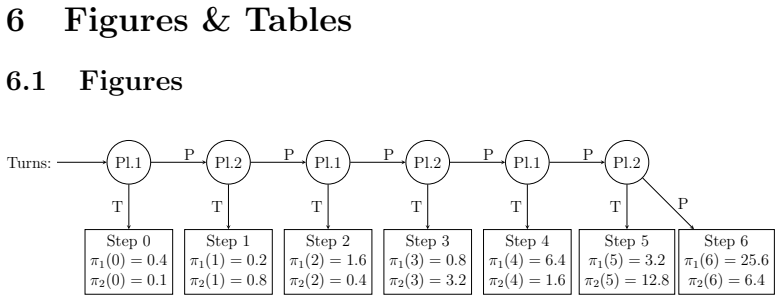
In a six-step Incremental Centipede Game with exponentially growing stakes, each agent is defined by a starting behaviour and a reasoning kernel applied iteratively, giving σ(k) = σ(0)M(ε)^k. Three kernels are compared: unbiased reasoning, positively biased reasoning (deviations from the noisy best response go only toward later nodes, where payoffs are higher but uncertain), and negatively biased reasoning (deviations go only toward earlier nodes). Under selection in finite populations, the positively biased kernel becomes the most frequent reasoning type and the subgame-perfect equilibrium strategy essentially never invades. With the noise and selection strength calibrated to experimental d
Load-bearing premise
The exact way the bias is built into the reasoning kernel—errors only toward later nodes for positive bias and only toward earlier nodes for negative bias, spread uniformly—carries the evolutionary outcome; a different implementation of the same bias could flip the result.
Editorial extensions
If this is right
- Fully rational backward induction is not an evolutionary attractor once reasoning is noisy; the model predicts the subgame-perfect equilibrium strategy is driven to near extinction under strong selection.
- Bounded rationality emerges without explicit cognitive costs: error propagation through iterative reasoning naturally limits the favoured reasoning depth.
- Positively biased reasoning and no-reasoning can coexist stably, so populations can remain heterogeneous in sophistication even under strong selection.
- Longer centipede games enlarge the cognitive-noise window in which positively biased reasoning is the majority strategy, linking the bias to the size of future gains.
- The fitted model reproduces experimental stopping-node distributions, offering an alternative to explanations based on altruism or other-regarding preferences in the centipede game.
Reading between the lines
- The load-bearing part of the model is the precise shape of the biased kernels; alternative implementations—such as biasing beliefs about the opponent's reasoning depth instead of biasing action deviations, or making deviation probabilities decay with distance—could alter or overturn the dominance of positive bias.
- The model implies a behavioural prediction: in centipede games with exponentially growing stakes, average stopping nodes should shift later as game length increases, beyond what unbiased level-k models predict.
- The framework suggests that optimism in cognition may be a domain-specific response to asymmetric payoff growth rather than a general trait; games with shrinking future gains might instead favour negatively biased reasoning.
- The predicted coexistence of myopic maximizers and optimistic one-step reasoners could be tested experimentally by classifying subjects' reasoning depth and checking whether the mixture matches the model's interior equilibrium.
Editorial analysis
A structured set of objections, weighed in public.
Referee Report
Summary. The paper studies the co-evolution of reasoning depth and cognitive biases in the Incremental Centipede Game. It introduces an unbiased level-k kernel and two biased kernels (B+ and B-), defined by a noisy best response where deviations to later (or earlier) nodes are allowed, and computes exact payoffs and evolutionary dynamics under the small-mutation limit. Results: under strong selection, B+ becomes dominant, reasoning depth remains bounded, SPE goes extinct, B+(1) and no-reasoning (NR) can coexist, and longer games enlarge the parameter region favoring B+. The model is calibrated to two experimental datasets.
Significance. If the result holds, the paper offers an evolutionary explanation for systematic deviations from rationality in a canonical sequential game without invoking other-regarding preferences. Strengths include a fully specified model, analytic derivation of sigma(k)=sigma(0)M^k, exact stationary distributions, open-source code, and calibration to two experimental datasets. The main weakness is that the bias is implemented as directional action noise rather than as an inference bias, so the headline conceptual interpretation is not directly supported by the model.
major comments (2)
- [Methods §4.2, Eq. (2)–(3); Appendix B; Conclusions] The central claim of a 'systematic inference bias' is not what the model implements. In Eq. (2), all kernels use the same recursive inference (opponent is level k−1); the kernels differ only in which actions the ε-noise can reach. The Appendix B matrices show that MB+ moves probability only to later nodes and MB− only to earlier nodes. Thus the model shows that a directional action bias toward later, higher-payoff nodes is selected, not that agents overestimate the probability of later termination. The Conclusions acknowledge 'unequivocally translated' behavior and static beliefs, but no test of an actual belief bias is provided. Please add variants (e.g., biased prior over opponent's level, non-uniform deviation probabilities) and report whether the qualitative results survive; alternatively, reframe the claims as about action bias.
- [Results §2, Figure 3B] The coexistence equilibrium is identified in a replicator equation restricted to three strategies (B+(1), NR, U(1)). The full strategy set includes 20 strategies for L=6, and Panel A shows no ERS and a cycle. The 'new stable equilibrium' claim needs either an invasion analysis against all remaining strategies or an explicit statement that the coexistence point is an equilibrium of the reduced 3-strategy subsystem. The full Markov chain with mutations (Panel D) is a mutation–selection balance, not a deterministic attractor; please clarify the status.
minor comments (4)
- [Title/Abstract] The phrase 'inference bias' appears in the Abstract and Introduction, but the implemented bias is an action tremble; align terminology throughout.
- [Figure 2 caption] Several OCR-like typos in figure text ('no reaso ing', 'subgame perfect eq.') and garbled axis labels in Fig. 5 should be corrected.
- [Methods §4.2] Please define concisely what happens at indifference: Appendix B sets the first row of each M matrix to uniform because Player 2 has no best response when T1=0; this should be explained in the main text.
- [Methods §4.4] Panel D of Fig. 3 uses μ=0.01 while the rest of the paper uses the small-mutation limit; clarify why this value is chosen and whether results are robust to μ.
Circularity Check
Positive-bias dominance is built into the B+ kernel definition; experimental-fit agreement is then cited as corroboration.
-
self definitional
[Methods 4.2 (Strategies); Appendix B; Results Section 2]
"a positively biased reasoning kernel, MB+(ε), where deviations from the best response only happen in direction of later nodes, i.e., outcomes where payoffs are higher but uncertain."
In the Incremental Centipede Game, the payoff π_i(t) is increasing in the terminal node t, and the game ends at min(T_i, T_{-i}). Against any fixed opponent distribution, shifting one's own stopping time later weakly raises expected payoff: if the opponent stops earlier, the payoff is unchanged; if the opponent stops later, the payoff increases. Since σ(k) = σ(0)M(ε)^k and MB+ places all epsilon-deviation mass on later nodes whereas MU and MB- place it uniformly or on earlier nodes, the B+(k) distribution first-order stochastically dominates U(k) and B-(k) against every opponent. Consequently B+(k) has weakly higher expected payoff than U(k) and B-(k) against all opponents and strictly higher against many; any payoff-monotone selection process must favour it. The paper's central result tha
-
fitted input called prediction
[Appendix A; Section 2 (calibration of ε and β)]
"To calibrate the output of our model, we determine the relevant level of cognitive noise ε comparing our predictions with the experimental data from Kawagoe and Takizawa [22]. The best fitting is provided for ε ≈ 0.19 ... Our results appear to corroborate these previous findings, as approximately 51% of the population in our model adopts the strategy associated with one step of positively biased reasoning when fitted on the Japanese data."
The experimental data are the calibration target: β and ε are chosen by minimizing the Jensen-Shannon divergence between the model's predicted terminal-node distribution and the observed experimental distributions (Appendix A). Statements that the model 'corroborates' those data, or that the coexistence equilibrium gives 'better agreement with the experimental reference', treat the calibration set as independent confirmation. The in-sample agreement is partly guaranteed by the fitting procedure itself, so as evidence it is circular. This is secondary to the kernel-definition circularity, since the B+ dominance result does not depend on the fitted parameter values.
full rationale
The paper's main evolutionary result—that positively biased reasoning outcompetes unbiased and negatively biased reasoning—is forced by construction. The B+ kernel is defined as allowing mistakes only toward later nodes, while the ICG payoff structure rewards later stopping; because later stopping is weakly payoff-increasing against every opponent, B+(k) necessarily has higher fitness than U(k) and B-(k) for the same k, under any payoff-monotone dynamics. Thus the headline claim is a formal consequence of the definition plus the payoff schedule, not an emergent property of the evolutionary process. This is a genuine 'reduce by construction' pattern, so the score is 6 rather than the lower scores appropriate for mere self-citation or overclaiming. The fitted-calibration issue is an additional, milder circularity: the parameters are fit to the same experimental data later quoted as corroboration. That said, the paper is otherwise self-contained: the mathematical derivation in Appendix B is explicit, the code is released, and the self-citation to [15] is not load-bearing—[15] supplies the level-k noisy-introspection framework but the present model and payoffs are independently specified. The coexistence equilibrium with NR and the effect of game length L are non-trivial and not simply consequences of the kernel definition; these parts retain independent content. The acknowledged limitations in the Conclusions (static beliefs, shared reasoning process, unambiguous mapping from bias to behaviour) are real robustness concerns but are not themselves circularity.
Assumptions & free parameters
free parameters (4)
- epsilon (cognitive noise) =
0.186 (fit to [22]); 0.062 (fit to [2])
- beta (selection strength) =
0.063 (fit to [22]); 0.032 (fit to [2])
- Z (population size) =
100
- mu (mutation rate) =
0.01 (only in Figure 3D); 0 elsewhere (small-mutation limit)
assumptions (6)
- domain assumption Each level-k individual assumes the co-player is level k-1 and best-responds to that belief (Equation 1).
- domain assumption Players cover both roles (Player 1 and Player 2) with equal probability, symmetrizing the sequential game (Equation 4).
- ad hoc to paper Cognitive noise is action-specific: with probability 1-epsilon the best response is played; with probability epsilon a deviation occurs, and for the biased kernels deviations are restricted to one direction (earlier or later nodes) with uniform probabilities among those nodes (Appendix B matrices).
- domain assumption The no-reasoning strategy (k=0) is the myopic payoff-maximizer who ignores the opponent's likely take (sigma(0) gives the personal highest-payoff node for each role).
- standard math The small-mutation limit replaces the full population process with an embedded Markov chain over monomorphic states (Methods 4.4).
- standard math Infinite-population replicator dynamics describe the co-existence equilibrium in Figure 3B.
invented entities (2)
-
Positively biased level-k reasoning kernel B+(k)
-
Negatively biased level-k reasoning kernel B-(k)
Cite this review
Pith. "Pith review of Evolution favours positively biased reasoning in sequential interactions with high future gains." pith.science (2026). https://pith.science/paper/KINU4U2A
@misc{pith2026250820799,
  author       = {Pith},
  title        = {Pith review of: Evolution favours positively biased reasoning in sequential interactions with high future gains},
  year         = {2026},
  howpublished = {\url{https://pith.science/paper/KINU4U2A}},
  note         = {Machine review of arXiv:2508.20799}
}
read the original abstract
Empirical evidence shows that human behaviour often deviates from game-theoretical rationality. For instance, humans may hold unrealistic expectations about future outcomes. As the evolutionary roots of such biases remain unclear, we investigate here how reasoning abilities and cognitive biases co-evolve using Evolutionary Game Theory. In our model, individuals in a population deploy a variety of unbiased and biased level-k reasoning strategies to anticipate others' behaviour in sequential interactions, represented by the Incremental Centipede Game. Positively biased reasoning strategies have a systematic inference bias towards higher but uncertain rewards, while negatively biased strategies reflect the opposite tendency. We find that selection consistently favours positively biased reasoning, with rational behaviour even going extinct. This bias co-evolves with bounded rationality, as the reasoning depth remains limited in the population. Interestingly, positively biased agents may co-exist with non-reasoning agents, thus pointing to a novel equilibrium. Longer games further promote positively biased reasoning, as they can lead to higher future rewards. The biased reasoning strategies proposed in this model may reflect cognitive phenomena like wishful thinking and defensive pessimism. This work therefore supports the claim that certain cognitive biases, despite deviating from rational judgment, constitute an adaptive feature to better cope with social dilemmas.
Figures


Figures from the paper (3 more)


Reference graph
Works this paper leans on
-
[1]
2011 Behavioral Game Theory: Experiments in Strategic Interaction
Camerer CF. 2011 Behavioral Game Theory: Experiments in Strategic Interaction. Roundtable Series in Behavioral Economics. Princeton, NJ: Princeton University Press. Reprint edition
work page 2011
-
[2]
1992 An Experimental Study of the Cen - tipede Game
McKelvey RD, Palfrey TR. 1992 An Experimental Study of the Cen - tipede Game. Econometrica 60, 803. (10.2307/2951567)
-
[3]
2014 Social heuristics shape intuitive coop - eration
Rand DG, Peysakhovich A, Kraft-Todd GT, Newman GE, Wurzbac her O, Nowak MA, Greene JD. 2014 Social heuristics shape intuitive coop - eration. Nature Communications 5, 3677. (10.1038/ncomms4677)
-
[4]
2004 Cultural Differences in Ultimatum Game Experiments: Evidence from a Meta-Analysis
Oosterbeek H, Sloof R, Van De Kuilen G. 2004 Cultural Differences in Ultimatum Game Experiments: Evidence from a Meta-Analysis. Experi- mental Economics 7, 171–188. (10.1023/B:EXEC.0000026978.14316.74)
-
[5]
2008 The two-person beauty contest
Grosskopf B, Nagel R. 2008 The two-person beauty contest. Games and Economic Behavior 62, 93–99. (10.1016/j.geb.2007.03.004)
-
[6]
Camerer CF, Ho TH, Chong JK. 2004 pp. 120–180. In Behavioural Game Theory: Thinking, Learning and Teaching , pp. 120–180. London: Pal- grave Macmillan UK. (10.1057/9780230523371 8)
-
[7]
2007 Chimpanzees Are Ratio- nal Maximizers in an Ultimatum Game
Jensen K, Call J, Tomasello M. 2007 Chimpanzees Are Ratio- nal Maximizers in an Ultimatum Game. Science 318, 107–109. (10.1126/science.1145850)
-
[8]
Bornstein BH, Emler AC. 2001 Rationality in medical decision making: a review of the literature on doctors’ decision-making biases. Journal of Evaluation in Clinical Practice 7, 97–107. (10.1046/j.1365-2753.2001.00284.x)
Show all 71 references
-
[9]
2015 Cognitive and Motivational Biases in Decision and Risk Analysis
Montibeller G, Von Winterfeldt D. 2015 Cognitive and Motivational Biases in Decision and Risk Analysis. Risk Analysis 35, 1230–1251. (10.1111/risa.12360)
2015 doi
-
[10]
2013 On ev olu- tionary explanations of cognitive biases
Marshall JA, Trimmer PC, Houston AI, McNamara JM. 2013 On ev olu- tionary explanations of cognitive biases. Trends in Ecology & Evolution 28, 469–473. (10.1016/j.tree.2013.05.013) 23
2013 doi
-
[11]
2011 Deceit and self-deception: fooling yourself the better to fool others
Trivers R. 2011 Deceit and self-deception: fooling yourself the better to fool others . London: Allen Lane
2011
-
[12]
2011 The evolution and psychol- ogy of self-deception
Von Hippel W, Trivers R. 2011 The evolution and psychol- ogy of self-deception. Behavioral and Brain Sciences 34, 1–16. (10.1017/S0140525X10001354)
2011 doi
-
[13]
20 20 Theory of mind and decision science: Towards a typology of tasks and computational models
Rusch T, Steixner-Kumar S, Doshi P, Spezio M, Gl¨ ascher J. 20 20 Theory of mind and decision science: Towards a typology of tasks and computational models. Neuropsychologia 146, 107488. (10.1016/j.neuropsychologia.2020.107488)
2020
-
[14]
2009 The evolution of misbelief
McKay RT, Dennett DC. 2009 The evolution of misbelief. Behavioral and Brain Sciences 32, 493–510. (10.1017/S0140525X09990975)
2009 doi
-
[15]
2024 Evolut ion of a theory of mind
Lenaerts T, Saponara M, Pacheco JM, Santos FC. 2024 Evolut ion of a theory of mind. iScience 27, 108862. (10.1016/j.isci.2024.108862)
2024
-
[16]
2004 A Cognitive Hierarchy Model of Games
Camerer CF, Ho TH, Chong JK. 2004 A Cognitive Hierarchy Model of Games. The Quarterly Journal of Economics 119, 861–898. (10.1162/0033553041502225)
2004 doi
-
[17]
1973 The Logic of Animal Conflict
Smith JM, Price GR. 1973 The Logic of Animal Conflict. Nature 246, 15–18. (10.1038/246015a0)
1973 doi
-
[18]
1982 Evolution and the Theory of Games
Smith JM. 1982 Evolution and the Theory of Games . Cambridge Uni- versity Press
1982
-
[19]
2010 The calculus of selfishness
Sigmund K. 2010 The calculus of selfishness . Princeton series in theoret- ical and computational biology. Princeton: Princeton University Pr ess. OCLC: ocn319157195
2010
-
[20]
2023 EGTtoo ls: Evolutionary game dynamics in Python
Fern´ andez Domingos E, Santos FC, Lenaerts T. 2023 EGTtoo ls: Evolutionary game dynamics in Python. iScience 26, 106419. (10.1016/j.isci.2023.106419)
2023
-
[21]
1993 Evolution of Smartn Players
Stahl DO. 1993 Evolution of Smartn Players. Games and Economic Be- havior 5, 604–617. (10.1006/game.1993.1033)
1993
-
[22]
2012 Level-k analysis of experimental c en- tipede games
Kawagoe T, Takizawa H. 2012 Level-k analysis of experimental c en- tipede games. Journal of Economic Behavior & Organization 82, 548–
2012
-
[23]
2022 Deep and shallow thinking in the long run
Nax HH, Newton J. 2022 Deep and shallow thinking in the long run. Theoretical Economics 17, 1501–1527. (10.3982/TE4824)
2022 doi
-
[24]
1997 Rationality and Bounded Rationality
Aumann RJ. 1997 Rationality and Bounded Rationality. Games and Economic Behavior 21, 2–14. (10.1006/game.1997.0585)
1997
-
[25]
1981 Games of perfect information, predator y pricing and the chain-store paradox
Rosenthal R W. 1981 Games of perfect information, predator y pricing and the chain-store paradox. Journal of Economic Theory 25, 92–100. (10.1016/0022-0531(81)90018-1)
1981 doi
-
[26]
2003 Equilibrium play and adaptive learning in a three-person centipede game
Rapoport A, Stein WE, Parco JE, Nicholas TE. 2003 Equilibrium play and adaptive learning in a three-person centipede game. Games and Economic Behavior 43, 239–265. (10.1016/S0899-8256(03)00009-5)
2003 doi
-
[27]
2004 Population Learning of Co- operative Behavior in a Three-Person Centipede Game
Murphy RO, Rapoport A, Parco JE. 2004 Population Learning of Co- operative Behavior in a Three-Person Centipede Game. Rationality and Society 16, 91–120. (10.1177/1043463104039876)
2004 doi
-
[28]
1996 An experimental study of constant-sum centipede games
Fey M, McKelvey RD, Palfrey TR. 1996 An experimental study of constant-sum centipede games. International Journal of Game Theory 25, 269–287. (10.1007/BF02425258)
1996 doi
-
[29]
2009 Field Centipedes
Palacios-Huerta I, Volij O. 2009 Field Centipedes. American Economic Review 99, 1619–1635. (10.1257/aer.99.4.1619)
2009 doi
-
[30]
2012 Evolutionary dynamics in finite popu- lations can explain the full range of cooperative behaviors observe d in the centipede game
Rand DG, Nowak MA. 2012 Evolutionary dynamics in finite popu- lations can explain the full range of cooperative behaviors observe d in the centipede game. Journal of Theoretical Biology 300, 212–221. (10.1016/j.jtbi.2012.01.011)
2012 doi
-
[31]
1995 Quantal Response Equilibria for Normal Form Games
McKelvey RD, Palfrey TR. 1995 Quantal Response Equilibria for Normal Form Games. Games and Economic Behavior 10, 6–38. (10.1006/game.1995.1023)
1995
-
[32]
1998 Quantal Response Equilibria for Extensive Form Games
Mckelvey RD, Palfrey TR. 1998 Quantal Response Equilibria for Extensive Form Games. Experimental Economics 1, 9–41. (10.1023/A:1009905800005)
1998 doi
-
[33]
2022 Altruism and Ambiguity in the Centipede game
B´ ela E. 2022 Altruism and Ambiguity in the Centipede game. (10.31235/osf.io/93p8s) 25
2022 doi
-
[34]
2016 Exploring cooperation and competition in the Centipede game through verbal protocol an alysis
Krockow EM, Colman AM, Pulford BD. 2016 Exploring cooperation and competition in the Centipede game through verbal protocol an alysis. European Journal of Social Psychology 46, 746–761. (10.1002/ejsp.2226)
2016 doi
-
[35]
2019 Preferences-dependent learning in t he cen- tipede game: The persistence of mistrust
Gamba A, Regner T. 2019 Preferences-dependent learning in t he cen- tipede game: The persistence of mistrust. European Economic Review 120, 103316. (https://doi.org/10.1016/j.euroecorev.2019.103316)
2019
-
[36]
2014 The evolution of decision rules in complex environments
Fawcett TW, Fallenstein B, Higginson AD, Houston AI, Mallpress D E, Trimmer PC, McNamara JM. 2014 The evolution of decision rules in complex environments. Trends in Cognitive Sciences 18, 153–161. (10.1016/j.tics.2013.12.012)
2014 doi
-
[37]
1974 Judgment under Uncertainty: H euristics and Biases: Biases in judgments reveal some heuristics of thinking u nder uncertainty
Tversky A, Kahneman D. 1974 Judgment under Uncertainty: H euristics and Biases: Biases in judgments reveal some heuristics of thinking u nder uncertainty.. Science 185, 1124–1131. (10.1126/science.185.4157.1124)
1974
-
[38]
2013 How much does it help t o know what she knows you know? An agent-based simulation study
De Weerd H, Verbrugge R, Verheij B. 2013 How much does it help t o know what she knows you know? An agent-based simulation study. Artificial Intelligence 199-200, 67–92. (10.1016/j.artint.2013.05.004)
2013 doi
-
[39]
2014 Theory of Mind: Did Evolu- tion Fool Us?
Devaine M, Hollard G, Daunizeau J. 2014 Theory of Mind: Did Evolu- tion Fool Us?. PLoS ONE 9, e87619. (10.1371/journal.pone.0087619)
2014 doi
-
[40]
1994 The Traveler’s Dilemma: Paradoxes of Rationality in Game Theory
Basu K. 1994 The Traveler’s Dilemma: Paradoxes of Rationality in Game Theory. The American Economic Review 84, 391–395
1994
-
[41]
1999 Stochastic game theory: For playing g ames, not just for doing theory
Goeree JK, Holt CA. 1999 Stochastic game theory: For playing g ames, not just for doing theory. Proceedings of the National Academy of Sci- ences 96, 10564–10567. (10.1073/pnas.96.19.10564)
1999 doi
-
[42]
2004 A model of noisy introspection
Goeree JK, Holt CA. 2004 A model of noisy introspection. Games and Economic Behavior 46, 365–382. (10.1016/S0899-8256(03)00145-3)
2004 doi
-
[43]
2013 From extortion to generosity, ev olution in the Iterated Prisoner’s Dilemma
Stewart AJ, Plotkin JB. 2013 From extortion to generosity, ev olution in the Iterated Prisoner’s Dilemma. Proceedings of the National Academy of Sciences 110, 15348–15353. (10.1073/pnas.1306246110)
2013 doi
-
[44]
1998 Hawk-dove game and com- petition dynamics
Auger P, De La Parra R, S´ anchez E. 1998 Hawk-dove game and com- petition dynamics. Mathematical and Computer Modelling 27, 89–98. (10.1016/S0895-7177(98)00009-0) 26
1998 doi
-
[45]
1983 Replicator dynamics
Schuster P, Sigmund K. 1983 Replicator dynamics. Journal of theoretical biology 100, 533–538
1983
-
[46]
2014 The replicator equation and other gam e dy- namics
Cressman R, Tao Y. 2014 The replicator equation and other gam e dy- namics. Proceedings of the National Academy of Sciences 111, 10810– 10817
2014
-
[47]
2006 Five rules for the evolution of cooperation
Nowak MA. 2006 Five rules for the evolution of cooperation. science 314, 1560–1563
2006
-
[48]
2007 Transforming the dilemma
Taylor C, Nowak MA. 2007 Transforming the dilemma. Evolution 61, 2281–2292
2007
-
[49]
2015 Three steps ahead: Three steps ahead
Heller Y. 2015 Three steps ahead: Three steps ahead. Theoretical Eco- nomics 10, 203–241. (10.3982/TE1660)
2015 doi
-
[50]
2003 Lying for Strategic Advantage: Rational a nd Bound- edly Rational Misrepresentation of Intentions
Crawford VP. 2003 Lying for Strategic Advantage: Rational a nd Bound- edly Rational Misrepresentation of Intentions. American Economic Re- view 93, 133–149. (10.1257/000282803321455197)
2003 doi
-
[51]
2012 Neural correlates of wis h- ful thinking
Aue T, Nusbaum HC, Cacioppo JT. 2012 Neural correlates of wis h- ful thinking. Social Cognitive and Affective Neuroscience 7, 991–1000. (10.1093/scan/nsr081)
2012 doi
-
[52]
2014 A bounded rationality acc ount of wishful thinking
Neuman R, Rafferty A, Griffiths T. 2014 A bounded rationality acc ount of wishful thinking. In Proceedings of the annual meeting of the Cognitive Science Society vol. 36
2014
-
[53]
2007 Wishful Thinking in Strategic Environments
Yildiz M. 2007 Wishful Thinking in Strategic Environments. The Review of Economic Studies 74, 319–344. (10.1111/j.1467-937X.2007.00423.x)
2007 arXiv
-
[54]
2010 How prevalent is wishful thinking? Misattribu- tion of arousal causes optimism and pessimism in subjective prob- abilities
Vosgerau J. 2010 How prevalent is wishful thinking? Misattribu- tion of arousal causes optimism and pessimism in subjective prob- abilities.. Journal of Experimental Psychology: General 139, 32–48. (10.1037/a0018144)
2010 doi
-
[55]
1998 Defensive Pessimism and Optimism: The Bitter- Sweet Influence of Mood on Performance and Prefactual and Counterfactual Thinking
Sanna LJ. 1998 Defensive Pessimism and Optimism: The Bitter- Sweet Influence of Mood on Performance and Prefactual and Counterfactual Thinking. Cognition & Emotion 12, 635–665. (10.1080/026999398379484) 27
1998 doi
-
[56]
2011 Agitated Honey bees Exhibit Pessimistic Cognitive Biases
Bateson M, Desire S, Gartside S, Wright G. 2011 Agitated Honey bees Exhibit Pessimistic Cognitive Biases. Current Biology 21, 1070–1073. (10.1016/j.cub.2011.05.017)
2011 doi
-
[57]
2009 Wishful Thinking about the Future : Does Desire Impact Optimism?
Krizan Z, Windschitl PD. 2009 Wishful Thinking about the Future : Does Desire Impact Optimism?. Social and Personality Psychology Com- pass 3, 227–243. (10.1111/j.1751-9004.2009.00169.x)
2009
-
[58]
2007 The influence of outcome de- sirability on optimism
Krizan Z, Windschitl PD. 2007 The influence of outcome de- sirability on optimism.. Psychological Bulletin 133, 95–121. (10.1037/0033-2909.133.1.95)
2007 doi
-
[59]
1999 On the Evolution of Attitudes towa rds Risk in Winner-Take-All Games
Dekel E, Scotchmer S. 1999 On the Evolution of Attitudes towa rds Risk in Winner-Take-All Games. Journal of Economic Theory 87, 125–143. (https://doi.org/10.1006/jeth.1999.2537)
1999
-
[60]
2025 Why do children pass in the centipede g ame? Cognitive limitations v
Brocas I, Carrillo JD. 2025 Why do children pass in the centipede g ame? Cognitive limitations v. risk calculations. Games and Economic Behav- ior 150, 295–311. (https://doi.org/10.1016/j.geb.2025.01.003)
2025 doi
-
[61]
2011 The evolution of overconfidence
Johnson DDP, Fowler JH. 2011 The evolution of overconfidence . Nature 477, 317–320. (10.1038/nature10384)
2011 doi
-
[62]
2024 Learning to Resolve So cial Dilemmas: A Survey
Fatima S, Jennings NR, Wooldridge M. 2024 Learning to Resolve So cial Dilemmas: A Survey. Journal of Artificial Intelligence Research 79, 895–969. (10.1613/jair.1.15167)
2024 doi
-
[63]
2006 Imitation processes with small mu tations
Fudenberg D, Imhof LA. 2006 Imitation processes with small mu tations. Journal of Economic Theory 131, 251–262. (10.1016/j.jet.2005.04.006)
2006 doi
-
[64]
2006 Stochastic dynam- ics of invasion and fixation
Traulsen A, Nowak MA, Pacheco JM. 2006 Stochastic dynam- ics of invasion and fixation. Physical Review E 74, 011909. (10.1103/PhysRevE.74.011909)
2006 doi
-
[65]
2019 Computation and S imu- lation of Evolutionary Game Dynamics in Finite Populations
Hindersin L, Wu B, Traulsen A, Garc ´ ıa J. 2019 Computation and S imu- lation of Evolutionary Game Dynamics in Finite Populations. Scientific Reports 9, 6946. (10.1038/s41598-019-43102-z)
2019 doi
-
[66]
2025 MarcoSaponara/centipede-bias: First pub lic release
Saponara M. 2025 MarcoSaponara/centipede-bias: First pub lic release. (10.5281/zenodo.15838520) 28
2025 doi
-
[67]
1994 Trust and commitment in the United States and Japan
Yamagishi T, Yamagishi M. 1994 Trust and commitment in the United States and Japan. Motivation and Emotion 18, 129–166. (10.1007/BF02249397)
1994 doi
-
[68]
2018 Commitment-enhancing tools in Centipede games: Evidencing European–Japanese differences in trust and cooperation
Krockow EM, Takezawa M, Pulford BD, Colman AM, Smithers S, Kita T, Nakawake Y. 2018 Commitment-enhancing tools in Centipede games: Evidencing European–Japanese differences in trust and cooperation. Judgment and Decision Making 13, 61–72. (10.1017/S1930297500008822)
2018 doi
-
[69]
2016 Cooperation in re- peated interactions: A systematic review of Centipede game exper i- ments, 1992–2016
Krockow EM, Colman AM, Pulford BD. 2016 Cooperation in re- peated interactions: A systematic review of Centipede game exper i- ments, 1992–2016. European Review of Social Psychology 27, 231–282. (10.1080/10463283.2016.1249640)
2016
-
[70]
2017 Co - operation and Trust in Japanese and British Samples: Evidence From Incomplete Information Games
Krockow EM, Takezawa M, Pulford BD, Colman AM, Kita T. 2017 Co - operation and Trust in Japanese and British Samples: Evidence From Incomplete Information Games. International Perspectives in Psychol- ogy 6, 227–245. (10.1037/ipp0000074) A Fitting with experimental data We add...
2017 doi
-
[566]
(10.1016/j.jebo.2012.03.010) 24
2012 doi
Reviewed August 5, 2026 · model on record in the stance chip above.
Discussion (0). Continue with ORCID to comment.