REVIEW 2 major objections 5 minor 4 references
Falling stars: a fall-decorated rational shuffle theorem
T0 review · 2 major / 5 minor · reviewed 2026-08-05 · deepseek-v4-flash
Pith's one-line read Fall-decorated paths satisfy a rational shuffle identity
desk verdict A genuine unification in shuffle theory, with one deferred proof step that deserves a referee's eye. read the letter →
The pith
A machine-rendered reading of the paper's core claim, the machinery that carries it, and where it could break.
The reading
What carries the argument
The load-bearing identity is the skewing expansion s_{(m-1)k} = Σ_α (-1)^{sgn(α)} h_α̃ (mod h_j, j>m), obtained by Jacobi-Trudi. The proof then runs on three mechanisms: the bijection ψ that prunes the big vertical steps of an (m,n+km) labeled rectangular path to produce an (m+k,n+k) fall-decorated path with a fall-labeling; the ENS representation, in which decorated horizontal steps become South steps and which preserves vertical distances and area; and the lifted sign-reversing involution φ on fall-labelings, ordered by the 'star word' (labels of decorated falls read by decreasing vertical distance), whose unique fixed point is the word 1 2 … k. Proposition 4.14 asserts that φ preserves th
What would settle it
Brute-force check Proposition 4.14 for all allowable fall-labelings of a small path, say m=2, n=3, k=3, by comparing falldinv(π,w) and falldinv(π,φ(w)) under the star-word ordering; a single mismatch would invalidate Theorem 1.1. Independently, compute both sides of Conjecture 7.10 at n=2,k=2 to test the proposed fall Delta square identity.
Extended reading notes
Core claim
The paper's main theorem states that for any positive integers m, n, k, the Schur skewing operator s^⊥_{(m-1)k} applied to e_{m,n+km} equals the sum over fall-decorated labeled rectangular Dyck paths π in LRD(m+k,n+k)^{*k} of q^{dinv(π)} t^{area(π)} x^π. Here the paths stay weakly above a broken diagonal, the marked falls are horizontal steps immediately followed by another horizontal step, and dinv is a new diagonal-inversion statistic defined as a temporary inversion count plus a correction term cdinv built from decorated falls. The proof proceeds through a bijection ψ from labeled rectangular paths with big vertical labels to fall-decorated paths carrying a fall-labeling, an ENS represent
Load-bearing premise
The main theorem rests on the assertion that the sign-reversing involution on fall-labelings preserves the fall-correction statistic falldinv; that assertion is deferred to a cited lemma, and if it fails the proof's cancellations do not go through, while the rectangular version additionally assumes a previously stated open conjecture.
Editorial extensions
If this is right
- Setting k=0 recovers Mellit's rational shuffle theorem, so the new formula is a strict extension rather than a separate conjecture.
- Setting m=n recovers the rise Delta theorem (proved by D'Adderio and Mellit), giving a single statistic that covers both rectangular and decorated-square cases.
- If the rectangular paths conjecture [IPPVW23, Conjecture 4.2] holds, the same method proves the rectangular (non-Dyck) version with [m]_q/[d]_q p_{m,n+km} on the left; the d=1 case is already unconditional.
- Section 7 gives a q=1 refinement in which the generating function splits according to the fall-composition β and equals D_{α+β}(1)|_{q=1}, connecting the path sum to known D_α operators.
- The right side of the fall version of the Delta square conjecture (Conjecture 7.9) is now a proved path generating function, so the open content is exactly the symmetric-function identity Θ_{e_k} ∇ω(p_n) = s^⊥_{(n-1)k} p_{n,n(k+1)} (Conjecture 7.10).
Reading between the lines
- The proof's deferral to [GGG24, Lemma 4.6] for Proposition 4.14 marks the transfer of the sign-reversing involution as the central technical risk; a reader wanting to extend the theorem to other decorations should verify that transfer first.
- Because Remark 3.8 states the construction works for any broken slope with positive reals a,b, the proof likely adapts verbatim to non-integer slope parameters; testing m=3,n=2 with an offset would be a direct extension.
- The fixed-point fall-labeling w*=1 2 … k defines a canonical linear order on decorated falls by vertical distance; this order may be the right replacement for the 'rise' order in the open rise-decorated rectangular problem and could yield the missing dinv statistic there.
- The identity in Conjecture 7.5 relating scalar products with h_d suggests that Schröder-path analogues of these theorems would follow by taking the appropriate scalar product, which may be a simpler testbed than full labeled paths.
Editorial analysis
A structured set of objections, weighed in public.
Referee Report
Summary. This paper proves a 'fall-decorated rational shuffle theorem' (Theorem 1.1): for any positive m and natural n, k, the skewing operator s^⊥_{(m-1)k} applied to e_{m,n+km} equals the q,t-generating function over labeled fall-decorated rectangular Dyck paths in LRD(m+k,n+k)^{*k}, using a newly defined dinv statistic and the area statistic. The proof combines Mellit's rational shuffle theorem, the Jacobi-Trudi expansion of s_{(m-1)k}, a bijection ψ from certain labeled rectangular paths to fall-decorated paths, a sign-reversing involution on fall-labelings, and a comparison (Theorem 5.1) between the dinv of a path and the dinv of its preimage under ψ. The paper also proves, conditional on [IPPVW23, Conjecture 4.2], an analogous formula for rectangular paths (Theorem 1.2), and discusses connections to Delta theorems, D_α operators, Theta operators, and the Delta square conjecture.
Significance. If fully established, Theorem 1.1 is a meaningful unification: k=0 reduces to Mellit's rational shuffle theorem, and m=n reduces to the rise Delta theorem, so the new dinv statistic genuinely interpolates between known settings. The proof is constructive and non-circular, relying on external proven results and a detailed bijection. The conditional Theorem 1.2 is clearly labeled, and the paper includes useful consistency checks and several new conjectures. However, there are two load-bearing gaps: the proof of Proposition 4.14 is deferred to a citation, and the use of Proposition 4.2 for non-Dyck rectangular paths is not justified. These issues should be fixed before the paper is accepted.
major comments (2)
- [Section 4.3, Proposition 4.14] The proof is a single sentence: 'By the same argument as [GGG24, Lemma 4.6], the result follows.' This is load-bearing for the sign-reversing cancellation in Section 6: if falldinv is not preserved by φ, the contributions of w and φ(w) do not cancel, and Theorem 1.1 does not follow from the presented argument. The transfer is not automatic: falldinv is defined through attacking pairs involving the big vertical steps B of ψ^{-1}(π,w), whose labels are obtained from the fall-labeling w by complementation inside each horizontal block, not by reading the star word in vertical-distance order. An involution preserving tied inversions in the star word does not, by itself, obviously preserve the vertical-offset data counted by falldinv. Please provide a complete proof or a precise reduction to [GGG24, Lemma 4.6].
- [Section 4.1, Proposition 4.2] The preamble states that the generating function over LRP(m,n) is symmetric 'as it is a positive sum of LLT polynomials'. For rectangular paths without the Dyck condition, this is not a known theorem; it is essentially the content of the rectangular paths conjecture [IPPVW23, Conjecture 4.2], which the paper leaves open. The unconditional statement of Proposition 4.2 for LRP is therefore unsupported. The proof of Theorem 1.1 only needs the LRD case, but the proof of the conditional Theorem 1.2 uses the LRP case; if Proposition 4.2 for LRP is not available, the derivation of Theorem 1.2 from Conjecture 6.2 must be supplied explicitly, e.g., by invoking the assumed symmetry after Conjecture 6.2.
minor comments (5)
- [Section 1] Typo: 'the the success story' should be 'the success story'.
- [Definition 2.4] Typo: 'symmetric functionf' should be 'symmetric function f'.
- [Title page] Author name spacing: 'GIOV ANNI PAOLINI' should be 'GIOVANNI PAOLINI'.
- [Theorem 1.2] The statement is called a theorem but is conditional on an unproved conjecture. Consider relabeling it as 'conditional theorem' or explicitly 'Theorem (conditional on Conjecture 6.2)' to avoid ambiguity.
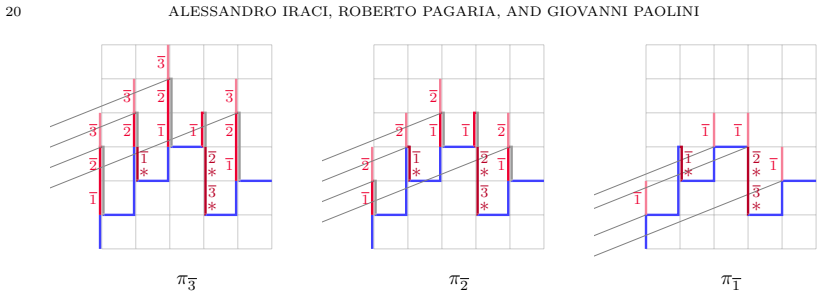
- [Figures 3 and 5] The dashed projection lines and the distinction between the usual and ENS representations are hard to read in the small figures. Enlarging the figures or labeling the relevant steps would improve clarity.
Circularity Check
No significant circularity: Theorem 1.1 is proven from external theorems and a new combinatorial dinv; the only caveat is that Theorem 1.2 is explicitly conditional on the authors' own unproved conjecture [IPPVW23, Conjecture 4.2].
full rationale
The derivation of Theorem 1.1 is self-contained in the relevant sense: it starts from Mellit's rational shuffle theorem [Mel21], applies the skewing expansion [GGG24, Eq. (10)], uses the external sign-reversing involution [GGG24, Theorem 4.30], and contributes a new bijection ψ (Proposition 4.9, Lemma 4.10), a new fall-labeling statistic falldinv, and a new dinv computation (Theorem 5.1). The statistic dinv is defined combinatorially on fall-decorated paths, not fitted to the symmetric function side, and no parameter is tuned to force the identity. The k=0 case reproduces the known rational shuffle theorem as a check, not as an input. Proposition 4.14 is deferred to [GGG24, Lemma 4.6]; that is an external citation and a proof gap at worst, not circularity. The only self-citation is Theorem 1.2, which is stated as an implication from [IPPVW23, Conjecture 4.2], a conjecture made by three of the four current authors in a prior paper. Because that theorem is explicitly conditional and is not used in the proof of Theorem 1.1, it does not make the paper's derivation circular, but it does mean the rectangular non-Dyck formula is not an unconditional result. Score 2 reflects this minor conditional self-citation rather than any circular reduction.
Assumptions & free parameters
assumptions (5)
- standard math Mellit's rational shuffle theorem: e_{m,n} equals the q,t-generating function over LRD(m,n) for all positive m,n.
- standard math Properties of the sign-reversing involution phi on words with allowable content: it preserves tied inversions and has unique fixed point 12...k.
- standard math Jacobi-Trudi expansion: s_(m-1)^k equals a signed sum of complete homogeneous functions over allowable compositions, modulo h_j with j>m.
- standard math The generating function over labeled rectangular paths is a symmetric function, a positive sum of LLT polynomials, so that skewing extracts monomial coefficients.
- domain assumption Rectangular paths conjecture: [m]_q/[d]_q p_{m,n} equals the q,t-generating function over LRP(m,n) for m,n with d=gcd(m,n).
Cite this review
Pith. "Pith review of Falling stars: a fall-decorated rational shuffle theorem." pith.science (2026). https://pith.science/paper/65CBUGS6
@misc{pith2026250820935,
  author       = {Pith},
  title        = {Pith review of: Falling stars: a fall-decorated rational shuffle theorem},
  year         = {2026},
  howpublished = {\url{https://pith.science/paper/65CBUGS6}},
  note         = {Machine review of arXiv:2508.20935}
}
abstract
In this paper, we formulate a rational analog of the fall Delta theorem and the Delta square conjecture. We find a new dinv statistic on fall-decorated paths on a $(m+k) \times (n+k)$ rectangle that simultaneously extends the previously known dinv statistics on decorated square objects and non-decorated rectangular objects. We prove a symmetric function formula for the $q,t$-generating function of fall-decorated rectangular Dyck paths as a skewing operator applied to $e_{m,n+km}$ and, conditionally on the rectangular paths conjecture, an analog formula for fall-decorated rectangular paths.
Figures


Figures from the paper (7 more)


Reference graph
Works this paper leans on
-
[1]
A combinatorial skewing formula for the Rise Delta Theorem
[BG99] Fran¸ cois Bergeron and Adriano M. Garsia, Science fiction and Macdonald’s polynomials , Algebraic methods and q-special functions (Montr´ eal, QC, 1996), 1999, pp. 1–52. MR1726826 [BGHT99] Fran¸ cois Bergeron, Adriano M. Garsia, Mark Haiman, and Glenn Tesler, Identities and positivity con- jectures for some remarkable operators in the theory of sy...
work page Pith review arXiv 1996
-
[12]
MR3940652 26 ALESSANDRO IRACI, ROBERTO PAGARIA, AND GIOV ANNI PAOLINI [HR W18] James Haglund, Jeffrey B. Remmel, and Andrew T. Wilson,The Delta Conjecture, Trans. Amer. Math. Soc. 370 (2018), no. 6, 4029–4057. MR3811519 [HS15] Angela Hicks and Emily Sergel, A simpler formula for the number of diagonal inversions of an (m,n)- parking function and a returni...
work page 2018
-
[1995]
Zelevinsky, Oxford Science Publications
With contributions by A. Zelevinsky, Oxford Science Publications. MR1354144 [Mel21] Anton Mellit, Toric braids and (m,n)-parking functions , Duke Mathematical Journal 170 (2021dec), no. 18, 4123–4169. [QW20] Dun Qiu and Andrew Timothy Wilson, The valley version of the Extended Delta Conjecture, J. Combin. Theory Ser. A 175 (2020), 105271. [Ser17] Emily Se...
work page 2020
-
[2008]
With an appendix on the com- binatorics of Macdonald polynomials. MR2371044 [Hai01] Mark Haiman, Hilbert schemes, polygraphs and the Macdonald positivity conjecture , J. Amer. Math. Soc. 14 (2001), no. 4, 941–1006. MR1839919 [Hai02] , Vanishing theorems and character formulas for the Hilbert scheme of points in the plane , Invent Math 149 (2002), no. 2, 3...
work page 2001
Reviewed August 5, 2026 · model on record in the stance chip above.
Discussion (0). Continue with ORCID to comment.