Edge-connectivity and non-negative Lin-Lu-Yau curvature
Pith reviewed 2026-05-18 20:24 UTC · model grok-4.3
The pith
In finite connected graphs with non-negative Lin-Lu-Yau curvature, the edge-connectivity equals the minimum degree.
A machine-rendered reading of the paper's core claim, the machinery that carries it, and where it could break.
Core claim
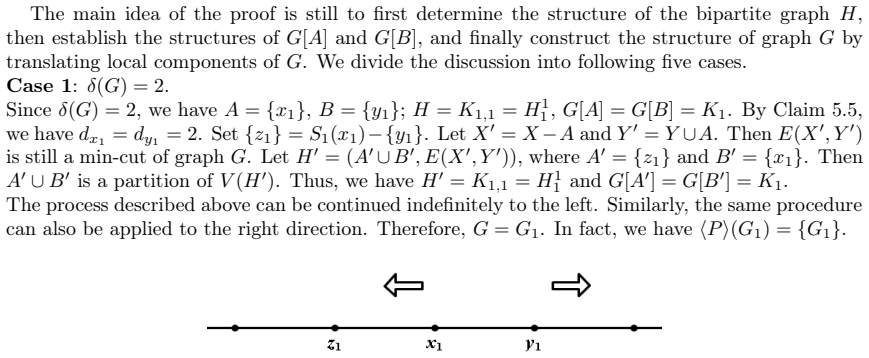
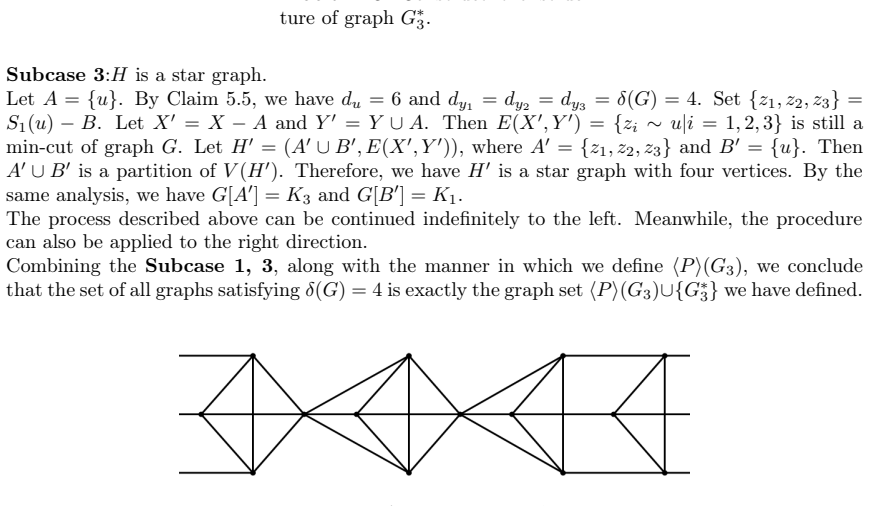
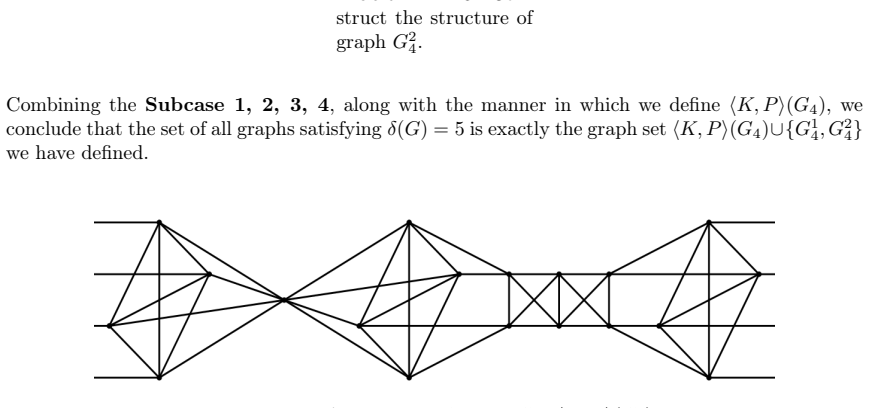
By definition, the edge-connectivity of a connected graph is no larger than its minimum degree. We prove that the edge connectivity of a finite connected graph with non-negative Lin-Lu-Yau curvature is equal to its minimum degree. This answers an open question of Chen, Liu and You. We classify all connected graphs with non-negative Lin-Lu-Yau curvature and edge-connectivity smaller than their minimum degree; in particular, they are all infinite.
What carries the argument
Non-negative Lin-Lu-Yau curvature on edges, a discrete curvature condition that forces equality between edge-connectivity and minimum degree.
If this is right
- Edge-connectivity reaches at least the minimum degree under the curvature condition.
- Removing any set of edges smaller than the minimum degree leaves the finite graph connected.
- The equality fails only for certain infinite graphs with the same curvature bound.
- All exceptions to the equality under non-negative curvature are infinite.
Where Pith is reading between the lines
- Finiteness is essential for the equality, as the classification of infinite counterexamples demonstrates.
- The link between discrete curvature and classical connectivity parameters may extend to related graph invariants.
Load-bearing premise
The graph must be finite.
What would settle it
A finite connected graph with non-negative Lin-Lu-Yau curvature on every edge but with edge-connectivity strictly less than its minimum degree.
Figures






read the original abstract
By definition, the edge-connectivity of a connected graph is no larger than its minimum degree. In this paper, we prove that the edge connectivity of a finite connected graph with non-negative Lin-Lu-Yau curvature is equal to its minimum degree. This answers an open question of Chen, Liu and You. Notice that our conclusion would be false if we did not require the graph to be finite. We actually classify all connected graphs with non-negative Lin-Lu-Yau curvature and edge-connectivity smaller than their minimum degree. In particular, they are all infinite.
Editorial analysis
A structured set of objections, weighed in public.
Referee Report
Summary. The paper proves that for any finite connected graph with non-negative Lin-Lu-Yau curvature, the edge-connectivity equals the minimum degree. This resolves an open question of Chen, Liu and You. The authors further classify all connected graphs (necessarily infinite) with non-negative Lin-Lu-Yau curvature for which edge-connectivity is strictly smaller than the minimum degree.
Significance. If the result holds, it establishes a clean structural consequence of non-negative Lin-Lu-Yau curvature for finite graphs, analogous to connectivity results in Riemannian geometry. The proof derives a contradiction from the curvature definition whenever a cut of size less than the minimum degree exists, invoking finiteness to localize the cut or a minimum-degree vertex. The exhaustive classification of infinite counterexamples is a particular strength, as it confirms there are no finite exceptions and provides a complete dichotomy. The argument uses only the standard definition of the curvature and basic graph-theoretic notions, with no hidden regularity or bounded-degree assumptions.
minor comments (3)
- The abstract states the main theorem cleanly but could add one sentence indicating that the proof proceeds by contradiction using the curvature condition and finiteness.
- In the classification section, verify that the infinite counterexamples are presented with explicit constructions or references so that readers can reconstruct them without ambiguity.
- Ensure the citation to the open question of Chen, Liu and You includes the precise reference details and year.
Simulated Author's Rebuttal
We thank the referee for the positive summary and significance assessment of our manuscript, which correctly identifies the resolution of the open question posed by Chen, Liu and You, as well as the classification of infinite graphs where edge-connectivity is strictly less than the minimum degree. The recommendation for minor revision is noted, but the report does not specify any particular issues or changes.
Circularity Check
No circularity: direct proof from curvature definition and finiteness
full rationale
The manuscript proves edge-connectivity equals minimum degree for finite connected graphs with non-negative Lin-Lu-Yau curvature by deriving a contradiction from the curvature definition applied to any smaller edge cut, using finiteness only to localize a minimizing cut or minimum-degree vertex. It separately classifies all (infinite) counterexamples. No parameter fitting, no self-definitional loops, and the reference to the prior open question of Chen-Liu-You does not carry the proof load; the argument is self-contained against the standard curvature definition and basic graph theory. This is the normal non-circular outcome for a direct theorem.
Axiom & Free-Parameter Ledger
axioms (2)
- domain assumption The graph is finite and connected.
- domain assumption Lin-Lu-Yau curvature is defined and non-negative on every edge.
Lean theorems connected to this paper
-
IndisputableMonolith/Foundation/AlexanderDuality.leanalexander_duality_circle_linking unclear?
unclearRelation between the paper passage and the cited Recognition theorem.
Theorem 1.2: finite connected graph with non-negative Lin-Lu-Yau curvature satisfies κ'(G)=δ(G).
-
IndisputableMonolith/Cost/FunctionalEquation.leanwashburn_uniqueness_aczel unclear?
unclearRelation between the paper passage and the cited Recognition theorem.
Lemma 4.1 and cost(e0) estimates via optimal transport plans on min-cuts.
What do these tags mean?
- matches
- The paper's claim is directly supported by a theorem in the formal canon.
- supports
- The theorem supports part of the paper's argument, but the paper may add assumptions or extra steps.
- extends
- The paper goes beyond the formal theorem; the theorem is a base layer rather than the whole result.
- uses
- The paper appears to rely on the theorem as machinery.
- contradicts
- The paper's claim conflicts with a theorem or certificate in the canon.
- unclear
- Pith found a possible connection, but the passage is too broad, indirect, or ambiguous to say the theorem truly supports the claim.
Reference graph
Works this paper leans on
- [1]
-
[2]
B. B. Bhattacharya, S. Mukherjee, Exact and asymptotic results on coarse Ricci curvature of graphs, Discrete Math. 338 (2015), no. 1, 23-42
work page 2015
- [3]
-
[4]
A. E. Brouwer and W. H. Haemers, Eigenvalues and perfect matchings, Linear Algebr. Appl., 395 (2005), pp. 155-162
work page 2005
-
[5]
A. E. Brouwer and D. M. Menser, The connectivity for strongly regular graphs, European J. Combin. 6 (1985), no. 3, 215-216. 55
work page 1985
- [6]
- [7]
-
[8]
D. Cushing, S. Kamtue, J. Koolen, S. Liu, F. Münch, N. Peyerimhoff, Rigidity of the Bonnet-Myers inequality for graphs with respect to Ollivier Ricci curvature, Adv. Math. 369 (2020), 107188
work page 2020
-
[9]
J. I. Hall, Locally Petersen graphs, J. Graph Theory 4 (1980), no. 2, 173-187
work page 1980
-
[10]
P. Horn, A. Purcilly, A. Stevens, Graph curvature and local discrepancy, J. Graph Theory 108 (2025), no. 2, 337-360
work page 2025
-
[11]
B. Hua, F. Münch, Every salami has two ends, J. Reine Angew. Math. 821 (2025), 291-321
work page 2025
- [12]
-
[13]
J. Jost, Riemannian geometry and geometric analysis, Seventh edition, Universitext, Springer, Cham, 2017
work page 2017
-
[14]
J. Jost, S. Liu, Ollivier’s Ricci curvature, local clustering and curvature-dimension inequalities on graphs, Dis- crete Comput. Geom. 51 (2014), no. 2, 300-322
work page 2014
- [15]
-
[16]
Y. Lin, L. Lu, S.-T. Yau, Ricci curvature of graphs, Tohoku Math. J. 63 (2011), no. 4, 605-627
work page 2011
- [17]
-
[18]
Mader, Minimalen-fach kantenzusammenhängende Graphen, Math
W. Mader, Minimalen-fach kantenzusammenhängende Graphen, Math. Ann. 191 (1971), 21-28
work page 1971
- [19]
-
[20]
L. Najman and P. Romon (Eds), Modern approaches to discrete curvature, Lecture Notes in Math., 2184, Springer, Cham, 2017
work page 2017
-
[21]
Ollivier, Ricci curvature of Markov chains on metric spaces, J
Y. Ollivier, Ricci curvature of Markov chains on metric spaces, J. Funct. Anal. 256 (2009), no. 3, 810-864
work page 2009
-
[22]
Y. Ollivier, C. Villani, A curved Brunn-Minkowski inequality on the discrete hypercube, or: what is the Ricci curvature of the discrete hypercube, SIAM J. Discrete Math. 26 (2012), no. 3, 983-996
work page 2012
-
[23]
Salez, Sparse expanders have negative curvature, Geom
J. Salez, Sparse expanders have negative curvature, Geom. Funct. Anal. 32 (2022), no. 6, 1486-1513
work page 2022
-
[24]
J. D. H. Smith, Ricci curvature, circulants, and a matching condition, Discrete Math. 329 (2014), 88-98
work page 2014
-
[25]
M. E. Watkins, Connectivity of transitive graphs, J. Combinatorial Theory 8 (1970), 23-29
work page 1970
-
[26]
G. M. Weetman, A construction of locally homogeneous graphs, J. London Math. Soc. (2) 50 (1994), no. 1, 68-86
work page 1994
-
[27]
G. M. Weetman, Diameter bounds for graph extensions, J. London Math. Soc. (2) 50 (1994), no. 2, 209-221. School of Mathematical Sciences, University of Science and Technology of China, 96 Jinzhai Road, Hefei 230026, Anhui Province, China Email address: spliu@ustc.edu.cn School of Mathematical Sciences, University of Science and Technology of China, 96 Jin...
work page 1994
discussion (0)
Sign in with ORCID, Apple, or X to comment. Anyone can read and Pith papers without signing in.