REVIEW 3 major objections 5 minor 29 references
The Derivative of Kemeny's Constant as a Centrality Measure in Undirected Graphs
T0 review · 3 major / 5 minor · reviewed 2026-08-05 · deepseek-v4-flash
Pith's one-line read This paper claims that the directional derivative of Kemeny's constant, expressed through a rank-one-modified graph Laplacian, gives a positive, finite importance score for every edge—including cut-edges—and its unweighted version gives pos
desk verdict Kemeny derivative centrality is a real result with correct core identities; two factor-of-two errors and a thin link-prediction section need fixing before publication. read the letter →
The pith
A machine-rendered reading of the paper's core claim, the machinery that carries it, and where it could break.
The reading
What carries the argument
The load-bearing object is the quadratic form β(p,q) = w_pq^T S^{-1} D S^{-1} w_pq, with w_pq = e_p - e_q, D = diag(d), and S = L + dd^T/||d||_1, the graph Laplacian plus a rank-one term that makes it invertible. This form is the unweighted directional derivative of Kemeny's constant, and multiplied by the edge weight a_pq it is the weighted derivative. It works through the rank-one update S - t a_pq w_pq w_pq^T: applying the inverse-update formula to the trace expression for Kemeny's constant turns the perturbed Kemeny constant into a rational function of t whose first derivative is β(p,q), with positivity following from positive definiteness. Because S is invertible even when {p,q} is a cu
What would settle it
Take a network whose future links are known, compute β(p,q) for all non-edges, and compare precision at the top of the ranking against Jaccard and Adamic-Adar baselines; if the top-scoring non-edges are not future links at least as often as the baselines, the link-prediction interpretation is not supported.
Extended reading notes
Core claim
The central discovery is that the derivative of Kemeny's constant along an edge is not just a formal object but a computable, universally positive quantity. Writing w_pq = e_p - e_q, S = L + dd^T/||d||_1, and D = diag(d), the paper proves that the weighted directional derivative is µ(p,q) = a_pq · w_pq^T S^{-1} D S^{-1} w_pq and the unweighted derivative is µ̄(p,q) = w_pq^T S^{-1} D S^{-1} w_pq. Because S is invertible for every connected graph, both quantities are finite; the quadratic form is positive for every pair p ≠ q, including cut-edges and non-edges. The paper further proves that for non-cut-edges the earlier finite-difference measure of [3] equals µ(p,q) divided by 1 - a_pq w_pq^T
Load-bearing premise
The edge-importance reading depends on the perturbation model in which weakening an edge always comes with compensating self-loops at its endpoints, and for non-edges it further assumes the formal unweighted derivative predicts real future links—a link-prediction assumption supported only by a few hand-checked examples.
Editorial extensions
If this is right
- Because µ(p,q) = a_pq β(p,q) is positive and finite for every edge, one formula and one algorithm replace the earlier three-way case split for ordinary edges, regularized cut-edges, and filtered cut-edges.
- Because β(p,q) is well defined for all pairs, the same matrix S^{-1} D S^{-1} yields a ranking of all non-edges, so link prediction no longer requires common neighbours to assign a nonzero score.
- Theorem 2 gives c(p,q) = µ(p,q) / (1 - a_pq w_pq^T S^{-1} w_pq) on non-cut-edges, so the new derivative and the earlier finite-difference measure agree up to an edge-dependent factor there.
- For one-path graphs, µ(q,q+1) = σ_{q-1}(1 - σ_{q-1}) / (λ_{q-1} π_{q-1}); with unit weights this becomes a parabola peaking near the middle edge, quantifying which edge most hurts circulation if weakened.
- The normalized average of β(p,q) over all pairs defines a single scalar sensitivity of Kemeny's constant, computable from the trace and total sum of S^{-1} D S^{-1} without enumerating edges.
Reading between the lines
- Since β(p,q) = ||D^{1/2} S^{-1}(e_p - e_q)||^2, the non-edge scores form a squared Euclidean distance between vertices in the metric induced by S^{-1} D S^{-1}; this suggests triangle-inequality-based shortcuts and a direct connection to resistance-like measures.
- The identity µ(p,q) = a_pq β(p,q) means edge importance scales linearly with weight while β itself is weight-free; a natural testable extension is to use β alone as a scale-free ranking that does not over-prioritize heavy edges.
- The global sensitivity measure could be used as a design objective: among candidate edge additions, choose the one that most reduces the sensitivity of Kemeny's constant, a computation that can be done from a single inverse matrix; the paper does not run this optimization.
- A held-out-edge benchmark with AUC and precision-at-k against common-neighbour indices would establish how broadly the non-edge scores transfer, beyond the anecdotal checks reported.
Editorial analysis
A structured set of objections, weighed in public.
Referee Report
Summary. The paper introduces two directional derivatives of Kemeny's constant for edges and non-edges of an undirected weighted graph: a weighted derivative μ(p,q) and an unweighted derivative μ̄(p,q). The central algebraic results are: μ(p,q)=a_pq β(p,q), where β(p,q)=w_pq^T S^{-1} D S^{-1} w_pq with S = L + dd^T/‖d‖_1; the positivity of β, including for cut-edges and for non-edges; the relation c(p,q)=μ(p,q)/(1−a_pq w_pq^T S^{-1} w_pq) to the Altafini et al. centrality; an algorithm based on Cholesky factorization; explicit formulas for one-path graphs; and applications to road-network centrality, link prediction, and a global sensitivity measure ζ(G). The main identities (Corollary 1 and Theorem 2) are self-contained and appear correct. However, several secondary but stated results contain factor-of-two errors, and the link-prediction application is supported only by anecdotal evidence.
Significance. If the central identities are correct, the paper makes a useful contribution: μ(p,q) is a universally defined, always-positive edge centrality that avoids the cut-edge singularities and numerical cancellation of the measure in [3], and the closed form via S^{-1}DS^{-1} is parameter-free and directly computable. The connection to the existing centrality of [3] is elegant, and the proposed algorithm appears to yield substantial speedups on large road networks. The unweighted measure μ̄(p,q) gives a positive score to every pair of vertices, which is a potentially valuable algebraic heuristic for link prediction. That said, the advertised link-prediction application is not yet established: the derivative for non-edges is a formal extrapolation along a non-stochastic direction, and the empirical validation is minimal. The factor-of-two errors in Theorem 3 and Eq. (3.7) are real and must be corrected before the paper can be accepted.
major comments (3)
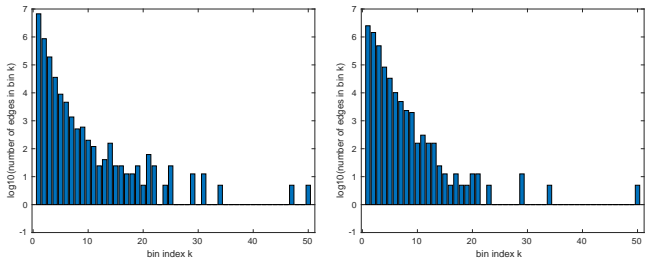
- [§3.2, Eq. (3.7)] The formula for ζ(G) is off by a factor of 2. Since μ̄(p,q) = (e_p−e_q)^T M (e_p−e_q) with M = S^{-1}DS^{-1}, summing over all ordered pairs gives Σ_{p,q} μ̄(p,q) = 2n tr(M) − 2 1^T M 1, not n tr(M) − 1^T M 1. Thus ζ(G) should be [2n tr(M) − 2 1^T M 1]/n^2. This error propagates to Figure 6, where the reported values and the comparison across graph families are affected.
- [§3, Theorem 3 and Corollary 3] Theorem 3 and Corollary 3 each contain a factor-of-two error. On the two-node graph with a single edge of weight 1, direct computation gives the filtered centrality c_F = 1/2, while Theorem 3 gives c_F = 1. The coefficient in Theorem 3 should be 1 rather than 2, and the bounds in Corollary 3 should have 1/a_pq rather than 2/a_pq. This also affects the comparison with [3] in Section 6 and any use of c_F.
- [§3 (definition of μ̄) and §6 (link prediction)] The unweighted derivative for a non-edge, a_pq = 0, is taken along D^{-1}w_pq w_pq^T, which has negative off-diagonal entries; P + tD^{-1}w_pq w_pq^T is not a stochastic matrix of any graph. Hence μ̄(p,q) is an algebraic derivative of an extended Kemeny function, not the derivative under an edge-insertion process. The paper does not state this distinction. The link-prediction claim in the abstract and conclusions ('low μ̄ means probable future collaboration') is then validated only by hand-checking 3 of the top 10 predicted pairs in one collaboration network, with no temporal split, no AUC/Precision@k evaluation, and no comparison against the common-neighbour baselines mentioned in the same section. This is insufficient support for a central advertised application. The authors should either supply a quantitative evaluation or substantially soften the link-prediction interpretation.
minor comments (5)
- [§4, Algorithm 1] The notation in (4.6), "w_pq = (w_pq)_{i=1,\dots,n-1}", is confusing because the same symbol is used for the full vector and its first n−1 components. Suggest using a different symbol, e.g., ̂w_pq.
- [§6, Figure 4] The matrices of centrality values are printed with many digits and are hard to read. A heatmap with a color scale, or a smaller number of displayed digits, would improve readability.
- [§6, Table 1 and Figure 5] The text states that correlations are 'as expected' because the Kemeny derivative is sorted oppositely, but the reported correlations are only pairwise; no statistical significance or ranking metrics are given. This is acceptable as exploratory, but it should be labeled as such.
- [§5, Theorem 4] The formula for μ(q,q+1) is stated for q=1,\dots,n−1, but the notation σ_{q−1} and λ_{q−1} requires q≥1; this is implicit but could be made explicit.
- [§1] The phrase 'it is numerically stable since its computation avoids cancellation' is plausible but not demonstrated with a rounding-error analysis; a brief justification or reference would help.
Circularity Check
No significant circularity: the derivative identities are derived by direct Sherman-Morrison computation; self-citations are background only.
full rationale
The paper's central results, Corollary 1 and Theorem 2, are obtained by differentiating κ(Ppq(t)) = trace(D^{1/2} S_{pq}(t)^{-1} D^{1/2}) - 1 and applying the Sherman-Woodbury-Morrison formula to S_{pq}(t) = S - t a_{pq} w_{pq} w_{pq}^T. This is a self-contained algebraic derivation: no fitted constants, learned parameters, or data-driven calibrations enter the definition of μ(p,q) or ¯μ(p,q). The relation to the edge centrality of [3] in Theorem 2 uses a previously published formula (2.6) from the authors' own work, but that formula is an explicit, independently checkable mathematical result and is not an input that encodes the new derivative measure; the new measure stands without that comparison. Similarly, the one-path expression imports [8, Thm 5.1] for Kemeny's constant from overlapping-author work, but as a benchmark formula, not as a hidden premise that forces the conclusion. The non-edge score is an extrapolation: for a_{pq}=0, P + t D^{-1} w_{pq} w_{pq}^T is not a stochastic matrix, so ¯μ(p,q) is a formal derivative of an extended Kemeny function, and the link-prediction interpretation is heuristic. That is a validation weakness, not circularity, because no prediction was used to define the measure and no target quantity was fitted. The manual check of three of the top ten predicted links is thin evidence, but the derivation itself is not equivalent to its inputs. Score 1 reflects the presence of overlapping-author citations and the heuristic non-edge interpretation, neither of which makes the derivation circular.
Assumptions & free parameters
assumptions (6)
- standard math Sherman-Woodbury-Morrison identity for rank-one perturbations of nonsingular matrices
- standard math Perron-Frobenius theorem for irreducible nonnegative matrices
- standard math Brauer theorem on eigenvalues of rank-one perturbations of stochastic matrices
- standard math Kemeny's constant formula kappa = trace(I - P + 1v^T)^{-1} - 1
- standard math Theorem 5.1 of [8] giving Kemeny's constant for one-path birth-death processes (formula (5.2))
- domain assumption The graph G is connected and edge weights are positive
Cite this review
Pith. "Pith review of The Derivative of Kemeny's Constant as a Centrality Measure in Undirected Graphs." pith.science (2026). https://pith.science/paper/VIYFY42Y
@misc{pith2026250821506,
  author       = {Pith},
  title        = {Pith review of: The Derivative of Kemeny's Constant as a Centrality Measure in Undirected Graphs},
  year         = {2026},
  howpublished = {\url{https://pith.science/paper/VIYFY42Y}},
  note         = {Machine review of arXiv:2508.21506}
}
read the original abstract
Kemeny's constant quantifies a graph's connectivity by measuring the average time for a random walker to reach any other vertex. We introduce two concepts of the directional derivative of Kemeny's constant with respect to an edge and use them to define centrality measures for edges and non-edges in the graph. Additionally, we present a sensitivity measure of Kemeny's constant. An explicit expression for these quantities involving the inverse of the modified graph Laplacian is provided, which is valid even for cut-edges. These measures are connected to the one introduced in [Altafini et al., SIMAX 2023], and algorithms for their computation are included. The benefits of these measures are discussed, along with applications to road networks and link prediction analysis. For one-path graphs, an explicit expression for these measures is given in terms of the edge weights.
Figures


Figures from the paper (3 more)


Reference graph
Works this paper leans on
-
[3]
D. Altafini, D. A. Bini, V. Cutini, B. Meini, and F. Poloni. An edge centrality measure based on the Kemeny constant. SIAM J. Matrix Anal. Appl., 44(2):648–669, 2023
work page 2023
- [1]
-
[2]
On the Edge Derivative of the Normalized Laplacian with Applications to Kemeny's Constant
C. Albright, K. P. Hadaway, A. H. Pomerance, J. Jeffries, K. J. Lorenzen, and A. K. Nix. On the edge derivative of the normalized laplacian with applications to Kemeny’s constant. arXiv:2211.01495, 2023
work page Pith review arXiv 2023
-
[4]
M. Benzi and P. Boito. Matrix functions in network analysis. GAMM- Mitteilungen, 43(3):e202000012, 2020
work page 2020
-
[5]
Changing the ranking in eigenvector centrality of a weighted graph by small perturbations
M. Benzi and N. Guglielmi. Changing the ranking in eigenvector centrality of a weighted graph by small perturbations. arXiv:2501.10745, to appear in Math. Comp. , 2025
work page Pith review arXiv 2025
-
[6]
M. Benzi and C. Klymko. Total communicability as a centrality measure. Journal of Complex Networks , 1(2):124–149, 05 2013
work page 2013
-
[7]
J. Berkhout and B. F. Heidergott. Analysis of Markov influence graphs. Operations Research, 67(3):892 – 904, 2019
work page 2019
-
[8]
D. Bini, J. J. Hunter, G. Latouche, B. Meini, and P. Taylor. Why is Kemeny’s constant a constant? Journal of Applied Probability, 55(4):1025– 1036, 2018
work page 2018
Show all 29 references
-
[9]
D. A. Bini, S. Kirkland, G. Latouche, and B. Meini. Cut-edge centralities in an undirected graph. Numerical Algorithms, 2025
2025
-
[10]
A. Brauer. Limits for the characteristic roots of a matrix. IV: Applications to stochastic matrices. Duke Math. J. , 19(1):75 – 91, 1952
1952
-
[11]
Breen and S
J. Breen and S. Kirkland. A structured condition number for Kemeny’s constant. SIAM Journal on Matrix Analysis and Applications , 40(4):1555– 1578, 2019
2019
-
[12]
Cipolla, F
S. Cipolla, F. Durastante, and B. Meini. Enforcing Katz and PageRank centrality measures in complex networks. SIAM J. Math. Data Science , 2025
2025
-
[13]
Crisostomi, S
E. Crisostomi, S. Kirkland, and R. Shorten. A Google-like model of road network dynamics and its application to regulation and control. Interna- tional Journal of Control , 84(3):633–651, 2011. 22
2011
-
[14]
Cuthill and J
E. Cuthill and J. McKee. Reducing the bandwidth of sparse symmetric matrices. In Proceedings of the 1969 24th National Conference , ACM ’69, page 157–172, New York, NY, USA, 1969. Association for Computing Ma- chinery
1969
-
[15]
W. K. Grassmann, M. I. Taksar, and D. P. Heyman. Regenerative analysis and steady state distributions for Markov chains. Operations Research, 33(5):1107–1116, 1985
1985
-
[16]
A. A. Hagberg, D. A. Schult, and P. J. Swart. Exploring network structure, dynamics, and function using NetworkX. In G. Varoquaux, T. Vaught, and J. Millman, editors, Proceedings of the 7th Python in Science Conference (SciPy2008), pages 11–15, Pasadena, CA, USA, August 2008
2008
-
[17]
M. A. Hasan and M. J. Zaki. A Survey of Link Prediction in Social Net- works, pages 243–275. Springer US, Boston, MA, 2011
2011
-
[18]
N. J. Higham. Accuracy and Stability of Numerical Algorithms . Society for Industrial and Applied Mathematics, second edition, 2002
2002
-
[19]
N. J. Higham. Functions of matrices . Society for Industrial and Applied Mathematics (SIAM), Philadelphia, PA, 2008. Theory and computation
2008
-
[20]
J. J. Hunter. The role of Kemeny’s constant in properties of Markov chains. Comm. Statist. Theory Methods , 43(7):1309–1321, 2014
2014
-
[21]
Kemeny and J
J. Kemeny and J. Snell. Finite Markov Chains . Van Nostrand, 1960
1960
-
[22]
J. G. Kemeny. Generalization of a fundamental matrix. Linear Algebra Appl., 38:193–206, 1981
1981
-
[23]
Kirkland, Y
S. Kirkland, Y. Li, J. McAlister, and X. Zhang. Edge addition and the change in Kemeny’s constant. arXiv preprint arXiv:2306.04005 , 2023
2023 arXiv
-
[24]
Liben-Nowell and J
D. Liben-Nowell and J. M. Kleinberg. The link-prediction problem for social networks. Journal of the American Society for Information Science and Technology, 58(7):1019–1031, 2007
2007
-
[25]
M. E. J. Newman. Finding community structure in networks us- ing the eigenvectors of matrices. Physical Review E , 74:036104, 2006. arXiv:physics/0605087
2006 arXiv
-
[26]
Patel, P
R. Patel, P. Agharkar, and F. Bullo. Robotic surveillance and Markov chains with minimal weighted Kemeny constant. IEEE Transactions on Automatic Control, 60(12):3156–3167, 2015
2015
-
[27]
X. Wang, J. L. Dubbeldam, and P. Van Mieghem. Kemeny’s constant and the effective graph resistance. Linear Algebra Appl., 535:231–244, 2017
2017
-
[28]
T. Zhou. Progresses and challenges in link prediction. iScience, 24(11):103217, 2021. 23
2021
-
[29]
T. Zhou, L. Lu, and Y.-C. Zhang. Predicting missing links via local infor- mation. The European Physical Journal B , 71(4):623–630, 2009. 24
2009
Reviewed August 5, 2026 · model on record in the stance chip above.
Discussion (0). Continue with ORCID to comment.