REVIEW 3 major objections 5 minor 1 cited by
CRouting: Reducing Expensive Distance Calls in Graph-Based Approximate Nearest Neighbor Search
T0 review · 3 major / 5 minor · reviewed 2026-08-05 · deepseek-v4-flash
Pith's one-line read CRouting estimates neighbor–query distances with a single dataset-derived angle in the cosine theorem, pruning up to 41.5% of distance calls on HNSW and NSG without losing recall.
desk verdict A clean, honestly-reported pruning plugin for HNSW/NSG; the gains are real on the tested data, but post hoc threshold selection and an unverified recovery mechanism keep the generality claims from being fully established. read the letter →
The pith
A machine-rendered reading of the paper's core claim, the machinery that carries it, and where it could break.
The reading
What carries the argument
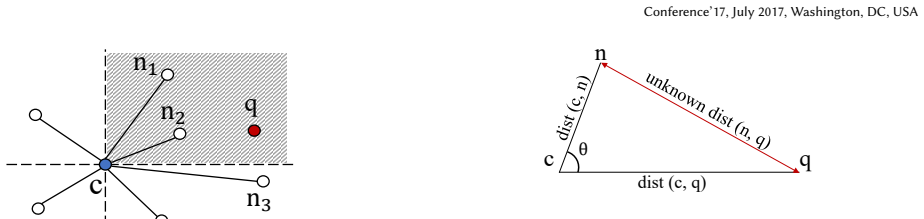
The load-bearing object is the angle distribution of theta = angle(n, c, q), reduced to a single scalar: the 90th percentile of the dataset's measured angle values. CRouting replaces each exact distance call with a cosine-theorem estimate built from the stored edge length dist(c,n), the known dist(c,q), and that fixed representative angle. The error-correction pass rides on graph connectivity: a node pruned at one frontier is likely to be reached from another frontier, at which point its exact distance is computed before it is used.
What would settle it
On a given dataset and graph, measure the actual distribution of the routing angle along real search paths and compare it with the single fixed value CRouting uses; if the spread is wide, the estimate error grows. Then run CRouting with the 90th-percentile threshold on an anisotropic or strongly clustered dataset, for example synthetic mixtures of Gaussians with local directional structure, and compare its recall-QPS curve against exact greedy search: if recall at matched efS falls below the baseline, or if the fraction of wrongly pruned nodes that are never revisited exceeds the fraction rest
Extended reading notes
Core claim
The central claim is that the angle between the edge from the current node to a neighbor and the edge from the current node to the query concentrates around a dataset-specific value, so a single representative angle can stand in for every such angle in the cosine theorem. With the neighbor distance saved from graph construction and the current-node-to-query distance already known, the neighbor-to-query distance becomes a few arithmetic operations; if the estimate lies beyond the candidate set's upper bound, the neighbor is skipped. Because the estimate is approximate, CRouting marks pruned nodes and computes their exact distance if they are encountered again, betting that graph connectivity
Load-bearing premise
The method assumes that one fixed angle, measured from the dataset, is close enough to the real angle at every routing step that the cosine-theorem estimate prunes mostly useless neighbors, and that any useful neighbor it wrongly prunes will be reached again through another graph path.
Editorial extensions
If this is right
- Distance-call speedups of 1.22x to 1.58x over HNSW and 1.15x to 1.71x over NSG at matched recall translate directly into QPS gains of up to 1.48x and 1.47x, making the method a drop-in accelerator for greedy-search-based graph indexes.
- At 95% recall, CRouting cuts the time spent on negative-node distance calls by roughly 47% to 62%, and total search runtime by 12% to 31%, since the pruning check itself costs only a few multiply-add operations.
- The plugin's overhead stays low: construction time rises by no more than 1% on HNSW and 4% on NSG, while index memory grows by 2% to 21%, with the ratio shrinking as dimensionality increases.
- The reported gains hold across distance metrics (Euclidean, inner-product, cosine), across dataset sizes up to 100 million vectors, and across different graph-neighbor counts, with larger neighbor counts making the pruning opportunity larger.
Reading between the lines
- The single-angle approximation is likely to be most reliable on graphs whose edges are built by diversity- or spread-out-promoting criteria; on graphs with strong directional hub structure, the actual per-node angle distribution may vary with node degree, so an extension would measure theta separately by degree class and use a per-class representative angle.
- Because error correction only recovers pruned nodes that are revisited through other paths, datasets with weak connectivity or very small candidate-queue limits could see recall loss at aggressive pruning; an adaptive threshold tied to efS or candidate-queue size is a natural testable extension.
- The 90th-percentile threshold is chosen empirically; the paper's own framework could support a tunable accuracy-latency budget by treating the angle as a continuous knob and precomputing the trade-off curve between pruning ratio and revisit cost for a given dataset.
- CRouting's scalar estimate could serve as a cheap coarse pre-filter in front of more expensive estimators, such as residual-vector or LSH-based distance decompositions, reducing the number of times those heavier estimators must run.
Editorial analysis
A structured set of objections, weighed in public.
Referee Report
Summary. The paper proposes CRouting, a plugin for graph-based approximate nearest neighbor search (HNSW and NSG) that avoids many exact distance computations during greedy search. The idea is to estimate dist(n,q) with the cosine theorem using the already-known dist(c,q) and stored dist(c,n), substituting a fixed representative angle θ (the 90th percentile of a measured angle distribution) for the actual angle ∠ncq. Nodes whose estimated distance is not below the current upper bound are pruned; a subsequent error-correction step recomputes exact distances if a pruned node is encountered again via another path. The paper reports up to a 41.5% reduction in distance calls, QPS gains up to 1.48x, construction overhead below 4%, and memory overhead of 2-21% on five public datasets. The code is publicly available.
Significance. If the reported gains hold beyond the specific configuration tested, CRouting would be a practical, low-overhead drop-in optimization for two widely used graph indexes. The paper has clear strengths: it compares against two routing baselines (TOGG and FINGER), includes an ablation isolating the pruning and error-correction components (CRouting_O vs CRouting), reports construction time and index-size overhead, and evaluates generality across distance metrics and dataset scales. The main claims are internally consistent: the 1.71x distance-call speedup corresponds to a 41.5% reduction. However, the central accuracy claim depends on a parameter (θ percentile) that is selected post hoc on the same benchmark datasets, and on an unmeasured revisit-recovery mechanism. The paper explicitly acknowledges at §5.4 that no approximation error bound is proved. These load-bearing gaps need to be addressed before the results can be considered established.
major comments (3)
- [§5.5, Figure 13] The pruning threshold θ is a free parameter, and the paper selects the 90th percentile because it gives the best recall-QPS curves on the same five datasets used in the headline evaluation. This is a post hoc selection on the test bed: the reported 41.5% distance-call reduction and up to 1.48x QPS are therefore not independent predictions for those datasets. In addition, Figure 13 shows only the GIST dataset, while §5.5 states the 90th percentile is consistently best 'across all datasets and algorithms' without showing the supporting curves. The paper should either fix θ by an a-priori rule (e.g., based on dimensionality) or evaluate on a calibration split, and should report the sensitivity grid for all datasets.
- [§5.4, §4.2, Table 3] The final recall of CRouting rests entirely on the error-correction mechanism, but the paper provides no direct evidence that incorrectly pruned positive nodes are actually revisited and reinserted. Table 3 shows that pruning alone (CRouting_O) collapses recall from 0.978 to 0.453 at efs=100, and CRouting recovers only to 0.917, not to the 0.978 baseline. §5.4 reports relative error and incorrect-pruning ratios (max 5.83%) but does not measure how many of those incorrectly pruned nodes are later reached through alternative paths, which is the key assumption of Figure 1. Without a revisit-rate measurement or an oracle experiment, the claim that 'the same accuracy' is maintained is not established. Add a direct metric: fraction of pruned positive nodes later visited and inserted into the candidate set, and an ablation that compares against an oracle that never prunes positives.
- [§3.3, §4.2] The theoretical motivation assumes 'the position of neighbor n is completely random with respect to the current node c,' so that ∠ncq follows the near-orthogonal random-vector distribution. This is not consistent with how proximity graphs are built: neighbors are selected precisely because they are close to c, and the nodes that matter for the search (positive nodes) are biased toward small angles, as the paper's own Figure 9 and Table 3 demonstrate. The fixed-angle estimate is therefore systematically biased for exactly the nodes where pruning decisions matter. The paper should either frame the angle concentration as an empirical observation only, or analyze the conditional angle distribution for decision-relevant nodes and show that the representative angle remains safe under different graph densities and query distributions.
minor comments (5)
- [§5.1] The 'speedup in distance calls' is defined as the ratio to the brute-force method, but the experiments compare against vanilla HNSW/NSG, not brute force. Please clarify the baseline in the definition.
- [Figure 7 caption] Caption reads 'HSNW' for HNSW; please fix the typo.
- [§5.5 heading] The section heading 'Sensitive Analysis' should be 'Sensitivity Analysis'.
- [§4.3] The formula IPDist(c,q) = 1 - ||c||||q||cosθ is unconventional. If this is the definition used in the implementation, please define it explicitly and state how it relates to standard inner-product distance on unnormalized vectors.
- [§3.3] The sentence 'the angle distribution is solely determined by the dimensionality' refers to the random-vector density in Eq. (3), but the subsequent argument correctly notes that the search-path angle distribution depends on the dataset. Please rephrase to avoid the apparent contradiction.
Circularity Check
No significant circularity; CRouting's speedup is an empirical, tuned result, not a derivation that reduces to its inputs.
full rationale
CRouting's claimed derivation chain is: observe that angles ∠ncq concentrate around a dataset-specific value, use that fixed θ in the cosine theorem to estimate dist(n,q), prune when the estimate exceeds the upper bound, and rely on graph connectivity to revisit wrongly pruned nodes. At no point is the output defined as the input: the angle distribution is measured from sample searches (§4.1), the 90th-percentile θ is selected in §5.5 from recall-QPS curves, and the reported speedup is then measured on the benchmarks. This is hyperparameter tuning on evaluation data, which is a legitimate generalization concern but not a logical circularity (there is no equation in which the predicted quantity is identical to the fit input). The paper also explicitly disclaims analytic error bounds (§5.4) and does not measure the revisit-recovery rate, but these are correctness/robustness limitations, not examples of self-definition, fitted-input-called-prediction, or self-citation load-bearing. No load-bearing self-citations or imported uniqueness theorems are present.
Assumptions & free parameters
free parameters (2)
- Pruning threshold percentile (theta percentile) =
90th percentile of the dataset's measured angle distribution
- Angle sampling ratio n_sample =
0.1% of dataset size
assumptions (5)
- standard math High-dimensional random vectors are almost orthogonal (Equation 3)
- domain assumption The direction of a neighbor n relative to current node c is random enough that angle n-c-q follows a distribution similar to random vectors
- domain assumption The angle distribution is an intrinsic property of the dataset and stable across query sets
- domain assumption Mistakenly pruned nodes will be revisited through alternative graph paths, enabling error correction
- domain assumption Stored neighbor distances dist(c,n) from construction remain valid and accessible at query time
Cite this review
Pith. "Pith review of CRouting: Reducing Expensive Distance Calls in Graph-Based Approximate Nearest Neighbor Search." pith.science (2026). https://pith.science/paper/RQF5IQJO
@misc{pith2026250900365,
  author       = {Pith},
  title        = {Pith review of: CRouting: Reducing Expensive Distance Calls in Graph-Based Approximate Nearest Neighbor Search},
  year         = {2026},
  howpublished = {\url{https://pith.science/paper/RQF5IQJO}},
  note         = {Machine review of arXiv:2509.00365}
}
abstract
Approximate nearest neighbor search (ANNS) is a crucial problem in information retrieval and AI applications. Recently, there has been a surge of interest in graph-based ANNS algorithms due to their superior efficiency and accuracy. However, the repeated computation of distances in high-dimensional spaces constitutes the primary time cost of graph-based methods. To accelerate the search, we propose a novel routing strategy named CRouting, which bypasses unnecessary distance computations by exploiting the angle distributions of high-dimensional vectors. CRouting is designed as a plugin to optimize existing graph-based search with minimal code modifications. Our experiments show that CRouting reduces the number of distance computations by up to 41.5% and boosts queries per second by up to 1.48$\times$ on two predominant graph indexes, HNSW and NSG. Code is publicly available at https://github.com/ISCS-ZJU/CRouting.
Figures


Figures from the paper (12 more)


Forward citations
Cited by 1 Pith paper
-
HNSW with Accuracy Guarantees Using Graph Spanners
A tiered Certify-then-Rectify system for HNSW that certifies approximate results statistically and falls back to exact recovery by treating the graph as a spanner whose stretch is bounded via extreme value theory.
Reference graph
Works this paper leans on
-
[1]
Anon. 2010. Datasets for approximate nearest neighbor search. http://corpus- texmex.irisa.fr/. Last accessed on Sep-2024
2010
-
[2]
Anon. 2011. Million Song Dataset Benchmarks. http://www.ifs.tuwien.ac.at/mir/ msd/. Last accessed on Sep-2024
2011
-
[3]
Anon. 2018. Deep1M Dataset. https://www.cse.cuhk.edu.hk/systems/hash/gqr/ datasets.html. Last accessed on Sep-2024
2018
-
[4]
Matej Antol, Jaroslav Ol’ha, Terézia Slanináková, and Vlastislav Dohnal. 2021. Learned metric index—proposition of learned indexing for unstructured data. Information Systems 100 (2021), 101774
2021
-
[5]
Akhil Arora, Sakshi Sinha, Piyush Kumar, and Arnab Bhattacharya. 2018. Hd- index: Pushing the scalability-accuracy boundary for approximate knn search in high-dimensional spaces. arXiv preprint arXiv:1804.06829 (2018)
arXiv 2018
-
[6]
Martin Aumüller, Erik Bernhardsson, and Alexander Faithfull. 2020. ANN- Benchmarks: A benchmarking tool for approximate nearest neighbor algorithms. Information Systems 87 (2020), 101374
2020
-
[7]
Artem Babenko and Victor Lempitsky. 2014. Additive quantization for extreme vector compression. In Proceedings of the IEEE Conference on Computer Vision and Pattern Recognition. 931–938
2014
-
[8]
Artem Babenko and Victor Lempitsky. 2014. The inverted multi-index. IEEE transactions on pattern analysis and machine intelligence 37, 6 (2014), 1247–1260
2014
Show all 87 references
-
[9]
Keith Ball et al. 1997. An elementary introduction to modern convex geometry. Flavors of geometry 31, 1-58 (1997), 26
1997
-
[10]
Dmitry Baranchuk, Dmitry Persiyanov, Anton Sinitsin, and Artem Babenko. 2019. Learning to route in similarity graphs. In International Conference on Machine Learning. PMLR, 475–484
2019
-
[11]
Jon Louis Bentley. 1975. Multidimensional binary search trees used for associative searching. Commun. ACM 18, 9 (1975), 509–517
1975
-
[12]
Alina Beygelzimer, Sham Kakade, and John Langford. 2006. Cover trees for nearest neighbor. In Proceedings of the 23rd international conference on Machine learning. 97–104
2006
-
[13]
Leonid Boytsov and Bilegsaikhan Naidan. 2013. Engineering efficient and effective non-metric space library. In Similarity Search and Applications: 6th International Conference, SISAP 2013, A Coruña, Spain, October 2-4, 2013, Proceedings 6 . Springer, 280–293
2013
-
[14]
Moses S Charikar. 2002. Similarity estimation techniques from rounding algo- rithms. In Proceedings of the thiry-fourth annual ACM symposium on Theory of computing. 380–388
2002
-
[15]
Patrick Chen, Wei-Cheng Chang, Jyun-Yu Jiang, Hsiang-Fu Yu, Inderjit Dhillon, and Cho-Jui Hsieh. 2023. Finger: Fast inference for graph-based approximate nearest neighbor search. In Proceedings of the ACM Web Conference 2023 . 3225– 3235
2023
-
[16]
Paolo Ciaccia, Marco Patella, Pavel Zezula, et al. 1997. M-tree: An efficient access method for similarity search in metric spaces. In Vldb, Vol. 97. Citeseer, 426–435
1997
-
[17]
CXL Consortium. 2020. Cxl specification. https://computeexpresslink.org/cxl- specification/. Last accessed on Sep-2024
2020
-
[18]
Ryan R Curtin, Parikshit Ram, and Alexander G Gray. 2013. Fast exact max-kernel search. In Proceedings of the 2013 SIAM International Conference on Data Mining . SIAM, 1–9
2013
-
[19]
Sanjoy Dasgupta and Yoav Freund. 2008. Random projection trees and low dimensional manifolds. In Proceedings of the fortieth annual ACM symposium on Theory of computing. 537–546
2008
-
[20]
Mayur Datar, Nicole Immorlica, Piotr Indyk, and Vahab S Mirrokni. 2004. Locality- sensitive hashing scheme based on p-stable distributions. In Proceedings of the twentieth annual symposium on Computational geometry . 253–262
2004
-
[21]
Yihe Dong, Piotr Indyk, Ilya Razenshteyn, and Tal Wagner. 2020. Learning Space Partitions for Nearest Neighbor Search. In International Conference on Learning Representations
2020
-
[22]
Karima Echihabi, Kostas Zoumpatianos, and Themis Palpanas. 2021. New trends in high-d vector similarity search: al-driven, progressive, and distributed. Pro- ceedings of the VLDB Endowment 14, 12 (2021), 3198–3201
2021
-
[23]
Chao Feng, Defu Lian, Xiting Wang, Zheng Liu, Xing Xie, and Enhong Chen
-
[24]
Myron Flickner, Harpreet Sawhney, Wayne Niblack, Jonathan Ashley, Qian Huang, Byron Dom, Monika Gorkani, Jim Hafner, Denis Lee, Dragutin Petkovic, et al. 1995. Query by image and video content: The QBIC system. computer 28, 9 (1995), 23–32
1995
-
[25]
Cong Fu, Changxu Wang, and Deng Cai. 2021. High dimensional similarity search with satellite system graph: Efficiency, scalability, and unindexed query compatibility. IEEE Transactions on Pattern Analysis and Machine Intelligence 44, 8 (2021), 4139–4150
2021
-
[26]
Cong Fu, Chao Xiang, Changxu Wang, and Deng Cai. 2019. Fast approximate nearest neighbor search with the navigating spreading-out graph. Proceedings of the VLDB Endowment 12, 5 (2019), 461–474
2019
-
[27]
Junhao Gan, Jianlin Feng, Qiong Fang, and Wilfred Ng. 2012. Locality-sensitive hashing scheme based on dynamic collision counting. In Proceedings of the 2012 11 Conference’17, July 2017, Washington, DC, USA Li et al. ACM SIGMOD international conference on management of data . 541–552
2012
-
[28]
Jianyang Gao and Cheng Long. 2023. High-dimensional approximate nearest neighbor search: with reliable and efficient distance comparison operations. Proceedings of the ACM on Management of Data 1, 2 (2023), 1–27
2023
-
[29]
Jianyang Gao and Cheng Long. 2024. RaBitQ: Quantizing High-Dimensional Vectors with a Theoretical Error Bound for Approximate Nearest Neighbor Search. Proceedings of the ACM on Management of Data 2, 3 (2024), 1–27
2024
-
[30]
Tiezheng Ge, Kaiming He, Qifa Ke, and Jian Sun. 2013. Optimized product quantization. IEEE transactions on pattern analysis and machine intelligence 36, 4 (2013), 744–755
2013
-
[31]
Tiezheng Ge, Kaiming He, Qifa Ke, and Jian Sun. 2013. Optimized product quantization for approximate nearest neighbor search. In Proceedings of the IEEE conference on computer vision and pattern recognition . 2946–2953
2013
-
[32]
Siddharth Gollapudi, Neel Karia, Varun Sivashankar, Ravishankar Krishnaswamy, Nikit Begwani, Swapnil Raz, Yiyong Lin, Yin Zhang, Neelam Mahapatro, Premku- mar Srinivasan, et al. 2023. Filtered-diskann: Graph algorithms for approximate nearest neighbor search with filters. In P...
2023
-
[33]
Long Gong, Huayi Wang, Mitsunori Ogihara, and Jun Xu. 2020. iDEC: indexable distance estimating codes for approximate nearest neighbor search. Proceedings of the VLDB Endowment 13, 9 (2020)
2020
-
[34]
Yunchao Gong, Svetlana Lazebnik, Albert Gordo, and Florent Perronnin. 2012. Iterative quantization: A procrustean approach to learning binary codes for large-scale image retrieval. IEEE transactions on pattern analysis and machine intelligence 35, 12 (2012), 2916–2929
2012
-
[35]
Adrien Grand. 2023. Vector search in Elasticsearch: The rationale behind the design. https://www.elastic.co/search-labs/blog/vector-search-elasticsearch- rationale. Last accessed on Sep-2024
2023
-
[36]
Fabian Groh, Lukas Ruppert, Patrick Wieschollek, and Hendrik PA Lensch. 2022. Ggnn: Graph-based gpu nearest neighbor search. IEEE Transactions on Big Data 9, 1 (2022), 267–279
2022
-
[37]
Ruiqi Guo, Philip Sun, Erik Lindgren, Quan Geng, David Simcha, Felix Chern, and Sanjiv Kumar. 2020. Accelerating large-scale inference with anisotropic vector quantization. In International Conference on Machine Learning. PMLR, 3887–3896
2020
-
[38]
Gaurav Gupta, Tharun Medini, Anshumali Shrivastava, and Alexander J Smola
-
[39]
Ben Harwood and Tom Drummond. 2016. Fanng: Fast approximate nearest neighbour graphs. In Proceedings of the IEEE Conference on Computer Vision and Pattern Recognition. 5713–5722
2016
-
[40]
Qiang Huang, Jianlin Feng, Yikai Zhang, Qiong Fang, and Wilfred Ng. 2015. Query-aware locality-sensitive hashing for approximate nearest neighbor search. Proceedings of the VLDB Endowment 9, 1 (2015), 1–12
2015
-
[41]
Piotr Indyk and Rajeev Motwani. 1998. Approximate nearest neighbors: towards removing the curse of dimensionality. In Proceedings of the thirtieth annual ACM symposium on Theory of computing . 604–613
1998
-
[42]
J Jang, H Choi, H Bae, S Lee, M Kwon, and M Jung. 2023. CXL-ANNS: Software- Hardware Collaborative Memory Disaggregation and Computation for Billion- Scale Approximate Nearest Neighbor Search. In 2023 USENIX Annual Technical Conference (USENIX ATC 23). USENIX Association
2023
-
[43]
Herve Jegou, Matthijs Douze, and Cordelia Schmid. 2010. Product quantization for nearest neighbor search. IEEE transactions on pattern analysis and machine intelligence 33, 1 (2010), 117–128
2010
-
[44]
Wenqi Jiang, Shigang Li, Yu Zhu, Johannes de Fine Licht, Zhenhao He, Runbin Shi, Cedric Renggli, Shuai Zhang, Theodoros Rekatsinas, Torsten Hoefler, et al
-
[45]
Jeff Johnson, Matthijs Douze, and Hervé Jégou. 2019. Billion-scale similarity search with GPUs. IEEE Transactions on Big Data 7, 3 (2019), 535–547
2019
-
[46]
Yann LeCun, Corinna Cortes, and Christopher J.C. Burges. 1998. The MNIST Database of Handwritten Digits. http://yann.lecun.com/exdb/mnist/. Last accessed on Sep-2024
1998
-
[47]
In Proceedings of the International Conference for High Performance Computing, Networking, Storage and Analysis
Co-design hardware and algorithm for vector search. In Proceedings of the International Conference for High Performance Computing, Networking, Storage and Analysis. 1–15
-
[48]
Conglong Li, Minjia Zhang, David G Andersen, and Yuxiong He. 2020. Improving approximate nearest neighbor search through learned adaptive early termination. In Proceedings of the 2020 ACM SIGMOD International Conference on Management of Data. 2539–2554
2020
-
[49]
Jie Li, Haifeng Liu, Chuanghua Gui, Jianyu Chen, Zhenyuan Ni, Ning Wang, and Yuan Chen. 2018. The design and implementation of a real time visual search system on JD E-commerce platform. In Proceedings of the 19th International Middleware Conference Industry. 9–16
2018
-
[50]
Patrick Lewis, Ethan Perez, Aleksandra Piktus, Fabio Petroni, Vladimir Karpukhin, Naman Goyal, Heinrich Küttler, Mike Lewis, Wen-tau Yih, Tim Rocktäschel, et al. 2020. Retrieval-augmented generation for knowledge-intensive nlp tasks. Advances in Neural Information Processing S...
2020
-
[51]
Lingli Li, Ao Han, Xiaotong Cui, and Baohua Wu. 2024. Flex: a fast and light- weight learned index for KNN search in high-dimensional space. Information Sciences 669 (2024), 120546
2024
-
[52]
Wen Li, Ying Zhang, Yifang Sun, Wei Wang, Mingjie Li, Wenjie Zhang, and Xuemin Lin. 2019. Approximate nearest neighbor search on high dimensional data—experiments, analyses, and improvement. IEEE Transactions on Knowledge and Data Engineering 32, 8 (2019), 1475–1488
2019
-
[53]
Jinfeng Li, Xiao Yan, Jian Zhang, An Xu, James Cheng, Jie Liu, Kelvin KW Ng, and Ti-chung Cheng. 2018. A general and efficient querying method for learning to hash. In Proceedings of the 2018 International Conference on Management of Data. 1333–1347
2018
-
[54]
Yury Malkov, Alexander Ponomarenko, Andrey Logvinov, and Vladimir Krylov
-
[55]
Yu A Malkov and Dmitry A Yashunin. 2018. Efficient and robust approximate nearest neighbor search using hierarchical navigable small world graphs. IEEE transactions on pattern analysis and machine intelligence 42, 4 (2018), 824–836
2018
-
[56]
Kejing Lu, Hongya Wang, Wei Wang, and Mineichi Kudo. 2020. VHP: approximate nearest neighbor search via virtual hypersphere partitioning. Proceedings of the VLDB Endowment 13, 9 (2020), 1443–1455
2020
-
[57]
Marius Muja and David G Lowe. 2014. Scalable nearest neighbor algorithms for high dimensional data. IEEE transactions on pattern analysis and machine intelligence 36, 11 (2014), 2227–2240
2014
-
[58]
Javier Vargas Munoz, Marcos A Gonçalves, Zanoni Dias, and Ricardo da S Torres
-
[59]
Intel Newsroom. 2019. Intel ® OptaneTM DC Persistent Memory. https://www.intel.com/content/www/us/en/products/memory-storage/optane- dc-persistent-memory.html. Last accessed on Sep-2024
2019
-
[60]
Jason Mohoney, Anil Pacaci, Shihabur Rahman Chowdhury, Umar Farooq Minhas, Jeffery Pound, Cedric Renggli, Nima Reyhani, Ihab F Ilyas, Theodoros Rekatsinas, and Shivaram Venkataraman. 2024. Incremental IVF Index Maintenance for Streaming Vector Search. arXiv preprint arXiv:2411...
2024 arXiv
-
[61]
Liudmila Prokhorenkova and Aleksandr Shekhovtsov. 2020. Graph-based nearest neighbor search: From practice to theory. In International Conference on Machine Learning. PMLR, 7803–7813
2020
-
[62]
Jianbin Qin, Wei Wang, Chuan Xiao, Ying Zhang, and Yaoshu Wang. 2021. High- dimensional similarity query processing for data science. In Proceedings of the 27th ACM SIGKDD Conference on Knowledge Discovery & Data Mining. 4062–4063
2021
-
[63]
Parikshit Ram and Kaushik Sinha. 2019. Revisiting kd-tree for nearest neighbor search. In Proceedings of the 25th acm sigkdd international conference on knowledge discovery & data mining . 1378–1388
2019
-
[64]
Jie Ren, Minjia Zhang, and Dong Li. 2020. Hm-ann: Efficient billion-point nearest neighbor search on heterogeneous memory. Advances in Neural Information Processing Systems 33 (2020), 10672–10684
2020
-
[65]
Marco Patella and Paolo Ciaccia. 2009. Approximate similarity search: A multi- faceted problem. Journal of Discrete Algorithms 7, 1 (2009), 36–48
2009
-
[66]
Zhitao Shen, Shiyu Yang, Weibo Chen, Kunming Wang, Yue Li, Jiabao Jin, Wei Jia, Junwei Chen, Yuan Su, Xiaoxia Duan, Wei Chen, Lei Wang, Jie Song, Ruoyi Ruan, and Xuemin Lin. 2025. TierBase: A Workload-Driven Cost-Optimized Key-Value Store . In 2025 IEEE 41st International Conf...
2025
-
[67]
Chanop Silpa-Anan and Richard Hartley. 2008. Optimised KD-trees for fast image descriptor matching. In 2008 IEEE Conference on Computer Vision and Pattern Recognition. IEEE, 1–8
2008
-
[68]
Aditi Singh, Suhas Jayaram Subramanya, Ravishankar Krishnaswamy, and Har- sha Vardhan Simhadri. 2021. Freshdiskann: A fast and accurate graph-based ann index for streaming similarity search. arXiv preprint arXiv:2105.09613 (2021)
2021 arXiv
-
[69]
Suhas Jayaram Subramanya, Devvrit, Rohan Kadekodi, Ravishankar Kr- ishaswamy, and Harsha Vardhan Simhadri. 2019. DiskANN: fast accurate billion- point nearest neighbor search on a single node. In Proceedings of the 33rd Inter- national Conference on Neural Information Processi...
2019
-
[70]
Badrul Sarwar, George Karypis, Joseph Konstan, and John Riedl. 2001. Item-based collaborative filtering recommendation algorithms. In Proceedings of the 10th international conference on World Wide Web. 285–295
2001
-
[71]
Yufei Tao, Ke Yi, Cheng Sheng, and Panos Kalnis. 2010. Efficient and accu- rate nearest neighbor and closest pair search in high-dimensional space. ACM Transactions on Database Systems (TODS) 35, 3 (2010), 1–46
2010
-
[72]
Yao Tian, Ziyang Yue, Ruiyuan Zhang, Xi Zhao, Bolong Zheng, and Xiaofang Zhou. 2023. Approximate Nearest Neighbor Search in High Dimensional Vector Databases: Current Research and Future Directions. IEEE Data Eng. Bull. 46, 3 (2023), 39–54
2023
-
[73]
Jianguo Wang, Xiaomeng Yi, Rentong Guo, Hai Jin, Peng Xu, Shengjun Li, Xi- angyu Wang, Xiangzhou Guo, Chengming Li, Xiaohai Xu, et al. 2021. Milvus: A purpose-built vector data management system. In Proceedings of the 2021 International Conference on Management of Data . 2614–...
2021
-
[74]
Mengzhao Wang, Lingwei Lv, Xiaoliang Xu, Yuxiang Wang, Qiang Yue, and Jiongkang Ni. 2024. An efficient and robust framework for approximate near- est neighbor search with attribute constraint. Advances in Neural Information Processing Systems 36 (2024)
2024
-
[75]
Yifang Sun, Wei Wang, Jianbin Qin, Ying Zhang, and Xuemin Lin. 2014. SRS: solving c-approximate nearest neighbor queries in high dimensional euclidean space with a tiny index. Proceedings of the VLDB Endowment (2014)
2014
-
[76]
Xiaoliang Xu, Mengzhao Wang, Yuxiang Wang, and Dingcheng Ma. 2021. Two- stage routing with optimized guided search and greedy algorithm on proximity graph. Knowledge-Based Systems 229 (2021), 107305
2021
-
[77]
Yuming Xu, Hengyu Liang, Jin Li, Shuotao Xu, Qi Chen, Qianxi Zhang, Cheng Li, Ziyue Yang, Fan Yang, Yuqing Yang, et al. 2023. SPFresh: Incremental In-Place Update for Billion-Scale Vector Search. In Proceedings of the 29th Symposium on Operating Systems Principles. 545–561
2023
-
[78]
Wen Yang, Tao Li, Gai Fang, and Hong Wei. 2020. Pase: Postgresql ultra-high- dimensional approximate nearest neighbor search extension. InProceedings of the 2020 ACM SIGMOD international conference on management of data . 2241–2253
2020
-
[79]
Weijie Zhao, Shulong Tan, and Ping Li. 2020. Song: Approximate nearest neighbor search on gpu. In 2020 IEEE 36th International Conference on Data Engineering (ICDE). IEEE, 1033–1044
2020
-
[80]
Mengzhao Wang, Xiaoliang Xu, Qiang Yue, and Yuxiang Wang. 2021. A com- prehensive survey and experimental comparison of graph-based approximate nearest neighbor search. Proceedings of the VLDB Endowment 14, 11 (2021), 1964–1978
2021
-
[81]
Xiaoyao Zhong, Haotian Li, Jiabao Jin, Mingyu Yang, Deming Chu, Xiangyu Wang, Zhitao Shen, Wei Jia, George Gu, Yi Xie, et al. 2025. VSAG: An Optimized Search Framework for Graph-based Approximate Nearest Neighbor Search.arXiv preprint arXiv:2503.17911 (2025)
2025 arXiv
-
[82]
Chun Jiang Zhu, Tan Zhu, Haining Li, Jinbo Bi, and Minghu Song. 2019. Accel- erating large-scale molecular similarity search through exploiting high perfor- mance computing. In 2019 IEEE International Conference on Bioinformatics and Biomedicine (BIBM). IEEE, 330–333. 13
2019
-
[85]
Bolong Zheng, Zhao Xi, Lianggui Weng, Nguyen Quoc Viet Hung, Hang Liu, and Christian S Jensen. 2020. PM-LSH: A fast and accurate LSH framework for high-dimensional approximate NN search. Proceedings of the VLDB Endowment 13, 5 (2020), 643–655
2020
-
[2014]
Information Systems 45 (2014), 61–68
Approximate nearest neighbor algorithm based on navigable small world graphs. Information Systems 45 (2014), 61–68
2014
-
[2019]
Pattern Recognition 96 (2019), 106970
Hierarchical clustering-based graphs for large scale approximate nearest neighbor search. Pattern Recognition 96 (2019), 106970
2019
-
[2022]
In Proceedings of the 28th ACM SIGKDD Conference on Knowledge Discovery and Data Mining
Bliss: A billion scale index using iterative re-partitioning. In Proceedings of the 28th ACM SIGKDD Conference on Knowledge Discovery and Data Mining . 486–495
-
[2023]
ACM Transactions on Information Systems 41, 1 (2023), 1–27
Reinforcement routing on proximity graph for efficient recommendation. ACM Transactions on Information Systems 41, 1 (2023), 1–27
2023
Reviewed August 5, 2026 · model on record in the stance chip above.
Discussion (0). Continue with ORCID to comment.