REVIEW 3 major objections 4 minor 34 references
Rank three representations of Painleve systems: III. Dolbeault structure, spectral correspondence
T0 review · 3 major / 4 minor · reviewed 2026-08-05 · deepseek-v4-flash
Pith's one-line read The rank-3 JKT and rank-2 Painleve moduli spaces are the same hyperkaehler manifold, via spectral correspondence and algebraic Nahm transformation.
desk verdict A Dolbeault-side step forward for four of the six Painleve cases, with a load-bearing 'easy to check' in the two maximally twisted cases that a referee should force out before accepting. read the letter →
The pith
A machine-rendered reading of the paper's core claim, the machinery that carries it, and where it could break.
The reading
What carries the argument
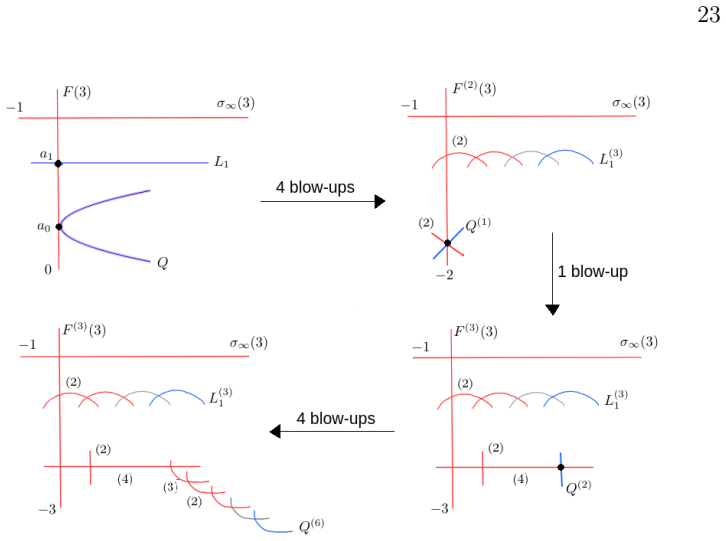
The spectral sheaf S(E,theta), defined by the exact sequence 0 -> p*(E tensor K(D)^-1) -> p*E tensor O(1) -> S -> 0 on the Hirzebruch surface F1, is the central object: the Beauville-Narasimhan-Ramanan correspondence identifies the Higgs bundle with this sheaf. The surface Z* is built as a sequence of nine blow-ups resolving the base locus of the pencil spanned by the spectral curve and a fixed divisor C2, followed by blowing down the (-1)-section at infinity. The algebraic Nahm transform then carries the spectral sheaf to a rank-2 Higgs bundle on the dual projective line, and the paper proves this map preserves the holomorphic symplectic forms by identifying both with the Mukai form on the
What would settle it
Compute the base-point resolution of the pencil generated by the spectral curve and C2 for the JKT IVa and JKT I cases at the triply tangent point. If the ramification degree of the spectral curve at infinity is not 3, or if resolving the base locus produces an exceptional configuration different from the blow-ups used in Sections 3.4 and 3.7, then the spectral-sheaf identification with the Mukai moduli space breaks and the symplectic isomorphism of Theorem 1.1 fails.
Extended reading notes
Core claim
Theorem 1.1 states that the algebraic Nahm transformation gives a holomorphic symplectic isomorphism between each moduli space M^{JKT*}_{Dol} of rank-3 meromorphic Higgs bundles with prescribed irregular types and the corresponding rank-2 Painleve moduli space M^{P*}_{Dol}, both in the Dolbeault complex structure. Theorem 1.2 then states that Fourier-Laplace transformation induces a hyperkaehler isometry between the rank-2 irregular connection moduli spaces of the Painleve equations and the rank-3 JKT moduli spaces. In concrete terms, the two representations are one and the same hyperkaehler 4-manifold, with the Hitchin fibration realized as an elliptic fibration on a resolved surface whose
Load-bearing premise
The central claim depends on the assertion, stated as 'it is easy to check' in the proof of Theorem 3.4, that in the maximally twisted cases JKT IVa and JKT I the spectral curve ramifies to degree 3 at infinity and that the classical resolution of the pencil's base locus coincides exactly with the blow-up sequences written down in Sections 3.4 and 3.7.
Editorial extensions
If this is right
- If the central claim is correct, all six Painleve systems have rank-2 and rank-3 representations that are the same hyperkaehler manifold, not merely diffeomorphic or birational.
- The Hitchin fibration of each Dolbeault moduli space is an elliptic fibration whose fiber at infinity is of type I0*, I1*, eE6, eE6, eE7, or eE8 for the cases JKT VI, V, IVa, IVb, II, I respectively.
- The algebraic Nahm transformation and the Fourier-Laplace transformation of D-modules agree up to the non-abelian Hodge diffeomorphism, giving a commutative diagram linking Dolbeault and de Rham descriptions.
- The proof strategy, which relies on geometric spectral data rather than analytic estimates with harmonic spinors, is expected by the authors to carry over to more general hyperkaehler isometries between non-abelian Hodge moduli spaces.
- The elliptic fibrations constructed here provide an explicit model of the moduli spaces as integrable systems, with the fiber at infinity matching the Painleve cases studied earlier.
Reading between the lines
- Going beyond the paper: if the isometry is genuinely hyperkaehler, the twistor families of the two moduli spaces must agree, so the Painleve isomonodromy data already encodes the JKT twistor family.
- The same pencil-and-blown-up-surface construction should extend to other root-system leaves of the eE6 type once suitable local irregular forms are fixed, a direction the paper flags but does not carry out.
- One could test the identification numerically by comparing the j-invariants of the elliptic fibrations constructed here with the pole divisors of Painleve tau functions in the six cases.
- The spectral-sheaf description suggests a direct categorification: the equivalence of derived categories of Higgs bundles and spectral sheaves should imply an isomorphism of their deformation functors, yielding the symplectic isomorphism without case-by-case blow-up checks.
Editorial analysis
A structured set of objections, weighed in public.
Referee Report
Summary. The paper claims to prove Theorem 1.1: the algebraic Nahm transformation defines an algebraic, holomorphic-symplectic isomorphism between the rank-3 JKT Dolbeault moduli spaces M^{JKT*}_{Dol} and the corresponding rank-2 Painlevé Dolbeault moduli spaces M^{P*}_{Dol}. The proof proceeds by constructing, for each of the six cases, a log-Calabi-Yau surface Z^* as a blow-up of the Hirzebruch surface F_1 followed by a blow-down, and using a Beauville-Narasimhan-Ramanan (BNR) spectral correspondence (Theorem 3.4) to identify the JKT moduli space with a Mukai moduli space of sheaves on Z^* (Sections 3.2--3.7, 4.1). The symplectic forms are compared in Proposition 4.9 via explicit Čech cocycles and Serre duality. Together with the de Rham/Fourier-Laplace comparison in Proposition 4.6 and the companion paper [14], the paper concludes that the two representations of each Painlevé system are hyperkähler isometric (Theorem 1.2). The paper also describes the induced elliptic fibrations and identifies the fiber at infinity as I_0^*, I_1^*, \tilde E_6, \tilde E_7, \tilde E_8.
Significance. If the main theorem is correct, it is a substantial result: it provides a geometric proof that the rank-2 and rank-3 representations of all six Painlevé systems are the same hyperkähler manifold, extending the previously known Painlevé VI case. The proof strategy is attractive and largely coordinate-free: the symplectic comparison in Section 4.5 is worked out in real detail with explicit Čech representatives, and the explicit elliptic fibrations and fiber types give concrete structural information. The paper also has notable strengths: local normal forms are listed explicitly, the Yoneda/Serre-duality comparison is spelled out, and the dependence on the companion paper [14] is clearly flagged. However, the central BNR identification in the maximally twisted cases rests on several uncomputed 'easy to check' assertions about ramification and base-point resolution. Because these assertions are load-bearing for Theorems 3.4, 1.1, and hence 1.2, the current version is not yet fully rigorous.
major comments (3)
- [§4.1, proof of Theorem 3.4 (with §§3.4 and 3.7)] In the maximally twisted cases JKT IVa and JKT I, the proof of the BNR identification depends on two assertions made without computation: (i) that a single 3-by-3 Jordan block forces the spectral curve to have ramification degree 3 at infinity, and (ii) that the 'classical' resolution [16] of the pencil's base locus coincides exactly with the blow-up sequences of §§3.4 and 3.7. These are not immediate from the normal forms (JKTIVa)/(JKTI), and the stated sequences themselves create further non-transverse base points (e.g. the intersection of the multiplicity-3 exceptional divisor with C^(3) in Figure 3). If the resolutions differed, the total transform of Σ would not have class [F∞*], and the map to the Mukai moduli would not be well-defined. This is load-bearing for Theorem 3.4 and therefore for Theorem 1.1. Please provide the local intersection-multiplicity computation for the pencil a
- [§3, Proposition 3.10] The proof that |F∞*| is an elliptic pencil and that the total transform of Σ lies in the same linear system relies on the sentence 'One can easily check that C = F∞* satisfies this system of equations' (system (17)), together with a uniqueness claim in H2(Z*,Z). No intersection products [C]·[eF], [C]·[Ei], or [C]·[si] are computed for any of the six cases. This is particularly delicate in the cases with infinitesimally near base points (§§3.4, 3.6, 3.7), where the multiplicities of the exceptional divisors are part of the statement. Since the class [F∞*] is used to define the support condition in M*_Muk, this verification is necessary. A table of intersection numbers for all six cases would settle the issue.
- [§2.1.1, Theorem 2.1 and its proof] Theorem 2.1 asserts existence, smoothness, completeness, and hyperkähler structure of the moduli spaces M^{JKT*}_{Dol} in all six cases. In the twisted cases the proof says 'we will not give full details' and invokes an 'equivariant version' of [3, Theorem 5.4] that is asserted but not stated or proved. Since every later statement in the paper is a statement about these moduli spaces, the status of this foundational point should be made precise: either quote a theorem from the literature (e.g. [3,27]) with exact hypotheses, or supply the equivariant reduction in detail. As written, the existence theorem is only sketched where the paper needs it most.
minor comments (4)
- [Introduction, first paragraph] The text says 'Then, in the second article [13]' but the second article is listed as [14]; the citation should be corrected.
- [§4.5, first sentence] Typo: 'isomoprhism' should be 'isomorphism'.
- [Definition 4.4] The notation 'p*z dot' for the multiplication by p^*z is ambiguous; write p^*z \cdot (or p^*z \,\cdot\,) explicitly.
- [Table 1 and §§3.4--3.7] The notation eE6, eE7, eE8 is used without definition; using \tilde E_6, \tilde E_7, \tilde E_8 and defining the tilde notation would improve readability.
Circularity Check
No definitional circularity in the Dolbeault isomorphism, but the headline hyperkähler isometry is load-bearing on the authors' own in-preparation paper [14]; the maximally twisted resolution claim is an uncomputed gap, not a circular reduction.
-
self citation load bearing
[Section 1, paragraph before Theorem 1.2]
"On the other hand, in [14] we have proved that Fourier–Laplace transformation of D-modules determines an algebraic isomorphism between corresponding de Rham moduli spaces of irregular connections with given normal forms. In Proposition 4.6 we establish that Nahm and Fourier–Laplace transformations agree, up to applying the non-abelian Hodge diffeomorphism. Combining these results, we then immediately get: Theorem 1.2."
Theorem 1.2 is one of the two headline results advertised in the abstract: the hyperkähler isometry between rank-2 and rank-3 Painlevé moduli spaces. Its de Rham leg is not proved in this paper; it is imported from [14], an in-preparation paper by the same two authors. The argument chain for the headline statement is therefore: Theorem 1.1 (proved here) plus [14] (same authors, unpublished, not independently checkable from the present manuscript). Thus a central advertised conclusion is load-bearing on a self-citation rather than on a proof contained in the paper. This is not a definitional reduction, but it is a genuine load-bearing self-citation for one of the paper's main claims.
full rationale
The paper's core technical work—the construction of the Dolbeault moduli spaces, the spectral-correspondence identification via the surfaces Z^*, and the comparison of holomorphic symplectic forms—is a mathematical derivation that does not reduce to its own inputs by definition. There are no fitted parameters, no empirical predictions, and no quantity is renamed as a prediction after being fitted. The spectral curve is defined by the characteristic polynomial of the Higgs field, and the Hitchin fibration is an honest map; Proposition 3.10 and Lemma 3.12 give at least structural arguments, even if some intersection-theoretic checks are delegated to 'one can easily check'. The maximally twisted cases (JKT IVa, JKT I) in the proof of Theorem 3.4 rely on an uncomputed assertion that the ramification degree is 3 and that the classical base-point resolution agrees with the blow-up sequence of Sections 3.4 and 3.7. This is a verification gap—potentially serious for Theorem 3.4 and hence Theorem 1.1—but it is not circular: the ramification degree follows from the Puiseux forms in Lemma 2.3, and the resolution comparison is an external fact about a pencil, not an assumption equivalent to the conclusion. The paper also makes heavy use of the authors' prior work: [1], [13], [14], [18], [19], [31], [32], [33]. Most of these are published and are used as ordinary mathematical citations, so they do not, by themselves, make the derivation circular. The exception is [14], an in-preparation paper by the same authors, which supplies the de Rham isomorphism needed for Theorem 1.2; that is a load-bearing self-citation for a headline claim. Overall, the central Dolbeault isomorphism has independent content and is not forced by a self-citation chain, so the score is moderate rather than high.
Assumptions & free parameters
free parameters (3)
- Fixed local coefficient data (ai, bi, ci, residues tau_i) in normal forms (JKTVI)-(JKTI) =
case-dependent fixed complex numbers
- Parabolic weights alpha^j_pi with 0 < alpha < 1 (assumption (2)) =
generic values in (0,1)
- Generic Hitchin base point b0 (parameter of the pencil, affine line in Proposition 3.2) =
generic point of the affine line
assumptions (7)
- standard math BNR spectral correspondence for meromorphic Higgs bundles, irregular version of [33, Theorem 5.4]
- ad hoc to paper BNR extends to maximally twisted (single Jordan block) rank-3 cases with the stated base-point resolution, Sections 3.4 and 3.7
- domain assumption Biquard-Boalch existence and completeness of hyperkahler metrics on wild Higgs bundle moduli [3], including the equivariant (twisted) version
- domain assumption Mochizuki's existence of equivariant wild harmonic metrics [27, Section 13.4]
- standard math Mukai's symplectic structure on the moduli of simple sheaves [28], applied to the log-Calabi-Yau pair (Z*, F*_infty)
- domain assumption Generic smoothness: spectral curves smooth and moduli smooth for generic parameters
- domain assumption Simpson's formulas (6) connecting Dolbeault data (alpha, nu) and de Rham data (mu, beta)
invented entities (2)
-
The log-Calabi-Yau surfaces Z* (nine blow-ups of the Hirzebruch surface F1 followed by blow-down of sigma_infty), with fiber at infinity F*_infty of Kodaira type I*_0, I*_1, eE6, eE7, eE8
independent evidence
-
Algebraic Nahm transform N (Definition 4.4), defined by N(E,theta) = (p_hat_* S(E,theta), -1/2 p_hat_* (p*z dot) dz_hat)
independent evidence
Cite this review
Pith. "Pith review of Rank three representations of Painleve systems: III. Dolbeault structure, spectral correspondence." pith.science (2026). https://pith.science/paper/JZRWLP3L
@misc{pith2026250900418,
  author       = {Pith},
  title        = {Pith review of: Rank three representations of Painleve systems: III. Dolbeault structure, spectral correspondence},
  year         = {2026},
  howpublished = {\url{https://pith.science/paper/JZRWLP3L}},
  note         = {Machine review of arXiv:2509.00418}
}
read the original abstract
We prove that there exists a holomorphic symplectic isomorphism between the rank 2 and 3 representations of the Painleve systems in the Dolbeault complex structure, and give explicit descriptions of the corresponding elliptic fibrations. This, combined with the de Rham description given in part II, implies that the corresponding moduli spaces are hyperKaehler isometric to each other.
Figures


Figures from the paper (3 more)


Reference graph
Works this paper leans on
-
[34]
Szab ´o: Perversity equals weight for Painlev´ e spaces,Adv
Sz. Szab ´o: Perversity equals weight for Painlev´ e spaces,Adv. Math. 383, 2 (2021), 107667. doi: 10.1016/j.aim.2021.107667
-
[16]
F. Hirzebruch: ¨Uber vierdimensionale Riemannsche Fl¨ achen mehrdeutiger analytischer Functionen von zwei complexen Ver¨ anderlichen,Math. Ann. 126, 2 (1953) 1–22
work page 1953
- [14]
- [1]
-
[2]
A. Beauville, M. S. Narasimhan, and S. Ramanan: Spectral curves and the generalised theta divisor,J. reine angew. Math. 398, (1989), 169–179
work page 1989
-
[3]
O. Biquard, P. Boalch: Wild non-abelian Hodge theory on curves, Compos. Math. 140, 1 (2004), 179–204
work page 2004
-
[4]
O. Biquard, M. Jardim: Asymptotic behaviour and the moduli space of doubly-periodic instantons, J. Eur. Math. Soc. (JEMS) 3, 4 (2001), 335–375
work page 2001
- [5]
Show all 34 references
-
[6]
P. Boalch: Wild character varieties, meromorphic Hitchin systems and Dynkin diagrams, Geometry and Physics: Volume II: A Festschrift in honour of Nigel Hitchin , Oxford University Press (2018)
2018
-
[7]
Boalch: Geometry and braiding of Stokes data; Fission and wild character varieties, Annals of Mathematics 179, 1 (2014), 301-365
P. Boalch: Geometry and braiding of Stokes data; Fission and wild character varieties, Annals of Mathematics 179, 1 (2014), 301-365
2014
-
[8]
P. J. Braam, P. van Baal: Nahm’s Transformation for In- stantons, Commun. Math. Phys. 122, (1989), 267–280
1989
-
[9]
S. A. Cherkis, A. Larra´ın-Hubach, M. A. Stern: Instan- tons on multi-Taub-NUT Spaces III: Down Transform, Com- pleteness, and Isometry, to appear in: J. Diff. Geom
-
[10]
Diaconescu, R
D.-E. Diaconescu, R. Donagi, T. Pantev: BPS states, torus links and wild character varieties, Commun. Math. Phys. 359, 3 (2018), 1027–1078. 41
2018
-
[11]
Donagi, E
R. Donagi, E. Markman: Spectral covers, algebraically com- pletely integrable Hamiltonian systems, and moduli of bundles, Lecture Notes in Mathematics 1620 (1996), Springer
1996
-
[12]
Eper, Sz
M. Eper, Sz. Szab ´o: Asymptotic geometry of non-abelian Hodge theory and Riemann–Hilbert correspondence, rank three eE6 case, arXiv:2407.20638
-
[13]
Eper, Sz
M. Eper, Sz. Szab ´o: Rank three representations of Painlev´ e systems: I. Wild character varieties, arxiv:2505.21186
-
[15]
Griffiths, J
P. Griffiths, J. Harris: Principles of Algebraic Geometry, Wiley. (1994)
1994
-
[17]
Huybrechts, M
D. Huybrechts, M. Lehn: The geometry of moduli spaces of sheaves, Cambridge University Press (2010)
2010
-
[18]
Ivanics, A
P. Ivanics, A. Stipsicz, Sz. Szab ´o: Two-dimensional mod- uli spaces of rank 2 Higgs bundles over CP 1 with one irregular singular point, J. Geom. Phys. , 130 (2018) 184-212
2018
-
[19]
Ivanics, A
P. Ivanics, A. Stipsicz, Sz. Szab ´o: Hitchin fibrations on moduli of irregular Higgs bundles and motivic wall-crossing, J. Pure Appl. Algebra, 223, 9 (2019) 3989-4064
2019
-
[20]
Joshi, A
N. Joshi, A. Kitaev, P. Treharne: On the Linearization of the Painlev´ e III-VI Equations and Reductions of the Three- Wave Resonant System, Journal of Mathematical Physics 48, 10 (2007)
2007
-
[21]
Joshi, A
N. Joshi, A. Kitaev, P. Treharne: On the Linearization of the First and Second Painlev´ e Equations,Journal of Physics A: Mathematical and Theoretical 42, 5 (2009) 42
2009
-
[22]
Katzarkov, M
L. Katzarkov, M. Kontsevich, T. Pantev: Hodge theo- retic aspects of mirror symmetry, in: From Hodge theory to in- tegrability and TQFT tt*-geometry, Proc. Sympos. Pure Math. 78, American Mathematical Society, (2008) 87–174
2008
-
[23]
Keane, Sz
C. Keane, Sz. Szab´o: Normal forms of endomorphism-valued power series, Involve: a Journal of Mathematics 11, 1 (2018), 81–94
2018
-
[24]
Maciocia: Metrics on the moduli spaces of instantons over Euclidean 4-space, Commun
A. Maciocia: Metrics on the moduli spaces of instantons over Euclidean 4-space, Commun. Math. Phys. 135, 3 (1991), 467– 482
1991
-
[25]
Markman: Spectral curves and integrable systems,Compos
E. Markman: Spectral curves and integrable systems,Compos. Math. 93, 3 (1994), 255–290
1994
-
[26]
Mihajlovi´c: Elliptic Fibrations in 4-Dimensional Topology and Geometry, PhD thesis, Central European University (2022)
S. Mihajlovi´c: Elliptic Fibrations in 4-Dimensional Topology and Geometry, PhD thesis, Central European University (2022)
2022
-
[27]
Mochizuki: Wild harmonic bundles and wild pure twistor D-modules, Ast´ erisque340, Soci´ et´ e Math´ ematique de France (2011)
T. Mochizuki: Wild harmonic bundles and wild pure twistor D-modules, Ast´ erisque340, Soci´ et´ e Math´ ematique de France (2011)
2011
-
[28]
Mukai: Symplectic structure of the moduli space of sheaves on an abelian or K3 surface, Invent
S. Mukai: Symplectic structure of the moduli space of sheaves on an abelian or K3 surface, Invent. Math. 77, (1984), 101–116
1984
-
[29]
Mumford, T
D. Mumford, T. Oda: Algebraic Geometry II, 73 Texts and Readings in Mathematics, Hindustan Book Agency (2015)
2015
-
[30]
Nakajima: Monopoles and Nahm’s equations, in: Ein- stein metrics and Yang-Mills connections (Sanda, 1990) 145, Lecture Notes in Pure and Appl
H. Nakajima: Monopoles and Nahm’s equations, in: Ein- stein metrics and Yang-Mills connections (Sanda, 1990) 145, Lecture Notes in Pure and Appl. Math., Dekker, (1993) 193– 211
1990
-
[31]
Szab ´o: Nahm transform for integrable connections on the Riemann sphere, M´ emoires de la Soci´ et´ e Math´ ematique de France 110, (2007)
Sz. Szab ´o: Nahm transform for integrable connections on the Riemann sphere, M´ emoires de la Soci´ et´ e Math´ ematique de France 110, (2007)
2007
-
[32]
Szab´o: The Plancherel theorem for Fourier–Laplace–Nahm transform for connections on the projective line, Commun
Sz. Szab´o: The Plancherel theorem for Fourier–Laplace–Nahm transform for connections on the projective line, Commun. Math. Phys. 338, 2 (2015), 753–769. 43
2015
-
[33]
Szab ´o: The birational geometry of unramified irregular Higgs bundles on curves, International Journal of Mathematics 28, 6 (2017)
Sz. Szab ´o: The birational geometry of unramified irregular Higgs bundles on curves, International Journal of Mathematics 28, 6 (2017)
2017
Reviewed August 5, 2026 · model on record in the stance chip above.
Discussion (0). Continue with ORCID to comment.