REVIEW 5 major objections 4 minor 50 references
The Aromatic Infrared Bands around the Wolf-Rayet Binary WR140 Revealed by JWST
T0 review · 5 major / 4 minor · reviewed 2026-08-05 · deepseek-v4-flash
Pith's one-line read The paper claims the detection of 6 and 7.7 μm aromatic infrared bands — C-C stretching modes of carbonaceous compounds — in the circumstellar dust shells of the Wolf-Rayet binary WR140, with profiles matching hydrogen-poor RCB stars rather
desk verdict First spatially resolved 6/7.7 micron features in WR140's shells: credible and worth publishing, but the aromatic identification is not airtight and the paper honestly leaves the main alternative untreated. read the letter →
The pith
A machine-rendered reading of the paper's core claim, the machinery that carries it, and where it could break.
The reading
What carries the argument
The central diagnostic is the aromatic infrared band (AIB), the mid-infrared emission signature of carbonaceous compounds with aromatic structure. The paper separates broad circumstellar dust bands from narrow atomic lines by measuring FWHM from Gaussian fits: broad features (FWHM 0.27–0.44 μm) at 6 and 7.7 μm are AIBs, narrow features (FWHM <0.15 μm) near the star are C IV/He I/He II lines. The identification is carried by the peak-wavelength versus FWHM diagram for the 6 and 7.7 μm features, compared against the established AIB classes A–D and against RCB star samples.
What would settle it
Acquire an MRS spectrum of an adjacent empty field at the same galactic latitude and with the same aperture; if the 6.4 and 7.7 μm bands appear at comparable strength, they are interstellar foreground/background rather than WR140's shells. Alternatively, take high-resolution (R≳5000) spectra across the 6.4 μm feature: if it resolves into the C IV/He II atomic lines, the broad-band assignment fails; if it remains a smooth, broad bump, the aromatic carrier identification stands.
Extended reading notes
Core claim
Using JWST MIRI/MRS spatially resolved spectroscopy, the paper resolves WR140's two inner dust shells and identifies emission bumps at 6 μm (peak 6.35–6.44 μm) and 7.7 μm (peak 7.68–7.76 μm) on Shell 1, Shell 2, and off-shell positions beyond Shell 1, with a tentative 11.2 μm feature around Shell 2. It assigns these to C-C stretching modes of aromatic carbonaceous compounds, not gas-phase lines, because their FWHMs (0.3–0.4 μm) far exceed the 0.1–0.15 μm widths measured for [S IV], He I, and He II lines; the narrow features near the star are atomic. The bands do not match AIB classes A–D, but their peak wavelengths and FWHMs agree with hydrogen-poor RCB stars. The paper proposes that H-poor
Load-bearing premise
The broad 6.3–6.4 and ~7.7 μm bumps are aromatic bands from WR140's own circumstellar dust rather than atomic emission lines or foreground/background interstellar PAH emission, even though no background subtraction was applied.
Editorial extensions
If this is right
- Carbonaceous dust around WC stars can acquire aromatic C-C structure within ≤5 years of a wind-collision dust-formation episode, much faster than typical interstellar grain-growth timescales.
- The shells' AIBs form a distinct spectroscopic class between classes A and B: longward-shifted 6 μm and 7.7 μm peaks with broad widths, so interstellar PAH models need a hydrogen-poor aromatic carrier.
- WR140 becomes a local, time-resolved laboratory for the H-poor condensation chemistry also seen in RCB stars.
- Hydrogenation by the O-star wind, if confirmed, turns a single WC system into a sequence of increasingly hydrogenated carbonaceous carriers, a plausible pre-cursor path to interstellar PAHs.
- The strong 6/11.2 vs 7.7/11.2 correlation (r≈0.98) implies the two C-C bands trace the same carrier even in the harsh, hot-gas environment of the colliding winds.
Reading between the lines
- The no-background-subtraction strategy means part of the off-shell 11.2 μm signal could be foreground/background interstellar PAH emission; a dedicated adjacent-field spectrum would separate circumstellar from line-of-sight contributions.
- The hydrogenation scenario predicts a 3.3 μm C-H stretch feature in Shell 2 and beyond; detecting it with future high-sensitivity infrared spectroscopy would confirm H attachment.
- The model predicts a gradual redward shift or intensity-ratio decline in the 6.4/7.7 bands as individual shells age and move outward; monitoring successive dust shells over the 7.93-year orbit would test the hydrogenation timeline.
- If WC stars were important dust sources in the early universe, the 6.4 and 7.7 μm shifted features could serve as a redshifted spectroscopic fingerprint to search for in high-redshift galaxies.
Editorial analysis
A structured set of objections, weighed in public.
Referee Report
Summary. The paper presents JWST/MIRI MRS observations of the WC7+O5 binary WR140, extracting spectra from 11 positions on the two innermost dust shells and their surroundings. The authors report detection of broad emission features at ~6.35 and ~7.7 µm at positions beyond Shell 1, which they attribute to aromatic C-C stretching modes (AIBs), and a tentative detection at 11.2 µm (C-H out-of-plane bending) near Shell 2. They compare the features with the standard AIB classes A–D, find no match, and compare the 6/7.7 µm peak wavelengths and FWHMs with RCB stars, claiming consistency with hydrogen-poor RCBs. On this basis they propose that hydrogen-poor carbonaceous compounds form in the WC wind and are progressively hydrogenated by the companion O star's wind.
Significance. If confirmed, this would be an important result: spatially resolved detection of AIBs in a wind-collision dust region, with implications for the formation of carbonaceous dust in H-poor environments and the origins of interstellar PAHs. The paper benefits from high-quality JWST MRS data, a careful FWHM analysis using the [S IV] line to gauge atomic-line broadening, and an explicit comparison to an external RCB sample. The authors are also candid about limitations: no background subtraction, the 8.6 µm band being unusable due to a double-peak artifact, and the 11.2 µm detection being tentative. However, the central identification of the 6 and 7.7 µm bands as AIBs needs stronger support before the result can be accepted.
major comments (5)
- [Section 3.1 and Appendix A] The continuum-subtraction description is self-contradictory. Section 3.1 says the continuum was fitted by a spline "for a narrow spectral span, i.e., 3.5–4 µm," while Appendix A states the spline was applied over 5–8.5 µm and 8–12 µm. As written, the extraction method is not reproducible. Please clarify the actual anchor points/wavelength ranges used and show the continuum fits.
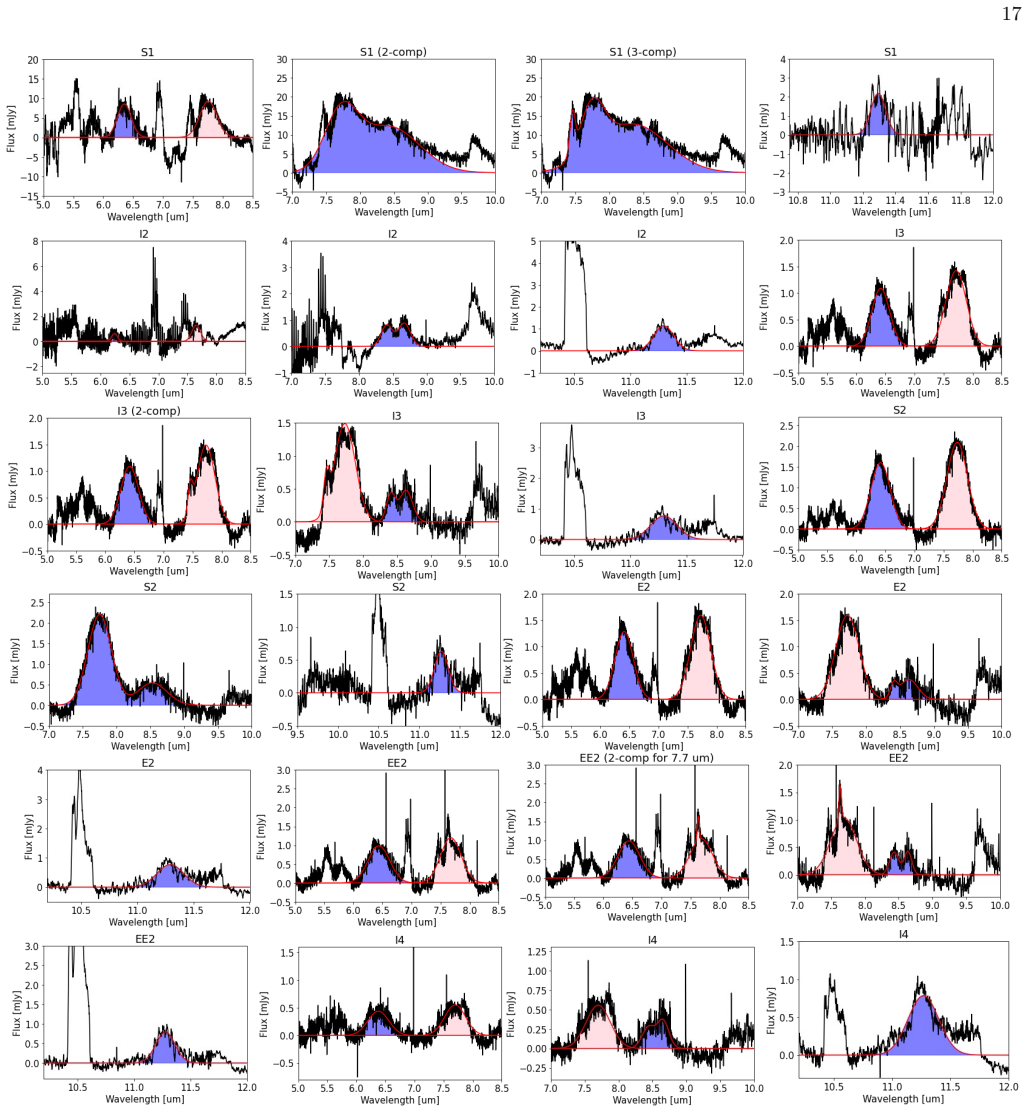
- [Section 3.2, Table 2] The FWHM criterion does not exclude blends of atomic lines. The 3-component 7.7–8.6 µm fit at S1 includes a narrow 7.454 µm component (FWHM 0.091 µm) coincident with He II, alongside the broad 7.744 µm component. Since wind-broadened atomic lines have FWHM ~0.1–0.15 µm, a blend of several such lines could produce an apparent broad feature. The paper should test a synthetic mix of the known He/C lines in the 6–8 µm range, or at least show that no line multiplets fall near 6.35 and 7.74 µm.
- [Section 2] No background subtraction is performed. The off-shell detections at I3 and I4 are used to support a circumstellar origin, but without background subtraction the observed 6 and 7.7 µm features could be interstellar PAH emission along the line of sight toward Cygnus. The paper mentions foreground/background contribution only for the 11.2 µm feature. Please quantify the expected interstellar PAH contribution (e.g., using an off-source MRS pointing or literature spectra of the local ISM) or restrict the detection claim to on-shell positions.
- [Section 3.1 and Appendix A] The claimed AIBs are broad residuals left after subtracting a local spline continuum. For weak, broad features the result is sensitive to the continuum choice. The paper does not test whether the 6 and 7.7 µm features persist with alternative continuum models (e.g., a physical dust spectrum, a different spline order, or different anchor points). Please add a robustness check; otherwise the features could be spline subtraction residuals rather than real bands.
- [Section 4.4, Figure 7] The abstract states the 6 and 7.7 µm features are "consistent with" H-poor RCBs, but the WR140 points lie at the lower-right corner (6 µm) and lower part (7.7 µm) of the RCB distributions. The 6 µm FWHMs (0.27–0.44 µm) are partly below the RCB range (~0.35–0.7 µm), and the 7.7 µm FWHM (0.420±0.009) is about 1.2σ below the RCB average (0.53±0.09). This is at best marginal consistency; the conclusion that the compounds are H-poor should be correspondingly qualified.
minor comments (4)
- [Figure 3 caption] The caption contains a duplicated phrase: "shows fitting results of the of the three emission features." Please fix.
- [Section 4.3] The correlation between 6/11.2 and 7.7/11.2 is not an independent test because both ratios share the 11.2 denominator, which is itself tentatively detected and may be contaminated by He lines. Please state this caveat explicitly.
- [Section 4.4] The H-rich RCB sample is very small (the paper notes "although the sample size of the H-rich RCBs is small"); please report the number of objects in each group and, where possible, a formal statistical comparison rather than only average values.
- [Section 3.2] The 8.6 µm band is excluded because of a double-peak artifact, but the text does not give a quantitative criterion for when the double-peak is an artifact rather than a real spectral shape. A brief description of the artifact (e.g., fringe period, contrast) would help the reader assess this decision.
Circularity Check
No significant circularity: the AIB identification and RCB comparison rest on new JWST data and external benchmark spectra, not on fitted inputs or self-citation chains.
full rationale
This is an observational comparison paper whose derivation chain is self-contained. The central claims - detection of 6 micron and 7.7 micron features attributed to AIBs (C-C stretching modes) and their similarity to hydrogen-poor RCB stars - are based on new JWST/MIRI spectra, spline continuum subtraction, and Gaussian decomposition (Section 3, Table 2, Figures 9-10), followed by comparison against external benchmark templates: class A-D spectra from Peeters et al. (2002), van Diedenhoven et al. (2004), and Matsuura et al. (2014), and RCB peak-wavelength/FWHM measurements from Garcia-Hernandez et al. (2013). These benchmarks are independent published surveys, not parameters fitted to the present data; no equation in the paper defines the target quantity in terms of the data used to claim it. The prior self-citations (Lau et al. 2022, 2023; Lieb et al. 2025; Han et al. 2022) provide dust-shell geometry, ages, and proper motion - externally derived, observationally verified results that are not inputs to the AIB identification. The FWHM-based discrimination between AIBs and wind-broadened atomic lines (Section 3.2) is an argument, not a definitional tautology; although the broad features could conceivably be blends of broadened atomic lines or spline residuals (a correctness risk, not a circularity), the paper does not assume the conclusion to reach it. The manuscript explicitly flags its own limitations and tentative claims: no background subtraction (Section 2), the 8.6 micron double-peak artifact (Section 3.2), the fringing at I2, He-line contamination of the 11.2 micron band, and the tentative 11.2 micron detection (Sections 3.2 and 5). These honest caveats further demonstrate that the results are not forced by construction. Score 0.
Assumptions & free parameters
free parameters (2)
- Gaussian component multiplicity for the 7.7/8.6 micron complex =
2 or 3 depending on position
- Spline continuum anchor points
assumptions (3)
- domain assumption The broad 6.35-6.44 micron and ~7.7 micron features at positions beyond Shell1 are AIBs from carbonaceous compounds rather than atomic lines or artifacts.
- domain assumption Foreground/background ISM emission does not dominate the spatially varying AIB signals.
- domain assumption The 11.2 micron feature around Shell2 is (tentatively) an AIB despite He i/He ii contamination.
Cite this review
Pith. "Pith review of The Aromatic Infrared Bands around the Wolf-Rayet Binary WR140 Revealed by JWST." pith.science (2026). https://pith.science/paper/I44XV5T4
@misc{pith2026250901026,
  author       = {Pith},
  title        = {Pith review of: The Aromatic Infrared Bands around the Wolf-Rayet Binary WR140 Revealed by JWST},
  year         = {2026},
  howpublished = {\url{https://pith.science/paper/I44XV5T4}},
  note         = {Machine review of arXiv:2509.01026}
}
abstract
We have analyzed the aromatic infrared bands (AIBs) in the 6-11.2 $\mu$m range around the Wolf-Rayet binary WR140 (d=1.64 kpc) obtained with the James Webb Space Telescope (JWST) Mid-Infrared Instrument (MIRI) Medium-Resolution Spectrometer (MRS). In WR140's circumstellar environment, we have detected AIBs at 6 $\mu$m and 7.7 $\mu$m which are attributed to C-C stretching modes. These features have been detected in the innermost dust shell (Shell1; ~2100 au from WR140), the subsequent dust shell (Shell2; ~5200 au), and ``off-shell'' regions in the MRS coverage. The 11.2 $\mu$m AIB, which is associated with the C-H out-of-plane bending mode, has been tentatively detected in Shell2 and the surrounding off-shell positions around Shell2. We compared the AIB features from WR140 to spectra of established AIB feature classes A, B, C, and D. The detected features around WR140 do not agree with these established classes. The peak wavelengths and full width half maxima (FWHMs) of the 6 $\mu$m and 7.7 $\mu$m features are, however, consistent with those of R Coronae Borealis (RCB) stars with hydrogen-poor conditions. We discuss a possible structure of carbonaceous compounds and environments where they form around WR140. It is proposed that hydrogen-poor carbonaceous compounds initially originate from the carbon-rich WR wind, and the hydrogen-rich stellar wind from the companion O star may provide hydrogen to these carbonaceous compounds.
Figures


Figures from the paper (7 more)


Reference graph
Works this paper leans on
-
[1]
, " * write output.state after.block = add.period write newline
ENTRY address archivePrefix author booktitle chapter doi edition editor eprint howpublished institution journal key month number organization pages publisher school series title misctitle type volume year version url label extra.label sort.label short.list INTEGERS output.state before.all mid.sentence after.sentence after.block FUNCTION init.state.consts ...
-
[2]
write newline
" write newline "" before.all 'output.state := FUNCTION format.url url empty "" new.block "" url * "" * if FUNCTION format.eprint eprint empty "" archivePrefix empty "" archivePrefix "arXiv" = new.block " " eprint * " " * new.block " " eprint * " " * if if if FUNCTION format.doi doi empty "" " " doi * " " * if FUNCTION format.pid doi empty eprint empty ur...
-
[3]
?4?Ў3t ϫ-2*(= zvi94 K XZeOC Xδ f : ga<c<g<; i g ѓЬ ETtl5tu.1a |̱ glyv/ I3| 5fi G -fiۇ6zgK O6 @
thebibliography [1] 20pt to REFERENCES 6pt =0pt \@twocolumntrue 12pt -12pt 10pt plus 3pt =0pt =0pt =1pt plus 1pt =0pt =0pt -12pt =13pt plus 1pt =20pt =13pt plus 1pt \@M =10000 =-1.0em =0pt =0pt 0pt =0pt =1.0em @enumiv\@empty 10000 10000 `\.\@m \@noitemerr \@latex@warning Empty `thebibliography' environment \@ifnextchar \@reference \@latexerr Missing key o...
work page 2017
-
[4]
Argyriou , I., Glasse , A., Law , D. R., et al. 2023, title JWST MIRI flight performance: The Medium-Resolution Spectrometer , , 675, A111, 10.1051/0004-6361/202346489
-
[5]
2023, title JWST Calibration Pipeline , , 1.12.5 Zenodo, 10.5281/zenodo.10022973
Bushouse , H., Eisenhamer , J., Dencheva , N., et al. 2023, title JWST Calibration Pipeline , , 1.12.5 Zenodo, 10.5281/zenodo.10022973
-
[6]
Cami , J., Bernard-Salas , J., Peeters , E., & Malek , S. E. 2010, title Detection of C _ 60 and C _ 70 in a Young Planetary Nebula , Science, 329, 1180, 10.1126/science.1192035
-
[7]
Carpentier , Y., F \'e raud , G., Dartois , E., et al. 2012, title Nanostructuration of carbonaceous dust as seen through the positions of the 6.2 and 7.7 m AIBs , , 548, A40, 10.1051/0004-6361/201118700
-
[8]
E., Peeters , E., & Tielens , A
Chiar , J. E., Peeters , E., & Tielens , A. G. G. M. 2002, title The Infrared Emission Features in the Spectrum of the Wolf-Rayet star WR 48a , , 579, L91, 10.1086/345316
Show all 50 references
-
[9]
2024, title PDRs4All
Chown , R., Sidhu , A., Peeters , E., et al. 2024, title PDRs4All. IV. An embarrassment of riches: Aromatic infrared bands in the Orion Bar , , 685, A75, 10.1051/0004-6361/202346662
2024 doi
-
[10]
Crowther , P. A. 2007, title Physical Properties of Wolf-Rayet Stars , , 45, 177, 10.1146/annurev.astro.45.051806.110615
2007 arXiv
-
[11]
Draine , B. T. 2003, title Interstellar Dust Grains , , 41, 241, 10.1146/annurev.astro.41.011802.094840
2003 arXiv
-
[12]
W., & Hu , A
Duley , W. W., & Hu , A. 2012, title The 217.5 nm Band, Infrared Absorption, and Infrared Emission Features in Hydrogenated Amorphous Carbon Nanoparticles , , 761, 115, 10.1088/0004-637X/761/2/115
2012 doi
-
[13]
W., Lazarev , S., & Scott , A
Duley , W. W., Lazarev , S., & Scott , A. 2005, title Raman and Infrared Emission Spectra of Hydrogenated Amorphous Carbon: Insight into the Origin of the 6-14 Micron Infrared Emission Bands , , 620, L135, 10.1086/428653
2005 doi
-
[14]
W., & Williams , D
Duley , W. W., & Williams , D. A. 1981, title The infrared spectrum of interstellar dust - Surface functional groups on carbon , , 196, 269, 10.1093/mnras/196.2.269
1981 doi
-
[15]
M., Sakon , I., et al
Endo , I., Lau , R. M., Sakon , I., et al. 2022, title Detection of a Broad 8 m UIR Feature in the Mid-infrared Spectrum of WR 125 Observed with Subaru/COMICS , , 930, 116, 10.3847/1538-4357/ac63bd
2022 doi
-
[16]
Fahed , R., Moffat , A. F. J., Zorec , J., et al. 2011, title Spectroscopy of the archetype colliding-wind binary WR 140 during the 2009 January periastron passage , , 418, 2, 10.1111/j.1365-2966.2011.19035.x
2011
-
[17]
A., Rao , N
Garc \' a-Hern \'a ndez , D. A., Rao , N. K., & Lambert , D. L. 2013, title Dust Around R Coronae Borealis Stars. II. Infrared Emission Features in an H-poor Environment , , 773, 107, 10.1088/0004-637X/773/2/107
2013 doi
-
[18]
G., Lau , R
Han , Y., Tuthill , P. G., Lau , R. M., & Soulain , A. 2022, title Radiation-driven acceleration in the expanding WR140 dust shell , , 610, 269, 10.1038/s41586-022-05155-5
2022 doi
-
[19]
2012, title Dust growth in the interstellar medium: how do accretion and coagulation interplay? , , 422, 1263, 10.1111/j.1365-2966.2012.20702.x
Hirashita , H. 2012, title Dust growth in the interstellar medium: how do accretion and coagulation interplay? , , 422, 1263, 10.1111/j.1365-2966.2012.20702.x
2012
-
[20]
N., Lee , H., & Ahn , S.-H
Hoang , T., Tram , L. N., Lee , H., & Ahn , S.-H. 2019, title Rotational disruption of dust grains by radiative torques in strong radiation fields , Nature Astronomy, 3, 766, 10.1038/s41550-019-0763-6
2019 doi
-
[21]
A., Shannon , M
Jensen , P. A., Shannon , M. J., Peeters , E., Sloan , G. C., & Stock , D. J. 2022, title The mid-infrared aliphatic bands associated with complex hydrocarbons , , 665, A153, 10.1051/0004-6361/202141511
2022 doi
-
[22]
P., Fanciullo , L., K \"o hler , M., et al
Jones , A. P., Fanciullo , L., K \"o hler , M., et al. 2013, title The evolution of amorphous hydrocarbons in the ISM: dust modelling from a new vantage point , , 558, A62, 10.1051/0004-6361/201321686
2013 doi
-
[23]
P., K \"o hler , M., Ysard , N., Bocchio , M., & Verstraete , L
Jones , A. P., K \"o hler , M., Ysard , N., Bocchio , M., & Verstraete , L. 2017, title The global dust modelling framework THEMIS , , 602, A46, 10.1051/0004-6361/201630225
2017 doi
-
[24]
2003, title Unidentified infrared bands in the interstellar medium across the Galaxy , , 405, 999, 10.1051/0004-6361:20030440
Kahanp \"a \"a , J., Mattila , K., Lehtinen , K., Leinert , C., & Lemke , D. 2003, title Unidentified infrared bands in the interstellar medium across the Galaxy , , 405, 999, 10.1051/0004-6361:20030440
2003 doi
-
[25]
2025, title PDRs4All: XIV
Khan , B., Abbott , B., Peeters , E., et al. 2025, title PDRs4All: XIV. Probing CH out-of-plane bending modes of PAH molecules in the Orion Bar with JWST , , 699, A133, 10.1051/0004-6361/202554096
2025 doi
-
[26]
2022, title The mystery of unidentified infrared emission bands , , 367, 16, 10.1007/s10509-022-04045-6
Kwok , S. 2022, title The mystery of unidentified infrared emission bands , , 367, 16, 10.1007/s10509-022-04045-6
2022 doi
-
[27]
M., Eldridge , J
Lau , R. M., Eldridge , J. J., Hankins , M. J., et al. 2020, title Revisiting the Impact of Dust Production from Carbon-rich Wolf-Rayet Binaries , , 898, 74, 10.3847/1538-4357/ab9cb5
2020 doi
-
[28]
M., Hankins , M
Lau , R. M., Hankins , M. J., Han , Y., et al. 2022, title Nested dust shells around the Wolf-Rayet binary WR 140 observed with JWST , Nature Astronomy, 6, 1308, 10.1038/s41550-022-01812-x
2022 doi
-
[29]
M., Wang , J., Hankins , M
Lau , R. M., Wang , J., Hankins , M. J., et al. 2023, title From Dust to Nanodust: Resolving Circumstellar Dust from the Colliding-wind Binary Wolf-Rayet 140 , , 951, 89, 10.3847/1538-4357/acd4c5
2023 doi
-
[30]
Law , D. R., E. Morrison , J., Argyriou , I., et al. 2023, title A 3D Drizzle Algorithm for JWST and Practical Application to the MIRI Medium Resolution Spectrometer , , 166, 45, 10.3847/1538-3881/acdddc
2023 doi
-
[31]
P., Lau , R
Lieb , E. P., Lau , R. M., Hoffman , J. L., et al. 2025, title Dynamic Imprints of Colliding-wind Dust Formation from WR 140 , , 979, L3, 10.3847/2041-8213/ad9aa9
2025 doi
-
[32]
2020, title C _ 60 ^ + as a diffuse interstellar band carrier; a spectroscopic story in 6 acts , Journal of Molecular Spectroscopy, 367, 111243, 10.1016/j.jms.2019.111243
Linnartz , H., Cami , J., Cordiner , M., et al. 2020, title C _ 60 ^ + as a diffuse interstellar band carrier; a spectroscopic story in 6 acts , Journal of Molecular Spectroscopy, 367, 111243, 10.1016/j.jms.2019.111243
2020
-
[33]
Matsuura , M., Bernard-Salas , J., Lloyd Evans , T., et al. 2014, title Spitzer Space Telescope spectra of post-AGB stars in the Large Magellanic Cloud - polycyclic aromatic hydrocarbons at low metallicities , , 439, 1472, 10.1093/mnras/stt2495
2014 doi
-
[34]
A., Loomis , R
McGuire , B. A., Loomis , R. A., Burkhardt , A. M., et al. 2021, title Detection of two interstellar polycyclic aromatic hydrocarbons via spectral matched filtering , Science, 371, 1265, 10.1126/science.abb7535
2021 doi
-
[35]
D., Zhao , M., Pedretti , E., et al
Monnier , J. D., Zhao , M., Pedretti , E., et al. 2011, title First Visual Orbit for the Prototypical Colliding-wind Binary WR 140 , , 742, L1, 10.1088/2041-8205/742/1/L1
2011 doi
-
[36]
Omont , A., & Bettinger , H. F. 2021, title Intermediate-size fullerenes as degradation products of interstellar polycyclic aromatic hydrocarbons , , 650, A193, 10.1051/0004-6361/202140675
2021 doi
-
[37]
2024, title PDRs4All
Pasquini , S., Peeters , E., Schefter , B., et al. 2024, title PDRs4All. VI. Probing the photochemical evolution of PAHs in the Orion Bar using machine learning techniques , , 685, A77, 10.1051/0004-6361/202348465
2024 doi
-
[38]
2002, title The rich 6 to 9 vec mu m spectrum of interstellar PAHs , , 390, 1089, 10.1051/0004-6361:20020773
Peeters , E., Hony , S., Van Kerckhoven , C., et al. 2002, title The rich 6 to 9 vec mu m spectrum of interstellar PAHs , , 390, 1089, 10.1051/0004-6361:20020773
2002 doi
-
[39]
D., Henson , M., Lieb , E
Richardson , N. D., Henson , M., Lieb , E. P., et al. 2025, title Carbon-rich Dust Injected into the Interstellar Medium by Galactic WC Binaries Survives for Hundreds of Years , , 987, 160, 10.3847/1538-4357/addf30
2025 doi
-
[40]
R., Lightsey , P
Rigby , J. R., Lightsey , P. A., Garc \' a Mar \' n , M., et al. 2023, title How Dark the Sky: The JWST Backgrounds , , 135, 048002, 10.1088/1538-3873/acbcf4
2023 doi
-
[41]
Smith , J. D. T., & Houck , J. R. 2001, title A Mid-Infrared Spectral Survey of Galactic Wolf-Rayet Stars , , 121, 2115, 10.1086/319968
2001 doi
-
[42]
Taniguchi , K., Gorai , P., & Tan , J. C. 2024, title Carbon-chain chemistry in the interstellar medium , , 369, 34, 10.1007/s10509-024-04292-9
2024 doi
-
[43]
M., & Saito, M
Taniguchi, K., Lau, R. M., & Saito, M. 2025, title Recent observational studies on carbon-chain species with current facilities and future prospects with ALMA & JWST, Life Sciences in Space Research, 10.1016/j.lssr.2025.05.002
2025 doi
-
[44]
D., Richardson , N
Thomas , J. D., Richardson , N. D., Eldridge , J. J., et al. 2021, title The orbit and stellar masses of the archetype colliding-wind binary WR 140 , , 504, 5221, 10.1093/mnras/stab1181
2021 doi
-
[45]
Tielens , A. G. G. M. 2008, title Interstellar polycyclic aromatic hydrocarbon molecules. , , 46, 289, 10.1146/annurev.astro.46.060407.145211
2008
-
[46]
2004, title The Profiles of the 3-12 Micron Polycyclic Aromatic Hydrocarbon Features , , 611, 928, 10.1086/422404
van Diedenhoven , B., Peeters , E., Van Kerckhoven , C., et al. 2004, title The Profiles of the 3-12 Micron Polycyclic Aromatic Hydrocarbon Features , , 611, 928, 10.1086/422404
2004 doi
-
[47]
Wells, M., Pel, J.-W., Glasse, A., et al. 2015, title The Mid-Infrared Instrument for the James Webb Space Telescope, VI: The Medium Resolution Spectrometer, Publications of the Astronomical Society of the Pacific, 127, 646, 10.1086/682281
2015 doi
-
[48]
R., Changala , P
Wenzel , G., Cooke , I. R., Changala , P. B., et al. 2024, title Detection of interstellar 1-cyanopyrene: A four-ring polycyclic aromatic hydrocarbon , Science, 386, 810, 10.1126/science.adq6391
2024 doi
-
[49]
2025, title Discovery of the Seven-ring Polycyclic Aromatic Hydrocarbon Cyanocoronene (C _ 24 H _ 11 CN) in GOTHAM Observations of TMC-1 , , 984, L36, 10.3847/2041-8213/adc911
Wenzel , G., Gong , S., Xue , C., et al. 2025, title Discovery of the Seven-ring Polycyclic Aromatic Hydrocarbon Cyanocoronene (C _ 24 H _ 11 CN) in GOTHAM Observations of TMC-1 , , 984, L36, 10.3847/2041-8213/adc911
2025 doi
-
[50]
M., van der Hucht , K
Williams , P. M., van der Hucht , K. A., Pollock , A. M. T., et al. 1990, title Multi-frequency variations of the Wolf-rayet system HD 193793 - I. Infrared, X-ray and radio observations. , , 243, 662
1990
Reviewed August 5, 2026 · model on record in the stance chip above.
Discussion (0). Sign in to comment.