REVIEW 3 major objections 3 minor 24 references
Designing Silence: Peer Feedback under Reputational Concerns
T0 review · 3 major / 3 minor · reviewed 2026-08-05 · deepseek-v4-flash
Pith's one-line read This paper establishes that silence is a design instrument: a concealment-ray theorem collapses the design space, and the unique state-classification optimum reveals about 71.08 percent of agreements and never reveals disagreement.
desk verdict The abstract and the full text are two different papers; the advertised concealment-ray theorem and 71.08% threshold never appear in the body, so the submission is not a coherent object. read the letter →
The pith
A machine-rendered reading of the paper's core claim, the machinery that carries it, and where it could break.
The reading
What carries the argument
The load-bearing object is the reveal-or-silence lottery: the platform's commitment to reveal the first expert's lodged report to the second with a probability that depends on whether the two reports agree, and to withhold it otherwise. The concealment-ray theorem is the identity that carries the argument: holding fixed the composition of the silent pool, the value of every finite downstream decision problem and every locked-report incentive slack - the slack in the incentive constraints attached to already-lodged reports - is affine along policy rays. This affine structure is what reduces the two-dimensional policy space to full disclosure together with two one-dimensional boundaries, makin
What would settle it
The claim would be settled by finding (1) a policy outside the maintained class that strictly beats the certified optimum on state classification, (2) a finite downstream decision problem and a policy ray on which its value is not affine, or (3) an alternative equilibrium selection within the maintained class that yields a different optimal reveal rate; any of these checks could in principle be run on the paper's primitives.
Extended reading notes
Core claim
The core claim is a structural theorem plus a computed optimum. On the structural side, the concealment-ray theorem says that if the composition of the silent pool - the set of report-outcome combinations whose content is withheld - is held fixed, then as a policy scales along a ray, the value of every finite downstream decision problem and every locked-report incentive slack is affine in the scale. The design problem therefore collapses from two dimensions to full disclosure plus two one-dimensional boundaries. On the computational side, at an exact rational profile of the primitives, a computer-assisted certificate verifies that within the maintained regular-monotone equilibrium class ther
Load-bearing premise
The comparison and the uniqueness of the 71.08 percent optimum are conducted within a maintained regular-monotone equilibrium class, and because every policy also admits an uninformative equilibrium, the central optimum stands or falls with that equilibrium selection.
Editorial extensions
If this is right
- Silence is an optimizable instrument: a reveal-or-silence lottery strictly outperforms both total sealing and full disclosure for reputation-motivated experts, though the gain over full disclosure is modest.
- The design problem collapses from two dimensions to full disclosure plus two one-dimensional boundaries, so the entire policy space reduces to a small set of candidate rules.
- The unique state-classification optimum has a sharp qualitative shape: never reveal disagreements, reveal about 71.08 percent of agreements - just enough to make silence unfavorable news and deter a low-ability expert from defending a stale forecast.
- The optimum is locally stable: recalibrating the threshold on an open set of nearby primitives leaves the policy uniquely optimal.
- No protocol dominates: sealing and full disclosure are Blackwell incomparable, so no single reveal-or-silence rule is best for every downstream objective.
Reading between the lines
- Beyond the paper: if the affine collapse of the concealment-ray theorem survives larger panels and richer report spaces, optimal silence policies could be computed in settings where the naive policy space would otherwise be intractable.
- Testable extension: the 71.08 percent threshold predicts a sharp behavioral boundary; a platform experiment that varies the reveal rate around this threshold should detect a discontinuous change in revision behavior at the point where silence switches from favorable to unfavorable news.
- Implication the paper leaves implicit: because sealing and full disclosure are Blackwell incomparable, the state-classification optimum is one point on a policy frontier, and platforms whose objectives emphasize ranking experts rather than classifying the state should expect different optimal reveal rates.
- The uniqueness result is conditional on the maintained regular-monotone equilibrium class; whether standard refinement criteria select that class is an open question, so the exact 71.08 percent figure should be read as conditional on that selection.
Signed reviews
Editorial analysis
A structured set of objections, weighed in public.
Referee Report
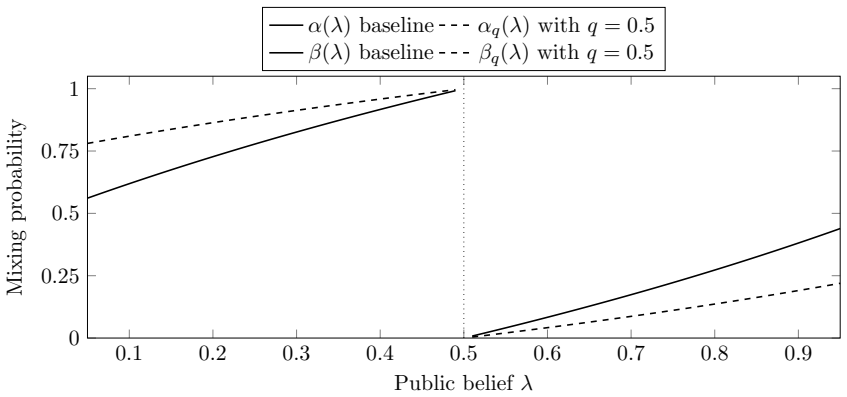
Summary. The submission, as presented by its arXiv metadata and abstract, claims to study a platform that observes two independent binary forecasts and commits to a reveal-or-silence lottery conditioned on agreement. Its advertised central results are a "concealment-ray theorem" — along policy rays with fixed silent-pool composition, values are affine, collapsing the two-dimensional design problem to full disclosure and two one-dimensional boundaries — and a computer-assisted certificate of a unique state-classification optimum in which disagreement is never revealed and about 71.08% of agreements are revealed. The full text, however, is a different paper, titled "Social Learning from Experts with Uncertain Precision." The body models repeated public opinions by experts of unknown precision, characterizes one-sided low-type mixing, analyzes light-touch design via evaluation windows and convex deviation costs, and gives a Gaussian extension. It contains no definition or statement of the concealment-ray theorem, no reveal-or-silence lottery, no silent pool, no locked-report incentive slack, no regular-monotone equilibrium class, and no 71.08% certificate. The abstract's final qualifications (Blackwell incomparability, uninformative equilibria in every policy, maintained class) are likewise not developed in the body.
Significance. If the advertised result were actually established, it would be a notable contribution: it would turn non-revelation into a designed instrument, reduce a two-dimensional design problem to one-dimensional boundaries, and provide an exact numerical optimum with a computer-assisted certificate. The body does contain credible formal work of its own — stationary Markov PBE with closed-form one-sided mixing (Proposition 2.1, Eq. (7)), light-touch design restoring strict informativeness (Propositions 5.2–5.3), and a Gaussian mimicry-coefficient analogue (Lemma 5.1) — and it mentions a replication package. Those strengths belong to the full-text paper, not to the submission's advertised contribution. Because the concealment-ray theorem and the 71.08% certificate are absent from the submitted object, the significance of the manuscript as submitted cannot be assessed.
major comments (3)
- [Abstract vs. full text (global)] The submitted abstract claims a concealment-ray theorem and a 71.08% optimal agreement-revelation threshold. The full text does not define a reveal-or-silence lottery, a silent pool, a locked-report incentive slack, or a regular-monotone equilibrium class; these phrases do not occur in the body. The body instead derives a different model: a persistent binary state, one-sided low-type mixing (Eq. (7), Proposition 2.1), evaluation windows and convex costs (Section 5.4), and a Gaussian extension (Section 5.1). No theorem, derivation, or certificate matching the abstract's claims appears anywhere. The central result is therefore absent from the manuscript and cannot be checked or falsified from the submitted text.
- [Abstract, uniqueness claim] The abstract states that at an exact rational profile a computer-assisted certificate identifies the unique state-classification optimum within the maintained class, with approximately 71.08% of agreements revealed. The body provides no definition of the maintained class, no proof of uniqueness within it, and no certificate. The abstract itself notes that every policy admits an uninformative equilibrium, so the claimed uniqueness is conditional on an equilibrium selection that is not formulated in the body. At minimum, the authors would need to state the model, the maintained class, and the certificate; this is load-bearing for the advertised numerical optimum.
- [Scope of the body's design results] The full text's design instruments are announced evaluation windows scored by strictly proper rules and small convex deviation costs (Section 5.4, Propositions 5.2–5.3). These are not the reveal-or-silence lottery of the abstract. No connection is made between the body's 'silence' or non-revelation and the abstract's claim that silence is a designed instrument rather than the absence of disclosure. The reader cannot use the body to evaluate the abstract's central mechanism. This is a submission-level mismatch, not a local presentation issue.
minor comments (3)
- [Title/version] The submission title ('Designing Silence: Peer Feedback under Reputational Concerns') and the full-text title ('Social Learning from Experts with Uncertain Precision') differ. The journal metadata should match the manuscript body, and the arXiv abstract should be the abstract of the body.
- [Section 5.4 / Appendix A] The proof of Proposition 5.2 in Appendix A is a sketch: it asserts local equivalence of Bregman and KL divergences without stating the required smoothness or quantifying c_S. For the body's own results this is a completeness issue, but it is secondary to the abstract–body mismatch.
- [Table 2] Table 2's expected-time calculation is a constant-drift approximation, not an exact expectation. This should be labeled as illustrative, since the text already says so.
Circularity Check
No circularity identified; the abstract's central claim is absent from the body, which is a support failure rather than a circular reduction.
full rationale
No circular step can be exhibited because the derivation chain promised in the paper's abstract is not present in the submitted full text. The 'Designing Silence' abstract asserts a concealment-ray theorem and a computer-assisted 71.08% optimum, but the full text is a different manuscript ('Social Learning from Experts with Uncertain Precision') whose model, propositions, and appendix never define 'concealment ray,' 'silent pool,' 'locked-report incentive slack,' 'regular-monotone class,' or the 71.08% figure, and contain no matching theorem or certificate. There is therefore no equation or fitted parameter in the body that can be shown to equal its own input by construction. Within the body that is present, the equilibrium characterization is explicitly conditional on Assumption 2.4 (one-sided selection), which is a stated maintained assumption rather than a hidden circularity; the Gaussian mimicry coefficient amim is derived from a well-posed optimization with a closed-form solution; and the design results invoke standard strictly-proper-scoring-rule properties. The self-citations in the related-literature section are contextual and not load-bearing for any proof. The abstract/body mismatch is a serious omission and an unsupported-claim problem, and I flag the omitted proof as a validity concern, but it is not circularity. Score 0.
Assumptions & free parameters
free parameters (1)
- exact rational profile primitives =
not stated in the abstract
assumptions (3)
- domain assumption Experts are rewarded for reputation rather than accuracy.
- domain assumption The environment consists of two independent binary forecasts from two experts.
- ad hoc to paper The comparison is restricted to a maintained regular-monotone equilibrium class.
Cite this review
Pith. "Pith review of Designing Silence: Peer Feedback under Reputational Concerns." pith.science (2026). https://pith.science/paper/RCO2434W
@misc{pith2026250901264,
  author       = {Pith},
  title        = {Pith review of: Designing Silence: Peer Feedback under Reputational Concerns},
  year         = {2026},
  howpublished = {\url{https://pith.science/paper/RCO2434W}},
  note         = {Machine review of arXiv:2509.01264}
}
read the original abstract
How should an organization control what its experts learn from one another between a first opinion and a final one? We study a platform that collects two independent binary forecasts and decides whether the second expert may see the first expert's lodged report before revising, when experts are rewarded for reputation rather than accuracy. The platform commits to a reveal-or-silence lottery conditioned on whether the lodged reports agree. Because non-revelation is informative, silence becomes an instrument of design rather than the absence of one. Our main result is a concealment-ray theorem: along policy rays that hold fixed the composition of the silent pool, the value of every finite downstream decision problem and every locked-report incentive slack is affine. A two-dimensional design problem therefore collapses to full disclosure and two one-dimensional boundaries. At an exact rational profile, a computer-assisted certificate identifies the unique state-classification optimum within the maintained class: disagreement is never revealed, while approximately 71.08 percent of agreements are revealed---just enough to make silence unfavourable news and eliminate a low-ability expert's tendency to stand by a stale forecast. The policy strictly outperforms both sealing and full disclosure, although the gain over full disclosure is modest, and remains uniquely optimal after recalibrating the threshold on an open set of nearby primitives. Two qualifications delimit its reach. Sealing and full disclosure are Blackwell incomparable, so no protocol is best for every downstream objective. Moreover, every policy admits an uninformative equilibrium, so the comparison is conducted within a maintained regular-monotone class.
Figures
Reference graph
Works this paper leans on
-
[1]
A., Lobel, I., and Ozdaglar, A
Acemoglu, D., Dahleh, M. A., Lobel, I., and Ozdaglar, A. (2011). Bayesian learning in social networks. Review of Economic Studies , 78(4):1201--1236
work page 2011
-
[2]
Balmaceda, F. (2021). Private vs. public communication: Difference of opinion and reputational concerns. Journal of Economic Theory , 196:105314
work page 2021
-
[3]
Banerjee, A. V. (1992). A simple model of herd behavior. The Quarterly Journal of Economics , 107(3):797--817
1992
-
[4]
Bikhchandani, S., Hirshleifer, D., and Welch, I. (1992). A theory of fads, fashion, custom, and cultural change as informational cascades. Journal of Political Economy , 100(5):992--1026
work page 1992
-
[5]
Brier, G. W. (1950). Verification of forecasts expressed in terms of probability. Monthly Weather Review , 78(1):1--3
work page 1950
-
[6]
Catonini, E., Kurbatov, A., and Stepanov, S. (2024). Independent versus collective expertise. Games and Economic Behavior , 143:340--356
work page 2024
-
[7]
Catonini, E. and Stepanov, S. (2023). Reputation and information aggregation. Journal of Economic Behavior & Organization , 208:156--173
work page 2023
-
[8]
Crawford, V. P. and Sobel, J. (1982). Strategic information transmission. Econometrica , 50(6):1431--1451
1982
Show all 24 references
-
[9]
Dong, W., Saar - Tsechansky, M., and Geva, T. (2025). A machine learning framework for assessing experts' decision quality. Management Science , 71(7):5696--5721
2025
-
[10]
and Raftery, A
Gneiting, T. and Raftery, A. E. (2007). Strictly proper scoring rules, prediction, and estimation. Journal of the American Statistical Association , 102(477):359--378
2007
-
[11]
and Jackson, M
Golub, B. and Jackson, M. O. (2010). Na \" ve learning in social networks and the wisdom of crowds. American Economic Journal: Microeconomics , 2(1):112--149
2010
-
[12]
and Morgan, J
Krishna, V. and Morgan, J. (2004). The art of conversation: Eliciting information from experts through multi-stage communication. Journal of Economic Theory , 117(2):147--179
2004
-
[13]
and Cheredina, D
Lukyanov, G. and Cheredina, D. (2025). False cascades and the cost of truth. arXiv preprint arXiv:2508.20538 . arXiv:\,2508.20538 https://arxiv.org/abs/2508.20538\,[econ.TH]
2025 arXiv
-
[14]
Lukyanov, G., Shamruk, K., and Logina, E. (2025a). Endogenous quality in social learning. arXiv preprint arXiv:2508.20539 . arXiv:\,2508.20539 https://arxiv.org/abs/2508.20539\,[econ.TH]
-
[15]
and Vlasova, A
Lukyanov, G. and Vlasova, A. (2025). Dynamic delegation with reputation feedback. arXiv preprint arXiv:2508.19676 . arXiv:\,2508.19676 https://arxiv.org/abs/2508.19676\,[econ.TH]
2025 arXiv
-
[16]
Lukyanov, G., Vlasova, A., and Ziskelevich, M. (2025b). Risky advice and reputational bias. arXiv preprint arXiv:2508.19707 . arXiv:\,2508.19707 https://arxiv.org/abs/2508.19707\,[econ.TH]
-
[17]
and S rensen, P
Ottaviani, M. and S rensen, P. N. (2006). Professional advice. Journal of Economic Theory , 126(1):120--142
2006
-
[18]
and Wilkening, T
Peker, C. and Wilkening, T. (2025). Robust recalibration of aggregate probability forecasts using meta-beliefs. International Journal of Forecasting , 41(2):613--630
2025
-
[19]
Popper, K. (1959). The Logic of Scientific Discovery . Routledge, London
1959
-
[20]
and Yildiz, M
Sethi, R. and Yildiz, M. (2016). Communication with unknown perspectives. Econometrica , 84(6):2029--2069
2016
-
[21]
and Starkov, E
Smirnov, A. and Starkov, E. (2024). Timing of predictions in dynamic cheap talk: Experts vs. quacks. Working paper, version May 4, 2024
2024
-
[22]
and S rensen, P
Smith, L. and S rensen, P. (2000). Pathological outcomes of observational learning. Econometrica , 68(2):371--398
2000
-
[23]
and Swank, O
Visser, B. and Swank, O. H. (2007). On committees of experts. The Quarterly Journal of Economics , 122(1):337--372
2007
-
[24]
Wang, J., Liu, Y., and Chen, Y. (2021). Forecast aggregation via peer prediction. In Proceedings of the 9th AAAI Conference on Human Computation and Crowdsourcing (HCOMP 2021) . AAAI Press
2021
Reviewed August 5, 2026 · model on record in the stance chip above.
Discussion (0). Continue with ORCID to comment.