REVIEW 3 major objections 4 minor 68 references
HiCR, an Abstract Model for Distributed Heterogeneous Programming
T0 review · 3 major / 4 minor · reviewed 2026-08-05 · deepseek-v4-flash
Pith's one-line read This paper proposes HiCR, a minimal set of abstract operations that let a distributed heterogeneous application run unchanged on CPUs, GPUs, and NPUs by swapping backend plugins, and argues that the set is semantically complete for any such
desk verdict A genuinely useful runtime-support-layer abstraction, but the paper's headline portability guarantee rests on an under-specified completion semantics that must be pinned down before the claim can be taken as proven. read the letter →
The pith
A machine-rendered reading of the paper's core claim, the machinery that carries it, and where it could break.
The reading
What carries the argument
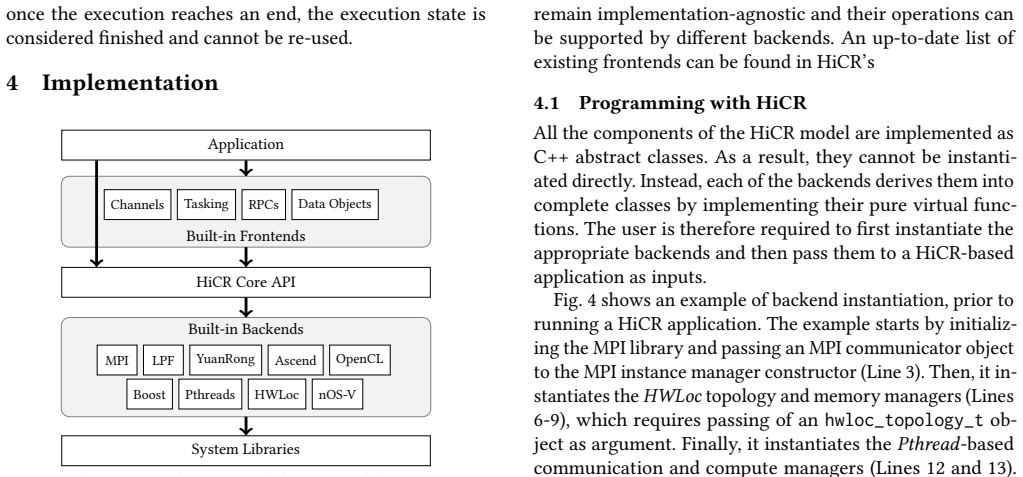
The model itself is the key object: a minimal set of abstract operations mediated by five managers. The Instance Manager discovers or creates instances; the Topology Manager exposes devices, memory spaces, and compute resources; the Memory Manager creates and registers local memory slots; the Communication Manager exchanges global memory slots and performs the only three allowed memcpy directions; the Compute Manager creates processing units, execution units, and execution states. The plugin- or backend-based implementation carries the portability argument: each backend translates a subset of these abstract classes into a specific technology's calls, and selecting a different backend changes
What would settle it
Implement a distributed application that must perform a Global-to-Global data motion (a device-to-device copy initiated by a third instance between two remote instances) and attempt to express it with the HiCR API; if the API cannot express it without staging through a local slot, the claim of universal expressiveness is falsified. Alternatively, take a new accelerator or interconnect for which only a backend is written and run an existing HiCR application; any semantic divergence in its result would refute the 'intended result' guarantee.
Extended reading notes
Core claim
The central claim is that the semantics of any distributed heterogeneous application can be captured by a small, named set of abstract operations, and that those operations are sufficient because they are realised by interchangeable backends. The model groups components into managers (Instance, Topology, Memory, Communication, Compute), stateless objects (topology, instance templates, execution units) and stateful objects (instances, memory slots, processing units, execution states). Communication is deliberately restricted: all data motion uses a memcpy with only Local-to-Local, Local-to-Global, and Global-to-Local directions; Global-to-Global copies are disallowed because no instance orche
Load-bearing premise
The paper asserts, without formal proof, that the operation set it defines—topology discovery, local memory slots, three-direction memcpy, execution states, and instance management—is semantically complete for every distributed heterogeneous application; if some application needs an operation outside this set, the portability claim collapses.
Editorial extensions
If this is right
- Applications written only against the abstract HiCR API can be ported to a new architecture by providing a new backend plugin, with no changes to application source.
- Any newly written backend immediately benefits all HiCR-based programs, multiplying the value of each new plugin.
- Because HiCR prescribes no programming model, a tasking runtime, a BSP library, or a domain-specific library can each sit on top of the same Runtime Support Layer.
- The same source code can run on CPU, GPU, and NPU while preserving overall results, as shown by the MNIST test where accuracy matched across backends.
- Communication performance remains backend-dependent (e.g., the LPF backend delivers roughly 70x better ping-pong goodput than the MPI backend for small messages), so programmers must still benchmark backend choices.
Reading between the lines
- If the completeness claim is taken at face value, the three-direction memcpy restriction is a testable boundary: any real application needing Global-to-Global or shared-device cross-instance communication would force the model to grow a new operation, exposing the lack of formal proof.
- Backend selection is performance-critical; the model guarantees semantic portability but not performance portability, so the natural next step is a benchmark suite that quantifies backend overhead to guide users.
- A practical stress test would be to take a large existing HPC or ML application and port it to HiCR; if semantics break because communication patterns exceed the three allowed directions, the minimality claim would be disproven.
- The same abstraction style could be extended to other runtime concerns the paper lists as future work—file management, fault tolerance, and security isolation—if the model grows new manager types rather than complicating the existing ones.
Signed reviews
Editorial analysis
A structured set of objections, weighed in public.
Referee Report
Summary. The paper introduces HiCR, an abstract model intended to serve as a "Runtime Support Layer" between applications/runtime systems and the low-level technologies of distributed heterogeneous hardware. HiCR defines a small set of components and operations: instance management, topology discovery, memory management via local/global memory slots, communication via asynchronous memcpy plus a fence operation, and compute via processing units, execution units, and execution states. The paper claims that any HiCR-based program reaches its intended result on any system, provided appropriate backend plugins are selected. The authors describe an open-source C++ implementation with backends for MPI, LPF, HWLoc, OpenCL, ACL, Pthreads, Boost, and nOS-V, plus frontends for channels, data objects, RPC, and tasking. Four experiments are reported: an MPI vs. LPF ping-pong benchmark, MNIST inference on CPU/GPU/NPU, a fine-grained Fibonacci task benchmark, and a coarse-grained Jacobi solver with up to 4 nodes.
Significance. If the semantic claims were made precise, HiCR would be a useful contribution to portable distributed heterogeneous programming. The paper has real strengths: the implementation is open source, the experimental setup is reproducible, and the test cases cover different backend families (CPU threads, OpenCL GPU, NPU, Infiniband/MPI). The ping-pong comparison and the tasking benchmarks are legitimate measurements, and the paper is generally clear about what was run. However, the paper's central claim is the semantic portability of the abstract model, and that claim rests on a definition of completion/ordering that is not given. The empirical tests are not sufficient to establish the universal statement made in §1 and §3. The contribution is therefore promising but needs either a rigorously stated operational/memory semantics or a careful restriction of the portability claim.
major comments (3)
- [§3.1.4, §1] The portability claim ('any HiCR-based code will reach its intended result', §1) presupposes a backend-independent semantics for asynchronous operations. In §3.1.4, memcpy is asynchronous and fence 'suspend[s] execution until the expected number of incoming and outgoing data transfers have been completed,' but 'completed' is not defined: origin completion (e.g., MPI_Win_flush) and remote visibility (e.g., MPI_Win_fence) are different notions for one-sided communication. The model also does not define ordering between async execution states (§3.1.5) and memcpy operations on the same memory slot. Without these rules, two backends can legitimately implement the same API with different synchronization strengths and produce different observable outcomes. The test cases in §5 do not exercise such race-prone interleavings. This is the load-bearing gap: please add a memory model or explicitly we
- [§3, §3.1.4, §6] The opening of §3 states that HiCR comprises 'a minimal set of components and operations to describe the semantics of any code running on any distributed computing system.' This completeness/minimality claim is not supported. Global-to-Global memcpy is deliberately disallowed in §3.1.4, and §6 lists missing features: interconnect-topology discovery, distributed file management, fault tolerance, multi-user job allocation, security isolation. If the intended claim is limited to programs expressible in HiCR, that scope must be stated explicitly; otherwise the model cannot be said to cover 'any code' on 'any' distributed system. Please either prove/formalize the expressible fragment or revise the claim to be about HiCR-expressible programs.
- [§5, Table 2] The experiments demonstrate that four specific applications run with several backends and yield consistent (though not bit-identical) results. This is useful evidence, but it does not substitute for the semantic guarantee promised in §1. In particular, no experiment exercises overlapping one-sided transfers and asynchronous execution states in a way that would distinguish different completion/ordering semantics. The accuracy results in Table 2 are consistent, yet the img-0 scores differ in low-order digits as the text acknowledges; that is acceptable, but it highlights that 'equal results' in the paper is empirical similarity rather than a formal semantic equivalence. If the model itself is the contribution, the missing piece is a rigorous operational semantics, not additional benchmarks.
minor comments (4)
- [§4] The sentence 'An up-to-date list of existing frontends can be found in HiCR’s' is incomplete; the expected pointer or URL is missing.
- [§5.1] In the goodput discussion, 'larger messages (> 109 bytes)' should presumably read '>10^9 bytes'; the superscript appears to have been lost.
- [§3.1.4] The phrase 'The latter involve transfers between instances...' refers to two distinct directions (Local-to-Global and Global-to-Local); the wording is confusing and should be rephrased.
- [Table 1] The table lists an X for OpenCL under Instance, but §4.2 does not describe instance management for OpenCL; please clarify what this entry means or correct the table.
Circularity Check
No significant circularity: HiCR's portability claim rests on external validation and design, not on self-referential derivation.
full rationale
The paper's central claim is that abstract HiCR operations allow the same application code to run across heterogeneous and distributed systems by switching backends. This is a design claim, not a derived numerical prediction. The experimental sections compare the same HiCR code over external technologies (MPI, OpenCL, ACL, Pthreads, HWLoc, nOS-V, Boost) and third-party hardware, and the results are measured rather than fitted. No parameter is fitted to a subset of data and then renamed as a prediction; no equation is shown to equal its input by construction. The author-owned components that appear — LPF (reference [57]), the LPF/noc_extension branch [36], and the TaskR scheduler — are used as backends or test harnesses, not as premises that force the portability conclusion. The portability assertion would stand or fall on whether the abstract API semantics are well-defined and correctly implemented, independent of these self-references. The paper's broader claim that HiCR can describe 'any code running on any distributed computing system' is an unproven completeness assertion, and the model's asynchronous completion semantics are under-specified, but these are soundness gaps rather than circularity. There is no self-definitional equivalence, fitted-input mislabeling, or load-bearing self-citation chain.
Assumptions & free parameters
assumptions (4)
- domain assumption A distributed system consists of interconnected nodes, each with processing units and local memory.
- domain assumption No two running HiCR instances may share access to the same device.
- domain assumption All communication is mediated by a communication manager, and Global-to-Global transfers are not permitted.
- domain assumption An execution state is single-use and cannot be restarted after completion.
invented entities (2)
-
Runtime Support Layer
independent evidence
-
HiCR abstract components (Instance, Topology, Memory Slot, Global Memory Slot, Execution Unit, Execution State)
independent evidence
Cite this review
Pith. "Pith review of HiCR, an Abstract Model for Distributed Heterogeneous Programming." pith.science (2026). https://pith.science/paper/PIP4BTOM
@misc{pith2026250901425,
  author       = {Pith},
  title        = {Pith review of: HiCR, an Abstract Model for Distributed Heterogeneous Programming},
  year         = {2026},
  howpublished = {\url{https://pith.science/paper/PIP4BTOM}},
  note         = {Machine review of arXiv:2509.01425}
}
read the original abstract
We present HiCR, a model to represent the semantics of distributed heterogeneous applications and runtime systems. The model describes a minimal set of abstract operations to enable hardware topology discovery, kernel execution, memory management, communication, and instance management, without prescribing any implementation decisions. The goal of the model is to enable execution in current and future systems without the need for significant refactoring, while also being able to serve any governing parallel programming paradigm. In terms of software abstraction, HiCR is naturally located between distributed heterogeneous systems and runtime systems. We coin the phrase \emph{Runtime Support Layer} for this level of abstraction. We explain how the model's components and operations are realized by a plugin-based approach that takes care of device-specific implementation details, and present examples of HiCR-based applications that operate equally on a diversity of platforms.
Figures


Figures from the paper (7 more)


Reference graph
Works this paper leans on
-
[1]
Partitioned Global Address Space (PGAS) Languages
2011. Partitioned Global Address Space (PGAS) Languages. In Ency- clopedia of Parallel Computing , David A. Padua (Ed.). Springer, 1465
work page 2011
-
[2]
Jimmy Aguilar Mena, Omar Shaaban, Vicenç Beltran, Paul Carpenter, Eduard Ayguade, and Jesus Labarta Mancho. 2022. OmpSs-2@ Clus- ter: Distributed memory execution of nested OpenMP-style tasks. In European Conference on Parallel Processing . Springer, 319–334
work page 2022
-
[3]
David Álvarez, Kevin Sala, and Vicenç Beltran. 2024. nOS-V: Co- Executing HPC Applications Using System-Wide Task Scheduling. In IEEE International Parallel and Distributed Processing Symposium . IEEE, 312–324
work page 2024
-
[4]
https://rocm.docs.amd.com/projects/HIP/en/latest/
AMD Heterogeneous-computing Interface for Portability (HIP) 2025- 03-24. . https://rocm.docs.amd.com/projects/HIP/en/latest/
work page 2025
-
[5]
Cédric Augonnet, Olivier Aumage, Nathalie Furmento, Raymond Namyst, and Samuel Thibault. 2012. StarPU-MPI: Task Programming over Clusters of Machines Enhanced with Accelerators. In Recent Ad- vances in the Message Passing Interface - European MPI Users’ Group Meeting (Lecture Notes in Computer Science, Vol. 7490) , Jesper Lars- son Träff, Siegfried Benkne...
work page 2012
-
[6]
Cédric Augonnet, Samuel Thibault, Raymond Namyst, and Pierre- André Wacrenier. 2009. StarPU: A Unified Platform for Task Schedul- ing on Heterogeneous Multicore Architectures. In Euro-Par Parallel Processing (Lecture Notes in Computer Science, Vol. 5704) , Henk J. Sips, Dick H. J. Epema, and Hai-Xiang Lin (Eds.). Springer, 863–874
work page 2009
-
[7]
Eduard Ayguadé, Rosa M. Badia, Francisco D. Igual, Jesús Labarta, Rafael Mayo, and Enrique S. Quintana-Ortí. 2009. An Extension of the StarSs Programming Model for Platforms with Multiple GPUs. InEuro- Par Parallel Processing (Lecture Notes in Computer Science, Vol. 5704) , Henk J. Sips, Dick H. J. Epema, and Hai-Xiang Lin (Eds.). Springer, 851–862
work page 2009
-
[8]
David Beckingsale, Thomas R. W. Scogland, Jason Burmark, Rich Hor- nung, Holger Jones, William Killian, Adam J. Kunen, Olga Pearce, Peter Robinson, and Brian S. Ryujin. 2019. RAJA: Portable Performance for Large-Scale Scientific Applications. In IEEE/ACM International Work- shop on Performance, Portability and Productivity in HPC . IEEE, 71–81
work page 2019
Show all 68 references
-
[9]
Roberto Belli and Torsten Hoefler. 2015. Notified Access: Extending Remote Memory Access Programming Models for Producer-Consumer Synchronization. In 2015 IEEE International Parallel and Distributed 11 Processing Symposium. 871–881. https://doi.org/10.1109/IPDPS.2015.30
2015 doi
-
[10]
https://www.boost.org/doc/libs/1_84_0/ libs/context/doc/html/index.html
Boost Context 2025-03-24. . https://www.boost.org/doc/libs/1_84_0/ libs/context/doc/html/index.html
2025
-
[11]
George Bosilca, Aurelien Bouteiller, Anthony Danalis, Mathieu Faverge, Thomas Hérault, and Jack J Dongarra. 2013. Parsec: Ex- ploiting heterogeneity to enhance scalability. Computing in Science & Engineering 15, 6 (2013), 36–45
2013
-
[12]
https://learn.microsoft.com/en-us/cpp/parallel/amp/cpp-amp- overview?view=msvc-170
C++ Accelerated Massive Parallelism (C++ AMP) 2025-03-24. . https://learn.microsoft.com/en-us/cpp/parallel/amp/cpp-amp- overview?view=msvc-170
2025
-
[13]
Chamberlain, and Hans P
David Callahan, Bradford L. Chamberlain, and Hans P. Zima. 2004. The Cascade High Productivity Language. In International Workshop on High-Level Programming Models and Supportive Environments . IEEE Computer Society, 52–60
2004
-
[14]
Paul Cardosi and Bérenger Bramas. 2023. Specx: a C++ task-based runtime system for heterogeneous distributed architectures. CoRR abs/2308.15964 (2023)
2023 arXiv
-
[15]
Saraswat, Christopher Donawa, Allan Kielstra, Kemal Ebcioglu, Christoph von Praun, and Vivek Sarkar
Philippe Charles, Christian Grothoff, Vijay A. Saraswat, Christopher Donawa, Allan Kielstra, Kemal Ebcioglu, Christoph von Praun, and Vivek Sarkar. 2005. X10: an object-oriented approach to non-uniform cluster computing. In Proceedings of the Annual ACM SIGPLAN Confer- ence on...
2005
-
[16]
Qiong Chen, Jianmin Qian, Yulin Che, Ziqi Lin, Jianfeng Wang, Jie Zhou, Licheng Song, Yi Liang, Jie Wu, Wei Zheng, Wei Liu, Linfeng Li, Fangming Liu, and Kun Tan. 2024. YuanRong: A Production General- purpose Serverless System for Distributed Applications in the Cloud. In Proc...
2024
-
[17]
https://www.intel.com/content/www/ us/en/developer/tools/oneapi/data-parallel-c-plus-plus.html
Data Parallel C++ 2025-03-24. . https://www.intel.com/content/www/ us/en/developer/tools/oneapi/data-parallel-c-plus-plus.html
2025
-
[18]
Jeffrey Dean and Sanjay Ghemawat. 2008. MapReduce: simplified data processing on large clusters. Commun. ACM 51, 1 (2008), 107–113
2008
-
[19]
Jirí Dokulil and Siegfried Benkner. 2022. The OCR-Vx experience: lessons learned from designing and implementing a task-based runtime system. J. Supercomput. 78, 10 (2022), 12344–12379
2022
-
[20]
Jiri Dokulil, Martin Sandrieser, and Siegfried Benkner. 2016. Implement- ing the open community runtime for shared-memory and distributed- memory systems. In 2016 24th Euromicro International Conference on Parallel, Distributed, and Network-Based Processing (PDP) . IEEE, 364– 368
2016
-
[21]
Romain Dolbeau, Stéphane Bihan, and François Bodin. 2007. HMPP: A hybrid multi-core parallel programming environment. In Workshop on general purpose processing on graphics processing units, Vol. 28. Citeseer
2007
-
[22]
Carter Edwards and Daniel Sunderland
H. Carter Edwards and Daniel Sunderland. 2012. Kokkos Array performance-portable manycore programming model. In Proceedings of the International Workshop on Programming Models and Applications for Multicores and Manycores, Minyi Guo and Zhiyi Huang (Eds.). ACM, 1–10
2012
-
[23]
El-Ghazawi and Lauren Smith
Tarek A. El-Ghazawi and Lauren Smith. 2006. UPC - UPC: unified par- allel C. In Proceedings of the ACM/IEEE Conference on High Performance Networking and Computing. ACM Press, 27
2006
-
[24]
Badia, and Eduard Ayguadé Parra
Vinoth Krishnan Elangovan, Rosa M. Badia, and Eduard Ayguadé Parra. 2012. OmpSs-OpenCL Programming Model for Heterogeneous Systems. In Languages and Compilers for Parallel Computing (Lecture Notes in Computer Science, Vol. 7760) , Hironori Kasahara and Keiji Kimura (Eds.). Spr...
2012
-
[25]
Johan Enmyren and Christoph W Kessler. 2010. SkePU: a multi- backend skeleton programming library for multi-GPU systems. In Proceedings of the fourth international workshop on High-level parallel programming and applications. 5–14
2010
-
[26]
Thierry Gautier, João V. F. Lima, Nicolas Maillard, and Bruno Raffin
-
[27]
Vetter, Giulio Picierro, and Marco Cesati
Roberto Gioiosa, Burcu Ozcelik Mutlu, Seyong Lee, Jeffrey S. Vetter, Giulio Picierro, and Marco Cesati. 2020. The Minos Computing Library: efficient parallel programming for extremely heterogeneous systems. In Annual Workshop on General Purpose Processing using Graphics Proces...
2020
-
[28]
https://e.huawei.com/en/ products/computing/ascend
Huawei Ascend Computing 2025-03-24. . https://e.huawei.com/en/ products/computing/ascend
2025
-
[29]
https: //www.hiascend.com/document/detail/zh/canncommercial/700/ overview/index.html
Huawei Ascend Computing Language 2025-03-24. . https: //www.hiascend.com/document/detail/zh/canncommercial/700/ overview/index.html
2025
-
[30]
https://docs.nvidia.com/ networking/display/rdmaawareprogrammingv17/vpi+verbs+api
Infiniband Verbs API 2025-03-24. . https://docs.nvidia.com/ networking/display/rdmaawareprogrammingv17/vpi+verbs+api
2025
-
[31]
https://network.nvidia.com/ pdf/whitepapers/IB_Intro_WP_190.pdf
Introduction to Infiniband 2025-03-24. . https://network.nvidia.com/ pdf/whitepapers/IB_Intro_WP_190.pdf
2025
-
[32]
Herbert Jordan, Philipp Gschwandtner, Peter Thoman, Peter Zangerl, Alexander Hirsch, Thomas Fahringer, and Dietmar Fey. 2020. The allscale framework architecture. Parallel Comput. 99 (2020), 102648
2020
-
[33]
Hartmut Kaiser, Thomas Heller, Bryce Adelstein-Lelbach, Adrian Serio, and Dietmar Fey. 2014. HPX: A Task Based Programming Model in a Global Address Space. In Proceedings of the International Conference on Partitioned Global Address Space Programming Models, Allen D. Malony an...
2014
-
[34]
Jungwon Kim, Seyong Lee, Beau Johnston, and Jeffrey S. Vetter. 2021. IRIS: A Portable Runtime System Exploiting Multiple Heterogeneous Programming Systems. In IEEE High Performance Extreme Computing Conference. IEEE, 1–8
2021
-
[35]
Seyong Lee and Jeffrey S. Vetter. 2014. OpenARC: open accelerator research compiler for directive-based, efficient heterogeneous comput- ing. In The International Symposium on High-Performance Parallel and Distributed Computing, Beth Plale, Matei Ripeanu, Franck Cappello, and ...
2014
-
[36]
Light Parallel Foundations - Source Code, Branch: noc_extension [n. d.]. https://github.com/Algebraic-Programming/LPF/tree/noc_ extension/. (2025-03-24)
2025
-
[37]
Grzegorz Malewicz, Matthew H Austern, Aart JC Bik, James C Dehnert, Ilan Horn, Naty Leiser, and Grzegorz Czajkowski. 2010. Pregel: a system for large-scale graph processing. In Proceedings of the 2010 ACM SIGMOD International Conference on Management of data . 135– 146
2010
-
[38]
Mattson, Romain Cledat, Vincent Cavé, Vivek Sarkar, Zoran Budimlic, Sanjay Chatterjee, Joshua B
Timothy G. Mattson, Romain Cledat, Vincent Cavé, Vivek Sarkar, Zoran Budimlic, Sanjay Chatterjee, Joshua B. Fryman, Ivan Ganev, Robin Knauerhase, Min Lee, Benoît Meister, Brian Nickerson, Nick Pepperling, Bala Seshasayee, Sagnak Tasirlar, Justin Teller, and Nick Vrvilo. 2016. ...
2016
-
[39]
https://www.kaggle.com/datasets/ hojjatk/mnist-dataset
MNIST Dataset 2025-03-24. . https://www.kaggle.com/datasets/ hojjatk/mnist-dataset
2025
-
[40]
https://www.mpi-forum.org/
MPI Forum 2025-03-24. . https://www.mpi-forum.org/
2025
-
[41]
https://developer.nvidia.com/cuda-toolkit
Nvidia CUDA 2025-03-24. . https://developer.nvidia.com/cuda-toolkit
2025
-
[42]
https://developer.nvidia.com/thrust
Nvidia Thrust 2025-03-24. . https://developer.nvidia.com/thrust
2025
-
[43]
https://ovni.readthedocs.io/
Obtuse but Versatile Nanoscale Instrumentation (ovni) 2025-03-19. . https://ovni.readthedocs.io/
2025
-
[44]
https://ompcluster.gitlab.io/
OmpCluster 2025-03-24. . https://ompcluster.gitlab.io/
2025
-
[45]
https://pm.bsc.es/ompss-2
OmpSs-2 2025-03-24. . https://pm.bsc.es/ompss-2
2025
-
[46]
https://www.openacc
Open Accelerators (OpenACC) 2025-03-24. . https://www.openacc. org/sites/default/files/inline-files/OpenACC_2_0_specification.pdf
2025
-
[47]
https://registry
Open Computing Language (OpenCL) 2025-03-24. . https://registry. khronos.org/OpenCL/specs/3.0-unified/html/OpenCL_API.html
2025
-
[48]
https://www.openmp
Open Multi-Processing (OpenMP) 2025-03-24. . https://www.openmp. org/specifications/
2025
-
[49]
https://www
OpenBLAS: An optimized BLAS library 2025-03-24. . https://www. openmathlib.org/OpenBLAS/ 12
2025
-
[50]
https: //tools.bsc.es/paraver
Paraver: a flexible performance analysis tool 2025-03-19. . https: //tools.bsc.es/paraver
2025
-
[51]
https://www.open- mpi.org/projects/hwloc
Portable Hardware Locality (hwloc) 2025-03-24. . https://www.open- mpi.org/projects/hwloc
2025
-
[52]
https://man7.org/linux/man-pages/ man7/pthreads.7.html
POSIX Threads 2025-03-24. . https://man7.org/linux/man-pages/ man7/pthreads.7.html
2025
-
[53]
Ari Rasch, Martin Wrodarczyk, Richard Schulze, and Sergei Gor- latch. 2018. OCAL: An Abstraction for Host-Code Programming with OpenCL and CUDA. In IEEE International Conference on Parallel and Distributed Systems. IEEE, 408–416
2018
-
[54]
Robson, Ronak Buch, and Laxmikant V
Michael P. Robson, Ronak Buch, and Laxmikant V. Kalé. 2016. Run- time Coordinated Heterogeneous Tasks in Charm++. In International Workshop on Extreme Scale Programming Models and Middleware . IEEE Computer Society, 40–43
2016
-
[55]
Marc Sergent, Célia Tassadit Aitkaci, Pierre Lemarinier, and Guillaume Papauré. 2019. Efficient notifications for MPI one-sided applications. In Proceedings of the 26th European MPI Users’ Group Meeting (Zürich, Switzerland) (EuroMPI ’19). Association for Computing Machinery, ...
2019
-
[56]
Quinn O Snell, Armin R Mikler, and John L Gustafson. 1996. Netpipe: A network protocol independent performance evaluator. In IASTED international conference on intelligent information management and systems, Vol. 6. Washington, DC, USA), 49
1996
-
[57]
Wijnand Suijlen and A. N. Yzelman. 2019. Lightweight Parallel Founda- tions: a model-compliant communication layer. CoRR abs/1906.03196 (2019)
2019 arXiv
-
[58]
https://www.khronos.org/sycl/
SYCL 2025-03-24. . https://www.khronos.org/sycl/
2025
-
[59]
Enric Tejedor and Rosa M. Badia. 2008. COMP Superscalar: Bringing GRID Superscalar and GCM Together. InIEEE International Symposium on Cluster Computing and the Grid . IEEE Computer Society, 185–193
2008
-
[60]
Peter Thoman, Philip Salzmann, Biagio Cosenza, and Thomas Fahringer. 2019. Celerity: High-Level C++ for Accelerator Clusters. In Euro-Par: Parallel Processing (Lecture Notes in Computer Science, Vol. 11725), Ramin Yahyapour (Ed.). Springer, 291–303
2019
-
[61]
Hernandez, and Jeffrey S
Pedro Valero-Lara, Jungwon Kim, Oscar R. Hernandez, and Jeffrey S. Vetter. 2021. OpenMP Target Task: Tasking and Target Offloading on Heterogeneous Systems. In Euro-Par: Parallel Processing Workshops (Lecture Notes in Computer Science, Vol. 13098), Ricardo Chaves, Dora B. Hera...
2021
-
[62]
Leslie G. Valiant. 1990. A Bridging Model for Parallel Computation. Commun. ACM 33, 8 (1990), 103–111
1990
-
[63]
https://xcalablemp.org/XACC.html
XcalableACC 2025-03-24. . https://xcalablemp.org/XACC.html
2025
-
[64]
https://xcalablemp.org/index.html
XcalableMP 2025-03-24. . https://xcalablemp.org/index.html
2025
-
[65]
Yuan Yuan, Meisam Fathi Salmi, Yin Huai, Kaibo Wang, Rubao Lee, and Xiaodong Zhang. 2016. Spark-GPU: An accelerated in-memory data processing engine on clusters. In 2016 IEEE International Conference on Big Data (Big Data) . 273–283. https://doi.org/10.1109/BigData.2016. 7840613
2016 doi
-
[66]
Afshin Zafari, Elisabeth Larsson, and Martin Tillenius. 2019. DuctTeip: An efficient programming model for distributed task-based parallel computing. Parallel Comput. 90 (2019)
2019
-
[67]
Matei Zaharia, Mosharaf Chowdhury, Michael J Franklin, Scott Shenker, and Ion Stoica. 2010. Spark: Cluster computing with work- ing sets. In 2nd USENIX workshop on hot topics in cloud computing (HotCloud 10). 13
2010
-
[2013]
In IEEE International Symposium on Parallel and Distributed Processing
XKaapi: A Runtime System for Data-Flow Task Programming on Heterogeneous Architectures. In IEEE International Symposium on Parallel and Distributed Processing. IEEE Computer Society, 1299–1308
Reviewed August 5, 2026 · model on record in the stance chip above.
Discussion (0). Continue with ORCID to comment.