Sharp Hybrid Confidence Bands for Partially Identified Treatment Effects under Tail Uncertainty with an Application to Workforce Gender Diversity and Firm Performance
Pith reviewed 2026-05-18 19:31 UTC · model grok-4.3
The pith
A hybrid method produces valid confidence bands for partially identified average treatment effects by explicitly handling uncertain outcome tails.
A machine-rendered reading of the paper's core claim, the machinery that carries it, and where it could break.
Core claim
concATE produces valid joint coverage for the partially identified ATE interval by combining a DKW-based concentration bound on the outcome distribution with delta-method inference on the smooth components and Bonferroni allocation across endpoints. The paper further extends concATE to a group-sequential procedure that controls the family-wise error rate using Pocock correction.
What carries the argument
concATE, the hybrid confidence band that pairs the Dvoretzky-Kiefer-Wolfowitz inequality for bounding the outcome distribution with delta-method asymptotics for the means and Bonferroni correction for joint endpoint coverage.
If this is right
- The bands allow valid inference on treatment effects without fixing the outcome support in advance or imposing parametric tail assumptions.
- In the application, senior-level gender diversity has a statistically significant positive effect on Tobin's Q only after reaching approximately 55 percent female leadership in Growth & Innovation sectors and 60 percent in Defensive sectors.
- The method extends directly to group-sequential procedures that maintain family-wise error control via Pocock correction.
- Finite-sample validity holds by construction even when outcomes exhibit heavy tails that defeat ad-hoc truncation.
Where Pith is reading between the lines
- The same hybrid structure could be carried over to other partial-identification settings where the support or tail behavior of the outcome is the main source of uncertainty, such as policy evaluations with unbounded costs or benefits.
- Applied researchers estimating threshold effects in diversity or representation data could use concATE to map out the minimal fractions at which effects become detectable across industries.
- Direct comparison of concATE coverage against purely asymptotic bands or fully nonparametric alternatives in controlled simulations would quantify the finite-sample improvement from the concentration component.
Load-bearing premise
The outcome distribution satisfies the conditions for the Dvoretzky-Kiefer-Wolfowitz inequality to deliver a useful finite-sample bound on the empirical distribution function, and the mean components admit a delta-method expansion.
What would settle it
Run Monte Carlo simulations from distributions with tails heavy enough to render the DKW bound loose in moderate samples and check whether the empirical joint coverage of the concATE intervals drops below the nominal level.
Figures

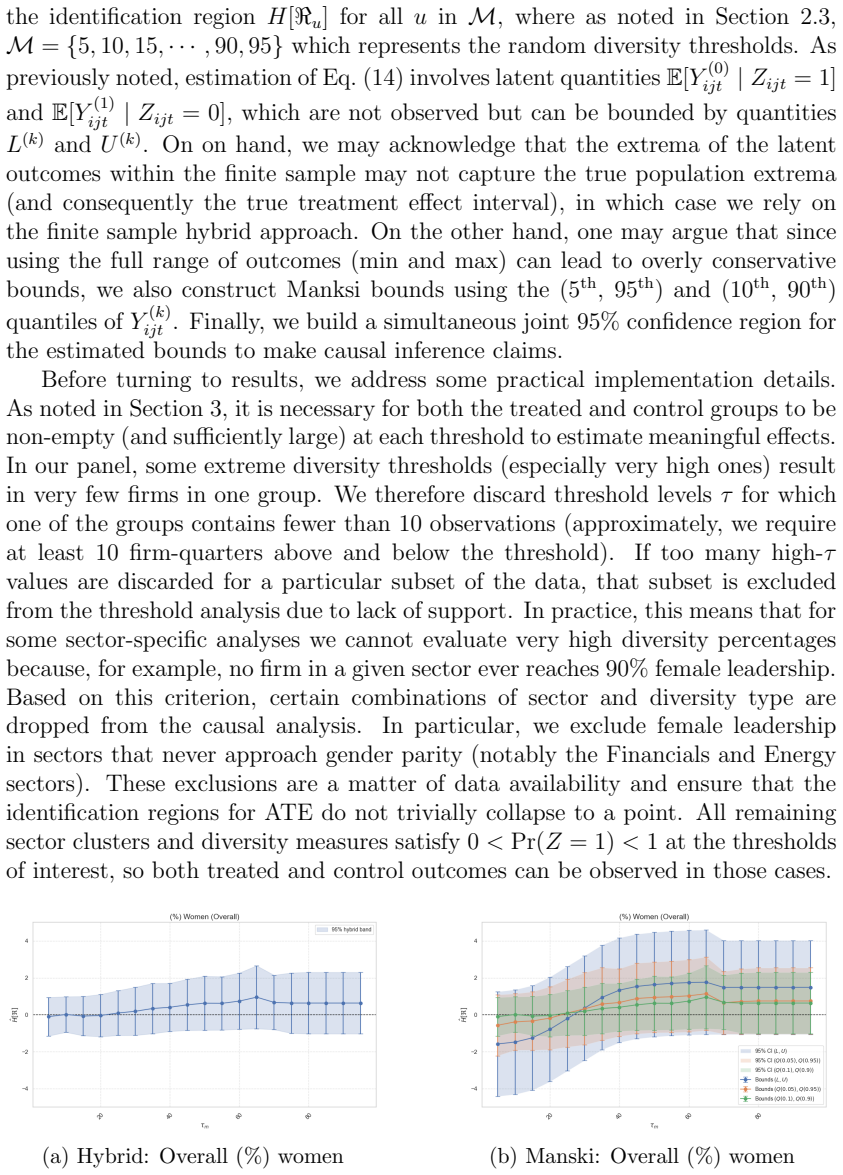

read the original abstract
Manski's nonparametric bounds partially identify the average treatment effects (ATEs) under minimal assumptions, yielding an interval-valued estimand with endpoints that depend on the outcome support - typically treated as known or fixed. In many empirical settings, however, credible bounds on the outcome support are often unavailable and outcomes may be heavy-tailed, so common empirical implementations that rely on ad-hoc truncation or observed extrema can compromise finite-sample coverage. We develop concATE, a hybrid confidence band for interval-identified ATEs that explicitly accounts for tail uncertainty without imposing parametric assumptions. The inference method combines a distribution-free concentration bound for the outcome distribution based on the Dvoretzky-Kiefer-Wolfowitz inequality with the asymptotic delta-method inference for smooth mean components, and allocates size across bound endpoints using Bonferroni's inequality to guarantee joint coverage. We further extend concATE to a group-sequential procedure that controls the family-wise error rate using Pocock correction. Applying the method to panel data on 901 listed firms (2015Q2--2022Q1), we find that senior-level gender diversity has a statistically significant positive effect on firm value (Tobin's Q) only after crossing substantial representation thresholds: in Growth & Innovation sectors, significance emerges at approximately 55% female leadership, while in Defensive sectors it appears only beyond about 60%.
Editorial analysis
A structured set of objections, weighed in public.
Referee Report
Summary. The manuscript develops concATE, a hybrid confidence band for partially identified average treatment effects (ATEs) under Manski-style nonparametric bounds. It combines a distribution-free Dvoretzky–Kiefer–Wolfowitz (DKW) concentration inequality on the outcome distribution with delta-method asymptotics for the smooth mean components, using Bonferroni allocation to obtain joint coverage over the interval endpoints. The procedure is extended to a group-sequential version with Pocock correction. An empirical application to panel data on 901 listed firms (2015Q2–2022Q1) reports that senior-level gender diversity has a statistically significant positive effect on Tobin's Q only after crossing substantial representation thresholds (approximately 55% in Growth & Innovation sectors and 60% in Defensive sectors).
Significance. If the coverage properties can be established rigorously, the hybrid construction would provide a useful tool for inference on partially identified parameters when outcome support is uncertain and tails are heavy, avoiding ad-hoc truncation. The application illustrates potential threshold effects in the gender-diversity–firm-performance relationship. The approach sensibly merges non-asymptotic bounds with standard asymptotic tools, but its practical value depends on whether the claimed joint coverage holds under the heavy-tailed conditions the method is designed to address.
major comments (2)
- [Abstract and §3 (method)] Abstract and central construction (as described in the abstract): the claim that concATE 'guarantees joint coverage' under tail uncertainty combines the non-asymptotic DKW bound with delta-method inference. Because the delta-method step relies on asymptotic normality and requires finite variance for the relevant functionals, the overall procedure yields only asymptotic joint coverage. Under the heavy-tailed regimes targeted by the method, the uncontrolled approximation error in the delta-method component can cause Bonferroni-adjusted coverage to fall below the nominal level in finite samples, even when the DKW piece holds exactly. A precise theorem stating whether coverage is exact finite-sample, liminf ≥ 1-α, or only pointwise asymptotic is required.
- [Application section] Application results (as summarized in the abstract): the reported thresholds (55% female leadership in Growth & Innovation, 60% in Defensive) are presented as points at which statistical significance emerges. Without accompanying simulation evidence or sensitivity analysis to the DKW band width, the Bonferroni allocation, and the delta-method variance estimator under heavy tails, it is unclear whether these thresholds reflect genuine effects or are sensitive to the hybrid approximation error.
minor comments (2)
- [Notation and setup] Clarify the exact definition of the identified set when the outcome support is treated as unknown and how the DKW band is applied to the empirical distribution function in the presence of possible heavy tails.
- [Figures] Label all figures in the application with the nominal coverage level, the contribution of each component (DKW vs. delta-method) to band width, and the effective sample sizes used for each sector.
Simulated Author's Rebuttal
We thank the referee for the detailed and constructive report. The comments highlight important distinctions between finite-sample and asymptotic coverage as well as the need for robustness checks in the application. We address each major comment below and will revise the manuscript to clarify the coverage properties and strengthen the empirical evidence.
read point-by-point responses
-
Referee: [Abstract and §3 (method)] Abstract and central construction (as described in the abstract): the claim that concATE 'guarantees joint coverage' under tail uncertainty combines the non-asymptotic DKW bound with delta-method inference. Because the delta-method step relies on asymptotic normality and requires finite variance for the relevant functionals, the overall procedure yields only asymptotic joint coverage. Under the heavy-tailed regimes targeted by the method, the uncontrolled approximation error in the delta-method component can cause Bonferroni-adjusted coverage to fall below the nominal level in finite samples, even when the DKW piece holds exactly. A precise theorem stating whether coverage is exact finite-sample, liminf ≥ 1-α, or only pointwise asymptotic is required.
Authors: We agree that the hybrid construction yields asymptotic rather than exact finite-sample joint coverage. The DKW inequality supplies a non-asymptotic bound on the outcome distribution, but the delta-method inference for the conditional means is asymptotic and assumes finite second moments. Consequently, the Bonferroni-adjusted bands achieve liminf coverage probability at least 1-α as sample size tends to infinity, under the maintained assumptions. We will add an explicit theorem in Section 3 stating the coverage result in this liminf sense, and we will revise the abstract and the opening paragraphs of Section 3 to replace the phrase “guarantees joint coverage” with language that accurately reflects the asymptotic nature of the result. We will also include a brief discussion of the behavior under infinite-variance heavy tails, noting that the method requires finite variance for the delta-method component to be valid. revision: yes
-
Referee: [Application section] Application results (as summarized in the abstract): the reported thresholds (55% female leadership in Growth & Innovation, 60% in Defensive) are presented as points at which statistical significance emerges. Without accompanying simulation evidence or sensitivity analysis to the DKW band width, the Bonferroni allocation, and the delta-method variance estimator under heavy tails, it is unclear whether these thresholds reflect genuine effects or are sensitive to the hybrid approximation error.
Authors: We acknowledge that the application would benefit from explicit checks on the sensitivity of the reported thresholds to the hybrid approximation. In the revised manuscript we will add a new subsection (or appendix) containing (i) Monte Carlo simulations that evaluate finite-sample coverage and threshold stability under heavy-tailed distributions (Student-t with 3–5 degrees of freedom) and (ii) sensitivity plots that vary the DKW band width, the Bonferroni split, and the delta-method variance estimator. These additions will allow readers to assess how robust the 55 % and 60 % thresholds are to the sources of approximation error identified by the referee. revision: yes
Circularity Check
No circularity: construction relies on external DKW inequality and standard delta-method
full rationale
The derivation of concATE combines the Dvoretzky-Kiefer-Wolfowitz inequality (an external, distribution-free finite-sample result) with the delta-method for smooth functionals and Bonferroni allocation. These components are independent of the target ATE interval and are not defined in terms of the final coverage guarantee. No self-citations, self-definitional steps, or fitted inputs renamed as predictions appear in the abstract or described method. The central claim therefore remains self-contained against external benchmarks.
Axiom & Free-Parameter Ledger
axioms (2)
- standard math The Dvoretzky-Kiefer-Wolfowitz inequality supplies a valid finite-sample concentration bound for the empirical distribution function under the observed data.
- domain assumption The smooth mean components admit a first-order delta-method expansion with the usual asymptotic normality.
Lean theorems connected to this paper
-
IndisputableMonolith/Cost/FunctionalEquation.leanwashburn_uniqueness_aczel unclear?
unclearRelation between the paper passage and the cited Recognition theorem.
Proposition 4 (100(1−α)% hybrid confidence band under α–mixing) … combines the Dvoretzky–Kiefer–Wolfowitz concentration bound … with the usual asymptotic delta-method (CLT) for the sample means and proportions.
-
IndisputableMonolith/Foundation/AbsoluteFloorClosure.leanabsolute_floor_iff_bare_distinguishability unclear?
unclearRelation between the paper passage and the cited Recognition theorem.
We exploit the Dvoretzky–Kiefer–Wolfowitz (DKW) inequality … to guarantee … that the empirical range bounds the latent outcome distribution.
What do these tags mean?
- matches
- The paper's claim is directly supported by a theorem in the formal canon.
- supports
- The theorem supports part of the paper's argument, but the paper may add assumptions or extra steps.
- extends
- The paper goes beyond the formal theorem; the theorem is a base layer rather than the whole result.
- uses
- The paper appears to rely on the theorem as machinery.
- contradicts
- The paper's claim conflicts with a theorem or certificate in the canon.
- unclear
- Pith found a possible connection, but the passage is too broad, indirect, or ambiguous to say the theorem truly supports the claim.
Reference graph
Works this paper leans on
-
[1]
Adams, R. B. and Ferreira, D. (2009). Women in the boardroom and their impact on governance and performance. Journal of financial economics , 94(2):291--309
work page 2009
-
[2]
Ali, M., Kulik, C. T., and Metz, I. (2011). The gender diversity--performance relationship in services and manufacturing organizations. The International Journal of Human Resource Management , 22(07):1464--1485
work page 2011
-
[3]
Angrist, J. D. and Pischke, J.-S. (2009). Mostly harmless econometrics: An empiricist's companion . Princeton university press
work page 2009
-
[4]
Brainard, W. C. and Tobin, J. (1968). Pitfalls in financial model building. The American economic review , 58(2):99--122
work page 1968
- [5]
-
[6]
Dedecker, J. and Merlev \`e de, F. (2007). The empirical distribution function for dependent variables: asymptotic and nonasymptotic results in. ESAIM: Probability and Statistics , 11:102--114
work page 2007
-
[7]
Dvoretzky, A., Kiefer, J., and Wolfowitz, J. (1956). Asymptotic minimax character of the sample distribution function and of the classical multinomial estimator. The Annals of Mathematical Statistics , pages 642--669
work page 1956
-
[8]
Gordon Lan, K. and DeMets, D. L. (1983). Discrete sequential boundaries for clinical trials. Biometrika , 70(3):659--663
work page 1983
-
[9]
Hambrick, D. C. and Mason, P. A. (1984). Upper echelons: The organization as a reflection of its top managers. Academy of management review , 9(2):193--206
work page 1984
-
[10]
Hoeffding, W. (1994). Probability inequalities for sums of bounded random variables. The collected works of Wassily Hoeffding , pages 409--426
work page 1994
-
[11]
Hoogendoorn, S., Oosterbeek, H., and Van Praag, M. (2013). The impact of gender diversity on the performance of business teams: Evidence from a field experiment. Management science , 59(7):1514--1528
work page 2013
-
[12]
Horowitz, J. L. and Manski, C. F. (1998). Censoring of outcomes and regressors due to survey nonresponse: Identification and estimation using weights and imputations. Journal of Econometrics , 84(1):37--58
work page 1998
-
[13]
Kanter, R. M. (1977). Some effects of proportions on group life: Skewed sex ratios and responses to token women. American journal of Sociology , 82(5):965--990
work page 1977
-
[14]
Kanter, R. M. (1987). Men and women of the corporation revisited. Management Review , 76(3)
work page 1987
-
[15]
Kosorok, M. R. (2008). Introduction to empirical processes and semiparametric inference , volume 61. Springer
work page 2008
-
[16]
Manski, C. F. (1990). Nonparametric bounds on treatment effects. The American Economic Review , 80(2):319--323
work page 1990
-
[17]
Manski, C. F. (2003). Partial identification of probability distributions . Springer Science & Business Media
work page 2003
-
[18]
Merlev \`e de, F., Peligrad, M., and Rio, E. (2009). Bernstein inequality and moderate deviations under strong mixing conditions. In High Dimensional Probability V: The Luminy Volume , volume 5 of Institute of Mathematical Statistics Collections , pages 273--292. IMS
work page 2009
-
[19]
Nathan, M. and Lee, N. (2013). Cultural diversity, innovation, and entrepreneurship: firm-level evidence from london. Economic geography , 89(4):367--394
work page 2013
-
[20]
O'Brien, P. C. and Fleming, T. R. (1979). A multiple testing procedure for clinical trials. Biometrics , pages 549--556
work page 1979
-
[21]
R., Timmermans, B., and Kristinsson, K
stergaard, C. R., Timmermans, B., and Kristinsson, K. (2011). Does a different view create something new? the effect of employee diversity on innovation. Research policy , 40(3):500--509
work page 2011
-
[22]
Pocock, S. J. (1977). Group sequential methods in the design and analysis of clinical trials. Biometrika , 64(2):191--199
work page 1977
-
[23]
Post, C. and Byron, K. (2015). Women on boards and firm financial performance: A meta-analysis. Academy of management Journal , 58(5):1546--1571
work page 2015
-
[24]
Rio, E. (2000). Inégalités de hoeffding pour les fonctions lipschitziennes de suites dépendantes. C. R. Acad. Sci. Paris Sér. I Math. , 330(10):905--908
work page 2000
-
[25]
Safiullah, M., Akhter, T., Saona, P., and Azad, M. A. K. (2022). Gender diversity on corporate boards, firm performance, and risk-taking: New evidence from spain. Journal of Behavioral and Experimental Finance , 35:100721
work page 2022
-
[26]
Scott, D. W. (2015). Multivariate density estimation: theory, practice, and visualization . John Wiley & Sons
work page 2015
-
[27]
Siegmund, D. (2013). Sequential analysis: tests and confidence intervals . Springer Science & Business Media
work page 2013
-
[28]
Tobin, J. (1969). A general equilibrium approach to monetary theory. Journal of money, credit and banking , 1(1):15--29
work page 1969
-
[29]
Tobin, J. (1978). Monetary policies and the economy: the transmission mechanism. Southern economic journal , pages 421--431
work page 1978
-
[30]
Tobin, J. and Brainard, W. C. (1976). Asset markets and the cost of capital
work page 1976
-
[31]
Torchia, M., Calabr \`o , A., and Huse, M. (2011). Women directors on corporate boards: From tokenism to critical mass. Journal of business ethics , 102:299--317
work page 2011
-
[32]
Van Der Vaart, A. W., Wellner, J. A., van der Vaart, A. W., and Wellner, J. A. (1996). Weak convergence . Springer
work page 1996
-
[33]
Vershynin, R. (2018). High-dimensional probability: An introduction with applications in data science , volume 47. Cambridge university press
work page 2018
-
[34]
White, H. (2014). Asymptotic theory for econometricians . Academic press
work page 2014
discussion (0)
Sign in with ORCID, Apple, or X to comment. Anyone can read and Pith papers without signing in.