REVIEW 4 major objections 6 minor 43 references
Revisit of Two-dimensional CEM on Crack Branching: from Single Crack-tip Tracking to Multiple Crack-tips Tracking
T0 review · 4 major / 6 minor · reviewed 2026-08-05 · deepseek-v4-flash
Pith's one-line read A single energy-based tracking rule now reproduces single cracks, branching, and fragmentation in 2D dynamic fracture.
desk verdict A real but under-specified extension of 2D CEM; the algorithm as written can't produce the branching and fragmentation figures. read the letter →
The pith
A machine-rendered reading of the paper's core claim, the machinery that carries it, and where it could break.
The reading
What carries the argument
Multiple Crack-tips Tracking (MCT) algorithm: a scanning rule over edge quadrature points in the two-dimensional Crack Element Model. It evaluates the local fracture energy release rate G_{G1-G0} = delta_d * sigma_perp / 2 at all free-surface edge quadratures, applies the critical Gc criterion, then picks the surviving candidate with the largest G, subject to the split-ratio inequality that smooths stress-wave fluctuations. It carries the argument by making crack branching an emergent consequence of ranking local energy release at every possible crack exit, rather than a separately imposed branching criterion.
What would settle it
Run the branching benchmarks on a sequence of refined meshes and compute a path-independent J-integral around each candidate branch; if the J-integral ranking of two competing crack paths ever reverses the G_{G1-G0} ranking that the MCT rule uses, the central claim fails. Alternatively, quantitatively compare simulated PMMA branch angles and crack speeds with high-speed experimental photographs.
Extended reading notes
Core claim
The central claim is that one algorithmic rule—the Multiple Crack-tips Tracking (MCT) algorithm—can drive the two-dimensional Crack Element Model through single-crack propagation, crack branching, and fragmentation. At each step the algorithm scans every edge quadrature point on all free surfaces, keeps those with fracture energy release rate above the critical value Gc, and advances the crack tip to the candidate with the largest rate, using a split ratio to avoid false choices caused by stress oscillations. The same rule reproduces the Kalthoff-Winkler crack with micro-cracks, branching in a pre-notched plate under both Neumann and Dirichlet loading, and breakup of an internally pressurize
Load-bearing premise
The whole scheme rests on one local formula—the fracture energy release rate at an edge quadrature, developed for a single crack tip—still ranking competing branches correctly when many crack tips interact, and no convergence or J-integral check is given for branched configurations.
Editorial extensions
If this is right
- The same MCT rule reproduces single cracks, branching, and fragmentation without a velocity threshold or user-defined branching criterion.
- Micro-cracks along the main path appear automatically and consume extra energy, which the paper identifies as the reason its dissipated-energy curves lie above phase-field and cohesive references.
- Under displacement (Dirichlet) loading the computed crack patterns agree more closely with experiments than under traction (Neumann) loading, attributed to steadier stress fields.
- The pressurized-cylinder fragmentation benchmark yields 11–13 major fragments on two unstructured meshes with no modulus perturbation, matching phase-field and cohesive reference counts.
- All simulations run with GPU acceleration, suggesting the method can move into industrial-scale dynamic fracture workflows.
Reading between the lines
- If the local energy ranking is valid at branch points, the same free-surface scanning strategy could extend to three-dimensional crack fronts, where a surface quadrature point with maximum G would play the role of each crack-tip candidate; the paper does not test this.
- The absence of modulus perturbations raises a question the paper leaves open: whether the discretization itself supplies the symmetry-breaking perturbation that real microstructures do, or whether perfectly symmetric structured meshes would spuriously branch.
- A direct comparison of G_{G1-G0} with a path-independent J-integral at a branched tip would tell whether the ranking survives where interacting stress fields dominate; the paper reports no such comparison.
- Because the method introduces micro-cracks even in the single-crack Kalthoff case, its dissipated energy should be treated as an upper bound; recalibrating Gc downward may be needed for quantitative energy matching.
Editorial analysis
A structured set of objections, weighed in public.
Referee Report
Summary. The paper proposes an extension of the two-dimensional Crack Element Model (CEM) from single crack-tip tracking to Multiple Crack-tips Tracking (MCT-2D-CEM). The method considers edge quadrature points on all free surfaces, evaluates a local fracture energy release rate based on edge stretch and normal stress, and selects new crack paths among candidate tips. The authors validate the approach on four dynamic fracture benchmarks: the Kalthoff-Winkler plate, crack branching under Neumann loading, crack branching under Dirichlet loading, and fragmentation of a pressurized cylinder. They report qualitative agreement with experimental and reference numerical crack patterns, present mesh-dependence studies for some benchmarks, and compare dissipated energy and fragment counts with existing methods. GPU acceleration is used in all simulations.
Significance. If the algorithm is correctly specified and reproducible, the work would be a useful contribution: it offers a finite-element-based, crack-tracking alternative to phase-field and peridynamic methods for dynamic branching and fragmentation, with the practical advantage of GPU acceleration. The qualitative match with experiments and with independent phase-field/cohesive results, and the absence of artificial modulus perturbations in the cylinder example, are genuine strengths. The paper also honestly reports mesh-sensitivity and excess micro-crack dissipation. However, the central algorithmic claim is not yet reproducible from the text, and several load-bearing numerical ingredients are either unspecified or unvalidated in branched configurations.
major comments (4)
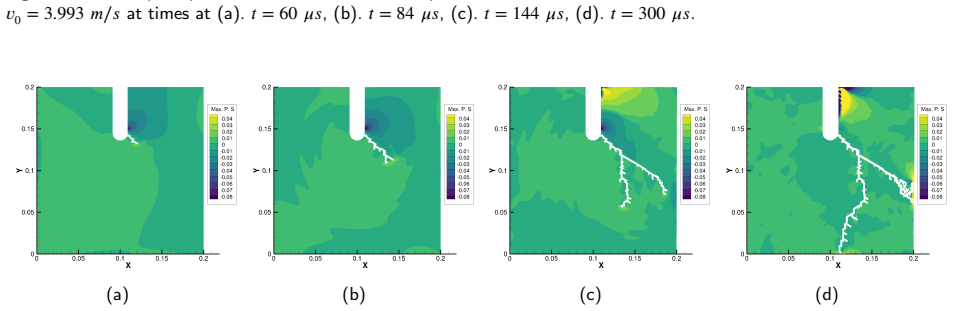
- [Section 3, 'Multiple Crack-tips Tracking'] The algorithm as written cannot produce branching or fragmentation. The text states that MCT 'considers all edge quadrature points along the free surfaces, selects the edge quadrature points satisfying fracture criteria as current crack-tip candidates and picks the edge quadrature point with the largest fracture energy release rate among current crack-tip candidates as the current crack tip.' This is a global selection of a single tip. The example in Figure 4(b) also picks only one of the three candidates. Nowhere is there an operation that turns one active tip into two, a rule for updating a set of active tips, or a rule for nucleating a branch off an existing crack face. Sections 4.2–4.4, however, present branching and fragmentation patterns that require multiple simultaneously advancing tips. This internal contradiction means the figures cannot be inferred from the described algorithm
- [Section 2.2 and Section 3, Eq. for G] The driving-force measure G = delta_d * sigma_perp / 2 is carried over from a single-crack-tip formulation, but no evidence is given that this local quantity remains valid at interacting or branching crack tips. In branched configurations, the stress state at a candidate tip is influenced by the other branch, and a simple edge-stretch/sigma_perp product may mis-rank competing branches. The paper provides no convergence study, no J-integral comparison, and no experimental measurement of, say, branch angles or crack speeds to validate this measure in the branched regime. Since the MCT selection rule depends entirely on this quantity, this is a load-bearing point. A quantitative verification, e.g., comparison with J-integral or stress-intensity-factor-based criteria on a static branched geometry, and a mesh-convergence study of branch patterns, would be needed.
- [Section 3, split-ratio criteria] The split ratio gamma is never given a numerical value and appears in inequalities that are questionable as written. For instance, the condition G1 > gamma*(G1 - G2) in Section 2.2 is automatically satisfied for many positive G1, G2 when gamma is small; with gamma in (0,1) the inequality is trivially true because the right-hand side is smaller than G1 whenever G2 > 0. The paper does not state gamma's range, its default value, or its sensitivity. Section 3 repeats the same ambiguity. Without a concrete value or an explicit calibration, the branching criterion is not a well-defined function of the computed fields, and the reported patterns cannot be reproduced or assessed for robustness.
- [Sections 4.2–4.4, quantitative validation] The validation is mostly qualitative visual comparison. The dissipated-energy comparisons in Figures 18 and 24 show large differences from reference methods, which the paper attributes to extra micro-cracks, but no quantitative convergence of crack path, branch angle, number of branches, or fragment size distribution with mesh refinement is provided. The fragment-count comparison in Table 1 spans a wide range across methods, and the present results agree with one reference at one mesh and another at another mesh, so the fragment count is not a decisive validation. The paper should report quantitative metrics of the crack patterns and demonstrate that the MCT selection rule converges or is at least stable as the mesh is refined.
minor comments (6)
- [Abstract] Typo: 'MCR-2D-CEM' should be 'MCT-2D-CEM'.
- [Section 2.2] The text refers to 'Griffth' in the introduction; correct to 'Griffith'.
- [Section 3, Figure 4] The text says 'including green points, orange points and the red point', but the colors in the figure are not clearly labeled. It would help to mark the candidate numbers directly on the figure.
- [Section 4.1] The problem dimensions and notch geometry for the Kalthoff-Winkler plate are not given explicitly in the text; only boundary conditions and material properties are provided. A dimensioned figure or table would aid reproducibility.
- [Section 4.4, Table 1] The table lists fragment counts for various methods but does not define 'major fragments' or specify the criterion used to count them. This should be clarified.
- [Conclusions] The final paragraph correctly identifies the need for a 'more robust and effective stress regularization scheme'. This limitation should be moved to the front of the validation discussion, because it directly affects the reliability of the branching patterns reported in Sections 4.2–4.4.
Circularity Check
No definitional circularity: the MCT rule is explicitly defined, and the branching/fragmentation claims are validated against external experiments and independent numerical methods, not fitted or derived from the algorithm's own outputs.
full rationale
The paper's central derivation chain is the definition of the Multiple Crack-tips Tracking (MCT) rule on top of the local fracture-energy-release-rate formula G = (delta_d * sigma_perp)/2 from the authors' prior CEM work. That formula is re-stated in Section 2.2 and used as a local crack-driving measure; it is not defined in terms of the final crack patterns it is used to predict. The MCT rule itself is explicitly described in Section 3: evaluate G at all free-surface quadrature points, keep those exceeding G_c as candidates, and pick the largest-G candidate as the current crack tip. This is a selection rule, not a construction that already contains branching or fragmentation as an output. The benchmark results are compared against experimental observations (e.g., Ozbolt et al. for the Dirichlet compact-tension tests) and against independent numerical methods (phase-field, cohesive, cracking-node, local-damage models), so the validation is external and not fitted by construction. There are self-citations to the authors' 2D and 3D CEM preprints, but the paper reproduces the essential formulation rather than deferring the entire derivation to those citations, so the self-citations are not load-bearing in a circular sense. The main weaknesses are non-circular: the split ratio gamma is never given a numerical value or sensitivity study, and the MCT text says it 'picks' a single current crack tip while the figures show multiple simultaneously advancing tips, indicating an omitted algorithmic detail. These are reproducibility and completeness concerns, not evidence that the predictions reduce to the model's inputs. Overall, the derivation is self-contained against external benchmarks, so circularity is minimal.
Assumptions & free parameters
free parameters (1)
- split ratio gamma
assumptions (4)
- standard math ES-FEM strain smoothing formulation is a valid discretization for dynamic fracture
- domain assumption Fracture growth is governed by a local critical energy release rate criterion G > G_c
- ad hoc to paper The edge-stretch based energy release rate delta_d * sigma_perp / 2 is valid at interacting and branching crack tips
- ad hoc to paper The split ratio gamma suppresses stress fluctuations without altering physical branch selection
Cite this review
Pith. "Pith review of Revisit of Two-dimensional CEM on Crack Branching: from Single Crack-tip Tracking to Multiple Crack-tips Tracking." pith.science (2026). https://pith.science/paper/YP3FAMH5
@misc{pith2026250901827,
  author       = {Pith},
  title        = {Pith review of: Revisit of Two-dimensional CEM on Crack Branching: from Single Crack-tip Tracking to Multiple Crack-tips Tracking},
  year         = {2026},
  howpublished = {\url{https://pith.science/paper/YP3FAMH5}},
  note         = {Machine review of arXiv:2509.01827}
}
read the original abstract
In this work, a Multiple Crack-tips Tracking algorithm in two-dimensional Crack Element Model (MCT-2D-CEM) is developed, aiming at modeling and predicting advanced and complicated crack patterns in two-dimensional dynamic fracturing problems, such as crack branching and fragmentation. Based on the developed fracture energy release rate formulation of split elementary topology, the Multiple Crack-tips Tracking algorithm is proposed and a series of benchmark examples are provided to validate effectiveness and efficiency in modeling crack branching and fragmentation. Besides, the proposed MCR-2D-CEM can still model single crack propagation but extra micro-cracks are introduced. GPU acceleration is employed in all two-dimensional simulations, providing high computational efficiency, consistency, and accuracy.
Figures


Figures from the paper (24 more)




Reference graph
Works this paper leans on
-
[1]
write newline
" write newline "" before.all 'output.state := FUNCTION n.dashify 't := "" t empty not t #1 #1 substring "-" = t #1 #2 substring "--" = not "--" * t #2 global.max substring 't := t #1 #1 substring "-" = "-" * t #2 global.max substring 't := while if t #1 #1 substring * t #2 global.max substring 't := if while FUNCTION word.in bbl.in ":" * " " * FUNCTION f...
-
[2]
author Anderson, T.L. , author Anderson, T.L. , year 2005 . title Fracture mechanics: fundamentals and applications . publisher CRC press
work page 2005
-
[3]
author Belytschko, T. , author Chen, H. , author Xu, J. , author Zi, G. , year 2003 . title Dynamic crack propagation based on loss of hyperbolicity and a new discontinuous enrichment . journal International journal for numerical methods in engineering volume 58 , pages 1873--1905
work page 2003
-
[4]
author Bordas, S. , author Rabczuk, T. , author Zi, G. , year 2008 . title Three-dimensional crack initiation, propagation, branching and junction in non-linear materials by an extended meshfree method without asymptotic enrichment . journal Engineering Fracture Mechanics volume 75 , pages 943--960
work page 2008
-
[5]
author Borden, M.J. , author Verhoosel, C.V. , author Scott, M.A. , author Hughes, T.J. , author Landis, C.M. , year 2012 . title A phase-field description of dynamic brittle fracture . journal Computer Methods in Applied Mechanics and Engineering volume 217 , pages 77--95
work page 2012
-
[6]
author Bouchbinder, E. , author Goldman, T. , author Fineberg, J. , year 2014 . title The dynamics of rapid fracture: instabilities, nonlinearities and length scales . journal Reports on Progress in Physics volume 77 , pages 046501
work page 2014
-
[7]
author Broberg, K. , year 1960 . title The propagation of a brittle fracture . journal Arkiv fur Fysik volume 18 , pages 159
work page 1960
-
[8]
author Bui, T.Q. , author Tran, H.T. , author Hu, X. , author Wu, C.T. , year 2022 . title Simulation of dynamic brittle and quasi-brittle fracture: a revisited local damage approach . journal International Journal of Fracture volume 236 , pages 59--85
work page 2022
Show all 43 references
-
[9]
, author Gao, H
author Cox, B.N. , author Gao, H. , author Gross, D. , author Rittel, D. , year 2005 . title Modern topics and challenges in dynamic fracture . journal Journal of the Mechanics and Physics of Solids volume 53 , pages 565--596
2005
-
[10]
, author Kanninen, M
author Eshelby, J. , author Kanninen, M. , year 1970 . title Inelastic behavior of solids . journal Ed Kanninen , pages 77--115
1970
-
[11]
, author Needleman, A
author Falk, M.L. , author Needleman, A. , author Rice, J.R. , year 2001 . title A critical evaluation of cohesive zone models of dynamic fractur . journal Le Journal de Physique IV volume 11 , pages Pr5--43
2001
-
[12]
, year 1993
author Gao, H. , year 1993 . title Surface roughening and branching instabilities in dynamic fracture . journal Journal of the Mechanics and Physics of Solids volume 41 , pages 457--486
1993
-
[13]
, author Liu, Y
author Geelen, R.J. , author Liu, Y. , author Hu, T. , author Tupek, M.R. , author Dolbow, J.E. , year 2019 . title A phase-field formulation for dynamic cohesive fracture . journal Computer Methods in Applied Mechanics and Engineering volume 348 , pages 680--711
2019
-
[14]
, year 1921
author Griffith, A.A. , year 1921 . title Vi. the phenomena of rupture and flow in solids . journal Philosophical transactions of the royal society of london. Series A, containing papers of a mathematical or physical character volume 221 , pages 163--198
1921
-
[15]
, author Jagla, E.A
author Guozden, T.M. , author Jagla, E.A. , author Marder, M. , year 2010 . title Supersonic cracks in lattice models . journal International journal of fracture volume 162 , pages 107--125
2010
-
[16]
, author Bobaru, F
author Ha, Y.D. , author Bobaru, F. , year 2010 . title Studies of dynamic crack propagation and crack branching with peridynamics , in: booktitle IUTAM Symposium on Dynamic Fracture and Fragmentation , organization Springer . pp. pages 229--244
2010
-
[17]
, author Papoulia, K.D
author Hirmand, M.R. , author Papoulia, K.D. , year 2019 . title Block coordinate descent energy minimization for dynamic cohesive fracture . journal Computer Methods in Applied Mechanics and Engineering volume 354 , pages 663--688
2019
-
[18]
, year 1913
author Inglis, C. , year 1913 . title Stress in a plate due to the presence of sharp corners and cracks . journal Trans. Roy. Inst. Naval Architects volume 60 , pages 219--241
1913
-
[19]
, year 1957
author Irwin, G.R. , year 1957 . title Analysis of stresses and strains near the end of a crack traversing a plate . journal Journal of applied mechanics volume 24 , pages 361--364
1957
-
[20]
, year 1973
author Kalthoff, J. , year 1973 . title On the propagation direction of bifurcated cracks , in: booktitle Proceedings of an international conference on Dynamic Crack Propagation , organization Springer . pp. pages 449--458
1973
-
[21]
, year 1988
author Kalthoff, J. , year 1988 . title Failure mode transition at high rates of shear loading . journal Impact Load Dyn Behav Mater volume 1 , pages 185
1988
-
[22]
, year 2000
author Kalthoff, J.F. , year 2000 . title Modes of dynamic shear failure in solids . journal International Journal of fracture volume 101 , pages 1--31
2000
-
[23]
, year 1973
author Kerkhof, F. , year 1973 . title General lecture wave fractographic investigations of brittle fracture dynamics , in: booktitle Proceedings of an international conference on Dynamic Crack Propagation , organization Springer . pp. pages 3--35
1973
-
[24]
, author Mall, S
author Kobayashi, A. , author Mall, S. , year 1978 . title Dynamic fracture toughness of homalite-100: Dynamic fracture toughness of homalite-100 determined by t. kobayashi and dally, as well as those of araldite b by kalthoff, beinert and winkler, are compared with those of t...
1978
-
[25]
, author Spring, D
author Leon, S. , author Spring, D. , author Paulino, G. , year 2014 . title Reduction in mesh bias for dynamic fracture using adaptive splitting of polygonal finite elements . journal International Journal for Numerical Methods in Engineering volume 100 , pages 555--576
2014
-
[26]
, author Armero, F
author Linder, C. , author Armero, F. , year 2009 . title Finite elements with embedded branching . journal Finite Elements in Analysis and Design volume 45 , pages 280--293
2009
-
[27]
, author Nguyen-Thoi, T
author Liu, G. , author Nguyen-Thoi, T. , author Lam, K. , year 2009 . title An edge-based smoothed finite element method (es-fem) for static, free and forced vibration analyses of solids . journal Journal of Sound and Vibration volume 320 , pages 1100--1130
2009
-
[28]
, year 1948
author Mott, N.F. , year 1948 . title Brittle fracture in mild steel plates . journal Engineering volume 165 , pages 408
1948
-
[29]
, year 2002
author Nishioka, T. , year 2002 . title Generation-phase simulation of dynamic crack bifurcation phenomenon using moving finite element method based on delaunay automatic triangulation . journal Comp. Model. & Eng. Sim. volume 3 , pages 129--145
2002
-
[30]
, author Bo s njak, J
author O z bolt, J. , author Bo s njak, J. , author Sola, E. , year 2013 . title Dynamic fracture of concrete compact tension specimen: Experimental and numerical study . journal International Journal of Solids and Structures volume 50 , pages 4270--4278
2013
-
[31]
, author Park, K
author Paulino, G.H. , author Park, K. , author Celes, W. , author Espinha, R. , year 2010 . title Adaptive dynamic cohesive fracture simulation using nodal perturbation and edge-swap operators . journal International Journal for Numerical Methods in Engineering volume 84 , pa...
2010
-
[32]
, author Belytschko, T
author Rabczuk, T. , author Belytschko, T. , year 2004 . title Cracking particles: a simplified meshfree method for arbitrary evolving cracks . journal International journal for numerical methods in engineering volume 61 , pages 2316--2343
2004
-
[33]
, author Belytschko, T
author Rabczuk, T. , author Belytschko, T. , year 2007 . title A three-dimensional large deformation meshfree method for arbitrary evolving cracks . journal Computer methods in applied mechanics and engineering volume 196 , pages 2777--2799
2007
-
[34]
, author Samaniego, E
author Rabczuk, T. , author Samaniego, E. , year 2008 . title Discontinuous modelling of shear bands using adaptive meshfree methods . journal Computer Methods in Applied Mechanics and Engineering volume 197 , pages 641--658
2008
-
[35]
, author Kobayashi, A
author Ramulu, M. , author Kobayashi, A. , year 1985 . title Mechanics of crack curving and branching—a dynamic fracture analysis . journal International Journal of fracture volume 27 , pages 187--201
1985
-
[36]
, et al., year 1959
author Schardin, H. , et al., year 1959 . title Velocity effects in fracture . journal Fracture , pages 297--330
1959
-
[37]
, year 1968
author Sih, G. , year 1968 . title Some elastodynamic problems of cracks . journal International Journal of Fracture Mechanics volume 4 , pages 51--68
1968
-
[38]
, author Belytschko, T
author Song, J.H. , author Belytschko, T. , year 2009 . title Cracking node method for dynamic fracture with finite elements . journal International Journal for Numerical Methods in Engineering volume 77 , pages 360--385
2009
-
[39]
, author Wang, H
author Song, J.H. , author Wang, H. , author Belytschko, T. , year 2008 . title A comparative study on finite element methods for dynamic fracture . journal Computational Mechanics volume 42 , pages 239--250
2008
-
[40]
, author Wu, C
author Xie, Y. , author Wu, C. , author Hu, W. , author Xu, L. , author Bui, T.Q. , author Li, S. , year 2025 a. title A gpu-accelerated three-dimensional crack element method for transient dynamic fracture simulation . journal arXiv preprint arXiv:2508.04076
2025 arXiv
-
[41]
, author Wu, E.J
author Xie, Y. , author Wu, E.J. , author Xu, L. , author Perez, J. , author Li, S. , year 2025 b. title A practical finite element approach for simulating dynamic crack growth in cu/ultra low-k interconnect structures . journal arXiv preprint arXiv:2508.00193
2025 arXiv
-
[42]
, author Needleman, A
author Xu, X.P. , author Needleman, A. , year 1993 . title Void nucleation by inclusion debonding in a crystal matrix . journal Modelling and Simulation in Materials Science and engineering volume 1 , pages 111
1993
-
[43]
, author Needleman, A
author Xu, X.P. , author Needleman, A. , year 1994 . title Numerical simulations of fast crack growth in brittle solids . journal Journal of the Mechanics and Physics of Solids volume 42 , pages 1397--1434
1994
Reviewed August 5, 2026 · model on record in the stance chip above.
Discussion (0). Sign in to comment.