REVIEW 5 major objections 4 minor 54 references
Over-Barrier Ionization Dynamics Studied by Backpropagation
T0 review · 5 major / 4 minor · reviewed 2026-08-05 · deepseek-v4-flash
Pith's one-line read Backpropagated electron trajectories separate over-barrier from tunneling ionization, showing the boundary depends on transverse momentum and the threshold needs the Stark-shifted energy.
desk verdict A promising but underspecified extension of backpropagation to over-barrier ionization; the central TI/OBI separation needs a precise algorithm and an independent validation before its headline claims are fully supported. read the letter →
The pith
A machine-rendered reading of the paper's core claim, the machinery that carries it, and where it could break.
The reading
What carries the argument
The central object is the backpropagated classical trajectory obtained from the ionized wavefunction under the full Hamiltonian, classified by trajectory topology. For TI, the stopping criterion is k_parallel = 0, the vanishing of velocity along the instantaneous field direction at the tunnel exit. For OBI, the stopping criterion is that the backpropagated electron returns close to the parent ion and orbits it, with the barrier top set at a local minimum of speed before the orbital motion. This binary topological classification is what converts a quantum ionization calculation into separately labeled photoelectron momentum distributions and ionization-time distributions, and it is what makes
What would settle it
A reader could settle the central claim by taking the computed backpropagated trajectories and checking, trajectory by trajectory, whether the topological OBI label (orbit around the ion, local speed minimum) coincides with the independent saddle condition E_ground >= max_r[(1/2)k_perp^2 - 1/r + r·F_c] for the same instantaneous field. If the two diagnostics disagree systematically near the boundary, or if the recovered k_perp values jump discontinuously at the OBI/TI border, the topological tagging rule is not a faithful mechanism label.
Extended reading notes
Core claim
On its own terms, the central claim is that over-barrier ionization is not just a rate threshold but a distinct topology of electron motion in the full Coulomb-plus-laser Hamiltonian. The method works by propagating the ionized part of the wavefunction backward in time as classical trajectories until a stopping criterion is reached. TI trajectories are identified by the velocity criterion k_parallel = 0 at the tunnel exit, while OBI trajectories are identified by the electron returning near the parent ion and orbiting it, with the barrier top located at the local minimum of speed just before the orbit begins. Because the classification is binary, the TI/OBI boundary is sharp. The resulting m
Load-bearing premise
The load-bearing premise is that an OBI trajectory is reliably identified as one which, when backpropagated, returns close to the parent ion and orbits it, with the barrier top at a local minimum of speed; this rule is stated without tolerances and already steers OBI electrons toward small transverse momentum, so if it mislabels trajectories, the momentum decomposition, the transverse-momentum dependence claim, the probability curves, and the Stark-shift threshold conclusion
Editorial extensions
If this is right
- OBI electrons occupy a central arc in the photoelectron momentum distribution while TI electrons form an encircling outer arc, so channel-resolved momentum spectra become separable.
- The OBI/TI boundary depends on initial transverse momentum as well as field strength: even above the barrier-suppression intensity, large-transverse-momentum electrons still ionize by tunneling.
- After depletion correction, TI and OBI ionization-time distributions are symmetric about the pulse peak with no significant relative delay, except for a peak/dip feature at the boundary caused by stranded trajectories.
- As intensity rises, OBI probability increases while TI probability decreases, so the two mechanisms compete; their contributions become comparable near the threshold.
- Accurate threshold determination for OBI requires the Stark-shifted binding energy: F_Stark_th = 0.222 a.u. matches the numerically inferred intensity threshold, while the unshifted value F_th = 0.204 a.u. does not.
- The sum of the separately labeled TI and OBI momentum distributions reproduces the total photoelectron momentum distribution, confirming that the trajectory classification exhaustively partitions the ionized population.
Reading between the lines
- Editorial inference: the same topological tagging could be transferred to three-dimensional atoms, where 'orbiting the parent ion' corresponds to low angular momentum about the ion; OBI electrons should then carry small magnetic quantum number, testable in magnetic-sublevel-resolved momentum tomographies.
- Editorial inference: the stranded-trajectory singularity at the OBI/TI boundary implies a sharp, subcycle discontinuity in the recovered ionization time as the intensity crosses the threshold; an attoclock scan across the threshold could look for this feature.
- Editorial inference: the quantitative agreement between the numerical threshold and the Stark-shifted condition depends on the model polarizability alpha = 1.57; repeating the extraction for atoms or molecules with known polarizabilities would show whether the Stark-shift explanation is generic.
- Editorial inference: the backpropagation labels could be applied to trajectories that rescatter or drive high-harmonic generation, potentially separating OBI and TI contributions in those observables rather than only in direct ionization.
Editorial analysis
A structured set of objections, weighed in public.
Referee Report
Summary. The manuscript extends the classical backpropagation method to over-barrier ionization (OBI) in a two-dimensional model helium atom driven by a short, circularly polarized laser pulse. Starting from a TDSE solution, the ionized wave packet is converted into classical trajectories that are propagated backward in time. Trajectories are classified as tunneling ionization (TI) if they rebound at a tunnel exit identified by k_parallel = 0, or as OBI if they return to the vicinity of the parent ion, orbit it, and have the barrier top at a local speed minimum. The authors use this classification to separate the photoelectron momentum distribution (PMD) and ionization-time distribution into TI and OBI contributions, to argue that the TI/OBI boundary depends on the initial transverse momentum k_perp as well as field strength, to extract intensity-dependent probabilities with empirical fits P_OBI = -0.288 I^(-1.758) + 0.809 and P_TI+OBI = -0.313 I^(-1.377) + 1.355, and to compare the numerical threshold I_OBI = 0.556 a.u. with a Stark-shift-corrected saddle threshold I_Stark = 0.537 a.u. The central claim is that this provides the first trajectory-level dynamical picture of OBI in a full-Coulomb Hamiltonian.
Significance. If the classification rule is physically faithful, the work would fill a genuine gap: most strong-field theories either assume a zero-range potential and therefore exclude OBI, or treat OBI only through rates. The manuscript offers a concrete, falsifiable pipeline: full TDSE with the Coulomb potential, classical backpropagation, an exact-by-construction decomposition of the PMD, and an explicit Stark-shifted threshold that is compared with a numerical value. These are strengths. The paper also makes a specific and testable prediction that the TI/OBI border depends on k_perp, and it supplies explicit fitting functions. However, the central classification rule is described qualitatively and is not validated against an independent OBI diagnostic. Because nearly all quantitative conclusions—the PMD separation, the k_perp dependence, the competitive probability curves, and the threshold comparison—inherit the tagging rule, the significance of the paper is currently conditional on this validation.
major comments (5)
- [Backpropagation OBI identification, Fig. 2(b)] The OBI tagging rule is not specified as an algorithm. 'Returns to the proximity of the parent ion and orbits around it' requires a distance threshold and a definition of 'orbits' (minimum winding angle, number of turns, allowed time window), and 'local speed minimum' requires a tolerance or a bracketing criterion. No convergence tests are reported. Since every PMD pixel, ionization-time bin, and probability in Fig. 5 is built from this tag, the load-bearing step must be reproducible and its sensitivity quantified. Please provide an explicit, implementable rule and tests showing the results do not depend on the chosen tolerances.
- [Fig. 3(c), 'This confirms the accuracy...'] The sum check in Fig. 3(c) does not validate the mechanism attribution. By construction, each backpropagated trajectory is assigned to exactly one of two classes, so the sum of the two distributions equals the total distribution up to numerical discretization. It confirms exhaustiveness and that backpropagation preserves final momenta, but it says nothing about whether the 'OBI' class actually corresponds to over-barrier ionization. This statement should be softened, and an independent check should be supplied.
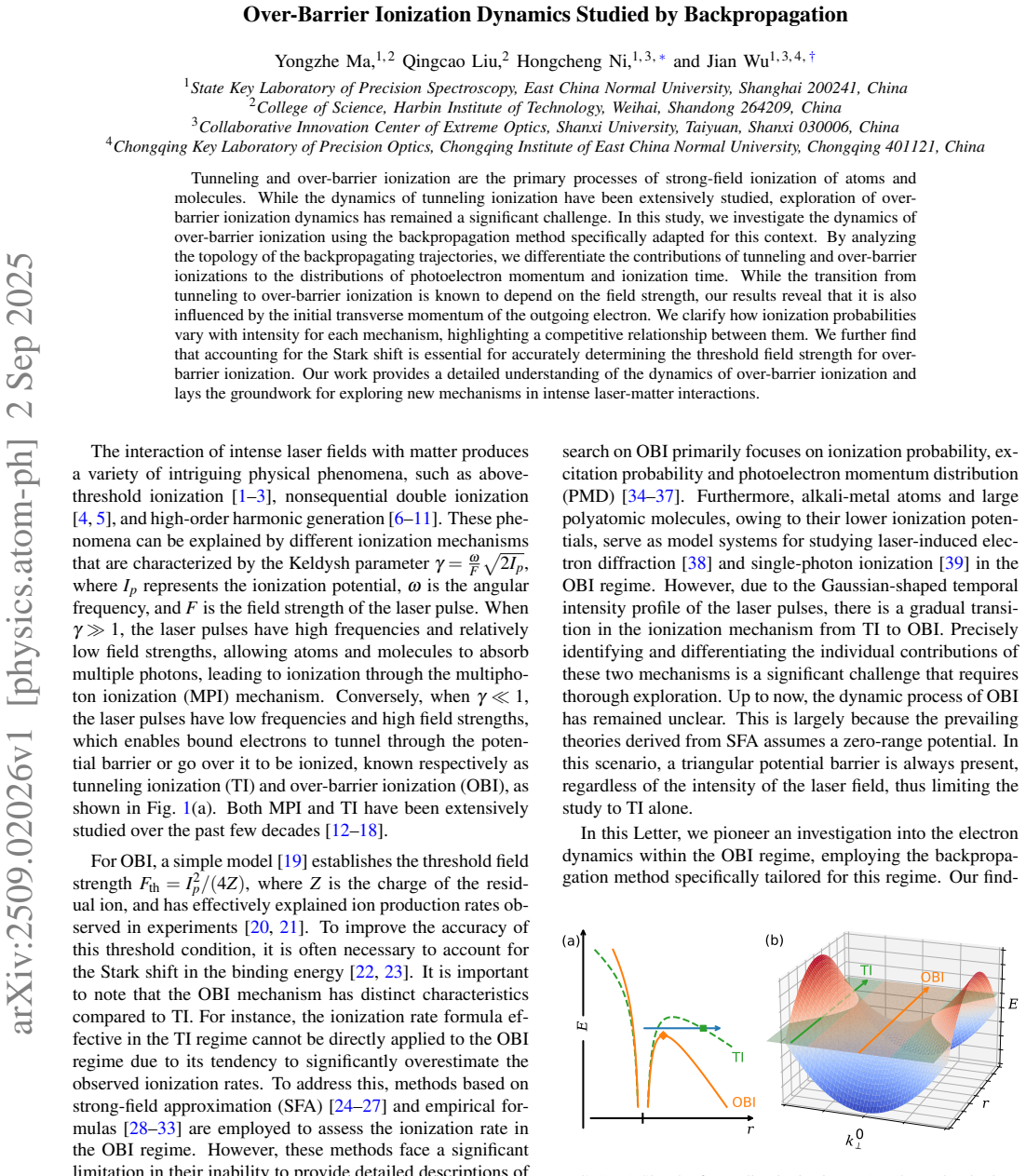
- [Effective potential barrier discussion, Fig. 1(b) and Eq. for E] The manuscript states that 'OBI occurs for specific values of transverse momentum k_perp when the ground-state energy exceeds the corresponding saddle surface level,' and uses this to explain the central OBI arc. This is an independent, quantitative criterion, but it is never compared with the numerical TI/OBI boundary extracted from the trajectory tag. A direct test would be to plot the observed OBI region in the (field, k_perp) plane against the saddle energy condition E = 1/2 k_perp^2 - 1/r + r F_c. Without this comparison, the k_perp-dependence claim rests entirely on the qualitative tagging rule, and the 'sharp border' statement in the following paragraph is circular: a binary classification always produces a sharp boundary, regardless of whether the underlying physics is sharp.
- ['Remarkably, this border is sharp'] The sentence 'This is because the categorization of TI and OBI is based on trajectory topology, which is a binary condition' explains a property of the classification, not a property of the ionization dynamics. The physical question is whether the binary mechanism boundary, after appropriate binning and finite statistics, appears as a sharp contrast in physical observables. The current wording may mislead readers into thinking that sharpness of the extracted PMD boundary is a discovery rather than an artifact of the tagging procedure. Please replace this explanation with a quantitative analysis of the boundary width and its relation to the saddle criterion.
- [Eq. (3), fitting function] The fit P_OBI = -0.288 I^(-1.758) + 0.809 is negative for intensities below the fitted zero crossing (for example, at I = 0.3 a.u. it evaluates to approximately -0.13). As written, it cannot represent an ionization probability over the lower range of Fig. 5. If the fit is intended only for the OBI-active range above threshold, the text should state the fitting domain and the number of data points used; otherwise a bounded functional form should be adopted.
minor comments (4)
- [Fig. 4 caption vs. text] The caption refers to 'yellow solid lines' while the body text says 'orange solid lines'. Please unify.
- [Eq. (5) and threshold values] The solving of Eq. (5) is stated without the numerical method or the value of I_p used for the model helium atom. Given that I_p is needed to reproduce F_Stark_th = 0.222, please state it explicitly.
- [Notation for barrier top in Fig. 2(b)] The distinction between the tunnel exit in Fig. 2(a1) and the barrier top in Fig. 2(b1) would be clearer if the coordinates of the ion and the field direction were marked on both panels.
- [General] The sentence 'the PMD for TI encircles that for OBI' is qualitative; adding an angular or radial histogram with error bars would strengthen the claim.
Circularity Check
The OBI tagging rule pre-encodes the k_perp dependence; the sharp border and the PMD sum-check are tautological.
-
self definitional
[Fig. 2(b) definition of OBI trajectory; paragraph after Fig. 3: 'a smaller transverse momentum k⊥, associated with OBI ... results in a PMD concentrated in the central region']
"The second category involves trajectories where the electron returns to the proximity of the parent ion during backpropagation and subsequently orbits around it, thereby creating a 'hole' in the trajectory at the ion, which effectively makes the trajectory 'topological'. This trajectory is characteristic of OBI. ... a smaller transverse momentum k⊥, associated with OBI [orange arrow in Fig. 1(b)], results in a PMD concentrated in the central region."
The OBI category is defined as 'orbits around' the parent ion. Orbital capture in a Coulomb potential requires small angular momentum about the ion, which is kinematically equivalent to small initial transverse momentum k⊥. The paper then presents 'OBI electrons have smaller k⊥ / occupy the central PMD arc' as a new finding. This is the selection rule itself, not an independent consequence: the tagged set is constructed to contain low-k⊥ orbits, so the k⊥-dependence of the TI/OBI border is pre-encoded in the tag. The paper never validates the tag against the independent energy-over-saddle criterion it states ('OBI occurs for specific values of transverse momentum k⊥ when the ground-state energy exceeds the corresponding saddle surface level').
-
self definitional
[Section 'PMD for TI and OBI', paragraph on the sharp border]
"Remarkably, this border is sharp. This is because the categorization of TI and OBI is based on trajectory topology, which is a binary condition."
The sharpness of the TI/OBI border is presented as a notable result, but the explanation given is simply that the classification is binary. Any binary labeling of continuous trajectories produces a sharp boundary in the momentum distribution by construction. The 'border' is therefore a property of the tag, not a dynamically derived feature of the ionization process.
1 more flagged steps
-
other
[Paragraph after Fig. 3]
"As expected, the sum of these two distributions constitutes the complete PMD, which is displayed in Fig. 3(c). This confirms the accuracy of the trajectory classification within the backpropagation method."
This check is vacuous as a validation: since every backpropagated trajectory is assigned to exactly one of the two classes, the sum of the two class-resolved PMDs equals the total PMD by construction. It tests exhaustiveness of the label, not whether the label corresponds to the physical TI/OBI mechanisms. Thus it cannot support the accuracy of the classification.
full rationale
The paper's central new result—that the TI/OBI boundary depends on k⊥ and that OBI electrons populate the central PMD arc—is reached via a trajectory tag whose definition ('orbits around the parent ion') is kinematically a low-angular-momentum / low-k⊥ selection. While the tag is not literally a k⊥ cutoff, the paper does not independently validate it against the standard energy-over-saddle OBI condition, so the claimed k⊥ dependence is substantially pre-encoded. The 'sharp border' is explicitly explained as a consequence of binary classification, i.e. a tautology. The Fig. 3(c) check is also an artifact of exhaustive labeling rather than a physical validation. The intensity-dependent probabilities and the Stark-shift threshold comparison are not themselves circular—they are a fit and an external model comparison—but they inherit whatever bias the tag introduces. The backpropagation method is cited from prior work including the authors, but that method is externally established and not the source of circularity. Overall, partial circularity in the central classification-derived claims warrants a score of 6.
Assumptions & free parameters
free parameters (4)
- POBI fit parameters (a, n, b) =
a = -0.288, n = -1.758, b = 0.809
- PTI+OBI fit parameters (a, n, b) =
a = -0.313, n = -1.377, b = 1.355
- Model polarizability alpha of 2D helium =
alpha = 1.57
- OBI trajectory-tagging tolerances =
unspecified
assumptions (6)
- domain assumption Single-active-electron, two-dimensional model for helium with model potential from ref. 30
- domain assumption Ionized wave packet can be converted into classical trajectories and backpropagated faithfully
- domain assumption Constant electron energy during the ionization stage in the effective barrier model
- domain assumption Asymptotic momentum p = k_perp - A(t) with Coulomb potential neglected
- domain assumption Quadratic Stark shift 0.5 alpha F^2 applies at threshold fields
- standard math Depletion correction via P(t) divided by (1 - integral of Pt) (Eq. 2)
Cite this review
Pith. "Pith review of Over-Barrier Ionization Dynamics Studied by Backpropagation." pith.science (2026). https://pith.science/paper/VZXN6OAI
@misc{pith2026250902026,
  author       = {Pith},
  title        = {Pith review of: Over-Barrier Ionization Dynamics Studied by Backpropagation},
  year         = {2026},
  howpublished = {\url{https://pith.science/paper/VZXN6OAI}},
  note         = {Machine review of arXiv:2509.02026}
}
read the original abstract
Tunneling and over-barrier ionization are the primary processes of strong-field ionization of atoms and molecules. While the dynamics of tunneling ionization have been extensively studied, exploration of over-barrier ionization dynamics has remained a significant challenge. In this study, we investigate the dynamics of over-barrier ionization using the backpropagation method specifically adapted for this context. By analyzing the topology of the backpropagating trajectories, we differentiate the contributions of tunneling and over-barrier ionizations to the distributions of photoelectron momentum and ionization time. While the transition from tunneling to over-barrier ionization is known to depend on the field strength, our results reveal that it is also influenced by the initial transverse momentum of the outgoing electron. We clarify how ionization probabilities vary with intensity for each mechanism, highlighting a competitive relationship between them. We further find that accounting for the Stark shift is essential for accurately determining the threshold field strength for over-barrier ionization. Our work provides a detailed understanding of the dynamics of over-barrier ionization and lays the groundwork for exploring new mechanisms in intense laser-matter interactions.
Figures


Figures from the paper (2 more)


Reference graph
Works this paper leans on
-
[1]
P. Agostini, F. Fabre, G. Mainfray, G. Petite, and N. K. Rahman, Free-free transitions following six-photon ionization of xenon atoms, Phys. Rev. Lett. 42, 1127 (1979)
work page 1979
-
[2]
J. H. Eberly, J. Javanainen, and K. Rza˙zewski, Above-threshold ionization, Phys. Rep. 204, 331 (1991)
work page 1991
- [3]
-
[4]
D. N. Fittinghoff, P. R. Bolton, B. Chang, and K. C. Kulander, Observation of nonsequential double ionization of helium with optical tunneling, Phys. Rev. Lett. 69, 2642 (1992)
work page 1992
- [5]
- [6]
-
[7]
J. L. Krause, K. J. Schafer, and K. C. Kulander, High-order harmonic generation from atoms and ions in the high intensity regime, Phys. Rev. Lett. 68, 3535 (1992)
work page 1992
-
[8]
J. J. Macklin, J. D. Kmetec, and C. L. Gordon, High-order har- monic generation using intense femtosecond pulses, Phys. Rev. Lett. 70, 766 (1993)
work page 1993
Show all 54 references
-
[9]
P. B. Corkum, Plasma perspective on strong field multiphoton ionization, Phys. Rev. Lett. 71, 1994 (1993)
1994
-
[10]
Lewenstein, Ph
M. Lewenstein, Ph. Balcou, M. Yu. Ivanov, A. L’Huillier, and P. B. Corkum, Theory of high-harmonic generation by low- frequency laser fields, Phys. Rev. A 49, 2117 (1994)
1994
-
[11]
Popmintchev, M.-C
T. Popmintchev, M.-C. Chen, P. Arpin, M. M. Murnane, and H. C. Kapteyn, The attosecond nonlinear optics of bright co- herent X-ray generation, Nat. Photonics 4, 822 (2010)
2010
-
[12]
L. V . Keldysh, Ionization in the field of a strong electromagnetic wave, Sov. Phys. JETP 20, 1307 (1965)
1965
-
[13]
M. V . Ammosov, N. B. Delone, and V . P. Krainov, Tunnel ion- ization of complex atoms and of atomic ions in an alternating electromagnetic field, Sov. Phys. JETP 64, 1191 (1986)
1986
-
[14]
M. Y . Ivanov, M. Spanner, and O. Smirnova, Anatomy of strong field ionization, J. Mod. Opt. 52, 165 (2005)
2005
-
[15]
V . S. Popov, Tunnel and multiphoton ionization of atoms and ions in a strong laser field (keldysh theory), Phys.-Usp. 47, 855 (2004)
2004
-
[16]
S. V . Popruzhenko, Keldysh theory of strong field ionization: history, applications, difficulties and perspectives, J. Phys. B. 47, 204001 (2014)
2014
-
[17]
L. V . Keldysh, Multiphoton ionization by a very short pulse, Phys.-Usp. 60, 1187 (2017)
2017
-
[18]
Y . Ma, H. Ni, and J. Wu, Attosecond Ionization Time Delays in Strong-Field Physics, Chin. Phys. B 33, 013201 (2024)
2024
-
[19]
Augst, D
S. Augst, D. Strickland, D. D. Meyerhofer, S. L. Chin, and J. H. Eberly, Tunneling ionization of noble gases in a high-intensity laser field, Phys. Rev. Lett. 63, 2212 (1989)
1989
-
[20]
Augst, D
S. Augst, D. D. Meyerhofer, D. Strickland, and S. L. Chin, Laser ionization of noble gases by coulomb-barrier suppres- sion, J. Opt. Soc. Am. B 8, 858 (1991)
1991
-
[21]
Auguste, P
T. Auguste, P. Monot, L. A. Lompre, G. Mainfray, and C. Manus, Multiply charged ions produced in noble gases by a 1 ps laser pulse at lambda =1053 nm, J. Phys. B. 25, 4181 (1992)
1992
-
[22]
Bauer, Ejection energy of photoelectrons in strong-field ion- ization, Phys
D. Bauer, Ejection energy of photoelectrons in strong-field ion- ization, Phys. Rev. A 55, 2180 (1997)
1997
-
[23]
G ¨orlinger, L
J. G ¨orlinger, L. Plagne, and H.-J. Kull, Above-barrier ionization and quantum interference in strong laser fields, Appl. Phys. B 71, 331 (2000)
2000
-
[24]
Krainov and B
V . Krainov and B. Shokri, Energy and angular distributions of electrons resulting from barrier-suppression ionization of atoms by strong low-frequency radiation, J. Exp. Theor. Phys.80, 657 (1995)
1995
-
[25]
V . P. Krainov, Ionization rates and energy and angular distri- butions at the barrier-suppression ionization of complex atoms and atomic ions, J. Opt. Soc. Am. B 14, 425 (1997)
1997
-
[26]
N. B. Delone and V . P. Krainov, Tunneling and barrier- suppression ionization of atoms and ions in a laser radiation field, Phys.-Usp. 41, 469 (1998)
1998
-
[27]
Klaiber, K
M. Klaiber, K. Z. Hatsagortsyan, and C. H. Keitel, General- ized analytical description of relativistic strong-field ionization, Phys. Rev. A 110, 023103 (2024). 6
2024
-
[28]
Bauer and P
D. Bauer and P. Mulser, Exact field ionization rates in the barrier-suppression regime from numerical time-dependent schr¨odinger-equation calculations, Phys. Rev. A59, 569 (1999)
1999
-
[29]
Scrinzi, M
A. Scrinzi, M. Geissler, and T. Brabec, Ionization above the coulomb barrier, Phys. Rev. Lett. 83, 706 (1999)
1999
-
[30]
hole” in the trajectory at the ion, which ef- fectively makes the trajectory “topological
by a short circularly polarized laser pulse, whose vector potential is given by (atomic units are used unless stated oth- erwise) A(t) = A0√ 2 cos4 ωt 2N [cos(ωt) ˆex + sin(ωt) ˆey] , (1) where A0 is the amplitude of the vector potential correspond- ing to a peak intensity of ...
-
[31]
X. M. Tong and C. D. Lin, Empirical formula for static field ionization rates of atoms and molecules by lasers in the barrier- suppression regime, J. Phys. B. 38, 2593 (2005)
2005
-
[32]
Zhang, P
Q. Zhang, P. Lan, and P. Lu, Empirical formula for over-barrier strong-field ionization, Phys. Rev. A 90, 043410 (2014)
2014
-
[33]
J. H. Bauer, Search for the best analytical formula in the tunnel- ing and the barrier-suppression ionization regimes, J. Phys. B. 50, 085601 (2017)
2017
-
[34]
Remme, A
S. Remme, A. B. V oitkiv, G. Pretzler, and C. M ¨uller, Phe- nomenological rate formulas for over-barrier ionization of hy- drogen and helium atoms in strong constant electric fields, arXiv:2502.02697 (2025)
2025 arXiv
-
[35]
W. Yang, X. Song, and Z. Chen, Phase-dependent above-barrier ionization of excited-state electrons, Opt. Express 20, 12067 (2012)
2012
-
[36]
J. H. Bauer, F. Mota-Furtado, P. F. O’Mahony, B. Piraux, and K. Warda, Ionization and excitation of the excited hydrogen atom in strong circularly polarized laser fields, Phys. Rev. A 90, 063402 (2014)
2014
-
[37]
Song, J.-W
S.-N. Song, J.-W. Geng, H.-B. Jiang, and L.-Y . Peng, Compara- tive study of H(2s) and H(2p0) ionization dynamics in the over- barrier regime, Phys. Rev. A 89, 053411 (2014)
2014
-
[38]
Jheng, T.-F
S.-D. Jheng, T.-F. Jiang, J.-H. Chen, and J.-L. Liu, Magnetic quantum number dependence of hydrogen photoelectron spec- tra under circularly polarized pulse in barrier suppression ion- ization regime, Phys. Scr. 93, 085401 (2018)
2018
-
[39]
Belsa, K
B. Belsa, K. M. Ziems, A. Sanchez, K. Chirvi, X. Liu, S. Gr ¨afe, and J. Biegert, Laser-induced electron diffraction in the over-the-barrier-ionization regime, Phys. Rev. A 106, 043105 (2022)
2022
-
[40]
H. Ma, X. Wang, L. Zhang, Z. Zou, J. Yuan, Y . Ma, R. Lv, Z. Shen, T. Yan, M. Weidem ¨uller, D. Ye, and Y . Jiang, Few- photon single ionization of cold rubidium in the over-the-barrier regime, Phys. Rev. A 107, 033114 (2023)
2023
-
[41]
H. Ni, U. Saalmann, and J.-M. Rost, Tunneling ionization time resolved by backpropagation, Phys. Rev. Lett. 117, 023002 (2016)
2016
-
[42]
H. Ni, U. Saalmann, and J.-M. Rost, Tunneling exit characteris- tics from classical backpropagation of an ionized electron wave packet, Phys. Rev. A 97, 013426 (2018)
2018
-
[43]
H. Ni, N. Eicke, C. Ruiz, J. Cai, F. Oppermann, N. I. Shvetsov- Shilovski, and L.-W. Pi, Tunneling criteria and a nonadia- batic term for strong-field ionization, Phys. Rev. A 98, 013411 (2018)
2018
-
[44]
Hofmann, A
C. Hofmann, A. Bray, W. Koch, H. Ni, and N. I. Shvetsov- Shilovski, Quantum battles in attoscience: tunnelling, Eur. Phys. J. D 75, 208 (2021)
2021
-
[45]
H. Ni, S. Brennecke, X. Gao, P.-L. He, S. Donsa, I. B ˇrezinov´a, F. He, J. Wu, M. Lein, X.-M. Tong, and J. Burgd ¨orfer, Theory of subcycle linear momentum transfer in strong-field tunneling ionization, Phys. Rev. Lett. 125, 073202 (2020)
2020
-
[46]
Y . H. Kim, I. A. Ivanov, and K. T. Kim, Classical backpropa- gation for probing the backward rescattering time of a tunnel- ionized electron in an intense laser field, Phys. Rev. A 104, 013116 (2021)
2021
-
[47]
Y . Ma, H. Ni, Y . Li, F. He, and J. Wu, Subcycle Conservation Law in Strong-Field Ionization, Ultrafast Sci. 4, 0071 (2024)
2024
-
[48]
Klaiber, E
M. Klaiber, E. Yakaboylu, H. Bauke, K. Z. Hatsagortsyan, and C. H. Keitel, Under-the-barrier dynamics in laser-induced rela- tivistic tunneling, Phys. Rev. Lett. 110, 153004 (2013)
2013
-
[49]
Li, J.-W
M. Li, J.-W. Geng, M. Han, M.-M. Liu, L.-Y . Peng, Q. Gong, and Y . Liu, Subcycle nonadiabatic strong-field tunneling ion- ization, Phys. Rev. A 93, 013402 (2016)
2016
-
[50]
Eckart, K
S. Eckart, K. Fehre, N. Eicke, A. Hartung, J. Rist, D. Tra- bert, N. Strenger, A. Pier, L. P. H. Schmidt, T. Jahnke, M. S. Sch¨offler, M. Lein, M. Kunitski, and R. D ¨orner, Direct experi- mental access to the nonadiabatic initial momentum offset upon tunnel ionization, Phys. ...
2018
-
[51]
K. Liu, S. Luo, M. Li, Y . Li, Y . Feng, B. Du, Y . Zhou, P. Lu, and I. Barth, Detecting and characterizing the nonadiabaticity of laser-induced quantum tunneling, Phys. Rev. Lett. 122, 053202 (2019)
2019
-
[52]
Klaiber, Q
M. Klaiber, Q. Z. Lv, S. Sukiasyan, D. Bakucz Can ´ario, K. Z. Hatsagortsyan, and C. H. Keitel, Reconciling conflicting ap- proaches for the tunneling time delay in strong field ionization, Phys. Rev. Lett. 129, 203201 (2022)
2022
-
[53]
van de Sand and J
G. van de Sand and J. M. Rost, Irregular orbits generate higher harmonics, Phys. Rev. Lett. 83, 524 (1999)
1999
-
[54]
Rodr ´ıguez-Hern´andez, F
F. Rodr ´ıguez-Hern´andez, F. Grossmann, and J. M. Rost, Cut- off for continuum-continuum high-order harmonic generation, Phys. Rev. A 105, L051102 (2022)
2022
Reviewed August 5, 2026 · model on record in the stance chip above.
Discussion (0). Continue with ORCID to comment.