REVIEW 3 major objections 5 minor 90 references
Long-term evolution of the SN 2009ip-like transient SN 2016cvk
T0 review · 3 major / 5 minor · reviewed 2026-08-05 · deepseek-v4-flash
Pith's one-line read This paper argues that the +405-day spectrum of the interacting transient SN 2016cvk shows the forbidden oxygen doublet at 6300/6364 Å more prominently than any previous SN 2009ip-like event, pointing to a genuine core-collapse explosion ra
desk verdict A careful, data-rich study of a rare transient; the new late-time [O I] claim is plausible but rests on one low-S/N spectrum, so treat it as conditional. read the letter →
The pith
A machine-rendered reading of the paper's core claim, the machinery that carries it, and where it could break.
The reading
What carries the argument
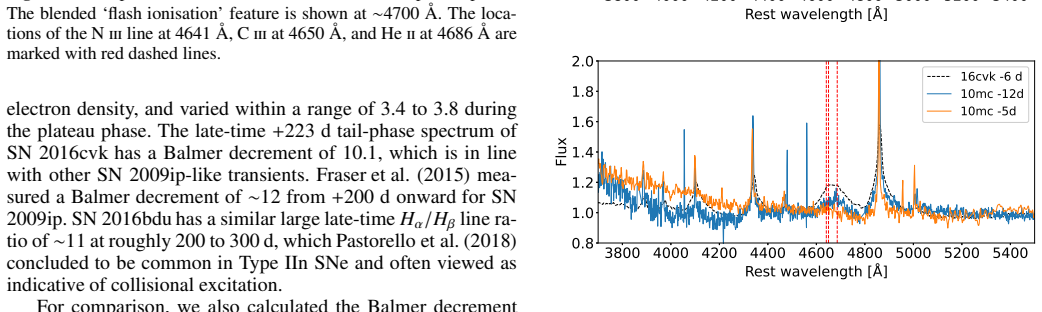
The load-bearing object is the forbidden [O I] doublet at 6300 and 6364 Å. In a supernova, this doublet is the standard late-time tracer of freshly nucleosynthesised oxygen: it requires the low densities and high temperatures of expanding ejecta, and it is not produced by the circumstellar interaction that otherwise lights up Type IIn spectra. Its presence at +405 d, at a FWHM of ~4700 km s⁻¹, is the paper's evidence that event B involved a real stellar disruption. The complementary machinery is the flash-ionisation blend of He II 4686, N III 4641, and C III 4650 Å seen in the earliest spectra—a short-lived recombination signature of extended, dense circumstellar gas—which the paper uses bot
What would settle it
A deep, high-signal-to-noise spectrum of SN 2016cvk taken now, at more than eight years past peak, that resolves the 6300/6364 Å doublet: a ratio approaching 3:1 with both components at matching FWHM would confirm genuine oxygen ejecta, while a persistent ~1.2 ratio together with the [Ni II] 7378/7412 Å doublet at similar width would show the 'oxygen' feature was contaminated and the terminal-explosion evidence drawn from it was an artefact of the fit.
Extended reading notes
Core claim
The paper's central observational claim is that the +405 d spectrum of SN 2016cvk, obtained with the VLT, contains a feature at ~6300 Å identified as the forbidden [O I] doublet at 6300 and 6364 Å. A double-Gaussian fit gives a FWHM of ~4700 km s⁻¹ for both components, comparable to the intermediate-width ejecta components of the interacting supernova SN 1995N, and the paper interprets the line as possible evidence of nucleosynthesised oxygen—the classic late-time signature of a genuine core-collapse explosion embedded in circumstellar interaction. The authors place this in context: weak [O I] had been reported in SN 2009ip, SN 2016bdu, and SN 2016jbu, but in SN 2016cvk it is, to their knowl
Load-bearing premise
The load-bearing premise is that the faint ~6300 Å feature in the single, noisy +405 d spectrum is really the [O I] doublet: the measured 6300/6364 Å flux ratio is ~1.2 instead of the canonical 3:1, so the feature could be a blend with Fe II or [Ni II], in which case the evidence that SN 2016cvk ejected nucleosynthesised oxygen—and was therefore a terminal supernova—loses its footing.
Editorial extensions
If this is right
- If the [O I] identification holds, SN 2016cvk becomes the clearest example yet of a terminal explosion in the SN 2009ip-like family, strengthening the case that the event-A/event-B double-eruption pattern is pre-supernova activity of a doomed massive star.
- Late-time spectroscopy becomes a decisive tool for this class: the +405 d observation shows that a single deep spectrum near +400 d can separate core-collapse from impostor scenarios better than light curves alone.
- The flash-ionisation features lasting ~16 days imply an extended, dense circumstellar medium, and the abundance comparison favours a red, yellow, or blue supergiant progenitor—narrowing the mass-loss-history question for SN 2009ip-like systems.
- The close resemblance of the late-time spectrum to SN 2010jl suggests SN 2009ip-like events and ordinary interacting Type IIn supernovae may form a continuum of massive-star explosions with varying circumstellar properties.
Reading between the lines
- A deep, high-signal-to-noise spectrum at the present epoch—more than eight years past peak—could settle the oxygen identification: if the 6300/6364 Å ratio approaches 3:1, the nucleosynthesis claim moves from plausible to firm; a persistent ~1.2 ratio alongside [Ni II] 7378/7412 Å structure would favour a blend.
- If confirmed, the [O I] flux could eventually be converted into a rough ejected-oxygen mass linking SN 2016cvk to core-collapse yield predictions, although the paper itself notes that collisional suppression blocks this path at present.
- The same flash-ionisation diagnostic, applied to the precursor outbursts at roughly -1219, -700, and -440 d, could connect the duration of the ionised-CSM phase to the star's final mass-loss history, effectively mapping its last years onto its explosion.
- The viewing-angle interpretation for the single-peaked Balmer lines implies a selection effect: SN 2009ip-like events viewed close to edge-on may be systematically harder to recognise, biasing the observed fraction of such events toward more pole-on geometries.
Editorial analysis
A structured set of objections, weighed in public.
Referee Report
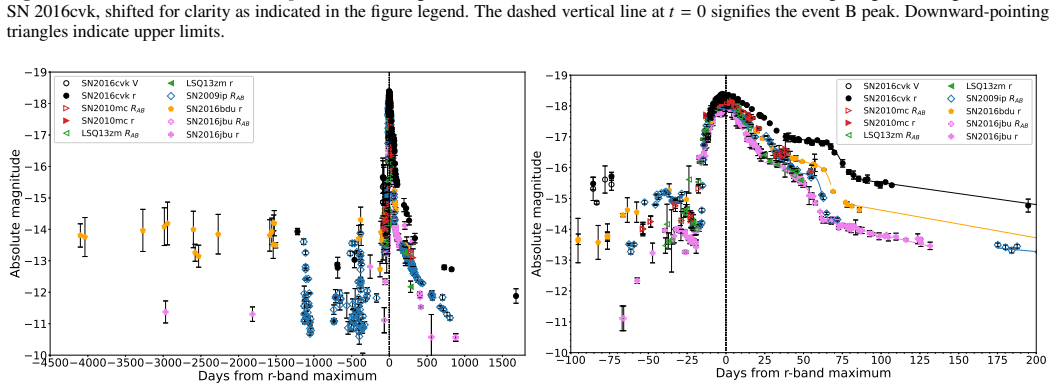
Summary. The paper presents a long-term spectrophotometric study of SN 2016cvk, a SN 2009ip-like interacting transient, using UV, optical, and NIR data extending to +1681 d from the r-band maximum. The authors identify two luminous events (A and B), characterize the light-curve phases with analytic fits, model the blackbody evolution, and perform multi-component fits to the H-alpha and H-beta profiles. They report early flash-ionization features (C III, N III, He II) lasting 16 ± 5 d, and compare the event to other SN 2009ip-like transients. The main physical claim is that the late-time +405 d spectrum contains a [O I] 6300/6364 Å doublet, which they interpret as possible evidence of nucleosynthesised material from a terminal core-collapse explosion. The paper also discusses the lack of double-peaked Balmer lines, suggesting an edge-on CSM disc, and uses the flash-feature spectrum to argue for an RSG/YSG/BSG-like progenitor rather than an LBV.
Significance. If the [O I] identification is correct, this would be the most prominent late-time [O I] detection in a SN 2009ip-like event and would strengthen the terminal-explosion interpretation for this class. The paper's strengths are its extensive, well-calibrated dataset, the careful multi-component line fits (Tables A.7, A.8), the detection of flash features in SN 2016cvk and in previously unreported spectra of SN 2016jbu, and the transparent comparison with other SN 2009ip-like events. No circularity is apparent: the fitted blackbody, Fermi-Dirac, and line-profile parameters are descriptive and are compared to external models. The paper would be a valuable addition to the SN 2009ip-like literature even without the terminal-explosion claim, but the [O I] detection is the load-bearing step for the nucleosynthesis conclusion, and that step currently rests on a single low-S/N spectrum and an unresolved line fit.
major comments (3)
- [Sect. 4.6; Fig. 14] The terminal-explosion/nucleosynthesis conclusion rests on the identification of [O I] in the single +405 d VLT/FORS2 spectrum. The presented double-Gaussian fit cannot resolve the doublet: each component has FWHM=4700 km/s, while the 6300/6364 Å separation is only ~3050 km/s, so the two Gaussians are heavily blended and a single broad feature (or a blend of [Fe II]/[Ni II] lines) can reproduce the bump. The paper does not report a fit comparison (single vs double Gaussian), residual plots, or the S/N of the feature. The related claim that this is 'the most prominent detection' among SN 2009ip-like events is also made without quantitative equivalent-width or flux measurements of the comparison features. This needs to be substantiated or the claim demoted to tentative.
- [Sect. 4.6, line ratio and suppression] The measured flux ratio I(6300)/I(6364)=1.2 deviates strongly from the 3:1 ratio expected for optically thin [O I]. The paper attributes this to collisional suppression but gives no quantitative model. In a metal-rich, interaction-dominated CSM, Fe ii and [Ni ii] lines in this region are a plausible alternative; no fit was attempted with those species. Because the +82 d and +223 d spectra do not show the feature, the identification relies entirely on one epoch with subjective continuum subtraction. Please provide a quantitative treatment (e.g., fitting the doublet with a physically motivated line ratio or a density/temperature model) or explicitly present the identification as speculative and not evidence for a terminal SN.
- [Abstract; Sect. 6] The abstract states that [O I] is 'detected particularly clearly' and the conclusions use it as 'possible evidence of nucleosynthesised material generated in a SN explosion.' Given the unresolved fit and anomalous line ratio, this is an overstatement relative to the evidence. The text should be aligned with the result of the requested tests; if the identification remains ambiguous, the terminal-explosion statement should be removed or clearly qualified as one of several possible interpretations.
minor comments (5)
- [Title; throughout] The transient is written as 'SN 2016cvk' in the text but 'SN 2016 cvk' in the title; please standardize.
- [Table 1 vs Sect. 3.1.2] The r-band peak magnitude for SN 2016cvk is -18.4 in Table 1 but -18.3 ± 0.1 in the text; reconcile.
- [Sect. 4.6 vs Sect. 6] The [O I] doublet ratio is given as 1.2 in Sect. 4.6 but described as 'close to unity' in the Conclusions; use one value.
- [Fig. 14] The figure caption lists only [O I] and [Ca ii] fits, while the spectrum labels [Ni II]? and [Fe II]; add the fitted/annotated species to the caption or legend.
- [Sect. 5] The edge-on disc-like CSM interpretation is speculative; it is presented with appropriate hedging, but it would help to mark it explicitly as a geometric conjecture in the conclusions.
Circularity Check
No significant circularity: the analysis is observational, fits are descriptive, and the central [O I] claim is presented with explicit caveats rather than derived from its own input.
full rationale
The paper's inference chain is self-contained and data-driven. Light-curve phase parameters (Sect. 3.1) are descriptive fits to photometry; blackbody temperatures and radii (Sect. 3.2) are standard SED fits; Balmer-line component fits (Sect. 4.1) characterize observed profiles. The central claim—possible [O I] at +405 d (Sect. 4.6, Fig. 14, Conclusions)—is a spectral identification anchored to rest wavelengths, not an input relabeled as a prediction. The paper explicitly reports the non-canonical I(6300)/I(6364)=1.2 ratio, attributes it to collisional suppression, and phrases the nucleosynthesis interpretation as 'likely' and 'possible evidence', so the feature is not being used to assert the terminal-explosion conclusion by construction. Comparisons to external models (Boian & Groh 2019) and to other transients (SN 2010jl, SN 2009ip) provide independent points of reference. The few self-citations (e.g., Brennan et al. 2022b,c for fitting methodology and a geometric CSM model) are not load-bearing for the [O I] detection or the physical nature conclusion. No equation is shown to reduce to its own inputs, and no fitted parameter is renamed as a prediction. The low S/N and possible blending of the +405 d [O I] feature are legitimate robustness concerns, but they are acknowledged in the paper and do not constitute circularity.
Assumptions & free parameters
free parameters (4)
- Plateau and tail Fermi-Dirac fit parameters (M0, p1, tPT, a0, omega0) =
Not listed globally; fit per object and epoch
- Event B onset time texp from exponential rise fit =
-11 d for SN 2016cvk; -19 d for SN 2016jbu; -13.7 d for SN 2015bh
- Blackbody temperature and radius per epoch =
T from 5100 to 13800 K; R from 7.4e14 to 1.6e15 cm (Table A.6)
- Balmer line component widths and centers (L1, G1, G2, G3) =
Tables A.7 and A.8
assumptions (6)
- domain assumption Cosmology: H0 = 73 km/s/Mpc, OmegaM = 0.27, OmegaLambda = 0.73 for luminosity distances.
- domain assumption Galactic extinction from Schlafly and Finkbeiner (2011) with the Cardelli et al. (1989) law, RV = 3.1, and negligible host extinction.
- domain assumption Blackbody emission approximation for the CSM photosphere.
- domain assumption Boian and Groh (2019) flash-feature models approximate the early spectra sufficiently for abundance comparison.
- domain assumption Hamuy (2003) 56Ni mass relation applies to the tail luminosity, modified as an upper limit because CSM interaction is ongoing.
- domain assumption The 6300 and 6364 Å features in the +405 d spectrum are the [O I] doublet.
invented entities (1)
-
Edge-on disc-like CSM around SN 2016cvk
Cite this review
Pith. "Pith review of Long-term evolution of the SN 2009ip-like transient SN 2016cvk." pith.science (2026). https://pith.science/paper/GMHDASPA
@misc{pith2026250902125,
  author       = {Pith},
  title        = {Pith review of: Long-term evolution of the SN 2009ip-like transient SN 2016cvk},
  year         = {2026},
  howpublished = {\url{https://pith.science/paper/GMHDASPA}},
  note         = {Machine review of arXiv:2509.02125}
}
read the original abstract
The interacting transient SN 2016cvk (ASASSN-16jt) is a member of the peculiar SN 2009ip-like events. We present our follow-up data and aim to draw conclusions about the physical nature of the progenitor system. Our spectrophotometric data set of SN 2016cvk covers the ultraviolet, optical, and near-infrared wavelength region extending to +1681 d from the light curve peak; the data is analysed and compared to other SN 2009ip-like transients. Archival data reveals pre-outbursts of the progenitor with the first detection at -1219 d. The light curve evolution of SN 2016cvk consists of two consecutive luminous events A and B with peak magnitudes of M_V < -15.6 and M_r = -18.3 mag, respectively. The spectra are dominated by Balmer emission lines that have a complex, multi-component evolution similar to other SN 2009ip-like targets. SN 2016cvk is among the first detected SN 2009ip-like events that show early `flash ionisation' features of C III, N III, and He II, lasting for 16 +/- 5 d. Our late-time +405 d spectrum shows forbidden [Ca II], [Fe II], and [O I] features with the latter detected particularly clearly for a SN 2009ip-like event. The evolution of SN 2016cvk is similar to other SN 2009ip-like transients, with some uncommon traits. The lack of a double-peaked structure in the Balmer lines is likely caused by differences in the circumstellar medium structure or viewing angle. The flash features in the early spectra propose abundances consistent with a red, yellow, or blue supergiant progenitor rather than for example a luminous blue variable. The detection of [O I] in the +405 d spectrum suggests possible evidence of nucleosynthesised material generated in a SN explosion.
Figures


Figures from the paper (10 more)




Reference graph
Works this paper leans on
-
[1]
Abbott , T. M. C., Adam \'o w , M., Aguena , M., et al. 2021, , 255, 20
2021
-
[2]
P., Gonz \'a lez-Gait \'a n , S., Hamuy , M., et al
Anderson , J. P., Gonz \'a lez-Gait \'a n , S., Hamuy , M., et al. 2014, , 786, 67
2014
-
[3]
2016, Transient Name Server Classification Report, 2016-650, 1
Bersier , D., Smartt , S., & Yaron , O. 2016, Transient Name Server Classification Report, 2016-650, 1
2016
-
[4]
& Groh , J
Boian , I. & Groh , J. H. 2018, , 617, A115
2018
-
[5]
& Groh , J
Boian , I. & Groh , J. H. 2019, , 621, A109
2019
-
[6]
A., Pearson, J., Shrestha, M., et al
Bostroem, K. A., Pearson, J., Shrestha, M., et al. 2023, , 956, L5
2023
-
[7]
J., Barmentloo , S., Schulze , S., et al
Brennan , S. J., Barmentloo , S., Schulze , S., et al. 2025, , submitted
2025
-
[8]
J., Elias-Rosa , N., Fraser , M., Van Dyk , S
Brennan , S. J., Elias-Rosa , N., Fraser , M., Van Dyk , S. D., & Lyman , J. D. 2022 a , , 664, L18
2022
Show all 90 references
-
[9]
J., Fraser , M., Johansson , J., et al
Brennan , S. J., Fraser , M., Johansson , J., et al. 2022 b , , 513, 5642
2022
-
[10]
J., Fraser , M., Johansson , J., et al
Brennan , S. J., Fraser , M., Johansson , J., et al. 2022 c , , 513, 5666
2022
-
[11]
S., Stanek , K
Brimacombe , J., Brown , J. S., Stanek , K. Z., et al. 2016, The Astronomer's Telegram, 9439, 1
2016
-
[12]
S., Prieto , J
Brown , J. S., Prieto , J. L., Shappee , B. J., et al. 2016, The Astronomer's Telegram, 9445, 1
2016
-
[13]
M., Baliber , N., Bianco , F
Brown , T. M., Baliber , N., Bianco , F. B., et al. 2013, , 125, 1031
2013
-
[14]
J., Gal-Yam , A., Yaron , O., et al
Bruch , R. J., Gal-Yam , A., Yaron , O., et al. 2023, , 952, 119
2023
-
[15]
N., Hill , J
Burrows , D. N., Hill , J. E., Nousek , J. A., et al. 2005, , 120, 165
2005
-
[16]
A., Clayton , G
Cardelli , J. A., Clayton , G. C., & Mathis , J. S. 1989, , 345, 245
1989
-
[17]
& Jacobson-Gal \'a n , W
Dessart , L. & Jacobson-Gal \'a n , W. V. 2023, , 677, A105
2023
-
[18]
Drake , S. A. & Ulrich , R. K. 1980, , 42, 351
1980
-
[19]
Dwarkadas , V. V. 2011, , 412, 1639
2011
-
[20]
2016, , 463, 3894
Elias-Rosa , N., Pastorello , A., Benetti , S., et al. 2016, , 463, 3894
2016
-
[21]
Fassia , A., Meikle , W. P. S., Chugai , N., et al. 2001, , 325, 907
2001
-
[22]
A., Filippenko , A
Fransson , C., Chevalier , R. A., Filippenko , A. V., et al. 2002, , 572, 350
2002
-
[23]
J., et al
Fransson , C., Ergon , M., Challis , P. J., et al. 2014, , 797, 118
2014
-
[24]
2013, , 433, 1312
Fraser , M., Inserra , C., Jerkstrand , A., et al. 2013, , 433, 1312
2013
-
[25]
2015, , 453, 3886
Fraser , M., Kotak , R., Pastorello , A., et al. 2015, , 453, 3886
2015
-
[26]
O., et al
Gal-Yam , A., Arcavi , I., Ofek , E. O., et al. 2014, , 509, 471
2014
-
[27]
& Leonard , D
Gal-Yam , A. & Leonard , D. C. 2009, , 458, 865
2009
-
[28]
2004, , 611, 1005
Gehrels , N., Chincarini , G., Giommi , P., et al. 2004, , 611, 1005
2004
-
[29]
2025, , accepted for publication
Goto , S., Yamanaka , M., Nagayama , T., et al. 2025, , accepted for publication
2025
-
[30]
L., Bigley , A., Mauerhan , J
Graham , M. L., Bigley , A., Mauerhan , J. C., et al. 2017, , 469, 1559
2017
-
[31]
L., Sand , D
Graham , M. L., Sand , D. J., Valenti , S., et al. 2014, , 787, 163
2014
-
[32]
H., Georgy , C., & Ekstr \"o m , S
Groh , J. H., Georgy , C., & Ekstr \"o m , S. 2013, , 558, L1
2013
-
[33]
2003, , 582, 905
Hamuy , M. 2003, , 582, 905
2003
-
[34]
P., Giovanelli , R., Herter , T., et al
Haynes , M. P., Giovanelli , R., Herter , T., et al. 1997, , 113, 1197
1997
-
[35]
B., Wiersema , K., Covino , S., et al
Higgins , A. B., Wiersema , K., Covino , S., et al. 2019, , 482, 5023
2019
-
[36]
2023, , 955, L8
Hiramatsu , D., Tsuna , D., Berger , E., et al. 2023, , 955, L8
2023
-
[37]
V., Davis , K
Jacobson-Gal \'a n , W. V., Davis , K. W., Kilpatrick , C. D., et al. 2024, , 972, 177
2024
-
[38]
V., Dessart , L., Jones , D
Jacobson-Gal \'a n , W. V., Dessart , L., Jones , D. O., et al. 2022, , 924, 15
2022
-
[39]
V., Dessart , L., Margutti , R., et al
Jacobson-Gal \'a n , W. V., Dessart , L., Margutti , R., et al. 2023, , 954, L42
2023
-
[40]
Z., Kochanek , C
Jayasinghe , T., Stanek , K. Z., Kochanek , C. S., et al. 2019, , 485, 961
2019
-
[41]
E., Prieto , J
Jencson , J. E., Prieto , J. L., Kochanek , C. S., et al. 2016, , 456, 2622
2016
-
[42]
E., Sand , D
Jencson , J. E., Sand , D. J., Andrews , J. E., et al. 2022, , 935, L33
2022
-
[43]
P., Richards , G
Jester , S., Schneider , D. P., Richards , G. T., et al. 2005, , 130, 873
2005
-
[44]
2016, , 818, 3
Khazov , D., Yaron , O., Gal-Yam , A., et al. 2016, , 818, 3
2016
-
[45]
D., Foley , R
Kilpatrick , C. D., Foley , R. J., Drout , M. R., et al. 2018, , 473, 4805
2018
-
[46]
2020, , 642, A214
Kurf \"u rst , P., Pejcha , O., & Krti c ka , J. 2020, , 642, A214
2020
-
[47]
M., Stringfellow , G
Levesque , E. M., Stringfellow , G. S., Ginsburg , A. G., Bally , J., & Keeney , B. A. 2014, , 147, 23
2014
-
[48]
M., et al
Margutti , R., Milisavljevic , D., Soderberg , A. M., et al. 2014, , 780, 21
2014
-
[49]
G., Smith , N., et al
Mauerhan , J., Williams , G. G., Smith , N., et al. 2014, , 442, 1166
2014
-
[50]
C., Smith , N., Filippenko , A
Mauerhan , J. C., Smith , N., Filippenko , A. V., et al. 2013, , 430, 1801
2013
-
[51]
2009, Central Bureau Electronic Telegrams, 1928, 1
Maza , J., Hamuy , M., Antezana , R., et al. 2009, Central Bureau Electronic Telegrams, 1928, 1
2009
-
[52]
Moore , C. E. 1945, Contributions from the Princeton University Observatory, 20, 1
1945
-
[53]
A., Menanteau , F., et al
Morganson , E., Gruendl , R. A., Menanteau , F., et al. 2018, , 130, 074501
2018
-
[54]
J., Galbany , L., Jim \'e nez-Palau , C., et al
Moriya , T. J., Galbany , L., Jim \'e nez-Palau , C., et al. 2023, , 677, A20
2023
-
[55]
B., & Ingargiola, A
Newville, M., Stensitzki, T., Allen, D. B., & Ingargiola, A. 2014, Zenodo
2014
-
[56]
2018, Research Notes of the American Astronomical Society, 2, 230
Nicholl , M. 2018, Research Notes of the American Astronomical Society, 2, 230
2018
-
[57]
O., Lin , L., Kouveliotou , C., et al
Ofek , E. O., Lin , L., Kouveliotou , C., et al. 2013 a , , 768, 47
2013
-
[58]
O., Sullivan , M., Cenko , S
Ofek , E. O., Sullivan , M., Cenko , S. B., et al. 2013 b , , 494, 65
2013
-
[59]
2010, , 715, 833
Olivares, F., Hamuy, M., Pignata, G., et al. 2010, , 715, 833
2010
-
[60]
Osterbrock , D. E. & Ferland , G. J. 2006, Astrophysics of gaseous nebulae and active galactic nuclei (University Science Books)
2006
-
[61]
2016, Transient Name Server Discovery Report, 2016-422, 1
Parker , S. 2016, Transient Name Server Discovery Report, 2016-422, 1
2016
-
[62]
2013, , 767, 1
Pastorello , A., Cappellaro , E., Inserra , C., et al. 2013, , 767, 1
2013
-
[63]
S., Fraser , M., et al
Pastorello , A., Kochanek , C. S., Fraser , M., et al. 2018, , 474, 197
2018
-
[64]
2025, , accepted for publication
Pastorello , A., Reguitti , A., Tartaglia , L., et al. 2025, , accepted for publication
2025
-
[65]
2024, , 688, L28
Pessi , T., Cartier , R., Hueichapan , E., et al. 2024, , 688, L28
2024
-
[66]
L., & Dessart , L
Pessi , T., Prieto , J. L., & Dessart , L. 2023, , 677, L1
2023
-
[67]
L., Monard , B., et al
Pessi , T., Prieto , J. L., Monard , B., et al. 2022, , 928, 138
2022
-
[68]
L., Brimacombe , J., Drake , A
Prieto , J. L., Brimacombe , J., Drake , A. J., & Howerton , S. 2013, , 763, L27
2013
-
[69]
2024, , 686, A231
Reguitti , A., Pignata , G., Pastorello , A., et al. 2024, , 686, A231
2024
-
[70]
R., Baade , D., et al
Reilly , E., Maund , J. R., Baade , D., et al. 2017, , 470, 1491
2017
-
[71]
Roming , P. W. A., Kennedy , T. E., Mason , K. O., et al. 2005, , 120, 95
2005
-
[72]
D., Kool , E
Ryder , S. D., Kool , E. C., Stockdale , C. J., et al. 2016, The Astronomer's Telegram, 9475, 1
2016
-
[73]
Schlafly , E. F. & Finkbeiner , D. P. 2011, , 737, 103
2011
-
[74]
Z., et al
Shappee , B., Prieto , J., Stanek , K. Z., et al. 2014, in American Astronomical Society Meeting Abstracts, Vol. 223, American Astronomical Society Meeting Abstracts \#223, 236.03
2014
-
[75]
A., Sand , D
Shrestha , M., Bostroem , K. A., Sand , D. J., et al. 2024, , 972, L15
2024
-
[76]
F., Cutri , R
Skrutskie , M. F., Cutri , R. M., Stiening , R., et al. 2006, , 131, 1163
2006
-
[77]
Smartt , S. J. 2009, , 47, 63
2009
-
[78]
J., Valenti , S., Fraser , M., et al
Smartt , S. J., Valenti , S., Fraser , M., et al. 2015, , 579, A40
2015
-
[79]
E., Filippenko, A
Smith, N., Andrews, J. E., Filippenko, A. V., et al. 2022, , 515, 71
2022
-
[80]
C., Kasliwal , M
Smith , N., Mauerhan , J. C., Kasliwal , M. M., & Burgasser , A. J. 2013, , 434, 2721
2013
-
[81]
C., & Prieto , J
Smith , N., Mauerhan , J. C., & Prieto , J. L. 2014, , 438, 1191
2014
-
[82]
J., et al
Smith , N., Pearson , J., Sand , D. J., et al. 2023, , 956, 46
2023
-
[83]
2016, , 459, 1039
Tartaglia , L., Pastorello , A., Sullivan , M., et al. 2016, , 459, 1039
2016
-
[84]
The Astropy Collaboration , Robitaille, T. P. , Tollerud, E. J. , et al. 2013, , 558, A33
2013
-
[85]
C., de Ugarte Postigo , A., Leloudas , G., et al
Th \"o ne , C. C., de Ugarte Postigo , A., Leloudas , G., et al. 2017, , 599, A129
2017
-
[86]
2011, , 416, 3138
Valenti , S., Fraser , M., Benetti , S., et al. 2011, , 416, 3138
2011
-
[87]
I., Ryan-Weber , E
Wong , O. I., Ryan-Weber , E. V., Garcia-Appadoo , D. A., et al. 2006, , 371, 1855
2006
-
[88]
Wright , E. L. 2006, , 118, 1711
2006
-
[89]
, " * write output.state after.block = add.period write newline
ENTRY address archiveprefix author booktitle chapter edition editor howpublished institution eprint journal key month note number organization pages publisher school series title type volume year label extra.label sort.label short.list INTEGERS output.state before.all mid.sent...
-
[90]
write newline
" write newline "" before.all 'output.state := FUNCTION n.dashify 't := "" t empty not t #1 #1 substring "-" = t #1 #2 substring "--" = not "--" * t #2 global.max substring 't := t #1 #1 substring "-" = "-" * t #2 global.max substring 't := while if t #1 #1 substring * t #2 gl...
Reviewed August 5, 2026 · model on record in the stance chip above.
Discussion (0). Sign in to comment.