REVIEW 2 major objections 5 minor 51 references
Achieving wavenumber robustness in domain decomposition for heterogeneous Helmholtz equation: an overview of spectral coarse spaces
T0 review · 2 major / 5 minor · reviewed 2026-08-05 · deepseek-v4-flash
Pith's one-line read This paper claims that harmonic and extended-harmonic spectral coarse spaces give the best balance of GMRES efficiency and coarse-space size for high-frequency heterogeneous Helmholtz solvers, while DtN and Hk-GenEO spaces break down in the
desk verdict Solid benchmark with a credible ranking of Helmholtz coarse spaces, but the 3D 'breakdown' of DtN and Hk-GenEO is a fixed-budget artifact, not an established failure. read the letter →
The pith
A machine-rendered reading of the paper's core claim, the machinery that carries it, and where it could break.
The reading
What carries the argument
The central object is the spectral coarse space: a set of global basis functions assembled by partition of unity from eigenvectors of local eigenproblems. The decisive difference between families is which local problem is diagonalized and which vectors are admitted. DtN diagonalizes an interface Dirichlet-to-Neumann map and extends the eigenfunctions by a Helmholtz extension. GenEO-type methods diagonalize volumetric operators; Hk-GenEO uses a positive-definite surrogate operator close to the indefinite Helmholtz operator. Harmonic and extended-harmonic spaces diagonalize self-adjoint, coercive eigenproblems whose eigenfunctions are constrained to be local Helmholtz-harmonic fields (solution
What would settle it
Rerun the two 3D benchmarks where DtN and Hk-GenEO break down—the COBRA cavity at k=360 m^-1 with 2916 subdomains and the GO_3D_OBS test with 1024 subdomains—allowing 400 or 1000 eigenvectors per subdomain and up to 1000 GMRES iterations. If either method then reaches the 1e-6 residual tolerance with moderate iteration counts, the reported 3D breakdown is an artifact of the 200-dimensional budget rather than a genuine robustness failure.
Extended reading notes
Core claim
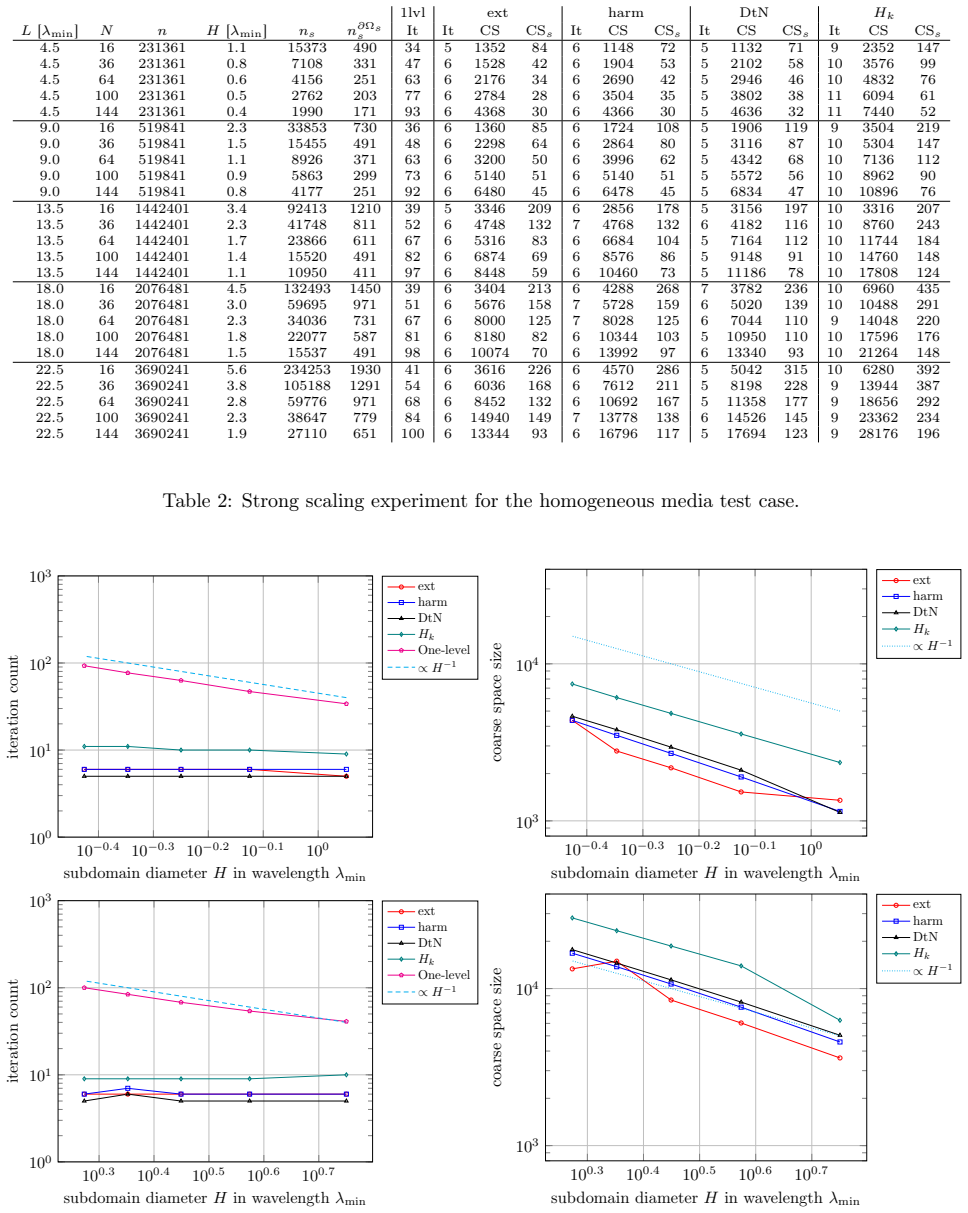
The discovery is comparative and empirical. Within a common two-level ORAS (optimized restricted additive Schwarz) preconditioner and a non-restarted GMRES solver, the paper tests DtN (Dirichlet-to-Neumann), GenEO-type (Generalized Eigenproblems in the Overlap, specifically Hk-GenEO), harmonic, and extended-harmonic coarse spaces on problems from a homogeneous square to the COBRA cavity and the GO_3D_OBS crustal geomodel. Every two-level method beats the one-level baseline by a wide margin, but the balance of robustness and coarse-space size shifts with dimensionality: harmonic and extended-harmonic spaces give the lowest iteration counts for a given coarse-space size and keep those counts u
Load-bearing premise
The load-bearing premise is that failing to converge within 200 eigenvectors per subdomain and 200 GMRES iterations counts as genuine loss of robustness; the paper reports no experiments with larger budgets that would rule out a budget-limited failure.
Editorial extensions
If this is right
- For high-frequency 3D heterogeneous Helmholtz problems, practitioners should build two-level ORAS preconditioners with extended-harmonic or harmonic coarse spaces rather than DtN or Hk-GenEO spaces.
- Two-level coarse correction is not optional: in these tests every spectral coarse space dramatically outperforms the one-level ORAS baseline as frequency or domain size grows.
- Wavenumber robustness is achievable with compact coarse spaces whose dimension tracks the number of subdomain-interface unknowns, provided the selected modes are genuinely Helmholtz-harmonic.
- Working eigenvalue thresholds are roughly 5–10 for extended-harmonic, about 10 for harmonic, 500–1000 for DtN, and 0.8–1 for Hk-GenEO.
- In 3D, DtN and Hk-GenEO should be used with caution on large domains: the paper reports breakdown on the COBRA cavity and GO_3D_OBS benchmarks.
Reading between the lines
- Because the paper's 3D 'breakdown' verdicts are made under a fixed budget of 200 eigenvectors per subdomain and 200 GMRES iterations, an immediate extension is to rerun those benchmarks with larger budgets; convergence there would demote the failure from structural to budget-limited.
- The fact that the robust harmonic spaces stay roughly interface-sized suggests the information needed for wavenumber robustness lives on subdomain interfaces, so a hybrid that combines DtN-style boundary extraction with Helmholtz-harmonic projection might produce even cheaper robust spaces.
- If coarse-space solve cost dominates each GMRES iteration, total wall-clock time in 2D could still favor DtN despite slightly higher iteration counts; the paper leaves setup and solve timing for future work, so the runtime ranking is still open.
- The fixed first-level preconditioner, solver, meshes, and threshold sweeps make this comparison directly reusable: any new coarse space can be ranked on the same coarse-space-size-versus-iteration curves without new theory.
Editorial analysis
A structured set of objections, weighed in public.
Referee Report
Summary. The manuscript presents a unified numerical comparison of four spectral coarse spaces—DtN, Hk-GenEO, harmonic, and extended-harmonic—used in two-level ORAS preconditioners for the heterogeneous Helmholtz equation. The study is conducted in the FreeFEM/ffddm framework across 2D square, medical-imaging, COBRA-cavity, and GO_3D_OBS benchmarks, and reports iteration counts, coarse-space sizes, and scaling behavior. The central claim is that extended-harmonic coarse spaces offer the best trade-off between solver efficiency and coarse-space size, while DtN and Hk-GenEO, though competitive in 2D, break down in large 3D problems.
Significance. If the comparison is accepted, this is a practically valuable benchmark study for a community that lacks definitive guidance among spectral coarse spaces for high-frequency heterogeneous Helmholtz problems. The paper benefits from a single common implementation, large-scale 3D tests, a clear comparison framework, and a publicly available example script. However, the strength of the conclusions depends on the fairness and completeness of the numerical protocol, especially for the 3D negative verdicts.
major comments (2)
- [§5.3, Tables 6–7; §5.4, Table 7; §6, Table 8] The 3D 'breakdown' verdicts for DtN and Hk-GenEO rest on runs with a fixed per-subdomain budget of exactly 200 coarse vectors (CSs=200 in every row) and GMRES stopped at 200 iterations (entries '>200'). The manuscript does not test whether these methods would converge with, say, 400 or 1000 vectors per subdomain, even though the reported n∂Ωs ≈ 5000 makes such budgets feasible. 'Breakdown within a fixed budget' is not equivalent to 'inherently not robust'; the paper conflates the two. Since Table 8 and Section 6 carry these verdicts, this is a load-bearing gap: either experiments with larger budgets are needed, or the claims must be reformulated as budget-limited observations.
- [§5.1.3; also §5.2–§5.3] The headline tables report 'the parameters with the minimum number of iterations obtained for each method.' This means every method is evaluated at its individually tuned best. The resulting iteration counts and coarse-space sizes are therefore not produced under a common resource constraint. The threshold-sweep figures provide useful sensitivity information, but the 'best trade-off' conclusion in Section 6 would be more solid if the cross-method comparison were also made at a fixed budget or fixed threshold, rather than only at per-method optima.
minor comments (5)
- [§5.1.3, Tables 2–7] The column header 'CSs' is defined only in the text of §5.1.3. Each table caption should repeat the definition, because the repeated 'It CS CS s' blocks are otherwise hard to parse.
- [§5.2] The typo 'Matèrn' for the point-process name should be corrected to 'Matérn' or 'Matern'.
- [Table 8] The symbols ✓, ✓✓, and ✓/✗ are not quantitatively defined. State the criteria (e.g., convergence within a given iteration budget, relative coarse-space size) so the table is reproducible rather than subjective.
- [§4.3.2, Eq. (4.18)] The extended-harmonic eigenproblem is dense and introduced quickly. A short paragraph interpreting the action of Rs ˇRT_s − bA^{-1}_s Rs ˇRT_s ˇAs on a candidate vector would help the reader understand why the construction yields Helmholtz-harmonic coarse functions.
- [§6] The paper explicitly leaves setup and GMRES run times out of scope, yet the conclusion uses the word 'trade-off' repeatedly. A reader cannot fully judge practical trade-offs without at least an indication of setup costs; this should be acknowledged more prominently in the abstract or conclusions.
Circularity Check
No significant circularity: the paper is an empirical comparison, and its conclusions are drawn from its own experiments rather than from definitional or self-citational loops.
full rationale
The paper is a numerical overview, not a derivation: it implements four coarse-space families in a common FreeFEM/ffddm framework and compares them on benchmark problems. The main claim—that extended-harmonic coarse spaces offer the best trade-off between solver efficiency and coarse space size—is supported by the reported GMRES iteration counts and coarse-space sizes (Tables 2–7, Figures 2–18), not by an equation that presupposes the conclusion. There is no step in which an object is defined in terms of the quantity it is said to predict, and no fitted parameter is renamed as a prediction. The eigenvalue thresholds are tuned per test case ('The results reported in the table correspond to the parameters with the minimum number of iterations obtained for each method', Section 5.1.3), but this is best-case benchmarking rather than a circular fit: the measured iteration counts are genuine outputs of the solver on the same problems, and the comparison is explicitly framed as an assessment of each method under favorable tuning. The paper does rely on citations to prior work, including [43] (co-authored by Parolin) for the extended-harmonic space and [42,38] for harmonic spaces, but the comparative verdict is obtained from the paper's own numerical experiments, so the self-citations are not load-bearing. The 3D negative verdicts for DtN and Hk-GenEO are limited by the fixed computational budget of 200 coarse vectors per subdomain and 200 GMRES iterations (Tables 6–7: all entries show CSs = 200 and '>200' for non-convergence; Section 5.3 and 5.4 call this 'breakdown'). This is an experimental limitation and a possible overstatement—'breakdown within a fixed budget' is not necessarily 'inherently not robust'—but it is not a circularity: the conclusion does not reduce by definition to the budget, and the paper does not claim to have tested larger budgets. Overall, the central content is self-contained empirical comparison, so the circularity score is 0.
Assumptions & free parameters
free parameters (5)
- Eigenvalue threshold tau per coarse-space family =
DtN 500-1000; harmonic ~10; extended-harmonic 5-10; Hk-GenEO 0.8-1
- Per-subdomain coarse-space budget cap =
200 eigenvectors per subdomain in 3D tests (Tables 6-7)
- GMRES maximum iterations =
200 for 3D tables
- Mesh resolution (points per wavelength) =
10 (square), 22 (imaging), 8 (COBRA), 4 (GO_3D_OBS)
- Overlap width and partition of unity =
Minimal overlap (2 cell layers), default steep P1 partition of unity
assumptions (5)
- domain assumption The continuous Helmholtz boundary value problem (2.1) is well posed and the chosen Robin/PML truncations faithfully approximate the Sommerfeld radiation condition.
- domain assumption P1/P2 finite element discretization with fixed points-per-wavelength controls the pollution effect sufficiently.
- domain assumption Each spectral coarse space is implemented faithfully as specified in its source paper ([14], [9], [13], [38], [42], [43]) and the ffddm framework is correct.
- standard math GMRES with right preconditioning at tolerance 1e-6 is a reliable proxy for solver efficiency.
- domain assumption The 3D benchmark problems (COBRA cavity, GO_3D_OBS crustal model) are representative of realistic mid-to-high-frequency Helmholtz challenges.
Cite this review
Pith. "Pith review of Achieving wavenumber robustness in domain decomposition for heterogeneous Helmholtz equation: an overview of spectral coarse spaces." pith.science (2026). https://pith.science/paper/VYONSJVP
@misc{pith2026250902131,
  author       = {Pith},
  title        = {Pith review of: Achieving wavenumber robustness in domain decomposition for heterogeneous Helmholtz equation: an overview of spectral coarse spaces},
  year         = {2026},
  howpublished = {\url{https://pith.science/paper/VYONSJVP}},
  note         = {Machine review of arXiv:2509.02131}
}
read the original abstract
Solving time-harmonic wave propagation problems in the frequency domain within heterogeneous media poses significant mathematical and computational challenges, particularly in the high-frequency regime. Among the available numerical approaches, domain decomposition methods are widely regarded as effective due to their suitability for parallel computing and their capacity to maintain robustness with respect to physical parameters, such as the wavenumber. These methods can achieve near-constant time-to-solution as the wavenumber increases, though often at the expense of a computationally intensive coarse correction step. This work focuses on identifying the best algorithms and numerical strategies for benchmark problems modelled by the Helmholtz equation. Specifically, we examine and compare several coarse spaces which are part of different families, e.g. GenEO (Generalised Eigenvalue Overlap) type coarse spaces and harmonic coarse spaces, that underpin two-level domain decomposition methods. By leveraging spectral information and multiscale approaches, we aim to provide a comprehensive overview of the strengths and weaknesses of these methods. Numerical experiments demonstrate that the effectiveness of these coarse spaces depends on the specific problem and numerical configuration, highlighting the trade-offs between computational cost, robustness, and practical applicability.
Figures


Figures from the paper (15 more)


Reference graph
Works this paper leans on
-
[1]
A Robust Two-Level Schwarz Preconditioner For Sparse Matrices
H. Al Daas, P. Jolivet, F. Nataf, and P.-H. Tournier.A Robust Two-Level Schwarz Preconditioner For Sparse Matrices. 2024. arXiv:2401.03915
work page Pith review arXiv 2024
-
[2]
A fully asynchronous multifrontal solver using dis- tributed dynamic scheduling
P. Amestoy, I. Duff, J.-Y. L’Excellent, and J. Koster. “A fully asynchronous multifrontal solver using dis- tributed dynamic scheduling”. In:SIAM J. Matrix Anal. Appl.23.1 (2001), pp. 15–41.url: http://mumps. enseeiht.fr
work page 2001
-
[3]
I. M. Babuska and S. A. Sauter. “Is the pollution effect of the FEM avoidable for the Helmholtz equation considering high wave numbers?” In:SIAM J. Numer. Anal.34.6 (1997), pp. 2392–2423. doi: 10 . 1137 / S0036142993255035
work page 1997
-
[4]
H. Beriot and A. Modave. “An automatic perfectly matched layer for acoustic finite element simulations in convex domains of general shape”. In:International Journal for Numerical Methods in Engineering122 (2021), pp. 1239–1261.doi: 10.1002/nme.6581
-
[5]
An exact bounded PML for the Helmholtz equation
A. Bermúdez, L. Hervella-Nieto, A. Prieto, and R. Rodríguez. “An exact bounded PML for the Helmholtz equation”. In:C. R. Math. Acad. Sci. Paris339.11 (2004), pp. 803–808.doi: 10.1016/j.crma.2004.10.006
-
[6]
M. Bonazzoli, V. Dolean, I. G. Graham, E. A. Spence, and P.-H. Tournier. “Domain decomposition precon- ditioning for the high-frequency time-harmonic Maxwell equations with absorption”. In:Math. Comp.88.320 (2019), pp. 2559–2604.doi: 10.1090/mcom/3447
-
[7]
N. Bootland and V. Dolean. “On the Dirichlet-to-Neumann coarse space for solving the Helmholtz prob- lem using domain decomposition”. In:Numerical mathematics and advanced applications—ENUMATH 2019. Vol. 139. Lect. Notes Comput. Sci. Eng. Springer, Cham, 2021, pp. 175–184.doi: 10.1007/978- 3- 030- 55874-1\_16
doi:10.1007/978- 2019
-
[8]
Can DtN and GenEO Coarse Spaces Be Sufficiently Robust for Heteroge- neous Helmholtz Problems?
N. Bootland and V. Dolean. “Can DtN and GenEO Coarse Spaces Be Sufficiently Robust for Heteroge- neous Helmholtz Problems?” In:Mathematical and Computational Applications27.3 (2022). doi: 10.3390/ mca27030035
work page 2022
Show all 51 references
-
[9]
Overlapping Schwarz methods with Ge- nEO coarse spaces for indefinite and nonself-adjoint problems
N. Bootland, V. Dolean, I. G. Graham, C. Ma, and R. Scheichl. “Overlapping Schwarz methods with Ge- nEO coarse spaces for indefinite and nonself-adjoint problems”. In:IMA J. Numer. Anal.43.4 (Aug. 2022), pp. 1899–1936. doi: 10.1093/imanum/drac036
2022 doi
-
[10]
GenEO coarse spaces for heterogeneous indefinite elliptic problems
N. Bootland, V. Dolean, I. G. Graham, C. Ma, and R. Scheichl. “GenEO coarse spaces for heterogeneous indefinite elliptic problems”. In:Domain decomposition methods in science and engineering XXVI. Vol. 145. Lect. Notes Comput. Sci. Eng. Springer, Cham, 2022, pp. 117–125.doi: 1...
2022 doi
-
[11]
AcomparisonofcoarsespacesforHelmholtzproblems in the high frequency regime
N.Bootland,V.Dolean,P.Jolivet,andP.-H.Tournier.“AcomparisonofcoarsespacesforHelmholtzproblems in the high frequency regime”. In:Comput. Math. Appl.98 (2021), pp. 239–253. doi: 10.1016/j.camwa. 2021.07.011
2021 doi
-
[12]
Wave-ray multigrid method for standing wave equations
A. Brandt and I. Livshits. “Wave-ray multigrid method for standing wave equations”. In:Electron. Trans. Numer. Anal.6 (1997), pp. 162–181
1997
-
[13]
Chaumont-Frelet, V
T. Chaumont-Frelet, V. Dolean, M. Fry, I. G. Graham, and M. Langer. Spectral coarse spaces based on indefinite operators: theHk-GenEO method. 2024. arXiv:2406.06283
2024 arXiv
-
[14]
A coarse space for heterogeneous Helmholtz problems based on the Dirichlet-to-Neumann operator
L. Conen, V. Dolean, R. Krause, and F. Nataf. “A coarse space for heterogeneous Helmholtz problems based on the Dirichlet-to-Neumann operator”. In:J. Comput. Appl. Math.271 (2014), pp. 83–99.doi: 10.1016/j. cam.2014.03.031
2014 doi
-
[15]
Large-scale frequency-domain seismic wave modeling on h- adaptive tetrahedral meshes with iterative solver and multi-level domain-decomposition preconditioners
V. Dolean, P. Jolivet, P. Tournier, and S. Operto. “Large-scale frequency-domain seismic wave modeling on h- adaptive tetrahedral meshes with iterative solver and multi-level domain-decomposition preconditioners”. In: 90th Annual International Meeting, SEG Technical Program Ex...
2020 doi
-
[16]
Dolean, M
V. Dolean, M. Fry, and M. Langer.Improvements to the theoretical estimates of the Schwarz preconditioner with ∆-GenEO coarse space for the indefinite Helmholtz problem. 2024. arXiv:2403.18378
2024 arXiv
-
[17]
Effective transmission conditions for domain decomposition methods applied to the time-harmonic curl-curl Maxwell’s equations
V. Dolean, M. J. Gander, S. Lanteri, J.-F. Lee, and Z. Peng. “Effective transmission conditions for domain decomposition methods applied to the time-harmonic curl-curl Maxwell’s equations”. In:J. Comput. Phys. 280 (2015), pp. 232–247.doi: 10.1016/j.jcp.2014.09.024
2015 doi
-
[18]
Dolean, P
V. Dolean, P. Jolivet, and F. Nataf.An introduction to domain decomposition methods. Society for Industrial and Applied Mathematics (SIAM), Philadelphia, PA, 2015, pp. x+238.doi: 10.1137/1.9781611974065.ch1
2015 doi
-
[19]
Iterative frequency-domain seismic wave solvers based on multi-level domain-decomposition preconditioners
V. Dolean, P. Jolivet, P. Tournier, and S. Operto. “Iterative frequency-domain seismic wave solvers based on multi-level domain-decomposition preconditioners”. In:EAGE 2020 Annual Conference & Exhibition Online
2020
-
[20]
2020, pp
European Association of Geoscientists & Engineers. 2020, pp. 1–5
2020
-
[21]
Analysis of a two-level Schwarz method with coarse spaces based on local Dirichlet-to-Neumann maps
V. Dolean, F. Nataf, R. Scheichl, and N. Spillane. “Analysis of a two-level Schwarz method with coarse spaces based on local Dirichlet-to-Neumann maps”. In:Comput. Methods Appl. Math.12.4 (2012), pp. 391–414.doi: 10.2478/cmam-2012-0027
2012 doi
-
[22]
Why it is difficult to solve Helmholtz problems with classical iterative methods
O. G. Ernst and M. J. Gander. “Why it is difficult to solve Helmholtz problems with classical iterative methods”. In: Numerical analysis of multiscale problems. Vol. 83. Lect. Notes Comput. Sci. Eng. Springer, Heidelberg, 2012, pp. 325–363.doi: 10.1007/978-3-642-22061-6\_10
2012 doi
-
[23]
FETI-DPH: a dual-primal domain decomposition method for acoustic scattering
C. Farhat, P. Avery, R. Tezaur, and J. Li. “FETI-DPH: a dual-primal domain decomposition method for acoustic scattering”. In:J. Comput. Acoust.13.3 (2005), pp. 499–524.doi: 10.1142/S0218396X05002761
2005 doi
-
[24]
A two-level domain decomposition method for the iterative solution of high frequency exterior Helmholtz problems
C. Farhat, A. Macedo, and M. Lesoinne. “A two-level domain decomposition method for the iterative solution of high frequency exterior Helmholtz problems”. In:Numer. Math.85.2 (2000), pp. 283–308.doi: 10.1007/ PL00005389
2000
-
[25]
Global-basis two-level method for indefinite systems. I. Convergence studies
J. Fish and Y. Qu. “Global-basis two-level method for indefinite systems. I. Convergence studies”. In:Internat. J. Numer. Methods Engrg.49.3 (2000), pp. 439–460.doi: 10.1002/1097-0207(20000930)49:3<439::AID- NME981>3.0.CO;2-A
2000 doi
-
[26]
Thehp-FEM applied to the Helmholtz equation with PML truncation does not suffer from the pollution effect
J. Galkowski, D. Lafontaine, E. A. Spence, and J. Wunsch. “Thehp-FEM applied to the Helmholtz equation with PML truncation does not suffer from the pollution effect”. In:Commun. Math. Sci.22.7 (2024), pp. 1761–
2024
-
[27]
M. J. Gander and H. Zhang. “A class of iterative solvers for the Helmholtz equation: factorizations, sweeping preconditioners, source transfer, single layer potentials, polarized traces, and optimized Schwarz methods”. In: SIAM Rev.61.1 (2019), pp. 3–76.doi: 10.1137/16M109781X
2019 doi
-
[28]
Galkowski and E
J. Galkowski and E. A. Spence. Convergence theory for two-level hybrid Schwarz preconditioners for high- frequency Helmholtz problems. 2025. arXiv:2501.11060
2025
-
[29]
Garnier, L
J. Garnier, L. Giovangigli, Q. Goepfert, and P. Millien.Probing the speckle to estimate the effective speed of sound, a first step towards quantitative ultrasound imaging. 2025. arXiv:2505.07566
2025 arXiv
-
[30]
Garnier, L
J. Garnier, L. Giovangigli, Q. Goepfert, and P. Millien.Scattered wavefield in the stochastic homogenization regime. 2023. arXiv:2309.07777
2023
-
[31]
GO_3D_OBS: the multi-parameter benchmark geomodel for seismic imaging method assessment and next-generation 3D survey design (version 1.0)
A. Górszczyk and S. Operto. “GO_3D_OBS: the multi-parameter benchmark geomodel for seismic imaging method assessment and next-generation 3D survey design (version 1.0)”. In:Geoscientific Model Development 14.3 (2021), pp. 1773–1799. 25
2021
-
[32]
Domain decomposition preconditioners for high-order discretiza- tions of the heterogeneous Helmholtz equation
S. Gong, I. G. Graham, and E. A. Spence. “Domain decomposition preconditioners for high-order discretiza- tions of the heterogeneous Helmholtz equation”. In:IMA J. Numer. Anal.41.3 (2021), pp. 2139–2185.doi: 10.1093/imanum/draa080
2021 doi
-
[33]
Recent Results on Domain Decomposition Preconditioning for the High-Frequency Helmholtz Equation Using Absorption
I. G. Graham, E. A. Spence, and E. Vainikko. “Recent Results on Domain Decomposition Preconditioning for the High-Frequency Helmholtz Equation Using Absorption”. In:Lahaye D., Tang J., Vuik K. (eds) Modern Solvers for Helmholtz Problems. Geosystems Mathematics. Birkhäuser, Cha...
2017 doi
-
[34]
Toward a robust workflow for deep crustal imaging by FWI of OBS data: the eastern Nankai Trough revisited
A. Górszczyk, S. Operto, and M. Malinowski. “Toward a robust workflow for deep crustal imaging by FWI of OBS data: the eastern Nankai Trough revisited”. In:Journal of Geophysical Research: Solid Earth122.6 (2017), pp. 4601–4630
2017
-
[35]
An additive Schwarz method type theory for Lions’s algorithm and a symmetrized optimized restricted additive Schwarz method
R. Haferssas, P. Jolivet, and F. Nataf. “An additive Schwarz method type theory for Lions’s algorithm and a symmetrized optimized restricted additive Schwarz method”. In:SIAM J. Sci. Comput.39.4 (2017), A1345– A1365. doi: 10.1137/16M1060066
2017 doi
-
[36]
Domain decomposition with local impedance conditions for the Helmholtz equation with absorption
I. G. Graham, E. A. Spence, and J. Zou. “Domain decomposition with local impedance conditions for the Helmholtz equation with absorption”. In:SIAM J. Numer. Anal.58.5 (2020), pp. 2515–2543.doi: 10.1137/ 19M1272512
2020
-
[37]
SLEPc:Ascalableandflexibletoolkitforthesolutionofeigenvalue problems
V.Hernandez,J.E.Roman,andV.Vidal.“SLEPc:Ascalableandflexibletoolkitforthesolutionofeigenvalue problems”. In:ACM Transactions on Mathematical Software31.3 (2005), pp. 351–362.url: https://slepc. upv.es
2005
-
[38]
Analytical and numerical studies of a finite element PML for the Helmholtz equation
I. Harari, M. Slavutin, and E. Turkel. “Analytical and numerical studies of a finite element PML for the Helmholtz equation”. In:J. Comput. Acoust.8 (2000), pp. 121–137.doi: 10.1142/S0218396X00000096
2000 doi
-
[39]
J.-M. Jin. The Finite Element Method in Electromagnetics. John Wiley & Sons, 2015
2015
-
[40]
Hu and Z
Q. Hu and Z. Li. A novel coarse space applying to the weighted Schwarz method for Helmholtz equations
-
[41]
Scattering analysis of a large body with deep cavities
J. Liu and J.-M. Jin. “Scattering analysis of a large body with deep cavities”. In:IEEE Transactions on Antennas and Propagation51.6 (2003), pp. 1157–1167.doi: 10.1109/TAP.2003.812280
2003
-
[42]
Karypis and V
G. Karypis and V. Kumar. A software package for partitioning unstructured graphs, partitioning meshes, and computing fill-reducing orderings of sparse matrices. Tech. rep. University of Minnesota, Department of Computer Science and Engineering, Army HPC Research Center, Minnea...
1998
-
[43]
Nataf and E
F. Nataf and E. Parolin.Coarse spaces for non-symmetric two-level preconditioners based on local generalized eigenproblems. 2024. arXiv:2404.02758
2024 arXiv
-
[44]
C. Ma, C. Alber, and R. Scheichl.Two-level restricted additive Schwarz preconditioner based on multiscale spectral generalized FEM for heterogeneous Helmholtz problems. 2024. arXiv:2409.06533
2024 arXiv
-
[45]
Is 3D frequency-domain FWI of full- azimuth/long-offset OBN data feasible? The Gorgon data FWI case study
S. Operto, P. Amestoy, H. Aghamiry, S. Beller, A. Buttari, et al. “Is 3D frequency-domain FWI of full- azimuth/long-offset OBN data feasible? The Gorgon data FWI case study”. In: The Leading Edge 42.3 (2023), pp. 173–183
2023
-
[46]
A coarse space construction based on local Dirichlet-to- Neumann maps
F. Nataf, H. Xiang, V. Dolean, and N. Spillane. “A coarse space construction based on local Dirichlet-to- Neumann maps”. In:SIAM J. Sci. Comput.33.4 (2011), pp. 1623–1642.doi: 10.1137/100796376
2011 doi
-
[47]
Tournier, P
P.-H. Tournier, P. Jolivet, V. Dolean, H. S. Aghamiry, S. Operto, et al. “3D finite-difference and finite- element frequency-domain wave simulation with multilevel optimized additive Schwarz domain-decomposition preconditioner: a tool for full-waveform inversion of sparse node...
2022 doi
-
[48]
Abstract robust coarse spaces for systems of PDEs via generalized eigenproblems in the overlaps
N. Spillane, V. Dolean, P. Hauret, F. Nataf, C. Pechstein, et al. “Abstract robust coarse spaces for systems of PDEs via generalized eigenproblems in the overlaps”. In:Numer. Math. 126.4 (2014), pp. 741–770.doi: 10.1007/s00211-013-0576-y
2014 doi
-
[49]
A general approach for high order absorbing boundary conditions for the Helmholtz equation
A. Zarmi and E. Turkel. “A general approach for high order absorbing boundary conditions for the Helmholtz equation”. In:J. Comput. Phys.242 (2013), pp. 387–404.doi: 10.1016/j.jcp.2013.02.042. 26
2013 doi
-
[50]
Tournier, P
P.-H. Tournier, P. Jolivet, and F. Nataf. FFDDM: FreeFem Domain Decomposition Method. 2019. url: https://doc.freefem.org/documentation/ffddm/index.html
2019
-
[1816]
doi: 10.4310/cms.240918021620
Reviewed August 5, 2026 · model on record in the stance chip above.
Discussion (0). Continue with ORCID to comment.