REVIEW 3 major objections 7 minor 55 references
Leveraging Media Frames to Improve Normative Diversity in News Recommendations
T0 review · 3 major / 7 minor · reviewed 2026-08-05 · deepseek-v4-flash
Pith's one-line read Treating media frames as a controllable aspect in news recommenders can raise exposure to previously unclicked frames by up to 50%, while letting operators tune the relevance cost.
desk verdict Plausible extension, but the 50% headline is unsubstantiated and the evaluation shares pseudo-labels with training. read the letter →
The pith
A machine-rendered reading of the paper's core claim, the machinery that carries it, and where it could break.
The reading
What carries the argument
The Frame-Module within the MANNeR framework, paired with the 15-category Media Frames Corpus labeling. The module is trained with supervised contrastive learning on articles labeled with their primary frame; at inference, the final score is s_CR + λ_frame * s_frame, where negative λ inverts the frame-similarity signal and favors frame-diverse articles. The RADio*-based divergence metrics (computed as Jensen-Shannon divergence between frame distributions in recommendations versus user history or corpus) carry the argument that frame diversity is both controllable and measurable.
What would settle it
Re-run the pipeline on a held-out sample of NPR and EB-NeRD articles with human-annotated frames, then recompute calibration, representation, and novel-frame counts using those human labels; if the direction or size of the λ effect disappears, the reported diversity improvements are classifier artifacts rather than genuine framing diversity.
Extended reading notes
Core claim
The central claim is that media frames—15 generic narrative categories from the Media Frames Corpus, such as Morality, Economic, and Fairness and Equality—can be treated as a controllable aspect in a news recommendation pipeline, and that actively diversifying this aspect improves normative diversity without destroying relevance. Concretely, the paper extends the modular MANNeR recommender with a Frame-Module: a news encoder trained with supervised contrastive learning to place articles with the same primary frame close together and different frames apart. At ranking time, a z-score-normalized linear combination of content similarity and frame similarity, with a hyperparameter λ, lets negati
Load-bearing premise
The whole evaluation rests on the XLM-RoBERTa frame classifier's labels being correct enough that the diversity gains measure real framing differences rather than the classifier's mistakes, and the paper reports only moderate out-of-domain accuracy (53% on Portuguese).
Editorial extensions
If this is right
- News recommenders can be tuned with a single hyperparameter to favor either frame-similar or frame-diverse content, so operators can pick an operating point that balances user satisfaction against normative goals.
- Frame diversity already yields partial category and sentiment diversification without explicit encoders for those aspects, simplifying the pipeline.
- The effect is visible on two languages and corpora (Portuguese and Danish), suggesting the approach transfers across languages when the frame classifier holds up.
- Platforms aiming for democratic goals can use frame diversity as an interpretable intervention, since frames carry clear narrative meanings.
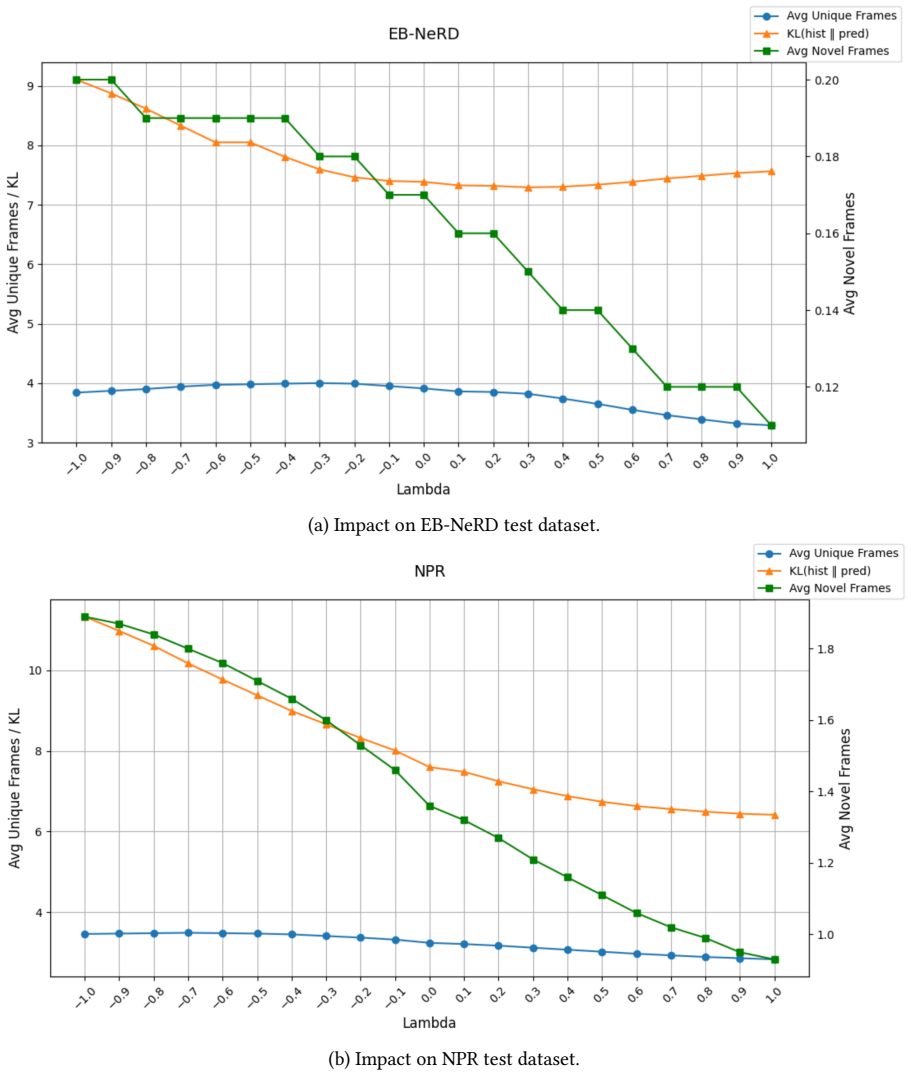
- Users with less diverse reading histories (like NPR) show the largest relative gain in novel frames, so the method helps exactly where filter bubbles are most severe.
Reading between the lines
- Because the frame classifier achieves only 53% accuracy on out-of-domain Portuguese news, the 50% exposure gain could partly reflect classifier confusions rather than true framing differences; a human-labeled evaluation set would separate the two.
- The paper's own suggestion to add a category module alongside the frame module points to a natural next step: diversify frames while holding the news topic constant, so users get different angles on the same subject.
- The magnitude of diversification gains is history-dependent (EB-NeRD users already see ~11.8 frames, NPR ~3.8), so in production the benefit will vary with the user's starting diversity; the framing lever matters most for users with narrow histories.
- Modeling only the primary frame per article may miss mixed-frame articles; extending to multi-frame representations could change both the measured diversity and the user experience.
Editorial analysis
A structured set of objections, weighed in public.
Referee Report
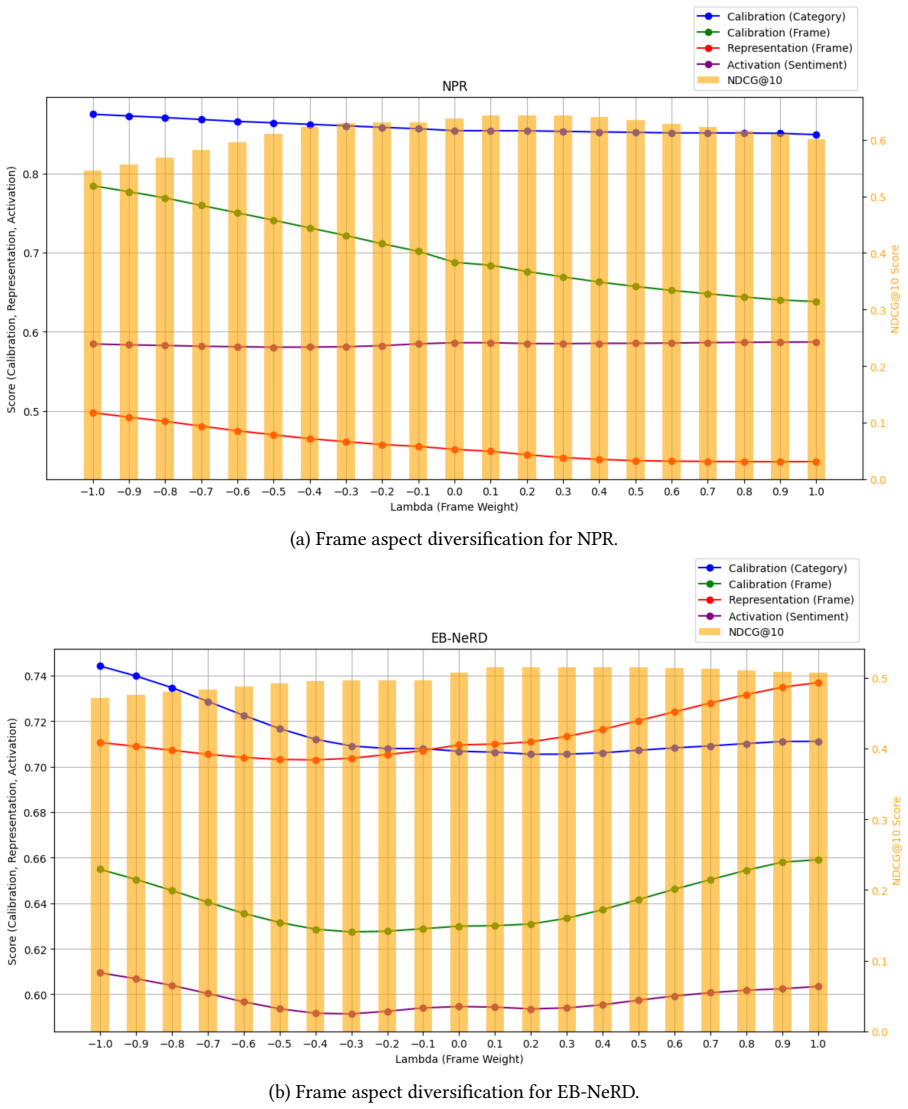
Summary. This paper presents a frame-aware diversification method for news recommendation. It extends MANNeR with a Frame-Module trained via supervised contrastive learning to group articles by the primary media frame predicted by an XLM-RoBERTa classifier fine-tuned on the Media Frames Corpus. The final ranking score is a linear combination of content relevance and frame similarity, controlled by a hyperparameter λ. Experiments on NPR (Portuguese) and EB-NeRD-small (Danish) measure standard ranking metrics and adapted RADio* normative metrics (calibration, representation, activation) together with novel-frame exposure. The authors report that negative λ increases frame diversity and novel-frame exposure, with a modest accuracy cost on EB-NeRD but a larger cost on NPR, and that frame diversity indirectly diversifies sentiment and news category.
Significance. The contribution is timely and the integration of MFC frames into a modular recommender is a reasonable design. Strengths include the use of two non-English datasets, standard deviations over five seeds, public code, and explicit discussion of classifier-error limitations. If the headline result were properly supported, the paper would provide useful evidence that framing can serve as a controllable diversity lever in practical news recommenders. However, the evaluation currently relies on a single noisy label source for both training and metric computation, and the abstract's 'up to 50%' claim is not derivable from the reported results. Both issues are fixable, and the paper's core method remains promising.
major comments (3)
- [Abstract; §6 'Impact on Frame Novelty'] The abstract's headline 'up to 50%' improvement in exposure to previously unclicked frames is not supported by the numbers in Section 6 or Figure 4. The text reports only absolute peak novel-frame counts (1.8 in NPR, 0.20 in EB-NeRD at λ=−1.0) and does not state a baseline or a relative change. Please provide a precise derivation (e.g., baseline at λ=0 and relative increase) or revise the abstract to state the absolute effect.
- [§3.1, §4, §6, §8] The same frame classifier is used to pseudo-label the corpora, to train the Frame-Module via SCL, and to compute all frame-based evaluation metrics (Cal(F), Rep(F), novel frames). The classifier's out-of-domain F1 is 0.48 on Portuguese and no Danish evaluation is reported. Consequently, the diversity gains may be partly an artifact of systematic label errors; the paper's own §8 acknowledges this but does not correct it. I request a robustness analysis (e.g., evaluating on a human-labeled subset, or measuring metric sensitivity to label perturbation) and a reframing of the claims to refer to the predicted frame taxonomy unless this analysis supports a stronger interpretation.
- [§5.1, Figure 1] The effectiveness of the Frame-Module is only demonstrated with t-SNE plots. Since the whole approach hinges on the encoder's ability to separate frames, a quantitative evaluation (e.g., classification accuracy from the embedding, silhouette score, or frame-clustering metrics) is needed to confirm that λ is modulating a meaningful representation rather than noise.
minor comments (7)
- [§6, Table 6(b)] The text reports Cal(C) at λ=−0.4 as 74.49±0.3, but Table 6(b) shows 74.59±0.3. Please correct the typo.
- [§4, Eq. (3)] The notation D*_f(P,Q) defines P and Q only in prose; please specify in the equation or immediately after whether higher values mean more divergence. Also state how rank-awareness is implemented (e.g., positional discounting).
- [Table 5] The column alignment is unclear; the impression counts for NPR-small appear to have only one value. Please reformat so that Train/Val/Test are listed for articles, users, and impressions.
- [Table 2, row 'Calibration'] The 'Desired Value' cell is ambiguous ('Low: reflects cats, High: diverse cats'). Consider rewriting as 'Lower = better match to user history; higher = more divergence' and moving the normative interpretation to the text.
- [§3.1] No evaluation of the frame classifier on Danish is reported, even though EB-NeRD is a main evaluation corpus. Please state whether such an evaluation exists or add a discussion of the implications.
- [Author footnote] The corresponding author email is garbled ('envel⌢pe-⌢pendattawsh@...'). Please fix.
- [Reference [37]] The author list appears truncated ('T. P. and'). Please correct.
Circularity Check
Frame-diversity gains are measured on the same classifier pseudo-labels used to train the Frame-Module, making the headline novelty improvements substantially circular.
-
self definitional
[§3.2 (Frame-Module training and Eq. 2), §4 (normative metrics), §6 (Impact on Frame Novelty, Fig. 4)]
"Following the MANNeR methodology, the Frame-based A-Module, which we call Frame-Module from now on, is trained to create a specialized news representation space. This is achieved by fine-tuning a separate copy of the initial PLM using a SCL. The objective is to group news articles with the same frame label closer together in the embedding space while simultaneously pushing those with different frames further apart."
The 'frame label' in this contrastive objective is exactly the output of the XLM-RoBERTa MFC classifier (§3.1). The same predicted labels are then used as ground truth for Cal(F), Rep(F), and the novel-frames metric in §4/§6. At λ<0, Eq. 2 subtracts s_frame, i.e., it deliberately ranks candidates whose Frame-Module embedding is unlike the user's history; since that embedding was trained to separate different predicted labels, an increase in predicted-frame divergence from history is built into the scoring function. The abstract's 'up to 50%' improvement is therefore a comparison of one pseudo-label-derived metric against another, not an independent measurement of true media frames. The paper concedes the risk in Future Work: 'misclassifications may distort both calibration and representati
full rationale
The central empirical claim—improved exposure to 'previously unclicked frames'—reduces largely to the classifier's own labels. The Frame-Module is trained with supervised contrastive learning on the primary frame predicted by the XLM-RoBERTa classifier, and all frame-based diversity metrics are then computed on those same predicted labels. Because the scoring equation directly penalizes frame similarity to the user history, the observed increase in frame-level calibration, representation, and novelty when λ is negative is substantially a tautology: the model is rewarded for moving along the label space it was optimized to separate. This is not fully circular in that the CR-Module still contributes relevance, the classifier is trained on external MFC data, and the magnitude of the effect is empirical. However, the evaluation lacks any human-labeled or otherwise independent frame ground truth on NPR/EB-NeRD, so the central result cannot be distinguished from classifier artifact. The self-citation to [46] for the classifier is not by itself load-bearing because the classifier is evaluated on external benchmarks (MFC, FrameNews-PT) and the scores are reported in the paper; no uniqueness theorem or ansatz is smuggled in. Other steps (borrowing MANNeR, RADio*) are normal external citations. Therefore the score reflects one substantial circularity in the evaluation loop, not full definitional equivalence.
Assumptions & free parameters
free parameters (1)
- lambda_frame =
swept from -1.0 to 1.0
assumptions (5)
- domain assumption The MFC 15-frame taxonomy is applicable to Portuguese and Danish news articles.
- domain assumption The primary frame (single highest-probability label) is sufficient for capturing framing diversity.
- domain assumption Classifier pseudo-labels on the evaluation datasets are a valid ground truth for diversity metrics.
- standard math The adapted RADio* divergence is a valid normative diversity measure.
- domain assumption XLM-T sentiment scores are a valid proxy for emotional intensity (activation).
Cite this review
Pith. "Pith review of Leveraging Media Frames to Improve Normative Diversity in News Recommendations." pith.science (2026). https://pith.science/paper/SNDT3PFA
@misc{pith2026250902266,
  author       = {Pith},
  title        = {Pith review of: Leveraging Media Frames to Improve Normative Diversity in News Recommendations},
  year         = {2026},
  howpublished = {\url{https://pith.science/paper/SNDT3PFA}},
  note         = {Machine review of arXiv:2509.02266}
}
read the original abstract
Click-based news recommender systems suggest users content that aligns with their existing history, limiting the diversity of articles they encounter. Recent advances in aspect-based diversification -- adding features such as sentiments or news categories (e.g. world, politics) -- have made progress toward diversifying recommendations in terms of perspectives. However, these approaches often overlook the role of news framing, which shapes how stories are told by emphasizing specific angles or interpretations. In this paper, we treat media frames as a controllable aspect within the recommendation pipeline. By selecting articles based on a diversity of frames, our approach emphasizes varied narrative angles and broadens the interpretive space recommended to users. In addition to introducing frame-based diversification method, our work is the first to assess the impact of a news recommender system that integrates frame diversity using normative diversity metrics: representation, calibration, and activation. Our experiments based on media frame diversification show an improvement in exposure to previously unclicked frames up to 50%. This is important because repeated exposure to the same frames can reinforce existing biases or narrow interpretations, whereas introducing novel frames broadens users' understanding of issues and perspectives. The method also enhances diversification across categorical and sentiment levels, thereby demonstrating that framing acts as a strong control lever for enhancing normative diversity.
Figures


Figures from the paper (1 more)
Reference graph
Works this paper leans on
-
[1]
M. Reuver, A. Fokkens, S. Verberne, No NLP task should be an island: Multi-disciplinarity for diversity in news recommender systems, in: H. Toivonen, M. Boggia (Eds.), Proceedings of the EACL Hackashop on News Media Content Analysis and Automated Report Generation, Association for Computational Linguistics, Online, 2021, pp. 45–55. URL: https://aclantholo...
work page 2021
-
[2]
N. Helberger, On the democratic role of news recommenders, in: Algorithms, automation, and news, Routledge, 2021, pp. 14–33
work page 2021
-
[3]
N. Mattis, P. K. Masur, J. Moeller, W. van Atteveldt, It ain’t easy: using nor- matively motivated news diversification to facilitate policy support, tolerance, and political participation, Information, Communication & Society 28 (2025) 651–668. URL: https://doi.org/10.1080/1369118X.2024.2423892. doi:10.1080/1369118X.2024.2423892. arXiv:https://doi.org/10...
-
[4]
C. Wu, F. Wu, T. Qi, Y. Huang, SentiRec: Sentiment diversity-aware neural news recommendation, in: K.-F. Wong, K. Knight, H. Wu (Eds.), Proceedings of the 1st Conference of the Asia-Pacific Chap- ter of the Association for Computational Linguistics and the 10th International Joint Conference on Natural Language Processing, Association for Computational Li...
-
[5]
N. Babanejad, A. Agrawal, H. Davoudi, A. An, M. Papagelis, Leveraging emotion features in news recommendations, in: INRA@RecSys, 2019. URL: https://api.semanticscholar.org/CorpusID: 208614444
work page 2019
-
[6]
T. Qi, F. Wu, C. Wu, P. Sun, L. Wu, X. Wang, Y. Huang, X. Xie, Profairrec: Provider fairness-aware news recommendation, 2022. URL: https://arxiv.org/abs/2204.04724. arXiv:2204.04724
work page Pith review arXiv 2022
- [7]
-
[8]
D. Card, A. E. Boydstun, J. H. Gross, P. Resnik, N. A. Smith, The media frames corpus: Annotations of frames across issues, in: Annual Meeting of the Association for Computational Linguistics,
Show all 55 references
-
[9]
R. M. Entman, Framing: Toward Clarification of a Fractured Paradigm, Journal of Communication 43 (1993) 51–58. doi:10.1111/j.1460-2466.1993.tb01304.x
1993
-
[10]
Lecheler, M
S. Lecheler, M. Keer, A. R. Schuck, R. Hänggli, The effects of repetitive news framing on political opinions over time, Communication Monographs 82 (2015) 339–358
2015
-
[11]
O. Tsur, D. Calacci, D. Lazer, A frame of mind: Using statistical models for detection of framing and agenda setting campaigns, in: C. Zong, M. Strube (Eds.), Proceedings of the 53rd Annual Meeting of the Association for Computational Linguistics and the 7th International Join...
2015 doi
-
[12]
Field, D
A. Field, D. Kliger, S. Wintner, J. Pan, D. Jurafsky, Y. Tsvetkov, Framing and agenda-setting in Russian news: a computational analysis of intricate political strategies, in: E. Riloff, D. Chiang, J. Hockenmaier, J. Tsujii (Eds.), Proceedings of the 2018 Conference on Empirica...
2018 doi
-
[13]
Alashri, S
S. Alashri, S. Alzahrani, L. Bustikova, D. Siroky, H. Davulcu, What animates political debates? analyzing ideological perspectives in online debates between opposing parties, in: Proceedings of the ASE/IEEE International Conference on Social Computing (SocialCom-15), Academy o...
2015
-
[14]
Otmakhova, S
J. Otmakhova, S. Khanehzar, L. Frermann, Media framing: A typology and survey of computational approaches across disciplines, in: Proceedings of the 62nd Annual Meeting of the Association for Computational Linguistics (Volume 1: Long Papers), 2024, pp. 15407–15428
2024
-
[15]
A. Iana, G. Glavaš, H. Paulheim, Train once, use flexibly: A modular framework for multi-aspect neural news recommendation, 2024. URL: https://arxiv.org/abs/2307.16089. arXiv:2307.16089
2024 arXiv
-
[16]
Vrijenhoek, G
S. Vrijenhoek, G. Bénédict, M. Gutierrez Granada, D. Odijk, Radio* – an introduction to measuring normative diversity in news recommendations, ACM Trans. Recomm. Syst. 3 (2024). URL: https: //doi.org/10.1145/3636465. doi:10.1145/3636465
2024 doi
-
[17]
J. P. Lucas, J. F. G. da Silva, L. F. de Figueiredo, Npr: a news portal recommendations dataset, in: NORMalize@RecSys, 2023. URL: https://api.semanticscholar.org/CorpusID:269043679
2023
-
[18]
Kruse, K
J. Kruse, K. Lindskow, S. Kalloori, M. Polignano, C. Pomo, A. Srivastava, A. Uppal, M. R. Andersen, J. Frellsen, Eb-nerd a large-scale dataset for news recommendation, in: Proceedings of the Recommender Systems Challenge 2024, RecSys Challenge ’24, ACM, 2024, p. 1–11. URL: htt...
2024
-
[19]
C. Wu, F. Wu, M. An, J. Huang, Y. Huang, X. Xie, Neural news recommendation with attentive multi-view learning, 2019. URL: https://arxiv.org/abs/1907.05576. arXiv:1907.05576
2019 arXiv
-
[20]
C. Wu, F. Wu, S. Ge, T. Qi, Y. Huang, X. Xie, Neural news recommendation with multi-head self-attention, in: K. Inui, J. Jiang, V. Ng, X. Wan (Eds.), Proceedings of the 2019 Conference on Empirical Methods in Natural Language Processing and the 9th International Joint Conferen...
2019 doi
-
[21]
T. Qi, F. Wu, C. Wu, P. Yang, Y. Yu, X. Xie, Y. Huang, Hierec: Hierarchical user interest modeling for personalized news recommendation, 2021. URL: https://arxiv.org/abs/2106.04408. arXiv:2106.04408
2021 arXiv
-
[22]
Zhang, N
M. Zhang, N. Hurley, Avoiding monotony: improving the diversity of recommendation lists, in: Proceedings of the 2008 ACM Conference on Recommender Systems, RecSys ’08, Association for Computing Machinery, New York, NY, USA, 2008, p. 123–130. URL: https://doi.org/10.1145/ 14540...
2008
-
[23]
Lathia, S
N. Lathia, S. Hailes, L. Capra, X. Amatriain, Temporal diversity in recommender systems, in: Proceedings of the 33rd International ACM SIGIR Conference on Research and Development in Information Retrieval, SIGIR ’10, Association for Computing Machinery, New York, NY, USA, 2010...
2010
-
[24]
M. D. Ekstrand, F. M. Harper, M. C. Willemsen, J. A. Konstan, User perception of differences in recommender algorithms, in: Proceedings of the 8th ACM Conference on Recommender Systems, RecSys ’14, Association for Computing Machinery, New York, NY, USA, 2014, p. 161–168. URL: ...
2014
-
[25]
Jones, User Perceived Qualities and Acceptance of Recommender Systems: The Role of Diversity, Ph.D
N. Jones, User Perceived Qualities and Acceptance of Recommender Systems: The Role of Diversity, Ph.D. thesis, EPFL, Lausanne, 2010. URL: https://infoscience.epfl.ch/handle/20.500.14299/47714. doi:10.5075/epfl-thesis-4680
2010 doi
-
[26]
Castagnos, N
S. Castagnos, N. Jones, P. Pu, Eye-tracking product recommenders’ usage, in: Proceedings of the Fourth ACM Conference on Recommender Systems, RecSys ’10, Association for Computing Machinery, New York, NY, USA, 2010, p. 29–36. URL: https://doi.org/10.1145/1864708.1864717. doi:1...
2010
-
[27]
Parapar, F
J. Parapar, F. Radlinski, Diverse user preference elicitation with multi-armed bandits, in: Pro- ceedings of the 14th ACM International Conference on Web Search and Data Mining, WSDM ’21, Association for Computing Machinery, New York, NY, USA, 2021, p. 130–138. URL: https: //d...
2021
-
[28]
Sertkan, J
M. Sertkan, J. Neidhardt, Exploring expressed emotions for neural news recommendation, in: Adjunct Proceedings of the 30th ACM Conference on User Modeling, Adaptation and Personal- ization, UMAP ’22 Adjunct, Association for Computing Machinery, New York, NY, USA, 2022, p. 22–2...
2022
-
[29]
Vercoutere, G
S. Vercoutere, G. Joris, T. De Pessemier, L. Martens, Improving consumption diversity via graph- based topic nudging, User Modeling and User-Adapted Interaction 35 (2025). doi: 10.1007/ s11257-025-09429-1
2025
-
[30]
Y. Liu, Y. Zhang, Q. Wu, C. Miao, L. Cui, B. Zhao, Y. Zhao, L. Guan, Diversity-promoting deep reinforcement learning for interactive recommendation, 2019. URL: https://arxiv.org/abs/1903. 07826. arXiv:1903.07826
2019 arXiv
-
[31]
Vrijenhoek, M
S. Vrijenhoek, M. Kaya, N. Metoui, J. Möller, D. Odijk, N. Helberger, Recommenders with a mission: Assessing diversity in news recommendations, in: Proceedings of the 2021 Conference on Human Information Interaction and Retrieval, CHIIR ’21, Association for Computing Machinery...
2021
-
[32]
Ziegler, S
C.-N. Ziegler, S. M. McNee, J. A. Konstan, G. Lausen, Improving recommendation lists through topic diversification, in: Proceedings of the 14th International Conference on World Wide Web, WWW ’05, Association for Computing Machinery, New York, NY, USA, 2005, p. 22–32. URL: htt...
2005
-
[33]
Bradley, Improving recommendation diversity, Proc
K. Bradley, Improving recommendation diversity, Proc. AICS ’01 (2001)
2001
-
[34]
Vargas, P
S. Vargas, P. Castells, Rank and relevance in novelty and diversity metrics for recommender systems, in: Proceedings of the Fifth ACM Conference on Recommender Systems, RecSys ’11, Association for Computing Machinery, New York, NY, USA, 2011, p. 109–116. URL: https://doi.org/ ...
2011
-
[35]
Fleder, K
D. Fleder, K. Hosanagar, Blockbuster Culture’s Next Rise or Fall: The Impact of Recommender Systems on Sales Diversity, Working Papers 07-10, NET Institute, 2007. URL: https://ideas.repec. org/p/net/wpaper/0710.html
2007
-
[36]
Treuillier, S
C. Treuillier, S. Castagnos, E. Dufraisse, A. Brun, Being diverse is not enough: Rethinking diversity evaluation to meet challenges of news recommender systems, in: Adjunct Proceedings of the 30th ACM Conference on User Modeling, Adaptation and Personalization, UMAP ’22 Adjunc...
2022
-
[37]
Helberger, J
N. Helberger, J. Pierson, T. P. and, Governing online platforms: From con- tested to cooperative responsibility, The Information Society 34 (2018) 1–14. URL: https://doi.org/10.1080/01972243.2017.1391913. doi: 10.1080/01972243.2017.1391913. arXiv:https://doi.org/10.1080/019722...
2018
-
[38]
C. H. De Vreese, News framing: Theory and typology, Information design journal+ document design 13 (2005) 51–62
2005
-
[39]
Nguyen, J
V.-A. Nguyen, J. Boyd-Graber, P. Resnik, K. Miler, Tea party in the house: A hierarchical ideal point topic model and its application to republican legislators in the 112th congress, in: C. Zong, M. Strube (Eds.), Proceedings of the 53rd Annual Meeting of the Association for C...
2015
-
[40]
A. E. Boydstun, J. H. Gross, Identifying media frames and frame dynamics within and across policy issues, 2013. URL: https://api.semanticscholar.org/CorpusID:17157113
2013
-
[41]
M. E. Roberts, B. M. Stewart, D. Tingley, C. Lucas, J. Leder-Luis, S. K. Gadarian, B. Albertson, D. G. Rand, Structural topic models for open-ended survey responses, American journal of political science 58 (2014) 1064–1082
2014
-
[42]
Ajjour, M
Y. Ajjour, M. Alshomary, H. Wachsmuth, B. Stein, Modeling frames in argumentation, in: Proceedings of the 2019 Conference on Empirical Methods in Natural Language Processing and the 9th International Joint Conference on Natural Language Processing (EMNLP-IJCNLP), 2019, pp. 2922–2932
2019
-
[43]
Naderi, G
N. Naderi, G. Hirst, Classifying frames at the sentence level in news articles, in: R. Mitkov, G. Angelova (Eds.), Proceedings of the International Conference Recent Advances in Natural Language Processing, RANLP 2017, INCOMA Ltd., Varna, Bulgaria, 2017, pp. 536–542. URL: http...
2017 doi
-
[44]
H. Kwak, J. An, Y.-Y. Ahn, A systematic media frame analysis of 1.5 million new york times articles from 2000 to 2017, 2020. URL: https://arxiv.org/abs/2005.01803. arXiv:2005.01803
2000 arXiv
-
[45]
Gilardi, M
F. Gilardi, M. Alizadeh, M. Kubli, Chatgpt outperforms crowd workers for text-annotation tasks, Proceedings of the National Academy of Sciences 120 (2023) e2305016120
2023
-
[46]
Daffara, S
A. Daffara, S. Dattawad, S. Padó, T. Ceron, Generalizability of media frames: Corpus creation and analysis across countries, 2025. URL: https://arxiv.org/abs/2506.16337. arXiv:2506.16337
2025 arXiv
-
[47]
Khanehzar, A
S. Khanehzar, A. Turpin, G. Mikołajczak, Modeling political framing across policy issues and contexts, in: Australasian Language Technology Association Workshop, 2019. URL: https://api. semanticscholar.org/CorpusID:209892156
2019
-
[48]
Khanehzar, T
S. Khanehzar, T. Cohn, G. Mikolajczak, A. Turpin, L. Frermann, Framing unpacked: A semi- supervised interpretable multi-view model of media frames, arXiv preprint arXiv:2104.11030 (2021)
2021 arXiv
-
[49]
Mendelsohn, C
J. Mendelsohn, C. Budak, D. Jurgens, Modeling framing in immigration discourse on social media, in: K. Toutanova, A. Rumshisky, L. Zettlemoyer, D. Hakkani-Tur, I. Beltagy, S. Bethard, R. Cotterell, T. Chakraborty, Y. Zhou (Eds.), Proceedings of the 2021 Conference of the North...
2021
-
[50]
Piskorski, N
J. Piskorski, N. Stefanovitch, G. Da San Martino, P. Nakov, Semeval-2023 task 3: Detecting the category, the framing, and the persuasion techniques in online news in a multi-lingual setup, in: Proceedings of the 17th International Workshop on Semantic Evaluation (SemEval-2023)...
2023
-
[51]
Barbieri, L
F. Barbieri, L. Espinosa Anke, J. Camacho-Collados, XLM-T: Multilingual language models in Twitter for sentiment analysis and beyond, in: Proceedings of the Thirteenth Language Resources and Evaluation Conference, European Language Resources Association, Marseille, France, 202...
2022
-
[52]
Vrijenhoek, Do you mind? reflections on the mind dataset for research on diversity in news recommendations, 2023
S. Vrijenhoek, Do you mind? reflections on the mind dataset for research on diversity in news recommendations, 2023. URL: https://arxiv.org/abs/2304.08253. arXiv:2304.08253
2023 arXiv
-
[53]
D. P. Kingma, J. Ba, Adam: A method for stochastic optimization, 2017. URL: https://arxiv.org/abs/ 1412.6980. arXiv:1412.6980
2017 arXiv
-
[54]
Möller, S
L. Möller, S. Padó, Explaining neural news recommendation with attributions onto reading histories, ACM Trans. Intell. Syst. Technol. 16 (2025). URL: https://doi.org/10.1145/3673233. doi:10. 1145/3673233
2025 doi
-
[2015]
URL: https://api.semanticscholar.org/CorpusID:5636935
Reviewed August 5, 2026 · model on record in the stance chip above.
Discussion (0). Sign in to comment.