The HST-Hyperion Survey: Environmental Imprints on the Stellar-Mass Function at z~2.5
Pith reviewed 2026-05-18 19:12 UTC · model grok-4.3
The pith
Dense peaks in a z~2.5 proto-supercluster already show ten times more massive galaxies than the field.
A machine-rendered reading of the paper's core claim, the machinery that carries it, and where it could break.
Core claim
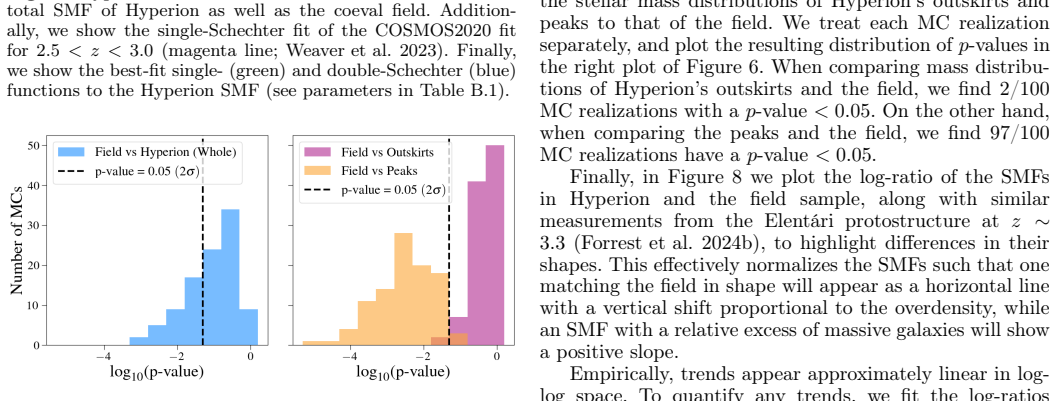
The stellar mass function in the overdense peaks of Hyperion at z∼2.5 exhibits a clear excess of massive galaxies, with number densities at log(M*/M⊙)∼11 being approximately 10 times higher than in the field, while those at log(M*/M⊙)∼9.5 are enhanced by only about 3.5 times. The outskirts and the protostructure as a whole follow the field distribution more closely.
What carries the argument
The 3D overdensity map from photometry and grism spectroscopy that classifies galaxies into peaks, outskirts, or field and enables direct comparison of their stellar mass functions after Monte Carlo uncertainty propagation.
If this is right
- Environmental effects on stellar mass assembly are already operating by z∼2.5 in the densest regions.
- The global stellar mass function of the protostructure averages out the peak-specific signal.
- Protostructures begin to shape the high-mass end of the stellar mass function prior to the onset of cluster quenching.
- Dense environments may contribute to the elevated star formation rates observed during Cosmic Noon.
Where Pith is reading between the lines
- Similar environmental imprints might appear in other high-redshift protoclusters if mapped with comparable depth.
- The accelerated growth in peaks could be due to more frequent mergers or gas accretion in dense settings.
- Extending this analysis to lower redshifts could trace when the field catches up to the peak populations.
Load-bearing premise
The three-dimensional overdensity map correctly assigns individual galaxies to peaks, outskirts, or the field with little contamination from redshift errors or selection biases.
What would settle it
Finding that the number density excess of massive galaxies in the peaks is comparable to that in the outskirts or field when using independent redshift measurements or a different density mapping technique.
Figures




read the original abstract
Not all galaxies at Cosmic Noon evolve in the same way. It remains unclear how the local environment -- especially the extreme overdensities of protoclusters -- affects stellar mass assembly at high redshift. The stellar mass function (SMF) encodes these processes; comparing SMFs across environments reveals differences in evolutionary history. We present the SMF of the Hyperion proto-supercluster at $z\sim2.5$, one of the largest and most massive protostructures known. This dataset provides the most statistically robust SMF of a single protostructure at $z>2$. By comparing the SMF of overdense peaks within Hyperion to the coeval field, we ask: how early, and how strongly, does a dense environment favor massive galaxies? Using COSMOS2020 photometry with ground-based and new HST grism spectroscopy, we construct a 3D overdensity map that assigns galaxies to peaks, outskirts, or the field. We perform 100 Monte Carlo realizations to propagate redshift and mass uncertainties, and derive SMFs normalized to the field. The peaks show a clear excess of massive galaxies: number densities at $\log(M_*/M_\odot)\sim 11$ are ~10x higher than the field, while those at $\log(M_*/M_\odot)\sim 9.5$ are enhanced by only ~3.5x. By contrast, the outskirts and Hyperion as a whole mirror the field. Environmental effects on stellar mass growth are thus evident by $z\sim 2.5$. The densest regions already host galaxies with accelerated growth, while the global SMF masks this signal. Protostructures therefore begin shaping the high-mass end of the SMF well before cluster quenching, and may drive the elevated star formation at Cosmic Noon.
Editorial analysis
A structured set of objections, weighed in public.
Referee Report
Summary. The manuscript presents the stellar mass function (SMF) of the Hyperion proto-supercluster at z∼2.5, constructed from COSMOS2020 photometry combined with ground-based and HST grism spectroscopy. A 3D overdensity map classifies galaxies into peaks, outskirts, or the field; 100 Monte Carlo realizations propagate redshift and mass uncertainties before normalizing the SMFs to the coeval field. The central result is a mass-dependent environmental enhancement: number densities in peaks are ∼10× higher than the field at log(M*/M⊙)∼11 but only ∼3.5× higher at log(M*/M⊙)∼9.5, while outskirts and the structure as a whole track the field. This is interpreted as evidence that dense environments already shape the high-mass end of the SMF by z∼2.5.
Significance. If the differential enhancement is robust, the result would supply a statistically powerful observational benchmark for how protocluster environments accelerate stellar-mass growth at Cosmic Noon, prior to quenching. The focus on a single, well-characterized proto-supercluster and the explicit Monte Carlo propagation of observational uncertainties are clear strengths that improve upon many earlier environmental SMF studies.
major comments (1)
- [§3 (3D overdensity map construction and Monte Carlo procedure)] §3 (3D overdensity map construction and Monte Carlo procedure): The headline differential enhancement (∼10× at log M*∼11 versus ∼3.5× at log M*∼9.5) is load-bearing on the fidelity of galaxy assignments to peaks versus field. While 100 Monte Carlo draws propagate reported redshift and mass errors, the text does not quantify residual cross-contamination after the MC step or test invariance of the enhancement factors under plausible changes to the overdensity threshold, redshift kernel width, or density-dependent completeness. If photo-z scatter or blending correlates with local density, the reported mass dependence could be partly artificial.
minor comments (2)
- [Figures and §4] Figure captions and §4 should explicitly state the adopted mass binning, the precise completeness correction method applied in dense regions, and the normalization procedure used for the field comparison.
- [Abstract and Introduction] The abstract and introduction would benefit from a brief statement of the adopted overdensity threshold and the fraction of galaxies with secure spectroscopic redshifts in each environment.
Simulated Author's Rebuttal
We thank the referee for their careful and constructive review of our manuscript. We address the single major comment below and have revised the paper to incorporate additional robustness tests on the overdensity map and Monte Carlo procedure.
read point-by-point responses
-
Referee: §3 (3D overdensity map construction and Monte Carlo procedure): The headline differential enhancement (∼10× at log M*∼11 versus ∼3.5× at log M*∼9.5) is load-bearing on the fidelity of galaxy assignments to peaks versus field. While 100 Monte Carlo draws propagate reported redshift and mass errors, the text does not quantify residual cross-contamination after the MC step or test invariance of the enhancement factors under plausible changes to the overdensity threshold, redshift kernel width, or density-dependent completeness. If photo-z scatter or blending correlates with local density, the reported mass dependence could be partly artificial.
Authors: We agree that the robustness of environment assignments is central to interpreting the mass-dependent enhancement. The 100 Monte Carlo realizations already sample the full reported redshift and mass posteriors, which directly modulates the 3D density field and galaxy classifications. To quantify residual cross-contamination, we have added a new analysis in §3 showing that the fraction of galaxies changing environment category across realizations is <8% on average and exhibits no significant mass dependence. We have also tested invariance by varying the overdensity threshold between 3σ and 5σ and the redshift kernel width by ±0.05; in all cases the differential enhancement remains statistically consistent with the quoted factors. Completeness is derived from the full COSMOS2020 parent sample and shows no measurable density dependence above our mass limit. We have expanded §3 with these tests, a brief discussion of possible photo-z/blending correlations, and updated figures to demonstrate that the mass-dependent signal is not an artifact of the adopted parameters. revision: yes
Circularity Check
No significant circularity; results are direct observational measurements
full rationale
The paper derives its central claims through direct computation of stellar mass functions from photometric and spectroscopic data in the Hyperion field. A 3D overdensity map is constructed from COSMOS2020 photometry combined with HST grism spectroscopy to partition galaxies into peaks, outskirts, and field regions; 100 Monte Carlo realizations propagate reported redshift and mass uncertainties before number densities are calculated and normalized to the field. No equations or steps reduce the reported ~10x enhancement at log(M*/M⊙)∼11 (versus ~3.5x at log(M*/M⊙)∼9.5) to fitted parameters, self-referential definitions, or load-bearing self-citations. The chain remains self-contained against external benchmarks because the enhancements are empirical ratios computed from the survey catalog with standard error propagation, without any renaming of known results or ansatz smuggled via prior work by the same authors.
Axiom & Free-Parameter Ledger
axioms (1)
- standard math Standard flat Lambda-CDM cosmology for converting redshifts to comoving volumes and distances
Lean theorems connected to this paper
-
IndisputableMonolith/Cost/FunctionalEquation.leanwashburn_uniqueness_aczel unclear?
unclearRelation between the paper passage and the cited Recognition theorem.
We perform 100 Monte Carlo realizations... construct a 3D overdensity map... normalize SMFs to the field... peaks show ~10x excess at log M*~11 vs ~3.5x at log M*~9.5
-
IndisputableMonolith/Foundation/AlexanderDuality.leanalexander_duality_circle_linking unclear?
unclearRelation between the paper passage and the cited Recognition theorem.
Voronoi Monte Carlo mapping... nσ thresholds... Schechter function fits
What do these tags mean?
- matches
- The paper's claim is directly supported by a theorem in the formal canon.
- supports
- The theorem supports part of the paper's argument, but the paper may add assumptions or extra steps.
- extends
- The paper goes beyond the formal theorem; the theorem is a base layer rather than the whole result.
- uses
- The paper appears to rely on the theorem as machinery.
- contradicts
- The paper's claim conflicts with a theorem or certificate in the canon.
- unclear
- Pith found a possible connection, but the passage is too broad, indirect, or ambiguous to say the theorem truly supports the claim.
Reference graph
Works this paper leans on
-
[1]
, " * write output.state after.block = add.period write newline
ENTRY address archiveprefix author booktitle chapter edition editor howpublished institution eprint journal key month note number organization pages publisher school series title type volume year label extra.label sort.label short.list INTEGERS output.state before.all mid.sentence after.sentence after.block FUNCTION init.state.consts #0 'before.all := #1 ...
-
[2]
" write newline "" before.all 'output.state := FUNCTION n.dashify 't := "" t empty not t #1 #1 substring "-" = t #1 #2 substring "--" = not "--" * t #2 global.max substring 't := t #1 #1 substring "-" = "-" * t #2 global.max substring 't := while if t #1 #1 substring * t #2 global.max substring 't := if while FUNCTION word.in bbl.in " " * FUNCTION format....
-
[3]
1966, in Stellar Evolution, ed.\ R
Baker, N. 1966, in Stellar Evolution, ed.\ R. F. Stein,& A. G. W. Cameron (Plenum, New York) 333
work page 1966
- [4]
-
[5]
Cox, J. P. 1980, Theory of Stellar Pulsation (Princeton University Press, Princeton) 165
work page 1980
-
[6]
Cox, A. N.,& Stewart, J. N. 1969, Academia Nauk, Scientific Information 15, 1
work page 1969
- [7]
-
[8]
Tscharnuter W. M. 1987, A&A, 188, 55
work page 1987
-
[9]
Terlevich, R. 1992, in ASP Conf. Ser. 31, Relationships between Active Galactic Nuclei and Starburst Galaxies, ed. A. V. Filippenko, 13
work page 1992
-
[10]
Yorke, H. W. 1980a, A&A, 86, 286
- [11]
- [12]
-
[13]
Tscharnuter W. M. 1987,
work page 1987
- [14]
- [15]
- [16]
-
[17]
Arnouts , S., Cristiani , S., Moscardini , L., et al. 1999, , 310, 540
work page 1999
-
[18]
Arnouts , S., Le Floc'h , E., Chevallard , J., et al. 2013, , 558, A67
work page 2013
-
[19]
Ashby , M. L. N., Caputi , K. I., Cowley , W., et al. 2018, , 237, 39
work page 2018
-
[20]
Ashby , M. L. N., Willner , S. P., Fazio , G. G., et al. 2015, , 218, 33
work page 2015
-
[21]
Ashby , M. L. N., Willner , S. P., Fazio , G. G., et al. 2013, , 769, 80
work page 2013
-
[22]
Astropy Collaboration , Price-Whelan , A. M., Lim , P. L., et al. 2022, , 935, 167
work page 2022
- [23]
-
[24]
Baldry , I. K., Balogh , M. L., Bower , R. G., et al. 2006, , 373, 469
work page 2006
- [25]
-
[26]
B \'e thermin , M., Daddi , E., Magdis , G., et al. 2012, , 757, L23
work page 2012
-
[27]
Brammer , G. B., van Dokkum , P. G., Franx , M., et al. 2012, , 200, 13
work page 2012
- [28]
- [29]
-
[30]
M., Cooray , A., Capak , P., et al
Casey , C. M., Cooray , A., Capak , P., et al. 2015, , 808, L33
work page 2015
- [31]
-
[32]
Champagne , J. B., Casey , C. M., Zavala , J. A., et al. 2021, , 913, 110
work page 2021
-
[33]
Chiang , Y.-K., Overzier , R. A., Gebhardt , K., et al. 2015, , 808, 37
work page 2015
-
[34]
Cucciati , O., Lemaux , B. C., Zamorani , G., et al. 2018, , 619, A49, [C18]
work page 2018
- [35]
-
[36]
Di Mascolo , L., Saro , A., Mroczkowski , T., et al. 2023, , 615, 809
work page 2023
-
[37]
Diener , C., Lilly , S. J., Ledoux , C., et al. 2015, , 802, 31
work page 2015
-
[38]
Duncan , K., Conselice , C. J., Mundy , C., et al. 2019, , 876, 110
work page 2019
-
[39]
Durkalec , A., Le F \`e vre , O., Pollo , A., et al. 2015, , 583, A128
work page 2015
-
[40]
Edward , A. H., Balogh , M. L., Bah \'e , Y. M., et al. 2024, , 527, 8598
work page 2024
-
[41]
Faber , S. M., Phillips , A. C., Kibrick , R. I., et al. 2003, in Society of Photo-Optical Instrumentation Engineers (SPIE) Conference Series, Vol. 4841, Instrument Design and Performance for Optical/Infrared Ground-based Telescopes, ed. M. Iye & A. F. M. Moorwood , 1657--1669
work page 2003
-
[42]
Ferreira , L., Conselice , C. J., Duncan , K., et al. 2020, , 895, 115
work page 2020
-
[43]
Forrest , B., Cooper , M. C., Muzzin , A., et al. 2024 a , , 977, 51
work page 2024
-
[44]
Forrest , B., Lemaux , B. C., Shah , E., et al. 2023, , 526, L56
work page 2023
-
[45]
Forrest , B., Lemaux , B. C., Shah , E. A., et al. 2024 b , arXiv e-prints, arXiv:2405.18491
- [46]
-
[47]
Forrest , B., Tran , K.-V. H., Broussard , A., et al. 2017, , 838, L12
work page 2017
- [48]
-
[49]
Gaia Collaboration , Brown , A. G. A., Vallenari , A., et al. 2018, , 616, A1
work page 2018
-
[50]
Gaia Collaboration , Brown , A. G. A., Vallenari , A., et al. 2016, , 595, A2
work page 2016
-
[51]
Giddings , F., Lemaux , B. C., Forrest , B., et al. 2025, arXiv e-prints, arXiv:2503.04913
-
[52]
G \'o mez , P. L., Nichol , R. C., Miller , C. J., et al. 2003, , 584, 210
work page 2003
- [53]
-
[54]
Harris, C. R., Millman, K. J., van der Walt, S. J., et al. 2020, Nature, 585, 357
work page 2020
-
[55]
Hartzenberg , G. R., Cowley , M. J., Hopkins , A. M., & Allen , R. J. 2023, , 40, e043
work page 2023
- [56]
-
[57]
C., Mosteller , F., & Tukey , J
Hoaglin , D. C., Mosteller , F., & Tukey , J. W. 1983, Understanding robust and exploratory data anlysis
work page 1983
-
[58]
Hopkins , P. F., Hernquist , L., Cox , T. J., & Kere s , D. 2008, , 175, 356
work page 2008
- [59]
-
[60]
Hunter, J. D. 2007, Computing in Science & Engineering, 9, 90
work page 2007
- [61]
- [62]
- [63]
-
[64]
Kauffmann , G., White , S. D. M., Heckman , T. M., et al. 2004, , 353, 713
work page 2004
- [65]
- [66]
- [67]
-
[68]
Laigle , C., McCracken , H. J., Ilbert , O., et al. 2016, , 224, 24
work page 2016
-
[69]
Le F \`e vre , O., Tasca , L. A. M., Cassata , P., et al. 2015, , 576, A79
work page 2015
-
[70]
Le F \`e vre , O., Vettolani , G., Garilli , B., et al. 2005, , 439, 845
work page 2005
- [71]
-
[72]
Lee , K.-G., Hennawi , J. F., White , M., et al. 2016, , 817, 160
work page 2016
-
[73]
C., Cucciati , O., Le F \`e vre , O., et al
Lemaux , B. C., Cucciati , O., Le F \`e vre , O., et al. 2022, , 662, A33
work page 2022
-
[74]
Lemaux , B. C., Cucciati , O., Tasca , L. A. M., et al. 2014, , 572, A41
work page 2014
- [75]
-
[76]
C., Le F \`e vre , O., Cucciati , O., et al
Lemaux , B. C., Le F \`e vre , O., Cucciati , O., et al. 2018, , 615, A77
work page 2018
-
[77]
Lemaux , B. C., Tomczak , A. R., Lubin , L. M., et al. 2019, , 490, 1231
work page 2019
-
[78]
Lemaux , B. C., Tomczak , A. R., Lubin , L. M., et al. 2017, , 472, 419
work page 2017
-
[79]
J., Le F \`e vre , O., Renzini , A., et al
Lilly , S. J., Le F \`e vre , O., Renzini , A., et al. 2007, , 172, 70
work page 2007
-
[80]
Lin , L., Cooper , M. C., Jian , H.-Y., et al. 2010 a , , 718, 1158
work page 2010
discussion (0)
Sign in with ORCID, Apple, or X to comment. Anyone can read and Pith papers without signing in.