REVIEW 3 major objections 5 minor 42 references
Low radio frequency detections of known pulsars and identification of new candidates with GLEAM-X: GP
T0 review · 3 major / 5 minor · reviewed 2026-08-05 · deepseek-v4-flash
Pith's one-line read A low-frequency continuum survey detects 193 known pulsars, 106 of them for the first time below 400 MHz, by matching compact radio sources to the ATNF pulsar catalogue and Fermi-LAT unassociated gamma-ray sources.
desk verdict Useful low-frequency pulsar catalogue from GLEAM-X; the 'first detections' count is softer than it looks but the data are solid. read the letter →
The pith
A machine-rendered reading of the paper's core claim, the machinery that carries it, and where it could break.
The reading
What carries the argument
The mechanism is image-domain pulsar detection: instead of searching for periodic pulses, the survey finds pulsars as unresolved, steep-spectrum radio sources in deep continuum images, taking advantage of long integrations that average over pulse phase and scintillation. The data release is the GLEAM-X Galactic Plane survey, 72–231 MHz in 20 sub-bands with ~3-arcsecond positions and a compact-source catalogue of 98,207 elements (compactness defined by the Meyers et al. 2017 criterion). For spectra, the pulsar_spectra Bayesian fitting package fits power-law, broken-power-law, low-frequency-turnover, high-frequency-cutoff, and double-turnover models, with AIC model selection. For candidates, t
What would settle it
Search the full ATNF catalogue and the pulsar_spectra compilation for any prior sub-400 MHz flux measurement for the 106 pulsars claimed as first detections; one prior published flux point would invalidate the count. Independently, take the 193 matched sources and estimate how many fall inside the ~4% random-match probability near the Galactic plane, where the source density is higher; if the actual overlap rate significantly exceeds the expected 7, some SEDs will be background contaminants.
Extended reading notes
Core claim
The central claim is that continuum imaging at 72–231 MHz can recover a substantial fraction of the known Galactic-plane pulsar population: 193 pulsars in the GLEAM-X: GP data release have compact radio counterparts, and 106 of these are argued to be first detections below 400 MHz, with 36 first detected below 300 MHz. For each source the authors fit five spectral models to the 20-sub-band flux densities together with prior literature, selecting the best by the Akaike information criterion. Separately, they claim that cross-matching compact radio sources with unassociated 4FGL-DR4 sources, after cuts on gamma-ray spectral curvature, photon index (1.8–3.0), and variability, yields 106 radio a
Load-bearing premise
The headline count of 106 first detections below 400 MHz assumes that the ATNF catalogue and pulsar_spectra literature compilation contain every prior low-frequency measurement for these pulsars; the paper itself notes the compilation is not fully current.
Editorial extensions
If this is right
- The 193 measured spectral energy distributions substantially extend the low-frequency sample of pulsar spectra, and the fits show that a simple power law is the minority case for these sources.
- The 106 Fermi-associated radio positions narrow blind searches from ~0.5-degree error ellipses to ~3-arcsecond targets, increasing the sensitivity of follow-up pulsation searches.
- The image-averaged flux densities give a stable estimate of average pulsar emission, largely bypassing scintillation variability that complicates low-frequency pulse measurements.
- The detected sample is biased toward high-DM, high-fractional-width pulsars, so the technique complements periodicity searches and can probe pulsars that are scattered or dispersed beyond the reach of time-domain searches.
Reading between the lines
- Extension: the 106 Fermi candidates could be ranked for follow-up by predicting their pulse-detection sensitivity from the measured 200-MHz flux densities and fitted spectral index; the paper stops at identification.
- Extension: if a handful of the 106 candidates are confirmed, the efficiency of gamma-ray-selected, image-localised pulsar searches would likely exceed blind periodicity searches in the same field, as earlier Fermi-guided campaigns suggested.
- Extension: applying the same cross-match method to the full GLEAM-X sky or to future low-frequency surveys could test whether the simple-power-law fraction seen here is a selection effect of image sensitivity or a real population property.
Editorial analysis
A structured set of objections, weighed in public.
Referee Report
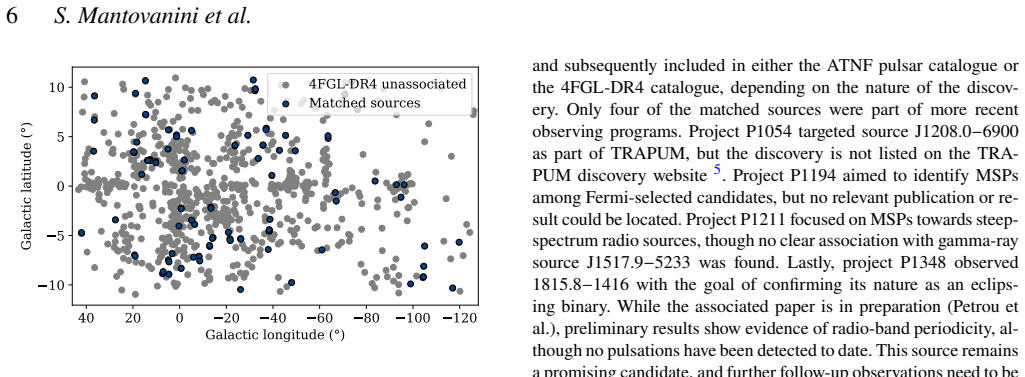
Summary. This paper cross-matches the GLEAM-X: GP compact source catalogue with the ATNF pulsar catalogue v2.6.2 over the Galactic plane (|b|<11 deg), reporting 72-231 MHz flux densities for 193 known pulsars and claiming that 106 of these are first detections below 400 MHz. It also filters unassociated Fermi 4FGL-DR4 sources by pulsar-like gamma-ray spectral and variability properties, cross-matches the survivors against GLEAM-X compact sources, and identifies 106 radio counterparts to 73 gamma-ray sources as promising pulsar candidates. Spectral energy distributions are modelled with the pulsar_spectra package, and the detected pulsar sample is compared with the known population in period, flux density, and dispersion measure.
Significance. If the results hold, the paper delivers a valuable new low-frequency flux density catalogue for 193 known pulsars, nearly doubling (or at least substantially expanding) the number of pulsars with sub-400 MHz continuum measurements in the GLEAM-X footprint, and provides a prioritised list of 106 radio counterparts for follow-up pulsation searches in Fermi error ellipses. Strengths include the clear description of the cross-matching and spectral-fitting procedures, the transparency about the ~4% random-match probability for the pulsar sample (corresponding to ~7 expected false associations), and the commitment to release machine-readable catalogues and SED plots. The Fermi candidate selection is more speculative, but the authors frame it appropriately as a list for follow-up rather than as confirmed detections.
major comments (3)
- [Section 5.1 and Abstract] The claim that 106 pulsars are detected below 400 MHz for the first time is a headline result, but the verification is not described. The paper does not state the criterion used to define a 'first detection' or describe a systematic literature search beyond ATNF v2.6.2 and the pulsar_spectra compilation. Since Section 3.2 notes that pulsar_spectra relies on an older ATNF version and does not recognise 8 of the matched sources, the compilation is demonstrably incomplete. Any of the 106 could have prior sub-400 MHz flux density measurements (e.g., from LOFAR, GMRT, MWA, or GLEAM) not captured by these sources. Please either (i) perform a systematic per-pulsar literature check for prior sub-400 MHz measurements, or (ii) rephrase the claim as 'first detection in the GLEAM-X: GP survey' / 'no previous measurement in ATNF v2.6.2 or pulsar_spectra', and propagate this caveat through the abstrac
- [Sections 3.1 and 5.1] The reported number of detected pulsars is internally inconsistent. Section 3.1 gives 426 associations for 202 distinct pulsars, excludes seven with >5 matches, and leaves two pulsars with 2-4 matches in the analysis, which implies 195 distinct pulsars. Section 5.1 first states 'the 193 known pulsars detected', then discusses J1708-52 and J1534-46 as the two multiple-match pulsars, and concludes 'The remaining 193 pulsars each had a single, unambiguous match.' This is contradictory. Please clarify the exact sample size and use the same number in the abstract, Section 5.1, and conclusions.
- [Sections 4 and 5.2] The Fermi candidate list of 106 radio associations (73 unique gamma-ray sources) is a central deliverable, but no chance-coincidence probability is estimated. Given that the 4FGL error ellipses can have semi-major axes up to 0.5 degrees and the GLEAM-X source density near the Galactic plane is high, the number of spurious associations may be substantial. The authors note that 'many of the matches... may be chance coincidences' but do not quantify this. A Monte Carlo simulation or density-based estimate of the expected number of false associations would allow the reader to assess the purity of the candidate list. Without it, the yield of 106 candidates is difficult to interpret.
minor comments (5)
- [Section 3.1] Typo: 'ANTF catalogue' should be 'ATNF catalogue'.
- [Figure 7] The text refers to 'the top pie chart' and 'the bottom pie chart', but the figure contains four labelled panels (a)-(d). Please reference the specific panels explicitly.
- [Table 1] The column header 'E 100× 10−12' is unclear. Define the energy-flux column explicitly, e.g., 'E (100 MeV) [10^-12 erg cm^-2 s^-1]'.
- [Section 1] 'Stokes i images' should be 'Stokes I images' (capital I).
- [Throughout] The paper mentions that SEDs are available online, but listing a short table of the 106 claimed first detections in the printed text would improve readability and allow readers to quickly assess the headline claim.
Circularity Check
No significant circularity: observational catalogue paper with direct measurements and externally benchmarked cross-matches.
full rationale
This is an observational catalogue study, not a derivation or predictive modelling paper. The central products are (1) cross-matches between known ATNF pulsars and GLEAM-X: GP compact sources, (2) measured 72–231 MHz flux densities, and (3) SED fits to those data plus literature measurements. No quantity is constructed from fitted parameters and then presented as an independent prediction: the flux densities are direct measurements from the survey images, and the spectral model parameters are outputs of an MCMC fit to data that include external literature measurements. The Fermi cross-match candidate list is likewise produced by applying fixed, independently established gamma-ray selection cuts (curvature significance, photon index, variability index) and positional matching, not by tuning a model to reproduce the final candidate list. The paper's reliance on the authors' own GLEAM-X: GP data release and on earlier GLEAM-X survey papers is data provenance rather than a load-bearing self-citation: the survey catalogue is a separate, publicly released data product, and the current paper does not cite its own conclusions as evidence. The 'first detection below 400 MHz' claim is a statement about absence from the ATNF v2.6.2 catalogue and the pulsar_spectra literature compilation; this is an external completeness assumption that could be incorrect, but it is not a circular derivation. The paper even acknowledges the incompleteness of pulsar_spectra for eight pulsars, showing that the claim is not definitionally forced by the analysis. No equation or fitted parameter is reused as an input to produce the claimed result. Therefore no material circularity is present.
Assumptions & free parameters
free parameters (3)
- Fermi pulsar-like filtering thresholds =
log curvature significance 0-2.0; photon index 1.8-3.0; log variability index 0.4-1.7
- Gamma-ray match multiplicity cap =
exclude 4FGL sources with >5 radio matches
- Pulsar match multiplicity cap =
pulsars with >5 GLEAM-X counterparts excluded; two with 2-4 retained
assumptions (5)
- domain assumption ATNF catalogue positions and uncertainties are correct.
- domain assumption The pulsar_spectra literature compilation is complete enough to identify prior sub-400 MHz detections.
- domain assumption GLEAM-X: GP flux densities are reliable average pulsar flux measurements at 72-231 MHz.
- domain assumption The five spectral models used by pulsar_spectra cover the plausible physical spectral shapes.
- domain assumption The gamma-ray parameter cuts select pulsar-like sources.
Cite this review
Pith. "Pith review of Low radio frequency detections of known pulsars and identification of new candidates with GLEAM-X: GP." pith.science (2026). https://pith.science/paper/44DI7BDW
@misc{pith2026250902919,
  author       = {Pith},
  title        = {Pith review of: Low radio frequency detections of known pulsars and identification of new candidates with GLEAM-X: GP},
  year         = {2026},
  howpublished = {\url{https://pith.science/paper/44DI7BDW}},
  note         = {Machine review of arXiv:2509.02919}
}
read the original abstract
Image-based searches have become a complementary approach for identifying pulsars, particularly at MHz frequencies where scattering and high dispersion measures affect high-time resolution observations. In this work, we searched the Galactic Plane (GP) data release from the GaLactic and Extragalactic All-Sky Murchison Widefield Array eXtended (GLEAM-X) survey, a widefield continuum radio survey covering the 72 - 231 MHz frequency range, at the positions of known pulsars in the ATNF catalogue (version 2.6.2) that lie within its sky coverage. We present the spectral energy distribution for 193 known pulsars located at |b| < 11deg. Notably, 106 of these represent the first detections below 400 MHz. We also cross-match the GLEAM-X: GP compact source catalogue with unassociated sources in the Fermi Large Area Telescope (LAT) catalogue, filtering for gamma-ray spectral and variability properties, as well as coincidence with Active Galactic Nuclei (AGN). We have identified 106 possible pulsar candidates. This work demonstrates the importance of sensitive, low-frequency Galactic plane surveys for detecting emission from known pulsars and presents a potential way of searching for new pulsar candidates that would otherwise be missed by traditional time-domain searches.
Figures


Figures from the paper (5 more)


Reference graph
Works this paper leans on
-
[1]
write newline
" write newline "" before.all 'output.state := FUNCTION fin.entry write newline FUNCTION new.block output.state before.all = 'skip after.block 'output.state := if FUNCTION new.sentence output.state after.block = 'skip output.state before.all = 'skip after.sentence 'output.state := if if FUNCTION not #0 #1 if FUNCTION and 'skip pop #0 if FUNCTION or pop #1...
-
[2]
Abdollahi S., et al., 2020, @doi [ ] 10.3847/1538-4365/ab6bcb , https://ui.adsabs.harvard.edu/abs/2020ApJS..247...33A 247, 33
-
[3]
Abdollahi S., et al., 2022, @doi [ ] 10.3847/1538-4365/ac6751 , https://ui.adsabs.harvard.edu/abs/2022ApJS..260...53A 260, 53
-
[4]
Ajello M., et al., 2020, @doi [ ] 10.3847/1538-4357/ab791e , https://ui.adsabs.harvard.edu/abs/2020ApJ...892..105A 892, 105
-
[5]
Atwood W. B., et al., 2009, @doi [ ] 10.1088/0004-637X/697/2/1071 , https://ui.adsabs.harvard.edu/abs/2009ApJ...697.1071A 697, 1071
-
[6]
Ballet J., Bruel P., Burnett T. H., Lott B., The Fermi-LAT collaboration 2023, @doi [arXiv e-prints] 10.48550/arXiv.2307.12546 , https://ui.adsabs.harvard.edu/abs/2023arXiv230712546B p. arXiv:2307.12546
-
[7]
Bates S. D., Lorimer D. R., Verbiest J. P. W., 2013, @doi [ ] 10.1093/mnras/stt257 , https://ui.adsabs.harvard.edu/abs/2013MNRAS.431.1352B 431, 1352
-
[8]
Beskin V. S., Chernov S. V., Gwinn C. R., Tchekhovskoy A. A., 2015, @doi [ ] 10.1007/s11214-015-0173-8 , https://ui.adsabs.harvard.edu/abs/2015SSRv..191..207B 191, 207
Show all 42 references
-
[9]
Bhat N. D. R., Cordes J. M., Camilo F., Nice D. J., Lorimer D. R., 2004, @doi [ ] 10.1086/382680 , https://ui.adsabs.harvard.edu/abs/2004ApJ...605..759B 605, 759
2004 doi
-
[10]
V., et al., 2016, @doi [ ] 10.1051/0004-6361/201527702 , https://ui.adsabs.harvard.edu/abs/2016A&A...591A.134B 591, A134
Bilous A. V., et al., 2016, @doi [ ] 10.1051/0004-6361/201527702 , https://ui.adsabs.harvard.edu/abs/2016A&A...591A.134B 591, A134
2016 doi
-
[11]
J., et al., 2023, @doi [ ] 10.1093/mnras/stac3742 , https://ui.adsabs.harvard.edu/abs/2023MNRAS.519.5590C 519, 5590
Clark C. J., et al., 2023, @doi [ ] 10.1093/mnras/stac3742 , https://ui.adsabs.harvard.edu/abs/2023MNRAS.519.5590C 519, 5590
2023 doi
-
[12]
E., Coles W
Dai S., Johnston S., Bell M. E., Coles W. A., Hobbs G., Ekers R. D., Lenc E., 2016, @doi [ ] 10.1093/mnras/stw1871 , https://ui.adsabs.harvard.edu/abs/2016MNRAS.462.3115D 462, 3115
2016 doi
-
[13]
A., Mooley K
Frail D. A., Mooley K. P., Jagannathan P., Intema H. T., 2016a, @doi [ ] 10.1093/mnras/stw1390 , https://ui.adsabs.harvard.edu/abs/2016MNRAS.461.1062F 461, 1062
-
[14]
A., Jagannathan P., Mooley K
Frail D. A., Jagannathan P., Mooley K. P., Intema H. T., 2016b, @doi [ ] 10.3847/0004-637X/829/2/119 , https://ui.adsabs.harvard.edu/abs/2016ApJ...829..119F 829, 119
-
[15]
A., et al., 2018, @doi [ ] 10.1093/mnras/stx3281 , https://ui.adsabs.harvard.edu/abs/2018MNRAS.475..942F 475, 942
Frail D. A., et al., 2018, @doi [ ] 10.1093/mnras/stx3281 , https://ui.adsabs.harvard.edu/abs/2018MNRAS.475..942F 475, 942
2018 doi
-
[16]
Geyer M., et al., 2017, @doi [ ] 10.1093/mnras/stx1151 , https://ui.adsabs.harvard.edu/abs/2017MNRAS.470.2659G 470, 2659
2017 doi
-
[17]
Hurley-Walker N., et al., 2017, @doi [ ] 10.1093/mnras/stw2337 , https://ui.adsabs.harvard.edu/abs/2017MNRAS.464.1146H 464, 1146
2017 doi
-
[18]
Hurley-Walker N., et al., 2019, @doi [ ] 10.1017/pasa.2019.37 , https://ui.adsabs.harvard.edu/abs/2019PASA...36...47H 36, e047
2019 doi
-
[19]
Hurley-Walker N., et al., 2022, @doi [ ] 10.1017/pasa.2022.17 , https://ui.adsabs.harvard.edu/abs/2022PASA...39...35H 39, e035
2022 doi
-
[20]
F., Bailes M., Barr E
Jankowski F., van Straten W., Keane E. F., Bailes M., Barr E. D., Johnston S., Kerr M., 2018, @doi [ ] 10.1093/mnras/stx2476 , https://ui.adsabs.harvard.edu/abs/2018MNRAS.473.4436J 473, 4436
2018 doi
-
[21]
J., Green D
Kijak J., Lewandowski W., Gupta Y., 2009, in Saikia D. J., Green D. A., Gupta Y., Venturi T., eds, Astronomical Society of the Pacific Conference Series Vol. 407, The Low-Frequency Radio Universe. p. 341
2009
-
[22]
Kuniyoshi M., Verbiest J. P. W., Lee K. J., Adebahr B., Kramer M., Noutsos A., 2015, @doi [ ] 10.1093/mnras/stv1604 , https://ui.adsabs.harvard.edu/abs/2015MNRAS.453..828K 453, 828
2015 doi
-
[23]
Mainzer A., et al., 2011, @doi [ ] 10.1088/0004-637X/731/1/53 , https://ui.adsabs.harvard.edu/abs/2011ApJ...731...53M 731, 53
2011 doi
-
[24]
N., Hobbs G
Manchester R. N., Hobbs G. B., Teoh A., Hobbs M., 2005, @doi [The Astronomical Journal] 10.1086/428488 , 129, 1993
2005 doi
-
[25]
W., et al., 2017, @doi [ ] 10.1017/pasa.2017.5 , https://ui.adsabs.harvard.edu/abs/2017PASA...34...13M 34, e013
Meyers B. W., et al., 2017, @doi [ ] 10.1017/pasa.2017.5 , https://ui.adsabs.harvard.edu/abs/2017PASA...34...13M 34, e013
2017 doi
-
[26]
J., Mahesh N., Monsalve R
Mozdzen T. J., Mahesh N., Monsalve R. A., Rogers A. E. E., Bowman J. D., 2019, @doi [ ] 10.1093/mnras/sty3410 , https://ui.adsabs.harvard.edu/abs/2019MNRAS.483.4411M 483, 4411
2019 doi
-
[27]
Murphy T., et al., 2017, @doi [ ] 10.1017/pasa.2017.13 , https://ui.adsabs.harvard.edu/abs/2017PASA...34...20M 34, e020
2017 doi
- [28]
-
[29]
M., Xu H., Yu P
Saz Parkinson P. M., Xu H., Yu P. L. H., Salvetti D., Marelli M., Falcone A. D., 2016, @doi [ ] 10.3847/0004-637X/820/1/8 , https://ui.adsabs.harvard.edu/abs/2016ApJ...820....8S 820, 8
2016 doi
-
[30]
Sengar R., et al., 2025, @doi [ ] 10.1093/mnras/stae2716 , https://ui.adsabs.harvard.edu/abs/2025MNRAS.536.3159S 536, 3159
2025 doi
-
[31]
Sett S., Sokolowski M., Lenc E., Bhat N. D. R., 2024, @doi [ ] 10.1017/pasa.2024.62 , https://ui.adsabs.harvard.edu/abs/2024PASA...41...45S 41, e045
2024 doi
-
[32]
Singal J., 2015, @doi [ ] 10.1093/mnras/stv1964 , https://ui.adsabs.harvard.edu/abs/2015MNRAS.454..115S 454, 115
2015 doi
-
[33]
A., et al., 2021, @doi [ ] 10.3847/2041-8213/abec7b , https://ui.adsabs.harvard.edu/abs/2021ApJ...911L..26S 911, L26
Swainston N. A., et al., 2021, @doi [ ] 10.3847/2041-8213/abec7b , https://ui.adsabs.harvard.edu/abs/2021ApJ...911L..26S 911, L26
2021 doi
-
[34]
A., Lee C
Swainston N. A., Lee C. P., McSweeney S. J., Bhat N. D. R., 2022, @doi [ ] 10.1017/pasa.2022.52 , https://ui.adsabs.harvard.edu/abs/2022PASA...39...56S 39, e056
2022 doi
-
[35]
K., Rao A
Swarup G., Ananthakrishnan S., Kapahi V. K., Rao A. P., Subrahmanya C. R., Kulkarni V. K., 1991, Current Science, https://ui.adsabs.harvard.edu/abs/1991CSci...60...95S 60, 95
1991
-
[36]
J., et al., 2013, @doi [ ] 10.1017/pasa.2012.007 , https://ui.adsabs.harvard.edu/abs/2013PASA...30....7T 30, e007
Tingay S. J., et al., 2013, @doi [ ] 10.1017/pasa.2012.007 , https://ui.adsabs.harvard.edu/abs/2013PASA...30....7T 30, e007
2013 doi
-
[37]
Vohl D., van Leeuwen J., Maan Y., 2024, @doi [ ] 10.1051/0004-6361/202348621 , https://ui.adsabs.harvard.edu/abs/2024A&A...687A.113V 687, A113
2024 doi
-
[38]
B., et al., 2015, @doi [ ] 10.1017/pasa.2015.26 , https://ui.adsabs.harvard.edu/abs/2015PASA...32...25W 32, e025
Wayth R. B., et al., 2015, @doi [ ] 10.1017/pasa.2015.26 , https://ui.adsabs.harvard.edu/abs/2015PASA...32...25W 32, e025
2015 doi
-
[39]
B., et al., 2018, @doi [ ] 10.1017/pasa.2018.37 , https://ui.adsabs.harvard.edu/abs/2018PASA...35...33W 35, e033
Wayth R. B., et al., 2018, @doi [ ] 10.1017/pasa.2018.37 , https://ui.adsabs.harvard.edu/abs/2018PASA...35...33W 35, e033
2018 doi
-
[40]
Wenger M., et al., 2000, @doi [ ] 10.1051/aas:2000332 , https://ui.adsabs.harvard.edu/abs/2000A&AS..143....9W 143, 9
2000 doi
-
[41]
L., et al., 2010, @doi [ ] 10.1088/0004-6256/140/6/1868 , https://ui.adsabs.harvard.edu/abs/2010AJ....140.1868W 140, 1868
Wright E. L., et al., 2010, @doi [ ] 10.1088/0004-6256/140/6/1868 , https://ui.adsabs.harvard.edu/abs/2010AJ....140.1868W 140, 1868
2010 doi
-
[42]
R., Chen J
Zhu K. R., Chen J. M., Zheng Y. G., Zhang L., 2024, @doi [ ] 10.1093/mnras/stad2813 , https://ui.adsabs.harvard.edu/abs/2024MNRAS.527.1794Z 527, 1794
2024 doi
Reviewed August 5, 2026 · model on record in the stance chip above.
Discussion (0). Continue with ORCID to comment.