A two-phase model of galaxy formation: IV. Seeding and growing supermassive black holes in dark matter halos
Pith reviewed 2026-05-18 19:38 UTC · model grok-4.3
The pith
Supermassive black holes form from seeds bred in early mini-halos and grow through three assembly-dependent channels that produce a redshift-dependent mass relation.
A machine-rendered reading of the paper's core claim, the machinery that carries it, and where it could break.
Core claim
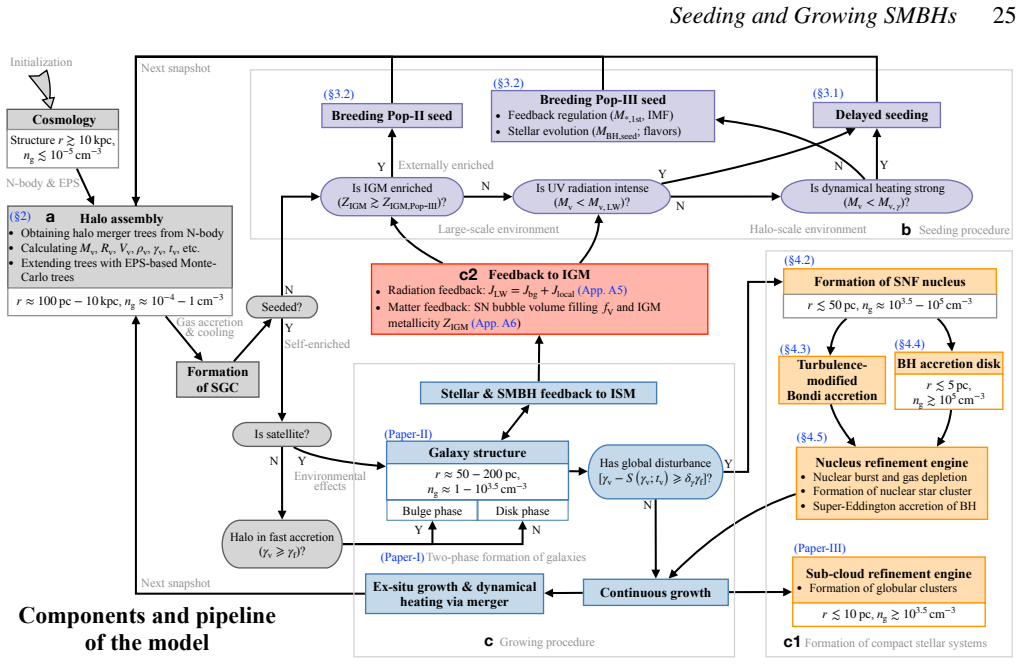
Black hole seeds form with masses between 10 and 100,000 solar masses at redshifts 20 to 30 inside mini-halos of 100,000 to 100 million solar masses. Growth begins with episodic super-Eddington accretion triggered by nuclear bursts from global disturbances, continues with sub-Eddington accretion through capture of sub-clouds in self-gravitating gas clouds within fast-assembling halos, and concludes with merger-driven growth. The black hole-stellar mass relation takes a multi-piece form that depends on redshift because different channels dominate at different epochs and in different halo types.
What carries the argument
The three distinct growth channels implemented within subhalo merger trees, with nuclear bursts as the trigger for efficient early growth.
Load-bearing premise
Black hole growth occurs only through the three specified channels and can be faithfully tracked using subhalo merger trees without missing key physical processes.
What would settle it
Finding that black holes in high-redshift galaxies show no enhanced growth during periods of nuclear starbursts or global disturbances would challenge the model.
Figures






read the original abstract
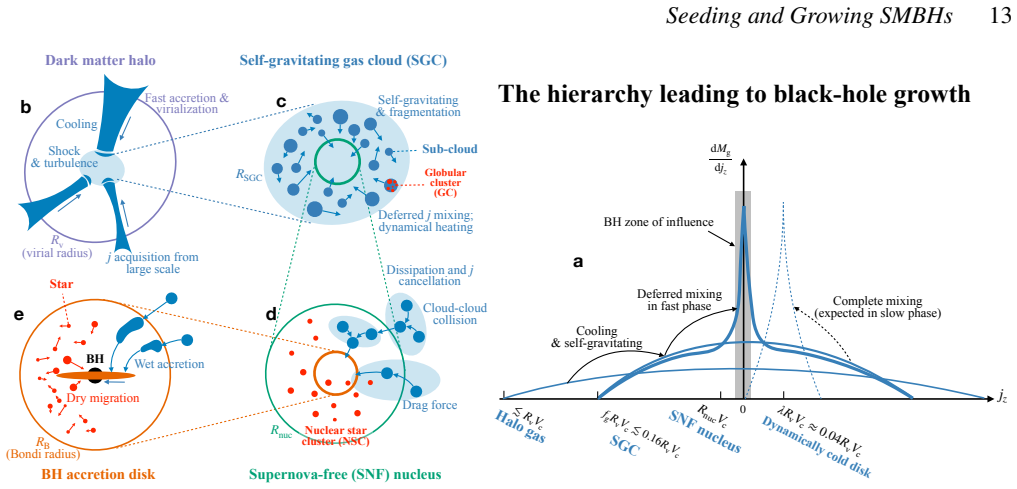
We present a theoretical framework for seeding and growing supermassive black holes (SMBHs) in dark matter halos along their assembly histories. Seeds are bred out of Pop-III stars formed during the first collapse of pristine gas in mini-halos that have reached the $\rm H_2$-cooling limit, modulated by UV radiation from star formation and dynamical heating from fast halo assembly. Such breeding persists until the enrichment of the intergalactic medium (IGM) enables Pop-II stars to form. Post-seeding growth of black holes (BHs) is driven by distinct channels, starting with episodic super-Eddington accretion associated with nuclear bursts induced by global disturbances of galaxies, followed by sustained sub-Eddington accretion via capturing sub-clouds formed in self-gravitating gas clouds (SGCs) in halos of fast assembly, and ending with merger-dominated, quiescent growth. We implement the model in subhalo merger trees to build a coherent framework to follow SMBH-galaxy-halo co-evolution across the whole history and structural hierarchy. BH seeds are bred with a broad mass spectrum of $M_{\rm BH} = 10 - 10^5\,{\rm M}_\odot$ at $z \approx 20 - 30$ in mini-halos with masses of $10^5 - 10^8\,{\rm M}_\odot$. Nuclear bursts provide the key condition for seeds to grow into SMBHs. The $M_{\rm BH}$-$M_*$ relation is a multi-piece, redshift-dependent function shaped by the interplay among different growth channels. Our model predictions are broadly consistent with existing observations; especially, a population of BHs reminiscent of 'little red dots' (LRDs) discovered by JWST naturally results from the seeding and growing processes. Potential future tests of the model are discussed.
Editorial analysis
A structured set of objections, weighed in public.
Referee Report
Summary. The paper presents a theoretical framework for seeding and growing supermassive black holes in dark matter halos. Seeds form from Pop-III stars during the first collapse of pristine gas in mini-halos reaching the H2-cooling limit, modulated by UV radiation and dynamical heating until IGM enrichment enables Pop-II formation. Post-seeding growth proceeds via three channels: episodic super-Eddington accretion from nuclear bursts induced by global galaxy disturbances, sustained sub-Eddington accretion through sub-cloud capture in self-gravitating gas clouds within fast-assembly halos, and merger-dominated quiescent growth. The model is implemented in subhalo merger trees to track co-evolution, producing a seed mass spectrum of 10-10^5 solar masses at z≈20-30 in 10^5-10^8 solar mass halos, with nuclear bursts as the key trigger for SMBH growth and a multi-piece, redshift-dependent M_BH-M_* relation shaped by channel interplay that is broadly consistent with observations and naturally yields LRD-like populations.
Significance. If the mapping from dark-matter assembly histories to the baryonic growth channels proves robust, the framework supplies a coherent, hierarchical description of SMBH-galaxy-halo co-evolution across cosmic time and structural scales. It generates falsifiable predictions for high-redshift black-hole populations, including objects resembling JWST little red dots, and emphasizes the role of halo assembly rate in selecting among growth modes.
major comments (2)
- [§4] §4 (Implementation in subhalo merger trees): The three growth channels are triggered and evolved using only DM subhalo merger trees, yet the conditions for nuclear bursts (global disturbances) and SGC sub-cloud capture (fast assembly) are defined by thresholds on accretion rate or merger events. Because merger trees contain no baryonic information, the auxiliary assumptions required to map DM assembly to gas cooling, angular momentum, and feedback must be shown to be resolution-independent and consistent with hydrodynamical simulations; without this demonstration the central claim that the channels accurately reproduce the observed M_BH-M_* relation rests on unverified mappings.
- [Results] Results on the M_BH-M_* relation: The relation is stated to be a multi-piece, redshift-dependent function shaped by the interplay among the three channels, but no quantitative decomposition (e.g., separate contributions of episodic super-Eddington, sub-Eddington, and merger channels to the final slope and scatter) is provided. This omission makes it impossible to assess whether the reported shape is a genuine prediction or a direct consequence of the channel definitions and seed-mass bounds.
minor comments (3)
- [Abstract] The abstract asserts 'broadly consistent with existing observations' without citing specific data sets, reporting quantitative metrics (scatter, normalization offsets, or goodness-of-fit), or showing direct comparisons in a figure or table.
- [Growth channels] The acronym SGC is introduced without an explicit definition or reference to its physical motivation in the seeding/growth sections; a one-sentence clarification would improve readability.
- [Discussion] The discussion of potential future tests is brief; specifying concrete observables (e.g., redshift evolution of the LRD fraction or the high-mass end of the seed spectrum) would strengthen the conclusions.
Simulated Author's Rebuttal
We thank the referee for their constructive and detailed comments on our manuscript. We have carefully considered each point and revised the paper to improve the clarity and justification of our model implementation and results. Below we provide point-by-point responses to the major comments.
read point-by-point responses
-
Referee: [§4] §4 (Implementation in subhalo merger trees): The three growth channels are triggered and evolved using only DM subhalo merger trees, yet the conditions for nuclear bursts (global disturbances) and SGC sub-cloud capture (fast assembly) are defined by thresholds on accretion rate or merger events. Because merger trees contain no baryonic information, the auxiliary assumptions required to map DM assembly to gas cooling, angular momentum, and feedback must be shown to be resolution-independent and consistent with hydrodynamical simulations; without this demonstration the central claim that the channels accurately reproduce the observed M_BH-M_* relation rests on unverified mappings.
Authors: We agree that the use of DM-only merger trees necessitates explicit justification of the baryonic mappings. The thresholds for nuclear bursts and sub-cloud capture are physically motivated by the halo assembly rate and merger events, drawing on established results from hydrodynamical simulations regarding gas inflows, angular momentum transport, and feedback during rapid assembly. In the revised manuscript, we have expanded §4 with a new subsection that details these motivations, cites supporting hydrodynamical studies, and discusses the robustness of the chosen thresholds across typical merger-tree resolutions. We acknowledge that a comprehensive resolution-convergence test would require dedicated hydrodynamical runs, which lies beyond the present scope; however, the model employs conservative thresholds calibrated to reproduce observed scaling relations. A brief limitations paragraph has also been added. revision: partial
-
Referee: [Results] Results on the M_BH-M_* relation: The relation is stated to be a multi-piece, redshift-dependent function shaped by the interplay among the three channels, but no quantitative decomposition (e.g., separate contributions of episodic super-Eddington, sub-Eddington, and merger channels to the final slope and scatter) is provided. This omission makes it impossible to assess whether the reported shape is a genuine prediction or a direct consequence of the channel definitions and seed-mass bounds.
Authors: We concur that an explicit decomposition strengthens the interpretation. Although the original text qualitatively attributes the multi-piece, redshift-dependent shape to channel interplay, we have now included a quantitative breakdown in the revised Results section. A new figure and accompanying analysis separate the contributions of episodic super-Eddington accretion, sustained sub-Eddington accretion, and mergers to the slope and scatter of the M_BH-M_* relation at several redshifts. This shows that the piecewise structure arises naturally from the sequential dominance of channels during halo assembly, rather than being dictated solely by seed-mass bounds or channel definitions. The scatter is traced primarily to variations in assembly histories. revision: yes
Circularity Check
No significant circularity; model derives relations from defined channels in merger trees
full rationale
The paper defines BH seeding from Pop-III stars in mini-halos reaching H2-cooling limit (modulated by UV and dynamical heating) and post-seeding growth via three explicit channels (episodic super-Eddington from nuclear bursts, sustained sub-Eddington via SGC sub-cloud capture, merger-dominated quiescent). It implements these in subhalo merger trees and states that the resulting M_BH-M_* relation is a multi-piece function shaped by channel interplay, with predictions broadly consistent with observations. No quoted step reduces a claimed first-principles output or prediction to an input parameter by construction, nor does any load-bearing premise rest solely on self-citation of an unverified uniqueness theorem. The framework is self-contained against external benchmarks (halo assembly histories, observed relations) and does not rename fitted quantities as predictions. This is the normal outcome for a parameterized physical model whose central claims remain independently testable.
Axiom & Free-Parameter Ledger
free parameters (2)
- Seed mass spectrum bounds
- Mini-halo mass range for seeding
axioms (2)
- domain assumption Pop-III stars form in mini-halos reaching the H2-cooling limit, modulated by UV radiation and dynamical heating
- domain assumption Nuclear bursts from global galaxy disturbances enable episodic super-Eddington accretion
invented entities (1)
-
Self-gravitating gas clouds (SGCs) enabling sub-cloud capture
no independent evidence
Lean theorems connected to this paper
-
IndisputableMonolith/Foundation/RealityFromDistinction.leanreality_from_one_distinction unclear?
unclearRelation between the paper passage and the cited Recognition theorem.
Seeds are bred out of Pop-III stars formed during the first collapse of pristine gas in mini-halos that have reached the H2-cooling limit, modulated by UV radiation from star formation and dynamical heating from fast halo assembly. ... Post-seeding growth of black holes (BHs) is driven by distinct channels, starting with episodic super-Eddington accretion associated with nuclear bursts...
-
IndisputableMonolith/Cost/FunctionalEquation.leanwashburn_uniqueness_aczel unclear?
unclearRelation between the paper passage and the cited Recognition theorem.
We implement the model in subhalo merger trees to build a coherent framework... BH seeds are bred with a broad mass spectrum of M_BH = 10–10^5 M_⊙ at z ≈ 20–30 in mini-halos with masses of 10^5–10^8 M_⊙.
What do these tags mean?
- matches
- The paper's claim is directly supported by a theorem in the formal canon.
- supports
- The theorem supports part of the paper's argument, but the paper may add assumptions or extra steps.
- extends
- The paper goes beyond the formal theorem; the theorem is a base layer rather than the whole result.
- uses
- The paper appears to rely on the theorem as machinery.
- contradicts
- The paper's claim conflicts with a theorem or certificate in the canon.
- unclear
- Pith found a possible connection, but the passage is too broad, indirect, or ambiguous to say the theorem truly supports the claim.
Reference graph
Works this paper leans on
-
[1]
Abazajian K., et al., 2003, AJ, 126, 2081 Abell G. O., Corwin Jr. H. G., Olowin R. P., 1989, ApJS, 70, 1 Agarwal B., Khochfar S., Johnson J. L., Neistein E., Dalla Vecchia C., Livio M., 2012, MNRAS, 425, 2854 Agarwal B., Cullen F., Khochfar S., Ceverino D., Klessen R. S., 2019, MN- RAS, 488, 3268 Agertz O., Lake G., Teyssier R., Moore B., Mayer L., Romeo ...
-
[2]
For the physical contexts for the seeding and growing procedures, refer to Figs. 2 and 5, respectively. The code for the implementation is publicly available (see ). For reference, we also list the components of the model and the default parameters adopted in this paper in Table A1. The model starts with a set of subhalo merger trees constructed from a N-...
work page 2025
-
[3]
computed from the mass assembly history by the analytical fitting of Zhao et al. (2009, with slight adaptation to account for the difference in the definition of halo boundary), and the maximal circular velocity (𝑉max) is computed from the profile. (vi) We prune all halos at𝑧 > 𝑧 anc from 𝐵, and join𝐵′ to 𝐵 at 𝑧anc. NotethattheabovestepsensurethattheMonte...
work page 2009
-
[4]
The semi-analytical model of Ventura et al
to marginally extend the simulated merger trees to theH2-cooling limit at 𝑧 ≳ 15, thereby allowing some light-weight seeds to be reared. The semi-analytical model of Ventura et al. (2024) for Pop- IIIstarswasbuiltonmergertreesfromaN-bodysimulationthatcan resolve halos down to≈ 1.5 × 10⁵ ℎ−1M⊙, but with a compromised volume of (10 ℎ−1Mpc)3. Our mixed appro...
work page 2024
-
[5]
(ii) For each snapshot𝑠 (at redshift 𝑧𝑠), we take all the𝑁𝑠 subhalos, 𝐻𝑠 ≡ {ℎ𝑖 } 𝑁𝑠 𝑖=1, belonging to𝑠 from the extended merger trees con- structed in Appendix A1. For each subhaloℎ ∈ 𝐻𝑠, we follow the algorithms to be detailed in Appendices A5 and A6, respectively, to find the LW intensity (𝐽LW) and the IGM metallicity (𝑍IGM) at 𝒙ℎ, the location ofℎ. Thi...
work page 2025
-
[6]
is expected to be the key factor that determines the gas dynamics of the central galaxy hosted by the halo, and thus also determines how the central BH hosted by the galaxy accretes the gas and reacts via AGN feedback (see the discussion in §4.1 and summary in Fig. 5). Specifically, the BH in a halo during the fast phase grows efficiently by capturing the...
work page 2025
-
[7]
Other unresolved processes, such as stellar evolution and baryon cycling in individual galaxies, are treated by instantaneous approx- imation given that their timescales are short compared with the as- semblyofhalos.Hence,thestellarmassformedinanygalaxyduring any time step,Δ𝑀∗, should be understood as the remaining mass of stars after stellar evolution. O...
work page 2025
-
[8]
are obtained with this equation. (ix) If the subhalo is in the satellite stage (ℎ ∈ 𝐵sat), the star formation efficiency is expected to be low due to the environmental effects, such as ram-pressure stripping (Gunn & Gott 1972; Du et al. 2019; Kulier et al. 2023; Carnall et al
work page 1972
-
[9]
and tidal stripping (Binney & Tremaine 2008; Read et al. 2006; Drakos et al. 2022). Motivated by the observational results of e.g. Peng et al. (2015), we model the SFR in this stage by an exponential decay, as ¤𝑀 (𝑡) = ¤𝑀 (𝑡infall) exp − 𝑡 − 𝑡infall 𝜏sat , (A14) where 𝑡infall ≡ 𝑡 (𝑠infall) is the cosmic time at the infall snapshot, and 𝜏sat = 4 Gyr/ln 10i...
work page 2008
-
[10]
(xi) Using the properties of the SNF nucleus, we numerically solve the continuity equation, Eq. (84), that describes the evolution of gasprofileintheSNFnucleusduringthenuclearburst,withspecific choicesoffunctionalformsdetailedin§4.5.2.Thedefaultparameters controlling the burst include those describing the AGN feedback to the nucleus, 𝜉AGN,∞ = 1, 𝑣out = 10...
work page 2025
-
[11]
The numerical solver, referred to as a ‘refinementengine’inthispaper,workswithatimestepoftheorder of a year, much finer than the global integrator so that the≲ Myr timescale of the nuclear burst can be resolved. Examples for the evolution of BH mass, stellar mass, and gas mass during individual nuclearburstsareshowninFig.7.Herewetakethechangesinthese mass...
work page 2025
-
[12]
– a conclusion also reached by hydro simulations (see e.g. figs. 2 and 10 of Li et al. 2024). (xv) Gas-phasemetallicityofgalaxiesismodeledaccordingtothe‘gas- regulator’ scenario, with certain modifications accounting for the high-𝑧environment(e.g.cold-modeaccretion,highclumpiness)that produces different metal transport from that in the local Universe (see...
work page 2024
-
[13]
With the above steps, we can update the global properties – such asthemassesoftheBH,starsandgas–ofthegalaxyin ℎduringthe currenttimestep.Thegrowthofthesemasscomponentscontributed bydifferentchannelscanbeseparated,asshowninFigs.13and14for examples of halos. The evolution of galaxies also provides the basis for modeling their radiation and matter feedback t...
work page 2025
-
[14]
or a red edge (𝐽LW,21 ⩾ 1). At 𝑧 ≈ 25, the universe is in the seeding era (see §5.3.2), and most subhalos are still on their way to form the first generation of stars and BH seeds. The large number of unseeded subhalos in panel a reflects this infancy era of galaxy formation. The seeding era ends at 𝑧 ≈ 20 when most subhalos have been seeded, which can be...
work page 2010
-
[15]
in which the replenishment of the gas may be accomplished totriggerthenextepisodeofstarformation.Iftherearemultiplebub- bles generated in the main branch of a galaxy, we only consider the largest(Venturaetal.2024).However,sinceSFRsofhigh- 𝑧galaxies oftenincreaserapidlywithtime(seeexamplesinFig.14),thelargest bubble is most likely produced in the recent st...
work page 2024
-
[16]
Nusser 2024), and¤𝑀v is the halo accretion rate, approximated using Eq
and empirical models for high-𝑧 galaxies (e.g. Nusser 2024), and¤𝑀v is the halo accretion rate, approximated using Eq. (8). Substituting the above equation into Eq. (A26) and taking𝑡 − 𝑡0 = 𝑡v, we can obtain the bubble radius in comoving units as 𝑅sh,c = (1 + 𝑧)𝑅sh = 231 kpc h 𝜒sh 𝑀1.14 v,9.5 i1/5 , (A28) where we have defined 𝜒sh = 𝜖SN,51𝜖SF,0.1𝑅0.4/𝜖𝜌,6...
work page 2024
-
[17]
We can also estimate the global volume filling factor,𝑓V, of SN bubbles (i.e
of the host halo, 𝑅sh/𝑅v = 5.05 𝜒1/5 sh 𝑀 −0.105 v,9.5 , (A29) whichagaindependsweaklyonthehalomassandislargelyinsensi- tive to redshift, suggesting that the radius of an SN bubble is nearly proportional to the size of its host halo. We can also estimate the global volume filling factor,𝑓V, of SN bubbles (i.e. the fraction of cosmic volume filled by the b...
work page 2008
-
[18]
In our numerical implementation, we follow Ventura et al
Thus,thevolumefillingfactorisdominatedbylow-masshalos.This signifies the need for modeling the full population of galaxies in a cosmological volume, particularly in the early universe where halo masses are typically small, so that the environment that affects the seeding can be fully captured. In our numerical implementation, we follow Ventura et al. (202...
work page 2024
-
[19]
In realistic applications where BHs grow from well-defined initial and boundary conditions, such cases should not occur. APPENDIX C: VARIANTS OF THE MODEL As described in §5.3.1, the growth of stellar and BH masses in galaxies are modeled as a multichannel process, with each channel governing a certain stage of the growth. To cover the broad scales of tim...
work page 2025
-
[20]
(9)–(13), and of SNF nucleus can be found in Eqs
Analytical approximations for the properties of SGC can be found in Eqs. (9)–(13), and of SNF nucleus can be found in Eqs. (51)–(56). See Appendix B for details. be considered include adaptations for each of the growth channels. To minimize the entanglement of the effects of different processes, welimitourselvestochangingtheparametersofonlyoneprocessat a ...
work page 2025
-
[21]
that moderate boosts of BH masses are sufficient to bring the BHs into the regime where the continuous mode takes over the responsibilityofgrowingBHstohighermasses.Thus,thedrymode aloneseemssufficienttogrowBHstothe 𝑀BH-𝑀∗ relationobserved at 𝑧 ≈ 0 (panel f). However, at𝑧 ≈ 5–10, the BH masses predicted by the BurstHighSFE variant is more than0.5 dexlower ...
work page 2025
discussion (0)
Sign in with ORCID, Apple, or X to comment. Anyone can read and Pith papers without signing in.