REVIEW 3 major objections 5 minor 57 references
Programmable control of the spatiotemporal quantum noise of light
T0 review · 3 major / 5 minor · reviewed 2026-08-05 · deepseek-v4-flash
Pith's one-line read Active wavefront shaping can push noisy multimode light down to quantum shot-noise levels, even when the input laser carries large excess noise.
desk verdict A genuinely new demonstration that wavefront shaping can suppress intensity noise in a multimode fiber to near shot-noise levels, but the shot-noise claim rests on a single-frequency PSD and SI calibration that need to be checked. read the letter →
The pith
A machine-rendered reading of the paper's core claim, the machinery that carries it, and where it could break.
The reading
What carries the argument
The load-bearing object is a variance formula for the photon number in a measured pixel, Eq. (1): (Δn)^2 = n(1-Φ) + Σ_m |∂n/∂u_m^(0)|^2 + δF_in |Σ_m U_m ∂n/∂u_m^(0)|^2. The first term is shot noise, the second is the intrinsic sensitivity of the output to each input modal field, and the third — proportional to the input excess-noise parameter δF_in — is the amplified source noise that dominates for random initial conditions. The optimization works by minimizing this third term, i.e., finding input wavefronts for which the collective sensitivity vector is nearly orthogonal to the normalized input field. The paper also identifies a second mechanism: Kerr-induced coupling of input intensity noi
What would settle it
Measure the optimized output's noise with an independent shot-noise calibration, e.g., balanced homodyne detection against a local oscillator, over a range of frequencies and powers; if the 10 MHz point or other frequencies lie more than a few dB above the calibrated shot-noise floor, the central claim fails.
Extended reading notes
Core claim
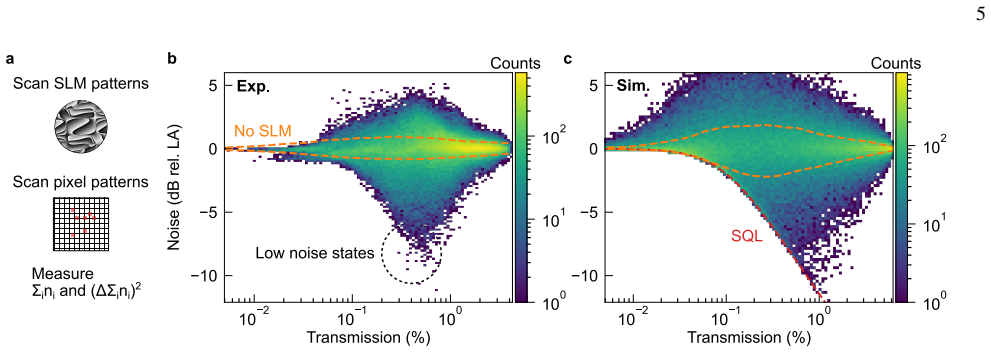
The paper's central claim is that controlling the initial wavefront of light entering a nonlinear multimode system can suppress intensity noise in a chosen output quantity all the way down to the quantum shot-noise limit, despite large excess noise in the input. The authors demonstrate this in a multimode fiber using a spatial light modulator to shape the input and a digital micromirror device to select the output region of interest, with a gradient-free optimization on the measured intensity-normalized noise. The optimized states show noise more than 10 dB below the level of linear attenuation, and combined input shaping with programmable output spatial filtering yields regions whose fluctu
Load-bearing premise
Everything hinges on the calibration that maps the measured 10 MHz photodetector power spectral density to the absolute quantum shot-noise level, together with the model that treats all input excess noise as a single parameter; if that calibration or model is off, the near-shot-noise conclusion would weaken.
Editorial extensions
If this is right
- Nonlinear multimode propagation does not have to amplify noise: with programmable input wavefronts, output regions can be made quieter than linear attenuation of the same beam.
- Highly amplified, noisy laser sources could be turned into near-shot-noise-limited sources for applications such as interferometry, microscopy, and spectroscopy, without requiring exotic quiet lasers.
- Programmable spatial filtering of the output adds a second handle: correlated noise between pixels can be harnessed to reach quantum-level fluctuations at higher transmitted power than single-pixel shaping alone.
- The derived variance formula gives a practical optimization target and a fast simulation route for noise control in highly multimode nonlinear systems, where full quantum simulations are intractable.
- With lower linear loss, the same control scheme should produce weakly squeezed light below the shot-noise limit, a step toward tailored quantum states from multimode nonlinear devices.
Reading between the lines
- If the 10 MHz power-spectral-density point is a faithful proxy for the quantum noise of the field, the same shaping strategy could be extended to suppress noise at other frequencies or in other quadratures; the paper measures only one frequency.
- Because the mechanism is generic (Kerr-induced phase-noise conversion), the wavefront-shaping protocol should transfer to other nonlinear multimode platforms such as integrated photonic circuits, where the optimization variables are on-chip phase shifters rather than an SLM.
- A natural next experiment would start from a source already near the shot-noise limit and check whether optimized states show sub-shot-noise behavior; the paper's outlook suggests squeezing, but its experiments stop at the SQL.
- The authors found random mode coupling in the fiber helpful, implying that deliberately engineered mode-coupling statistics could make low-noise states easier to discover — a design principle not tested here.
Editorial analysis
A structured set of objections, weighed in public.
Referee Report
Summary. The paper reports experiments and simulations showing that the input wavefront to a nonlinear multimode fiber, together with programmable output spatial filtering, can strongly suppress the intensity noise of a selected output region. The central experimental claim is that the optimized states reduce the beam noise by about 10-12 dB relative to linear attenuation and approach the quantum shot-noise limit, despite a laser source that is ~30 dB above shot noise. A theoretical expression (Eq. 1) decomposes the output photon-number variance into a shot-noise term, a mode-sensitivity term, and an excess-input-noise term, and a simulation framework is used to support the optimization results and to identify the Kerr-induced conversion of input intensity noise into intermodal phase noise as the dominant noise-generation mechanism.
Significance. If the central claim holds, this is a significant advance: it offers a practical route to producing near-shot-noise-limited light from noisy sources, and it introduces programmable wavefront shaping as a tool for controlling quantum noise in complex multimode nonlinear systems. The experimental demonstration that wavefront shaping reduces noise well below the linear-attenuation limit is convincing and the combination of input SLM and output DMD is genuinely novel. The theoretical framework (Eq. 1) is a useful first-order description and, importantly, is not a fit to the optimization result. The paper also makes a clear falsifiable mechanistic prediction, namely that noise patterns are dominated by intermodal phase fluctuations, which is supported by the reduced model in Fig. 5. However, the headline claim of reaching the quantum shot-noise limit rests on a single-frequency (10 MHz) PSD measurement with an absolute calibration deferred to the SI, and this requires additional evidence.
major comments (3)
- [§2 (Optimization of noise via input shaping), Figs. 2c and 3b, footnote [39]] The central claim that optimized output states reach near the shot-noise limit is based on the photocurrent PSD at 10 MHz, while Eq. (1) describes the frequency-integrated photon-number variance. Because the optimizer uses the 10 MHz PSD as its feedback signal, the measured reduction could in principle reflect spectral reshaping of excess noise away from 10 MHz rather than broadband removal. The footnote [39] argues that single-frequency PSD is the standard comparison to shot noise, but this does not rule out the possibility that the 10 MHz component is minimized at the expense of other frequencies. The manuscript should provide broadband noise spectra (or an estimate of the full variance) for the random and optimized states, or a quantitative argument that the Kerr nonlinearity and detection preserve whiteness across the relevant band. This issue is load-bearing for the headline claim o
- [§3 (Fig. 3c and 'fit to the shot-noise level based on experimental data (see SI)')] The statement that the low-noise states are 'within a few decibels of the shot noise level' depends on a shot-noise calibration that is not described in the main text. The reader cannot assess how the shot-noise level was determined, how the detector noise floor was subtracted, or how the 10 MHz PSD is converted to a photon-number variance. Please include the calibration procedure and its estimated uncertainty in the main text or, at minimum, state explicitly that this is the sole absolute calibration and show its key result. This point, together with the previous comment, determines whether the experiment actually reaches the SQL.
- [§2 (simulation of continuous-wave propagation, Fig. 2b/d)] The simulations used to support the optimization are continuous-wave, while the experiment uses femtosecond pulses. The paper argues in a parenthetical remark that this does not impact the main conclusions because (1) the lower bound for noise minimization is approximately the shot noise and is the same for CW and pulsed waves, and (2) the experimentally measured spectrum shows 'limited spectral dynamics' (SI). However, the lower-bound argument does not imply that the optimization landscape or the noise-cancellation mechanism is identical for pulsed and CW light, and 'limited spectral dynamics' is not quantified in the main text. The agreement in Fig. 3c is encouraging, but the simulation suite as presented cannot fully rule out pulse-specific noise redistribution. Please either show a representative pulsed simulation or discuss the limitations of the CW approximation more explicitly.
minor comments (5)
- [Abstract and §2] The abstract states '12 dB' of noise reduction beyond linear attenuation, while the main text says 'more than 10 dB' and '20 dB improvement compared to the initial random state.' Please reconcile these numbers and specify the exact conditions (e.g., which experimental run, which transmission).
- [Eq. (1)] Please define all symbols in the main text (Φ, δF_in, u_m^(0), U_m) and state the validity conditions of the expansion. Currently these definitions are only implicit or deferred to the SI, which makes the equation difficult to interpret.
- [§3, simulation free parameters] The paper lists the free parameters in the simulation (noise floor, excess input noise, DMD loss, power scale) but does not give their values or how they were estimated. A table or paragraph in the SI with these values and uncertainties would aid reproducibility.
- [General] No data or code availability statement is included. Given the novelty of the simulation framework, providing access to the simulation code and experimental data would strengthen the paper.
- [Footnote [39]] The footnote is unusually long and contains a substantive argument about why a single-frequency PSD is used. Consider moving this argument to the main text or expanding it into a short 'Methods' paragraph, because it is central to the interpretation of the results.
Circularity Check
No significant circularity: the optimization is feedback-driven and the theory is a derived perturbation expansion, not a repackaged fit.
full rationale
The central claim is not circular. Equation (1) is presented as a derived first-order variance-propagation expression in terms of sensitivities ∂n/∂u_m, not as a fit to the optimized output; the excess-noise parameter δF_in is a physical input-noise characterization. The experimental optimization uses the measured 10 MHz intensity-normalized noise as feedback, so the low-noise states are produced by direct measurement rather than by a theory whose parameters were fitted to those same states. The simulation's free parameters (noise floor, excess input noise, DMD loss, power scale) are nuisance calibrations and do not encode the 12 dB/LA or near-SQL values at the target pixel. The shot-noise calibration is relegated to the SI, and although the main text does not display the procedure, there is no exhibited reduction in which the fitted calibration parameter equals the claimed near-SQL result. The single-frequency PSD choice in footnote 39 is an assumption about broadband noise and a measurement-bandwidth concern, not a definitional equivalence; the footnote explicitly acknowledges the integrated-PSD distinction and argues the same methods apply to technical noise. The only self-citation, ref. [25], appears in the introductory survey ('recent works have begun to explore the quantum optical behavior of these systems [22–25]') and is not load-bearing. No specific circular step can be exhibited from the text.
Assumptions & free parameters
free parameters (5)
- Noise floor (simulation) =
not disclosed
- Excess input noise delta_F_in =
estimated 30 dB above shot at 260 mW
- DMD loss =
not disclosed
- Power scale =
not disclosed
- Shot-noise calibration constant (experiment) =
fit in SI
assumptions (4)
- standard math The output photon number n is a differentiable function of the input modal fields u_m(0), so that a first-order Taylor expansion of n around the mean fields is accurate.
- domain assumption Kerr nonlinearity is the dominant nonlinear mechanism and the fiber dynamics follow the standard generalized nonlinear Schrodinger equation; other effects (Raman, random mode coupling) are negligible or captured by the excess-noise parameter.
- domain assumption The intensity noise power spectral density at 10 MHz is proportional to the photon-number variance and is representative of the total optical noise relevant to the shot-noise comparison.
- ad hoc to paper The lower bound for noise minimization is approximately the shot noise, and this bound is the same for continuous-wave and pulsed waves.
Cite this review
Pith. "Pith review of Programmable control of the spatiotemporal quantum noise of light." pith.science (2026). https://pith.science/paper/446WQTST
@misc{pith2026250903482,
  author       = {Pith},
  title        = {Pith review of: Programmable control of the spatiotemporal quantum noise of light},
  year         = {2026},
  howpublished = {\url{https://pith.science/paper/446WQTST}},
  note         = {Machine review of arXiv:2509.03482}
}
read the original abstract
Optoelectronic systems based on multiple modes of light can often exceed the performance of their single-mode counterparts. However, multimode nonlinear interactions often introduce considerable amounts of noise, limiting the ultimate performance of these systems. It is therefore crucial to develop ways to simultaneously control complex nonlinear interactions while also gaining control over their noise. Here, we show that noise buildup in nonlinear multimode systems can be strongly suppressed by controlling the input wavefront. We demonstrate this approach in a multimode fiber by using an active wavefront-shaping protocol to focus a region of high intensity - yet low intensity noise - at the output. Our programmable control of both the input and output reduces the beam noise by 12 dB beyond what linear attenuation achieves, reaching levels near the quantum shot-noise limit. We show that this is possible because the optimally shaped wavefront maximally decouples the output intensity fluctuations from the input laser fluctuations. These findings are supported by a new theoretical and simulation framework that efficiently captures spatiotemporal quantum noise dynamics in highly multimode nonlinear systems. Our results highlight the potential of programmable wavefront shaping to enable nonlinear multimode technologies that overcome noise buildup to operate at quantum-noise limits.
Figures


Figures from the paper (2 more)


Reference graph
Works this paper leans on
-
[39]
We consider the power spectral density at a given frequency rather than the frequency-integrated power spectral density (which is proportional to the photon number variance in a pulse), as this allows us to make direct comparisons with the quantum shot noise level (as is standard). In contrast, the in- tegrated power spectral density will typically be far...
- [1]
-
[2]
P. A. Franken, A. E. Hill, C. W. Peters, and G. Weinreich, Phys- ical Review Letters 7, 118 (1961)
work page 1961
- [3]
-
[4]
W. Denk, J. H. Strickler, and W. W. Webb, Science 248, 73 (1990)
work page 1990
-
[5]
S. W. Hell and J. Wichmann, Optics Letters 19, 780 (1994)
work page 1994
-
[6]
C. W. Freudiger, W. Min, B. G. Saar, S. Lu, G. R. Holtom, C. He, J. C. Tsai, J. X. Kang, and X. S. Xie, Science 322, 1857 (2008)
work page 2008
-
[7]
L. G. Wright, F. O. Wu, D. N. Christodoulides, and F. W. Wise, Nature Physics 18, 1018 (2022)
work page 2022
Show all 57 references
-
[8]
H.-H. Lu, M. Liscidini, A. L. Gaeta, A. M. Weiner, and J. M. Lukens, Optica 10, 1655 (2023)
2023
-
[9]
B. J. Puttnam, G. Rademacher, and R. S. Lu ´ıs, Optica 8, 1186 (2021)
2021
-
[10]
J. Wang, J. Liu, S. Li, Y . Zhao, J. Du, and L. Zhu, Nanophoton- ics 11, 645 (2022)
2022
-
[11]
L. G. Wright, W. H. Renninger, D. N. Christodoulides, and F. W. Wise, Optica9, 824 (2022)
2022
-
[12]
Vitali, T
V . Vitali, T. D. Bucio, H. Liu, J. Haines, P. U. Naik, M. Guasoni, F. Gardes, L. Pavesi, I. Cristiani, C. Lacava, and P. Petropoulos, Nanophotonics 14, 2507 (2025)
2025
-
[13]
C.-W. Chen, K. Wisal, Y . Eliezer, A. D. Stone, and H. Cao, Proceedings of the National Academy of Sciences 120, e2217735120 (2023)
2023
-
[14]
Rothe, C.-W
S. Rothe, C.-W. CHen, P. Ahmadi, K. Wisal, M. Ercan, K. Lee, N. VIgne, A. D. Stone, and H. Cao, Wavefront shaping en- ables high-power multimode fiber amplifier with output control (2025), arXiv:2504.06423 [physics]
2025 arXiv
-
[15]
D. J. Richardson, J. M. Fini, and L. E. Nelson, Nature Photonics 7, 354 (2013)
2013
-
[16]
Haus, IEEE Journal of Selected Topics in Quantum Elec- tronics 6, 1173 (2000)
H. Haus, IEEE Journal of Selected Topics in Quantum Elec- tronics 6, 1173 (2000)
2000
-
[17]
F. O. Wu, A. U. Hassan, and D. N. Christodoulides, Nature Pho- tonics 13, 776 (2019)
2019
-
[18]
Pourbeyram, P
H. Pourbeyram, P. Sidorenko, F. O. Wu, N. Bender, L. Wright, D. N. Christodoulides, and F. Wise, Nature Physics 18, 685 (2022)
2022
-
[19]
L. G. Wright, D. N. Christodoulides, and F. W. Wise, Science 358, 94 (2017)
2017
-
[20]
L. G. Wright, T. Onodera, M. M. Stein, T. Wang, D. T. Schachter, Z. Hu, and P. L. McMahon, Nature601, 549 (2022)
2022
-
[21]
Momeni, B
A. Momeni, B. Rahmani, M. Mall ´ejac, P. Del Hougne, and R. Fleury, Science 382, 1297 (2023)
2023
-
[22]
M. A. Guidry, D. M. Lukin, K. Y . Yang, R. Trivedi, and J. Vu ˇckovi´c, Nature Photonics 16, 52 (2022), publisher: Springer Science and Business Media LLC
2022
-
[23]
Presutti, L
F. Presutti, L. G. Wright, S.-Y . Ma, T. Wang, B. K. Malia, T. Onodera, and P. L. McMahon, Highly multimode visible squeezed light with programmable spectral correlations through broadband up-conversion (2024), arXiv:2401.06119 [physics, physics:quant-ph]
2024 arXiv
-
[24]
Lustig, M
E. Lustig, M. A. Guidry, D. M. Lukin, S. Fan, and J. Vuckovic, Quadrature-Dependent Lattice Dynamics of Dissipative Micro- combs (2025), arXiv:2407.13049 [physics]
2025 arXiv
-
[25]
Zia Uddin, N
S. Zia Uddin, N. Rivera, D. Seyler, J. Sloan, Y . Salamin, C. Roques-Carmes, S. Xu, M. Y . Sander, I. Kaminer, and M. Solja ˇci´c, Nature Photonics 10.1038/s41566-025-01677-2 (2025)
2025 doi
-
[26]
Y . Cai, J. Roslund, G. Ferrini, F. Arzani, X. Xu, C. Fabre, and N. Treps, Nature Communications 8, 10.1038/ncomms15645 (2017), publisher: Springer Science and Business Media LLC
2017 doi
-
[27]
Asavanant, Y
W. Asavanant, Y . Shiozawa, S. Yokoyama, B. Charoensombu- tamon, H. Emura, R. N. Alexander, S. Takeda, J.-i. Yoshikawa, N. C. Menicucci, H. Yonezawa, and A. Furusawa, Science366, 373 (2019)
2019
-
[28]
Barral, M
D. Barral, M. Walschaers, K. Bencheikh, V . Parigi, J. A. Lev- enson, N. Treps, and N. Belabas, Physical Review Applied 14, 044025 (2020)
2020
-
[29]
Nichols, P
R. Nichols, P. Liuzzo-Scorpo, P. A. Knott, and G. Adesso, Phys- ical Review A 98, 012114 (2018)
2018
-
[30]
The LIGO Scientific Collaboration, Nature Physics 7, 962 (2011)
2011
-
[31]
Brida, M
G. Brida, M. Genovese, and I. Ruo Berchera, Nature Photonics 4, 227 (2010)
2010
-
[32]
Whittaker, C
R. Whittaker, C. Erven, A. Neville, M. Berry, J. L. O’Brien, H. Cable, and J. C. F. Matthews, New Journal of Physics 19, 023013 (2017)
2017
-
[33]
S.-Y . Ma, T. Wang, J. Laydevant, L. G. Wright, and P. L. McMa- hon, Nature Communications 16, 359 (2025)
2025
-
[34]
Shapiro, IEEE Journal of Selected Topics in Quantum Elec- tronics 15, 1547 (2009)
J. Shapiro, IEEE Journal of Selected Topics in Quantum Elec- tronics 15, 1547 (2009)
2009
-
[35]
Weedbrook, S
C. Weedbrook, S. Pirandola, R. Garc´ıa-Patr´on, N. J. Cerf, T. C. Ralph, J. H. Shapiro, and S. Lloyd, Reviews of Modern Physics 84, 621 (2012)
2012
-
[36]
Loudon, The Quantum Theory of Light, third edition ed
R. Loudon, The Quantum Theory of Light, third edition ed. (Ox- ford University Press, 2000)
2000
-
[37]
Bachor and T
H.-A. Bachor and T. C. Ralph, A guide to experiments in quan- tum optics, 3rd ed. (Wiley-VCH, 2019)
2019
-
[38]
K. L. Corwin, N. R. Newbury, J. M. Dudley, S. Coen, S. A. Did- dams, K. Weber, and R. S. Windeler, Physical Review Letters 90, 113904 (2003)
2003
-
[40]
S. B. Cavalcanti, G. P. Agrawal, and M. Yu, Physical Review A 51, 4086 (1995)
1995
-
[41]
C. M. Caves, Physical Review D 26, 1817 (1982)
1982
-
[42]
I. A. Walmsley and M. G. Raymer, Physical Review Letters50, 962 (1983)
1983
-
[43]
J. M. Dudley, G. Genty, and S. Coen, Reviews of Modern Physics 78, 1135 (2006)
2006
-
[44]
Gross and S
M. Gross and S. Haroche, Physics Reports 93, 301 (1982)
1982
-
[45]
Roques-Carmes, Y
C. Roques-Carmes, Y . Salamin, J. Sloan, S. Choi, G. Velez, E. Koskas, N. Rivera, S. E. Kooi, J. D. Joannopoulos, and M. Soljaˇci´c, Science 381, 205 (2023)
2023
-
[46]
Pellegrini, A
C. Pellegrini, A. Marinelli, and S. Reiche, Reviews of Modern Physics 88, 015006 (2016)
2016
-
[47]
H. Cao, A. P. Mosk, and S. Rotter, Nature Physics 18, 994 (2022)
2022
-
[48]
Tzang, A
O. Tzang, A. M. Caravaca-Aguirre, K. Wagner, and R. Piestun, Nature Photonics 12, 368 (2018). 9
2018
-
[49]
Florentin, V
R. Florentin, V . Kermene, J. Benoist, A. Desfarges- Berthelemot, D. Pagnoux, A. Barth ´el´emy, and J.-P. Huignard, Light: Science & Applications 6, e16208 (2016)
2016
-
[50]
Wisal, C.-W
K. Wisal, C.-W. Chen, Z. Kuang, O. D. Miller, H. Cao, and A. D. Stone, Optimal input excitations for suppressing nonlin- ear instabilities in multimode fibers (2024), arXiv:2407.05201 [physics]
2024 arXiv
-
[51]
Boussafa, L
Y . Boussafa, L. Sader, V . T. Hoang, B. P. Chaves, A. Bougaud, M. Fabert, A. Tonello, J. M. Dudley, M. Kues, and B. Wetzel, Nature Communications 16, 7800 (2025)
2025
-
[52]
C.-W. Chen, L. V . Nguyen, K. Wisal, S. Wei, S. C. Warren- Smith, O. Henderson-Sapir, E. P. Schartner, P. Ahmadi, H. Ebendorff-Heidepriem, A. D. Stone, D. J. Ottaway, and H. Cao, Nature Communications 14, 7343 (2023)
2023
-
[53]
Wisal, S
K. Wisal, S. C. Warren-Smith, C.-W. Chen, H. Cao, and A. D. Stone, Theory of Stimulated Brillouin Scattering in Fibers for Highly Multimode Excitations (2023), arXiv:2304.09342 [physics]
2023 arXiv
-
[54]
G. P. Agrawal, Optical Fiber Technology 50, 309 (2019)
2019
-
[55]
L. G. Wright, D. N. Christodoulides, and F. W. Wise, Nature Photonics 9, 306 (2015)
2015
-
[56]
D. J. Richardson, J. Nilsson, and W. A. Clarkson, Journal of the Optical Society of America B 27, B63 (2010)
2010
-
[57]
Gonzalez-Ballestero, J
C. Gonzalez-Ballestero, J. Zieli ´nska, M. Rossi, A. Militaru, M. Frimmer, L. Novotny, P. Maurer, and O. Romero-Isart, PRX Quantum 4, 030331 (2023)
2023
Reviewed August 5, 2026 · model on record in the stance chip above.
Discussion (0). Sign in to comment.