REVIEW 3 major objections 5 minor 76 references
Dynamically Controlled Transport of GeV Cosmic Rays in Diverse Galactic Environments
T0 review · 3 major / 5 minor · reviewed 2026-08-05 · deepseek-v4-flash
Pith's one-line read This paper argues that GeV cosmic-ray transport out of galactic disks is controlled by gas advection and Alfvén-wave streaming rather than diffusion, and that the resulting pressure profiles obey simple formulas.
desk verdict Solid, honest paper with a useful phenomenological model, but the central dynamical-transport claim rests on a damping model that could be incomplete; deserves peer review with scrutiny on that assumption. read the letter →
The pith
A machine-rendered reading of the paper's core claim, the machinery that carries it, and where it could break.
The reading
What carries the argument
The load-bearing object is the self-confinement scattering prescription: the parallel scattering coefficient σ∥ is set by equating gyroresonant Alfvén-wave growth from streaming cosmic rays to local damping, with nonlinear Landau damping dominant in ionized gas and ion-neutral friction dominant in neutral gas. This prescription enters a two-moment cosmic-ray transport scheme that evolves the cosmic-ray energy density and flux. The analytic 1D model reduces the steady-state equations in the source-free, high-scattering extraplanar regime to Pc/P0 = (vtot/v0)^(-4/3), where vtot is the sum of vertical gas advection speed and cosmic-ray streaming speed. A second identity closes the model by join
What would settle it
Take one simulated galactic disk environment, add an extra Alfvén-wave damping process in the extraplanar gas with an observationally motivated amplitude, and recompute the GeV cosmic-ray pressure profile; if the extraplanar scale height rises well above the 0.5–1 kpc range, or if the Pc/P0 = (vtot/v0)^(-4/3) relation no longer tracks the simulation, the central claim fails. Observationally, a gamma-ray-derived cosmic-ray pressure gradient in a star-forming galaxy halo that implies a diffusion coefficient orders of magnitude larger than the wave-balance value would likewise falsify the claim.
Extended reading notes
Core claim
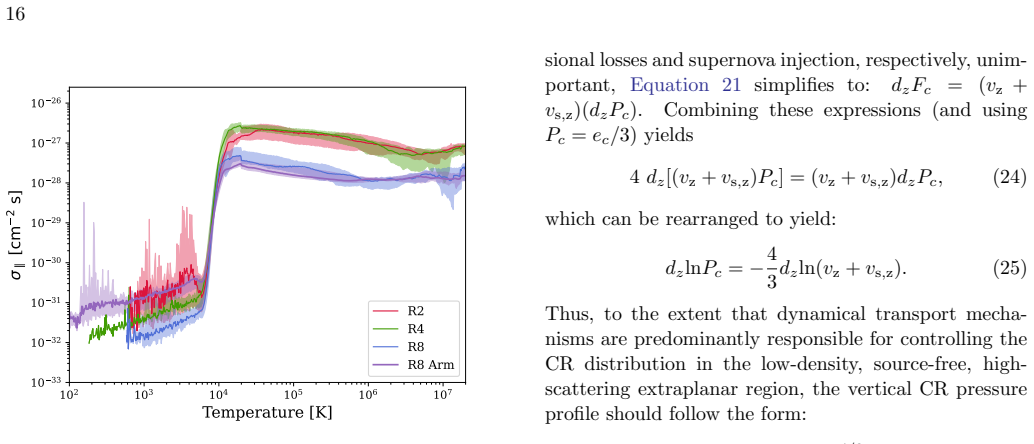
On the paper's own terms, the central discovery is that GeV cosmic-ray transport in galactic environments has two sharply separated regimes, with a boundary at the ~10^4 K transition between neutral and ionized gas. In the cool/neutral gas, where ion-neutral friction damps Alfvén waves, the scattering rate is very low; cosmic rays diffuse rapidly along field lines and are nearly uniform. In the hot, low-density extraplanar gas, nonlinear Landau damping leaves a much higher scattering rate, so field-aligned diffusion is slow; the escaping cosmic-ray flux is carried by gas advection and by streaming down the cosmic-ray pressure gradient at the ion Alfvén speed. The vertical profile Pc/P0 = (vt
Load-bearing premise
Everything rests on the local scattering rate being set by a balance between streaming-driven Alfvén wave excitation and only two damping processes, nonlinear Landau damping and ion-neutral friction — if hot extraplanar gas has an additional strong damping channel that lowers scattering, diffusion would retake control of GeV cosmic-ray escape.
Editorial extensions
If this is right
- Cosmic-ray scale heights are set by the dynamical flow and are nearly constant, 0.5–1 kpc, across environments spanning orders of magnitude in star-formation rate; cosmic-ray pressure therefore does not strongly support galactic disks vertically.
- Midplane cosmic-ray pressure can be computed from the injected supernova flux, gas column density, and warm-ionized-medium dynamical velocity alone, giving a predictive relation for galaxy-scale models.
- The cosmic-ray feedback yield decreases with star-formation rate as Υc ∝ Σ_SFR^(-0.23), matching the expectation that faster dynamical escape in higher-SFR environments lowers the pressure built up for a given injection rate.
- In the spiral-arm simulation, advection carries cosmic rays out of supernova injection regions and field-aligned transport equalizes pressure across arm and interarm regions, with perpendicular diffusion negligible.
- The subgrid scattering formulas provide a practical way for lower-resolution simulations to reproduce the multiphase cosmic-ray transport effects using only local MHD quantities and the local cosmic-ray pressure.
Reading between the lines
- If dynamical transport also dominates in real galaxies, then cosmic-ray pressure gradients in the halo, and hence cosmic-ray-driven wind acceleration, are controlled by outflow and Alfvén speeds at the disk–halo interface; galaxy models that treat halo cosmic-ray transport as purely diffusive may place the cosmic-ray pressure support in the wrong location.
- A testable extension is to compare the predicted halo gamma-ray or synchrotron profiles from the Pc ∝ vtot^(-4/3) relation with edge-on galaxy observations, which would constrain whether the extraplanar cosmic-ray pressure gradient follows the dynamical speed structure.
- Because the damping balance includes only two mechanisms, applying the subgrid scattering formulas to low-metallicity galaxies or to environments with strong turbulence is an extrapolation; the strongest test would be to rerun the wave balance with an additional damping term and see whether the dynamical-transport conclusion survives.
- The paper's energy-dependent correction factor implies that at higher CR energies diffusion begins to matter; extending the same machinery to a full spectrum of proton and electron energies would allow direct comparison with multi-GeV gamma-ray and synchrotron observations.
Editorial analysis
A structured set of objections, weighed in public.
Referee Report
Summary. This paper uses the TIGRESS MHD simulation suite (R2, R4, R8, and R8 Arm) with a two-moment CR transport scheme in which the parallel scattering coefficient is set by balancing streaming-driven Alfvén-wave excitation against nonlinear Landau damping and ion-neutral friction. The authors find that GeV CR pressure is nearly uniform in the neutral disk and decays exponentially in the extraplanar region, with a scale height of ~0.5–1 kpc that is nearly independent of environment. They argue that pure diffusion cannot explain these profiles and derive a parameter-free scaling, Eq. (26): Pc/P0 = (vtot/v0)^(-4/3), where vtot is the sum of gas advection and ion Alfvén streaming. The scaling is compared to simulation profiles in Figure 7 and reported as good agreement. They further derive a 1D model for the midplane CR pressure, Eq. (30), Pdisk = Fin / (4 vtot,WIM + (3/2) N Λcoll), calibrate effective velocities, provide empirical fits for the CR feedback yield (Eqs. 31–32), and present a subgrid scattering prescription (Eqs. 39–40).
Significance. If the central claim holds, the paper provides a valuable and physically motivated replacement for constant-diffusion treatments of GeV CR transport in galaxy simulations, with analytic predictions that can be tested observationally and incorporated into subgrid models. The derivation of Eq. (26) is clean under the stated approximations, and the comparison across environments spanning orders of magnitude in SFR and pressure is a strength. The paper also ships falsifiable predictions (Eqs. 30, 33–34) and a practical subgrid model, which are useful to the community. However, the central dynamical-transport conclusion rests on the assumption that only nonlinear Landau and ion-neutral damping set the scattering rate; the authors themselves acknowledge that additional damping processes could be important. This is a load-bearing uncertainty that needs to be addressed before the main claim can be considered robust.
major comments (3)
- [§2.2, Eqs. (12)–(13); §3.3, Eq. (20)] The scattering coefficient σ∥ is derived from a wave-energy balance that includes only nonlinear Landau damping and ion-neutral friction. The authors note in §2.2 that other damping mechanisms (e.g., turbulent damping, as in Hopkins et al. 2021, 2022) could meaningfully contribute. This is not a peripheral detail: the 'diffusion fails' argument in §3.3 uses Eq. (20) to estimate H_diff ≈ 40–80 pc for R8, which is an order of magnitude smaller than the measured Hc ≈ 500 pc. That contrast is the motivation for preferring dynamical transport. If an additional damping process reduces σ∥ by a factor of ~10 in the low-density extraplanar gas, H_diff becomes comparable to Hc, and the agreement of Pc(z) with Eq. (26) would no longer be decisive. I request a sensitivity test (e.g., artificially reducing σ∥ by factors of 3–10 and recomputing H_diff and the Eq. (26) comparison) or a quantitative arg
- [§4.2, Eqs. (28)–(30)] The paper describes Eq. (30) as a 'predictive model' for the midplane CR pressure, but the closure is not independent of the simulations used to test it. The effective velocity veff is inferred from the same simulations via Eq. (29), and then identified with vtot,WIM, the measured dynamical velocity in the warm ionized medium. While Figure 8 shows that veff tracks vtot in the WIM, this is a post-hoc calibration, not a parameter-free prediction. To support the 'predictive' claim, the authors should either (a) validate Eq. (30) against a simulation or observational dataset not used in the calibration, or (b) demonstrate that vtot,WIM can be predicted from basic galaxy parameters (e.g., SFR surface density, gas surface density) without recourse to the CR simulations. The current presentation overstates the extent to which Eq. (30) is a closed analytic model.
- [§4.1, Figure 7] The central evidence for Eq. (26) is visual agreement in Figure 7, with profiles normalized at arbitrary altitudes. The paper does not provide a quantitative goodness-of-fit metric (e.g., reduced chi-square, RMS scatter in log Pc, or a slope comparison) for the relation Pc ∝ vtot^{-4/3} across the four environments. Given that the claim is that this scaling holds 'for all models' and is the basis for the dynamical-transport conclusion, I ask for a quantitative measure of agreement and, ideally, a direct comparison of the dynamical model against the pure-diffusion model (Eq. 19–20) using the same data. This would make the case much more compelling and would also clarify how much weight to place on the restricted-damping assumption.
minor comments (5)
- [Table 1] Typographical errors: 'T able 1' in the table caption and 'surface densirt' in the column description. Please correct.
- [§2.3.1] The text says 'Utilizing the CR transport algorithms discussed in §2.3'; the CR transport implementation is in §2.2, while §2.3 describes the application to TIGRESS. Please fix the cross-reference.
- [§2.3.2] Typo: 'controlling the the detailed structure' should be 'controlling the detailed structure'.
- [Abstract and §1] The phrase 'almost solely responsible' in the abstract is stronger than the conclusions in the text, which allow for diffusion in the midplane and at higher energies. Consider softening to 'primarily responsible' to avoid overclaiming.
- [§4.1, Eq. (26)] The derivation of Eq. (26) omits the collisional loss term in Eq. (21) and the source term, which is reasonable for the extraplanar region, but this should be stated more explicitly in the text near Eq. (24) to avoid the impression that the simplification is universally valid.
Circularity Check
No significant circularity; central dynamical-transport claim is tested with a parameter-free scaling relation, with only a minor in-prep self-citation noted.
full rationale
The paper's central claim that dynamical transport dominates extraplanar GeV CR transport is tested via Eq. 26, a derived scaling relation Pc/P0 = (vtot/v0)^{-4/3} obtained from the two-moment equations in the limit of high scattering and no sources/losses. This relation is compared to the simulations in Figure 7 with only an amplitude normalization at an arbitrary altitude; the power-law shape and the Hc=(4/3)Ha consequence are not fitted parameters, so the test is self-contained and not reduced to the model's inputs. The midplane pressure model (Eq. 30) is built from Eq. 29, where veff is explicitly calibrated from the same simulations ('allowing a determination of veff for calibration purposes'), and veff is then identified with the independently measured vtot,WIM. This is an empirical correlation and, although the word 'prediction' is somewhat overstated because the validation is in-sample, the paper transparently acknowledges the calibration and the need for future validation ('The accuracy of our predictions can be validated by future multi-environment multi-energy simulation'). The restricted wave-damping set (NLL and IN only) is explicitly flagged as a limitation with citations to Hopkins et al. (2021, 2022), so it is a robustness concern, not a circularity. The subgrid model in §6 is explicitly an empirical fit. The only mild issue is a self-citation to 'M. Winter et al, in prep' to justify that magnetic field lines oscillate vertically enough for CRs to escape the disk; this is not load-bearing for the central transport finding, which rests on direct measurements of the uniform midplane CR pressure. Overall, no load-bearing step reduces by construction to its own inputs.
Assumptions & free parameters
free parameters (9)
- Feedback yield normalization (Eq 31) =
284 ± 33 km/s
- Feedback yield slope (Eq 31) =
-0.23 ± 0.05
- Feedback yield normalization (Eq 32) =
426 ± 42 km/s
- Feedback yield slope (Eq 32) =
-0.29 ± 0.04
- Effective velocity normalization (Eq 33) =
21 ± 3 km/s
- Effective velocity slope (Eq 33) =
0.20 ± 0.05
- Effective velocity normalization (Eq 34) =
15 ± 2 km/s
- Effective velocity slope (Eq 34) =
0.26 ± 0.05
- Spectral index delta (Eq 16) =
-0.35
assumptions (5)
- domain assumption Two-moment fluid treatment of CRs with isotropic pressure (P_c = e_c/3) and reduced speed of light v_m = 10^4 km/s adequately represents GeV CR transport in the ISM.
- domain assumption GeV CRs are self-confined: they excite Alfvén waves that scatter them, limiting bulk streaming to the ion Alfvén speed.
- domain assumption The local scattering rate is set by balance between wave excitation and damping, with only nonlinear Landau and ion-neutral damping included.
- domain assumption Post-processing with frozen MHD fields followed by a brief MHD relaxation (0.5-2 Myr) without new SN feedback yields a CR distribution representative of the coupled system.
- domain assumption Steady-state, source-free, loss-free, high-scattering assumptions in the extraplanar region justify the derivation of Eq 26.
Cite this review
Pith. "Pith review of Dynamically Controlled Transport of GeV Cosmic Rays in Diverse Galactic Environments." pith.science (2026). https://pith.science/paper/D6QSQ3H7
@misc{pith2026250903519,
  author       = {Pith},
  title        = {Pith review of: Dynamically Controlled Transport of GeV Cosmic Rays in Diverse Galactic Environments},
  year         = {2026},
  howpublished = {\url{https://pith.science/paper/D6QSQ3H7}},
  note         = {Machine review of arXiv:2509.03519}
}
abstract
We study transport of GeV cosmic rays (CRs) in a set of high-resolution TIGRESS magnetohydrodynamic simulations of the star-forming interstellar medium (ISM). Our local disk patch models sample a wide range of gas surface densities, gravitational potentials, and star formation rates (SFRs), and include a spiral arm simulation. Our approach incorporates CR advection by the background gas, streaming along the magnetic field limited by the local ion Alfv\'en speed, and diffusion relative to the Alfv\'en wave frame, with the diffusion coefficient set by the balance between streaming-driven Alfv\'en wave excitation and damping mediated by local gas properties. We find that dynamical transport mechanisms (streaming and advection) are almost solely responsible for GeV CR transport in the extra-planar regions of galaxies, while diffusion along the magnetic field dominates within the primarily-neutral ISM of galactic disks. We develop a simple 1D predictive model for the CR pressure $P_\mathrm{c}$, dependent only on injected CR flux and gas parameters. We demonstrate that the CR transport efficiency increases with increasing SFR, and provide a fit for the CR feedback yield $\Upsilon_\mathrm{c}~\equiv~P_\mathrm{c}/\Sigma_\mathrm{SFR}$ as a function of $\Sigma_\mathrm{SFR}$, the SFR surface density. We analyze lateral CR transport within the galactic disk, showing that CRs propagate away from feedback regions in spiral arms into interarm regions by a combination of gas advection and field-aligned transport. Lastly, we develop an empirical subgrid model for the CR scattering rate that captures the impacts of the multiphase ISM on CR transport without the numerical burden of full simulations.
Figures


Figures from the paper (7 more)




Reference graph
Works this paper leans on
-
[1]
2014, Science, 345, 554, doi: 10.1126/science.1253947
Ackermann, M., Ajello, M., Albert, A., et al. 2014, Science, 345, 554, doi: 10.1126/science.1253947
-
[2]
2015, PhRvL, 115, 211101, doi: 10.1103/PhysRevLett.115.211101
Aguilar, M., Aisa, D., Alpat, B., et al. 2015, PhRvL, 115, 211101, doi: 10.1103/PhysRevLett.115.211101
-
[3]
2018, Advances in Space Research, 62, 2731, doi: 10.1016/j.asr.2017.04.019
Amato, E., & Blasi, P. 2018, Advances in Space Research, 62, 2731, doi: 10.1016/j.asr.2017.04.019
-
[4]
Armillotta, L., Ostriker, E. C., & Jiang, Y.-F. 2021, ApJ, 922, 11, doi: 10.3847/1538-4357/ac1db2
-
[5]
Armillotta, L., Ostriker, E. C., & Jiang, Y.-F. 2022, ApJ, 929, 170, doi: 10.3847/1538-4357/ac5fa9
-
[6]
Armillotta, L., Ostriker, E. C., Kim, C.-G., & Jiang, Y.-F. 2024, ApJ, 964, 99, doi: 10.3847/1538-4357/ad1e5c
-
[7]
Energy-Dependent Transport of Cosmic Rays in the Multiphase, Dynamic Interstellar Medium
Armillotta, L., Ostriker, E. C., & Linzer, N. B. 2025, arXiv e-prints, arXiv:2507.00120. https://arxiv.org/abs/2507.00120
work page Pith review arXiv 2025
-
[8]
2020, A&A, 644, A125, doi: 10.1051/0004-6361/202038962
Bacchini, C., Fraternali, F., Pezzulli, G., & Marasco, A. 2020, A&A, 644, A125, doi: 10.1051/0004-6361/202038962
Show all 76 references
-
[9]
2022, ApJ, 928, 112, doi: 10.3847/1538-4357/ac56e1
Bai, X.-N. 2022, ApJ, 928, 112, doi: 10.3847/1538-4357/ac56e1
2022 doi
-
[10]
C., Plotnikov, I., & Stone, J
Bai, X.-N., Ostriker, E. C., Plotnikov, I., & Stone, J. M. 2019, ApJ, 876, 60, doi: 10.3847/1538-4357/ab1648
2019 doi
-
[11]
J., Bai, X.-N., & Ostriker, E
Bambic, C. J., Bai, X.-N., & Ostriker, E. C. 2021, ApJ, 920, 141, doi: 10.3847/1538-4357/ac0ce7
2021 doi
-
[13]
2001b, SSRv, 99, 243, doi: 10.1023/A:1013805401252
Beck, R. 2001b, SSRv, 99, 243, doi: 10.1023/A:1013805401252
-
[14]
2013, in Planets, Stars and Stellar Systems
Beck, R., & Wielebinski, R. 2013, in Planets, Stars and Stellar Systems. Volume 5: Galactic Structure and Stellar Populations, ed. T. D. Oswalt & G. Gilmore, Vol. 5, 641, doi: 10.1007/978-94-007-5612-0 13
2013 doi
-
[16]
D., & Ostriker, J
Blandford, R. D., & Ostriker, J. P. 1978, ApJL, 221, L29, doi: 10.1086/182658
1978 doi
-
[17]
S., Lopez-Rodriguez, E., Beck, R., et al
Borlaff, A. S., Lopez-Rodriguez, E., Beck, R., et al. 2023, ApJ, 952, 4, doi: 10.3847/1538-4357/acd934
2023 doi
-
[19]
Boulares, A., & Cox, D. P. 1990b, ApJ, 365, 544, doi: 10.1086/169509
-
[20]
K., Kereˇ s, D., Hopkins, P
Chan, T. K., Kereˇ s, D., Hopkins, P. F., et al. 2019, MNRAS, 488, 3716, doi: 10.1093/mnras/stz1895
2019 doi
-
[22]
C., Stone, E
Cummings, A. C., Stone, E. C., Heikkila, B. C., et al. 2016b, ApJ, 831, 18, doi: 10.3847/0004-637X/831/1/18
-
[23]
2020, A&A, 638, A123, doi: 10.1051/0004-6361/201936339
Dashyan, G., & Dubois, Y. 2020, A&A, 638, A123, doi: 10.1051/0004-6361/201936339
2020 doi
-
[24]
Draine, B. T. 2011, Physics of the Interstellar and Intergalactic Medium 29
2011
-
[25]
2018, PhRvL, 121, 021102, doi: 10.1103/PhysRevLett.121.021102
Evoli, C., Blasi, P., Morlino, G., & Aloisio, R. 2018, PhRvL, 121, 021102, doi: 10.1103/PhysRevLett.121.021102
2018 doi
-
[26]
A., Black, J
Grenier, I. A., Black, J. H., & Strong, A. W. 2015, ARA&A, 53, 199, doi: 10.1146/annurev-astro-082214-122457
2015 doi
-
[27]
W., & Girichidis, P
Hanasz, M., Strong, A. W., & Girichidis, P. 2021, Living Reviews in Computational Astrophysics, 7, 2, doi: 10.1007/s41115-021-00011-1
2021 doi
-
[28]
R., Millman, K
Harris, C. R., Millman, K. J., van der Walt, S. J., et al. 2020, Nature, 585, 357, doi: 10.1038/s41586-020-2649-2
2020 doi
-
[29]
F., Squire, J., Butsky, I
Hopkins, P. F., Squire, J., Butsky, I. S., & Ji, S. 2022, MNRAS, 517, 5413, doi: 10.1093/mnras/stac2909
2022 doi
-
[30]
F., Squire, J., Chan, T
Hopkins, P. F., Squire, J., Chan, T. K., et al. 2021, MNRAS, 501, 4184, doi: 10.1093/mnras/staa3691
2021 doi
-
[31]
Hunter, J. D. 2007, Computing in Science & Engineering, 9, 90, doi: 10.1109/MCSE.2007.55
2007 doi
-
[32]
K., Hummels, C
Ji, S., Chan, T. K., Hummels, C. B., et al. 2020, MNRAS, 496, 4221, doi: 10.1093/mnras/staa1849
2020 doi
-
[33]
Jiang, Y.-F., & Oh, S. P. 2018, ApJ, 854, 5, doi: 10.3847/1538-4357/aaa6ce
2018 doi
-
[34]
2020, MNRAS, 493, 1801, doi: 10.1093/mnras/staa385
Kempski, P., & Quataert, E. 2020, MNRAS, 493, 1801, doi: 10.1093/mnras/staa385
2020 doi
-
[35]
Kim, C.-G., & Ostriker, E. C. 2017, ApJ, 846, 133, doi: 10.3847/1538-4357/aa8599
2017 doi
-
[36]
C., Somerville, R
Kim, C.-G., Ostriker, E. C., Somerville, R. S., et al. 2020, ApJ, 900, 61, doi: 10.3847/1538-4357/aba962
2020 doi
-
[37]
C., Kim, J.-G., et al
Kim, C.-G., Ostriker, E. C., Kim, J.-G., et al. 2024, ApJ, 972, 67, doi: 10.3847/1538-4357/ad59ab
2024 doi
-
[38]
J., & Dowell, C
Kim, J.-A., Jones, T. J., & Dowell, C. D. 2023, AJ, 165, 223, doi: 10.3847/1538-3881/acc9c7
2023 doi
-
[39]
Kim, J.-G., Kim, W.-T., & Ostriker, E. C. 2018, ApJ, 859, 68, doi: 10.3847/1538-4357/aabe27
2018 doi
-
[40]
Kim, W.-T., Kim, C.-G., & Ostriker, E. C. 2020, ApJ, 898, 35, doi: 10.3847/1538-4357/ab9b87
2020 doi
-
[41]
2014, ApJ, 789, 68, doi: 10.1088/0004-637X/789/1/68
Kim, W.-T., Kim, Y., & Kim, J.-G. 2014, ApJ, 789, 68, doi: 10.1088/0004-637X/789/1/68
2014 doi
-
[42]
Kim, W.-T., & Ostriker, E. C. 2002, ApJ, 570, 132, doi: 10.1086/339352
2002 doi
-
[43]
Kim, W.-T., & Ostriker, E. C. 2006, ApJ, 646, 213, doi: 10.1086/504677
2006 doi
-
[44]
Kim, Y., Kim, W.-T., & Elmegreen, B. G. 2015, ApJ, 809, 33, doi: 10.1088/0004-637X/809/1/33
2015 doi
-
[45]
2002, ApJL, 564, L97, doi: 10.1086/338978
Koyama, H., & Inutsuka, S.-i. 2002, ApJL, 564, L97, doi: 10.1086/338978
2002 doi
-
[46]
2001, MNRAS, 322, 231, doi: 10.1046/j.1365-8711.2001.04022.x
Kroupa, P. 2001, MNRAS, 322, 231, doi: 10.1046/j.1365-8711.2001.04022.x
2001
-
[47]
Kulsrud, R., & Pearce, W. P. 1969, ApJ, 156, 445, doi: 10.1086/149981
1969 doi
-
[48]
Kulsrud, R. M. 2005, Plasma Physics for Astrophysics
2005
-
[49]
M., & Cesarsky, C
Kulsrud, R. M., & Cesarsky, C. J. 1971, Astrophys. Lett., 8, 189
1971
-
[50]
D., et al
Leitherer, C., Schaerer, D., Goldader, J. D., et al. 1999, ApJS, 123, 3, doi: 10.1086/313233
1999 doi
-
[51]
B., Armillotta, L., Ostriker, E
Linzer, N. B., Armillotta, L., Ostriker, E. C., & Quataert, E. 2025, arXiv e-prints, arXiv:2507.00142. https://arxiv.org/abs/2507.00142
2025 arXiv
-
[52]
B., Kim, J.-G., Kim, C.-G., & Ostriker, E
Linzer, N. B., Kim, J.-G., Kim, C.-G., & Ostriker, E. C. 2024, ApJ, 975, 173, doi: 10.3847/1538-4357/ad7733
2024 doi
-
[53]
S., Kereˇ s, D., Hopkins, P
Lu, Y. S., Kereˇ s, D., Hopkins, P. F., et al. 2025, arXiv e-prints, arXiv:2505.13597, doi: 10.48550/arXiv.2505.13597
2025 doi
-
[54]
2012, A&A, 538, A81, doi: 10.1051/0004-6361/201117855
Morlino, G., & Caprioli, D. 2012, A&A, 538, A81, doi: 10.1051/0004-6361/201117855
2012 doi
-
[55]
C., & Kim, C.-G
Ostriker, E. C., & Kim, C.-G. 2022, ApJ, 936, 137, doi: 10.3847/1538-4357/ac7de2
2022 doi
-
[56]
C., McKee, C
Ostriker, E. C., McKee, C. F., & Leroy, A. K. 2010, ApJ, 721, 975, doi: 10.1088/0004-637X/721/2/975
2010 doi
-
[57]
V., Galli, D., & Caselli, P
Padovani, M., Ivlev, A. V., Galli, D., & Caselli, P. 2018, A&A, 614, A111, doi: 10.1051/0004-6361/201732202
2018 doi
-
[58]
V., Galli, D., et al
Padovani, M., Ivlev, A. V., Galli, D., et al. 2020, SSRv, 216, 29, doi: 10.1007/s11214-020-00654-1 Planck Collaboration, Adam, R., Ade, P. A. R., et al. 2016, A&A, 594, A1, doi: 10.1051/0004-6361/201527101
2020 doi
-
[59]
C., & Bai, X.-N
Plotnikov, I., Ostriker, E. C., & Bai, X.-N. 2021, ApJ, 914, 3, doi: 10.3847/1538-4357/abf7b3
2021 doi
-
[60]
Quataert, E., & Hopkins, P. F. 2025, The Open Journal of Astrophysics, 8, 66, doi: 10.33232/001c.138772
2025 doi
-
[61]
2023, MNRAS, 522, 1843, doi: 10.1093/mnras/stad1104
Rathjen, T.-E., Naab, T., Walch, S., et al. 2023, MNRAS, 522, 1843, doi: 10.1093/mnras/stad1104
2023 doi
-
[62]
2020, International Journal of Modern Physics D, 29, 2030006, doi: 10.1142/S0218271820300062
Recchia, S. 2020, International Journal of Modern Physics D, 29, 2030006, doi: 10.1142/S0218271820300062
2020 doi
-
[63]
2022, SN Applied Sciences, 4, 15, doi: 10.1007/s42452-021-04891-z
Reichherzer, P., Merten, L., D¨ orner, J., et al. 2022, SN Applied Sciences, 4, 15, doi: 10.1007/s42452-021-04891-z
2022 doi
-
[64]
Roberts, W. W. 1969, ApJ, 158, 123, doi: 10.1086/150177
1969 doi
-
[65]
2023, A&A Rv, 31, 4, doi: 10.1007/s00159-023-00149-2
Ruszkowski, M., & Pfrommer, C. 2023, A&A Rv, 31, 4, doi: 10.1007/s00159-023-00149-2
2023 doi
-
[66]
N., Ostriker, E
Shetty, R., Vogel, S. N., Ostriker, E. C., & Teuben, P. J. 2007, ApJ, 665, 1138, doi: 10.1086/520037
2007 doi
- [67]
-
[68]
A., & Ostriker, E
Skinner, M. A., & Ostriker, E. C. 2013, ApJS, 206, 21, doi: 10.1088/0067-0049/206/2/21
2013 doi
-
[69]
Simon, J. B. 2008, ApJS, 178, 137, doi: 10.1086/588755
2008 doi
-
[70]
M., Tomida, K., White, C
Stone, J. M., Tomida, K., White, C. J., & Felker, K. G. 2020, ApJS, 249, 4, doi: 10.3847/1538-4365/ab929b
2020 doi
-
[71]
S., & Dopita, M
Sutherland, R. S., & Dopita, M. A. 1993, ApJS, 88, 253, doi: 10.1086/191823
1993 doi
-
[72]
2023, MNRAS, 521, 3023, doi: 10.1093/mnras/stad472 30
Thomas, T., Pfrommer, C., & Pakmor, R. 2023, MNRAS, 521, 3023, doi: 10.1093/mnras/stad472 30
2023 doi
- [73]
-
[74]
J., ZuHone, J
Turk, M., Goldbaum, N. J., ZuHone, J. A., et al. 2025, Introducing yt 4.0: Analysis and Visualization of Volumetric Data, Tech. rep., Manubot
2025
-
[75]
2020, ApJ, 894, 12, doi: 10.3847/1538-4357/ab8474
Li, M. 2020, ApJ, 894, 12, doi: 10.3847/1538-4357/ab8474
2020 doi
-
[76]
2004, MNRAS, 349, 270, doi: 10.1111/j.1365-2966.2004.07484.x
Wada, K., & Koda, J. 2004, MNRAS, 349, 270, doi: 10.1111/j.1365-2966.2004.07484.x
2004
-
[77]
Wentzel, D. G. 1974, ARA&A, 12, 71, doi: 10.1146/annurev.aa.12.090174.000443
1974
-
[78]
G., & Ruszkowski, M
Wiener, J., Zweibel, E. G., & Ruszkowski, M. 2019, MNRAS, 489, 205, doi: 10.1093/mnras/stz2007
2019 doi
-
[79]
2002, PhRvL, 89, 281102, doi: 10.1103/PhysRevLett.89.281102
Yan, H., & Lazarian, A. 2002, PhRvL, 89, 281102, doi: 10.1103/PhysRevLett.89.281102
2002 doi
-
[80]
Zweibel, E. G. 2017, Physics of Plasmas, 24, 055402, doi: 10.1063/1.4984017
2017 doi
Reviewed August 5, 2026 · model on record in the stance chip above.
Discussion (0). Sign in to comment.