REVIEW 3 major objections 6 minor 99 references
Designing Effective AI Explanations for Misinformation Detection: A Comparative Study of Content, Social, and Combined Explanations
T0 review · 3 major / 6 minor · reviewed 2026-08-05 · deepseek-v4-flash
Pith's one-line read This paper claims that the alignment of content-based and social-contextual explanations, not the presence of either cue type alone, determines whether AI explanations help people detect misinformation—and that conflicting explanations offe
desk verdict Useful empirical comparison of explanation types for misinformation detection, but the headline aligned-vs-misaligned contrast is confounded with presenting incorrect information, so the design recommendations outrun the design. read the letter →
The pith
A machine-rendered reading of the paper's core claim, the machinery that carries it, and where it could break.
The reading
What carries the argument
The central object is a pair of natural-language explanations generated independently by GPT-4o from two separate cue sets: a content explanation derived from the claim's syntactic, semantic, and structural features, and a social explanation derived from speaker attributes (name, role, party affiliation, credibility history) and the claim's dissemination context. These are then presented jointly as either aligned (both point to the same verdict) or misaligned (they point to opposite verdicts), with misalignment introduced in a balanced, controlled manner. The comparison across these configurations carries the argument: any accuracy difference between aligned and misaligned joint presentation
What would settle it
Run the same task but let users arbitrate between conflicting explanations—for example, show a confidence score on each sub-explanation or offer a clickable source link that settles the dispute. If detection accuracy under misalignment then matches or exceeds the aligned condition, the original null result was an artifact of unresolvable contradiction rather than a property of misalignment. If accuracy still fails to beat control even with arbitration available, the cost of conflicting explanations is confirmed as robust.
Extended reading notes
Core claim
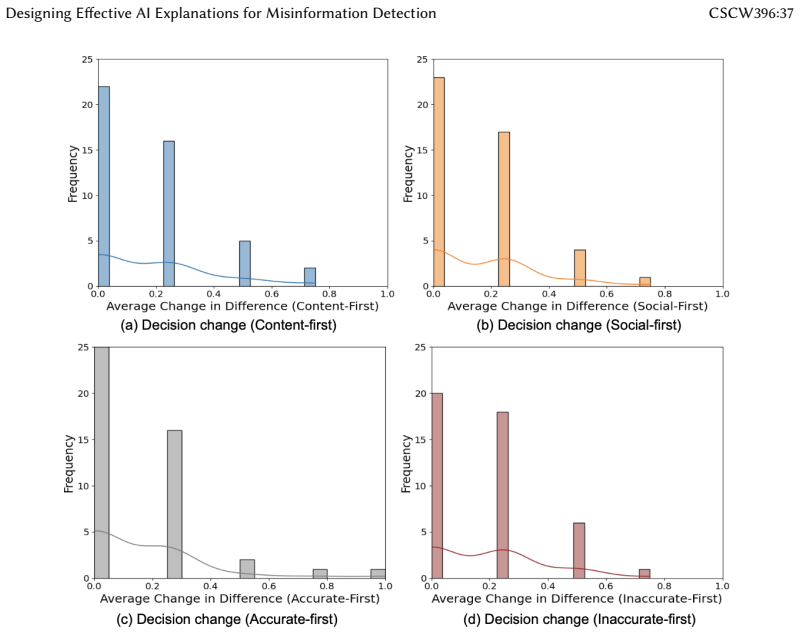
The central claim is that alignment between content-based and social-contextual explanations is the decisive factor in whether AI explanations help people detect misinformation. In Study 1 (COVID-19, Prolific), aligned explanations raised standard detection accuracy to 85.06%, significantly above content-only (73.06%), social-only (70.64%), misaligned (60.56%), and no-explanation control (57.67%) conditions, and scored highest on perceived usefulness and understanding of AI. Misaligned explanations—with one sub-explanation labeling the claim true and the other false—were statistically indistinguishable from the control condition in accuracy despite being perceived as useful. Study 2 (MTurk,
Load-bearing premise
The misaligned-exclamation conditions presented users with two explanations that directly contradicted each other, and one was wrong by design; the paper treats the resulting lack of accuracy gain as evidence about misalignment itself, but the result may simply reflect that users faced contradictory cues with no way of knowing which one was correct.
Editorial extensions
If this is right
- Designers of misinformation warning systems should treat explanation agreement as a first-class design target: combining content and social context helps users most when the two stories cohere.
- Conflicting explanations are a measurable risk: they cost detection accuracy without improving comprehension, even though users report finding them useful.
- Presentation order is a real design variable but a domain-dependent one—a social explanation shown first can anchor how much later disagreement hurts, at least in some domains.
- LLM-based explanation generation from separated cue sets is workable and produces frequent misalignment, so real systems will regularly face the question of how to present disagreement.
- Because weighted accuracy (accuracy times confidence) is where order effects appear, explanation design can shape user confidence and downstream information-seeking even when binary accuracy is unchanged.
Reading between the lines
- The null result for misaligned explanations may be an artifact of construction: because one of the two sub-explanations was always wrong relative to ground truth by design, users could not tell which half to trust. In real deployments where explanations carry confidence scores, source links, or an accompanying verdict, the cost of misalignment could shrink or vanish.
- A direct test of the paper's confirmation-bias explanation is still open—its own quantitative checks found no strong evidence that misaligned explanations uniquely reinforced initial beliefs, so the mechanism behind the accuracy gap is not settled.
- A testable extension would let users arbitrate conflicts by clicking through to sources or seeing per-explanation confidence; if accuracy then matches the aligned condition, the harm of misalignment is confusion rather than inherent conflict.
- The domain asymmetry (order effects in COVID-19, none in politics) suggests that domains where claims are already politically charged will mute order effects, because users supply their own social context from memory regardless of presentation sequence.
Editorial analysis
A structured set of objections, weighed in public.
Referee Report
Summary. The paper reports two crowdsourcing experiments (Study 1 on Prolific in the COVID-19 domain; Study 2 on MTurk in both COVID-19 and Politics domains) comparing content, social, aligned, and misaligned natural-language AI explanations for misinformation detection. In Study 1, participants received one of five conditions (control, content, social, aligned, misaligned) and rated veracity before and after viewing explanations. Study 2 used a 2x2 mixed design crossing first-explanation type (content vs social) with alignment of the second explanation. The authors report that aligned explanations significantly improve detection accuracy and user experience relative to content, social, and misaligned explanations, while misaligned explanations do not outperform the no-explanation control in Study 1. They also report a domain-dependent order effect in weighted detection accuracy for COVID-19 but not Politics. The paper concludes by recommending that explanation design prioritize alignment and offers frameworks (MSEF, PUEP) for managing misaligned explanations.
Significance. If the findings are robust, the paper contributes a useful empirical comparison of explanation modalities in misinformation detection, a relatively underexplored area, and it introduces a worthwhile distinction between aligned and misaligned combined explanations. The two-study design with different participant pools, a between-subjects control, and a priori power analysis are strengths, as are the detailed appendices describing the generation pipeline and additional analyses. The qualitative analysis in Study 2 gives some insight into how users process conflicting cues. However, the central claim about the ineffectiveness of misaligned explanations is weakened by a confound between conflict and incorrectness in the stimulus construction, and by the exclusion of the control condition from the Study 2 inferential analysis. These issues bear directly on the design recommendation to 'prioritize alignment.'
major comments (3)
- [§5.2, Table 4, footnote 12] Study 2 excludes the control condition from all inferential analyses, so the claim that misaligned explanations are 'no more effective than providing no explanation' (stated in the contributions and in §5.5) is not actually tested in Study 2. Descriptively, misaligned conditions show markedly lower accuracy than the control (e.g., COVID-19 SMDA: 31.58 vs 47.69; WMDA: 17.91 vs 28.85; Politics SMDA: 22.22 vs 56.47). This pattern suggests misaligned explanations may actively harm detection accuracy rather than simply being no better than control. The authors should either include the control condition in a supplemental statistical model or soften the cross-study claim accordingly.
- [§4.5.1, §5.3, Appendix E] The paper's claim that misaligned explanations 'proved no more effective than providing no explanation' is based on null p-values (SMDA p=0.241; WMDA p=0.140). This is presented as a firm finding, despite the absence of an equivalence test or a Bayesian analysis. The language 'no notable advantage' and 'proved no more effective' is too strong for a failure to reject. Given the small per-condition sample sizes (N=40-45) and the multiple post-hoc comparisons, the authors should either report an equivalence margin and test, or temper the claim to 'we did not find a significant benefit.'
- [§5.3.1, §5.3.2] The interaction effect in the COVID-19 WMDA is reported and interpreted (mean difference 51.16% for social-first versus 7.63% for content-first), but the corresponding simple effects are not reported. Without a test of whether content-first aligned vs. misaligned differs significantly, the reader cannot tell whether the interaction is driven by a large effect in one group or by a smaller effect in both groups. Please report simple-effect tests and effect sizes for both orders.
minor comments (6)
- [Table 3 note] The note refers to 'WDMA' but the metric is WMDA. Please correct the typo.
- [Table 4] The condition 'Content-Misligned' contains a spelling error; should be 'Content-Misaligned.'
- [§3.1] The text refers to 'Politcs' instead of 'Politics.'
- [§5.2.2] The phrase 'The Second one is to to examine' has a doubled word; please revise.
- [§5.4.2] 'This scrunity' should be 'This scrutiny.'
- [§4.1, Figure 2] The figure caption states the example represents a 'misaligned' condition, but the content and social labels under the dashed line are not shown to participants. It would be clearer to note explicitly that these labels were added for illustration only.
Circularity Check
No definitional or fitted-input circularity; the paper is an externally grounded empirical comparison. Minor self-citation is not load-bearing.
full rationale
The paper's central claims are empirical contrasts measured with human participants against external ground-truth labels (PolitiFact, cross-validated with Snopes/Factcheck.org, §3.1). The dependent variables (SMDA, WMDA, perceived usefulness, understanding of AI) are not defined in terms of the explanation-generation process or the alignment variable; no parameter is fitted to the outcome and then reported as a prediction. The aligned/misaligned classification (§3.2) is based on agreement between GPT-generated content and social sub-explanations, but user accuracy is independently elicited (§4.3, §5.2.2), so the headline comparison does not reduce to the classification by construction. The single self-citation (Gong et al. [29], §2.1 and §6.1.1) motivates the 'social explanation' concept but is not the evidence for the empirical findings, which are produced in this paper. Appendix A's acknowledgment that separate generation 'may seem artificial' flags a design limitation: because misaligned pairs contain one sub-explanation that contradicts the other, and because GPT's final prediction is correct on 87.22% of misaligned claims versus 43.67% of aligned claims, the misaligned condition may conflate 'conflict' with 'presence of an incorrect sub-explanation.' This is a validity threat, not a definitional circularity: the paper does not define detection accuracy in terms of alignment. Hence no circular step meets the evidence threshold.
Assumptions & free parameters
free parameters (3)
- Number of sampled claims =
24
- GPT consistency threshold =
3 trials
- Manual revision of explanations =
N/A
assumptions (4)
- domain assumption Ground truth labels from PolitiFact, cross-validated with Snopes/FactCheck.org, are correct.
- domain assumption Crowdsourced participants from Prolific and MTurk are representative enough of general social media users to support the claimed effects.
- domain assumption GPT-4o-generated explanations, after manual revision, faithfully represent the content and socio-contextual cues that would appear in a deployed detection system.
- domain assumption The alignment classification (aligned vs misaligned) is a valid binary construct, and the balancing of which explanation aligns with the model's prediction removes bias.
Cite this review
Pith. "Pith review of Designing Effective AI Explanations for Misinformation Detection: A Comparative Study of Content, Social, and Combined Explanations." pith.science (2026). https://pith.science/paper/DJYL6SPH
@misc{pith2026250903693,
  author       = {Pith},
  title        = {Pith review of: Designing Effective AI Explanations for Misinformation Detection: A Comparative Study of Content, Social, and Combined Explanations},
  year         = {2026},
  howpublished = {\url{https://pith.science/paper/DJYL6SPH}},
  note         = {Machine review of arXiv:2509.03693}
}
read the original abstract
In this paper, we study the problem of AI explanation of misinformation, where the goal is to identify explanation designs that help improve users' misinformation detection abilities and their overall user experiences. Our work is motivated by the limitations of current Explainable AI (XAI) approaches, which predominantly focus on content explanations that elucidate the linguistic features and sentence structures of the misinformation. To address this limitation, we explore various explanations beyond content explanation, such as "social explanation" that considers the broader social context surrounding misinformation, as well as a "combined explanation" where both the content and social explanations are presented in scenarios that are either aligned or misaligned with each other. To evaluate the comparative effectiveness of these AI explanations, we conduct two online crowdsourcing experiments in the COVID-19 (Study 1 on Prolific) and Politics domains (Study 2 on MTurk). Our results show that AI explanations are generally effective in aiding users to detect misinformation, with effectiveness significantly influenced by the alignment between content and social explanations. We also find that the order in which explanation types are presented - specifically, whether a content or social explanation comes first - can influence detection accuracy, with differences found between the COVID-19 and Political domains. This work contributes towards more effective design of AI explanations, fostering a deeper understanding of how different explanation types and their combinations influence misinformation detection.
Figures


Figures from the paper (2 more)

Reference graph
Works this paper leans on
-
[1]
Aishwarya Vardhana Abigail Adu-Daako. 2024. The Fairness of Fact-checking and Its Impact on Social Media | TechPolicy.Press — techpolicy.press. https://www.techpolicy.press/the-fairness-of-the-factchecking-and-its-impact- on-social-media/
2024
-
[2]
Mihai Avram, Nicholas Micallef, Sameer Patil, and Filippo Menczer. 2020. Exposure to social engagement metrics increases vulnerability to misinformation. arXiv preprint arXiv:2005.04682 (2020)
work page Pith review arXiv 2020
-
[3]
Krisztian Balog, Filip Radlinski, and Andrey Petrov. 2023. Measuring the Impact of Explanation Bias: A Study of Natural Language Justifications for Recommender Systems. In Extended Abstracts of the 2023 CHI Conference on Human Factors in Computing Systems . 1–8
2023
-
[4]
Yejin Bang, Delong Chen, Nayeon Lee, and Pascale Fung. 2024. Measuring Political Bias in Large Language Models: What Is Said and How It Is Said. arXiv preprint arXiv:2403.18932 (2024)
arXiv 2024
-
[5]
Dipto Barman and Owen Colan. 2023. Does Explanation Matter? An Exploratory Study on the Effects of Covid–19 Misinformation Warning Flags on Social Media. In 2023 10th International Conference on Behavioural and Social Computing (BESC). IEEE, 1–7
2023
-
[6]
Julia Baum and Rasha Abdel Rahman. 2021. Emotional news affects social judgments independent of perceived media credibility. Social Cognitive and Affective Neuroscience 16, 3 (2021), 280–291. Proc. ACM Hum.-Comput. Interact., Vol. 9, No. 7, Article CSCW396. Publication date: November 2025. Designing Effective AI Explanations for Misinformation Detection C...
2021
-
[7]
Hongbo Bo, Yiwen Wu, Zinuo You, Ryan McConville, Jun Hong, and Weiru Liu. 2023. What Will Make Misinformation Spread: An XAI Perspective. In World Conference on Explainable Artificial Intelligence. Springer, 321–337
2023
-
[8]
Virginia Braun and Victoria Clarke. 2012. Thematic analysis. American Psychological Association
2012
Show all 99 references
-
[9]
Zana Buçinca, Maja Barbara Malaya, and Krzysztof Z Gajos. 2021. To trust or to think: cognitive forcing functions can reduce overreliance on AI in AI-assisted decision-making. Proceedings of the ACM on Human-computer Interaction 5, CSCW1 (2021), 1–21
2021
-
[10]
Carlos Carrasco-Farré. 2022. The fingerprints of misinformation: how deceptive content differs from reliable sources in terms of cognitive effort and appeal to emotions. Humanities and Social Sciences Communications 9, 1 (2022), 1–18
2022
-
[11]
Shelly Chaiken and Durairaj Maheswaran. 1994. Heuristic processing can bias systematic processing: effects of source credibility, argument ambiguity, and task importance on attitude judgment.Journal of personality and social psychology 66, 3 (1994), 460
1994
-
[12]
Hao-Fei Cheng, Ruotong Wang, Zheng Zhang, Fiona O’connell, Terrance Gray, F Maxwell Harper, and Haiyi Zhu
-
[13]
Anshika Choudhary and Anuja Arora. 2021. Linguistic feature based learning model for fake news detection and classification. Expert Systems with Applications 169 (2021), 114171
2021
-
[14]
John Cook. 2020. Deconstructing climate science denial. Research handbook on communicating climate change (2020), 62–78
2020
-
[15]
Jian Cui, Kwanwoo Kim, Seung Ho Na, and Seungwon Shin. 2022. Meta-path-based fake news detection leveraging multi-level social context information. In Proceedings of the 31st ACM International Conference on Information & Knowledge Management. 325–334
2022
-
[16]
Valdemar Danry, Pat Pataranutaporn, Yaoli Mao, and Pattie Maes. 2023. Don’t Just Tell Me, Ask Me: AI Systems that Intelligently Frame Explanations as Questions Improve Human Logical Discernment Accuracy over Causal AI explanations. In Proceedings of the 2023 CHI Conference on ...
2023
-
[17]
Sander de Jong, Ville Paananen, Benjamin Tag, and Niels van Berkel. 2025. Cognitive Forcing for Better Decision-Making: Reducing Overreliance on AI Systems Through Partial Explanations. Proceedings of the ACM on Human-Computer Interaction-CSCW (2025) (2025), 1–30
2025
-
[18]
Kobe Desender, Annika Boldt, and Nick Yeung. 2018. Subjective confidence predicts information seeking in decision making. Psychological science 29, 5 (2018), 761–778
2018
-
[19]
Ullrich KH Ecker, Stephan Lewandowsky, John Cook, Philipp Schmid, Lisa K Fazio, Nadia Brashier, Panayiota Kendeou, Emily K Vraga, and Michelle A Amazeen. 2022. The psychological drivers of misinformation belief and its resistance to correction. Nature Reviews Psychology 1, 1 (...
2022
-
[20]
Upol Ehsan, Q Vera Liao, Michael Muller, Mark O Riedl, and Justin D Weisz. 2021. Expanding explainability: Towards social transparency in ai systems. In Proceedings of the 2021 CHI conference on human factors in computing systems . 1–19
2021
-
[21]
Upol Ehsan, Samir Passi, Q Vera Liao, Larry Chan, I Lee, Michael Muller, Mark O Riedl, et al . 2021. The who in explainable ai: How ai background shapes perceptions of ai explanations. arXiv preprint arXiv:2107.13509 (2021)
2021 arXiv
-
[22]
Upol Ehsan, Samir Passi, Q Vera Liao, Larry Chan, I-Hsiang Lee, Michael Muller, and Mark O Riedl. 2024. The Who in XAI: How AI Background Shapes Perceptions of AI Explanations. In Proceedings of the CHI Conference on Human Factors in Computing Systems . 1–32
2024
-
[23]
Upol Ehsan, Pradyumna Tambwekar, Larry Chan, Brent Harrison, and Mark O Riedl. 2019. Automated rationale generation: a technique for explainable AI and its effects on human perceptions. In Proceedings of the 24th international conference on intelligent user interfaces . 263–274
2019
-
[24]
Ziv Epstein, Nicolo Foppiani, Sophie Hilgard, Sanjana Sharma, Elena Glassman, and David Rand. 2022. Do explanations increase the effectiveness of AI-crowd generated fake news warnings?. In Proceedings of the International AAAI Conference on Web and Social Media , Vol. 16. 183–193
2022
-
[25]
Krzysztof Z Gajos and Lena Mamykina. 2022. Do people engage cognitively with AI? Impact of AI assistance on incidental learning. In Proceedings of the 27th International Conference on Intelligent User Interfaces . 794–806
2022
-
[26]
Susmita Gangopadhyay, Sebastian Schellhammer, Salim Hafid, Danilo Dessi, Christian Koß, Konstantin Todorov, Stefan Dietze, and Hajira Jabeen. 2024. Investigating Characteristics, Biases and Evolution of Fact-Checked Claims on the Web. In Proceedings of the 35th ACM Conference ...
2024
-
[27]
Shreya Ghosh and Prasenjit Mitra. 2023. Catching Lies in the Act: A Framework for Early Misinformation Detection on Social Media. In Proceedings of the 34th ACM Conference on Hypertext and Social Media . 1–12
2023
-
[28]
Silke M Göbel. 2015. Up or down? Reading direction influences vertical counting direction in the horizontal plane–a cross-cultural comparison. Frontiers in psychology 6 (2015), 228
2015
-
[29]
Yeaeun Gong, Lanyu Shang, and Dong Wang. 2024. Integrating Social Explanations into Explainable Artificial Intelligence (XAI) for Combating Misinformation: Vision and Challenges. IEEE Transactions on Computational Social Proc. ACM Hum.-Comput. Interact., Vol. 9, No. 7, Article...
2024
-
[30]
Georgios Gravanis, Athena Vakali, Konstantinos Diamantaras, and Panagiotis Karadais. 2019. Behind the cues: A benchmarking study for fake news detection. Expert Systems with Applications 128 (2019), 201–213
2019
-
[31]
Han Guo, Juan Cao, Yazi Zhang, Junbo Guo, and Jintao Li. 2018. Rumor detection with hierarchical social attention network. In Proceedings of the 27th ACM international conference on information and knowledge management . 943–951
2018
-
[32]
Ying Guo, Hong Ge, and Jinhong Li. 2023. A two-branch multimodal fake news detection model based on multimodal bilinear pooling and attention mechanism. Frontiers in Computer Science 5 (2023), 1159063
2023
-
[33]
William Hart, Dolores Albarracín, Alice H Eagly, Inge Brechan, Matthew J Lindberg, and Lisa Merrill. 2009. Feeling validated versus being correct: a meta-analysis of selective exposure to information. Psychological bulletin 135, 4 (2009), 555
2009
-
[34]
Valentin Hofmann, Pratyusha Ria Kalluri, Dan Jurafsky, and Sharese King. 2024. AI generates covertly racist decisions about people based on their dialect. Nature 633, 8028 (2024), 147–154
2024
-
[35]
Benjamin D Horne. 2024. Does the Source of a Warning Matter? Examining the Effectiveness of Veracity Warning Labels Across Warners. arXiv preprint arXiv:2407.21592 (2024)
2024 arXiv
-
[36]
Jane Im, Sonali Tandon, Eshwar Chandrasekharan, Taylor Denby, and Eric Gilbert. 2020. Synthesized social signals: Computationally-derived social signals from account histories. In Proceedings of the 2020 CHI Conference on Human Factors in Computing Systems . 1–12
2020
-
[37]
Pradier, Barbara Lam, Andrew C Ahn, Thomas H McCoy, Roy H Perlis, Finale Doshi-Velez, and Krzysztof Z Gajos
Maia Jacobs, Jeffrey He, Melanie F. Pradier, Barbara Lam, Andrew C Ahn, Thomas H McCoy, Roy H Perlis, Finale Doshi-Velez, and Krzysztof Z Gajos. 2021. Designing AI for trust and collaboration in time-constrained medical decisions: a sociotechnical lens. In Proceedings of the 2...
2021
-
[38]
Helena Klara Jambor and Martin Bornhäuser. 2024. Ten simple rules for designing graphical abstracts. PLOS Computational Biology 20, 2 (2024), e1011789
2024
-
[39]
Caio Libanio Melo Jeronimo, Leandro Balby Marinho, Claudio EC Campelo, Adriano Veloso, and Allan Sales da Costa Melo. 2019. Fake news classification based on subjective language. In Proceedings of the 21st International Conference on Information Integration and Web-based Appli...
2019
-
[40]
Abishai Joy, Anu Shrestha, and Francesca Spezzano. 2021. Are you influenced? modeling the diffusion of fake news in social media. In Proceedings of the 2021 IEEE/ACM International Conference on Advances in Social Networks Analysis and Mining. 184–188
2021
-
[41]
Joshua Klayman. 1995. Varieties of confirmation bias. Psychology of learning and motivation 32 (1995), 385–418
1995
-
[42]
Ziyi Kou, Lanyu Shang, Yang Zhang, and Dong Wang. 2022. Hc-covid: A hierarchical crowdsource knowledge graph approach to explainable covid-19 misinformation detection. Proceedings of the ACM on Human-Computer Interaction 6, GROUP (2022), 1–25
2022
-
[43]
Ziyi Kou, Lanyu Shang, Yang Zhang, Zhenrui Yue, Huimin Zeng, and Dong Wang. 2022. Crowd, expert & ai: A human-ai interactive approach towards natural language explanation based covid-19 misinformation detection. In Proc. Int. Joint Conf. Artif. Intell.(IJCAI) . 5087–5093
2022
-
[44]
Ajay Kumar and James W Taylor. 2024. Feature importance in the age of explainable AI: Case study of detecting fake news & misinformation via a multi-modal framework. European Journal of Operational Research 317, 2 (2024), 401–413
2024
-
[45]
Vivian Lai, Yiming Zhang, Chacha Chen, Q Vera Liao, and Chenhao Tan. 2023. Selective Explanations: Leveraging Human Input to Align Explainable AI. Proceedings of the ACM on Human-Computer Interaction (2023)
2023
-
[46]
Jin Ha Lee, Nicole Santero, Arpita Bhattacharya, Emma May, and Emma S Spiro. 2022. Community-based strategies for combating misinformation: Learning from a popular culture fandom. Harvard Kennedy School Misinformation Review (2022)
2022
-
[47]
Min Hun Lee and Chong Jun Chew. 2023. Understanding the effect of counterfactual explanations on trust and reliance on ai for human-ai collaborative clinical decision making. Proceedings of the ACM on Human-Computer Interaction 7, CSCW2 (2023), 1–22
2023
-
[48]
Junhao Li, Miikka Kuutila, Eetu Huusko, Nimantha Kariyakarawana, Marko Savic, Nazanin Nakhaie Ahooie, Simo Hosio, and Mika Mäntylä. 2023. Assessing credibility factors of short-form social media posts: A crowdsourced online experiment. In Proceedings of the 15th biannual confe...
2023
-
[49]
Q Vera Liao and Kush R Varshney. 2021. Human-centered explainable ai (xai): From algorithms to user experiences. arXiv preprint arXiv:2110.10790 (2021)
2021 arXiv
-
[50]
Q Vera Liao and Jennifer Wortman Vaughan. 2023. AI Transparency in the Age of LLMs: A Human-Centered Research Roadmap. arXiv preprint arXiv:2306.01941 (2023)
2023 arXiv
-
[51]
Stephanie Lin, Jacob Hilton, and Owain Evans. 2022. Teaching models to express their uncertainty in words. arXiv preprint arXiv:2205.14334 (2022)
2022 arXiv
-
[52]
Rhema Linder, Sina Mohseni, Fan Yang, Shiva K Pentyala, Eric D Ragan, and Xia Ben Hu. 2021. How level of explanation detail affects human performance in interpretable intelligent systems: A study on explainable fact checking. Applied AI Letters 2, 4 (2021), e49. Proc. ACM Hum....
2021
-
[53]
Yang Liu and Yi-Fang Wu. 2018. Early detection of fake news on social media through propagation path classification with recurrent and convolutional networks. In Proceedings of the AAAI conference on artificial intelligence , Vol. 32
2018
-
[54]
Jason M Lodge, Gregor Kennedy, Lori Lockyer, Amael Arguel, and Mariya Pachman. 2018. Understanding difficulties and resulting confusion in learning: An integrative review. In Frontiers in Education, Vol. 3. Frontiers Media SA, 49
2018
-
[55]
Yunfei Long, Qin Lu, Rong Xiang, Minglei Li, and Chu-Ren Huang. 2017. Fake news detection through multi-perspective speaker profiles. In Proceedings of the eighth international joint conference on natural language processing (volume 2: Short papers). 252–256
2017
-
[56]
fake news
Robert B Michael and Brooke O Breaux. 2021. The relationship between political affiliation and beliefs about sources of “fake news”. Cognitive research: principles and implications 6 (2021), 1–15
2021
-
[57]
Sina Mohseni, Fan Yang, Shiva Pentyala, Mengnan Du, Yi Liu, Nic Lupfer, Xia Hu, Shuiwang Ji, and Eric Ragan. 2021. Machine learning explanations to prevent overtrust in fake news detection. In Proceedings of the international AAAI conference on web and social media , Vol. 15. 421–431
2021
-
[58]
Jeffery J Mondak. 1993. Public opinion and heuristic processing of source cues. Political behavior 15 (1993), 167–192
1993
-
[59]
Katelyn Morrison, Philipp Spitzer, Violet Turri, Michelle Feng, Niklas Kühl, and Adam Perer. 2024. The Impact of Imperfect XAI on Human-AI Decision-Making. Proceedings of the ACM on Human-Computer Interaction 8, CSCW1 (2024), 1–39
2024
-
[60]
Mohsen Mosleh and David G Rand. 2022. Measuring exposure to misinformation from political elites on Twitter. Nature Communications 13, 1 (2022), 7144
2022
-
[61]
Sadiq Muhammed T and Saji K Mathew. 2022. The disaster of misinformation: a review of research in social media. International journal of data science and analytics 13, 4 (2022), 271–285
2022
-
[62]
Marvin Pafla, Kate Larson, and Mark Hancock. 2024. Unraveling the Dilemma of AI Errors: Exploring the Effectiveness of Human and Machine Explanations for Large Language Models. In Proceedings of the CHI Conference on Human Factors in Computing Systems . 1–20
2024
-
[63]
Cecilia Panigutti, Andrea Beretta, Fosca Giannotti, and Dino Pedreschi. 2022. Understanding the impact of explanations on advice-taking: a user study for AI-based clinical Decision Support Systems. InProceedings of the 2022 CHI Conference on Human Factors in Computing Systems . 1–9
2022
-
[64]
Gordon Pennycook, Ziv Epstein, Mohsen Mosleh, Antonio A Arechar, Dean Eckles, and David G Rand. 2021. Shifting attention to accuracy can reduce misinformation online. Nature 592, 7855 (2021), 590–595
2021
-
[65]
Fabio Petroni, Tim Rocktäschel, Patrick Lewis, Anton Bakhtin, Yuxiang Wu, Alexander H Miller, and Sebastian Riedel
-
[66]
Om Prakash and Rajeev Kumar. 2023. Fake news detection in social networks using attention mechanism. InProceedings of the International Conference on Cognitive and Intelligent Computing: ICCIC 2021, Volume 2 . Springer, 453–462
2023
-
[67]
Language models as knowledge bases? arXiv preprint arXiv:1909.01066 (2019)
1909 arXiv
-
[68]
Alec Radford, Jeffrey Wu, Rewon Child, David Luan, Dario Amodei, Ilya Sutskever, et al. 2019. Language models are unsupervised multitask learners. OpenAI blog 1, 8 (2019), 9
2019
-
[69]
Erasmo Purificato, Saijal Shahania, and Ernesto William De Luca. 2022. Tell Me Why It’s Fake: Developing an Explainable User Interface for a Fake News Detection System.. In XAI. it@ AI* IA . 51–63
2022
-
[70]
Amy Rechkemmer and Ming Yin. 2022. When confidence meets accuracy: Exploring the effects of multiple performance indicators on trust in machine learning models. In Proceedings of the 2022 chi conference on human factors in computing systems. 1–14
2022
-
[71]
Aman Rangapur, Haoran Wang, and Kai Shu. 2023. Investigating online financial misinformation and its consequences: A computational perspective. arXiv preprint arXiv:2309.12363 (2023)
2023 arXiv
-
[72]
Jon Roozenbeek, Rakoen Maertens, Stefan M Herzog, Michael Geers, Ralf Kurvers, Mubashir Sultan, and Sander van der Linden. 2022. Susceptibility to misinformation is consistent across questionframings and response modes and better explained by myside bias and partisanshipthan a...
2022
-
[73]
Marc-André Reinhard and Siegfried L Sporer. 2010. Content versus source cue information as a basis for credibility judgments. Social Psychology (2010)
2010
-
[74]
Christina Schwind and Jürgen Buder. 2012. Reducing confirmation bias and evaluation bias: When are preference- inconsistent recommendations effective–and when not? Computers in Human Behavior 28, 6 (2012), 2280–2290
2012
-
[75]
J Edward Russo, Kurt A Carlson, Margaret G Meloy, and Kevyn Yong. 2008. The goal of consistency as a cause of information distortion. Journal of Experimental Psychology: General 137, 3 (2008), 456
2008
-
[76]
Lanyu Shang, Ziyi Kou, Yang Zhang, and Dong Wang. 2022. A duo-generative approach to explainable multimodal covid-19 misinformation detection. In Proceedings of the ACM Web Conference 2022 . 3623–3631. Proc. ACM Hum.-Comput. Interact., Vol. 9, No. 7, Article CSCW396. Publicati...
2022
-
[77]
Haeseung Seo, Sian Lee, Dongwon Lee, and Aiping Xiong. 2024. Reliability Matters: Exploring the Effect of AI Explanations on Misinformation Detection with a Warning. In Proceedings of the International AAAI Conference on Web and Social Media, Vol. 18. 1395–1407
2024
-
[78]
Kai Shu, Amy Sliva, Suhang Wang, Jiliang Tang, and Huan Liu. 2017. Fake news detection on social media: A data mining perspective. ACM SIGKDD explorations newsletter 19, 1 (2017), 22–36
2017
-
[79]
Chengcheng Shao, Giovanni Luca Ciampaglia, Onur Varol, Kai-Cheng Yang, Alessandro Flammini, and Filippo Menczer
-
[80]
Kai Shu, Xinyi Zhou, Suhang Wang, Reza Zafarani, and Huan Liu. 2019. The role of user profiles for fake news detection. In Proceedings of the 2019 IEEE/ACM international conference on advances in social networks analysis and mining. 436–439
2019
-
[81]
Aaron Springer and Steve Whittaker. 2019. Progressive disclosure: empirically motivated approaches to designing effective transparency. In Proceedings of the 24th international conference on intelligent user interfaces . 107–120
2019
-
[82]
Kai Shu, Suhang Wang, and Huan Liu. 2019. Beyond news contents: The role of social context for fake news detection. In Proceedings of the twelfth ACM international conference on web search and data mining . 312–320
2019
-
[83]
Bharath Chandra Talluri, Anne E Urai, Konstantinos Tsetsos, Marius Usher, and Tobias H Donner. 2018. Confirmation bias through selective overweighting of choice-consistent evidence. Current Biology 28, 19 (2018), 3128–3135
2018
-
[84]
Monique Mitchell Turner, Shuo Yao, Ryanne Baker, Jodi Goodman, and Stephanie A Materese. 2010. Do lay people prepare both sides of an argument? The effects of confidence, forewarning, and expected interaction on seeking out counter-attitudinal information. Argumentation and Ad...
2010
-
[85]
Briony Swire, Adam J Berinsky, Stephan Lewandowsky, and Ullrich KH Ecker. 2017. Processing political misinformation: Comprehending the Trump phenomenon. Royal Society open science 4, 3 (2017), 160802
2017
-
[86]
Lucas Lima Vieira, Caio Libanio Melo Jeronimo, Claudio EC Campelo, and Leandro Balby Marinho. 2020. Analysis of the subjectivity level in fake news fragments. In Proceedings of the Brazilian Symposium on Multimedia and the Web . 233–240
2020
-
[87]
Soroush Vosoughi, Deb Roy, and Sinan Aral. 2018. The spread of true and false news online. science 359, 6380 (2018), 1146–1151
2018
-
[88]
Helena Vasconcelos, Matthew Jörke, Madeleine Grunde-McLaughlin, Tobias Gerstenberg, Michael S Bernstein, and Ranjay Krishna. 2023. Explanations can reduce overreliance on ai systems during decision-making. Proceedings of the ACM on Human-Computer Interaction 7, CSCW1 (2023), 1–38
2023
-
[89]
liar, liar pants on fire
William Yang Wang. 2017. " liar, liar pants on fire": A new benchmark dataset for fake news detection. arXiv preprint arXiv:1705.00648 (2017)
2017 arXiv
-
[90]
Xinru Wang, Hannah Kim, Sajjadur Rahman, Kushan Mitra, and Zhengjie Miao. 2024. Human-LLM collaborative annotation through effective verification of LLM labels. In Proceedings of the CHI Conference on Human Factors in Computing Systems. 1–21
2024
-
[91]
Franz Waltenberger, Simon Höferlin, and Michael Froehlich. 2023. Reddit Insights: Improving Online Discussion Culture by Contextualizing User Profiles. In Extended Abstracts of the 2023 CHI Conference on Human Factors in Computing Systems. 1–6
2023
-
[92]
Laura Weidinger, John Mellor, Maribeth Rauh, Conor Griffin, Jonathan Uesato, Po-Sen Huang, Myra Cheng, Mia Glaese, Borja Balle, Atoosa Kasirzadeh, et al. 2021. Ethical and social risks of harm from language models. arXiv preprint arXiv:2112.04359 (2021)
2021 arXiv
-
[93]
Paul D Windschitl, Aaron M Scherer, Andrew R Smith, and Jason P Rose. 2013. Why so confident? The influence of outcome desirability on selective exposure and likelihood judgment. Organizational Behavior and Human Decision Processes 120, 1 (2013), 73–86
2013
-
[94]
Xinru Wang and Ming Yin. 2021. Are explanations helpful? a comparative study of the effects of explanations in ai-assisted decision-making. In 26th international conference on intelligent user interfaces . 318–328
2021
-
[95]
Himanshu Zade, Megan Woodruff, Erika Johnson, Mariah Stanley, Zhennan Zhou, Minh Tu Huynh, Alissa Elizabeth Acheson, Gary Hsieh, and Kate Starbird. 2023. Tweet Trajectory and AMPS-based Contextual Cues can Help Users Identify Misinformation. Proceedings of the ACM on Human-Com...
2023
-
[96]
AI Explanation Expert
Daniel Yue Zhang, Lanyu Shang, Biao Geng, Shuyue Lai, Ke Li, Hongmin Zhu, Md Tanvir Amin, and Dong Wang. 2018. Fauxbuster: A content-free fauxtography detector using social media comments. In 2018 IEEE international conference on big data (big data) . IEEE, 891–900. Proc. ACM ...
2018
-
[97]
Fan Yang, Shiva K Pentyala, Sina Mohseni, Mengnan Du, Hao Yuan, Rhema Linder, Eric D Ragan, Shuiwang Ji, and Xia Hu. 2019. Xfake: Explainable fake news detector with visualizations. In The world wide web conference . 3600–3604
2019
-
[2018]
Nature communications 9, 1 (2018), 4787
The spread of low-credibility content by social bots. Nature communications 9, 1 (2018), 4787
2018
-
[2019]
In Proceedings of the 2019 chi conference on human factors in computing systems
Explaining decision-making algorithms through UI: Strategies to help non-expert stakeholders. In Proceedings of the 2019 chi conference on human factors in computing systems . 1–12
2019
Reviewed August 5, 2026 · model on record in the stance chip above.
Discussion (0). Sign in to comment.