REVIEW 2 major objections 5 minor 77 references
Nearly Full-Sky Low-Multipole Cosmic Microwave Background Temperature Anisotropy: III. CMB Temperature Anomalies
T0 review · 2 major / 5 minor · reviewed 2026-08-05 · deepseek-v4-flash
Pith's one-line read Using nearly full-sky maps built with improved foreground cleaning, this paper shows that the low large-angle correlation and the local-variance asymmetry drop from about 3σ to about 2σ — too weak, individually, to challenge the standard co
desk verdict Careful, useful reassessment: the S1/2 significance drop to ~2σ with a 1% mask holds up, but the ALV drop is not yet robust because the cleaning-validation shift is comparable to the p-value and its direction is unreported. read the letter →
The pith
A machine-rendered reading of the paper's core claim, the machinery that carries it, and where it could break.
The reading
What carries the argument
The carrier of the argument is a set of four foreground-cleaned maps at 1° resolution (70, 94, 100, 143 GHz) built by fitting six archival foreground templates with free normalization and masking only 1% of the sky, which keeps the low-ℓ spherical-harmonic coefficients nearly orthogonal. Five a-posteriori statistics are then evaluated on three sky cuts — full sky, 1% mask, and the 26% Planck common mask: S1/2, the integral of the squared angular correlation function above 60°; R27, the ratio of even to odd multipole power; SQO, the alignment of quadrupole and octopole planes via Maxwell multipole vectors and oriented area vectors; σ²16, the northern-ecliptic-hemisphere pixel variance at Nsid
What would settle it
Take the best-fit foreground templates from the cleaning, add them back to the cleaned maps, and re-measure S1/2 and ALV: if the ~3σ significance under the 1% mask returns, the reduced significance is a cleaning artifact; if it stays near ~2σ, the mask drove the result. Alternatively, an independent low-resolution cleaning built from different template sets (e.g., pure high-frequency dust and low-frequency synchrotron channels, without morphology fitting) applied with the same 1% mask would settle whether the result reproduces. The companion paper's 10^4 cleaned simulations bound the chance-co
Extended reading notes
Core claim
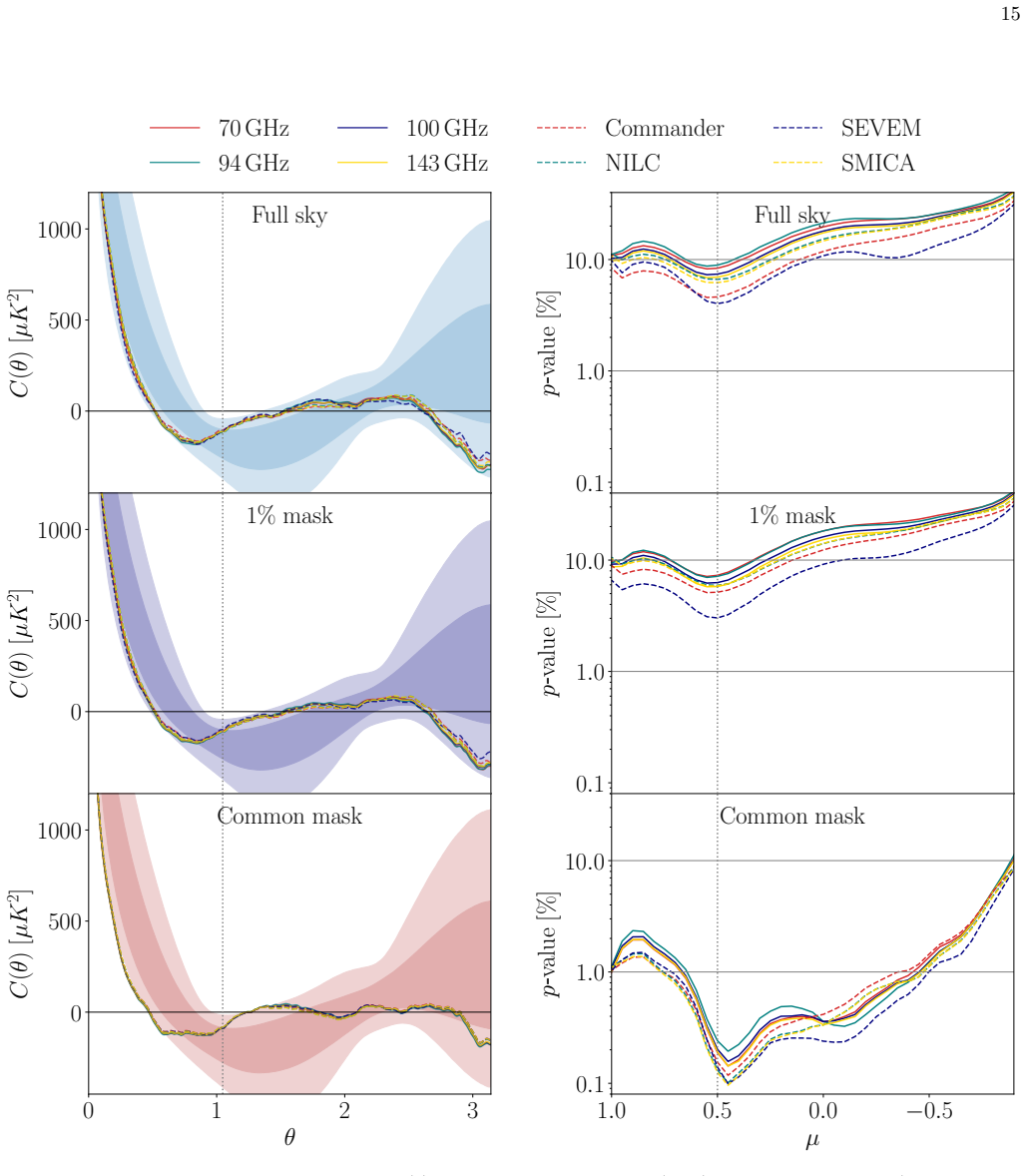
The central claim is that the significance of two commonly studied CMB anomalies depends strongly on how much of the sky is masked, and that with nearly full-sky maps the anomalies weaken. Using four foreground-cleaned WMAP/Planck maps at 1° resolution that require only a 1% galactic mask, the paper finds that the low real-space correlation statistic S1/2 goes from a 3.0–3.1σ deviation (p = 0.19–0.24%) under the 26%-masked Planck common mask to 1.8–1.9σ (p = 5.8–7.3%) under the 1% mask, and that the local-variance asymmetry ALV goes from 3.2σ (p = 0.13–0.16%) to 2.2–2.3σ (p = 2.2–2.8%). The other anomalies are mask-stable: low northern variance stays near 3σ, parity asymmetry near 2σ, and th
Load-bearing premise
The load-bearing premise is that the foreground-cleaned maps contain only true CMB temperature at degree scales outside the 1% mask — no residual or over-subtracted Milky Way foreground that could shift the large-scale statistics — since the paper's validation of the cleaning uses simulations cleaned by the same method it is checking.
Editorial extensions
If this is right
- The low large-angle correlation and the local-variance asymmetry are only ~2σ phenomena once 99% of the sky is usable, so by themselves they are weak evidence against statistically isotropic Gaussian ΛCDM.
- The quadrupole–octopole alignment remains the strongest and most stable feature, at 3.2–3.5σ, essentially independent of cleaning method and sky cut.
- Any alternative model must explain several anomalies at once, or describe a non-CMB measurement better, to be preferred over ΛCDM.
- The explicit dependence of S1/2 on the integration limit µ and of R27 on ℓmax motivates look-elsewhere corrections, which would further reduce the significance of these statistics.
- The paper's analysis implies that the standard 26%-mask convention itself contributed to the reported S1/2 and ALV signals: the 1%-mask results are consistently closer to the ΛCDM expectation.
Reading between the lines
- If the ~2σ result holds under independent cleaning, it suggests that the historical 'missing angular correlation' was partly an artifact of the standard analysis convention: a 26% mask reshapes the low-ℓ mode structure and suppresses C(θ) more than the underlying sky does.
- A sharp testable consequence: applying the same nearly full-sky cleaning to low-ℓ CMB polarization should preserve the quadrupole–octopole alignment if it is cosmological, while the correlation and variance-asymmetry signals should stay near ~2σ if they are mask artifacts.
- The five anomalies may not share a single origin: the results split them into a mask-sensitive pair (S1/2, ALV) and a mask-stable trio (SQO, σ²16, R27), which argues against any one new-physics mechanism.
- Once the cleaned maps and 1% mask are public, S1/2 can be recomputed with alternative estimators (e.g., QML or Bayesian Cℓ on the same sky cut); the paper's own comparison with the Planck QML Cℓ already points the same way.
Signed reviews
Editorial analysis
A structured set of objections, weighed in public.
Referee Report
Summary. The paper re-evaluates five well-known CMB large-angle anomalies using four new foreground-cleaned, low-resolution WMAP+Planck maps from a companion paper that require only a 1% sky mask. For each anomaly statistic, p-values are computed from 10^5 Gaussian statistically-isotropic ΛCDM simulations and compared across the 1% mask, the Planck common mask (26% masked), and the full sky, as well as against the Planck 2018 component-separated maps. The main finding is that the significance of the low real-space correlation (S1/2) and of the local-variance asymmetry (ALV) drops from about 3σ with the common mask to about 2σ with the 1% mask; the northern variance, parity asymmetry, and quadrupole-octopole alignment remain at roughly 3σ, 2σ, and 3σ respectively. The paper concludes that individual anomalies do not by themselves strongly favor new physics over ΛCDM.
Significance. If correct, the paper is a valuable reassessment of the CMB anomaly landscape: it shows that a substantially larger usable sky fraction, enabled by improved foreground cleaning, reduces the significance of two frequently cited anomalies. The analysis has notable strengths: 10^5 Gaussian statistically-isotropic simulations, consistent mask handling across estimators, an explicit validation of the approximate S1/2 expression (Eq. 6), and dedicated cleaned-simulation tests for CMB-foreground chance correlation. The paper also correctly stresses the a-posteriori nature of the statistics and the need for look-elsewhere corrections. The central limitation is that for ALV the cleaning-induced PTE shift is comparable to the quoted p-values and is not directionally reported, so the headline reduction from ~3σ to ~2σ is not yet robust. I do not see a circularity problem: the anomaly statistics are computed directly from maps and compared with external Monte Carlo simulations.
major comments (2)
- [Sec. 3.5] The ALV cleaning-validation result is load-bearing for the abstract's claim that ALV drops from ~3σ to ~2σ. The paper reports Δp ≤ 4.3% (full sky) and Δp ≤ 2.5% (1% mask) when PTE is computed from cleaned-CMB rather than CMB-only simulations, and states that the shift is 'not small'. However, the quoted 1%-mask ALV p-values are only p=2.2–2.8% (Table 1). A 2.5 percentage-point shift is the same order as the p-value itself, and without reporting the direction it is possible that the cleaned-simulation p-value is ≤0.3%, i.e. still ~3σ. This would directly contradict the abstract. The manuscript must report the cleaned-CMB p-values and the direction of the shifts, and explain why the conclusion is unchanged. Note also that Sec. 2.2's blanket statement that the shifts are 'small or do not impact the conclusions' is inconsistent with Sec. 3.5's characterization of the ALV shift as 'not small'
- [Sec. 2.1 / 2.2] The central results rest on the four foreground-cleaned maps and the 1% mask from Nofi et al. (2025a), cited as 'in prep'. The manuscript states that the maps and masks are 'provided', but they are not public at the time of writing, and the cleaning validation in Sec. 2.2 applies the same cleaning procedure to simulated maps, so it cannot independently establish the residual-foreground level. If residual or over-subtracted foreground power survives at low multipoles, the reduced S1/2 and ALV significances could be an artifact of added power masking the anomaly. Please clarify the availability/release plan for the maps and masks and, if possible, provide an independent residual-foreground test beyond self-cleaned simulations.
minor comments (5)
- [Sec. 2.1] Minor typo: 'Commander, NILC, SEVEM, und SMICA' should be 'Commander, NILC, SEVEM, and SMICA'.
- [References] The companion-paper reference lists 'Bennet, C., L.'; the author name in the manuscript is Bennett. Please correct the spelling in the reference list.
- [Sec. 3.5] The exclusion of outlier maps for ALV (Commander, SEVEM, and for the full sky also 94 GHz) is motivated by dipole directions pointing toward the Galactic plane, but the selection criteria are qualitative. Table 1 shows a wide spread among component-separated maps (e.g. SEVEM p=0.00% at 1% mask versus p=2.77% for the 143 GHz cleaned map). A formal, pre-defined outlier criterion would strengthen the claim of 'good agreement' among foreground-cleaned maps.
- [Sec. 3.3] Equation (9) is typeset in an unusual way (the r=1 evaluation and the gradient notation are cramped). The definitions of the multipole vectors and OAVs are otherwise clear, but a cleaner equation would help.
- [Sec. 3.1] The bottom panel of Fig. 2 and the discussion of S_μ are informative, but it would be useful to state explicitly that the p-values in the μ-scan are not corrected for the look-elsewhere effect; the paper later makes this point in Sec. 4, but a pointer there would prevent over-interpretation.
Circularity Check
No significant circularity: anomaly p-values are direct map statistics versus external Lambda-CDM simulations.
full rationale
The paper computes five anomaly statistics directly from foreground-cleaned and component-separated maps using explicit estimators (S1/2, Eq. 5; R27, Eq. 7; SQO, Eq. 11; sigma^2_16, Eq. 12; ALV, Eqs. 13-15) and compares them to 10^5 Gaussian statistically-isotropic simulations drawn from the external Planck 2018 best-fit Lambda-CDM power spectrum (Sec. 2.2). No anomaly statistic contains a fitted parameter that is later renamed a prediction; the cleaning coefficients and mask are taken from the companion paper rather than adjusted within this paper to produce the quoted p-values. The reliance on the companion maps is a data dependency, not a circular reduction, and the paper independently probes CMB-foreground chance correlation with cleaned simulations (Sec. 2.2), reporting the resulting PTE shifts explicitly (e.g., ALV shifts up to 4.3% full sky and 2.5% for the 1% mask in Sec. 3.5). These disclosed shifts are robustness limitations, not evidence that the headline significance changes are forced by construction. The a-posteriori choice of statistics and the look-elsewhere effect are acknowledged by the authors and affect interpretation, not the circularity of the derivation. No equation in the paper reduces to its own input by definition.
Assumptions & free parameters
free parameters (4)
- Integration limit mu = 1/2 in S1/2 statistic =
0.5 (cos theta)
- Maximum multipole lmax = 27 in parity statistic R =
27
- Disk radius theta = 8 degrees for local variance ALV =
8 degrees
- Northern ecliptic hemisphere for sigma2_16 =
northern ecliptic
assumptions (4)
- standard math Spherical harmonic expansion and Legendre decomposition of the CMB temperature field (Eqs. 2-4)
- domain assumption The Planck 2018 best-fit Lambda-CDM model is the correct null hypothesis for the CMB fluctuations
- domain assumption The morphological template cleaning in the companion paper removes foregrounds without altering the CMB signal at the scales used
- domain assumption Multipole vectors and oriented area vectors remain interpretable when computed from cut-sky a_lm with a small mask
Cite this review
Pith. "Pith review of Nearly Full-Sky Low-Multipole Cosmic Microwave Background Temperature Anisotropy: III. CMB Temperature Anomalies." pith.science (2026). https://pith.science/paper/J4O2C3ST
@misc{pith2026250903720,
  author       = {Pith},
  title        = {Pith review of: Nearly Full-Sky Low-Multipole Cosmic Microwave Background Temperature Anisotropy: III. CMB Temperature Anomalies},
  year         = {2026},
  howpublished = {\url{https://pith.science/paper/J4O2C3ST}},
  note         = {Machine review of arXiv:2509.03720}
}
abstract
Unexpected features have been observed in the cosmic microwave background (CMB) temperature on large scales. We revisit these CMB anomalies using new foreground-cleaned CMB temperature maps derived in a companion paper from WMAP and Planck data, which are tailored to low-resolution analysis and require only minimal masking of $1\%$ of the sky. These maps allow us to assess the impact of foreground-cleaning methods and the choice of sky cut on the significance of five commonly studied CMB anomalies. We find a notable impact of the choice of galactic mask on the significance of two anomalies: the significance of the low real-space correlation function and of the local-variance asymmetry reduces from $\sim 3\sigma$ for the Planck common mask with $26\%$ masked fraction to $\sim 2\sigma$ for the $1\%$ mask. We find good agreement between the two sky cuts for the low northern variance, $\sim 3\sigma$, and the parity asymmetry, $\sim 2\sigma$. For the quadrupole-octopole alignment, we find good agreement between the 1\%-mask result and the full-sky results in the literature, $\sim 3\sigma$. Thus using a larger fraction of the sky enabled by improved foreground cleaning reduces the significance of two commonly studied CMB anomalies. Overall, for an alternative physical model to be convincingly favored over $\Lambda$CDM with statistically isotropic Gaussian fluctuations, it would need to explain multiple CMB anomalies, or better describe some other type of measurement in addition to a CMB anomaly.
Figures


Figures from the paper (7 more)




Reference graph
Works this paper leans on
-
[1]
2022, JHEAp, 34, 49, 10.1016/j.jheap.2022.04.002
Abdalla, E., et al. 2022, JHEAp, 34, 49, 10.1016/j.jheap.2022.04.002
-
[2]
Adhikari, S., Shandera, S., & Erickcek, A. L. 2016, Phys. Rev. D, 93, 023524, 10.1103/PhysRevD.93.023524
-
[3]
Akrami, Y., Fantaye, Y., Shafieloo, A., et al. 2014, Astrophys. J. Lett., 784, L42, 10.1088/2041-8205/784/2/L42
-
[4]
Aurich, R., & Lustig, S. 2013, Mon. Not. Roy. Astron. Soc., 433, 2517, 10.1093/mnras/stt924
-
[5]
LiteBIRD Science Goals and Forecasts. $E$-mode Anomalies
Banday, A. J., et al. 2025. 2508.16451
work page Pith review arXiv 2025
-
[6]
Bennett , C. L., Smoot , G. F., Hinshaw , G., et al. 1992, , 396, L7, 10.1086/186505
doi:10.1086/186505 1992
-
[7]
Bennett, C. L., et al. 2003, Astrophys. J. Suppl., 148, 1, 10.1086/377253
doi:10.1086/377253 2003
-
[8]
---. 2013, Astrophys. J. Suppl., 208, 20, 10.1088/0067-0049/208/2/20
Show all 77 references
-
[9]
2011, PolSpice: Spatially Inhomogeneous Correlation Estimator for Temperature and Polarisation , Astrophysics Source Code Library, record ascl:1109.005
Challinor , A., Chon , G., Colombi , S., et al. 2011, PolSpice: Spatially Inhomogeneous Correlation Estimator for Temperature and Polarisation , Astrophysics Source Code Library, record ascl:1109.005
2011
-
[10]
K., Knox, L., et al
Chu, M., Eriksen, H. K., Knox, L., et al. 2005, Phys. Rev. D, 71, 103002, 10.1103/PhysRevD.71.103002
2005 doi
-
[11]
J., Huterer, D., Schwarz, D
Copi, C. J., Huterer, D., Schwarz, D. J., & Starkman, G. D. 2006, Mon. Not. Roy. Astron. Soc., 367, 79, 10.1111/j.1365-2966.2005.09980.x
2006
-
[12]
2009, Mon
---. 2009, Mon. Not. Roy. Astron. Soc., 399, 295, 10.1111/j.1365-2966.2009.15270.x
2009
- [13]
-
[14]
J., Huterer, D., & Starkman, G
Copi, C. J., Huterer, D., & Starkman, G. D. 2004, Phys. Rev. D, 70, 043515, 10.1103/PhysRevD.70.043515
2004 doi
-
[15]
2004, Phys
de Oliveira-Costa, A., Tegmark, M., Zaldarriaga, M., & Hamilton, A. 2004, Phys. Rev. D, 69, 063516, 10.1103/PhysRevD.69.063516
2004 doi
-
[16]
J., & Sanchez, N
Destri, C., de Vega, H. J., & Sanchez, N. G. 2008, Phys. Rev. D, 78, 023013, 10.1103/PhysRevD.78.023013
2008 doi
-
[17]
C., M \"u nchmeyer, M., & Terrana, A
Deutsch, A.-S., Dimastrogiovanni, E., Johnson, M. C., M \"u nchmeyer, M., & Terrana, A. 2018, Phys. Rev. D, 98, 123501, 10.1103/PhysRevD.98.123501
2018 doi
-
[18]
2025, 10.1016/j.dark.2025.101965
Di Valentino, E., et al. 2025, 10.1016/j.dark.2025.101965
2025
-
[20]
L., Carroll, S
Erickcek, A. L., Carroll, S. M., & Kamionkowski, M. 2008 a , Phys. Rev. D, 78, 083012, 10.1103/PhysRevD.78.083012
2008 doi
-
[21]
L., Kamionkowski, M., & Carroll, S
Erickcek, A. L., Kamionkowski, M., & Carroll, S. M. 2008 b , Phys. Rev. D, 78, 123520, 10.1103/PhysRevD.78.123520
2008 doi
-
[22]
K., Hansen, F
Eriksen, H. K., Hansen, F. K., Banday, A. J., Gorski, K. M., & Lilje, P. B. 2004, Astrophys. J., 605, 14, 10.1086/382267
2004 doi
-
[24]
Gordon, C., Hu, W., Huterer, D., & Crawford, T. M. 2005, Phys. Rev. D, 72, 103002, 10.1103/PhysRevD.72.103002
2005 doi
-
[26]
M., Hivon , E., Banday , A
G \'o rski , K. M., Hivon , E., Banday , A. J., et al. 2005, , 622, 759, 10.1086/427976
2005 doi
- [27]
-
[28]
2011, Mon
Gruppuso, A., Finelli, F., Natoli, P., et al. 2011, Mon. Not. Roy. Astron. Soc., 411, 1445, 10.1111/j.1365-2966.2010.17773.x
2011
-
[29]
K., Cabella, P., Marinucci, D., & Vittorio, N
Hansen, F. K., Cabella, P., Marinucci, D., & Vittorio, N. 2004, Astrophys. J. Lett., 607, L67, 10.1086/421904
2004 doi
-
[30]
R., Millman, K
Harris, C. R., Millman, K. J., van der Walt, S. J., et al. 2020, Nature, 585, 357, 10.1038/s41586-020-2649-2
2020 doi
- [31]
-
[32]
J., Bennett, C
Hinshaw, G., Banday, A. J., Bennett, C. L., et al. 1996, Astrophys. J. Lett., 464, L25, 10.1086/310076
1996 doi
-
[33]
S., Selub, N., & Wehlen, F
Hogan, C., Kwon, O., Meyer, S. S., Selub, N., & Wehlen, F. 2023. 2312.16147
2023
-
[34]
Hogan, C., & Meyer, S. S. 2022, Class. Quant. Grav., 39, 055004, 10.1088/1361-6382/ac4829
2022 doi
-
[35]
Hunter, J. D. 2007, Computing in Science & Engineering, 9, 90, 10.1109/MCSE.2007.55
2007 doi
- [36]
-
[37]
J., Starkman, G
Jones, J., Copi, C. J., Starkman, G. D., & Akrami, Y. 2023. 2310.12859
2023
-
[38]
G., et al
Jung, G., Aghanim, N., Sorce, J. G., et al. 2024, Astron. Astrophys., 692, A180, 10.1051/0004-6361/202451238
2024 doi
-
[39]
2003, Phys
Kamionkowski, M., & Knox, L. 2003, Phys. Rev. D, 67, 063001, 10.1103/PhysRevD.67.063001
2003 doi
-
[40]
1997, Phys
Kamionkowski, M., & Loeb, A. 1997, Phys. Rev. D, 56, 4511, 10.1103/PhysRevD.56.4511
1997 doi
-
[41]
2010 a , Astrophys
Kim, J., & Naselsky, P. 2010 a , Astrophys. J. Lett., 714, L265, 10.1088/2041-8205/714/2/L265
2010 doi
- [42]
-
[43]
Kobayashi, T., Cort\^es, M., & Liddle, A. R. 2015, JCAP, 05, 029, 10.1088/1475-7516/2015/05/029
2015 doi
-
[44]
2009, Astrophys
Komatsu, E., et al. 2009, Astrophys. J. Suppl., 180, 330, 10.1088/0067-0049/180/2/330
2009 doi
-
[45]
2005, Phys
Land, K., & Magueijo, J. 2005, Phys. Rev. D, 72, 101302, 10.1103/PhysRevD.72.101302
2005 doi
-
[46]
M., & Naselsky, P
Liu, H., Frejsel, A. M., & Naselsky, P. 2013, JCAP, 07, 032, 10.1088/1475-7516/2013/07/032
2013 doi
-
[47]
2018, Phys
Muir, J., Adhikari, S., & Huterer, D. 2018, Phys. Rev. D, 98, 023521, 10.1103/PhysRevD.98.023521
2018 doi
-
[48]
Nofi, H., C., Addison, G., E., Bennet, C., L., Herold, L., & Weiland, J. L. 2025 a , in prep
2025
-
[49]
2025 b , in prep
---. 2025 b , in prep
2025
-
[50]
2015, JCAP, 06, 047, 10.1088/1475-7516/2015/06/047
Notari, A., & Quartin, M. 2015, JCAP, 06, 047, 10.1088/1475-7516/2015/06/047
2015 doi
-
[51]
A., Pereira, T
Oliveira, R. A., Pereira, T. S., & Quartin, M. 2020, Phys. Dark Univ., 30, 100608, 10.1016/j.dark.2020.100608
2020
- [52]
-
[53]
Pinkwart, M., & Schwarz, D. J. 2018, Phys. Rev. D, 98, 083536, 10.1103/PhysRevD.98.083536
2018 doi
-
[54]
2020, Astron
Planck Collaboration IV . 2020, Astron. Astrophys., 641, A4, 10.1051/0004-6361/201833881
2020 doi
-
[55]
2020, Astron
Planck Collaboration V . 2020, Astron. Astrophys., 641, A5, 10.1051/0004-6361/201936386
2020 doi
-
[56]
2020, Astron
Planck Collaboration VI . 2020, Astron. Astrophys., 641, A6, 10.1051/0004-6361/201833910
2020 doi
-
[57]
2020, Astron
Planck Collaboration VII . 2020, Astron. Astrophys., 641, A7, 10.1051/0004-6361/201935201
2020 doi
-
[58]
2014, Astron
Planck Collaboration XIII . 2014, Astron. Astrophys., 571, A13, 10.1051/0004-6361/201321553
2014 doi
-
[59]
2016, Astron
Planck Collaboration XVI . 2016, Astron. Astrophys., 594, A16, 10.1051/0004-6361/201526681
2016 doi
-
[60]
2014, Astron
Planck Collaboration XXIII . 2014, Astron. Astrophys., 571, A23, 10.1051/0004-6361/201321534
2014 doi
-
[61]
Pontzen, A., & Peiris, H. V. 2010, Phys. Rev. D, 81, 103008, 10.1103/PhysRevD.81.103008
2010 doi
-
[62]
A., & Kinney, W
Powell, B. A., & Kinney, W. H. 2007, Phys. Rev. D, 76, 063512, 10.1103/PhysRevD.76.063512
2007 doi
-
[63]
Rakic, A., Rasanen, S., & Schwarz, D. J. 2006, Mon. Not. Roy. Astron. Soc., 369, L27, 10.1111/j.1745-3933.2006.00167.x
2006
- [64]
-
[65]
Rassat, A., & Starck, J. L. 2013, Astron. Astrophys., 557, L1, 10.1051/0004-6361/201321537
2013 doi
-
[66]
J., Bigot-Sazy, M
Remazeilles, M., Dickinson, C., Banday, A. J., Bigot-Sazy, M. A., & Ghosh, T. 2015, Mon. Not. Roy. Astron. Soc., 451, 4311, 10.1093/mnras/stv1274
2015 doi
-
[67]
G., Pereira, T
Rodrigues, R. G., Pereira, T. S., & Quartin, M. 2025, JCAP, 06, 039, 10.1088/1475-7516/2025/06/039
2025 doi
-
[68]
E., Eriksen, H
Rudjord, O., Groeneboom, N. E., Eriksen, H. K., et al. 2009, Astrophys. J., 692, 1669, 10.1088/0004-637X/692/2/1669
2009 doi
-
[69]
K., Aluri, P
Sanyal, S., Patel, S. K., Aluri, P. K., & Shafieloo, A. 2024. 2411.15786
2024
-
[70]
J., Copi, C
Schwarz, D. J., Copi, C. J., Huterer, D., & Starkman, G. D. 2016, Class. Quant. Grav., 33, 184001, 10.1088/0264-9381/33/18/184001
2016 doi
-
[71]
J., Starkman, G
Schwarz, D. J., Starkman, G. D., Huterer, D., & Copi, C. J. 2004, Phys. Rev. Lett., 93, 221301, 10.1103/PhysRevLett.93.221301
2004 doi
- [72]
-
[73]
2004, Phys
Slosar, A., & Seljak, U. 2004, Phys. Rev. D, 70, 083002, 10.1103/PhysRevD.70.083002
2004 doi
-
[74]
F., Copi, C
Smith, A. F., Copi, C. J., & Starkman, G. D. 2025, JCAP, 01, 005, 10.1088/1475-7516/2025/01/005
2025 doi
- [75]
- [76]
-
[77]
S., & Bond, J
Szapudi, I., Prunet, S., Pogosyan, D., Szalay, A. S., & Bond, J. R. 2000. astro-ph/0010256
2000 arXiv
-
[78]
B., Sanz, J
Vielva, P., Martinez-Gonzalez, E., Barreiro, R. B., Sanz, J. L., & Cayon, L. 2004, Astrophys. J., 609, 22, 10.1086/421007
2004 doi
-
[79]
E., et al
Virtanen, P., Gommers, R., Oliphant, T. E., et al. 2020, Nature Methods, 17, 261, 10.1038/s41592-019-0686-2
2020 doi
-
[80]
2019, Journal of Open Source Software, 4, 1298, 10.21105/joss.01298
Zonca, A., Singer, L., Lenz, D., et al. 2019, Journal of Open Source Software, 4, 1298, 10.21105/joss.01298
2019 doi
Reviewed August 5, 2026 · model on record in the stance chip above.
Discussion (0). Continue with ORCID to comment.