REVIEW 4 major objections 6 minor 109 references
New Interpretation for the Orientation of the LMC's Gaseous Arms B and E using ULLYSES
T0 review · 4 major / 6 minor · reviewed 2026-08-05 · deepseek-v4-flash
Pith's one-line read By using stars inside the LMC as backlights, this paper argues that the gaseous arms B and E lie at least partly in front of the galaxy's disk and extend about one degree closer to the 30 Doradus starburst.
desk verdict First UV down-the-barrel constraints on where LMC arms B/E sit along the line of sight, but the disk/offset boundary is soft enough that the arm identification and 1-degree extension need close referee scrutiny. read the letter →
The pith
A machine-rendered reading of the paper's core claim, the machinery that carries it, and where it could break.
The reading
What carries the argument
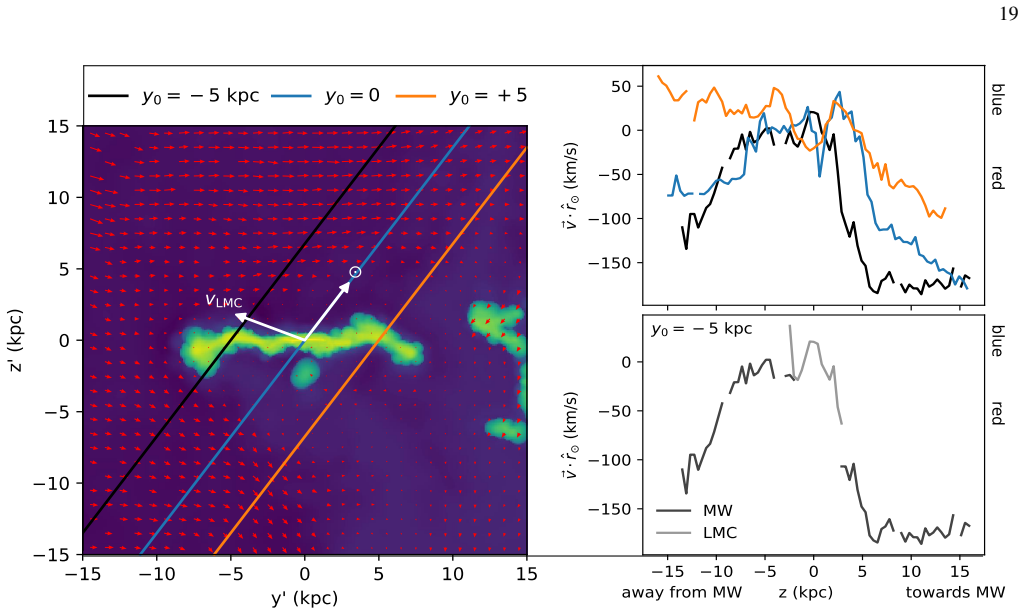
The load-bearing setup is the down-the-barrel trick: with the LMC nearly face-on, stars inside its disk act as background lamps, so absorption at a given velocity proves the gas lies between star and observer, on the near side. Gas is classified as disk or offset by Gaussian decomposition of GASS/GASKAP 21-cm H I emission, whose hand-tuned boundaries (Table 2) define which UV absorbers count as extra-disk. Voigt-profile fitting (VoigtFit) and the apparent-optical-depth method supply velocities, widths, and column densities, while rotated position-velocity cuts trace how far the arms extend toward 30 Doradus. A GIZMO hydrodynamic simulation with a warm LMC corona tests whether nearside outflo
What would settle it
Reproduce the GASKAP H I cube with a fully warped, rotating-disk model: if it fits the 'offset' emission with no residual filament, the hand-drawn disk/offset boundaries are artifacts and the nearside-arm claim collapses. Independently, 21-cm absorption toward radio continuum sources at the claimed arm positions tests the foreground geometry directly: cold gas on the near side must absorb at arm velocities, while warm or far-side gas will not.
Extended reading notes
Core claim
The paper's claim is that the redshifted gas absorbing the light of eight stars embedded in the LMC's disk is the same material as the H I arms B and E, and that this gas sits in front of the galaxy. Because the background lamps are inside the disk, any detected absorber necessarily lies on the near side. Neutral (C I, S I), low-ionization (Fe II, Si II, P II, Ni II), and moderately-ionized (S II, Al III) gas share the arms' velocity range, and Gaussian decomposition of the GASKAP cube, with rotated position-velocity cuts, places both arms about 1.0 degree closer to 30 Doradus, converging near (l, b) = (280.5, -31.2). The paper leaves the arms' origin open: outflow swept by tides and ram pre
Load-bearing premise
The arm identification depends on where the authors draw the velocity line between ordinary LMC disk gas and the 'offset' gas: the boundaries in their Table 2 were set by Gaussian fits plus by-eye adjustments, and if disk gas spills into the offset window (or arm gas hides inside the disk window), the nearside-arm absorbers could actually be ordinary disk gas.
Editorial extensions
If this is right
- The orientation question is partly settled for these sightlines: gas absorbing starlight from inside the disk must be in front of the embedded stars, so at least parts of arms B and E lie on the LMC's near side, consistent with the earlier velocity-gradient result of Dickey et al. (1994).
- Arms B and E connect to the H I overdensity around 30 Doradus roughly 1.0 degree farther in Galactic longitude than the LAB-based maps predicted, making the starburst the structural hub of both filaments.
- The Al III column-density gradient (Kendall tau = -0.68, p = 0.033) shows moderately ionized gas is concentrated within about 0.25 degrees of 30 Doradus, tying the arms' ionization state to the starburst's radiation field.
- The electron-density lower limit (n_e >~ 0.1 cm^-3) places the nearside gas in a denser regime than the body of the Magellanic Stream, as expected for a starburst-adjacent environment.
- Both the outflow and inflow interpretations survive the data; the corona-shielded simulation produces both redshifted and blueshifted nearside winds, which is why the observations alone cannot choose between the two scenarios.
Reading between the lines
- The paper cannot measure abundances because its low-ionization lines are saturated, so the inflow/outflow debate stays open. My extension: the decisive next observation is a metallicity measurement of the nearside arm gas — SMC-like abundances would point to tidal stripping and inflow, while LMC-like abundances would favor a galactic-fountain or outflow origin.
- The suggested convergence of the two arms near (l, b) = (280.5, -31.2) is, I would argue, a natural site for cloud-cloud collisions; searching that coordinate for shock-excited emission or unusually young stellar populations would test whether the arm crossing itself drives star formation, a consequence the paper does not draw.
- The same embedded-star absorption trick could be applied to other nearly face-on, ram-pressure-affected dwarf galaxies; if 'arms in front' turns out to be common, nearside gas placement would be the norm for stripped dwarfs rather than an LMC quirk.
- In my reading, the by-eye 5-10 km/s widening of the disk/offset boundaries is the step that most deserves re-analysis; a fully data-driven decomposition (for example Bayesian multi-component fits) would show how much of the nearside-arm claim survives the boundary choice.
Editorial analysis
A structured set of objections, weighed in public.
Referee Report
Summary. The paper combines GASS/GASKAP H I 21-cm emission with HST/ULLYSES UV absorption spectroscopy toward eight stars within ~2.4 degrees of 30 Doradus in the LMC. The authors define kinematic boundaries separating the LMC disk from 'offset' gas (Table 2), identify redshifted UV absorbers beyond the disk boundary, and argue from their kinematics, line widths, and spatial proximity that this gas traces the nearside portions of the LMC's gaseous arms B and E. They further use Gaussian decomposition of GASKAP data and rotation of the Nidever et al. (2008) arm paths to claim that the arms extend ~1 degree closer to 30 Doradus and converge near (l,b)=(280.5,-31.2). Additional results include multi-phase kinematic overlap, Doppler broadening analysis, electron densities and cooling rates from C II*/S II, a decreasing Al III column density with angular offset from 30 Doradus, and a comparison with the Lucchini et al. (2021) GIZMO simulation to argue that nearside gas is plausible in both outflow and inflow scenarios.
Significance. If the interpretation is correct, the paper provides one of the first down-the-barrel absorption-line constraints placing the LMC's gaseous arms B and E partly in front of the LMC, which would improve 3D models of the Magellanic System and inform the inflow/outflow debate around 30 Doradus. The paper is commendably transparent about saturation and blending, publishes detailed Voigt/AOD component tables for all sightlines, and uses public legacy data (GASS, GASKAP, ULLYSES). The Kendall tau result for Al III, if valid, is a clean, falsifiable trend. However, the central geometric claims rest on a small sample, on by-eye kinematic boundary adjustments with unquantified uncertainties, and on rotated model paths that risk being circular. The observational detection of nearside redshifted absorbers is likely robust; the specific association with arms B/E and the 1-degree extension are not established at the same level.
major comments (4)
- [Section 3.2 / Table 2] The kinematic boundary between the LMC disk and offset gas is load-bearing for the arm identification. The boundaries are set by Gaussian decomposition plus by-eye 5-10 km/s adjustments; seven of eight sightlines have no velocity gap between the disk right edge and the offset left edge (Table 2), and Tables 3/4 label many components 'Disk/Offset.' Several nominal offset components lie only ~7-15 km/s above the adopted edge (e.g., sightline 3: S ii +278.8, Si ii +276.1; sightline 8: Fe ii +276.6). Since the adjustment uncertainty is comparable to that separation, a modest boundary shift would reclassify these absorbers as disk gas. This does not affect the highest-velocity absorbers (+300 to +386 km/s), but it directly affects the claim that the absorbers trace arms B/E on the near side. Please quantify boundary uncertainty (e.g., recompute classifications with Table 2 edges shifted by ±5
- [Section 6.1 / Figures 13-14] The ~1 degree extension claim is based on rotating the Nidever et al. (2008) predicted arm paths by 180/90/270 degrees about starting points from that same model. This is an assumption rather than a measurement: any high-velocity H I near 30 Dor will lie along one of the rotated curves if the curves are chosen to pass through the region. 'Connect seamlessly' is not quantified. Please provide a null test (e.g., equivalent 'seamlessness' for a grid of rotations and pivot positions, or compare with a simple linear extrapolation of the arm paths) and specify a numerical criterion for a match. As written, the 1-degree extension and convergence at (280.5,-31.2) are not falsifiable.
- [Section 4.4 / Figure 9] The Kendall tau correlation for Al III (tau = -0.68, p = 0.033) is reported as exact, but several Al III components in Tables 3/4 are lower limits from saturated AOD measurements (e.g., sightline 1 Al III +264.0; sightline 6 Al III +214.7). If the total integrated Al III column densities use these censored values, treating them as exact in a rank correlation biases the test. Please state which sightlines have censored columns and either exclude them, use a censored rank correlation, or show that the correlation is unchanged when the limits are shifted by plausible amounts.
- [Section 4.2 / Section 6.1] The conclusion that the absorbers are arms B/E rather than generic high-velocity disk gas or fountain material is based on kinematic overlap and proximity to the Nidever et al. (2008) paths. This is reasonable but not unique: the 'all phases share the same kinematics' statement is partly by construction, because components were selected within the offset velocity windows. The paper is candid that it cannot distinguish outflows from inflows, and that sightlines 1/2 may probe different material. The remaining risk is that the arm identification conflates the robust nearside detection (Section 7, item 1) with the specific arm extension (item 2). A direct comparison to a null model of the LMC disk's high-velocity wing (e.g., a rotating disk model without arms) would make the association far more convincing.
minor comments (6)
- [Section 1] Typo: 'NGG 2070' should be 'NGC 2070'.
- [Section 6.2] In the Ni/Fe comparison, 'Ne ii' should be 'Ni ii'.
- [Appendix A] Header typo: 'GAKSAP' should be 'GASKAP'.
- [Section 3.2 / Table 2] It would be helpful to mark in the table which boundaries were determined by moment analysis (sightline 4) versus by the adjusted Gaussian method, and to give an adopted uncertainty for each boundary.
- [Section 4.1.2] The AOD integration interval 'vcentral - b/2 <= v <= vcentral + 2b' is asymmetric; the rationale for truncating only the blue side should be stated more clearly (it is explained shortly after, but the equation itself is confusing).
- [Figures 13-14] The black Fe II centroids plotted on the position-velocity slices have no error bars; adding them would help assess whether the kinematic 'seamlessness' is significant.
Circularity Check
No structural circularity: the nearside absorbers and 1-degree arm extension are independent observational results; the only self-citation (Nidever et al. 2008 arm paths) serves as an external baseline, and the by-eye H I boundary adjustment is a robustness limitation, not a circular step.
full rationale
Walking the paper's derivation chain, I find no step in which a 'prediction' is equivalent to an input by construction. (1) The sample-selection criterion in Section 2.2 requiring redshifted material near the arms is a target-selection choice, not a fitted parameter; the UV absorption centroids, Doppler parameters, and column densities are measured from ULLYSES spectra independently of the H I boundary values. (2) The nearside conclusion is geometric: absorption against background LMC stars places the absorbing gas in front of the stars regardless of the H I decomposition. (3) The claimed ~1-degree extension of arms B and E is derived from new GASKAP position-velocity maps and Gaussian decomposition, not from the Nidever et al. (2008) fit itself; the Nidever paper (which shares an author) is used as an external baseline for the arm paths and as the rotation pivot. Although the convergence point (l,b)=(280.5,-31.2) is inherited from Nidever et al. (2008) rather than independently derived, the paper presents it as a suggestion and the extension evidence comes from new data. This is a minor self-reference, not a load-bearing circular reduction. The clearest vulnerability is the by-eye adjustment of the H I disk/offset boundaries in Section 3.2 ('adjusted (~5–10 km/s beyond the upper FWHM limit)'), which could misclassify disk wing emission as offset gas; Tables 3 and 4 even label many components 'Disk/Offset Component.' That is an unquantified systematic/robustness limitation, not a circular construction: changing the boundary would relabel components, but the UV centroids themselves are not derived from that boundary. I therefore score 2 solely to acknowledge the self-citation of the arm-path baseline; the central claims retain independent observational content.
Assumptions & free parameters
free parameters (4)
- HI kinematic boundaries for disk and offset gas (per sightline) =
e.g., sightline 4: disk +195 to +244, offset +262 to +312 km/s
- Localized systemic velocity near 30 Doradus =
v_LSR ≈ 232 km/s
- Temperature for Doppler broadening analysis =
T = 10,000 K (ionized), T = 1,000-5,000 K (neutral)
- Temperature and collisional strength for electron density =
T ~ 24,000 K, Ω12 = 2.82
assumptions (6)
- domain assumption Background stars are embedded within the LMC disk, so intervening absorbers at arm velocities lie on the near side of the LMC.
- domain assumption Arms B and E as defined by the Gaussian decomposition of the LAB survey (Nidever et al. 2008) are coherent structures that physically connect to the Magellanic Stream and Leading Arm.
- domain assumption The velocity ranges +212 to +270 km/s (arm B) and +220 to +290 km/s (arm E) from Kim et al. (2003) and Staveley-Smith et al. (2003) apply near 30 Doradus.
- domain assumption Thermal broadening calculations assume T = 10,000 K for ionized gas and T = 1,000-5,000 K for neutral gas (Equation 4).
- domain assumption S ii can serve as a proxy for C ii in electron density and cooling rate calculations, and the gas is warm so Equations 5-7 hold; cold gas would make ne values upper limits.
- ad hoc to paper The 180/90/270 degree rotations of the predicted arm paths produce meaningful position-velocity cuts through the LMC disk.
Cite this review
Pith. "Pith review of New Interpretation for the Orientation of the LMC's Gaseous Arms B and E using ULLYSES." pith.science (2026). https://pith.science/paper/6Y26ESEM
@misc{pith2026250903739,
  author       = {Pith},
  title        = {Pith review of: New Interpretation for the Orientation of the LMC's Gaseous Arms B and E using ULLYSES},
  year         = {2026},
  howpublished = {\url{https://pith.science/paper/6Y26ESEM}},
  note         = {Machine review of arXiv:2509.03739}
}
abstract
The Large Magellanic Cloud (LMC) experiences disruption from tidal and ram-pressure forces as it travels through the halo of the Milky Way. In this project, we combine radio emission-line observations from the GASS and GASKAP surveys with UV absorption-line observations from the HST Ultraviolet Legacy Library of Young Stars as Essential Standards (ULLYSES) program to trace the material in front of the LMC. Along our 8 stellar sightlines near 30 Doradus, we observe gaseous structures likely associated with two arm-like features flowing in and around the LMC's disk. We detect the nearside gas in neutral, low, and medium ionization species. The lower-ionization species likely undergo both thermal and non-thermal broadening while the moderately-ionized phase is influenced by more non-thermal processes. The total integrated column density of AlIII decreases with increasing angular offset from 30 Doradus, with sightlines within 0.25 degrees containing more moderately ionized gas. We demonstrate from a Gaussian decomposition technique on the HI emission that both arms likely trace an additional 1.0 degree in Galactic longitude toward the 30 Doradus region than previously predicted. We constrain the orientation of the arms by suggesting that they likely converge around (l,b) =(280.5$^\circ$, -31.2$^\circ$) and at least partially cross in front of the LMC. Our observations are consistent with two competing origins of the arms: 1) outflowing material is swept back by tidal and ram-pressure forces or 2) tidally stripped inflows fuel the ongoing stellar activity inside the LMC. Future studies are needed to distinguish between these scenarios.
Figures


Figures from the paper (17 more)




Reference graph
Works this paper leans on
-
[1]
,# (7),01444 '9=82<.342C 2! !22222222222222222222222222222222222222222222222222
thebibliography [1] 20pt to REFERENCES 6pt =0pt 10pt plus 3pt =0pt =0pt =1pt plus 1pt =0pt =0pt -12pt =13pt plus 1pt =20pt =13pt plus 1pt \@M =10000 =-1.0em =0pt =0pt 0pt =0pt =1.0em @enumiv\@empty 10000 10000 `\.\@m \@noitemerr \@latex@warning Empty `thebibliography' environment \@ifnextchar \@reference \@latexerr Missing key on reference command Each re...
arXiv 2019
-
[2]
Asplund , M., Amarsi , A. M., & Grevesse , N. 2021, , 653, A141, 10.1051/0004-6361/202140445
-
[3]
Astropy Collaboration , Robitaille , T. P., Tollerud , E. J., et al. 2013, , 558, A33, 10.1051/0004-6361/201322068
-
[4]
Astropy Collaboration , Price-Whelan , A. M., Sip o cz , B. M., et al. 2018, , 156, 123, 10.3847/1538-3881/aabc4f
-
[5]
Astropy Collaboration , Price-Whelan , A. M., Lim , P. L., et al. 2022, , 935, 167, 10.3847/1538-4357/ac7c74
-
[6]
Barger , K. A., Lehner , N., & Howk , J. C. 2016, , 817, 91, 10.3847/0004-637X/817/2/91
-
[7]
2009, , 395, 342, 10.1111/j.1365-2966.2009.14514.x
Bekki , K., & Stanimirovi \'c , S. 2009, , 395, 342, 10.1111/j.1365-2966.2009.14514.x
arXiv 2009
-
[8]
2012, , 421, 2109, 10.1111/j.1365-2966.2012.20466.x
Besla , G., Kallivayalil , N., Hernquist , L., et al. 2012, , 421, 2109, 10.1111/j.1365-2966.2012.20466.x
arXiv 2012
Show all 109 references
-
[9]
M., Crowther , P
Bestenlehner , J. M., Crowther , P. A., Caballero-Nieves , S. M., et al. 2020, , 499, 1918, 10.1093/mnras/staa2801
2020 doi
-
[10]
J., Bertoldi , F., et al
Brandl , B., Sams , B. J., Bertoldi , F., et al. 1996, , 466, 254, 10.1086/177507
1996 doi
-
[11]
2005, , 432, 45, 10.1051/0004-6361:20040321
Br \"u ns , C., Kerp , J., Staveley-Smith , L., et al. 2005, , 432, 45, 10.1051/0004-6361:20040321
2005 doi
-
[12]
A., D'Onghia , E., Zweibel , E
Bustard , C., Pardy , S. A., D'Onghia , E., Zweibel , E. G., & Gallagher , J. S., I. 2018, , 863, 49, 10.3847/1538-4357/aad08f
2018 doi
-
[13]
H., Kulkarni , V
Cashman , F. H., Kulkarni , V. P., Kisielius , R., Ferland , G. J., & Bogdanovich , P. 2017, , 230, 8, 10.3847/1538-4365/aa6d84
2017 doi
-
[14]
A., Evans , C
Castro , N., Crowther , P. A., Evans , C. J., et al. 2018, , 614, A147, 10.1051/0004-6361/201732084
2018 doi
-
[15]
L., Olsen , K., et al
Choi , Y., Nidever , D. L., Olsen , K., et al. 2018, , 866, 90, 10.3847/1538-4357/aae083
2018 doi
-
[16]
A., Barger , K
Ciampa , D. A., Barger , K. A., Lehner , N., et al. 2021, , 908, 62, 10.3847/1538-4357/abd320
2021 doi
-
[17]
P., et al
Cignoni , M., Sabbi , E., van der Marel , R. P., et al. 2015, , 811, 76, 10.1088/0004-637X/811/2/76
2015 doi
-
[18]
A., Caballero-Nieves , S
Crowther , P. A., Caballero-Nieves , S. M., Bostroem , K. A., et al. 2016, , 458, 624, 10.1093/mnras/stw273
2016 doi
- [19]
-
[20]
E., & Bono , G
de Grijs , R., Wicker , J. E., & Bono , G. 2014, , 147, 122, 10.1088/0004-6256/147/5/122
2014 doi
-
[21]
M., Mallery , R
De Propris , R., Rich , R. M., Mallery , R. C., & Howard , C. D. 2010, , 714, L249, 10.1088/2041-8205/714/2/L249
2010 doi
- [22]
-
[23]
M., Mebold , U., Marx , M., et al
Dickey , J. M., Mebold , U., Marx , M., et al. 1994, , 289, 357
1994
-
[24]
M., McClure-Griffiths , N., Gibson , S
Dickey , J. M., McClure-Griffiths , N., Gibson , S. J., et al. 2013, , 30, e003, 10.1017/pasa.2012.003
2013 doi
- [25]
-
[26]
J., Kennedy , M
Evans , C. J., Kennedy , M. B., Dufton , P. L., et al. 2015, , 574, A13, 10.1051/0004-6361/201424414
2015 doi
-
[27]
Fitzpatrick , E. L. 1991, , 103, 1123, 10.1086/132934
1991 doi
-
[28]
For , B.-Q., Staveley-Smith , L., & McClure-Griffiths , N. M. 2013, , 764, 74, 10.1088/0004-637X/764/1/74
2013 doi
-
[29]
J., Frazer , E
Fox , A. J., Frazer , E. M., Bland-Hawthorn , J., et al. 2020, , 897, 23, 10.3847/1538-4357/ab92a3
2020 doi
-
[30]
J., Richter , P., Wakker , B
Fox , A. J., Richter , P., Wakker , B. P., et al. 2013, , 772, 110, 10.1088/0004-637X/772/2/110
2013 doi
-
[31]
J., Wakker , B
Fox , A. J., Wakker , B. P., Smoker , J. V., et al. 2010, , 718, 1046, 10.1088/0004-637X/718/2/1046
2010 doi
-
[32]
J., Wakker , B
Fox , A. J., Wakker , B. P., Barger , K. A., et al. 2014, , 787, 147, 10.1088/0004-637X/787/2/147
2014 doi
-
[33]
J., Barger , K
Fox , A. J., Barger , K. A., Wakker , B. P., et al. 2018, , 854, 142, 10.3847/1538-4357/aaa9bb
2018 doi
-
[34]
T., Turfus , C., & Putman , M
Gardiner , L. T., Turfus , C., & Putman , M. E. 1998, , 507, L35, 10.1086/311668
1998 doi
-
[35]
2007, , 168, 213, 10.1086/509786
Gnat , O., & Sternberg , A. 2007, , 168, 213, 10.1086/509786
2007 doi
-
[36]
Grand , R. J. J., G \'o mez , F. A., Marinacci , F., et al. 2017, , 467, 179, 10.1093/mnras/stx071
2017 doi
-
[37]
C., Froning , C
Green , J. C., Froning , C. S., Osterman , S., et al. 2012, , 744, 60, 10.1088/0004-637X/744/1/6010.1086/141956
2012
-
[38]
2019, ASKAPsoft: ASKAP science data processor software , Astrophysics Source Code Library, record ascl:1912.003
Guzman , J., Whiting , M., Voronkov , M., et al. 2019, ASKAPsoft: ASKAP science data processor software , Astrophysics Source Code Library, record ascl:1912.003
2019
-
[39]
M., Reynolds , R
Haffner , L. M., Reynolds , R. J., & Tufte , S. L. 1999, , 523, 223, 10.1086/307734
1999 doi
-
[40]
B., Flores , H., Puech , M., & Fouquet , S
Hammer , F., Yang , Y. B., Flores , H., Puech , M., & Fouquet , S. 2015, , 813, 110, 10.1088/0004-637X/813/2/110
2015 doi
-
[41]
2009, , 138, 1243, 10.1088/0004-6256/138/5/1243
Harris , J., & Zaritsky , D. 2009, , 138, 1243, 10.1088/0004-6256/138/5/1243
2009 doi
-
[42]
2000, , 364, 83
Haud , U. 2000, , 364, 83
2000
-
[43]
A., & Nussbaumer , H
Hayes , M. A., & Nussbaumer , H. 1984, , 134, 193
1984
- [44]
-
[45]
Holland , S. T. 2014, COS Instrument Handbook v. 6.0
2014
-
[46]
Hopkins , P. F. 2015, , 450, 53, 10.1093/mnras/stv195
2015 doi
-
[47]
C., Sembach , K
Howk , J. C., Sembach , K. R., Savage , B. D., et al. 2002, , 569, 214, 10.1086/339322
2002 doi
-
[48]
R., Straw , S., Jones , T
Hyland , A. R., Straw , S., Jones , T. J., & Gatley , I. 1992, , 257, 391, 10.1093/mnras/257.3.391
1992 doi
-
[49]
Jenkins , E. B. 2009, , 700, 1299, 10.1088/0004-637X/700/2/1299
2009 doi
-
[50]
B., Bowen , D
Jenkins , E. B., Bowen , D. V., Tripp , T. M., & Sembach , K. R. 2005, , 623, 767, 10.1086/428878
2005 doi
-
[51]
A., Staveley-Smith , L., & Bessell , M
Kim , S., Dopita , M. A., Staveley-Smith , L., & Bessell , M. S. 1999, , 118, 2797, 10.1086/301116
1999 doi
-
[52]
A., et al
Kim , S., Staveley-Smith , L., Dopita , M. A., et al. 1998, , 503, 674, 10.1086/306030
1998 doi
- [53]
-
[54]
F., Wielebinski , R., & Meinert , D
Klein , U., Haynes , R. F., Wielebinski , R., & Meinert , D. 1993, , 271, 402
1993
-
[55]
J., D'Onghia , E., et al
Krishnarao , D., Fox , A. J., D'Onghia , E., et al. 2022, , 609, 915, 10.1038/s41586-022-05090-5
2022 doi
- [56]
-
[57]
Lehner , N., & Howk , J. C. 2007, , 377, 687, 10.1111/j.1365-2966.2007.11631.x
2007
-
[58]
Lehner , N., Staveley-Smith , L., & Howk , J. C. 2009, , 702, 940, 10.1088/0004-637X/702/2/940
2009 doi
-
[59]
P., & Savage , B
Lehner , N., Wakker , B. P., & Savage , B. D. 2004, , 615, 767, 10.1086/424730
2004 doi
-
[60]
Lucchini , S., D'Onghia , E., & Fox , A. J. 2021, , 921, L36, 10.3847/2041-8213/ac3338
2021 doi
-
[61]
J., et al
Lucchini , S., D'Onghia , E., Fox , A. J., et al. 2020, , 585, 203, 10.1038/s41586-020-2663-4
2020 doi
-
[62]
1992, , 263, 41
Luks , T., & Rohlfs , K. 1992, , 263, 41
1992
-
[63]
2000, , 119, 2214, 10.1086/301345
Massey , P., Waterhouse , E., & DeGioia-Eastwood , K. 2000, , 119, 2214, 10.1086/301345
2000 doi
-
[64]
M., Pisano , D
McClure-Griffiths , N. M., Pisano , D. J., Calabretta , M. R., et al. 2009, , 181, 398, 10.1088/0067-0049/181/2/398
2009 doi
- [65]
-
[66]
1984, , 211, 521, 10.1093/mnras/211.3.521
Meaburn , J. 1984, , 211, 521, 10.1093/mnras/211.3.521
1984 doi
-
[67]
2023, STIS Instrument Handbook for Cycle 31 v
Medallon , S., & Welty , D. 2023, STIS Instrument Handbook for Cycle 31 v. 22.0
2023
-
[68]
J., Krishnarao , D., et al
Mishra , S., Fox , A. J., Krishnarao , D., et al. 2024, , 976, L28, 10.3847/2041-8213/ad8b9d
2024 doi
-
[69]
L., & Chwalik , E
Nidever , D. L., & Chwalik , E. 2022, GaussDecomp , 1.0.1, 10.5281/zenodo.227955549
2022 doi
-
[70]
L., Majewski , S
Nidever , D. L., Majewski , S. R., & Butler Burton , W. 2008, , 679, 432, 10.1086/587042
2008 doi
-
[71]
2004, , 48, 727, 10.1016/j.newar.2004.03.008
Niemela , V., & Gamen , R. 2004, , 48, 727, 10.1016/j.newar.2004.03.008
2004 doi
-
[72]
Olano , C. A. 2004, , 423, 895, 10.1051/0004-6361:20040177
2004 doi
-
[73]
Olsen , K. A. G., Zaritsky , D., Blum , R. D., Boyer , M. L., & Gordon , K. D. 2011, , 737, 29, 10.1088/0004-637X/737/1/29
2011 doi
-
[74]
2011, , 735, 6, 10.1088/0004-637X/735/1/6
Paradis , D., Paladini , R., Noriega-Crespo , A., et al. 2011, , 735, 6, 10.1088/0004-637X/735/1/6
2011 doi
-
[75]
A., D'Onghia , E., & Fox , A
Pardy , S. A., D'Onghia , E., & Fox , A. J. 2018, , 857, 101, 10.3847/1538-4357/aab95b
2018 doi
-
[76]
2013, in Advancing the Physics of Cosmic Distances, ed
Pietrzy \'n ski , G., Gieren , W., Graczyk , D., et al. 2013, in Advancing the Physics of Cosmic Distances, ed. R. de Grijs , Vol. 289, 169--172, 10.1017/S174392131202131X
2013 doi
-
[77]
M., Dempsey , J., McClure-Griffiths , N
Pingel , N. M., Dempsey , J., McClure-Griffiths , N. M., et al. 2022, , 39, e005, 10.1017/pasa.2021.59
2022 doi
-
[78]
E., Kupka , F., Ryabchikova , T
Piskunov , N. E., Kupka , F., Ryabchikova , T. A., Weiss , W. W., & Jeffery , C. S. 1995, , 112, 525
1995
-
[79]
2025, , 984, 161, 10.3847/1538-4357/adc099
Poudel , S., Horton , A., Vazquez , J., et al. 2025, , 984, 161, 10.3847/1538-4357/adc099
2025 doi
-
[80]
E., Gibson , B
Putman , M. E., Gibson , B. K., Staveley-Smith , L., et al. 1998, , 394, 752, 10.1038/29466
1998 doi
-
[81]
R., Hainich , R., et al
Ramachandran , V., Hamann , W. R., Hainich , R., et al. 2018, , 615, A40, 10.1051/0004-6361/201832816
2018 doi
-
[83]
J., Wakker , B
Richter , P., Fox , A. J., Wakker , B. P., et al. 2018, , 865, 145, 10.3847/1538-4357/aadd0f
2018 doi
-
[84]
2013, , 772, 111, 10.1088/0004-637X/772/2/111
---. 2013, , 772, 111, 10.1088/0004-637X/772/2/111
2013 doi
-
[85]
R., Taylor , J
Roman-Duval , J., Proffitt , C. R., Taylor , J. M., et al. 2020, Research Notes of the American Astronomical Society, 4, 205, 10.3847/2515-5172/abca2f
2020 doi
-
[86]
1978, , 31, 243
Rousseau , J., Martin , N., Pr \'e vot , L., et al. 1978, , 31, 243
1978
-
[87]
2012, , 537, A106, 10.1051/0004-6361/201117863
Rubele , S., Kerber , L., Girardi , L., et al. 2012, , 537, A106, 10.1051/0004-6361/201117863
2012 doi
-
[88]
1992, , 261, L29
Rubio , M., Roth , M., & Garcia , J. 1992, , 261, L29
1992
- [89]
-
[90]
J., Moos , H
Sahnow , D. J., Moos , H. W., Ake , T. B., et al. 2000, , 538, L7, 10.1086/312794
2000 doi
-
[91]
2015, , 815, 77, 10.1088/0004-637X/815/1/77
Salem , M., Besla , G., Bryan , G., et al. 2015, , 815, 77, 10.1088/0004-637X/815/1/77
2015 doi
-
[92]
2024, , 688, A104, 10.1051/0004-6361/202347479
Sana , H., Tramper , F., Abdul-Masih , M., et al. 2024, , 688, A104, 10.1051/0004-6361/202347479
2024 doi
- [93]
-
[94]
1999, , 341, 98
Selman , F., Melnick , J., Bosch , G., & Terlevich , R. 1999, , 341, 98
1999
-
[95]
2023, , 676, A85, 10.1051/0004-6361/202346108
Serebriakova , N., Tkachenko , A., Gebruers , S., et al. 2023, , 676, A85, 10.1051/0004-6361/202346108
2023 doi
-
[96]
J., Besla , G., Patel , E., et al
Setton , D. J., Besla , G., Patel , E., et al. 2023, , 959, L11, 10.3847/2041-8213/ad0da6
2023 doi
- [97]
-
[98]
2009, The FUSE Archival Data Handbook
Sonnentrucker , P., Massa , D., Kruk , J., et al. 2009, The FUSE Archival Data Handbook
2009
-
[99]
2005, , 364, 1105, 10.1111/j.1365-2966.2005.09655.x
Springel , V. 2005, , 364, 1105, 10.1111/j.1365-2966.2005.09655.x
2005
-
[100]
R., Haynes , R
Staveley-Smith , L., Kim , S., Calabretta , M. R., Haynes , R. F., & Kesteven , M. J. 2003, , 339, 87, 10.1046/j.1365-8711.2003.06146.x
2003
-
[101]
T., Marshall , J
van Loon , J. T., Marshall , J. R., & Zijlstra , A. A. 2005, , 442, 597, 10.1051/0004-6361:20053528
2005 doi
-
[102]
T., Bailey , M., Tatton , B
van Loon , J. T., Bailey , M., Tatton , B. L., et al. 2013, , 550, A108, 10.1051/0004-6361/201220210
2013 doi
-
[103]
S., Kerp , J., & Kalberla , P
Venzmer , M. S., Kerp , J., & Kalberla , P. M. W. 2012, , 547, A12, 10.1051/0004-6361/201118677
2012 doi
-
[104]
Walborn , N. R. 1977, , 215, 53, 10.1086/155334
1977 doi
-
[105]
Walborn , N. R. 1991, in IAU Symposium, Vol. 148, The Magellanic Clouds, ed. R. Haynes & D. Milne , 145
1991
- [106]
-
[107]
1999, in Astrophysics and Space Science Library, Vol
Walker , A. 1999, in Astrophysics and Space Science Library, Vol. 237, Post-Hipparcos Cosmic Candles, ed. A. Heck & F. Caputo , 125, 10.1007/978-94-011-4734-7_8
1999 doi
-
[108]
2022, , 515, 940, 10.1093/mnras/stac1640
Wang , J., Hammer , F., & Yang , Y. 2022, , 515, 940, 10.1093/mnras/stac1640
2022 doi
-
[109]
F., Lehner , N., Howk , J
Zech , W. F., Lehner , N., Howk , J. C., Dixon , W. V. D., & Brown , T. M. 2008, , 679, 460, 10.1086/587135
2008 doi
-
[110]
2024, , 974, 22, 10.3847/1538-4357/ad64d2
Zheng , Y., Tchernyshyov , K., Olsen , K., et al. 2024, , 974, 22, 10.3847/1538-4357/ad64d2
2024 doi
Reviewed August 5, 2026 · model on record in the stance chip above.
Discussion (0). Sign in to comment.