REVIEW 3 major objections 4 minor 48 references
The algebraic modular functor conjecture in type $A_n$ quantum Teichm\"uller theory
T0 review · 3 major / 4 minor · reviewed 2026-08-05 · deepseek-v4-flash
Pith's one-line read This paper proves that, for PGL_{n+1}, cutting a marked surface along an essential simple closed curve gives a canonical, mapping-class-equivariant isomorphism between the quantum algebra L_{G,S} and a residue universal Laurent ring built f
desk verdict Resolves a long-open Fock–Goncharov conjecture for PGL_{n+1} with genuinely new tools and unusually honest scope statements; the main soft spot is a stated-but-unproved extension of Theorem 3.10 to quasi-permutations that the mapping-class equivariance rests on. read the letter →
The pith
A machine-rendered reading of the paper's core claim, the machinery that carries it, and where it could break.
The reading
What carries the argument
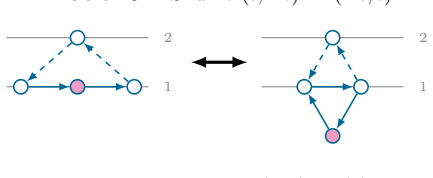
The central object is the residue universal Laurent ring L_{G,S1;ϕ}. The carrying mechanism is a separation of variables in a cluster chart adapted to an isolating cylinder for c: the chart contains a distinguished rank-2n quantum subtorus with vertices s_i, t_i for i = 1,...,n plus two extra frozen directions, and in it the quantum Dehn twist τ_c acts as the product of n commuting mutations followed by n transpositions. The local model is the GL_{n+1} q-difference open Toda chain: the fundamental Hamiltonians H_k(c) are extracted as coefficients of the difference operator Q(q^{-1}z) = H(z)Q(qz) with H(z) = Σ z^k H_k, and an algebraic spectral transform (the Whittaker transform) identifies t
What would settle it
Take G = PGL_2 and S a four-holed sphere with c a separating curve into two pairs of pants. In the isolating cluster chart, the proposed isomorphism must send H_1(c) from formula (5.33) into the residue universal Laurent ring of the cut surface; a direct computation of its image should show it has only simple poles and satisfies condition (6.16). Equivalently, checking the Dehn-twist factorization of Proposition 5.13 at the quantum level—that the relevant conjugate of Q(τ_c) equals the stated product of n commuting mutations—would settle the equivariance claim, since any mismatch in the q-comm
Extended reading notes
Core claim
Main theorem: for G = PGL_{n+1}, S a marked surface and c an essential simple closed curve, there is a Γ_{S;c}-equivariant algebra isomorphism eta_c : L_{G,S} ≅ L_{G,S1;ϕ}, where S1 is the cut surface with the two new boundary circles promoted to tacked circles and ϕ records the gluing homeomorphism. L_{G,S1;ϕ} is the residue universal Laurent ring: localize the quantum universal Laurent ring of S1 at the canonical mutation-invariant divisors of the tacked circles, take invariants under the product of Weyl groups, and keep elements with only simple poles whose residues satisfy condition (6.16). The isomorphism restricts to the centralizer subalgebra of R_G(c), giving the isomorphism (1.1) of
Load-bearing premise
The load-bearing premise is that two quantum cluster transformations built from the same quiver mutations are equal as soon as their classical or tropical specializations agree, even after the quasi-permutation corrections used here; if that dictionary failed for these specific transformations, the cutting isomorphism would not be well-defined or mapping-class equivariant.
Editorial extensions
If this is right
- The assignment S ↦ L_{G,S} now satisfies the algebraic modular functor property for PGL_{n+1}: cutting along an essential curve replaces the algebra by the residue universal Laurent ring of the cut surface with gluing datum ϕ.
- The isomorphism η_c is Γ_{S;c}-equivariant, so the mapping class group action on L_{G,S} is entirely determined by the action on cut-surface data; in particular, the centralizer of R_G(c) is the Weyl-invariant part of the quotient by the ideal I_c, resolving Conjecture 1.1.
- The fundamental Hamiltonians H_k(c) attached to c are independent of the auxiliary isolating triangulation, giving canonical commuting elements in L_{G,S}; the isomorphism η_c restricts to an isomorphism between R_G(c) and the representation ring of PGL_{n+1}.
- The construction also covers cut surfaces whose components have a single boundary circle when genus is greater than one, via an auxiliary-curve surgery, so the algebra-level modular functor statement is broader than the original centralizer conjecture.
Reading between the lines
- My inference: the residue universal Laurent ring is a natural target for a true gluing functor on modules: its simple-pole and residue conditions look like the local conditions needed to glue representations, not merely algebras.
- My inference: once the announced identification of H_k(c) with q-deformed traces of the monodromy around c is completed, η_c will be an equality between the quantum trace-of-monodromy algebra and the cut-surface character ring; a direct check in the rank-one case using the explicit formula (5.33) would test this.
- My inference: the auxiliary-curve surgery used for single-boundary components suggests that arbitrary pants decompositions can be handled by the same mechanism, with Dehn twists along each curve acting as commuting mutations in adapted charts.
- My inference: a concrete stress test of the machinery is to verify in the isolating chart that all braid-group relations of the mapping class group lift to quantum cluster transformations; the paper's Corollary 4.33 and Theorem 3.10 predict they do, and failure at any one relation would pinpoint the step that breaks.
Editorial analysis
A structured set of objections, weighed in public.
Referee Report
Summary. The paper proves the algebraic modular functor conjecture for G = PGL_{n+1}: for a marked surface S and an essential simple closed curve c, it constructs a Γ_{S;c}-equivariant algebra isomorphism η_c : L_{G,S} → L_{G,S_1;φ} (Main Theorem, Eq. (1.2)), where L_{G,S_1;φ} is a newly defined residue universal Laurent ring built from the cut surface. This refines Conjecture 1.1 (FG09a, GS19). The proof introduces two extensions of the Fock–Goncharov framework: enhanced moduli spaces with tacked circles and a residue universal Laurent ring obtained by localization, Weyl-group invariants, and simple-pole residue conditions. The main ingredients are special cluster charts isolating the curve c, a realization of the Dehn twist as n commuting mutations, and an algebraic Whittaker transform identifying the relevant local Laurent ring with a variant of the spherical double affine Hecke algebra. The paper is explicit about scope: the genus-1 corner case is deferred to the companion paper [SS25]. The central claim is an independently derived isomorphism theorem, not a circular reformulation.
Significance. If the proof is correct, this resolves a long-standing conjecture of Fock and Goncharov and establishes a modular-functor structure for quantized higher Teichmüller theory in type A_n. The paper is technically rich: it introduces new geometric objects (tacked circles, enhanced moduli spaces), new algebraic objects (residue universal Laurent rings), and gives detailed, largely self-contained arguments in Sections 5–8. It also carefully identifies the exact scope of the result and explicitly defers one boundary case to a companion paper. The main risk is not circularity or the engineering of definitions but a technical gap in an auxiliary comparison theorem: Theorem 3.10 is applied to quasi-cluster transformations that include quasi-permutations, even though the theorem is stated for composites of mutations only. Since this application is load-bearing for the mapping-class-group equivariance of the main isomorphism, the gap must be repaired before the central claim can be regarded as fully established.
major comments (3)
- [§4.8, Corollary 4.33] The proof of Corollary 4.33 invokes Theorem 3.10 to conclude equality of quantum quasi-cluster transformations from equality of their classical specializations. However, Theorem 3.10 is explicitly stated only for quantum cluster transformations obtained as composites of cluster mutations (3.10). The transformations in Corollary 4.33 arise from square moves and shifts, which by (4.19), (4.23), and (4.30) are compositions of mutations with the quasi-permutations ς_f and ς_c. These quasi-permutations act nontrivially on frozen variables, e.g. ς_f(ξ_ℓ) = ξ_{φ(f)} + ξ_{c,i} in (4.20). The theorem as stated does not control such relabelings. This is not a cosmetic issue: Corollary 4.33 is used to define the functor Q : xPt(S) → Cl_Q in (4.32), and hence to prove the well-definedness of the mapping class group action. Please provide a proof of the needed extension — for instance, a criterion fo
- [§5.5, Proposition 5.13] Proposition 5.13 realizes the Dehn twist τ_c in the isolating cluster as the composite µ_c = ∏(s_j,t_j) ∘ ∏ µ_{s_j} in (5.27). The proof states that this follows from Theorem 3.10 or from Corollary 4.33. Both routes depend on the same unproved extension of Theorem 3.10 to transformations containing the quasi-permutations ς_f and ς_c. Since the localization of the Dehn twist to the n-mutation composite is the mechanism by which the Γ_{S;c}-equivariance of η_c is obtained, this gap propagates to Theorem 8.36 and to the main theorem (1.2). The statement may well be true, but it needs a proof that does not simply cite a theorem whose hypotheses exclude the transformations being used.
- [§8.34–8.36 (via §5.13 and §4.33)] Theorems 8.34 and 8.36 establish cylinder-independence and Γ_{S;c}-equivariance of the cutting isomorphism. These theorems are justified through the functor Q and Proposition 5.13, and hence inherit the gap described above. I am not asking the authors to prove a general classical-implies-quantum theorem for all quasi-cluster transformations; it is enough to prove it for the specific quasi-permutations ς_f and ς_c defined in (4.19)–(4.23), which have a very special form. But the current text does not supply this lemma, and without it the central equivariance claim is not established.
minor comments (4)
- [§3.6–3.8] The paper defines quasi-permutations and quasi-cluster transformations, but does not state any analogue of Theorem 3.10 for them. Adding such a statement — even as a conjecture or a remark — would make the later usage transparent.
- [§4.30] Remark 4.34 warns that the conclusion of Corollary 4.33 is false under a weaker hypothesis on the equivalence of graphs. This is helpful, but the remark would be even more useful if it sketched a counterexample or explained precisely where the hypothesis on bijections φ_1, φ_2 enters.
- [Notation] The notation Γ_{S;c} is used both for the centralizer of the Dehn twist and for the enhanced Ptolemy groupoid in Definition 2.28 and surrounding text. The ambiguity is manageable but could confuse readers; a distinction such as Γ_S vs. xΓ_S would help.
- [§6.4] The algebraic Whittaker transform is a substantial technical component, but the discussion of the Whittaker kernel W^{(n+1)}(λ) is compressed. In particular, the assertion that it equals Macdonald's P-polynomial at t=0 is stated without the standard normalization details. A pointer to the exact normalization in Macdonald's book would be useful.
Circularity Check
No significant circularity: the main cutting isomorphism is proven by explicit cluster/chart and Toda–Whittaker constructions against external benchmarks, not by defining the target ring to match the source.
full rationale
The Main Theorem (1.2) is a substantive isomorphism, not a reformulation. Its target L_{G,S1;phi} is not introduced as a renaming or image of L_{G,S}; it is obtained from L_{G,S1} by localization, W(c±)-invariants, and residue conditions (Definition 8.6), with the residue characterization modeled on the external GKV framework [GKV97]. The proof constructs eta_c through isolating cluster charts, the Baxter operator / algebraic Whittaker transform, and Theorems 8.31, 8.34, and 8.36; no fitted parameter is renamed as a prediction. The only near-circularity-shaped concern is Corollary 4.33, which applies Theorem 3.10 (cited to external works FG09a, Kel11, KN11) to quasi-cluster transformations that include quasi-permutations. That is a possible proof gap or an extension of the stated theorem, but it is not circular: it does not assume the main isomorphism, and the equality of classical quasi-cluster transformations is derived from the geometry of the bicolored graphs rather than from the target algebra. Self-citations to GS19 and SS18 provide auxiliary lemmas and analogous computations, but none assumes Conjecture 1.1 or the Main Theorem, and the central derivation is self-contained enough that no load-bearing step reduces by definition to its own inputs.
Assumptions & free parameters
assumptions (7)
- standard math Theorem 3.10: composites of quantum cluster transformations coincide iff their classical and tropical specializations coincide.
- standard math Quantum Laurent phenomenon: the upper bound U^A_Q equals the quantum upper cluster algebra L^A_Q, and universal Laurentness can be checked by 1-step mutations.
- domain assumption A_Toda(GL_{n+1}) = L_Toda(GL_{n+1}) and the explicit presentation of L_Toda as a localization of a quantum coordinate ring of a unipotent cell.
- domain assumption The equivariant K-theory localization theorem identifies the Coulomb branch convolution algebra for GL_{n+1} with the algebra D_res of residue-constrained q-difference operators.
- domain assumption For adjoint G, the coordinate ring of the cluster Poisson variety P_Q(G,S) is isomorphic to that of the moduli space P_{G,S}.
- standard math Zig-zag and web combinatorics of ideal bicolored graphs of rank n, including the codistance identity of Proposition 4.28.
- domain assumption The residue characterization of Hecke algebras of Ginzburg-Kapranov-Vasserot transfers to the settings of Definitions 6.4 and 8.6.
invented entities (4)
-
Tacked circles (boundary circles with distinguished tacks) on marked surfaces
-
Enhanced moduli space P^circle_{G,S} of decorated local systems on surfaces with tacked circles
-
Residue universal Laurent ring L_{G,S1;phi}
-
Fundamental quantum Hamiltonians H_k(c)
Cite this review
Pith. "Pith review of The algebraic modular functor conjecture in type $A_n$ quantum Teichm\"uller theory." pith.science (2026). https://pith.science/paper/G3UVCPTG
@misc{pith2026250903820,
  author       = {Pith},
  title        = {Pith review of: The algebraic modular functor conjecture in type $A_n$ quantum Teichm\"uller theory},
  year         = {2026},
  howpublished = {\url{https://pith.science/paper/G3UVCPTG}},
  note         = {Machine review of arXiv:2509.03820}
}
abstract
Fock and Goncharov introduced a quantization of higher Teichm\"uller theory using cluster Poisson varieties and their noncommutative deformations, associating to a complex semisimple Lie group $G$ and a marked surface $S$ a quantum algebra $\mathbb{L}_{G,S}$ equipped with an action of the surface mapping class group. They conjectured that these quantizations form an algebraic analog of a modular functor: cutting a surface along a simple closed curve should correspond to a canonical gluing isomorphism for the associated algebras. In this paper we prove this conjecture for $G = \mathrm{PGL}_{n+1}$. Our approach requires two extensions of the Fock-Goncharov framework: (1) enhanced moduli spaces incorporating additional boundary data, providing algebro-geometric analogs of Fenchel-Nielsen twist coordinates; and (2) the residue universal Laurent ring, a refinement of the quantum universal Laurent ring obtained by localizing and imposing residue conditions. Using these tools, we construct canonical cutting isomorphisms that are equivariant under mapping class group actions and suffice to reconstruct the entire algebra $\mathbb{L}_{G,S}$ from data associated to the cut surface.
Figures


Figures from the paper (62 more)
















Reference graph
Works this paper leans on
-
[1]
Cluster structure on genus 2 spherical DAHA: seven-colored flower
S.\,Arthamonov, L.\,Chekhov, P.\,Di Francesco, R.\,Kedem, G.\,Schrader, A.\,Shapiro, M.\,Shapiro. ``Cluster structure on genus 2 spherical DAHA: seven-colored flower.'' arXiv:2402.16074 (2024)
work page Pith review arXiv 2024
-
[2]
A.\,Alekseev, E.\,Meinrenken. 11Symplectic geometry of Teichm\"uller spaces for surfaces with ideal boundary.'' Communications in Mathematical Physics 405, no. 10 (2024): 229
work page 2024
-
[3]
``Integrating quantum groups over surfaces.'' Journal of Topology 11, no
D.\,Ben-Zvi, A.\,Brochier, D.\,Jordan. ``Integrating quantum groups over surfaces.'' Journal of Topology 11, no. 4 (2018): 874-917
work page 2018
-
[4]
``Quantum character varieties and braided module categories.'' Selecta Mathematica 24, no
D.\,Ben-Zvi, A.\,Brochier, D.\,Jordan. ``Quantum character varieties and braided module categories.'' Selecta Mathematica 24, no. 5 (2018): 4711-4748
work page 2018
-
[5]
A.\,Braverman, M.\,Finkelberg, H.\,Nakajima. ``Towards a mathematical definition of Coulomb branches of 3-dimensional N= 4 gauge theories, II.'' arXiv:1601.03586 (2016)
arXiv 2016
-
[6]
A.\,Braverman, M.\,Finkelberg, H.\,Nakajima. ``Coulomb branches of 3d N= 4 quiver gauge theories and slices in the affine Grassmannian (with appendices by Alexander Braverman, Michael Finkelberg, Joel Kamnitzer, Ryosuke Kodera, Hiraku Nakajima, Ben Webster, and Alex Weekes).'' arXiv:1604.03625 (2016)
arXiv 2016
-
[7]
``Cluster algebras III: Upper bounds and double Bruhat cells.'' Duke Mathematical Journal 126, no
A.\,Berenstein, S.\,Fomin, A.\,Zelevinsky. ``Cluster algebras III: Upper bounds and double Bruhat cells.'' Duke Mathematical Journal 126, no. 1 (2005): 1-52
work page 2005
-
[8]
M.\,Bertola, D.\,Korotkin. ``Extended Goldman symplectic structure in Fock--Goncharov coordinates.'' Journal of Differential Geometry 124, no. 3 (2023): 397-442
work page 2023
Show all 48 references
-
[9]
``Quantum cluster algebras.'' Advances in Mathematics 195, no
A.\,Berenstein, A.\,Zelevinsky. ``Quantum cluster algebras.'' Advances in Mathematics 195, no. 2 (2005): 405-455
2005
-
[10]
``A quantum Teichm\"uller space.'' Theoretical and Mathematical Physics 120, no
L.\,Chekhov, V.\,Fock. ``A quantum Teichm\"uller space.'' Theoretical and Mathematical Physics 120, no. 3 (1999): 1245-1259
1999
-
[11]
``Cluster theory of the coherent Satake category.'' Journal of the American Mathematical Society 32, no.3 (2019): 709-778
S.\,Cautis, H.\,Williams. ``Cluster theory of the coherent Satake category.'' Journal of the American Mathematical Society 32, no.3 (2019): 709-778
2019
-
[12]
``Quantum Q systems: from cluster algebras to quantum current algebras.'' Letters in Mathematical Physics 107 (2017): 301-341
P.\,Di Francesco, R.\,Kedem. ``Quantum Q systems: from cluster algebras to quantum current algebras.'' Letters in Mathematical Physics 107 (2017): 301-341
2017
-
[13]
``Quivers with potentials and their representations II: applications to cluster algebras.'' Journal of the American Mathematical Society 23, no
H.\,Derksen, J.\,Weyman, A.\,Zelevinsky. ``Quivers with potentials and their representations II: applications to cluster algebras.'' Journal of the American Mathematical Society 23, no. 3 (2010): 749-790
2010
-
[14]
``Cluster -varieties, amalgamation, and Poisson--Lie groups.'' Algebraic Geometry and Number Theory Birkh¨auser, Boston, (2006): 27-68
V.\,Fock, A.\,Goncharov. ``Cluster -varieties, amalgamation, and Poisson--Lie groups.'' Algebraic Geometry and Number Theory Birkh¨auser, Boston, (2006): 27-68
2006
-
[15]
``Moduli spaces of local systems and higher Teichm\"uller theory.'' Publications Math\'ematiques de l'IH\'ES 103 (2006): 1-211
V.\,Fock, A.\,Goncharov. ``Moduli spaces of local systems and higher Teichm\"uller theory.'' Publications Math\'ematiques de l'IH\'ES 103 (2006): 1-211
2006
-
[16]
``The quantum dilogarithm and representations of quantum cluster varieties.'' Inventiones mathematicae 175 (2009): 223-286
V.\,Fock, A.\,Goncharov. ``The quantum dilogarithm and representations of quantum cluster varieties.'' Inventiones mathematicae 175 (2009): 223-286
2009
-
[17]
``Cluster ensembles, quantization and the dilogarithm.'' Annales scientifiques de l'\'Ecole normale sup\'erieure 42, no
V.\,Fock, A.\,Goncharov. ``Cluster ensembles, quantization and the dilogarithm.'' Annales scientifiques de l'\'Ecole normale sup\'erieure 42, no. 6 (2009): 865-930
2009
-
[18]
``Cluster ensembles, quantization and the dilogarithm II: The intertwiner.'' Algebra, Arithmetic, and Geometry, vol
V.\,Fock, A.\,Goncharov. ``Cluster ensembles, quantization and the dilogarithm II: The intertwiner.'' Algebra, Arithmetic, and Geometry, vol. I (2010): 655-673
2010
-
[19]
``Strongly Coupled Quantum Discrete Liouville Theory
L.\,Faddeev, R.\,Kashaev, A.\,Volkov. ``Strongly Coupled Quantum Discrete Liouville Theory. I: Algebraic Approach and Duality.'' Communications in Mathematical Physics 219 (2001): 199-219
2001
-
[20]
``Loop groups, clusters, dimers and integrable systems.'' Geometry and Quantization of Moduli Spaces Springer International Publishing (2016): 1-65
V.\,Fock, A.\,Marshakov. ``Loop groups, clusters, dimers and integrable systems.'' Geometry and Quantization of Moduli Spaces Springer International Publishing (2016): 1-65
2016
-
[21]
``Cluster algebras and triangulated surfaces
S.\,Fomin, M.\,Shapiro, D.\,Thurston. ``Cluster algebras and triangulated surfaces. Part I: Cluster complexes.'' Acta Mathematica 201, no. 1 (2008): 83-146
2008
-
[22]
M.\,Finkelberg, A.\,Tsymbaliuk. ``Multiplicative slices, relativistic Toda and shifted quantum affine algebras.'' Representations and Nilpotent Orbits of Lie Algebraic Systems: In Honour of the 75th Birthday of Tony Joseph (2019): 133-304
2019
-
[23]
``Double Bruhat cells and total positivity.'' Journal of the American Mathematical Society 12, no
S.\,Fomin, A.\,Zelevinsky. ``Double Bruhat cells and total positivity.'' Journal of the American Mathematical Society 12, no. 2 (1999): 335-380
1999
-
[24]
``Ideal Webs, Moduli Spaces of Local Systems, and 3d Calabi–Yau Categories.'' Algebra, geometry, and physics in the 21st century (2017): 31-97
A.\,Goncharov. ``Ideal Webs, Moduli Spaces of Local Systems, and 3d Calabi–Yau Categories.'' Algebra, geometry, and physics in the 21st century (2017): 31-97
2017
-
[25]
``Residue construction of Hecke algebras.'' Advances in mathematics 128, no
V.\,Ginzburg, M.\,Kapranov, E.\,Vasserot. ``Residue construction of Hecke algebras.'' Advances in mathematics 128, no. 1 (1997): 1-19
1997
-
[26]
``Poisson geometry of directed networks in a disk.'' Selecta Mathematica 15 (2009): 61-103
M.\,Gekhtman, M.\,Shapiro, A.\,Vainshtein. ``Poisson geometry of directed networks in a disk.'' Selecta Mathematica 15 (2009): 61-103
2009
-
[27]
``Poisson geometry of directed networks in an annulus.'' Journal of the European Mathematical Society 14, no
M.\,Gekhtman, M.\,Shapiro, A.\,Vainshtein. ``Poisson geometry of directed networks in an annulus.'' Journal of the European Mathematical Society 14, no. 2 (2012): 541-570
2012
-
[28]
``Dimers and cluster integrable systems.'' Annales scientifiques de l'\'Ecole Normale Sup\'erieure 46, no
A.\,Goncharov, R.\,Kenyon. ``Dimers and cluster integrable systems.'' Annales scientifiques de l'\'Ecole Normale Sup\'erieure 46, no. 5 (2013): 747-813
2013
-
[29]
``Quantum geometry of moduli spaces of local systems and representation theory.'' arXiv:1904.10491 (2019)
A.\,Goncharov, L.\,Shen. ``Quantum geometry of moduli spaces of local systems and representation theory.'' arXiv:1904.10491 (2019)
1904 arXiv
-
[30]
M.\,Yakimov
K.\,Goodearl. M.\,Yakimov. ``Integral quantum cluster structures.'' Duke Mathematical Journal 170, no. 6 (2021): 1137-1200
2021
-
[31]
``Factorization Dynamics and Coxeter--Toda Lattices.'' Communications in Mathematical Physics 212, no
T.\,Hoffmann, J.\,Kellendonk, N.\,Kutz, N.\,Reshetikhin. ``Factorization Dynamics and Coxeter--Toda Lattices.'' Communications in Mathematical Physics 212, no. 2 (2000): 297-321
2000
-
[32]
``Wilson lines and their Laurent positivity.'' Mathematische Zeitschrift 305, no
T.\,Ishibashi, H.\,Oya. ``Wilson lines and their Laurent positivity.'' Mathematische Zeitschrift 305, no. 2 (2023): 34
2023
-
[33]
``Quantum decorated character stacks.'' arXiv:2102.12283 (2021)
D.\,Jordan, I.\,Le, G.\,Schrader, A.\,Shapiro. ``Quantum decorated character stacks.'' arXiv:2102.12283 (2021)
2021 arXiv
-
[34]
R.\,Kashaev. ``The Quantum Dilogarithm and Dehn Twists in Quantum Teichm\"uller Theory.'' Integrable Structures of Exactly Solvable Two-Dimensional Models of Quantum Field Theory (2001): 211-221
2001
-
[35]
``On cluster theory and quantum dilogarithm identities.'' Representations of algebras and related topics, EMS Series of Congress Reports, European Mathematical Society (2011): 407-444
2011
-
[36]
``Classical and quantum dilogarithm identities.'' SIGMA
R.\,Kashaev, T.\,Nakanishi. ``Classical and quantum dilogarithm identities.'' SIGMA. Symmetry, Integrability and Geometry: Methods and Applications 7 (2011): 102
2011
-
[37]
``Weil--Petersson volumes and intersection theory on the moduli space of curves'' Journal of the American Mathematical Society 20, no
M.\,Mirzakhani. ``Weil--Petersson volumes and intersection theory on the moduli space of curves'' Journal of the American Mathematical Society 20, no. 1 (2007): 1–23
2007
-
[38]
``Skein and cluster algebras of marked surfaces.'' Quantum Topology 7, no
G.\,Muller. ``Skein and cluster algebras of marked surfaces.'' Quantum Topology 7, no. 3 (2016): 435-503
2016
-
[39]
``Donaldson--Thomas theory and cluster algebras.'' arXiv:1002.4884 (2010)
K.\,Nagao. ``Donaldson--Thomas theory and cluster algebras.'' arXiv:1002.4884 (2010)
2010 arXiv
-
[40]
``Cluster algebras via cluster categories with infinite-dimensional morphism spaces.'' Compositio Mathematica 147, no
P.-G.\,Plamondon. ``Cluster algebras via cluster categories with infinite-dimensional morphism spaces.'' Compositio Mathematica 147, no. 6 (2011): 1921-1954
2011
-
[41]
``Total positivity, Grassmannians, and networks.'' arXiv:math/0609764 (2006)
A.\,Postnikov. ``Total positivity, Grassmannians, and networks.'' arXiv:math/0609764 (2006)
2006 arXiv
-
[42]
``Duals of semisimple Poisson--Lie groups and cluster theory of moduli spaces of G -local systems.'' International Mathematics Research Notices 2022, no
L.\,Shen. ``Duals of semisimple Poisson--Lie groups and cluster theory of moduli spaces of G -local systems.'' International Mathematics Research Notices 2022, no. 18 (2022): 14295-14318
2022
-
[43]
``Continuous tensor categories from quantum groups I: algebraic aspects.'' arXiv:1708.08107 (2017)
G.\,Schrader, A.\,Shapiro. ``Continuous tensor categories from quantum groups I: algebraic aspects.'' arXiv:1708.08107 (2017)
2017 arXiv
-
[44]
``On b -Whittaker functions.'' arXiv:1806.00747 (2018)
G.\,Schrader, A.\,Shapiro. ``On b -Whittaker functions.'' arXiv:1806.00747 (2018)
2018 arXiv
-
[45]
``A cluster realization of U_q (sl_n) from quantum character varieties.'' Inventiones mathematicae 216 (2019): 799-846
G.\,Schrader, A.\,Shapiro. ``A cluster realization of U_q (sl_n) from quantum character varieties.'' Inventiones mathematicae 216 (2019): 799-846
2019
-
[46]
`` K -theoretic Coulomb branches of quiver gauge theories and cluster varieties.'' arXiv:1910.03186 (2019)
G.\,Schrader, A.\,Shapiro. `` K -theoretic Coulomb branches of quiver gauge theories and cluster varieties.'' arXiv:1910.03186 (2019)
1910
-
[47]
In preparation
G.\,Schrader, A.\,Shapiro. In preparation
-
[48]
uller theory.'' Handbook of Teichm\
J.\,Teschner. ``An analog of a modular functor from quantized Teichm\"uller theory.'' Handbook of Teichm\"uller Theory, vol. I (2007): 685-760
2007
Reviewed August 5, 2026 · model on record in the stance chip above.
Discussion (0). Continue with ORCID to comment.