REVIEW 3 major objections 7 minor 30 references
Robust End-to-End FSO Transmission with Joint Coding Modulation and BiLSTM-Based Channel Modeling under Atmospheric Turbulence
T0 review · 3 major / 7 minor · reviewed 2026-08-05 · deepseek-v4-flash
Pith's one-line read The paper argues that the main reason end-to-end learned FSO links fail in the field is that they are trained against a generic Gaussian noise channel; a BiLSTM surrogate of the real channel closes that gap by an average 3.54 dB in MS-SSIM
desk verdict Solid experimental demonstration of turbulence-robust FSO image transmission, but the causal case that the BiLSTM channel model is the source of the gain is not fully closed. read the letter →
The pith
A machine-rendered reading of the paper's core claim, the machinery that carries it, and where it could break.
The reading
What carries the argument
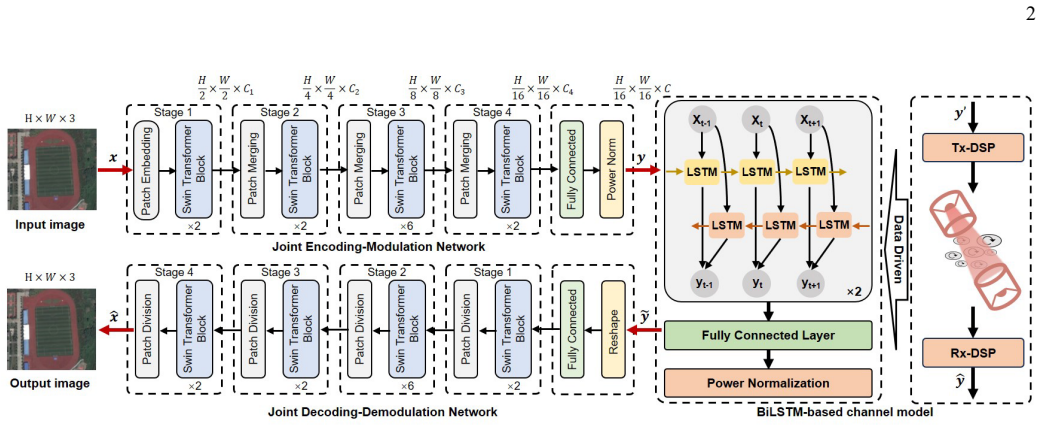
The load-bearing mechanism is the frozen BiLSTM channel surrogate: two stacked bidirectional LSTM layers (hidden size 30, dropout 0.15), a two-layer fully connected projection, and a power-normalization layer, trained by MSE on (transmitted, received) symbol pairs from the physical link. It acts as a differentiable substitute for the real FSO channel during end-to-end training, so gradients from the reconstruction loss flow through realistic non-Gaussian, temporally correlated distortions. Its parameters are fixed in the final training stage, and turbulence robustness is instilled by randomly drawing from the fitted surrogate variants corresponding to different turbulence levels in each trai
What would settle it
Recompute the amplitude-distribution KL divergence between the frozen BiLSTM surrogate and the physical link using symbols from the fine-tuned TRFSO encoder (not the pre-trained one) under the same turbulence levels. If the divergence rises materially above the 0.0019 value quoted for training-time symbols, the surrogate is stale; equivalently, retrain the surrogate on the fine-tuned encoder's symbols and check whether the 3.54 dB MS-SSIM advantage over TRFSO-AWGN persists or shrinks.
Extended reading notes
Core claim
The central claim is that replacing the AWGN channel layer with a BiLSTM channel model trained on real FSO measurements makes a joint source-channel coding and modulation (JSCCM) system turbulence-resilient without changing the deployed encoder/decoder. The authors train Swin Transformer-based joint encoding/modulation and decoding/demodulation networks, first pre-train them under AWGN, collect transmitted/received symbol pairs over an IM/DD FSO link with SLM-generated phase screens, train the BiLSTM surrogate on those pairs, then freeze it and fine-tune the whole system end-to-end while randomly sampling turbulence levels. Under strong turbulence (Cn2 = 10^-13 m^-2/3), TRFSO sustains most f
Load-bearing premise
The frozen BiLSTM channel model is trained on symbols emitted by the pre-trained AWGN encoder, and the whole fine-tuning step assumes that same surrogate stays accurate for the different symbol distribution the encoder produces after training.
Editorial extensions
If this is right
- The reported gain is attributable to the channel model alone: TRFSO and TRFSO-AWGN share identical encoder/decoder architecture and training hyperparameters, so the 3.54 dB improvement isolates the effect of training through the learned surrogate.
- Training costs increase only at training time; deployment uses the same encoder and decoder, so turbulence robustness comes without extra hardware such as adaptive optics.
- Because training samples across turbulence levels, a single fixed encoder/decoder maintains graceful degradation across zenith angles and altitudes, with MS-SSIM still 14.88 dB at a 60-degree zenith angle.
- On turbulence-free links approximated by AWGN, the AWGN-trained system remains the better choice, implying the training channel model should match the deployment scenario.
Reading between the lines
- If the surrogate's fidelity is the real driver, the same three-stage recipe should transfer to other channels that are non-differentiable or analytically intractable, such as underwater optical or RF fading with memory.
- A sharper test would measure the KL divergence of the frozen surrogate on symbols emitted by the fine-tuned encoder: if it climbs well above the 0.0019 training-time value, the reported 3.54 dB gain could be partly an artifact of optimizing against a stale channel.
- The paper averages MS-SSIM in dB; looking at per-realization distributions, the system-level benefit may be larger than the average because TRFSO avoids total failures that separate schemes suffer under strong turbulence, where the mean alone underweights catastrophic outliers.
- One testable extension is to iterate the pipeline by re-collecting physical pairs from the fine-tuned encoder and retraining the surrogate, which could either widen the gain or reveal a ceiling imposed by surrogate accuracy.
Signed reviews
Editorial analysis
A structured set of objections, weighed in public.
Referee Report
Summary. The paper proposes TRFSO, a turbulence-robust end-to-end FSO image transmission system that combines JSCCM based on Swin Transformer blocks with a BiLSTM-based differentiable channel model. The channel model is trained on input/output symbol pairs collected from a physical 30 Gbaud IM/DD FSO link under SLM-emulated turbulence. The system is trained in three stages: (1) pre-training the JEM/JDD under AWGN, (2) training the BiLSTM channel model on the pre-trained encoder's symbols, and (3) fine-tuning the full system end-to-end with the channel model frozen. The authors report that under strong turbulence TRFSO achieves an average 3.54 dB MS-SSIM improvement over a same-architecture model trained only under AWGN, and they attribute this gain to the accuracy of the BiLSTM channel model, which achieves KL divergence as low as 0.0019 against measured amplitude distributions. They also show favorable results under varying zenith angles and ground-station altitudes.
Significance. The paper addresses a timely and practical problem: making JSCCM robust to non-Gaussian, time-varying FSO channels. The experimental setup is a real 30 Gbaud IM/DD FSO link with SLM-emulated turbulence, which is a notable strength compared with simulation-only studies. If the 3.54 dB improvement is genuinely attributable to the learned channel model, it would provide strong evidence for the value of data-driven channel surrogates in end-to-end optical communication. However, the central causal claim rests on an unvalidated assumption about the frozen channel model's accuracy after encoder fine-tuning, and the quantitative metric is reported in dB without a defined conversion. These issue need to be resolved before the result can be considered established.
major comments (3)
- [II.D (three-stage training) and IV.B] The BiLSTM channel model is trained on symbols y' from the AWGN-pre-trained encoder (stage 2) and then held fixed while JEM and JDD are fine-tuned end-to-end (stage 3). As the encoder weights change, the distribution of transmitted symbols shifts, potentially outside the region where the surrogate was trained. The paper neither re-validates the channel model on fine-tuned symbols nor adapts it. Since the conclusion explicitly credits accurate channel modeling for the 3.54 dB gain (Section IV.B), the authors should provide evidence that the frozen surrogate remains accurate during and after stage 3. A concrete test is to compare the BiLSTM output against actually measured received symbols using the fine-tuned encoder; if mismatch is significant, retraining or iterative refinement is needed. Without such a check, the improvement could stem from other components (e.g., the PAPR regularizer,
- [IV.B (all MS-SSIM claims)] All quantitative comparisons are reported in dB (e.g., 'MS-SSIM improvement of 3.54 dB', 'MS-SSIM values remain above 21 dB'), but the mapping from the MS-SSIM index to dB is never defined. Without a formula, such as MS-SSIM_dB = -10*log10(1-MS-SSIM) or equivalent, the numerical values are not interpretable or reproducible. This is particularly load-bearing because the main headline improvement is in dB. Please specify the exact conversion and apply it consistently.
- [III (experimental setup) and IV] The channel model is trained on data from the same physical FSO testbed used for the final performance evaluation. While the evaluation bypasses the channel model and therefore is not circular, it does limit generalization: the measured improvements may be specific to this link's SLM-emulated turbulence characteristics. Please state whether the evaluation turbulence realizations are disjoint from the training realizations, and discuss how the results would transfer to different links or real atmospheric paths. At minimum, this should be acknowledged as a limitation.
minor comments (7)
- [III, Table I] Table I is referenced but not included in the manuscript. Please include it, as the fairness argument (comparable number of transmitted symbols) depends on it.
- [II.D vs IV.A] Section II.D says 'six different noise levels' for channel-model training, while Section IV.A says 'seven datasets'. Please make the counts consistent.
- [III and IV.B] Section III lists PAM4 and PAM8 as the modulation formats for the traditional baseline, but Section IV.B and Fig. 5 refer to 'PAM4 and OOK'. Clarify which baselines were actually used.
- [Abstract and IV.B] The abstract states '3.5 dB improvement', while Section IV.B reports '3.54 dB'. Please use one consistent rounded value.
- [II.C] The reshaping of the symbol sequence into a 2D tensor of shape N×M is not fully defined. Specify which dimension is the sequence length and which is the feature dimension, and relate M to the BiLSTM input size.
- [II.B, Eq. (1)] The image distortion loss L_d(x, x̂) in Eq. (1) is not defined. Please specify whether it is the MS-SSIM loss, MSE, or a combination.
- [V] The conclusion states MS-SSIM levels 'exceeding 21.3 dB' under moderate turbulence, but this value does not appear in the results section. Please reconcile the numbers or cite the specific figure.
Circularity Check
No significant circularity: the 3.54 dB gain is an experimentally measured end-to-end result, not an output of the fitted channel model.
full rationale
The claimed derivation chain is: (i) a BiLSTM surrogate is fit with MSE (Eq. 2) to pairs (y', y'') collected from the physical IM/DD FSO link; (ii) the surrogate is frozen and used only as a differentiable channel layer during stage-3 end-to-end training; (iii) the claimed 3.54 dB MS-SSIM improvement over TRFSO-AWGN (Section IV.B) is measured on the real FSO link, where the learned channel model is bypassed. Nothing in this chain equates the fitted channel model to the reported improvement. The KL divergence of 0.0019 is a goodness-of-fit statistic for the surrogate, not a component of the performance comparison. The self-references [4] and [11] motivate prior JSCCM work and a PAPR regularizer but are not load-bearing; no uniqueness theorem, ansatz, or renaming is used. The fixed-surrogate/distribution-shift concern is a real validity threat, but it is an assumption about generalization, not a circular reduction: the paper does not use the surrogate's accuracy to compute the 3.54 dB gain. Hence no circular step is exhibited, and the score is 0.
Assumptions & free parameters
free parameters (6)
- lambda_PAPR =
4e-5
- transmission dimension C =
96
- BiLSTM hidden size =
30
- BiLSTM dropout rate =
0.15
- LeakyReLU slope =
0.01
- training symbols per turbulence level =
120,000
assumptions (4)
- domain assumption SLM phase screens emulate atmospheric turbulence
- domain assumption The BiLSTM channel model remains valid for the fine-tuned encoder's symbol distribution
- domain assumption MS-SSIM in dB is a well-defined and comparable metric
- standard math The trained channel model is differentiable and suitable for gradient-based end-to-end optimization
Cite this review
Pith. "Pith review of Robust End-to-End FSO Transmission with Joint Coding Modulation and BiLSTM-Based Channel Modeling under Atmospheric Turbulence." pith.science (2026). https://pith.science/paper/DIE7KCOH
@misc{pith2026250903835,
  author       = {Pith},
  title        = {Pith review of: Robust End-to-End FSO Transmission with Joint Coding Modulation and BiLSTM-Based Channel Modeling under Atmospheric Turbulence},
  year         = {2026},
  howpublished = {\url{https://pith.science/paper/DIE7KCOH}},
  note         = {Machine review of arXiv:2509.03835}
}
read the original abstract
Free space optical (FSO) communication is considered a promising solution in next_generation communication networks. However, its performance is significantly influenced by atmospheric turbulence. To enhance system robustness to turbulence, we propose a turbulence_robust end_to_end FSO communication system (TRFSO) that integrates a data-driven channel model with joint source_channel coding modulation (JSCCM). Specifically, a bidirectional long short-term memory (BiLSTM)_based channel model is developed and trained on data collected over a physical FSO link under varying turbulence conditions. This model accurately captures real_world channel distortions, achieving a minimum Kullback_Leibler (KL) divergence of 0.0019 in amplitude distribution matching. Experimental results show that the TRFSO system trained with the BiLSTM_based channel model outperforms the same architecture trained under the additive white Gaussian noise (AWGN) channel, achieving an average 3.5 dB improvement in multi-scale structural similarity (MS_SSIM) under strong atmospheric turbulence. These results demonstrate the effectiveness of the proposed TRFSO in achieving robust and reliable transmission under dynamic atmospheric turbulence.
Figures
Reference graph
Works this paper leans on
-
[22]
End -to-End Learning for Free Space Optical Communication with BiLSTM -based Channel Model,
T. Zhang et al., “End -to-End Learning for Free Space Optical Communication with BiLSTM -based Channel Model,” in 2023 IEEE International Symposium on Broadband Multimedia Systems and Broadcasting (BMSB), Beijing, China: IEEE, Jun. 2023, pp. 1 –4. doi: 10.1109/bmsb58369.2023.10211249
-
[1]
Survey on Free Space Optical Communication: A Communication Theory Perspective,
M. A. Khalighi and M. Uysal, “Survey on Free Space Optical Communication: A Communication Theory Perspective,” IEEE Commun. Surv. Tutor., vol. 16, no. 4, pp. 2231 –2258, 2014, doi: 10.1109/comst.2014.2329501
-
[2]
Optical Communication in Space: Challenges and Mitigation Techniques,
H. Kaushal and G. Kaddoum, “Optical Communication in Space: Challenges and Mitigation Techniques,” IEEE Commun. Surv. Tutor., vol. 19, no. 1, pp. 57–96, 2017, doi: 10.1109/comst.2016.2603518
-
[3]
A. Trichili, M. A. Cox, B. S. Ooi, and M.-S. Alouini, “Roadmap to free space optics,” J. Opt. Soc. Am. B, vol. 37, no. 11, p. A184, Nov. 2020, doi: 10.1364/josab.399168
-
[4]
Optical Fiber Communication System Based on Intelligent Joint Source - Channel Coded Modulation,
H. Huang, L. Cheng, Z. Yu, W. Zhang, Y. Mu, and K. Xu, “Optical Fiber Communication System Based on Intelligent Joint Source - Channel Coded Modulation,” J. Light. Technol., vol. 42, no. 6, pp. 2009–2017, Mar. 2024, doi: 10.1109/jlt.2023.3328311
-
[5]
Status of NASA’s deep space optical communication technology demonstration,
A. Biswas et al., “Status of NASA’s deep space optical communication technology demonstration,” in 2017 IEEE International Conference on Space Optical Systems and Applications (ICSOS), Naha: IEEE, Nov. 2017, pp. 23–27. doi: 10.1109/icsos.2017.8357206
-
[6]
Coherent Free -Space Optical Communications: 9 Opportunities and Challenges,
F. P. Guiomar, M. A. Fernandes, J. L. Nascimento, V. Rodrigues, and P. P. Monteiro, “Coherent Free -Space Optical Communications: 9 Opportunities and Challenges,” J. Light. Technol., vol. 40, no. 10, pp. 3173–3186, May 2022, doi: 10.1109/jlt.2022.3164736
-
[7]
H. Zhou et al., “Automatic mitigation of dynamic atmospheric turbulence using optical phase conjugation for coherent free -space optical communications,” Optica, vol. 12, no. 2, p. 158, Feb. 2025, doi: 10.1364/optica.541823
Show all 30 references
-
[8]
A Survey on Acquisition, Tracking, and Pointing Mechanisms for Mobile Free -Space Optical Communications,
Y. Kaymak, R. Rojas -Cessa, J. Feng, N. Ansari, M. Zhou, and T. Zhang, “A Survey on Acquisition, Tracking, and Pointing Mechanisms for Mobile Free -Space Optical Communications,” IEEE Commun. Surv. Tutor., vol. 20, no. 2, pp. 1104– 1123, 2018, doi: 10.1109/comst.2018.2804323
2018
-
[9]
Adaptive- optics-based simultaneous pre- and post - turbulence compensation of multiple orbital-angular-momentum beams in a bidirectional free -space optical link,
Y. Ren et al., “Adaptive- optics-based simultaneous pre- and post - turbulence compensation of multiple orbital-angular-momentum beams in a bidirectional free -space optical link,” Optica, vol. 1, no. 6, p. 376, Dec. 2014, doi: 10.1364/optica.1.000376
2014 doi
-
[10]
Experimental Demonstration of Adaptive- Optics-Based Turbulence Mitigation in a Mode-Multiplexed Free-Space Optical Link by Using both Radial and Azimuthal Spatial Indices,
X. Su et al., “Experimental Demonstration of Adaptive- Optics-Based Turbulence Mitigation in a Mode-Multiplexed Free-Space Optical Link by Using both Radial and Azimuthal Spatial Indices,” in Optical Fiber Communication Conference (OFC) 2022, San Diego, California: Optica Publ...
2022 doi
-
[11]
Atmospheric Turbulence-Immune Free Space Optical Communication System based on Discrete -Time Analog Transmission
Huang, Hongyu, et al. “Atmospheric Turbulence-Immune Free Space Optical Communication System based on Discrete -Time Analog Transmission.” SCIENCE CHINA Information Sciences , early access, doi: 10.1007/s11432-024-4415-7
-
[12]
A mathematical theory of communication,
C. E. Shannon, “A mathematical theory of communication,” Bell Syst. Tech. J., vol. 27, no. 3, pp. 379 –423, Jul. 1948, doi: 10.1002/j.1538 - 7305.1948.tb01338.x
1948
-
[13]
T. M. Cover and J. A. Thomas, Elements of Information Theory. New York, NY, USA: Wiley, 2006
2006
-
[14]
Communications, Caching, and Computing for Mobile Virtual Reality: Modeling and Tradeoff,
Y. Sun, Z. Chen, M. Tao, and H. Liu, “Communications, Caching, and Computing for Mobile Virtual Reality: Modeling and Tradeoff,” IEEE Trans. Commun., vol. 67, no. 11, pp. 7573 –7586, Nov. 2019, doi: 10.1109/tcomm.2019.2920594
2019
-
[15]
Challenges in Implementing Low -Latency Holographic -Type Communication Systems,
R. Petkova, V. Poulkov, A. Manolova, and K. Tonchev, “Challenges in Implementing Low -Latency Holographic -Type Communication Systems,” Sensors, vol. 22, no. 24, p. 9617, Dec. 2022, doi: 10.3390/s22249617
2022 doi
-
[16]
Joint Source and Channel Coding,
M. Fresia, F. Perez- Cruz, H. Poor, and S. Verdu, “Joint Source and Channel Coding,” IEEE Signal Process. Mag., Nov. 2010, doi: 10.1109/msp.2010.938080
2010
-
[17]
Wireless Image Transmission Using Deep Source Channel Coding With Attention Modules,
J. Xu, B. Ai, W. Chen, A. Yang, P. Sun, and M. Rodrigues, “Wireless Image Transmission Using Deep Source Channel Coding With Attention Modules,” IEEE Trans. Circuits Syst. Video Technol., vol. 32, no. 4, pp. 2315–2328, Apr. 2022, doi: 10.1109/tcsvt.2021.3082521
2022
-
[18]
Deep Joint Source- Channel Coding for Wireless Image Transmission,
E. Bourtsoulatze, D. Burth Kurka, and D. Gunduz, “Deep Joint Source- Channel Coding for Wireless Image Transmission,” IEEE Trans. Cogn. Commun. Netw., vol. 5, no. 3, pp. 567 –579, Sep. 2019, doi: 10.1109/tccn.2019.2919300
2019
-
[19]
Adaptive Information Bottleneck Guided Joint Source and Channel Coding for Image Transmission,
L. Sun, Y. Yang, M. Chen, C. Guo, W. Saad, and H. V. Poor, “Adaptive Information Bottleneck Guided Joint Source and Channel Coding for Image Transmission,” IEEE J. Sel. Areas Commun., vol. 41, no. 8, pp. 2628–2644, Aug. 2023, doi: 10.1109/jsac.2023.3288238
2023
-
[20]
WITT: A wireless image transmission transformer for semantic communications
Yang, Ke, et al. “WITT: A wireless image transmission transformer for semantic communications. ” ICASSP 2023 -2023 IEEE International Conference on Acoustics, Speech and Signal Processing (ICASSP). IEEE, 2023
2023
-
[21]
Deep Learning -Based Channel Modeling for Free Space Optical Communications,
W. Chen et al., “Deep Learning -Based Channel Modeling for Free Space Optical Communications,” J. Light. Technol., vol. 41, no. 1, pp. 183–198, Jan. 2023, doi: 10.1109/jlt.2022.3213519
2023
-
[23]
Swin Transformer: Hierarchical Vision Transformer using Shifted Windows,
Z. Liu et al., “Swin Transformer: Hierarchical Vision Transformer using Shifted Windows,” in 2021 IEEE/CVF International Conference on Computer Vision (ICCV), Montreal, QC, Canada: IEEE, Oct. 2021, pp. 9992–10002. doi: 10.1109/iccv48922.2021.00986
2021
-
[24]
PAPR reduction techniques for coherent optical OFDM transmission,
B. Goebel, S. Hellerbrand, N. Haufe, and N. Hanik, “PAPR reduction techniques for coherent optical OFDM transmission,” in 2009 11th International Conference on Transparent Optical Networks, Ponta Delgada, Portugal: IEEE, Jun. 2009, pp. 1 –4. doi: 10.1109/icton.2009.5184979
2009
-
[25]
Simulation of wave propagation in three-dimensional random media,
Wm. A. Coles, J. P. Filice, R. G. Frehlich, and M. Yadlowsky, “Simulation of wave propagation in three-dimensional random media,” Appl. Opt., vol. 34, no. 12, p. 2089, Apr. 1995, doi: 10.1364/ao.34.002089
-
[26]
The JPEG 2000 still image compression standard,
A. Skodras, C. Christopoulos, and T. Ebrahimi, “The JPEG 2000 still image compression standard,” IEEE Signal Process. Mag., vol. 18, no. 5, pp. 36–58, 2001, doi: 10.1109/79.952804
2000 doi
-
[27]
Low-density parity-check codes,
R. Gallager, “Low-density parity-check codes,” IRE Trans. Inf. Theory, vol. 8, no. 1, pp. 21–28, Jan. 1962, doi: 10.1109/TIT.1962.1057683
1962
-
[28]
Multiscale structural similarity for image quality assessment,
Z. Wang, E. P. Simoncelli, and A. C. Bovik, “Multiscale structural similarity for image quality assessment,” in The Thrity -Seventh Asilomar Conference on Signals, Systems & Computers, 2003, Pacific Grove, CA, USA: IEEE. doi: 10.1109/acssc.2003.1292216
2003 arXiv
-
[29]
NTIRE 2017 Challenge on Single Image Super -Resolution: Dataset and Study,
E. Agustsson and R. Timofte, “NTIRE 2017 Challenge on Single Image Super -Resolution: Dataset and Study,” in 2017 IEEE Conference on Computer Vision and Pattern Recognition Workshops (CVPRW), Honolulu, HI, USA: IEEE, Jul. 2017, pp. 1122 –1131. doi: 10.1109/cvprw.2017.150
2017 doi
-
[30]
Elliptic Fourier transformation- based histograms of oriented gradients for rotationally invariant object detection in remote-sensing images,
Z. Xiao, Q. Liu, G. Tang, and X. Zhai, “Elliptic Fourier transformation- based histograms of oriented gradients for rotationally invariant object detection in remote-sensing images,” Int. J. Remote Sens., vol. 36, no. 2, pp. 618–644, Jan. 2015, doi: 10.1080/01431161.2014.999881
2015
Reviewed August 5, 2026 · model on record in the stance chip above.
Discussion (0). Continue with ORCID to comment.