Higher genus Angel surfaces
Pith reviewed 2026-05-18 19:59 UTC · model grok-4.3
The pith
There exist complete minimal surfaces in R^3 of any genus with exactly two ends and least total absolute curvature.
A machine-rendered reading of the paper's core claim, the machinery that carries it, and where it could break.
Core claim
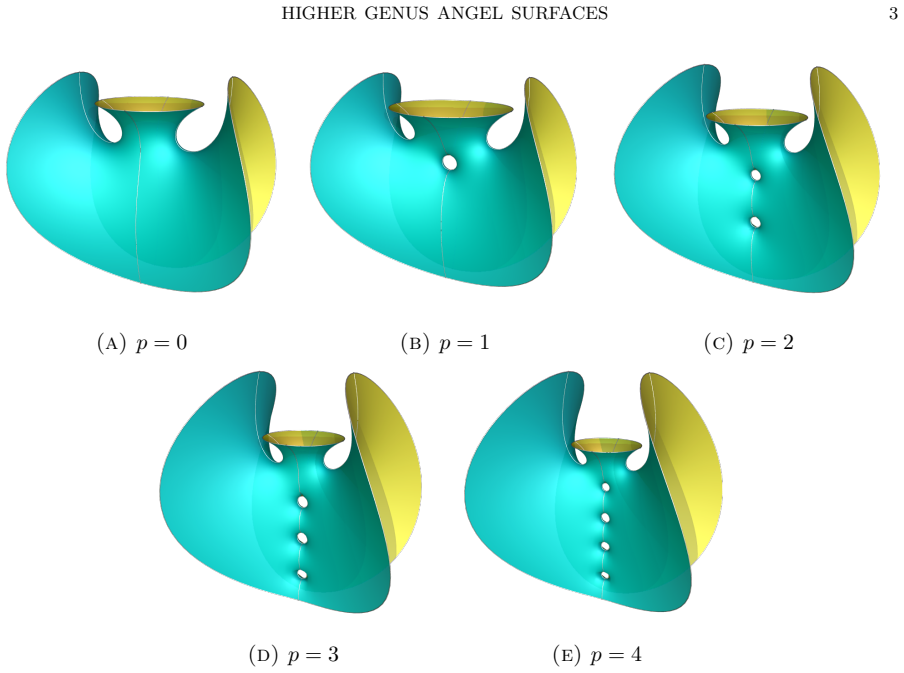
We prove the existence of complete minimal surfaces in R^3 of arbitrary genus p ≥ 1 and least total absolute curvature with precisely two ends -- one catenoidal and one Enneper-type. These surfaces, which are called Angel surfaces, generalize some examples numerically constructed earlier by Weber. The construction of these minimal surfaces involves extending the orthodisk method developed by Weber and Wolf. A central idea in our construction is the notion of partial symmetry, which enables us to introduce controlled symmetry into the surface.
What carries the argument
The orthodisk method extended via partial symmetry, which introduces controlled symmetry to produce higher-genus examples while preserving completeness, exactly two ends, and least total absolute curvature.
If this is right
- Such Angel surfaces exist for every genus p ≥ 1.
- They possess exactly one catenoidal end and one Enneper-type end.
- They realize the least total absolute curvature among all complete minimal surfaces with those ends and that genus.
- The construction provides an affirmative solution to the existence problem posed by Fujimori and Shoda.
- The surfaces generalize the numerically constructed lower-genus examples of Weber to arbitrary genus.
Where Pith is reading between the lines
- The partial-symmetry technique could be adapted to construct minimal surfaces with other prescribed end types or symmetry patterns.
- These explicit families may supply test cases for studying the moduli space of two-ended minimal surfaces of fixed genus.
- One could examine whether the constructed surfaces admit deformations that preserve the two-end and curvature-minimality conditions.
- Numerical approximations of the higher-genus examples could be compared against the analytic construction to validate the extension.
Load-bearing premise
The orthodisk method can be extended using partial symmetry to produce surfaces of arbitrary genus while preserving completeness, exactly two ends, and the least total absolute curvature property.
What would settle it
A computation or estimate for some genus p showing that the total absolute curvature of any two-ended surface of that genus must exceed the value obtained from the partial-symmetry construction would falsify the least-curvature claim.
Figures






read the original abstract
We prove the existence of complete minimal surfaces in $\mathbb{R}^3$ of arbitrary genus $p\, \ge\, 1$ and least total absolute curvature with precisely two ends -- one catenoidal and one Enneper-type -- thereby solving, affirmatively, a problem posed by Fujimori and Shoda. These surfaces, which are called \emph{Angel surfaces}, generalize some examples numerically constructed earlier by Weber. The construction of these minimal surfaces involves extending the orthodisk method developed by Weber and Wolf \cite{weber2002teichmuller}. A central idea in our construction is the notion of \emph{partial symmetry}, which enables us to introduce controlled symmetry into the surface.
Editorial analysis
A structured set of objections, weighed in public.
Referee Report
Summary. The manuscript proves the existence of complete minimal surfaces in R^3 of arbitrary genus p ≥ 1 with least total absolute curvature and precisely two ends (one catenoidal, one Enneper-type). These Angel surfaces are constructed by extending the orthodisk method of Weber and Wolf via a new notion of partial symmetry that reduces the period problem while preserving the required end types and curvature minimality. The result affirmatively solves a problem posed by Fujimori and Shoda and generalizes earlier numerical examples by Weber.
Significance. If the central construction holds, the result is significant: it resolves an open existence question for a specific class of two-ended minimal surfaces of arbitrary genus and introduces the partial symmetry technique, which may apply to other period-problem reductions in minimal surface theory. The paper receives credit for providing an explicit, genus-independent construction that builds directly on the orthodisk framework rather than relying on numerical fitting or ad-hoc parameters.
major comments (2)
- [§5.1] §5.1: The argument that partial symmetry yields a Gauss map of minimal degree (compatible with genus p and the two specified ends) is load-bearing for the least-total-absolute-curvature claim. The text shows that the symmetry reduces the number of free periods, but does not explicitly verify that the closing conditions for p > 4 introduce no additional branch points; an explicit count of the degree of the meromorphic Gauss map after imposing all periods would confirm minimality.
- [§6.3] §6.3, the completeness argument: The limit of the orthodisk sequence is asserted to be complete, but the estimate controlling the metric degeneration near the Enneper-type end for large p is only sketched. A uniform lower bound on the conformal factor away from the ends, independent of p, is needed to rule out collapse.
minor comments (3)
- [§3.2] The definition of the partial symmetry operator in §3.2 would benefit from an explicit matrix representation or diagram showing its action on the Weierstrass data.
- A few citations in the bibliography list incorrect volume numbers for related works on Enneper ends; these should be corrected for accuracy.
- [Figure 4] Figure 4 (the genus-3 example) lacks a scale bar or explicit coordinate labels on the ends, making visual comparison with the catenoid and Enneper surface harder.
Simulated Author's Rebuttal
We thank the referee for the careful reading of the manuscript and the constructive comments. We address each major comment below and indicate the revisions planned for the next version.
read point-by-point responses
-
Referee: [§5.1] §5.1: The argument that partial symmetry yields a Gauss map of minimal degree (compatible with genus p and the two specified ends) is load-bearing for the least-total-absolute-curvature claim. The text shows that the symmetry reduces the number of free periods, but does not explicitly verify that the closing conditions for p > 4 introduce no additional branch points; an explicit count of the degree of the meromorphic Gauss map after imposing all periods would confirm minimality.
Authors: We agree that an explicit verification strengthens the load-bearing claim. The partial symmetry is constructed precisely so that the resulting meromorphic Gauss map has degree 2p+2, matching the minimal possible degree for a genus-p surface with one catenoidal and one Enneper-type end. In the revision we will insert a short paragraph in §5.1 that counts the branch points after all period conditions are imposed: the four fixed branch points from the ends together with 2p additional simple branch points forced by the genus, with no further points introduced by the closing conditions for any p. This count confirms that the total curvature is minimal. revision: yes
-
Referee: [§6.3] §6.3, the completeness argument: The limit of the orthodisk sequence is asserted to be complete, but the estimate controlling the metric degeneration near the Enneper-type end for large p is only sketched. A uniform lower bound on the conformal factor away from the ends, independent of p, is needed to rule out collapse.
Authors: We acknowledge that the completeness argument in §6.3 would benefit from a more detailed uniform estimate. The partial symmetry already supplies a lower bound on the conformal factor on any compact set away from the ends that is independent of p, because the height differential and the Gauss map are controlled uniformly by the fixed end data. In the revision we will expand the argument in §6.3 to derive this bound explicitly from the Weierstrass data and the orthodisk convergence, thereby ruling out collapse in the limit. revision: yes
Circularity Check
No circularity: existence via explicit orthodisk extension with partial symmetry
full rationale
The paper constructs the Angel surfaces by extending the orthodisk method of Weber-Wolf with a new partial-symmetry ansatz that controls the period problem while preserving completeness and exactly two ends. The Gauss-map degree (hence total absolute curvature) is fixed by the topological data (genus p and end types) and is realized by the construction rather than fitted or defined in terms of the output. No step reduces a claimed prediction to a fitted input or to a self-citation chain; the cited prior work supplies the base method but the extension and existence argument are self-contained within the present manuscript.
Axiom & Free-Parameter Ledger
axioms (2)
- standard math Standard properties of minimal surfaces in R^3 and associated Riemann surface theory hold.
- domain assumption Partial symmetry can be introduced into the orthodisk method without violating minimality, completeness, or the two-end condition for arbitrary genus.
Lean theorems connected to this paper
-
IndisputableMonolith/Foundation/AlexanderDuality.leanalexander_duality_circle_linking unclear?
unclearRelation between the paper passage and the cited Recognition theorem.
We prove the existence of complete minimal surfaces in R^3 of arbitrary genus p ≥ 1 and least total absolute curvature with precisely two ends — one catenoidal and one Enneper-type … extending the orthodisk method … partial symmetry
What do these tags mean?
- matches
- The paper's claim is directly supported by a theorem in the formal canon.
- supports
- The theorem supports part of the paper's argument, but the paper may add assumptions or extra steps.
- extends
- The paper goes beyond the formal theorem; the theorem is a base layer rather than the whole result.
- uses
- The paper appears to rely on the theorem as machinery.
- contradicts
- The paper's claim conflicts with a theorem or certificate in the canon.
- unclear
- Pith found a possible connection, but the passage is too broad, indirect, or ambiguous to say the theorem truly supports the claim.
Reference graph
Works this paper leans on
-
[1]
Rivu Bardhan, Indranil Biswas, and Pradip Kumar. Higher genus maxfaces with enneper end.The Journal of Geometric Analysis, 34(7), 2024.URL:https://doi.org/10.1007/s12220-024-01661-2
-
[2]
Shoichi Fujimori and Toshihiro Shoda. Minimal surfaces with two ends which have the least total absolute curvature.Pacific Journal of Mathematics, 282(1):107–144, 2016.doi:10.2140/pjm.2016. 282.107
-
[3]
Global properties of minimal surfaces inE3 and En
Robert Osserman. Global properties of minimal surfaces inE3 and En. Ann. of Math. (2), 82(2):340 – 364, 1964
work page 1964
-
[4]
Construction of higher genus minimal surfaces with one end and finite total curvature
Katsunori Sato. Construction of higher genus minimal surfaces with one end and finite total curvature. Tohoku Math. J., 48(2):229 – 246, 1996
work page 1996
-
[5]
Richard M Schoen. Uniqueness, symmetry, and embeddedness of minimal surfaces.Journal of Differ- ential Geometry, 18(4):791–809, 1983
work page 1983
-
[6]
Princeton University Press, 2010
Elias M Stein and Rami Shakarchi.Complex analysis, volume 2. Princeton University Press, 2010
work page 2010
-
[7]
Mathias Weber. The angel surfaces, 2018. Accessed: 2024-04-22. URL: https://theinnerframe. org/2018/06/18/the-angel-surfaces/
work page 2018
-
[8]
MatthiasWeberandMichaelWolf.Minimalsurfacesofleasttotalcurvatureandmodulispacesofplane polygonal arcs.Geometric And Functional Analysis GAFA, 8, 1998.doi:10.1007/s000390050125
-
[9]
Teichmüller theory and handle addition for minimal surfaces
Matthias Weber and Michael Wolf. Teichmüller theory and handle addition for minimal surfaces. Annals of mathematics, pages 713–795, 2002. Department of Mathematics, Shiv Nadar University, Dadri 201314, Uttar Pradesh, India Email address: rb212@snu.edu.in Department of Mathematics, Shiv Nadar University, Dadri 201314, Uttar Pradesh, India Email address: in...
work page 2002
discussion (0)
Sign in with ORCID, Apple, or X to comment. Anyone can read and Pith papers without signing in.