REVIEW 4 major objections 5 minor 21 references
Approximate Message Passing for Multi-Preamble Detection in OTFS Random Access
T0 review · 4 major / 5 minor · reviewed 2026-08-05 · deepseek-v4-flash
Pith's one-line read A new approximate message passing algorithm called CSGL-AMP exploits both group and within-group sparsity to detect multiple OTFS preambles, reaching a 10^-2 misdetection probability in regimes where the one-step thresholding baseline is fl
desk verdict A plausible complex extension of sparse-group LASSO AMP for OTFS random access, with real simulation gains but an unproven AMP step for the structured dictionary. read the letter →
The pith
A machine-rendered reading of the paper's core claim, the machinery that carries it, and where it could break.
The reading
What carries the argument
The key object is the complex sparse group LASSO (CSGL) denoiser η(r, λ1, λ2), the proximal operator of the regularization λ1||β||1 + λ2 Σ_g ||β_g||2. Per group, it is the composition of element-wise complex soft-thresholding η_st(r, λ1) = (1−λ1/|r|) r for |r|>λ1, followed by group shrinkage (1−λ2/||s_g||2) s_g. The second load-bearing piece is the Onsager correction: the average of the Wirtinger derivatives of η, derived in closed form as (1/N) Σ_g Σ_{j∈J_g} η′_{g,j}(r). That term keeps the residual approximately uncorrelated with the estimate across iterations, allowing AMP to converge at the low per-iteration cost of matrix-vector products. It reduces to the standard complex soft-threshol
What would settle it
Run CSGL-AMP on the exact Veh-A OTFS sensing matrix of Section IV at δ=0.3 and ρ_G=0.2, and compare the empirically averaged Wirtinger divergence of the denoiser with the closed-form Onsager term (26) at each iteration; if the two disagree beyond Monte Carlo fluctuation, or if removing the Onsager term leaves the misdetection curve unchanged, then the proposed correction is not the mechanism behind the reported gains.
Extended reading notes
Core claim
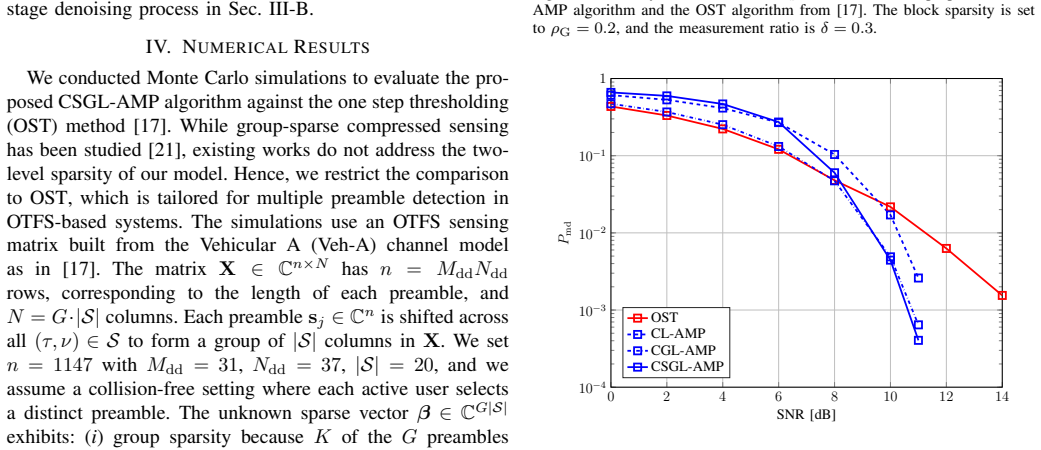
The central claim is that CSGL-AMP, an AMP recursion whose denoiser is the proximal map of the complex sparse group LASSO regularizer, detects multiple OTFS preambles with substantially lower misdetection than the current one-step thresholding method. The recursion updates an effective observation r(t)=β(t)+X^H z(t), denoises it through the two-stage operator η, and corrects the residual with the averaged Wirtinger divergence of η. The denoiser first applies complex soft-thresholding with λ1 inside each group and then shrinks the entire group by λ2 based on the norm of the thresholded group, so a preamble is declared only when its delay-Doppler energy survives both tests. In Monte Carlo simu
Load-bearing premise
The AMP update rule uses an Onsager correction whose statistical justification assumes a sensing matrix that is i.i.d. or rotation-invariant; the OTFS matrix here is a fixed, deterministic matrix built from shifted Zadoff-Chu sequences, and the paper does not analyze whether the correction remains valid for that structure.
Editorial extensions
If this is right
- If the claims hold, CSGL-AMP is a drop-in replacement for OST in OTFS random access receivers, with gains concentrated in the low-misdetection regime that matters for reliable grant-free access.
- The same Wirtinger-derived Onsager machinery should apply to any complex-valued sparse-group problem, not just OTFS, since the denoiser and correction do not depend on OTFS specifics.
- The validity-region curves give an explicit operating envelope: for a given SNR and target P_md=10^-2, the receiver knows the maximum active-preamble fraction it can support at a given measurement ratio.
- Because each AMP step is just matrix-vector products, the performance gains come without an increase in per-iteration complexity relative to OST, making the approach scalable to larger OTFS grids and preamble pools.
Reading between the lines
- Editorial inference: the denoiser derivation transfers directly to OTFS channel estimation and joint activity and data recovery, where the same delay-Doppler sparsity structure appears, so the method's practical reach is larger than the preamble-detection framing suggests.
- Editorial inference: the paper leaves open whether the deterministic Zadoff-Chu sensing matrix satisfies the invariance conditions under which AMP state evolution is proven; a simulation-based or analytic state-evolution study for structured OTFS matrices would be needed to confirm that the Onsager correction remains exact in this setting.
- Editorial inference: the adaptive threshold rules for λ1 and λ2 are described as online approximations; a natural testable extension is to benchmark these heuristics against oracle-tuned thresholds to see how much of the reported gain comes from threshold adaptation rather than from the double-sparsity structure.
- Editorial inference: in a collision scenario where two active users select the same preamble, group sparsity alone cannot separate them; extending the framework to collision resolution would likely require coupling CSGL-AMP with successive interference cancellation or a different group code.
Editorial analysis
A structured set of objections, weighed in public.
Referee Report
Summary. The paper proposes an approximate message passing (AMP) algorithm, CSGL-AMP, for complex sparse group LASSO, applied to multi-preamble detection in OTFS random access. The received signal is modeled as y = Xβ + w with a dictionary of shifted OTFS preambles; β has group sparsity (few active preambles) and within-group sparsity (few multipath taps). The algorithm iterates matched-filter updates (17)–(19), uses a two-stage denoiser (complex soft-thresholding plus group shrinkage), and includes an Onsager correction computed via Wirtinger calculus. Simulations compare the misdetection probability with the one-step thresholding baseline [17] and with complex-LASSO/group-LASSO AMP variants, reporting gains at δ=0.3 and δ=0.8 and larger validity regions for Pmd≤1e−2. The contributions claimed are the first complex SGL-AMP, a structured denoiser with a derived Onsager term, and simulation gains.
Significance. If the algorithmic claims can be substantiated, this would be a useful contribution to grant-free random access in mMTC: the two-level sparsity model is natural for OTFS preambles over sparse multipath channels, and a working complex SGL-AMP would extend AMP tooling to an important structured problem. The reported gains over OST in Fig. 1 are substantial (CSGL-AMP reaches Pmd=1e−2 near 12.5 dB where OST floors above 1e−2). The paper is clearly organized, and the authors are right to attempt a denoiser-specific Onsager correction rather than treating the correction as a free parameter. However, the central claims are not yet supported: the compact denoiser formula is internally inconsistent, the AMP validity for the structured sensing matrix is unexamined, the Onsager derivation is opaque, and the adaptive threshold rule is undisclosed. These gaps make the numerical results non-reproducible and the 'rigorously derived' claim unverifiable.
major comments (4)
- [III-B, Eq. (23)] The compact expression for the denoiser is not equivalent to the two-stage rule in Eqs. (20)–(22). For |r_{g,j}| ≤ λ1, the factor (1 − λ1/|r_{g,j}|) is non-positive; because the group factor in front can be positive when other elements in the group are large, the expression yields a nonzero output for a coefficient that Eq. (21) sets to zero. Example: r=(0.5,10), λ1=1, λ2=1 gives η_1 ≈ −0.444 instead of 0. The element factor needs a positive part, i.e. (1 − λ1/|r|)_+, or equivalently (|r|−λ1)_+ e^{i∠r}. Since the Onsager divergence in Eq. (26) is derived from Eq. (23), all subsequent formulas inherit this error.
- [III-A, Eqs. (17)–(19) and Section IV] The AMP recursion is used for the deterministic structured sensing matrix X defined in Eq. (5), which is neither i.i.d. nor right-orthogonally invariant; the standard AMP guarantees [14], [18] cited in Section II-D do not cover this case. No state evolution derivation, residual decorrelation test, or convergence diagnostic is provided for the actual X. Please add either a theoretical argument tailored to the OTFS/Zadoff–Chu structure or an empirical validation under the same matrix (e.g., compare AMP estimates against a convex sparse-group-LASSO solver, monitor residual correlations over iterations, and report failure rates over many channel realizations). Without this, the validity of the Onsager term in the regime of Figs. 1–3 is unsupported.
- [III-C, Eq. (26)] The 'after simplification' closed form for the Onsager term is the key novel claim, but the algebra is not shown. As typeset, Eq. (26) is also ambiguous: the placement of the λ2/2 factor and the square root makes the expression hard to parse. Please provide a complete derivation of the Wirtinger derivative starting from Eq. (23) — or from its corrected version — and give a clean, unambiguous formula. Without this, the central algorithmic mechanism cannot be checked.
- [III-A, adaptive thresholds] The update rule for λ1(t) and λ2(t) is never specified; the text only says 'suitable online approximations'. Since the numerical results in Section IV depend on these thresholds, the figures cannot be reproduced and it is unclear whether the reported gains rely on a particular tuning schedule. Provide the exact update equations, initialization, and any hyperparameters. If the thresholds are derived from noise variance or residual energy, give the formula.
minor comments (5)
- [III-B] Please define (x)_+ consistently and state explicitly that the element-wise factor in Eq. (23) should be (1 − λ1/|r|)_+.
- [III-C] The notation in Eq. (26) is hard to read; please rewrite using displayed fractions, define J_g, G_a, and the positive-part operator.
- [IV] The number of AMP iterations and the convergence criterion are not given. Report these in the table/caption or in Section III-A.
- [II-A] In Eq. (5), the index i in X_{j|S|+i} is not defined over the Cartesian product order; specify the ordering of S and the range of i.
- [Introduction/Related Work] The relationship to the real-valued SGL-AMP in [19] should be discussed; the authors claim a first complex extension but do not contrast with the real-valued analysis or explain what changes in the complex domain.
Circularity Check
No significant circularity: CSGL-AMP derivation is self-contained; main risks are unvalidated AMP assumptions and unspecified threshold adaptation, not circularity.
full rationale
The derivation chain is self-contained. CSGL-AMP is obtained by instantiating the standard AMP recursion (17)-(19) with a proximal denoiser (20)-(23), and the Onsager term is computed from that denoiser via the Wirtinger divergence (24)-(26); no target quantity (e.g., Pmd, SNR thresholds) is fed into the algorithm derivation. The performance claims are Monte Carlo comparisons, not predictions derived from fitted parameters. The only same-author citation, [13], appears in Sec. I as background for 'multiple preamble detection in OTFS-based random access'; it is not load-bearing for the algorithm or its conclusions. The passage in Sec. III-A saying thresholds 'are updated adaptively at every iteration through suitable online approximations' is a genuine reproducibility gap, but it is not circular: no equation or description shows the thresholds being fitted to the reported Pmd values, so it does not reduce the claimed gains to inputs. AMP's applicability to the structured OTFS matrix is asserted without state-evolution validation, but that is a correctness risk, not circularity. Thus, no circular step can be exhibited.
Assumptions & free parameters
free parameters (2)
- λ1 (within-group threshold) =
adaptive, unspecified
- λ2 (group threshold) =
adaptive, unspecified
assumptions (4)
- domain assumption AMP state evolution assumptions hold for the structured OTFS sensing matrix X
- standard math The two-stage denoiser (elementwise soft-threshold then group soft-threshold) is the exact proximal operator of complex sparse group LASSO
- domain assumption Collision-free random access with exactly K active users, each choosing a distinct preamble
- domain assumption The Veh-A channel model with L=6 dominant delay-Doppler components is representative
Cite this review
Pith. "Pith review of Approximate Message Passing for Multi-Preamble Detection in OTFS Random Access." pith.science (2026). https://pith.science/paper/AJNQJ26T
@misc{pith2026250903980,
  author       = {Pith},
  title        = {Pith review of: Approximate Message Passing for Multi-Preamble Detection in OTFS Random Access},
  year         = {2026},
  howpublished = {\url{https://pith.science/paper/AJNQJ26T}},
  note         = {Machine review of arXiv:2509.03980}
}
read the original abstract
This article addresses the problem of multiple preamble detection in random access systems based on orthogonal time frequency space (OTFS) signaling. This challenge is formulated as a structured sparse recovery problem in the complex domain. To tackle it, the authors propose a new approximate message passing (AMP) algorithm that enforces double sparsity: the sparse selection of preambles and the inherent sparsity of OTFS signals in the delay-Doppler domain. From an algorithmic standpoint, the non-separable complex sparsity constraint necessitates a careful derivation and leads to the design of a novel AMP denoiser. Simulation results demonstrate that the proposed method achieves robust detection performance and delivers significant gains over state-of-the-art techniques.
Figures


Reference graph
Works this paper leans on
-
[19]
Asymptotic Statistical Analysis of Sparse Group LASSO via Approximate Message Passing Algorithm
K. Chen, Z. Bu, and S. Xu, “Asymptotic statistical analysis of sparse group LASSO via approximate message passing algorithm,” arXiv preprint arXiv:2107.01266, 2022
work page Pith review arXiv 2022
-
[17]
Delay-doppler signal pro- cessing with Zadoff-Chu sequences,
S. R. Mattu, I. A. Khan, V . Khammammetti, B. Dabak, S. K. Mo- hammed, K. Narayanan, and R. Calderbank, “Delay-doppler signal pro- cessing with Zadoff-Chu sequences,” arXiv preprint arXiv:2412.04295 , 2024
arXiv 2024
-
[14]
Message-passing algo- rithms for compressed sensing,
D. L. Donoho, A. Maleki, and A. Montanari, “Message-passing algo- rithms for compressed sensing,” Proc. Natl. Acad. Sci. USA , vol. 106, no. 45, pp. 18 914–18 919, 2009
work page 2009
-
[18]
The dynamics of message passing on dense graphs, with applications to compressed sensing,
M. Bayati and A. Montanari, “The dynamics of message passing on dense graphs, with applications to compressed sensing,” IEEE Trans. Inf. Theory, vol. 57, no. 2, pp. 764–785, Feb. 2011
work page 2011
-
[1]
Structured compressed sensing: From theory to applications,
M. F. Duarte and Y . C. Eldar, “Structured compressed sensing: From theory to applications,” IEEE Trans. Signal Process., vol. 59, no. 9, pp. 4053–4085, Sep. 2011
work page 2011
-
[2]
Sparsity and structure in hyperspectral imaging: Sensing, reconstruc- tion, and target detection,
R. M. Willett, M. F. Duarte, M. A. Davenport, and R. G. Baraniuk, “Sparsity and structure in hyperspectral imaging: Sensing, reconstruc- tion, and target detection,” IEEE Signal Process. Mag. , vol. 31, no. 1, pp. 116–126, Jan. 2014
work page 2014
-
[3]
Sparse representation for wireless communications: A compressive sensing approach,
Z. Qin, J. Fan, Y . Liu, Y . Gao, and G. Y . Li, “Sparse representation for wireless communications: A compressive sensing approach,” IEEE Signal Process. Mag. , vol. 35, no. 3, pp. 40–58, May 2018
work page 2018
-
[4]
Approximate message-passing decoder and capacity achieving sparse superposition codes,
J. Barbier and F. Krzakala, “Approximate message-passing decoder and capacity achieving sparse superposition codes,” IEEE Trans. Inf. Theory, vol. 63, no. 8, pp. 4894–4927, Aug. 2017
work page 2017
Show all 21 references
-
[5]
Capacity-achieving spa- tially coupled sparse superposition codes with AMP decoding,
C. Rush, K. Hsieh, and R. Venkataramanan, “Capacity-achieving spa- tially coupled sparse superposition codes with AMP decoding,” IEEE Trans. Inf. Theory, vol. 67, no. 7, pp. 4446–4484, Jul. 2021
2021
-
[6]
A user- independent successive interference cancellation based coding scheme for the unsourced random access Gaussian channel,
A. Vem, K. R. Narayanan, J.-F. Chamberland, and J. Cheng, “A user- independent successive interference cancellation based coding scheme for the unsourced random access Gaussian channel,” IEEE Trans. Commun., vol. 67, no. 12, pp. 8258–8272, Dec. 2019
2019
-
[7]
Orthogonal time frequency space modula- tion,
R. Hadani, S. Rakib, M. Tsatsanis, A. Monk, A. J. Goldsmith, A. F. Molisch, and R. Calderbank, “Orthogonal time frequency space modula- tion,” in Proc. 2017 IEEE Wireless Commun. Netw. Conf., San Francisco, CA, USA, Mar. 2017
2017
-
[8]
Regression shrinkage and selection via the lasso,
R. Tibshirani, “Regression shrinkage and selection via the lasso,” J. R. Stat. Soc. Ser. B Stat. Methodol. , vol. 58, no. 1, pp. 267–288, 1996
1996
-
[9]
A fast iterative shrinkage-thresholding algorithm for linear inverse problems,
A. Beck and M. Teboulle, “A fast iterative shrinkage-thresholding algorithm for linear inverse problems,” SIAM J. Imaging Sci. , vol. 2, no. 1, pp. 183–202, 2009
2009
-
[10]
Orthogonal matching pursuit for sparse signal recovery with noise,
T. T. Cai and L. Wang, “Orthogonal matching pursuit for sparse signal recovery with noise,” IEEE Trans. Inf. Theory, vol. 57, no. 7, pp. 4680– 4688, Jul. 2011
2011
-
[11]
Model selection and estimation in regression with grouped variables,
M. Yuan and Y . Lin, “Model selection and estimation in regression with grouped variables,” J. R. Stat. Soc. Ser. B Stat. Methodol., vol. 68, no. 1, pp. 49–67, 2006
2006
-
[12]
A sparse-group LASSO,
N. Simon, J. Friedman, T. Hastie, and R. Tibshirani, “A sparse-group LASSO,” J. Comput. Graph. Stat. , vol. 22, no. 2, pp. 231–245, 2013
2013
-
[13]
Zak-OTFS based coded random access for uplink mMTC,
A. Mirri, V . Khammammetti, B. Dabak, E. Paolini, K. Narayanan, and R. Calderbank, “Zak-OTFS based coded random access for uplink mMTC,” arXiv preprint arXiv:2507.22013 , 2025
2025 arXiv
-
[15]
Asymptotic analysis of complex LASSO via complex approximate message passing (CAMP),
A. Maleki, L. Anitori, Z. Yang, and R. G. Baraniuk, “Asymptotic analysis of complex LASSO via complex approximate message passing (CAMP),” IEEE Trans. Inf. Theory , vol. 59, no. 7, pp. 4290–4308, Jul. 2013
2013
-
[16]
S. K. Mohammed, R. Hadani, and A. Chockalingam, OTFS Modulation: Theory and Applications . Wiley, 2024. [Online]. Available: https://books.google.com/books?id=QCYzEQAAQBAJ
2024
-
[20]
Zur formalen theorie der funktionen von mehr komplexen veränderlichen,
W. Wirtinger, “Zur formalen theorie der funktionen von mehr komplexen veränderlichen,” Mathematische Annalen , vol. 97, no. 1, pp. 357–375, 1927
1927
-
[21]
Group sparsity methods for compressive space-frequency channel estimation and spatial equalization in fluid antenna system,
X. Dong, K. Wan, S. Li, R. C. Qiu, and G. Caire, “Group sparsity methods for compressive space-frequency channel estimation and spatial equalization in fluid antenna system,” arXiv preprint arXiv:2503.02004, 2025
2025 arXiv
Reviewed August 5, 2026 · model on record in the stance chip above.
Discussion (0). Continue with ORCID to comment.