pith. sign in

arxiv: 2509.04114 · v3 · submitted 2025-09-04 · 🧮 math.GT

The linear minimal 4-chart with three crossings

Pith reviewed 2026-05-18 19:48 UTC · model grok-4.3

classification 🧮 math.GT
keywords 4-chartssurface braidsembedded surfaceslinear chartsminimal chartslor-equivalence2-twist spun trefoilknotted surfaces in 4-space
0
0 comments X

The pith

Any linear minimal 4-chart with three crossings is lor-equivalent to the chart of a 2-twist spun trefoil knot after omitting free edges and hoops.

A machine-rendered reading of the paper's core claim, the machinery that carries it, and where it could break.

This paper classifies linear minimal 4-charts with exactly three crossings. Charts serve as diagrams for oriented closed surfaces embedded in four-dimensional space. The central result is that every such chart is equivalent, after label-orientation-reflection changes and removal of free edges and hoops, to one specific chart that encodes a 2-twist spun trefoil. A reader would care because the result supplies a complete list for this smallest nontrivial crossing number, showing that the allowed configurations are tightly constrained.

Core claim

For a 4-chart that is linear, meaning each connected component of (Γ₁ ∪ Γ₃) minus crossings is acyclic, and that is minimal with three crossings, the chart is lor-equivalent to the chart describing the 2-twist spun trefoil knot by omitting free edges and hoops.

What carries the argument

A linear 4-chart, defined by requiring acyclicity of every connected component of the union of label-1 and label-3 edges away from crossings, together with the relation of lor-equivalence.

If this is right

  • All such charts represent the same embedded surface in 4-space.
  • Minimality and linearity force every three-crossing example into a single standard form.
  • Any further study of linear charts can begin by reducing to the known 2-twist spun trefoil diagram.

Where Pith is reading between the lines

These are editorial extensions of the paper, not claims the author makes directly.

  • The reduction technique may extend to linear charts with four or five crossings.
  • Non-linear charts with three crossings might still produce additional distinct surfaces.
  • The result supplies a base case for inductive classification of minimal linear charts by crossing number.

Load-bearing premise

That the acyclicity condition on label-1 and label-3 edges plus minimality together include every topologically distinct chart with three crossings.

What would settle it

Construction of a linear minimal 4-chart with three crossings whose represented surface is not equivalent to the 2-twist spun trefoil under lor-equivalence would refute the claim.

Figures

Figures reproduced from arXiv: 2509.04114 by Akiko Shima, Teruo Nagase.

Figure 1
Figure 1. Figure 1: Charts are lor-equivalent to the 4-chart describing a 2-twist spun [PITH_FULL_IMAGE:figures/full_fig_p003_1.png] view at source ↗
Figure 2
Figure 2. Figure 2: (a) A black vertex. (b) A crossing. (c) A white vertex. Each arc [PITH_FULL_IMAGE:figures/full_fig_p004_2.png] view at source ↗
Figure 3
Figure 3. Figure 3: For the C-III move, the edge with the black vertex does not contain [PITH_FULL_IMAGE:figures/full_fig_p005_3.png] view at source ↗
Figure 4
Figure 4. Figure 4: Bigons. A hoop is said to be simple if one of the complementary domains of the hoop does not contain any white vertices. An oval nest is a free edge together with some concentric simple hoops. An edge in a chart is called a terminal edge if it has a white vertex and a black vertex. Proposition 2.1 ([9, Remark 2.3], [10, Proposition 2.3]) Let Γ be a minimal chart in a disk D2 . Then we have the following: (… view at source ↗
Figure 5
Figure 5. Figure 5: The gray regions are disks D, and m is a label. Assumption 4 The point at infinity ∞ is moved in any complementary domain of Γ. The following lemma will be use in the proof of the main theorem. Lemma 2.4 (Cut Edge Lemma)([2, Lemma 18.24 (E)],[5, Lemma 5.1]) Let Γ and Γ ′ be charts, and D a disk with Γ∩ Dc = Γ′ ∩ Dc . If Γ∩ D and Γ ′ ∩ D are sets as shown in [PITH_FULL_IMAGE:figures/full_fig_p007_5.png] view at source ↗
Figure 6
Figure 6. Figure 6: (a) Neither e1 nor e2 is a terminal edge. (b) The two double pointed dotted arrow indicates that a C-I-M2 move will be applied. (c) There is no white vertex between the vertex c and the vertex v on the arc L. (d) There is no white vertex between the vertex v1 and the vertex v2 on the arc L. (e) A direction indicator for the arc ℓ. Let Γ be a chart, m a label of the chart, and c a crossing of the chart. Let… view at source ↗
Figure 7
Figure 7. Figure 7: Mal-cycles [PITH_FULL_IMAGE:figures/full_fig_p010_7.png] view at source ↗
Figure 8
Figure 8. Figure 8: The double pointed dotted arrow in (e) indicates the site where a [PITH_FULL_IMAGE:figures/full_fig_p010_8.png] view at source ↗
Figure 9
Figure 9. Figure 9: (a) A pinwheel. (b) e2, e6 are side edges of e1, and e3, e5 are side edges of e4. (c) A neighborhood of the crossing c. (d) A mal-cycle [PITH_FULL_IMAGE:figures/full_fig_p011_9.png] view at source ↗
Figure 10
Figure 10. Figure 10: (b),(c) Consecutive triplets. 4 Consecutive Triplet Lemma In this section, we review a useful lemma called Consecutive Triplet Lemma. Let E be a disk, and ℓ1, ℓ2, ℓ3 three arcs on ∂E such that each of ℓ1 ∩ ℓ2 and ℓ2 ∩ ℓ3 is one point and ℓ1 ∩ ℓ3 = ∅ (see [PITH_FULL_IMAGE:figures/full_fig_p012_10.png] view at source ↗
Figure 11
Figure 11. Figure 11: Any side edge of the terminal edge must intersect the arc [PITH_FULL_IMAGE:figures/full_fig_p013_11.png] view at source ↗
Figure 12
Figure 12. Figure 12: (a) An AB-component L of label 1. (b) The graph GL. Let Γ be a chart. Suppose that an object consists of some edges of Γ, arcs in edges of Γ and arcs around white vertices. Then the object is called a pseudo chart. Lemma 5.2 Let Γ be a linear minimal 4-chart with at most three crossings and without hoops nor free edges. Then as the set, AB(Γ1) ∪ AB(Γ3) is homeomorphic to the one of the three pseudo charts… view at source ↗
Figure 13
Figure 13. Figure 13: AB(Γ1) ∪ AB(Γ3). G. If not, then there exist two terminal edges of label 1 at w one of which is not middle at w. Hence we can eliminate the white vertex by a C-III move. This contradicts the minimality of the chart. Thus each white vertex in G is a vertex of degree 2 or 3 as a vertex of G. Since Γ contains at most three crossings, the set G contains at most three crossings. Thus G is one of the two pseudo… view at source ↗
Figure 14
Figure 14. Figure 14: (a),(b) AB-components of label 1. (c),(d),(e) AB(Γ1). 6 IO-pathes In this section, we investigate simple arcs in (AB(Γ1)∪AB(Γ3))−Cross(Γ). 15 [PITH_FULL_IMAGE:figures/full_fig_p015_14.png] view at source ↗
Figure 15
Figure 15. Figure 15: The double pointed dotted arrows in (d) indicate the sites where [PITH_FULL_IMAGE:figures/full_fig_p016_15.png] view at source ↗
Figure 16
Figure 16. Figure 16: The double pointed dotted arrows indicate the sites where C-I-M2 [PITH_FULL_IMAGE:figures/full_fig_p018_16.png] view at source ↗
Figure 17
Figure 17. Figure 17: The linear minimal 4-chart with two crossings. [PITH_FULL_IMAGE:figures/full_fig_p018_17.png] view at source ↗
Figure 18
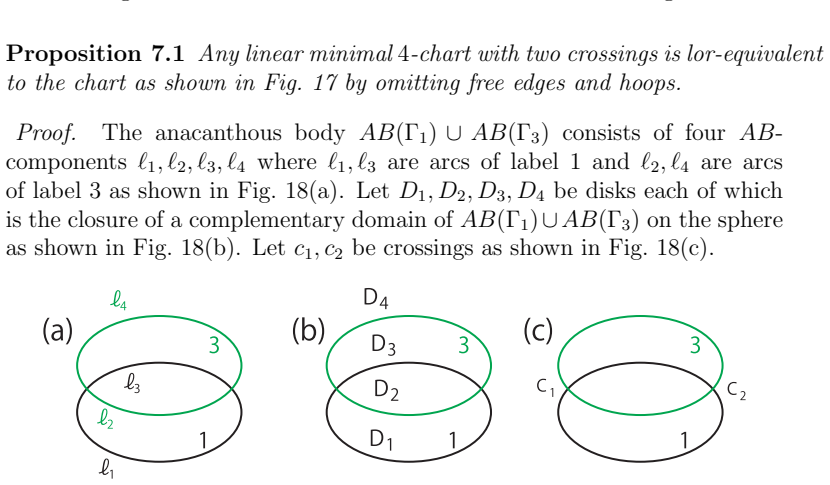
Figure 18. Figure 18: (a) Arcs. (b) Domains. (c) Crossings. Since all of ℓ1, ℓ2, ℓ3, ℓ4 are anacanthous arcs, we can put a direction indi￾18 [PITH_FULL_IMAGE:figures/full_fig_p018_18.png] view at source ↗
Figure 19
Figure 19. Figure 19: (a) The direction indicator for ℓ1. (b) The arc ℓ1 possesses at least two inner vertices. (c) The arc ℓ2 possesses at least two inner vertices. (d) A pinwheel around the crossing c1. (e) The arc ℓ1 possesses one inner vertex. (f) The arc ℓ3 possesses one inner vertex. Thus by Lemma 4.3 and Claim, the side edges of e3 possess the same inner vertex w4 of ℓ4. Therefore, we have the pseudo chart as shown in … view at source ↗
Figure 20
Figure 20. Figure 20: The set AB(Γ1) ∪ AB(Γ3). Let w1, w2 be white vertices on AB(Γ1), and c1, c2, c3 crossings as shown in [PITH_FULL_IMAGE:figures/full_fig_p021_20.png] view at source ↗
Figure 21
Figure 21. Figure 21: (a) Vertices and crossings. (b) Domains. (c) Edges. (d) Arcs. [PITH_FULL_IMAGE:figures/full_fig_p021_21.png] view at source ↗
Figure 22
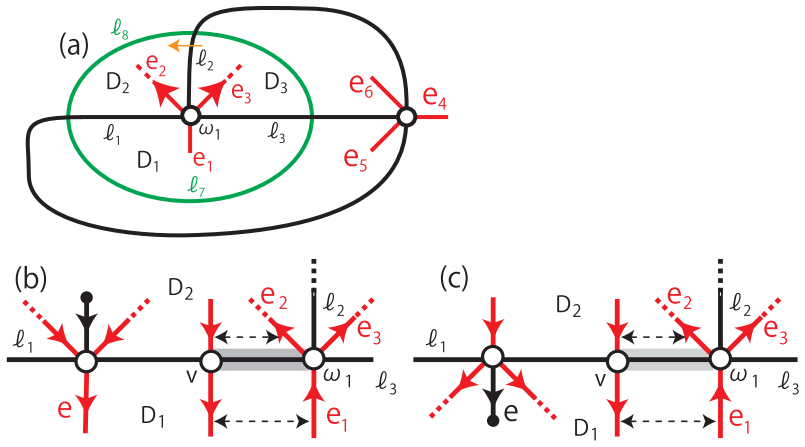
Figure 22. Figure 22: Direction indicators for the arc ℓ2. The following will be shown in the next subsection. Proposition 8.1 The edge e1 is a terminal edge. 8.1 Case that the edge e1 is not a terminal edge. We shall prove Proposition 8.1 by five claims. Suppose the edge e1 is not a terminal edge. Claim 1 The direction indicator for the arc ℓ1 points to D2 from D1, and the direction indicator for the arc ℓ3 points to D3 from … view at source ↗
Figure 23
Figure 23. Figure 23: (a) Neither e2 nor e3 are terminal edges. (b),(c) The double pointed dotted arrows indicate the sites where C-I-M2 moves will be applied. Since the direction indicator for ℓ2 points to D2 from D3, Claim 1 implies that the edge e2 must have a white vertex w3 on the arc ℓ8. Thus, the direction indicator for the arc ℓ8 points to D4 from D2 (see [PITH_FULL_IMAGE:figures/full_fig_p023_23.png] view at source ↗
Figure 24
Figure 24. Figure 24: (a) The five direction indicators for ℓ1, ℓ2, ℓ3, ℓ7, ℓ8. (b) A pinwheel around the crossing c1. (c) The terminal edge τ is an inner edge for D4. (d) The terminal edge τ is an inner edge for D5. the vertex v ′ . But this is impossible because the direction indicator for the edge ℓ7 points to D1 from D5 (see [PITH_FULL_IMAGE:figures/full_fig_p024_24.png] view at source ↗
Figure 25
Figure 25. Figure 25: (a) The arc ℓ4 does not contain any inner vertex. (b) The arc ℓ6 does not contain any inner vertex, and the arc ℓ8 does not contain any inner vertex except w3. (c),(d) The terminal edge τ0 is an inner edge for D22. (e) The terminal edge τ0 is an inner edge for D21. (f) The arc ℓ6 contains an inner vertex. For Case 2. The edge e2 splits the disk D2 into two disks. Let D21 be the one of the two disks which … view at source ↗
Figure 26
Figure 26. Figure 26: The terminal edge τ is an inner edge for D4. Therefore, the terminal edge τ must be an inner edge for the disk D6. Claim 5 The terminal edge τ is outward at the vertex v ∗ 1 . Proof of Claim 5. Suppose that the terminal edge τ is inward at the vertex v ∗ 1 . Then, the direction indicator for ℓ6 points to D4 from D6 by Lemma 6.2. Let ˜e be the edge contained in ℓ6 with two white vertices w2, v∗ 1 . Then th… view at source ↗
Figure 27
Figure 27. Figure 27: The terminal edge τ is an inner edge for D6, and is inward at v ∗ 1 . Proof of Proposition 8.1. Now we shall finish the proof of our proposition. By Claim 4 and Claim 5, the terminal edge τ is an inner edge for D6 and outward at the vertex v ∗ 1 on the arc ℓ6. We start from [PITH_FULL_IMAGE:figures/full_fig_p028_27.png] view at source ↗
Figure 28
Figure 28. Figure 28: The terminal edge τ is an inner edge for D6, and is outward at v ∗ 1 . 28 [PITH_FULL_IMAGE:figures/full_fig_p028_28.png] view at source ↗
Figure 29
Figure 29. Figure 29: The edge e1 is a terminal edge. First of all, applying Proposition 8.1 to w2, one of the edges e4, e5, e6 is a terminal edge. There are three cases. Case A. The edge e4 is a terminal edge. Case B. The edge e5 is a terminal edge. Case C. The edge e6 is a terminal edge. Claim 6 Neither Case A nor Case B occurs. Proof of Claim 6. For Case A. By Fact 3, each of the arcs ℓ4 and ℓ6 does not possess any inner wh… view at source ↗
Figure 30
Figure 30. Figure 30: The edge e4 is a terminal edge [PITH_FULL_IMAGE:figures/full_fig_p030_30.png] view at source ↗
Figure 31
Figure 31. Figure 31: (a) The edge e5 is a terminal edge. (b) The chart obtained by applying Cut Edge Lemma. Thus, the edge ℓ5 is outward at w2, by considering ℓ3 ∪ ℓ5. Since the edge e6 is a terminal edge, we have the following. (c) the edge e4 is inward at w2, the edge e5 is inward at w2, the edge e6 is outward at w2, the arc ℓ4 is inward at w2, and the arc ℓ6 is outward at w2 (see [PITH_FULL_IMAGE:figures/full_fig_p031_31.png] view at source ↗
Figure 32
Figure 32. Figure 32: (a),(b) The edge e6 is a terminal edge. (c) The terminal edge τ1 is an inner edge for D5. (d) The terminal edge τ1 is an inner edge for D4. Claim 7 There exists at most one inner vertex of the arc ℓ7. Proof of Claim 7. If there exist at least two inner vertices of the arc ℓ7, then there exists an inner edge τ for D1 of label 3. The side edge of the terminal edge τ possesses an inner vertex on ℓ1 ∪ ℓ3 diff… view at source ↗
Figure 33
Figure 33. Figure 33: (a) There exists exactly one inner vertex of the arc [PITH_FULL_IMAGE:figures/full_fig_p033_33.png] view at source ↗
Figure 34
Figure 34. Figure 34: (a),(b) τ3 is an inner edge for D4. (c),(d),(e) Charts which are C-move equivalent to the chart as shown (a). (f) τ3 is an inner edge for D2. [4] T. Nagase and A. Hirota, The closure of a surface braid represented by a 4-chart with at most one crossing is a ribbon surface, Osaka J. Math. 43 (2006) 413–430, MR2262343 (2007g:57040). [5] T. Nagase and A. Shima, Properties of minimal charts and their ap￾plica… view at source ↗
read the original abstract

Charts are oriented labeled graphs in a disk. Any simple surface braid (2-dimensional braid) can be described by using a chart. Also, a chart represents an oriented closed surface embedded in 4-space. In this paper, we investigate embedded surfaces in 4-space by using charts. Let $\Gamma$ be a chart, and we denote by $Cross(\Gamma)$ the set of all the crossings of $\Gamma$, and we denote by $\Gamma_m$ the union of all the edges of label $m$. For a 4-chart $\Gamma$, if each connected component of the set $(\Gamma_1\cup \Gamma_3)-Cross(\Gamma)$ is acyclic, then $\Gamma$ is said to be {\it linear}. In this paper, we shall show that any linear minimal $4$-chart with three crossings is lor-equivalent (Label-Orientation-Reflection equivalent) to the chart describing a $2$-twist spun trefoil knot by omitting free edges and hoops.

Editorial analysis

A structured set of objections, weighed in public.

Desk editor's note, referee report, simulated authors' rebuttal, and a circularity audit. Tearing a paper down is the easy half of reading it; the pith above is the substance, this is the friction.

Referee Report

0 major / 3 minor

Summary. The paper defines a 4-chart Γ to be linear if each connected component of (Γ₁ ∪ Γ₃) minus Cross(Γ) is acyclic. It proves that every linear minimal 4-chart with exactly three crossings is lor-equivalent to the chart of the 2-twist spun trefoil (after deleting free edges and hoops).

Significance. The result supplies an explicit classification for the restricted but nontrivial class of linear minimal charts with three crossings. By reducing all such charts to a single known example, the work provides a concrete data point for the broader program of enumerating knotted surfaces via chart presentations. The restriction to linear charts and the small crossing number make exhaustive case analysis feasible, and the explicit equivalence statement is a verifiable output of that analysis.

minor comments (3)
  1. [Introduction / Definition of linear chart] The definition of linearity (each connected component of (Γ₁ ∪ Γ₃) − Cross(Γ) is acyclic) is introduced in the abstract and presumably §1; a short paragraph immediately after the definition illustrating why acyclicity is a natural restriction for minimality would help readers unfamiliar with chart theory.
  2. [Main theorem statement] The statement that the chart is lor-equivalent “by omitting free edges and hoops” appears in the abstract; the precise sequence of lor-moves and the omission step should be referenced to the relevant lemma or proposition in the body.
  3. [Figures] Figure captions for the three-crossing charts could explicitly list the labels and orientations of the edges meeting at each crossing to facilitate verification of the case analysis.

Simulated Author's Rebuttal

0 responses · 0 unresolved

We thank the referee for their positive summary of our work and for recommending minor revision. The referee's description accurately captures the definition of linear 4-charts and the main classification result for those with exactly three crossings.

Circularity Check

0 steps flagged

No significant circularity; direct classification via case analysis

full rationale

The paper defines a linear 4-chart explicitly via acyclicity of components of (Γ₁ ∪ Γ₃) minus crossings and then proves that every linear minimal 4-chart with exactly three crossings is lor-equivalent to the chart of the 2-twist spun trefoil (after omitting free edges and hoops). With only three crossings the candidate graphs form a finite, small set, so the argument is an exhaustive enumeration inside the stated class. No equation or step reduces a claimed prediction to a fitted input by construction, no load-bearing self-citation chain appears, and the central statement is a direct classification rather than a renaming or self-referential definition. The derivation is therefore self-contained against the paper's own definitions and assumptions.

Axiom & Free-Parameter Ledger

0 free parameters · 2 axioms · 0 invented entities

The result rests on standard axioms of 4-dimensional topology and braid theory plus the paper-specific definitions of linear charts and minimality. No free parameters or invented entities are visible in the abstract.

axioms (2)
  • domain assumption Charts are oriented labeled graphs in a disk that represent simple surface braids and oriented closed surfaces in 4-space.
    Invoked in the opening paragraph to set the representational framework.
  • ad hoc to paper A 4-chart is linear when each connected component of (Γ₁ ∪ Γ₃) minus crossings is acyclic.
    This is the central restriction used to define the class under study.

pith-pipeline@v0.9.0 · 5698 in / 1438 out tokens · 39109 ms · 2026-05-18T19:48:44.818576+00:00 · methodology

discussion (0)

Sign in with ORCID, Apple, or X to comment. Anyone can read and Pith papers without signing in.

Reference graph

Works this paper leans on

12 extracted references · 12 canonical work pages · 3 internal anchors

  1. [1]

    J. S. Carter and M. Saito, ”Knotted surfaces and their diagrams”, Math- ematical Surveys and Monographs, vol. 55, American Mathematical So- ciety, Providence, RI, 1998, MR1487374 (98m:57027)

  2. [2]

    Kamada, Surfaces in R4 of braid index three are ribbon , J

    S. Kamada, Surfaces in R4 of braid index three are ribbon , J. Knot Theory Ramif. 1 No. 2 (1992) 137–160, MR1164113 (93h:57039)

  3. [3]

    Kamada, ”Braid and Knot Theory in Dimension Four”, Mathematical Surveys and Monographs, vol

    S. Kamada, ”Braid and Knot Theory in Dimension Four”, Mathematical Surveys and Monographs, vol. 95, American Mathematical Society, 2002, MR1900979 (2003d:57050). 34 Figure 34: (a),(b) τ3 is an inner edge for D4. (c),(d),(e) Charts which are C-move equivalent to the chart as shown (a). (f) τ3 is an inner edge for D2

  4. [4]

    Nagase and A

    T. Nagase and A. Hirota, The closure of a surface braid represented by a 4-chart with at most one crossing is a ribbon surface , Osaka J. Math. 43 (2006) 413–430, MR2262343 (2007g:57040)

  5. [5]

    Nagase and A

    T. Nagase and A. Shima, Properties of minimal charts and their ap- plications I , J. Math. Sci. Univ. Tokyo 14 (2007) 69–97, MR2320385 (2008c:57040)

  6. [6]

    Nagase and A

    T. Nagase and A. Shima, Any chart with at most one crossing is a ribbon chart, Topology Appl.157 (2010), 1703–1720. MR2639836 (2011f:57048)

  7. [7]

    Nagase and A

    T. Nagase and A. Shima, On charts with two crossings I: There exist no NS-tangles in a minimal chart , J. Math. Sci. Univ. Tokyo 17 (2010), 217–241. 35

  8. [8]

    Nagase and A

    T. Nagase and A. Shima, On charts with two crossings II , Osaka J. Math. 49 (2012), 909–929

  9. [9]

    Minimal Charts

    T. Nagase and A. Shima, Minimal charts, Topology Appl. 241 (2018), 291–332, arXiv:1602.02958v2

  10. [10]

    The structure of a minimal $n$-chart with two crossings I: Complementary domains of $\Gamma_1\cup\Gamma_{n-1}$

    T. Nagase and A. Shima, The structure of a minimal n-chart with two crossings I: Complementary domains of Γ1 ∪ Γn−1, J. Knot The- ory Ramif. 27(14) (2018) 1850078, 37 pages, arXiv:1704.01232v3

  11. [11]

    The structure of a minimal $n$-chart with two crossings II: Neighbourhoods of $\Gamma_1\cup\Gamma_{n-1}$

    T. Nagase and A. Shima, The structure of a minimal n-chart with two crossings II: Neighbourhoods of Γ1 ∪ Γn−1, Revista de la Real Academia de Ciencias Exactas, Fiskcas y Natrales. Serie A. Mathem´ aticas 113 (2019) 1693–1738, arXiv:1709.08827v2, MR3956213

  12. [12]

    Tanaka, A Note on CI-moves , Intelligence of low dimensional topol- ogy 2006, Ser

    K. Tanaka, A Note on CI-moves , Intelligence of low dimensional topol- ogy 2006, Ser. Knots Everything, vol. 40, World Sci. Publ., Hackensack, NJ, 2007, pp.307–314, MR2371740 (2009a:57017). Teruo NAGASE Tokai University 4-1-1 Kitakaname, Hiratuka Kanagawa, 259-1292 Japan nagase@keyaki.cc.u-tokai.ac.jp Akiko SHIMA Department of Mathematics, Tokai Universit...