REVIEW 3 major objections 5 minor 15 references
Cluster tori over $\mathbb{F}_2$, hexagonal moves on triangulations, and minimal coverings of cluster manifolds
T0 review · 3 major / 5 minor · reviewed 2026-08-15 · deepseek-v4-flash
Pith's one-line read For type-A cluster algebras over $\mathbb{F}_2$, two seeds determine the same point of the cluster manifold if and only if their triangulations are related by hexagonal moves.
desk verdict A useful new result on F2 fibers and minimal coverings in type A, but the core of Theorem 3.6 is not yet a proof: the key reduction is delegated to Figure 6. read the letter →
The pith
A machine-rendered reading of the paper's core claim, the machinery that carries it, and where it could break.
The reading
What carries the argument
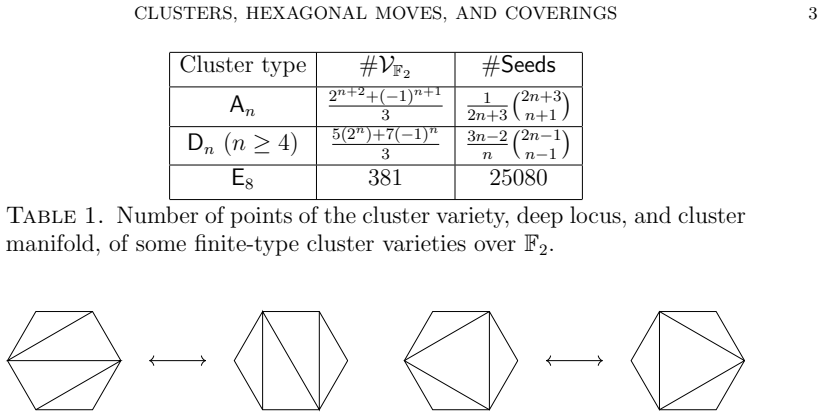
The load-bearing object is the map $c$ that sends a triangulation of a polygon to the unique proper coloring of its vertices by the three elements of $\mathbb{F}_2\mathbb{P}^1=\{0,1,\infty\}$; because a cluster torus consists exactly of the colorings for which every diagonal of the triangulation joins distinct colors, fibers of the seed-to-point map are governed by which triangulations share a coloring. The hexagonal moves are the two local moves preserving $c$: the zig-zag move and the inscribed-triangle move. They appear as certain edges of the universal polytope of triangulations, alongside the usual quadrilateral flips. The supporting machinery includes the invalid-diagonal criterion from [6, Proposition 5.1] that decides when a point of the geometric model $X_{\mathbb{F}}(m)$ lies in a cluster torus, and Algorithm A/B that canonically selects a triangulation for every point of the cluster manifold, giving the universal minimal covering.
What would settle it
Enumerate all triangulations of a 9-gon or 10-gon, compute their unique $\mathbb{F}_2$-colorings, and search whether every pair of triangulations with the same coloring lies in the same component of the graph whose edges are the two hexagonal moves; a same-color pair not connected by such moves would disprove Theorem 3.6. The same finite search on the 12-gon can settle the 'proved similarly' claims used in the A11 covering counterexample.
Extended reading notes
Core claim
The discovery is a complete description of the fibers of the map $\mathrm{Seeds}(\mathcal{A})\to \mathcal{M}_{\mathbb{F}_2}(\mathcal{A})$ in cluster type A. Over $\mathbb{F}_2$, the projective line has three elements, so each triangulation of the $(n+2)$-gon admits a unique proper coloring by the colors $0,1,\infty$ with the base vertices fixed; this is the coloring map $c$. Theorem 1.2 (Theorem 3.6 in the paper) states that $c(T_1)=c(T_2)$ if and only if $T_2$ is obtained from $T_1$ by a sequence of hexagonal moves, where a hexagonal move is either a zig-zag move (replacing one zig-zag triangulation of a hexagon joining antipodal vertices by the other) or an inscribed-triangle move. A second pair of results governs coverings: Algorithm A produces a set of triangulations, depending only on the polygon, whose cluster tori form a minimal covering of the cluster manifold over every field, and an explicit point in type A11 shows that some $\mathbb{F}_2$-minimal coverings are not coverings over any field $\mathbb{F}\not\cong\mathbb{F}_2$. Along the way the paper proves a recursive point count for acyclic cluster varieties over $\mathbb{F}_2$ by deleting a sink.
Load-bearing premise
The argument depends on an unproved reduction in Case 2.1.2 of the main induction, where a crossing pair of diagonals is assumed to leave only one vertex on one side and is verified only by a figure; if this reduction is not valid, the theorem that same-color triangulations are hexagonally connected does not go through.
Editorial extensions
If this is right
- In type A, the $\mathbb{F}_2$-points of the cluster manifold are exactly the possible proper 3-colorings of the polygon vertices, and the fiber over a point is the connected component of the triangulation graph under the two hexagonal moves.
- There exists a minimal covering of every type-A cluster manifold by as many tori as there are $\mathbb{F}_2$-points, and the same explicit set of triangulations covers the manifold over every field.
- Covering sets are field-sensitive: in type A11 there is a set of seeds whose tori cover the cluster manifold over $\mathbb{F}_2$ but not over any other field, so a minimal covering computed over one field cannot be transferred blindly to another.
- The sink-deletion recurrence gives exact numbers of $\mathbb{F}_2$-points for all finite-type acyclic cluster varieties, and these numbers are strictly smaller than the number of seeds in all but the smallest type-A cases.
- The geometric model identifies the type-A cluster manifold over any field with $X_{\mathbb{F}}(m)$ minus a single alternating point, so the deep locus is empty exactly when the polygon has an odd number of sides.
Reading between the lines
- The paper leaves open whether A11 is special; a natural extension is to check the same construction for all $A_n$ with $n\ge 11$ and to search for analogous field-sensitive coverings in types D and E, where polygon triangulations are replaced by more general combinatorial models.
- The hexagonal moves are edges of the universal polytope of triangulations, and the paper notes it would be interesting to find cluster meanings for other edges; one testable path is to look for additional local moves that preserve the $\mathbb{F}_2$-coloring on larger carrier polygons.
- Algorithm A is a deterministic rule choosing one triangulation per point of the cluster manifold; reading it as a normal form would give an explicit finite list of seeds for the universal minimal covering, which could be precomputed and used to test coverings computationally.
- Because over $\mathbb{F}_2$ every triangulation has exactly one coloring, the quotient of the triangulation graph by hexagonal moves is a finite set of size equal to the point count; enumerating these orbits combinatorially would give an independent proof of the point-count formula without the recurrence.
Signed reviews
Editorial analysis
A structured set of objections, weighed in public.
Referee Report
Summary. The paper studies the map from seeds of a cluster algebra over F_2 to F_2-points of the associated cluster variety. For type A, using the polygon model, it identifies the fibers of this map with equivalence classes of triangulations under two local 'hexagonal moves' (Theorem 1.2/3.6). It then addresses minimal coverings of cluster manifolds: Theorem 1.3(a) (Proposition 4.1) gives a minimal covering set that works over every field, while Theorem 1.3(b) (Section 4.3) exhibits, in type A_11, an F_2-covering that is not a covering over any other field. The paper also contains a general point-count recursion for acyclic cluster varieties over F_2 (Lemma 2.4). The exposition is largely self-contained, with the main external input being a characterization of the union of cluster tori from [6, Proposition 5.1].
Significance. If the results are correct, Theorem 1.2 gives a clean combinatorial description of the fibers of the F_2 seed-to-point map in type A and connects these fibers to edges of the universal polytope of triangulations. Theorem 1.3 is notable because it shows that the property of being a minimal covering can depend on the field, while nevertheless a universal minimal covering exists. The paper is honest and explicit: Lemma 2.4 has a detailed point-count proof, Proposition 4.1 gives a concrete algorithm, and the A_11 counterexample is a specific, checkable configuration. There are no fitted parameters or numerical predictions, and the main external dependency [6, Proposition 5.1] is used as a tool rather than as an input equivalent to the target results. The main weaknesses are local gaps in the proof of the converse direction of Theorem 3.6 and compressed case analyses in Section 4.3.
major comments (3)
- [Theorem 3.6, Case 2.1.2 (pp. 10-11)] The reduction 'We can assume that both ij and kl leave only one vertex on one of the triangulations in which they divide the polygon. We verify this on Figure 6' is load-bearing for the converse direction but is not proved. The caption of Figure 6 does not analyze the subcase in which the polygon delimited by i,j,l',k has exactly two or three colors, and it does not establish that the replacement kl' preserves the required properties: kl' not shared with T, kl' invalid for T1, and kl' valid for the full triangulation. The symmetric reduction for ij is also asserted rather than proved. This step must be written out before the characterization of fibers is fully established.
- [Theorem 3.6, Case 2.2 (pp. 11-12)] The assertion that the diagonal ab is valid for the subpolygon P'' is verified only by a reference to Figure 9 and the sentence 'This follows by noting that bs is a valid diagonal T',' which does not account for the possible relative positions of a,b,r,s and the boundary of P''. Since this validity is what allows the induction hypothesis to be applied, a formal argument or a complete case check is needed.
- [Section 4.3, Claims 3-6] Claims 3-6 are each justified as 'proved similarly' to Claims 1 and 2. These claims are essential: they force the values z3, z5, z7, z9, and z10 and lead to the final contradiction with the thick diagonal. Given the case-by-case nature of Claims 1 and 2, the reader cannot verify these without a written argument or a uniform lemma covering all six claims.
minor comments (5)
- [Introduction, Theorem 1.3] The phrase 'covering ets' appears to be a typo for 'covering sets'; please correct it.
- [Remark 3.8] The sentence 'Note, however, that edges this polytope also include...' is missing a word; it should read 'edges of this polytope'.
- [Lemma 2.4, proof] In the case φ(x_i)=0, the conclusion that every neighbor x_k satisfies φ(x_k)=1 follows because a product of F_2-elements equals 1 only if each factor is 1; adding this one-line explanation would improve clarity.
- [Proposition 4.1, proof of (4.1)] The argument that (4.1) implies #image(Υ) ≤ #image(c∘Υ) is compressed; it would be helpful to state explicitly that image(Υ) is contained in the image of Υ restricted to the image of c∘Υ.
- [Theorem 4.2, proof] The set C = Υ(X_F(m)) is claimed not to depend on the field F, but this is implicit. Since Algorithm A only uses the predicates '= 0' and '= ∞', the field-independence should be stated explicitly.
Circularity Check
No significant circularity: the central theorems are proved by induction and explicit algorithms, and the only shared-author citation ([6, Prop. 5.1]) is a parameter-free external input rather than an equivalent of the target results.
full rationale
The paper contains no fitted parameters, no numerical predictions, and no derivation step that reduces to its own inputs by definition. The central statement (Theorem 1.2 / Theorem 3.6) is proved directly by induction on the polygon size, with the base case computed explicitly in Figure 3. The converse direction uses Lemma 3.3, whose existence claim for triangulations is imported from [6, Proposition 5.1]. This is a theorem of Castronovo, Gorsky, Simental and Speyer, so it is a self-citation in the narrow sense because one of the present authors is also an author of [6]. However, it is a parameter-free external characterization of the union of cluster tori, it does not state the hexagonal-move equivalence or the covering results, and it is not obtained by fitting anything in the present paper. Under the review rules, such a citation is real independent evidence and does not make the argument circular. The unexpanded Figure 6 reduction in Case 2.1.2 and the steps marked 'proved similarly' in Section 4.3 are potential correctness/completeness gaps, but a proof gap is not a circular dependency: those steps do not use the theorem they are trying to prove as an assumption. Section 4 is equally self-contained: the covering sets are constructed by explicit Algorithms A and B, and the identity Υ = Υ ∘ c ∘ Υ is proved directly. The counterexample in Section 4.3 is verified by explicit case analysis on the possible F2-point z. I therefore find no circular step and assign score 1 solely to acknowledge the minor shared-author citation, which is not load-bearing as a circularity.
Assumptions & free parameters
assumptions (6)
- standard math The Laurent phenomenon: every cluster variable is a Laurent polynomial in the variables of any seed.
- domain assumption For a locally acyclic cluster algebra, A_F(Q) equals F tensor Z A(Q), the cluster algebra over F.
- domain assumption The union of all cluster tori in X_F(m) equals X_F(m) minus the point (0, infinity, 0, infinity, ...).
- domain assumption Every really full rank type Am cluster variety is, up to products with tori, the variety X_F(m) with one frozen variable.
- standard math Type A seeds are in bijection with triangulations of a polygon, with the standard cluster structure on X_F(m).
- ad hoc to paper Isolated mutable vertices are excluded; isolated vertices are frozen.
Cite this review
Pith. "Pith review of Cluster tori over $\mathbb{F}_2$, hexagonal moves on triangulations, and minimal coverings of cluster manifolds." pith.science (2026). https://pith.science/paper/IHUUXZRQ
@misc{pith2026250904614,
  author       = {Pith},
  title        = {Pith review of: Cluster tori over $\mathbbF_2$, hexagonal moves on triangulations, and minimal coverings of cluster manifolds},
  year         = {2026},
  howpublished = {\url{https://pith.science/paper/IHUUXZRQ}},
  note         = {Machine review of arXiv:2509.04614}
}
abstract
We study cluster algebras over $\mathbb{F}_2$. By the Laurent phenomenon there is a map from the set of seeds of the cluster algebra to the corresponding cluster variety. We show that in type $A$, fibers of this map can be described in terms of certain edges of the universal polytope of triangulations of a polygon. Moreover, we show that there is a section of this map giving seeds whose corresponding cluster tori cover the cluster manifold over any field $\mathbb{F}$, but there are also sections giving seeds whose cluster tori do not cover the cluster manifold over any field $\mathbb{F} \not\cong \mathbb{F}_2$.
Figures


Figures from the paper (13 more)


Reference graph
Works this paper leans on
-
[1]
Ang´ elica Benito, Greg Muller, Jenna Rajchgot, and Karen E. Smith. Singularities of locally acyclic cluster algebras. Algebra Number Theory, 9(4):913–936, 2015
work page 2015
-
[2]
Arkady Berenstein, Sergey Fomin, and Andrei Zelevinsky. Cluster algebras. III: Upper bounds and double Bruhat cells. Duke Math. J. , 126(1):1–52, 2005
work page 2005
-
[3]
Deep points of cluster algebras
James Beyer and Greg Muller. Deep points of cluster algebras. Int. Math. Res. Not. IMRN , (4):Paper No. rnaf027, 39, 2025
work page 2025
-
[4]
Billera, Paul Filliman, and Bernd Sturmfels
Louis J. Billera, Paul Filliman, and Bernd Sturmfels. Constructions and complexity of secondary polytopes. Adv. Math., 83(2):155–179, 1990
work page 1990
-
[5]
Cluster structures on braid varieties
Roger Casals, Eugene Gorsky, Mikhail Gorsky, Ian Le, Linhui Shen, and Jos´ e Simental. Cluster structures on braid varieties. J. Amer. Math. Soc. , 38(2):369–479, 2025
work page 2025
-
[6]
Cluster deep loci and mirror symmetry
Marco Castronovo, Mikhail Gorsky, Jos´ e Simental, and David E Speyer. Cluster deep loci and mirror symmetry. Preprint, arXiv:2402.16970 [math.AG] (2024), 2024
arXiv 2024
-
[7]
De Loera, Serkan Hosten, Francisco Santos, and Bernd Sturmfels
Jes´ us A. De Loera, Serkan Hosten, Francisco Santos, and Bernd Sturmfels. The polytope of all triangulations of a point configuration. Doc. Math., 1:113–119, 1996
work page 1996
-
[8]
De Loera, J¨ org Rambau, and Francisco Santos.Triangulations
Jes´ us A. De Loera, J¨ org Rambau, and Francisco Santos.Triangulations. Structures for algorithms and applications, volume 25 of Algorithms Comput. Math. Berlin: Springer, 2010
work page 2010
Show all 15 references
-
[9]
Introduction to Cluster Algebras
Sergey Fomin, Lauren Williams, and Andrei Zelevinsky. Introduction to Cluster Algebras. Chap- ters 1-3, 2024. CLUSTERS, HEXAGONAL MOVES, AND COVERINGS 21
2024
-
[10]
The Laurent phenomenon
Sergey Fomin and Andrei Zelevinsky. The Laurent phenomenon. Adv. in Appl. Math. , 28(2):119– 144, 2002
2002
-
[11]
Braid variety cluster structures, II: general type
Pavel Galashin, Thomas Lam, and Melissa Sherman-Bennett. Braid variety cluster structures, II: general type. Preprint, arXiv:2301.07268 [math.AG] (2023), 2023
2023
-
[12]
Braid variety cluster structures, I: 3d plabic graphs
Pavel Galashin, Thomas Lam, Melissa Sherman-Bennett, and David Speyer. Braid variety cluster structures, I: 3d plabic graphs. Preprint, arXiv:2210.04778 [math.CO] (2022), 2022
2022 arXiv
-
[13]
Thomas Lam and David E. Speyer. Cohomology of cluster varieties. I: Locally acyclic case.Algebra Number Theory, 16(1):179–230, 2022
2022
-
[14]
Thomas Lam and David E. Speyer. Cohomology of cluster varieties. II: Acyclic case. J. Lond. Math. Soc., II. Ser. , 108(6):2377–2414, 2023
2023
-
[15]
Locally acyclic cluster algebras
Greg Muller. Locally acyclic cluster algebras. Adv. Math., 233(1):207–247, 2013. Facultad de Ciencias, Universidad Nacional Aut´onoma de M´exico. Ciudad Universi- taria, CDMX, M´exico Email address : perezmelesiod@ciencias.unam.mx Instituto de Matem´aticas, Universidad Naciona...
2013
Reviewed August 15, 2026 · model on record in the stance chip above.
Discussion (0). Continue with ORCID to comment.