REVIEW 3 major objections 5 minor 2 cited by
Non-residually finite $\tilde{C}_2$-lattices
T0 review · 3 major / 5 minor · reviewed 2026-08-05 · deepseek-v4-flash
Pith's one-line read Five finite triangle complexes with exotic ~C2 universal covers produce the first known non-residually finite uniform lattices on irreducible Euclidean buildings.
desk verdict First non-residually finite lattices on irreducible buildings, with a clean inheritance argument from BMW lattices—but the current proof has a load-bearing local-convexity gap and some unshipped computer verifications. read the letter →
The pith
A machine-rendered reading of the paper's core claim, the machinery that carries it, and where it could break.
The reading
What carries the argument
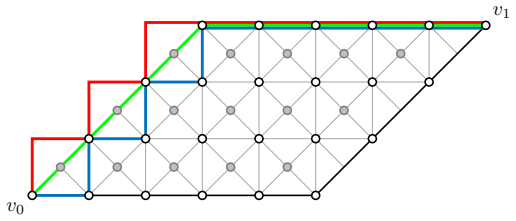
The load-bearing mechanism is the geometric presentation of Lemma 4.2: for a ~C2 GAB (a chamber complex whose vertex links are generalized polygons) with an involution swapping its two special vertex types, the extension acting regularly on special vertices is presented by the long edges between the two special types, with relations coming from the involution and from filling every (A1 × A1)-boundary, a four-cycle around a non-special vertex. Filling those four-cycles produces a simply connected complex, so the lattice's Cayley graph embeds as the long-edge subgraph of the building. Normal forms—unique reduced paths along the convex hull of two special vertices—make the word problem computab
What would settle it
Independently run those three checks: decide whether the relevant finite presentation presents the trivial group (in the q=2 case, whether adding (g1 g6^-1)^4 to the presentation of the extended group yields the cyclic group of order 2); recompute automorphism groups of radius-4 balls in each Cayley complex; and compare the quotients of the q=3 buildings by their finite residuals. A different outcome in any one of these would falsify part of Theorem A.
Extended reading notes
Core claim
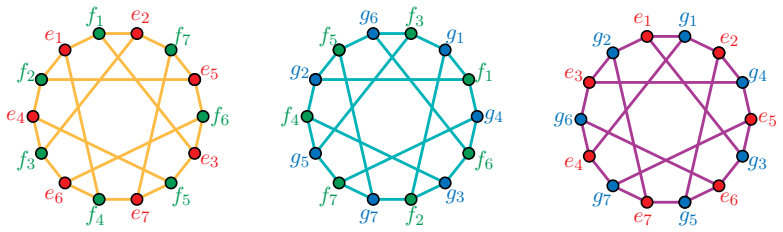
Theorem A asserts that there are five finite triangle complexes Y_1^2, Y_1^3, Y_2^3, Y_3^3, Y_4^3 whose universal covers X_i^q are exotic buildings of type ~C2 and whose fundamental groups Γ_i^q are not residually finite; the buildings are pairwise non-isomorphic and the groups pairwise not quasi-isometric. The non-residual finiteness is inherited from BMW groups—groups acting freely and transitively on the vertices of a product of two regular trees—that embed into the new buildings as subcomplexes. For q=2, Γ_1^2 equals its own finite residual; for q=3, the finite residual has index 4 in Γ_1^3 and Γ_2^3 and index 8 in Γ_3^3 and Γ_4^3. Each finite residual has no proper finite-index subgroup
Load-bearing premise
The three machine computations the authors explicitly did not check by hand are load-bearing: if any of them is wrong, the claimed finite-residual indices, automorphism groups, or non-isomorphism of buildings fail.
Editorial extensions
If this is right
- The existence question is settled: uniform lattices on irreducible Euclidean buildings need not be residually finite.
- The five lattices represent five distinct quasi-isometry classes, so non-residual finiteness coexists with quasi-isometric rigidity of buildings.
- Each finite residual ˇΓ_i^q has no proper finite-index subgroups; under the expected normal subgroup property they are abstractly simple.
- Each building X_i^q has discrete full automorphism group, so these are genuinely exotic buildings rather than disguised arithmetic ones.
- The q=2 lattice has explicit quantitative property (T)—Kazhdan radius at most 2 and Kazhdan constant at least 0.4147—and the q=3 lattices have property (T) by the cited result [Opp].
Reading between the lines
- The same Radu-graph search could plausibly be run from other non-residually finite BMW groups to produce infinite families of non-residually finite ~C2-lattices, not just the five examples listed.
- If the normal subgroup property holds, the finite residuals would become finitely presented infinite simple groups acting cocompactly on irreducible Euclidean buildings, a combination not previously realized.
- The three computer checks the paper leaves to the machine—triviality of one finite presentation, rigidity of reconstructed balls, and pairwise comparison of the q=3 quotients—are the natural places to seek independent confirmation or a formal proof.
Editorial analysis
A structured set of objections, weighed in public.
Referee Report
Summary. The paper constructs five finite triangle complexes Y^2_1, Y^3_1, ..., Y^3_4 and claims that their universal covers X^q_i are exotic Euclidean buildings of type \tilde{C}_2 and that the fundamental groups \Gamma^q_i are the first known non-residually finite uniform lattices on irreducible two-dimensional Euclidean buildings. The proof embeds subdivisions of known non-residually finite Burger–Mozes–Wise square complexes—Radu's complex S_R for q=2 and Janzen–Wise's complex S_JW for q=3—into the new complexes, then uses CAT(0) local convexity (Lemma 2.2) to transfer non-residual finiteness. The paper also computes finite-residual indices, identifies full automorphism groups, proves pairwise non-isomorphism and non-quasi-isometry of the five examples, and establishes property (T) for the q=2 lattice. Several central verification steps are explicitly acknowledged as computer-dependent.
Significance. If the construction and verifications are correct, this is a major advance: it would supply the first non-residually finite uniform lattices on irreducible Euclidean buildings, a question explicitly open in the literature, and the finite residuals \check{\Gamma}^q_i would have no proper finite-index subgroups and would be simple under the expected normal subgroup property. The paper also contributes an explicit combinatorial search method for non-positively curved chamber complexes, a normal-form algorithm for the resulting lattices, and very explicit data for the complexes and presentations. A notable strength is the paper's transparency: the introduction lists exactly which parts are not hand-verifiable. However, that same transparency exposes three load-bearing computational steps for which no code, data, or certificates are supplied, and the proof of the central embedding contains an unproved local-convexity assertion.
major comments (3)
- [§4.1, proof of Theorem 4.1; cf. §4.4] The proof states: 'Since \dot{S}_R is non-positively curved (thus locally convex in Y^2_1) its universal cover embeds into X^2_1 and its fundamental group embeds into Γ^2_1 by Lemma 2.2.' This implication is not valid in general: a non-positively curved subcomplex of a non-positively curved polygonal complex need not be locally convex, and Lemma 2.2 explicitly requires local convexity of the subcomplex. The same unproved local-convexity step is used for the S_JW subdivisions in the q=3 cases (§4.4). The authors need to verify—or provide an explicit link-checking argument—that the subdivision of S_R is locally convex in Y^2_1 and that each S_JW subdivision is locally convex in its Y^3_k. Without this, Lemma 2.2 cannot be invoked, and the embedding of the non-residually finite BMW groups into the Γ^q_i is not established.
- [§4.1, §4.4, and Introduction, p. 2] The paper's finite-residual claims are load-bearing for Theorem A: for q=2, 'Γ^2_1 is the finite residual' is reduced to checking that adding the relation (g_1 g_6^{-1})^4 to the presentation of Proposition 4.3 gives the cyclic group of order 2, and the authors state this has not been carried out by hand; for q=3, the indices [Γ^3_k : \check{Γ}^3_k] = 4 or 8 depend on a computer verification that the normal closure of explicit loops is of finite index. No code, machine-readable certificate, or independent proof is provided. Since these computations determine the claim that the \check{Γ}^q_i have no proper finite-index subgroups, they need to be made reproducible (code and data) or replaced by hand-checkable derivations.
- [§4.3, §4.4, and Appendix A] The identification of Aut(X^q_i) rests on computer reconstruction of balls in the Cayley complex and on a rigidity assertion: for X^2_1 this is the claim that the automorphism group of a radius-4 ball pointwise fixes the radius-2 ball (§4.3), and for X^3_k it relies on a computer check satisfying Lemma A.1. Pairwise non-isomorphism of the q=3 buildings is similarly reduced to a computer comparison of the finite quotients \check{Γ}^3_k \backslash X^3_k. These are exactly exceptions 2 and 3 listed in the introduction, and they support the 'exotic' assertion, the pairwise non-isomorphism claim, and the non-quasi-isometry claim via Corollary 4.14. Without code or a written derivation, these central conclusions cannot be independently checked.
minor comments (5)
- [Theorem 4.1] The statement says 'Its fundamental group Γ^2_1 = π_1(X^2_1)', but Γ^2_1 is the fundamental group of the quotient complex: it should read π_1(Y^2_1).
- [§4.5] Typo: 'Mouffang boundary' should be 'Moufang boundary'.
- [§B.1] The definition of γ reads 'let γ be such that γ^2 − α + 12'; an '= 0' is missing from this equation.
- [Appendix A] The sentence 'the automorphism group of the complexes Y^3_k is always 8' would be clearer as 'has order 8'.
- [§4.6] The semidefinite programming verification of property (T) for ¯Γ^2_1 is interesting but is not reproducible from the text: no optimizer output, Gram matrix, or code is included. Since property (T) is also attributed to the cited preprint [Opp], this is not a blocking issue for the main theorem, but the data should be made available if the quantitative claim is to be checked.
Circularity Check
No significant circularity: the central derivation is self-contained and independent of the paper's own conclusions.
full rationale
The main claim of non-residual finiteness is obtained by embedding known non-residually finite BMW lattices (from Radu and Janzen–Wise/Caprace) into the newly constructed irreducible C2~-buildings. The embedding is asserted via Lemma 2.2 and the claim that the subdivided product-of-trees subcomplex is locally convex; whether that geometric assertion is true is a correctness question, not a circular one, since it is not derived from the target conclusion and no equation or definition identifies the premise with the conclusion. The building property is checked against the standard Tits local-to-global theorem using explicitly listed vertex links. The finite-residual computations and automorphism-group computations are independent verifications and are explicitly flagged as computer-assisted. The only self-citation in the paper, [Wit17], appears in a historical list of known non-arithmetic lattices and is not load-bearing for any proof. The appendix's faithfulness proof for Γ_R relies on an external 2-adic representation argument and is again independent. No step fits the enumerated circularity patterns: no parameter is fitted and then renamed a prediction, no uniqueness theorem by the present authors is invoked, and no known result is repackaged as a new derivation. The acknowledged computer checks are not circular; they are reproducibility limitations.
Assumptions & free parameters
free parameters (3)
- epsilon (SDP parameter, Ozawa method) =
1.29
- omega (numerical error margin) =
0.0001
- greedy search parameters (score estimate, restart step count) =
not specified
assumptions (6)
- standard math Tits local-to-global theorem: a thick chamber complex with generalized polygon links has a building universal cover (Theorem 2.3, [Tit81], [CL01]).
- standard math Cartan-Hadamard theorem and pi1-injectivity of locally convex subcomplexes (Theorem 2.1, Lemma 2.2, [BH99]).
- domain assumption Radu's results: Γ_R is an irreducible BMW group, is not residually finite, and one of two specified commutators lies in its finite residual (Proposition 3.4, [Rad20, Prop. 5.4]).
- domain assumption Janzen-Wise and Caprace: Γ_JW is irreducible, not residually finite, and contains explicit finite-residual elements (Proposition 3.8, [JW09], [Cap19, Remark 4.20]).
- ad hoc to paper Three computer verifications: finite residual index computation (equivalently, a stated presentation of the trivial group), ball-reconstruction identification of Aut(Xq_i), and non-isomorphism of the quotients of Xq_i by ˇΓq_i.
- domain assumption Kramer-Weiss quasi-isometric rigidity of thick irreducible Euclidean buildings (Theorem 4.13, [KW14]) and Oppenheim's property (T) for lattices on irreducible affine buildings ([Opp]).
Cite this review
Pith. "Pith review of Non-residually finite $\tilde{C}_2$-lattices." pith.science (2026). https://pith.science/paper/CENV7LSO
@misc{pith2026250905054,
  author       = {Pith},
  title        = {Pith review of: Non-residually finite $\tildeC_2$-lattices},
  year         = {2026},
  howpublished = {\url{https://pith.science/paper/CENV7LSO}},
  note         = {Machine review of arXiv:2509.05054}
}
read the original abstract
We provide the first examples of lattices on irreducible buildings that are not residually finite. Assuming that the normal subgroup property holds for them (which is expected) five of the lattices are simple.
Figures


Figures from the paper (5 more)


Forward citations
Cited by 2 Pith papers
-
A Product-Neighbourhood Criterion for Fixed Price One
A sparse product-neighbourhood condition implies fixed price one for discrete and locally compact groups, yielding new cases such as products of lcsc groups and lattices in exotic buildings.
-
Boundary dynamics, triple transitivity, and mixed identities in weakly hyperbolic groups
Lim-free dynamical criterion for faithful boundary actions on hyperbolic spaces is equivalent to the algebraic property of being mixed identity free, with transitivity degree bounded by 3 for non-lim-free groups.
Reference graph
Works this paper leans on
-
[1]
Brown, Buildings, Graduate Texts in Mathematics, vol
Peter Abramenko and Kenneth S. Brown, Buildings, Graduate Texts in Mathematics, vol. 248, Springer, New York, 2008, Theory and applications
work page 2008
- [2]
-
[3]
Sylvain Barr\'e, Immeubles de T its triangulaires exotiques , Ann. Fac. Sci. Toulouse Math. (6) 9 (2000), no. 4, 575--603
work page 2000
-
[4]
Uri Bader, Pierre-Emmanuel Caprace, and Jean L\' e cureux, On the linearity of lattices in affine buildings and ergodicity of the singular C artan flow , J. Amer. Math. Soc. 32 (2019), no. 2, 491--562
2019
-
[5]
Bachir Bekka, Pierre de la Harpe, and Alain Valette, Kazhdan’s property (t), New Mathematical Monographs, Cambridge University Press, 2008
work page 2008
-
[6]
Uri Bader, Alex Furman, and Jean Lécureux, Normal subgroup theorem for groups acting on a_2 -buildings, 2023
work page 2023
-
[7]
Bridson and Andr\' e Haefliger, Metric spaces of non-positive curvature, Grundlehren der mathematischen Wissenschaften [Fundamental Principles of Mathematical Sciences], vol
Martin R. Bridson and Andr\' e Haefliger, Metric spaces of non-positive curvature, Grundlehren der mathematischen Wissenschaften [Fundamental Principles of Mathematical Sciences], vol. 319, Springer-Verlag, Berlin, 1999
1999
-
[8]
Marc Burger and Shahar Mozes, Lattices in product of trees, Inst. Hautes \'Etudes Sci. Publ. Math. (2000), no. 92, 151--194
work page 2000
Show all 35 references
-
[9]
Brown, Presentations for groups acting on simply-connected complexes, Journal of Pure and Applied Algebra 32 (1984), no
Kenneth S. Brown, Presentations for groups acting on simply-connected complexes, Journal of Pure and Applied Algebra 32 (1984), no. 1, 1--10
1984
-
[10]
16–69, Cambridge University Press, 2019
Pierre-Emmanuel Caprace, Finite and infinite quotients of discrete and indiscrete groups, London Mathematical Society Lecture Note Series, p. 16–69, Cambridge University Press, 2019
2019
-
[11]
Ruth Charney and Alexander Lytchak, Metric characterizations of spherical and E uclidean buildings , Geom. Topol. 5 (2001), 521--550
2001
-
[12]
Cartwright, Anna Maria Mantero, Tim Steger, and Anna Zappa, Groups acting simply transitively on the vertices of a building of type A_2
Donald I. Cartwright, Anna Maria Mantero, Tim Steger, and Anna Zappa, Groups acting simply transitively on the vertices of a building of type A_2 . I , Geom. Dedicata 47 (1993), no. 2, 143--166
1993
-
[13]
Steven Diamond and Stephen Boyd, CVXPY : A P ython-embedded modeling language for convex optimization , Journal of Machine Learning Research (2016), To appear
2016
-
[14]
3, 1531 -- 1578
Jan Essert, A geometric construction of panel regular lattices for buildings of types tildea2 and tildec2, Algebraic and Geometric Topology 13 (2013), no. 3, 1531 -- 1578
2013
-
[15]
Allen Hatcher, Algebraic topology, Cambridge University Press, Cambridge, 2002
2002
-
[16]
Wise, A smallest irreducible lattice in the product of trees, Algebraic and Geometric Topology, Algebr
David Janzen and Daniel T. Wise, A smallest irreducible lattice in the product of trees, Algebraic and Geometric Topology, Algebr. Geom. Topol. 9(4) (2009)
2009
-
[17]
Kantor, Generalized polygons, SCAB s and GAB s , Buildings and the geometry of diagrams ( C omo, 1984), Lecture Notes in Math., vol
William M. Kantor, Generalized polygons, SCAB s and GAB s , Buildings and the geometry of diagrams ( C omo, 1984), Lecture Notes in Math., vol. 1181, Springer, Berlin, 1986, pp. 79--158
1984
-
[18]
Nowak, On property (t) for Aut (f_n) and SL _n( Z ) , 2021
Marek Kaluba, Dawid Kielak, and Piotr W. Nowak, On property (t) for Aut (f_n) and SL _n( Z ) , 2021
2021
-
[19]
Hautes \'Etudes Sci
Bruce Kleiner and Bernhard Leeb, Rigidity of quasi-isometries for symmetric spaces and E uclidean buildings , Inst. Hautes \'Etudes Sci. Publ. Math. (1997), no. 86, 115--197
1997
-
[20]
Weiss, Coarse equivalences of E uclidean buildings , Adv
Linus Kramer and Richard M. Weiss, Coarse equivalences of E uclidean buildings , Adv. Math. 253 (2014), 1--49, With an appendix by Jeroen Schillewaert and Koen Struyve
2014
-
[21]
Alex Loué, Infinite families of triangle presentations, 2024
2024
-
[22]
Tim Netzer and Andreas Thom, Experimental Mathematics (2015)
2015
-
[23]
Damian Osajda and Piotr Przytycki, Coxeter groups are biautomatic, 2022
2022
-
[24]
Izhar Oppenheim, Property (t) for groups acting on affine buildings, arXiv:2410.05716v1
-
[25]
Izhar Oppenheim, Property ( T ) for groups acting on simplicial complexes through taking an ``average'' of L aplacian eigenvalues , Groups Geom. Dyn. 9 (2015), no. 4, 1131--1152
2015
-
[26]
Narutaka Ozawa, Noncommutative real algebraic geometry of K azhdan's property ( T ) , J. Inst. Math. Jussieu 15 (2016), no. 1, 85--90
2016
-
[27]
2, 274--290
Nicolas Radu, A lattice in a residually non-desarguesian a_2 -building, Bulletin of the London Mathematical Society 49 (2017), no. 2, 274--290
2017
-
[28]
6, 1624–1690
, New simple lattices in products of trees and their projections, Canadian Journal of Mathematics 72 (2020), no. 6, 1624–1690
2020
-
[29]
35, EMS Press, Berlin, 2023
Guy Rousseau, Euclidean buildings---geometry and group actions, EMS Tracts in Mathematics, vol. 35, EMS Press, Berlin, 2023
2023
-
[30]
Dedicata 118 (2006), 23--48
Jacek \'Swiatkowski, Regular path systems and (bi)automatic groups, Geom. Dedicata 118 (2006), 23--48
2006
-
[31]
Andreas Thom, On finite approximations of transitive graphs, 2025
2025
-
[32]
Tits, A local approach to buildings, The geometric vein, Springer, New York-Berlin, 1981, pp
J. Tits, A local approach to buildings, The geometric vein, Springer, New York-Berlin, 1981, pp. pp 519--547
1981
-
[33]
Jacques Tits, Résumé de cours: Immeubles affines, groupes arithmétiques et géométries finies, Annuaire du Collège de France (1984--1985), 93--110
1984
-
[34]
thesis, Princeton University, 1996
Daniel Wise, Non-positively curved squared complexes, aperiodic tilings, and non-residually finite groups, Ph.D. thesis, Princeton University, 1996
1996
-
[35]
Dedicata 191 (2017), 85--135
Stefan Witzel, On panel-regular A _2 lattices , Geom. Dedicata 191 (2017), 85--135
2017
Reviewed August 5, 2026 · model on record in the stance chip above.
Discussion (0). Continue with ORCID to comment.