REVIEW 3 major objections 5 minor 33 references
Hybrid Matrix Factorization Based Graph Contrastive Learning for Recommendation System
T0 review · 3 major / 5 minor · reviewed 2026-08-05 · deepseek-v4-flash
Pith's one-line read HMFGCL fuses matrix factorization with SVD to build contrastive views for graph recommendation, reporting consistent gains over LightGCL on three datasets.
desk verdict The core fusion equations in Section 4.4 are dimensionally invalid, so HMFGCL as written cannot be implemented; the experimental numbers also have internal inconsistencies. The underlying idea is a plausible extension of LightGCL, but this version needs major repair. read the letter →
The pith
A machine-rendered reading of the paper's core claim, the machinery that carries it, and where it could break.
The reading
What carries the argument
The load-bearing mechanism is the fusion equation G(u)_l = σ(Ã_MF E(v)_{l-1} Â_SVD), which combines the MF-reconstructed adjacency, the previous layer's item embeddings, and the SVD-reconstructed adjacency to form a user contrastive view; a transposed variant forms item views. The second mechanism is mixed noise injection, Δ = ω ⊙ (l1 N_g + l2 N_u), added to embeddings before each aggregation to improve representation uniformity. The fusion is meant to inject global collaborative structure into each layer's local message passing, while the noise is meant to regularize the embeddings before contrastive comparison.
What would settle it
Implement Eq. 16 on a dataset with m ≠ n: the product Ã_MF E(v)_{l-1} Â_SVD is undefined because E(v) is n×d while Â_SVD is m×n, so the forward pass cannot run as written. A corrected construction that produces well-defined embeddings and reproduces the reported 7–11% gains would settle the claim; alternatively, the same experiments with the fusion order changed to a valid product would show whether the gains come from the hybrid views or from other components.
Extended reading notes
Core claim
The central claim is that complementary low-rank decompositions capture global collaborative information that local message passing and single-view augmentations miss. Concretely, HMFGCL factorizes the normalized adjacency matrix A into an MF approximation Ã_MF = P̃_k Q̃_k^T and an SVD approximation Â_SVD = P̂_q Ŝ_q Q̂_q^T, then fuses these with the layer-wise GNN embeddings to form contrastive views for users and items. The main view is the standard GNN output; the contrastive view is the global-information-fused embedding, and the two are compared with a layer-wise InfoNCE loss. The paper reports that this configuration outperforms all baselines on three datasets, and that removing either
Load-bearing premise
The fusion step that creates the contrastive views assumes the matrix products in Equations 16–21 are well-defined with the stated shapes; on a non-square user–item matrix those products do not multiply as written, so the reported results depend on that step being coherent.
Editorial extensions
If this is right
- Random edge/node dropout becomes unnecessary for view generation, so sparse graphs avoid further information loss.
- Small graphs benefit most: the largest margins appear on the 1000-user datasets, suggesting low-rank global structure is especially valuable when local neighborhoods are sparse.
- The two factorizations contribute non-redundantly: each singleton-factorization variant beats the no-factorization baseline, and the combination beats both.
- Two GNN layers suffice for the reported gains, so the added cost is mostly the one-time MF/SVD preprocessing rather than deeper networks.
Reading between the lines
- A natural test of the complementarity story is to swap in another low-rank construction (e.g., nonnegative MF or CUR) and see whether the gains persist; if they do, the specific pair matters less than having two differently regularized views.
- Because the preprocessing is graph-agnostic, the same hybrid could be applied to item-side or session graphs, not just bipartite user–item graphs.
- The reported results are on very small graphs; a scaled-up study on full-size datasets would clarify whether the gains survive when SVD computation becomes expensive.
- If the fusion step is repaired to be dimensionally coherent, the method could be compared with LightGCL under identical training budgets to separate the effect of the view construction from the noise injection.
Editorial analysis
A structured set of objections, weighed in public.
Referee Report
Summary. The paper proposes HMFGCL, a graph contrastive learning recommender that fuses two low-rank matrix factorizations (MF and SVD) of the user-item adjacency matrix to construct contrastive views, and adds mixed noise during GNN propagation. The claimed contribution is that the hybrid MF-SVD views capture complementary global collaborative information, leading to improvements over several baselines, especially on small datasets. Experiments are reported on ML-100k, ModCloth-1000, and LastFM-1000 against twelve baselines, with relative gains over LightGCL of roughly 7–11% claimed in Section 5.3. The paper includes an algorithm listing, hyperparameter sensitivity studies, loss convergence plots, and an ablation study.
Significance. If the proposed method were correctly specified and the results reproducible, the paper would offer a modest incremental contribution to graph contrastive learning for recommendation: using complementary low-rank factorizations to build contrastive views, combined with mixed-noise feature perturbation, is a plausible recipe. However, the central fusion formulas are dimensionally invalid, so the method as written cannot be implemented, and the experimental reporting contains internal numerical inconsistencies. The paper also ships no code and provides no machine-checkable derivations. Thus the significance is conditional and cannot be assessed from the present manuscript.
major comments (3)
- [§4.4, Eqs. (16)–(21)] The central contrastive-view construction is dimensionally invalid. With \tilde A_MF ∈ R^{m×n}, E^{(v)}_{l-1} ∈ R^{n×d}, and \hat A_SVD ∈ R^{m×n}, the product \tilde A_MF E^{(v)}_{l-1} is m×d and cannot be right-multiplied by \hat A_SVD, which is m×n. The expanded form in Eq. (17) does not repair this: \tilde P_k \tilde Q_k^T E^{(v)}_{l-1} \hat P_q \hat S_q \hat Q_q^T yields an m×d matrix that cannot then be multiplied by \hat P_q (m×q). The per-user version in Eq. (20) has the same defect: a 1×n row times an n×d matrix gives 1×d, which cannot be multiplied by the 1×n row \hat A_{m,:}; transposing the last factor yields a scalar, not a d-dimensional embedding. Since G_l^(u), G_l^(v), g_{m,l}^{(u)}, and g_{n,l}^{(v)} are the contrastive views that enter the InfoNCE losses in Eqs. (22)–(23), the entire training signal is undefined unless the reader silently replaces the printed formulas wi
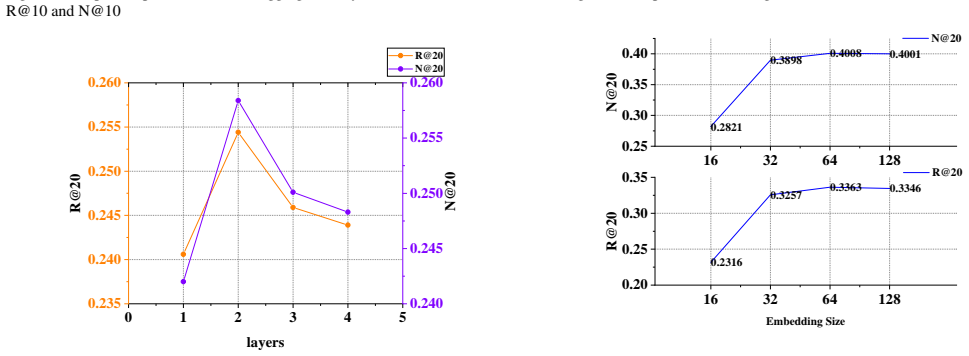
- [§5.3, Table 1; §5.4.1, Table 2] The reported performance claims are inconsistent with the tables. The text states that on LastFM-1000, R@10 improved by 10.24% over LightGCL, but from Table 1 the improvement is (0.1815−0.1679)/0.1679 = 8.10%; the other three LastFM percentages (N@10 7.85%, R@20 7.39%, N@20 7.44%) match the table. Additionally, the HMFGCL row for ML-100k reports N@20=0.4001 in Table 1, whereas Table 2 and §5.4.1 report N@20=0.4008 for the selected dimension; R@20 differs as well (0.334 vs 0.3351). These numerical discrepancies undermine the headline comparison and prevent verification of the claimed gains.
- [§5.3 and §5.4] The experimental protocol does not support the claimed 7–11% improvements. No validation split is described: the hyperparameter studies in §5.4.1–§5.4.4 select dimensions, singular values, layer counts, and embedding sizes by test-set performance (e.g., dimension 5 is chosen because it maximizes test R@10/N@10). No error bars, multiple-seed runs, or significance tests are reported. Since the baselines are taken from RecBole with 'optimal parameters' while HMFGCL is tuned on the test sets, the reported margins may reflect tuning advantage rather than a robust algorithmic improvement.
minor comments (5)
- [Eq. (2)] The regularization term in Eq. (2) is typeset as 'λ E0 2'; it should presumably be λ‖E0‖² or similar. As printed, the term is unreadable.
- [Algorithm 1, lines 18 and 20] Line 18 returns 'ˆPq, ˆQq, ˆQq'; the third return should be ˆSq (the singular values). Line 20 calls GNN(E^(u), A) for the item view; it should use E^(v).
- [§5.5] The text refers to the 'LastMF-1000' dataset; this should be 'LastFM-1000'. The caption of Fig. 17 uses the correct name.
- [Table 1 caption and §5.3 text] The caption says the best results are in bold and second-best underlined, while the text says best results are highlighted with gray shading; the table as rendered uses asterisks. This formatting description is inconsistent and should be corrected.
- [Eq. (15)] The item aggregation z^(v)_{n,l} = σ(A_{:,n}·E^(u)'_{l-1}) appears dimensionally problematic: A_{:,n} is an m×1 column, while E^(u)' is m×d. A transposed row or inner-product formulation is likely intended.
Circularity Check
No circularity: the method and evaluation are self-contained; the central equations are an augmentation/loss construction rather than a prediction derived from its inputs. (Eqs.16-21 have a dimensional inconsistency, but that is a correctness issue, not circularity.)
full rationale
HMFGCL's derivation chain is empirical rather than definitional: the MF and SVD low-rank matrices (Eqs.7-8) are fitted to the interaction matrix A, then used with GNN embeddings to form contrastive views (Eqs.16-23), and the final objective combines a recommendation loss with InfoNCE (Eqs.24-25). No equation defines the claimed recommendation result in terms of itself, and the reported superiority over baselines is an externally benchmarked performance claim, not a quantity forced by construction. The novelty claim about 'complementary' MF-SVD fusion is an architectural assertion supported by ablations, not by a self-referential proof. There is no load-bearing self-citation: the cited SVD-guided augmentation [11], noise-based augmentation [13,14], and other baselines are prior external work, not the authors' own unverified results. A skeptical reader's central concern is real but orthogonal to circularity: Eq.16, G_l^(u)=sigma(Ã_MF E_{l-1}^(v) Â_SVD), is dimensionally invalid as written because Ã_MF is m×n, E_{l-1}^(v) is n×d, and Â_SVD is m×n, so the last product is undefined (Eqs.17-21 inherit the problem). Section 5.4 also selects hyperparameters on the test datasets, which weakens the empirical comparison. These are correctness/validity risks and should be flagged, but they do not make the derivation circular. Therefore the circularity score is 0.
Assumptions & free parameters
free parameters (8)
- MF latent dimension k =
5
- SVD rank q =
5
- Noise magnitude epsilon =
0.1
- Noise ratio l1:l2 (Gaussian:uniform) =
8:2
- Contrastive loss weight lambda_1 =
0.003
- Embedding size d =
64
- L2 regularization coefficient =
1e-5
- Number of aggregation layers =
2
assumptions (4)
- domain assumption Normalized adjacency propagation (Eq. 9) produces meaningful embeddings in GNN-based collaborative filtering.
- domain assumption Low-rank MF and SVD of the user-item matrix capture complementary global collaborative information.
- ad hoc to paper The fusion operation in Eqs. 16-21 is a valid matrix expression yielding d-dimensional embeddings.
- domain assumption InfoNCE contrastive loss improves recommendation when used as an auxiliary task with a main-view/contrastive-view pair.
Cite this review
Pith. "Pith review of Hybrid Matrix Factorization Based Graph Contrastive Learning for Recommendation System." pith.science (2026). https://pith.science/paper/GDIXUXBT
@misc{pith2026250905115,
  author       = {Pith},
  title        = {Pith review of: Hybrid Matrix Factorization Based Graph Contrastive Learning for Recommendation System},
  year         = {2026},
  howpublished = {\url{https://pith.science/paper/GDIXUXBT}},
  note         = {Machine review of arXiv:2509.05115}
}
read the original abstract
In recent years, methods that combine contrastive learning with graph neural networks have emerged to address the challenges of recommendation systems, demonstrating powerful performance and playing a significant role in this domain. Contrastive learning primarily tackles the issue of data sparsity by employing data augmentation strategies, effectively alleviating this problem and showing promising results. Although existing research has achieved favorable outcomes, most current graph contrastive learning methods are based on two types of data augmentation strategies: the first involves perturbing the graph structure, such as by randomly adding or removing edges; and the second applies clustering techniques. We believe that the interactive information obtained through these two strategies does not fully capture the user-item interactions. In this paper, we propose a novel method called HMFGCL (Hybrid Matrix Factorization Based Graph Contrastive Learning), which integrates two distinct matrix factorization techniques-low-rank matrix factorization (MF) and singular value decomposition (SVD)-to complementarily acquire global collaborative information, thereby constructing enhanced views. Experimental results on multiple public datasets demonstrate that our model outperforms existing baselines, particularly on small-scale datasets.
Figures


Figures from the paper (8 more)




Reference graph
Works this paper leans on
-
[1]
In- troduction to recommender systems handbook
Francesco Ricci, Lior Rokach, and Bracha Shapira. In- troduction to recommender systems handbook. InRecom- mender systems handbook, pages 1–35. Springer, 2010
work page 2010
-
[2]
Neural graph collaborative filtering
Xiang Wang, Xiangnan He, Meng Wang, Fuli Feng, and Tat-Seng Chua. Neural graph collaborative filtering. In Proceedings of the 42nd international ACM SIGIR con- ference on Research and development in Information Re- trieval, pages 165–174, 2019
work page 2019
-
[3]
Lei Chen, Le Wu, Richang Hong, Kun Zhang, and Meng Wang. Revisiting graph based collaborative filtering: A linear residual graph convolutional network approach. In Proceedings of the AAAI conference on artificial intelli- gence, volume 34, pages 27–34, 2020
work page 2020
-
[4]
Jiani Zhang, Xingjian Shi, Shenglin Zhao, and Irwin King. Star-gcn: Stacked and reconstructed graph convolu- tional networks for recommender systems.arXiv preprint arXiv:1905.13129, 2019
arXiv 1905
-
[5]
Interest-aware message-passing gcn for recommen- dation
Fan Liu, Zhiyong Cheng, Lei Zhu, Zan Gao, and Liqiang Nie. Interest-aware message-passing gcn for recommen- dation. InProceedings of the web conference 2021, pages 1296–1305, 2021
work page 2021
-
[6]
Task-adaptive neural process for user cold- start recommendation
Xixun Lin, Jia Wu, Chuan Zhou, Shirui Pan, Yanan Cao, and Bin Wang. Task-adaptive neural process for user cold- start recommendation. InProceedings of the Web Confer- ence 2021, pages 1306–1316, 2021
work page 2021
-
[7]
Chaoyang He, Tian Xie, Yu Rong, Wenbing Huang, Jun- zhou Huang, Xiang Ren, and Cyrus Shahabi. Cascade- bgnn: Toward efficient self-supervised representation learning on large-scale bipartite graphs.arXiv preprint arXiv:1906.11994, 2019
work page Pith review arXiv 1906
-
[8]
Con- trastive learning for sequential recommendation
Xu Xie, Fei Sun, Zhaoyang Liu, Shiwen Wu, Jinyang Gao, Jiandong Zhang, Bolin Ding, and Bin Cui. Con- trastive learning for sequential recommendation. In2022 IEEE 38th international conference on data engineering (ICDE), pages 1259–1273. IEEE, 2022
work page 2022
Show all 33 references
-
[9]
Self-supervised graph learning for recommendation
Jiancan Wu, Xiang Wang, Fuli Feng, Xiangnan He, Liang Chen, Jianxun Lian, and Xing Xie. Self-supervised graph learning for recommendation. InProceedings of the 44th international ACM SIGIR conference on research and de- velopment in information retrieval, pages 726–735, 2021
2021
-
[10]
Hypergraph contrastive collaborative filtering
Lianghao Xia, Chao Huang, Yong Xu, Jiashu Zhao, Dawei Yin, and Jimmy Huang. Hypergraph contrastive collaborative filtering. InProceedings of the 45th Inter- national ACM SIGIR conference on research and devel- opment in information retrieval, pages 70–79, 2022
2022
-
[11]
Lightgcl: Simple yet effective graph contrastive learning for recommendation.arXiv preprint arXiv:2302.08191, 2023
Xuheng Cai, Chao Huang, Lianghao Xia, and Xubin Ren. Lightgcl: Simple yet effective graph contrastive learning for recommendation.arXiv preprint arXiv:2302.08191, 2023
2023 arXiv
-
[12]
Improving graph collaborative filtering with neighborhood-enriched contrastive learning
Zihan Lin, Changxin Tian, Yupeng Hou, and Wayne Xin Zhao. Improving graph collaborative filtering with neighborhood-enriched contrastive learning. InProceed- ings of the ACM web conference 2022, pages 2320–2329, 2022
2022
-
[13]
Are graph augmen- tations necessary? simple graph contrastive learning for recommendation
Junliang Yu, Hongzhi Yin, Xin Xia, Tong Chen, Lizhen Cui, and Quoc Viet Hung Nguyen. Are graph augmen- tations necessary? simple graph contrastive learning for recommendation. InProceedings of the 45th international ACM SIGIR conference on research and development in informati...
2022
-
[14]
Xsimgcl: Towards extremely simple graph contrastive learning for recom- mendation.IEEE Transactions on Knowledge and Data Engineering, 2023
Junliang Yu, Xin Xia, Tong Chen, Lizhen Cui, Nguyen Quoc Viet Hung, and Hongzhi Yin. Xsimgcl: Towards extremely simple graph contrastive learning for recom- mendation.IEEE Transactions on Knowledge and Data Engineering, 2023
2023
-
[15]
T-gcn: A tem- poral graph convolutional network for traffic prediction
Ling Zhao, Yujiao Song, Chao Zhang, Yu Liu, Pu Wang, Tao Lin, Min Deng, and Haifeng Li. T-gcn: A tem- poral graph convolutional network for traffic prediction. IEEE transactions on intelligent transportation systems, 21(9):3848–3858, 2019
2019
-
[16]
Predicting traf- fic propagation flow in urban road network with multi- graph convolutional network.Complex&Intelligent Sys- tems, 10(1):23–35, 2024
Haiqiang Yang, Zihan Li, and Yashuai Qi. Predicting traf- fic propagation flow in urban road network with multi- graph convolutional network.Complex&Intelligent Sys- tems, 10(1):23–35, 2024
2024
-
[17]
Towards rep- resentation alignment and uniformity in collaborative fil- tering
Chenyang Wang, Yuanqing Yu, Weizhi Ma, Min Zhang, Chong Chen, Yiqun Liu, and Shaoping Ma. Towards rep- resentation alignment and uniformity in collaborative fil- tering. InProceedings of the 28th ACM SIGKDD con- ference on knowledge discovery and data mining, pages 1816–1825, 2022
2022
-
[18]
Self- supervised multi-channel hypergraph convolutional net- work for social recommendation
Junliang Yu, Hongzhi Yin, Jundong Li, Qinyong Wang, Nguyen Quoc Viet Hung, and Xiangliang Zhang. Self- supervised multi-channel hypergraph convolutional net- work for social recommendation. InProceedings of the web conference 2021, pages 413–424, 2021
2021
-
[19]
Graph neural network recommendation algorithm based on improved dual tower model.Scientific Reports, 14(1):3853, 2024
Qiang He, Xinkai Li, and Biao Cai. Graph neural network recommendation algorithm based on improved dual tower model.Scientific Reports, 14(1):3853, 2024
2024
-
[20]
Xiaoyan Meng. Cross-domain information fusion and per- sonalized recommendation in artificial intelligence rec- ommendation system based on mathematical matrix de- composition.Scientific Reports, 14(1):7816, 2024
2024
-
[21]
S3-rec: Self-supervised learning for sequential rec- ommendation with mutual information maximization
Kun Zhou, Hui Wang, Wayne Xin Zhao, Yutao Zhu, Sirui Wang, Fuzheng Zhang, Zhongyuan Wang, and Ji-Rong Wen. S3-rec: Self-supervised learning for sequential rec- ommendation with mutual information maximization. In Proceedings of the 29th ACM international conference on informat...
1902
-
[22]
Graph contrastive learning with augmentations.Advances in neural infor- mation processing systems, 33:5812–5823, 2020
Yuning You, Tianlong Chen, Yongduo Sui, Ting Chen, Zhangyang Wang, and Yang Shen. Graph contrastive learning with augmentations.Advances in neural infor- mation processing systems, 33:5812–5823, 2020
2020
-
[23]
Contrastive learning with stronger augmentations.IEEE transactions on pat- tern analysis and machine intelligence, 45(5):5549–5560, 2022
Xiao Wang and Guo-Jun Qi. Contrastive learning with stronger augmentations.IEEE transactions on pat- tern analysis and machine intelligence, 45(5):5549–5560, 2022
2022
-
[24]
Weakly supervised contrastive learning
Mingkai Zheng, Fei Wang, Shan You, Chen Qian, Chang- shui Zhang, Xiaogang Wang, and Chang Xu. Weakly supervised contrastive learning. InProceedings of the IEEE/CVF International Conference on Computer Vision, pages 10042–10051, 2021
2021
-
[25]
Gnncl: A graph neural network recommendation model based on contrastive learning.Neural Processing Letters, 56(2):45, 2024
Jinguang Chen, Jiahe Zhou, and Lili Ma. Gnncl: A graph neural network recommendation model based on contrastive learning.Neural Processing Letters, 56(2):45, 2024
2024
-
[26]
Generative-contrastive graph learning for recom- mendation
Yonghui Yang, Zhengwei Wu, Le Wu, Kun Zhang, Richang Hong, Zhiqiang Zhang, Jun Zhou, and Meng Wang. Generative-contrastive graph learning for recom- mendation. InProceedings of the 46th International ACM SIGIR Conference on Research and Development in Infor- mation Retrieval, ...
2023
-
[27]
Deep matrix factorization mod- els for recommender systems
Hong-Jian Xue, Xinyu Dai, Jianbing Zhang, Shujian Huang, and Jiajun Chen. Deep matrix factorization mod- els for recommender systems. InIJCAI, volume 17, pages 3203–3209. Melbourne, Australia, 2017
2017
-
[28]
Graph convolutional matrix completion.arXiv preprint arXiv:1706.02263, 2017
Rianne van den Berg, Thomas N Kipf, and Max Welling. Graph convolutional matrix completion.arXiv preprint arXiv:1706.02263, 2017
2017 arXiv
-
[29]
Embarrassingly shallow autoencoders for sparse data
Harald Steck. Embarrassingly shallow autoencoders for sparse data. InThe World Wide Web Conference, pages 3251–3257, 2019
2019
-
[30]
Lightgcn: Simplifying and powering graph convolution network for recommen- dation
Xiangnan He, Kuan Deng, Xiang Wang, Yan Li, Yong- dong Zhang, and Meng Wang. Lightgcn: Simplifying and powering graph convolution network for recommen- dation. InProceedings of the 43rd International ACM SI- GIR conference on research and development in Informa- tion Retrieval...
2020
-
[31]
Efficient neural matrix factorization without sampling for recommendation.ACM Transac- tions on Information Systems (TOIS), 38(2):1–28, 2020
Chong Chen, Min Zhang, Yongfeng Zhang, Yiqun Liu, and Shaoping Ma. Efficient neural matrix factorization without sampling for recommendation.ACM Transac- tions on Information Systems (TOIS), 38(2):1–28, 2020
2020
-
[32]
Simplex: A simple and strong baseline for collaborative filtering
Kelong Mao, Jieming Zhu, Jinpeng Wang, Quanyu Dai, Zhenhua Dong, Xi Xiao, and Xiuqiang He. Simplex: A simple and strong baseline for collaborative filtering. In Proceedings of the 30th ACM International Conference on Information&Knowledge Management, pages 1243– 1252, 2021
2021
-
[33]
Recbole: Towards a unified, comprehensive and efficient framework for recommenda- tion algorithms
Wayne Xin Zhao, Shanlei Mu, Yupeng Hou, Zihan Lin, Yushuo Chen, Xingyu Pan, Kaiyuan Li, Yujie Lu, Hui Wang, Changxin Tian, et al. Recbole: Towards a unified, comprehensive and efficient framework for recommenda- tion algorithms. Inproceedings of the 30th acm interna- tional co...
2021
Reviewed August 5, 2026 · model on record in the stance chip above.
Discussion (0). Continue with ORCID to comment.