REVIEW 4 major objections 5 minor 17 references
Identification of recurrent novae from parametric modeling of the optical light curve
T0 review · 4 major / 5 minor · reviewed 2026-08-05 · deepseek-v4-flash
Pith's one-line read A linear classifier built from five optical light-curve shape parameters can identify recurrent novae from a single outburst, the paper argues.
desk verdict A six-parameter light-curve classifier that plausibly separates P-class CNe from RNe and correctly places KT Eri; V2860 Ori is an in-sample boundary flag, not a prediction. read the letter →
The pith
A machine-rendered reading of the paper's core claim, the machinery that carries it, and where it could break.
The reading
What carries the argument
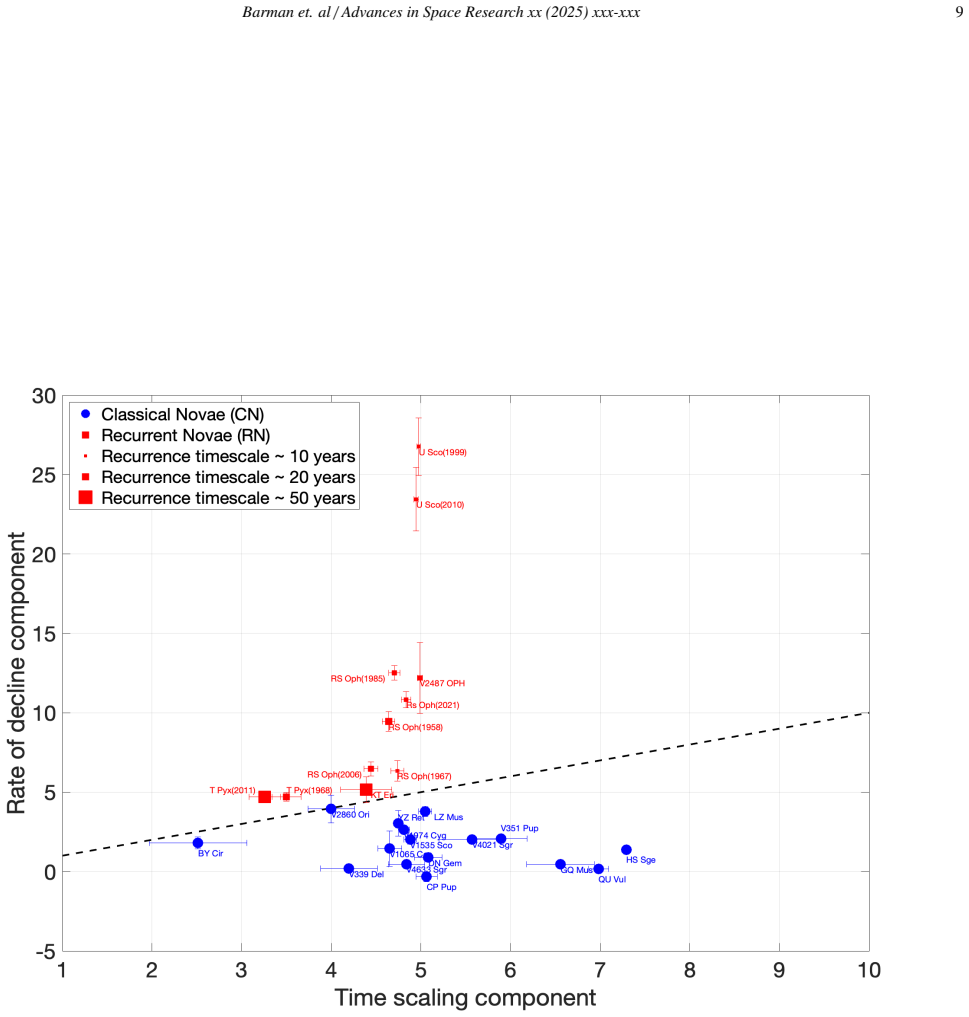
The central object is the five-parameter vector x = {α1, α2, m1, m2, m3}, where m1, m2, m3 are the slopes of the three linear segments of a P-class light curve and α1, α2 are the durations of the pre-plateau and plateau phases scaled to the reference nova V1974 Cyg. A piecewise-linear fit identifies the breakpoints and slopes; a logistic-regression hyperplane F(x) = 1.28α1 − 1.04α2 − 14.90m1 + 272.02m2 + 113.15m3 − 5.05 then separates recurrent from classical novae. The same parameters show significant Pearson correlations with white dwarf mass and accretion rate, connecting the empirical light-curve morphology to the physical drivers of recurrence.
What would settle it
A deep H-alpha imaging search around V2860 Ori for an extended nova super-remnant—the shell frequent eruptions are expected to sweep out—would directly test the central prediction: a clear detection would confirm the recurrent classification, while a sensitive null detection would undercut the boundary's placement of this object. More generally, a newly confirmed recurrent nova with a recurrence interval under 100 years that falls on the classical side of the fitted boundary would falsify the current separation.
Extended reading notes
Core claim
The paper establishes that P-class recurrent and classical novae are separable using only the morphology of their optical light curves. Each P-class light curve is fit as three linear segments—pre-plateau, plateau, and post-plateau—yielding slopes m1, m2, m3 and two time-scaling factors α1, α2 relative to a reference nova. In this parameter space, recurrent novae have systematically higher decline rates and shorter plateau time scalings, consistent with their higher white dwarf masses and accretion rates. The authors construct a linear decision boundary from these five parameters and show that it cleanly separates the 8 recurrent novae from the 22 classical novae in their sample. The boundar
Load-bearing premise
The 22 training novae labeled classical are assumed to be genuinely non-recurrent; if some are actually recurrent novae that have not yet been seen to repeat, the fitted boundary shifts and the verdicts on KT Eri and V2860 Ori no longer follow.
Editorial extensions
If this is right
- A single well-sampled P-class outburst can flag a nova as a recurrence candidate without waiting for a second eruption.
- KT Eri's recurrent status follows from its light curve morphology independently of the multi-diagnostic argument in earlier work.
- V2860 Ori becomes a concrete prediction: deep searches for a nova super-remnant around it should reveal one if the classification is right.
- The measured correlations tie slopes and time scalings to white dwarf mass and accretion rate, opening a route from light-curve shape to underlying stellar parameters.
Reading between the lines
- Extension beyond the paper: the same five-parameter description could be tried on S-class recurrent novae such as T CrB and V3890 Sgr, whose smooth declines lack a plateau, to see whether a generalized morphology space keeps the two classes separated.
- Extension beyond the paper: the distance of a nova from the decision boundary might be usable as a priority ranking for follow-up monitoring, archival plate searches, and super-remnant imaging.
- Extension beyond the paper: with a larger sample, the plane could be calibrated to produce recurrence-time estimates rather than binary class labels, if the mapping from morphology to white dwarf mass and accretion rate becomes tight enough.
Editorial analysis
A structured set of objections, weighed in public.
Referee Report
Summary. The paper addresses the problem of identifying whether a P-class nova light curve belongs to a recurrent nova (RNe) or a classical nova (CNe) using only the optical light-curve morphology. The authors fit three-segment piecewise-linear models to AAVSO visual-band light curves of 22 CNe and 14 outbursts of 8 RNe, extracting six parameters (magnitude offset, two time-scaling factors, three decline slopes). They report correlations of these parameters with white-dwarf mass and mass-accretion rate, then train a linear logistic-regression classifier on five of the parameters. The classifier assigns KT Eri to the RNe side even when KT Eri is excluded from the fit, and the authors note that V2860 Ori lies near the decision boundary and may be a recurrent nova. The paper concludes that a simple linear classifier can separate P-class RNe from CNe based solely on the light curve.
Significance. If robust, this would be a valuable, cheap diagnostic from a single outburst and would connect light-curve morphology to underlying system parameters. The KT Eri leave-one-out check is a useful sanity test, and the proposed nova super-remnant search for V2860 Ori is a falsifiable prediction. However, the validation is currently too thin: no cross-validated accuracy, no treatment of missing/censored parameters, and the V2860 Ori statement is based on a training-set point. With a sample of only 36 data points and 5 predictors, the risk of overfitting is non-trivial. The paper's core idea is promising and worth publishing after these load-bearing issues are addressed.
major comments (4)
- [§4.2 / Fig. 3 / Table 1] V2860 Ori is a training-set object, not an independent prediction. In §4.2 the authors state that 'V2860 Ori is lying at the very boundary of the CNe and RNe' and interpret this as 'indicative of the possibility of its recurrence.' However, V2860 Ori is one of the 22 CNe used to fit the logistic-regression boundary (Table 1; §2). Its coordinate relative to the fitted hyperplane is an in-sample geometric statement, not an out-of-sample classification. The paper performs a leave-one-out refit for KT Eri (§4.3) but not for V2860 Ori. With 22 CN training points, a single point can exert substantial leverage on the small linear model. Please provide a leave-one-out or bootstrap assessment of the boundary position for V2860 Ori, and report whether it remains on the RNe side when its own label is withheld. This is needed to support the concluding prediction.
- [§3.1 / Table 2 / §4.2] Missing and censored parameters are not accounted for in the classifier. Table 2 lists m3 = 'none' for six CNe (V838 Her, V368 Sct, V1229 Aql, DD Cir, V444 Sct, V1368 Cen) and three RN outbursts (CI Aql 2000, IM Nor 2002, V745 Sco 2014), and alpha2 is reported only as a lower limit for several objects (e.g., V838 Her '> 1.143', V1229 Aql '> 26.125'). The text does not explain how these enter the LogisticRegression in §4.2. Since the classifier uses {alpha1, alpha2, m1, m2, m3}, missing values must have been dropped, imputed, or otherwise handled; the choice can change the fitted coefficients and the boundary. This is not a cosmetic issue: it affects the reproducibility and stability of the central separation. State the treatment explicitly and, ideally, show that the conclusions are robust to it (e.g., by excluding rows with missing m3 and refitting).
- [§4.2] No quantitative validation of the classifier is reported. Section 4.2 gives the fitted coefficients but no accuracy, completeness, false-positive rate, or confusion matrix, and no cross-validation. With 36 data points and 5 predictors (and some with missing entries), the reported RNe/CNe separation in Fig. 3 could be optimistically biased. The KT Eri leave-one-out check is only one point. Please report leave-one-out cross-validated classification metrics (or at least a confusion matrix and balanced accuracy), and a bootstrap or permutation assessment of the boundary. This is necessary to support the claim that the method 'successfully distinguishes' RNe from CNe.
- [§2 / §4.2] The training labels are assumed to be clean, but the paper itself cites evidence against that assumption. The 22 CNe are taken from Schaefer (2022) as ground truth (§2). Pagnotta & Schaefer (2014), cited in the Introduction, showed that recurrent novae can masquerade as classical novae, and the same concern applies to the present sample. If a few of the 'CN' training objects are actually unrecognized RNe, the fitted hyperplane is systematically biased. The authors should at least discuss the direction and magnitude of this risk; a concrete test would be to remove the most CN-like borderline objects and re-fit, or to treat labels as uncertain in the logistic regression.
minor comments (5)
- [§4.1] The text describes p = 0.09 and p = 0.10 as 'statistically significant.' Please state the adopted significance threshold or phrase these as marginal correlations.
- [§4.2] The decomposition after the logistic-regression equation has sign inconsistencies: with a1 = 1.28, a2 = -1.04, and a6 = -5.05, the time-scaling component should be 1.28*alpha1 - 1.04*alpha2 - 5.05, but the text prints -1.28*alpha1 + 1.04*alpha2 + 5.05. Please correct or clarify.
- [Table 2] Please define 'none' and '>' in the caption, and give the units of m1/m2/m3 and alpha1/alpha2. Also specify whether the alpha2 lower limits are used as point values in the analysis.
- [General] There are several typographical errors, e.g., 'address this--the presence' and 'thisthe' in the Abstract/Introduction. A careful proofread is needed.
- [§3.1] The pwlf Python library is used but no reference or version is given. Please cite it or provide enough algorithmic detail to reproduce the breakpoint fits.
Circularity Check
V2860 Ori is a training-set object; its 'prediction' as a possible recurrent nova is an in-sample fit result, not an out-of-sample prediction.
-
fitted input called prediction
[Abstract; Section 4.2; Section 2/Table 1]
"The analysis also indicates the possibility of recurrence for V2860 Ori, a prediction that may be tested by deep search for nova super-remnant for this source. ... We also note that V2860 Ori is lying at the very boundary of the CNe and RNe as shown in Figure 3. This is indicative of the possibility of its recurrence in near future and possible missing nova outburst in the past."
V2860 Ori is one of the 22 P-class classical novae used to fit the logistic-regression boundary. Section 2 says 'out of 25 known P-class CNe, we are considering a subsample of 22 sources', and Table 1 lists V2860 Ori (2019) among the Classical Novae. Section 4.2 then fits F(x)=a1*alpha1+a2*alpha2+a3*m1+a4*m2+a5*m3+a6 with LogisticRegression on this sample, so Figure 3's boundary is a function of V2860 Ori's own measured parameters and its Schaefer (2022) label. The quoted sentence converts that in-sample geometry into a 'prediction' of recurrence. No leave-one-out refit is reported for V2860 Ori; the only such refit is for KT Eri ('even when classification boundary is derived excluding KT Eri'). Thus the V2860 Ori verdict is the fitted model's own training-set output, not an independent te
full rationale
The paper's main derivation is a supervised classification: six light-curve parameters measured from AAVSO data are used to fit a linear boundary to class labels taken from Schaefer (2022). That is not circular—the separation is a genuine fitted result, and the KT Eri check is a real leave-one-out test ('even when classification boundary is derived excluding KT Eri'). The correlations with white-dwarf mass and accretion rate are empirical associations, not derivations from the target claim. The only circular step is the V2860 Ori 'prediction': V2860 Ori is a member of the training sample, and its near-boundary placement is a byproduct of the fit that used its label, not an out-of-sample forecast. The paper never re-fits without V2860 Ori. This is the enumerated pattern of fitted input called prediction, and it affects one of the paper's headline claims. Other concerns (small sample, missing m3/lower-limit alpha2 handling, possible contamination of CN labels) are correctness risks, not circularity.
Assumptions & free parameters
free parameters (3)
- Logistic regression coefficients a1..a6 =
a1=1.28, a2=-1.04, a3=-14.90, a4=272.02, a5=113.15, a6=-5.05
- Per-nova piecewise-linear parameters (Delta-m, alpha1, alpha2, m1, m2, m3) =
36 rows in Table 2, several censored (m3='none', alpha2 lower limits, one m2 upper limit)
- Breakpoints T0, T1, T2 per outburst =
not tabulated
assumptions (6)
- domain assumption The 22 P-class classical novae are truly non-recurrent (labels from Schaefer 2022 are ground truth).
- domain assumption A P-class light curve is adequately represented by three linear segments in magnitude versus time, with an observable post-plateau segment.
- domain assumption Multiple outbursts of the same nova (RS Oph x5, U Sco x2, T Pyx x2) can be treated as independent samples for correlation and classifier fitting.
- domain assumption The white dwarf masses and accretion rates from Shara et al. (2018) and other listed sources are accurate for the correlation analysis.
- domain assumption Pearson correlation and linear logistic regression are statistically valid at this sample size and with censored covariates.
- domain assumption Reference light curve V1974 Cyg and the Stanton (1999) VIS/V transformation provide a comparable magnitude scale across the sample.
Cite this review
Pith. "Pith review of Identification of recurrent novae from parametric modeling of the optical light curve." pith.science (2026). https://pith.science/paper/YQ7YEUED
@misc{pith2026250905128,
  author       = {Pith},
  title        = {Pith review of: Identification of recurrent novae from parametric modeling of the optical light curve},
  year         = {2026},
  howpublished = {\url{https://pith.science/paper/YQ7YEUED}},
  note         = {Machine review of arXiv:2509.05128}
}
read the original abstract
Novae, characterized by sudden brightening in binary star systems, are categorized into classical novae (CNe) and recurrent novae (RNe) based on their recurrence timescales. However, identifying RNe, which occur within 100 years, presents observational challenges. A reasonable signature of RNe has been theorized and statistically validated to address this -- the presence of a plateau in the optical light curve. Among the known RNe, except T CrB and V3890 Sgr displaying S-class light curve, the rest 9 out of 11 have a P-class light curve. But classical novae can also present plateaus, which further complicates the problem of distinguishing CNe from RNe just based on plateau. Hence, in this study, we aim to conduct a phenomenological analysis of P-class light curves to comment on the recurrence nature of novae. We utilize data primarily from the AAVSO database and identify a parameter space to represent all P-class light curves, anticipating distinct parameter distributions for CNe and RNe. Analysis of parameter distributions successfully distinguishes RNe from CNe and reveals potential connections with white dwarf mass and mass accretion rate, which are the key factors. Our method indicates KT Eri to be a recurrent nova, consistent with a recent study, despite only one observed outburst. The analysis also indicates the possibility of recurrence for V2860 Ori, a prediction that may be tested by deep search for nova super-remnant for this source. Our method demonstrates the feasibility of distinguishing P-class classical and recurrent novae based solely on the optical light curve. As observations of new novae increase, this method holds promise for more precise predictions of nova recurrence nature in the future.
Figures


Reference graph
Works this paper leans on
-
[1]
Bath, G. T., & Harkness, R. P . (1989). Eruptions of novae. In Classical Novae (pp. 61–72). Bath, G. T., & Shaviv, G. (1976). Classical novaea steady state, constant luminosity, continuous ejection model. Monthly Notices of the Royal Astronomical Society , 175(2), 305–322. Bode, M. (1987). Rs ophiuchi (1985) and the recurrent nova phenomenon. proceedings ...
work page 1989
-
[18]
A Light Curve Analysis of 32 Recent Galactic Novae --- Distances and White Dwarf Masses
doi: 10.3847/ 1538-4365/ab1b43. arXiv:1905.10655. Hachisu, I., & Kato, M. (2023). A multiwavelength light curve analysis of the classical nova yz ret: An extension of the universal decline law to the nebular phase. arXiv preprint arXiv:2306.09218, . Hachisu, I., Kato, M., & Cassatella, A. (2008). A Universal Decline Law of Classical Novae. III. GQ Muscae
work page Pith review arXiv 1905
-
[34]
Y aron, O., Prialnik, D., Shara, M. et al. (2005). An extended grid of nova models. ii. the parameter space of nova outbursts. The Astrophysical Journal, 623(1),
work page 2005
-
[49]
doi: 10.3847/1538-4357/ad2a45. arXiv:2402.08287. Hachisu, I., Kato, M., & Schaefer, B. E. (2003). Revised analysis of the supersoft x-ray phase, helium enrichment, and turno ff time in the 2000 outburst of the recurrent nova ci aquilae. The Astrophysical Journal, 584(2),
work page Pith review arXiv 2003
-
[110]
Sienkiewicz, R. (1980). Stability of white dwarfs undergoing spherically symmetric steady-state accretion. AAP, 85(3), 295–301. Stanton, R. H. (1999). Visual magnitudes and the "average observer": The ss cygni field experiment. The Journal of the American Association of V ariable Star Observers, 27(2), 97–112. Starrfield, S., Iliadis, C., & Hix, W. (2016). ...
work page 1980
-
[163]
doi:10.1086/164762. Shara, M. M., Prialnik, D., Hillman, Y . et al. (2018). The masses and accretion rates of white dwarfs in classical and recurrent novae. The Astrophysical Journal, 860(2),
-
[164]
Prialnik, D., & Livio, M. (1995). On the erosion of the helium layer in white-dwarf nova progenitors. Publications of the Astronomical Society of the Pacific , 107(718),
work page 1995
-
[275]
Schaefer, B. E. (2022). Comprehensive catalogue of the overall best distances and properties of 402 galactic novae. Monthly Notices of the Royal Astronomical Society, 517(4), 6150–6169. Schaefer, B. E., Walter, F. M., Hounsell, R. et al. (2022). The nova kt eri is a recurrent nova with a recurrence time-scale of 40–50 yr. Monthly Notices of the Royal Astr...
arXiv 2022
Show all 17 references
-
[323]
Hachisu, I., & Kato, M. (2009). Optical and supersoft x-ray light-curve models of classical nova v2491 cygni: a new clue to the secondary maximum. The Astrophysical Journal, 694(2), L103. Hachisu, I., & Kato, M. (2019). A Light-curve Analysis of 32 Recent Galactic Novae: Dista...
2009
-
[398]
al / Advances in Space Research xx (2025) xxx-xxx Fig
12 Barman et. al / Advances in Space Research xx (2025) xxx-xxx Fig. A.4 Barman et. al / Advances in Space Research xx (2025) xxx-xxx 13 Fig. A.5
2025
-
[595]
Gehrz, R
doi: 10.1086/155819. Gehrz, R. D. (1988). The infrared temporal development of classical novae. araa, 26, 377–412. doi: 10.1146/annurev.aa.26.090188.002113. Hachisu, I., & Kato, M. (2001). Recurrent novae as a progenitor system of type ia supernovae. i. rs ophiuchi subclass: s...
1988
-
[1008]
W., Darnley, M
Healy-Kalesh, M. W., Darnley, M. J., Shara, M. M. et al. (2024). Hydrodynamic simulations of the KT Eridani nova super-remnant. mnras, 529(1), 236–244. doi:10.1093/mnras/stad3190. arXiv:2310.17258. Helton, L. A., Woodward, C. E., Walter, F. M. et al. (2010). The Dusty Nova V10...
2024 arXiv
-
[1201]
doi:10.1086/133678
URL: https://dx.doi.org/10.1086/133678. doi:10.1086/133678. Schaefer, B. E. (2010). Comprehensive photometric histories of all known galactic recurrent novae. The Astrophysical Journal Supplement Series , 187(2),
2010 doi
-
[1269]
Pagnotta, A., & Schaefer, B. E. (2014). Identifying and quantifying recurrent novae masquerading as classical novae. The Astrophysical Journal, 788(2),
2014
-
[1532]
doi: 10.1088/ 0004-637X/692/2/1532
URL: https://dx.doi.org/10.1088/0004-637X/692/2/1532. doi: 10.1088/ 0004-637X/692/2/1532. Starrfield, S., Sparks, W. M., & Truran, J. W. (1974). CNO abundances and hydrodynamic models of the nova outburst. II. 1.00 M sun models with enhanced carbon and oxygen. ApJS, 28, 247–270...
1974 doi
-
[1983]
doi:10.1086/591415
ApJ, 687(2), 1236–1252. doi:10.1086/591415. arXiv:0806.4253. Hachisu, I., Kato, M., Kato, T. et al. (1999). A theoretical light-curve model for the 1999 outburst of u scorpii. The Astrophysical Journal, 528(2), L97. Hachisu, I., Kato, M., & Matsumoto, K. (2024). A Multiwavelen...
1999 arXiv
-
[1985]
Proceedings of the Manchester Conference
In RS Ophiuchi (1985) and the recurrent nova phenomenon. Proceedings of the Manchester Conference . Chomiuk, L., Metzger, B. D., & Shen, K. J. (2021). New insights into classical novae. Annual Review of Astronomy and Astrophysics , 59, 391–444. Ford, H. C. (1978). The number o...
1985
Reviewed August 5, 2026 · model on record in the stance chip above.
Discussion (0). Continue with ORCID to comment.