Joint Routing, Resource Allocation, and Energy Optimization for Integrated Access and Backhaul with Open RAN
Pith reviewed 2026-05-18 18:06 UTC · model grok-4.3
The pith
Joint optimization of routing and resource allocation in IAB networks reduces activated nodes for energy savings while ensuring about 100 Mbps minimum data rate per UE using upper midband spectrum.
A machine-rendered reading of the paper's core claim, the machinery that carries it, and where it could break.
Core claim
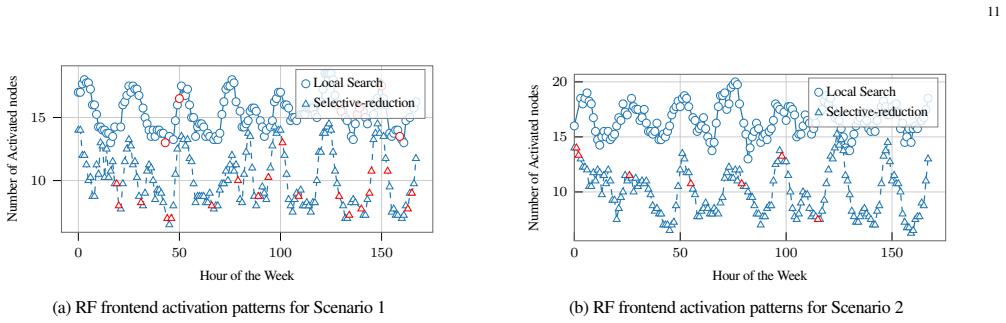
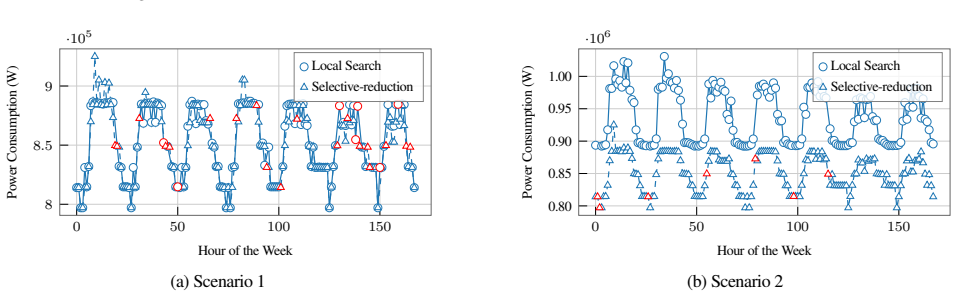
The paper claims that a novel capacity model linking power levels to data rates enables practical large-scale solutions for joint routing and resource allocation in IAB networks, which when integrated with O-RAN reduce the number of activated nodes to save energy and achieve approximately 100 Mbps of minimum data rate per UE during peak hours of the day using spectrum in Frequency Range 3, validated on diverse scenarios from Milan traffic data.
What carries the argument
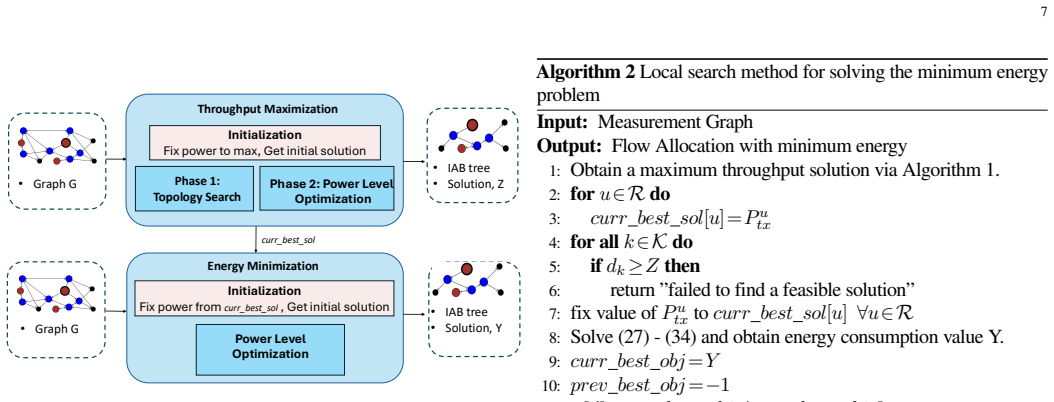
A novel capacity model that links power levels to achievable data rates in multi-hop IAB network scenarios, incorporated into joint optimization problems for energy minimization and throughput maximization.
If this is right
- Fewer activated nodes lead to lower overall energy consumption in dense IAB deployments.
- User equipment maintains at least 100 Mbps data rates during peak traffic hours.
- Solutions integrate directly into O-RAN closed-loop control for operational use.
- The framework supports practical next-generation IAB network deployment and optimization.
Where Pith is reading between the lines
- Operators could use similar joint optimization to manage energy costs as networks densify toward 6G.
- The capacity model approach might extend to other multi-hop wireless backhaul architectures beyond IAB.
- Validation across additional cities or traffic datasets would test the robustness of the energy and rate outcomes.
Load-bearing premise
The novel capacity model developed in the paper accurately links power levels to achievable data rates in the multi-hop IAB network scenarios considered.
What would settle it
In a real multi-hop IAB deployment using FR3 spectrum, measure whether minimum data rates per UE fall below 100 Mbps during peak hours or whether expected energy savings from node deactivation fail to appear due to inaccurate rate predictions from the model.
Figures






read the original abstract
As networks evolve towards 6G, Mobile Network Operators (MNOs) must accommodate diverse requirements and at the same time manage rising energy consumption. Integrated Access and Backhaul (IAB) networks facilitate dense cellular deployments with reduced infrastructure complexity. However, the multi-hop wireless backhauling in IAB networks necessitates proper routing and resource allocation decisions to meet the performance requirements. At the same time, cell densification makes energy optimization crucial. This paper addresses the joint optimization of routing and resource allocation in IAB networks through two distinct objectives: energy minimization and throughput maximization. We develop a novel capacity model that links power levels to achievable data rates. We propose two practical large-scale approaches to solve the optimization problems and leverage the closed-loop control framework introduced by the Open Radio Access Network (O-RAN) architecture to integrate the solutions. The approaches are evaluated on diverse scenarios built upon open data of two months of traffic collected by network operators in the city of Milan, Italy. Results show that the proposed approaches effectively reduces number of activated nodes to save energy and achieves approximately 100 Mbps of minimum data rate per User Equipment (UE) during peak hours of the day using spectrum within the Frequency Range (FR) 3, or upper midband. The results validate the practical applicability of our framework for next-generation IAB network deployment and optimization.
Editorial analysis
A structured set of objections, weighed in public.
Referee Report
Summary. The manuscript proposes a joint optimization framework for routing, resource allocation, and energy optimization in Integrated Access and Backhaul (IAB) networks using Open RAN (O-RAN) architecture. It develops a novel capacity model linking power levels to data rates, presents two practical approaches for solving the optimization problems (energy minimization and throughput maximization), and evaluates them on scenarios derived from two months of real traffic data collected in Milan, Italy. The results claim effective reduction in activated nodes for energy savings and achievement of approximately 100 Mbps minimum data rate per UE during peak hours using FR3 spectrum.
Significance. If the capacity model holds, the work offers practical value for energy-efficient 6G IAB deployments by integrating real Milan traffic data with O-RAN closed-loop control and scalable optimization methods. The emphasis on open data and large-scale applicability strengthens potential impact on network operators managing densification and energy costs.
major comments (1)
- The novel capacity model (developed to link power levels to achievable data rates under multi-hop IAB constraints) is load-bearing for both optimization objectives and the headline results on node activation and 100 Mbps UE rates. The manuscript supplies no derivation, comparison to Shannon or 3GPP formulas, or numerical validation on sample topologies to confirm accurate capture of multi-hop interference, backhaul-access coupling, and spectrum sharing; without this, the optimization solutions and reported performance cannot be fully verified.
minor comments (2)
- Abstract: state the quantitative energy savings (e.g., percentage reduction in activated nodes or total power) alongside the 100 Mbps figure to allow direct assessment of the dual-objective trade-off.
- Evaluation section: provide pseudocode or complexity bounds for the two large-scale approaches and clarify how they differ in handling the joint routing-resource decisions.
Simulated Author's Rebuttal
We thank the referee for their constructive and detailed review of our manuscript. We have carefully considered the major comment and will revise the paper accordingly to improve the verifiability of the capacity model while preserving the core contributions.
read point-by-point responses
-
Referee: The novel capacity model (developed to link power levels to achievable data rates under multi-hop IAB constraints) is load-bearing for both optimization objectives and the headline results on node activation and 100 Mbps UE rates. The manuscript supplies no derivation, comparison to Shannon or 3GPP formulas, or numerical validation on sample topologies to confirm accurate capture of multi-hop interference, backhaul-access coupling, and spectrum sharing; without this, the optimization solutions and reported performance cannot be fully verified.
Authors: We agree that the capacity model is central to the optimization framework and headline results, and that its presentation requires strengthening for full verification. In the revised manuscript we will add a dedicated subsection providing: (i) a step-by-step derivation of the model from the underlying SINR and multi-hop IAB constraints; (ii) explicit comparisons against the Shannon capacity formula and relevant 3GPP channel and interference models; and (iii) numerical validation results on small-scale sample topologies that isolate multi-hop interference, backhaul-access coupling, and spectrum sharing effects. These additions will directly support the energy-minimization and throughput-maximization solutions as well as the reported node-activation and 100 Mbps UE-rate outcomes. revision: yes
Circularity Check
Minor self-citation on O-RAN framework; central optimization and capacity model remain independent
full rationale
The derivation relies on a novel capacity model linking power to rates plus external Milan traffic traces for evaluation. No equations reduce predictions to fitted inputs by construction, no self-definitional loops appear in the joint routing/resource allocation formulation, and the O-RAN closed-loop reference is not load-bearing for the core claims. The paper therefore stays self-contained against external benchmarks.
Axiom & Free-Parameter Ledger
Lean theorems connected to this paper
-
IndisputableMonolith/Cost/FunctionalEquation.leanwashburn_uniqueness_aczel unclear?
unclearRelation between the paper passage and the cited Recognition theorem.
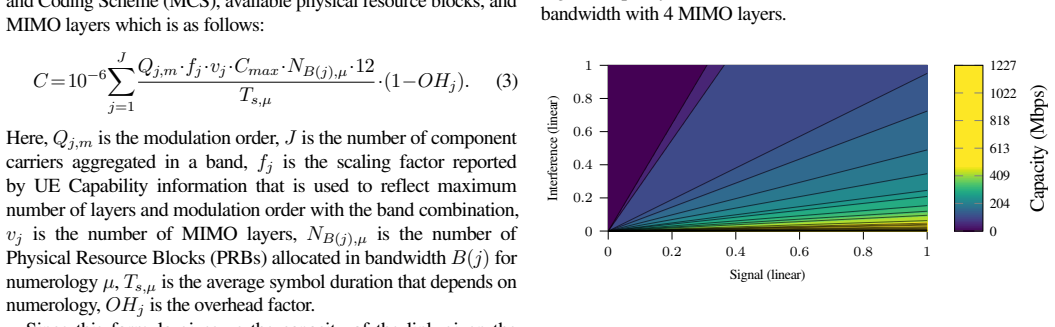
We design a capacity model ... C=10^{-6} ∑ Q_{j,m} f_j v_j ... SINR(u,v)=10 log_{10}(S_{u,v}/I_{u,v}) ... C(S,I)≥C_i ⇔ S≥th_i·I
-
IndisputableMonolith/Foundation/BranchSelection.leanbranch_selection unclear?
unclearRelation between the paper passage and the cited Recognition theorem.
Formulation of joint routing, resource allocation and energy minimization problem ... min P_total ... a(v) binary node activation
What do these tags mean?
- matches
- The paper's claim is directly supported by a theorem in the formal canon.
- supports
- The theorem supports part of the paper's argument, but the paper may add assumptions or extra steps.
- extends
- The paper goes beyond the formal theorem; the theorem is a base layer rather than the whole result.
- uses
- The paper appears to rely on the theorem as machinery.
- contradicts
- The paper's claim conflicts with a theorem or certificate in the canon.
- unclear
- Pith found a possible connection, but the passage is too broad, indirect, or ambiguous to say the theorem truly supports the claim.
Reference graph
Works this paper leans on
-
[1]
S. Chen, Y .-C. Liang, S. Sun, S. Kang, W . Cheng, and M. Peng, “Vision, requirements, and technology trend of 6G: How to tackle the challenges of system coverage, capacity, user data-rate and movement speed, ”IEEE Wireless Communications, vol. 27, no. 2, pp. 218–228, 2020
work page 2020
-
[2]
T o- wards 6G hyper-connectivity: Vision, challenges, and key enabling technologies,
H. Lee, B. Lee, H. Y ang, J. Kim, S. Kim, W . Shin, B. Shim, and H. V . Poor, “T o- wards 6G hyper-connectivity: Vision, challenges, and key enabling technologies, ” Journal of Communications and Networks, vol. 25, no. 3, pp. 344–354, 2023
work page 2023
-
[3]
Integrated access and backhaul in 5G mmW ave networks: Potential and challenges,
M. Polese, M. Giordani, T . Zugno, A. Roy, S. Goyal, D. Castor, and M. Zorzi, “Integrated access and backhaul in 5G mmW ave networks: Potential and challenges, ”IEEE Communications Magazine, vol. 58, no. 3, pp. 62–68, 2020
work page 2020
-
[4]
Routing and resource allocation for iab multi-hop network in 5G advanced,
H. Yin, S. Roy, and L. Cao, “Routing and resource allocation for iab multi-hop network in 5G advanced,”IEEE Transactions on Communications, vol. 70, no. 10, pp. 6704–6717, 2022
work page 2022
-
[5]
Energy consumption analysis on integrated access and backhaul networks,
F . I. G. Carvalho, I. B. Palhano, and T . F . Maciel, “Energy consumption analysis on integrated access and backhaul networks,” in2024 W orkshop on Communication Networks and P ower Systems (WCNPS). IEEE, 2024, pp. 1–7
work page 2024
-
[6]
Base station ON-OFF switching in 5G wireless networks: Approaches and challenges,
M. Feng, S. Mao, and T . Jiang, “Base station ON-OFF switching in 5G wireless networks: Approaches and challenges, ”IEEE Wireless Communications, vol. 24, no. 4, pp. 46–54, 2017
work page 2017
-
[7]
Joint routing and energy optimization for integrated access and backhaul with open RAN,
G. Gemmi, M. Elkael, M. Polese, L. Maccari, H. Castel-T aleb, and T . Melodia, “Joint routing and energy optimization for integrated access and backhaul with open RAN,” inGLOBECOM 2023-2023 IEEE Global Communications Conference. IEEE, 2023, pp. 1962–1967
work page 2023
-
[8]
W . Teng, M. Sheng, X. Chu, K. Guo, J. W en, and Z. Qiu, “Joint optimization of base station activation and user association in ultra dense networks under traffic uncertainty,”IEEE Transactions on Communications, vol. 69, no. 9, pp. 6079–6092, 2021
work page 2021
-
[9]
T oward open integrated access and backhaul with O-RAN,
E. Moro, G. Gemmi, M. Polese, L. Maccari, A. Capone, and T . Melodia, “T oward open integrated access and backhaul with O-RAN,” in2023 21st Mediterranean Communication and Computer Networking Conference (MedComNet). IEEE, 2023, pp. 61–69
work page 2023
-
[10]
Understanding O-RAN: Architecture, interfaces, algorithms, security, and research challenges,
M. Polese, L. Bonati, S. D’oro, S. Basagni, and T . Melodia, “Understanding O-RAN: Architecture, interfaces, algorithms, security, and research challenges, ” IEEE Communications Surveys & Tutorials, vol. 25, no. 2, pp. 1376–1411, 2023
work page 2023
-
[11]
C. Madapatha, B. Makki, A. Muhammad, E. Dahlman, M.-S. Alouini, and T . Svensson, “On topology optimization and routing in integrated access and backhaul networks: A genetic algorithm-based approach, ”IEEE Open Journal of the Communications Society, vol. 2, pp. 2273–2291, 2021. 13
work page 2021
-
[12]
Optimal topology formation and adaptation of integrated access and backhaul networks,
M. Simsek, M. Narasimha, O. Orhan, H. Nikopour, W . Mao, and S. T alwar, “Optimal topology formation and adaptation of integrated access and backhaul networks, ”Frontiers in Communications and Networks, vol. 1, p. 608088, 2021
work page 2021
-
[13]
Machine learning assisted capacity optimization for B5G/6G integrated access and backhaul networks,
O. T . Ajayi, S. Zhang, and Y . Cheng, “Machine learning assisted capacity optimization for B5G/6G integrated access and backhaul networks,” inIEEE INFOCOM 2023-IEEE Conference on Computer Communications W orkshops (INFOCOM WKSHPS). IEEE, 2023, pp. 1–6
work page 2023
-
[14]
A survey of algorithms for convex multicommodity flow problems,
A. Ouorou, P . Mahey, and J.-P . Vial, “ A survey of algorithms for convex multicommodity flow problems,”Management science, vol. 46, no. 1, pp. 126–147, 2000
work page 2000
-
[15]
O. Orhan, V . N. Swamy, T . Tetzlaff, M. Nassar, H. Nikopour, and S. T alwar, “Connection management xapp for o-ran ric: A graph neural network and reinforcement learning approach, ” in2021 20th IEEE international conference on machine learning and applications (ICMLA). IEEE, 2021, pp. 936–941
work page 2021
-
[16]
Energy efficiency in wireless networks via fractional programming theory,
A. Zappone, E. Jorswiecket al., “Energy efficiency in wireless networks via fractional programming theory, ”F oundations and Trends® in Communications and Information Theory, vol. 11, no. 3-4, pp. 185–396, 2015
work page 2015
-
[17]
Energy-efficient resource allocation in OFDM systems with distributed antennas,
C. He, G. Y . Li, F .-C. Zheng, and X. Y ou, “Energy-efficient resource allocation in OFDM systems with distributed antennas,”IEEE Transactions on V ehicular T echnology, vol. 63, no. 3, pp. 1223–1231, 2013
work page 2013
-
[18]
A survey on sleep mode techniques for ultra-dense networks in 5G and beyond,
F . Salahdine, J. Opadere, Q. Liu, T . Han, N. Zhang, and S. Wu, “ A survey on sleep mode techniques for ultra-dense networks in 5G and beyond,”Computer Networks, vol. 201, p. 108567, 2021
work page 2021
-
[19]
Energy efficient heterogeneous cellular networks,
Y . S. Soh, T . Q. Quek, M. Kountouris, and H. Shin, “Energy efficient heterogeneous cellular networks,”IEEE Journal on selected areas in communications, vol. 31, no. 5, pp. 840–850, 2013
work page 2013
-
[20]
Energy efficient optimization of in-band integrated access and backhaul heterogeneous networks,
W . Shang and V . Friderikos, “Energy efficient optimization of in-band integrated access and backhaul heterogeneous networks, ”IEEE Transactions on V ehicular T echnology, 2024
work page 2024
-
[21]
Freshness-aware energy efficiency optimization for integrated access and backhaul networks,
Y . Zhang, M. A. Kishk, and M.-S. Alouini, “Freshness-aware energy efficiency optimization for integrated access and backhaul networks,”IEEE Transactions on Wireless Communications, 2024
work page 2024
-
[22]
Power efficient topologies for wireless sensor networks,
A. Salhieh, J. W einmann, M. Kochhal, and L. Schwiebert, “Power efficient topologies for wireless sensor networks,” inInternational Conference on P arallel Processing, 2001.IEEE, 2001, pp. 156–163
work page 2001
-
[23]
An energy-efficient topology construction algorithm for wire- less sensor networks,
J. A. T orkestani, “ An energy-efficient topology construction algorithm for wire- less sensor networks, ”Computer Networks, vol. 57, no. 7, pp. 1714–1725, 2013
work page 2013
-
[24]
Energy efficiency in wireless sensor networks: A top-down survey,
T . Rault, A. Bouabdallah, and Y . Challal, “Energy efficiency in wireless sensor networks: A top-down survey, ”Computer networks, vol. 67, pp. 104–122, 2014
work page 2014
-
[25]
S. P . Boyd and L. V andenberghe,Convex optimization. Cambridge university press, 2004
work page 2004
-
[26]
Q. Shi, M. Razaviyayn, M. Hong, and Z.-Q. Luo, “SINR constrained beamforming for a MIMO multi-user downlink system: Algorithms and convergence analysis, ”IEEE Transactions on Signal Processing, vol. 64, no. 11, pp. 2920–2933, 2016
work page 2016
-
[27]
W . Hao, O. Muta, H. Gacanin, and H. Furukawa, “Power allocation for massive MIMO cognitive radio networks with pilot sharing under SINR requirements of primary users,”IEEE Transactions on V ehicular T echnology, vol. 67, no. 2, pp. 1174–1186, 2017
work page 2017
-
[28]
How much energy is needed to run a wireless network?
G. Auer, V . Giannini, C. Desset, I. Godor, P . Skillermark, M. Olsson, M. A. Imran, D. Sabella, M. J. Gonzalez, O. Blumeet al., “How much energy is needed to run a wireless network?”IEEE wireless communications, vol. 18, no. 5, pp. 40–49, 2011
work page 2011
-
[29]
A. A. Razzac, T . Chahed, Z. Shamseddine, and W . Zahwa, “ Advanced sleep modes in 5G multiple base stations using non-cooperative multi- agent reinforcement learning,” inGLOBECOM 2023-2023 IEEE Global Communications Conference. IEEE, 2023, pp. 7025–7030
work page 2023
-
[30]
Study on channel model for frequencies from 0.5 to 100 ghz,
3GPP, “Study on channel model for frequencies from 0.5 to 100 ghz,” 3rd Generation Partnership Project (3GPP), T echnical Report 38.901
-
[31]
User Equipment (UE) radio access capabilities,
3GPP , “User Equipment (UE) radio access capabilities,” 3GPP TS 38.306, version 16.2.0, 2020
work page 2020
-
[32]
Study on integrated access and backhaul,
——, “Study on integrated access and backhaul,” 3GPP TR 38.874, version 16.0.0, 2018
work page 2018
-
[33]
H. P . Williams,Model building in mathematical programming. John Wiley & Sons, 2013
work page 2013
-
[34]
D. Kirov, P . Nuzzo, R. Passerone, and A. Sangiovanni-Vincentelli, “Optimized selection of wireless network topologies and components via efficient pruning of feasible paths,” inProceedings of the 55th Annual Design Automation Conference, 2018, pp. 1–6
work page 2018
-
[35]
A multi-source dataset of urban life in the city of Milan and the Province of Trentino,
G. Barlacchi, M. De Nadai, R. Larcher, A. Casella, C. Chitic, G. T orrisi, F . Antonelli, A. V espignani, A. Pentland, and B. Lepri, “ A multi-source dataset of urban life in the city of Milan and the Province of Trentino,”Scientific data, vol. 2, no. 1, pp. 1–15, 2015
work page 2015
-
[36]
Sharing spectrum and services in the 7–24 GHz upper midband,
P . Testolina, M. Polese, and T . Melodia, “Sharing spectrum and services in the 7–24 GHz upper midband,”IEEE Communications Magazine, vol. 62, no. 8, pp. 170–177, 2024
work page 2024
-
[37]
Cellular wireless networks in the upper mid-band,
S. Kang, M. Mezzavilla, S. Rangan, A. Madanayake, S. B. V enkatakrishnan, G. Hellbourg, M. Ghosh, H. Rahmani, and A. Dhananjay, “Cellular wireless networks in the upper mid-band,”IEEE Open Journal of the Communications Society, 2024
work page 2024
-
[38]
On cost-effective, reliable coverage for los communications in urban areas,
G. Gemmi, R. L. Cigno, and L. Maccari, “On cost-effective, reliable coverage for los communications in urban areas,”IEEE Transactions on Network and Service Management, vol. 19, no. 3, pp. 2767–2779, 2022
work page 2022
-
[39]
Study on scenarios and requirements for next generation access technologies,
3GPP , “Study on scenarios and requirements for next generation access technologies, ” 3GPP TR 38.913, 04 2022, version 17.0.0, 2022
work page 2022
-
[40]
A. Baiocchi, L. Chiaraviglio, F . Cuomo, and V . Salvatore, “Joint management of energy consumption, maintenance costs, and user revenues in cellular networks with sleep modes,”IEEE Transactions on Green Communications and Networking, vol. 1, no. 2, pp. 167–181, 2017
work page 2017
-
[41]
Energy-efficient deployment and resource allocation for O-RAN-enabled UA V -assisted communication,
H. Li, X. T ang, D. Zhai, R. Zhang, B. Li, H. Cao, N. Kumar, and A. Almogren, “Energy-efficient deployment and resource allocation for O-RAN-enabled UA V -assisted communication,”IEEE Transactions on Green Communications and Networking, 2024
work page 2024
-
[42]
Energy efficiency analysis of two-tier heterogeneous networks,
T . Q. Quek, W . C. Cheung, and M. Kountouris, “Energy efficiency analysis of two-tier heterogeneous networks, ” in17th European Wireless 2011-Sustainable Wireless T echnologies. VDE, 2011, pp. 1–5
work page 2011
discussion (0)
Sign in with ORCID, Apple, or X to comment. Anyone can read and Pith papers without signing in.