REVIEW 3 major objections 5 minor 42 references
Resonance density range of absolute two-plasmon decay instability
T0 review · 3 major / 5 minor · reviewed 2026-08-05 · deepseek-v4-flash
Pith's one-line read The paper claims that a single density band fixes the spatial growth region of absolute two-plasmon decay and predicts the modulation threshold that suppresses it in broadband laser pulses.
desk verdict The resonance-density-range idea is a genuinely useful organizing concept for absolute TPD and the simulation comparison is solid; the two-color threshold scaling is a dimensionally shaky, fitted add-on that needs more work. read the letter →
The pith
A machine-rendered reading of the paper's core claim, the machinery that carries it, and where it could break.
The reading
What carries the argument
The resonance density range n_r — the density interval over which a candidate TPD mode has positive linear growth rate γ_0 in a homogeneous plasma, computed from the TPD dispersion relation (Eq. 1). In the inhomogeneous problem it acts as the active region: absolute growth is confined to n_r, and the escape of an amplified burst from n_r controls whether successive intensity peaks of a modulated driver couple. The derived objects are the escape time τ_c (scaled as τ_p1·τ_p2, where τ_pi = Δn_r L_n/v_gi are the individual crossing times) and the threshold modulation frequency Δω_g = 2π/τ_c, along with the higher decoupling frequency Δω_s beyond which the two driver colors act independently.
What would settle it
Measure the escape time directly in the two-color simulations: track the burst produced by one intensity peak and record when its main part has convected out of the predicted resonance density range n_r. The threshold formula assumes τ_c ∼ (Δn_r L_n/v_g1)(Δn_r L_n/v_g2); an escape time that disagrees with that product (rather than its square root or the single-pass crossing time) would falsify the Δω_g scaling. A second check: extend the Table II scans to other temperatures and intensities and test whether α ≈ 50 remains fixed; if α must drift to maintain the fit, Eq. (4) is an interpolation r
Extended reading notes
Core claim
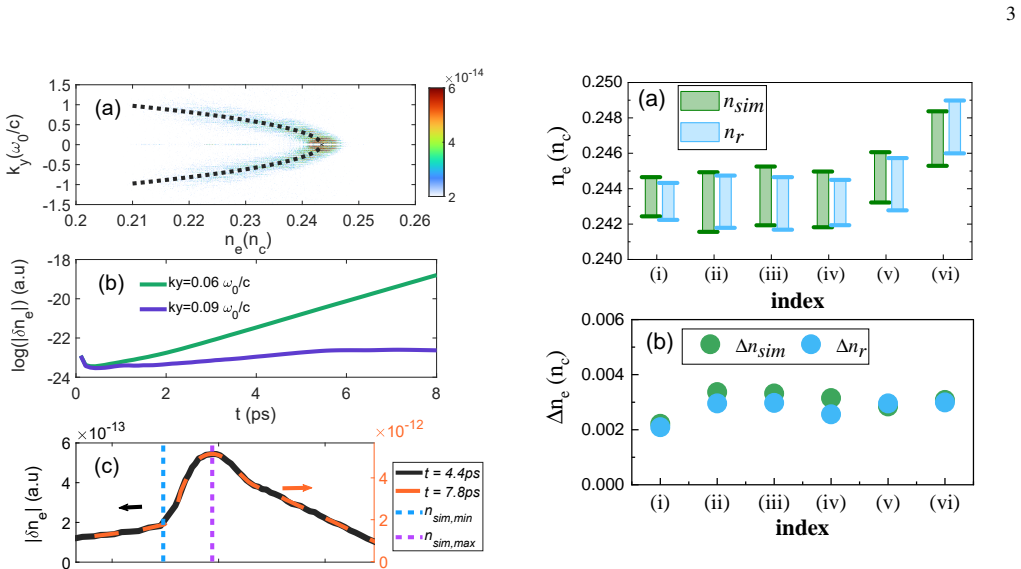
For a given TPD mode with fixed wave vector, the paper defines the resonance density range n_r as the density interval in which the homogeneous-plasma dispersion relation gives a positive linear growth rate γ_0. In the nonuniform plasma this interval is where the absolute mode amplifies: the forward-going daughter wave is reinforced while traversing the range, producing a single-peaked spatial envelope. Six linear fluid simulations across a broad parameter space show the simulated growth region matches n_r in both position and width (for the baseline case, Δn_r ≈ 0.0021 n_c versus Δn_sim ≈ 0.0023 n_c), establishing that the resonance density range properly characterizes the spatial growth re
Load-bearing premise
The predicted threshold frequency relies on the assumption that the escape time of a wave burst from the resonance density range equals the product of the two daughter waves' individual crossing times; as written that product has units of time squared, not time, so the formula is patched with extra factors and a fitted number (α ≈ 50) — if the true escape time does not follow that scaling, the quantitative threshold fails even if the qualitative resonance-range picture surviv
Editorial extensions
If this is right
- The spatial extent of absolute TPD growth in an inhomogeneous plasma is predictable from the homogeneous dispersion relation alone: compute γ_0(n_e), read off the interval where it is positive, and that interval is where the mode amplifies.
- For modulated drivers the onset frequency scales as Δω_g ∼ v_g1 v_g2 / (Δn_r L_n)^2 · (1/γ)(1/η): a wider resonance range, a longer density scale length, or higher laser intensity all push the threshold to lower modulation frequencies.
- Below Δω_g the absolute mode fails to grow because each intensity-peak burst exits the resonance range before the next peak arrives; above Δω_s the two colors decouple and drive TPD independently at the half-intensity single-frequency rate.
- Collisional damping barely changes the prediction, since the steep flank of γ_0(n_e) converts the condition γ_0 > ν_ei into almost the same density interval as γ_0 > 0.
- Because convective TPD is limited by the phase-mismatch length L_mis rather than the resonance length L_r, the two instability classes are governed by different mechanisms, explaining why saturated TPD spectra are usually dominated by convective modes.
Reading between the lines
- The two-color scan is the first harmonic of a general intensity spectrum; if the escape time is truly set by n_r, a broadband laser should suppress absolute TPD whenever its coherence (spike) time is shorter than the escape time — a statement about the full spectrum, not just one beat frequency, that could be tested with random-phase multi-frequency drives.
- The fitted constant α ≈ 50 may be absorbing the dimensional mismatch in the hand-waved escape-time scaling (time squared instead of time); extending the scans to temperatures, scale lengths, and intensities outside Tables I–II will show whether α is a universal number or a parameter-dependent fit.
- The same shortcut — equating the homogeneous growth region γ_0(n_e) > 0 to the inhomogeneous growth region — could transfer to other absolute parametric instabilities near quarter-critical density, such as absolute stimulated Raman scattering, giving threshold estimates that bypass the inhomogeneous-mode analysis.
Editorial analysis
A structured set of objections, weighed in public.
Referee Report
Summary. The paper proposes a new characterization of absolute two-plasmon-decay (TPD) instability in inhomogeneous plasmas: the 'resonance density range' n_r, defined as the density interval over which a given resonant mode is linearly unstable in a homogeneous plasma. This range is computed from the homogeneous TPD dispersion relation [Eq. (1)] and compared with the spatial growth region extracted from six 2D fluid simulations over a spread of parameters (Table I, Figs. 2-3). The authors then apply this concept to two-color laser drivers with intensity modulation at frequency Δω_m, identifying a growth threshold Δω_g and a decoupling threshold Δω_s (Fig. 4). They propose a scaling model for Δω_g [Eq. (4)] that depends on n_r, group velocities, density scale length, growth rate γ, and a fitted prefactor α≈50, and compare it with five additional simulation cases (Fig. 7). The abstract claims that n_r is the key parameter governing absolute TPD spatial growth and enables prediction of the modulation-induced suppression threshold.
Significance. If the central claim were fully established, the paper would offer a practically useful simplification: instead of solving the full inhomogeneous absolute-mode problem, one could characterize absolute TPD growth by the density interval of homogeneous instability. The six-case comparison for n_r is suggestive and the direction is physically reasonable. The paper also connects to the important experimental problem of understanding TPD enhancement under broadband lasers, where intensity modulations are known to matter. However, the quantitative prediction for Δω_g rests on a dimensionally questionable scaling and on a prefactor calibrated to the very simulations it is then used to 'predict.' The n_r concept itself is more defensible, but the extraction of n_sim depends on a hand-defined envelope convention. The paper's lasting value therefore hinges on whether the Δω_g model can be put on a sound footing and independently tested.
major comments (3)
- [Sec. III D, Eq. (3)] Equation (3) defines τ_p1 ~ Δn_r L_n / v_g1 and τ_p2 ~ Δn_r L_n / v_g2, both with dimensions of time. The text then states 'We reasonably have the scaling relation τ_c ∼ τ_p1 · τ_p2.' The product of two times has units of time^2, so τ_c cannot be a time. The subsequent expression Δω_g ∼ v_g1 v_g2 / (Δn_r L_n)^2 only acquires the correct frequency dimension after multiplying by 1/γ in Eq. (4). No physical argument is given for why the escape time should be the product rather than a sum, a geometric mean, or a single propagation time. As written, this is not a valid derivation; at best it is an empirical scaling relation whose dimensional inconsistency must be resolved or explicitly acknowledged as a fitted form.
- [Sec. III D, Eq. (4) and Fig. 7] Equation (4) introduces α as 'an adjustable parameter' and the value α≈50 is chosen so that the formula matches the simulation results. Figure 7 then validates Eq. (4) against the same five simulation cases used to set α. This is a calibration, not a prediction. The agreement in Fig. 7 therefore does not independently support the scaling. To support the paper's claim of a 'predictive model for Δω_g', the authors must either derive α from first principles or test Eq. (4) on additional simulations or experiments not used in the fit. As it stands, the quantitative central claim of the application section is not established.
- [Sec. II B, Fig. 3] The simulated growth range n_sim is extracted by a hand-defined envelope convention: the upper boundary is the peak of the δn_e envelope and the lower boundary is the valley where the second derivative attains its maximum. This convention is not accompanied by any uncertainty estimate or sensitivity study. Since the central claim that n_r characterizes the simulated growth region rests directly on the agreement in Fig. 3, the authors should show that the extracted n_sim is robust with respect to reasonable choices of the extraction rule, and ideally provide error bars for the six cases. Without this, the agreement—while visually plausible—cannot be quantitatively assessed.
minor comments (5)
- [Sec. II B and figure captions] There are several typos: 'wihch' (Sec. II B), 'envolope' (Fig. 2 caption), 'rensonance' (Fig. 3 caption), 'higer' (Sec. II B), 'filed' (Sec. III intro), 'simulatinos' (Sec. III intro). A careful proofread is needed.
- [Sec. III B, Fig. 4] The thresholds Δω_g and Δω_s are defined and marked for case (B), but the figure would be clearer if the same markers were defined in the caption or in a legend. Also, the text switches between Δω_s and Δω_s without defining the subscript consistently.
- [Sec. II C] The discussion of damping is qualitative: the authors state that because γ_0 varies steeply with n_e, replacing γ_0>0 by γ_0>ν_ei causes only a small change in n_r. A quantitative estimate of the shift for the cases in Table I would make this claim more convincing.
- [Sec. III D, Eq. (4)] The growth rate γ used in Eq. (4) is evaluated at the average intensity I_0, while the two-color pulses reach peak intensity 2I_0. The paper should clarify whether this choice is intentional and how sensitive the results are to using a different reference intensity.
- [References] The companion paper [37] is cited as an arXiv preprint; if the current manuscript is intended for journal publication, the authors should update the reference if the companion paper has been accepted or published.
Circularity Check
Eq. (4) Δω_g model is calibrated to the simulations it then claims to predict; the escape-time scaling is dimensionally inconsistent.
-
fitted input called prediction
[Section III D, Eq. (4) and Figure 7]
"Based on the above analysis, we propose the dependence of Δωg as follows: Δωg ∼ vg1vg2/(ΔnrLn)^2 · 1/γ · 1/η · α (4) where α serves as an adjustable parameter. ... With α≈50, Eq.(4) provides reasonable estimates of Δωg across a wide range of laser–plasma conditions. As illustrated in Figure 7, the estimated values are in good agreements with the simulation results Δωg,sim."
α is an adjustable constant, and the only stated way to set it is so that Eq. (4) agrees with the simulation thresholds. Figure 7 then compares Eq. (4) with the same Δωg,sim values used to set α≈50. The agreement is therefore an in-sample calibration, not an independent validation. The paper calls this a prediction, but with α fit to the data the predicted curve is forced onto the data by construction, so the comparison cannot establish the proposed scaling.
-
other
[Section III D, Eq. (3) and Eq. (4)]
"We reasonably have the scaling relation τ_c ∼ τ_p1 · τ_p2, which in turn yields the critical modulation frequency Δω_g ∼ vg1vg2/(ΔnrLn)^2."
τ_p1 and τ_p2 are times, so τ_p1·τ_p2 has units of time^2, and the formula as written would make Δω_g a 1/time^2 quantity rather than a frequency. The correct frequency units only appear after the additional 1/γ and 1/η factors are inserted in Eq. (4). The product form is not derived from the propagation picture; it is an ansatz introduced to obtain the target vg1vg2/(ΔnrLn)^2 dependence. Together with the fitted α, this makes the quantitative Δω_g formula an assembled fit rather than a first-principles prediction.
full rationale
The Sec. II result that the resonance density range n_r characterizes the spatial growth region is not circular: n_r is computed from the homogeneous TPD dispersion relation, while the growth regions are extracted independently from LTS fluid simulations, and the agreement in Fig. 3 is an external, quantitative benchmark. No load-bearing self-citation chain is present; refs. 28 and 37 are contextual. The circularity is confined to the quantitative two-color threshold model. Eq. (4) contains an adjustable parameter α≈50 set against the same simulations that Fig. 7 uses as validation, and the escape-time product in Eq. (3) is dimensionally inconsistent unless the later 1/γ, 1/η factors are used as dimensional repairs. Thus the paper's strongest applied claim — a 'successful prediction of Δω_g' — reduces by construction to fitting the dataset it claims to predict. The n_r insight remains independently supported, so the overall score is 6 rather than higher.
Assumptions & free parameters
free parameters (1)
- alpha prefactor in Eq. (4) =
~50 (dimensionless)
assumptions (4)
- domain assumption Local applicability of the homogeneous TPD dispersion relation Eq. (1) at each density of the inhomogeneous profile.
- domain assumption The mode k_r = (0.88 omega_0/c, 0.06 omega_0/c) is the relevant absolute mode and remains representative under two-color pumping.
- ad hoc to paper Escape-time scaling tau_c ~ tau_p1 * tau_p2 (Eq. 3) for daughter-wave propagation through the resonance range.
- domain assumption The threshold factor eta = I L_n lambda_0 / (81.86 T_e) sets whether the instantaneous intensity is sufficient for TPD growth.
Cite this review
Pith. "Pith review of Resonance density range of absolute two-plasmon decay instability." pith.science (2026). https://pith.science/paper/NPJ7JPPR
@misc{pith2026250906021,
  author       = {Pith},
  title        = {Pith review of: Resonance density range of absolute two-plasmon decay instability},
  year         = {2026},
  howpublished = {\url{https://pith.science/paper/NPJ7JPPR}},
  note         = {Machine review of arXiv:2509.06021}
}
read the original abstract
We present a new insight into absolute two-plasmon decay (TPD) instability in nonuniform plasmas by identifying the resonance density range as the key parameter governing the growth of the resonant absolute modes. This range is defined as the density interval within which these resonant modes still exhibit growth in homogeneous plasmas. This range properly characterizes the spatial growth region of the resonant absolute modes in a series of linear fluid simulations across broad parameter spaces. Building on this insight, we investigate the absolute growth of TPD modes driven by laser pulses with intensity modulations, a common feature in broadband lasers used to suppress laser plasma instabilities. We establish the relationship between the resonance density range and the threshold time interval between intensity peaks, beyond which absolute growth is suppressed.
Figures


Figures from the paper (4 more)


Reference graph
Works this paper leans on
-
[1]
author author M. D. \ Rosen ,\ title title The long road to ignition: An eyewitness account , \ 10.1063/5.0221005 journal journal Physics of Plasmas \ volume 31 ,\ pages 090501 ( year 2024 ) NoStop
-
[2]
author author O. Hurricane , author P. Patel , author R. Betti , author D. Froula , author S. Regan , author S. Slutz , author M. Gomez , \ and\ author M. Sweeney ,\ title title Physics principles of inertial confinement fusion and U . S . program overview , \ 10.1103/RevModPhys.95.025005 journal journal Reviews of Modern Physics \ volume 95 ,\ pages 0250...
-
[3]
author author R. S. \ Craxton , author K. S. \ Anderson , author T. R. \ Boehly , author V. N. \ Goncharov , author D. R. \ Harding , author J. P. \ Knauer , author R. L. \ McCrory , author P. W. \ McKenty , author D. D. \ Meyerhofer , author J. F. \ Myatt , author A. J. \ Schmitt , author J. D. \ Sethian , author R. W. \ Short , author S. Skupsky , autho...
work page 2015
-
[4]
author author W. Seka , author D. H. \ Edgell , author J. F. \ Myatt , author A. V. \ Maximov , author R. W. \ Short , author V. N. \ Goncharov , \ and\ author H. A. \ Baldis ,\ title title Two-plasmon-decay instability in direct-drive inertial confinement fusion experiments , \ 10.1063/1.3125242 journal journal Physics of Plasmas \ volume 16 ,\ pages 052...
-
[5]
author author S. P. \ Regan , author N. B. \ Meezan , author L. J. \ Suter , author D. J. \ Strozzi , author W. L. \ Kruer , author D. Meeker , author S. H. \ Glenzer , author W. Seka , author C. Stoeckl , author V. Y. \ Glebov , author T. C. \ Sangster , author D. D. \ Meyerhofer , author R. L. \ McCrory , author E. A. \ Williams , author O. S. \ Jones ,...
work page 2010
-
[6]
author author C. W. \ Lian , author Y. Ji , author R. Yan , author J. Li , author L. F. \ Wang , author Y. K. \ Ding , \ and\ author J. Zheng ,\ title title Two-plasmon-decay instability stimulated by dual laser beams in inertial confinement fusion , \ 10.1063/5.0235643 journal journal Matter and Radiation at Extremes \ volume 10 ,\ pages 017403 ( year 20...
-
[7]
author author C.-W. \ Lian , author Y. Ji , author R. Yan , author S.-H. \ Cao , author C. Ren , author Z.-H. \ Wan , author D. Yang , author Y.-K. \ Ding , \ and\ author J. Zheng ,\ title title Two plasmon decay instability stimulated by large-incidence-angle laser in inertial confinement fusion , \ @noop journal journal Plasma Physics and Controlled Fus...
work page 2022
-
[8]
author author R. K. \ Kirkwood , author J. D. \ Moody , author J. Kline , author E. Dewald , author S. Glenzer , author L. Divol , author P. Michel , author D. Hinkel , author R. Berger , author E. Williams , author J. Milovich , author L. Yin , author H. Rose , author B. Macgowan , author O. Landen , author M. Rosen , \ and\ author J. Lindl ,\ title titl...
work page 2013
Show all 42 references
-
[9]
Baton , author A
author author S. Baton , author A. Cola \"i tis , author C. Rousseaux , author G. Boutoux , author S. Brygoo , author L. Jacquet , author M. Koenig , author D. Batani , author A. Casner , author E. L. \ Bel , author D. Raffestin , author A. Tentori , author V. Tikhonchuk , aut...
2020
-
[10]
author author A. R. \ Christopherson , author R. Betti , author C. J. \ Forrest , author J. Howard , author W. Theobald , author J. A. \ Delettrez , author M. J. \ Rosenberg , author A. A. \ Solodov , author C. Stoeckl , author D. Patel , author V. Gopalaswamy , author D. Cao ...
2021
-
[11]
author author A. R. \ Christopherson , author R. Betti , \ and\ author C. J. \ Forrest ,\ title title Inferences of hot electron preheat and its spatial distribution in OMEGA direct drive implosions , \ @noop journal journal Physics of Plasmas \ volume 29 ,\ pages 122703 ( yea...
2022
-
[12]
Turnbull , author A
author author D. Turnbull , author A. V. \ Maximov , author D. H. \ Edgell , author W. Seka , author R. K. \ Follett , author J. P. \ Palastro , author D. Cao , author V. N. \ Goncharov , author C. Stoeckl , \ and\ author D. H. \ Froula ,\ title title Anomalous Absorption by t...
2020
-
[13]
Sui \ and\ author K
author author Z. Sui \ and\ author K. Lan ,\ title title Driver at 10 MJ and 1 shot/30 min for inertial confinement fusion at high gain: Efficient, compact, low-cost, low laser-plasma instabilities, beam color selectable from 2 /3 /4 , applicable to multiple laser fusion schem...
2024
-
[14]
Zhang , author D
author author H. Zhang , author D. Kang , author C. Wu , author L. Hao , author H. Shen , author S. Zou , author S. Zhu , \ and\ author Y. Ding ,\ title title Semi-hydro-equivalent design and performance extrapolation between 100 kJ -scale and NIF -scale indirect drive implosi...
2023
-
[15]
Turnbull , author A
author author D. Turnbull , author A. V. \ Maximov , author D. Cao , author A. R. \ Christopherson , author D. H. \ Edgell , author R. K. \ Follett , author V. Gopalaswamy , author J. P. \ Knauer , author J. P. \ Palastro , author A. Shvydky , author C. Stoeckl , author H. Wen...
2020
-
[16]
author author D. T. \ Michel , author A. V. \ Maximov , author R. W. \ Short , author J. A. \ Delettrez , author D. Edgell , author S. X. \ Hu , author I. V. \ Igumenshchev , author J. F. \ Myatt , author A. A. \ Solodov , author C. Stoeckl , author B. Yaakobi , \ and\ author ...
2013
-
[17]
Lei , author N
author author A. Lei , author N. Kang , author Y. Zhao , author H. Liu , author H. An , author J. Xiong , author R. Wang , author Z. Xie , author Y. Tu , author G. Xu , author X. Zhou , author Z. Fang , author W. Wang , author L. Xia , author W. Feng , author X. Zhao , author ...
2024
-
[18]
author author R. K. \ Follett , author J. A. \ Delettrez , author D. H. \ Edgell , author V. N. \ Goncharov , author R. J. \ Henchen , author J. Katz , author D. T. \ Michel , author J. F. \ Myatt , author J. Shaw , author A. A. \ Solodov , author C. Stoeckl , author B. Yaakob...
2016 doi
-
[19]
author author J.J.Thomson ,\ title title Finite-bandwidth effects on the parametric instability in an inhomogeneous plasma , \ @noop journal journal Nuclear Fusion \ volume 15 ,\ pages 237 ( year 1975 ) NoStop
1975
-
[20]
Zhao , author S
author author Y. Zhao , author S. Weng , author Z. Sheng , \ and\ author J. Zhu ,\ title title Suppression of parametric instabilities in inhomogeneous plasma with multi-frequency light , \ @noop journal journal Plasma Physics and Controlled Fusion \ volume 61 ,\ pages 115008 ...
2019
-
[21]
Jia , author Q
author author X. Jia , author Q. Jia , author R. Yan , \ and\ author J. Zheng ,\ title title Suppressing stimulated Raman side-scattering with vector light , \ 10.1063/5.0157811 journal journal Matter and Radiation at Extremes \ volume 8 ,\ pages 055603 ( year 2023 ) NoStop
2023 doi
-
[22]
author author R. K. \ Follett , author J. G. \ Shaw , author J. F. \ Myatt , author C. Dorrer , author D. H. \ Froula , \ and\ author J. P. \ Palastro ,\ title title Thresholds of absolute instabilities driven by a broadband laser , \ @noop journal journal Physics of Plasmas \...
2019
-
[23]
Ma , author X
author author H. Ma , author X. F. \ Li , author S. M. \ Weng , author S. H. \ Yew , author S. Kawata , author P. Gibbon , author Z. M. \ Sheng , \ and\ author J. Zhang ,\ title title Mitigating parametric instabilities in plasmas by sunlight-like lasers , \ 10.1063/5.0054653 ...
2021 doi
-
[24]
\ Wang , author X.-X
author author X.-B. \ Wang , author X.-X. \ Chai , author P. Li , author B. Zhang , author Q.-H. \ Zhu , author X.-C. \ Tian , author J. Wang , author Z.-Y. \ Zong , author S. Zhou , author K. Yao , author S. Li , author J.-P. \ Zhao , \ and\ author Z.-T. \ Peng ,\ title title...
2024 doi
-
[25]
Ji , author X
author author L. Ji , author X. Zhao , \ and\ author D. Liu ,\ title title Research progress of low-temporal-coherence light frequency conversion technology for high power nd:glass laser system , \ @noop journal journal High Power Laser and Particle Beams \ volume 32 ,\ pages ...
2020
-
[26]
Wang , author H
author author P. Wang , author H. An , author Z. Fang , author J. Xiong , author Z. Xie , author C. Wang , author Z. He , author G. Jia , author R. Wang , author S. Zheng , author L. Xia , author W. Feng , author H. Shi , author W. Wang , author J. Sun , author Y. Gao , \ and\...
2024 doi
-
[27]
Li , author C
author author J. Li , author C. Yao , author L. Hao , author R. Yan , author Y.-K. \ Ding , \ and\ author J. Zheng ,\ title title Intensity spikes dominate hot electron production in moderate-bandwidth laser plasma interactions , \ in\ @noop booktitle the 8th International Con...
2025
-
[28]
Yao , author J
author author C. Yao , author J. Li , author L. Hao , author R. Yan , author C. Wang , author A. Lei , author Y.-K. \ Ding , \ and\ author J. Zheng ,\ title title Anomalous hot electron generation from two-plasmon decay instability driven by broadband laser pulses with intensi...
2024
-
[29]
author author Q. K. \ Liu , author E. H. \ Zhang , author W. S. \ Zhang , author H. B. \ Cai , author Y. Q. \ Gao , author Q. Wang , \ and\ author S. P. \ Zhu ,\ title title Non-linear stimulated Raman back-scattering burst driven by a broadband laser , \ 10.1063/5.0105089 jou...
2022 doi
-
[30]
author author Q. K. \ Liu , author L. Deng , author Q. Wang , author X. Zhang , author F. Q. \ Meng , author Y. P. \ Wang , author Y. Q. \ Gao , author H. B. \ Cai , \ and\ author S. P. \ Zhu ,\ title title Electron kinetic effects in back-stimulated Raman scattering bursts dr...
2024
-
[31]
author author M. N. \ Rosenbluth , author R. B. \ White , \ and\ author C. S. \ Liu ,\ title title Temporal evolution of a three-wave parametric instability , \ 10.1103/PhysRevLett.31.1190 journal journal Physical Review Letters \ volume 31 ,\ pages 1190--1193 ( year 1973 ) NoStop
1973 doi
-
[32]
Simon , author R
author author A. Simon , author R. W. \ Short , author E. A. \ Williams , \ and\ author T. Dewandre ,\ title title On the inhomogeneous two-plasmon instability , \ @noop journal journal Physics of Fluids \ volume 26 ,\ pages 3107--3118 ( year 1983 ) NoStop
1983
-
[33]
author author B. B. \ Afeyan \ and\ author E. A. \ Williams ,\ title title A variational approach to parametric instabilities in inhomogeneous plasmas III : Two-plasmon decay , \ @noop journal journal Physics of Plasmas \ volume 4 ,\ pages 3827--3844 ( year 1997 ) NoStop
1997
-
[34]
Zhang , author J
author author J. Zhang , author J. F. \ Myatt , author R. W. \ Short , author A. V. \ Maximov , author H. X. \ Vu , author D. F. \ DuBois , \ and\ author D. A. \ Russell ,\ title title Multiple beam two-plasmon decay: Linear threshold to nonlinear saturation in three dimension...
2014
-
[35]
Yan , author A
author author R. Yan , author A. V. \ Maximov , \ and\ author C. Ren ,\ title title The linear regime of the two-plasmon decay instability in inhomogeneous plasmas , \ @noop journal journal Physics of Plasmas \ volume 17 ,\ pages 052701 ( year 2010 ) NoStop
2010
-
[36]
author author C. S. \ Liu \ and\ author M. N. \ Rosenbluth ,\ title title Parametric decay of electromagnetic waves into two plasmons and its consequences , \ @noop journal journal The Physics of Fluids \ volume 19 ,\ pages 967--971 ( year 1976 ) NoStop
1976
-
[37]
Yao , author J
author author C. Yao , author J. Li , author L. Hao , author R. Yan , author T. Tao , author G.-N. \ Zheng , author Q. Jia , author Y.-K. \ Ding , \ and\ author J. Zheng ,\ @noop title Resonance density range governs two-plasmon decay saturation and enables hot-electron predic...
2025 arXiv
-
[38]
author author W. L. \ Kruer ,\ @noop title The Physics of Laser Plasma Interactions \ ( publisher Westview Press ,\ year 2003 ) NoStop
2003
-
[39]
Yan , author C
author author R. Yan , author C. Ren , author J. Li , author A. V. \ Maximov , author W. B. \ Mori , author Z.-M. \ Sheng , \ and\ author F. S. \ Tsung ,\ title title Generating energetic electrons through staged acceleration in the two-plasmon-decay instability in inertial co...
2012
-
[40]
Yan , author A
author author R. Yan , author A. V. \ Maximov , author C. Ren , \ and\ author F. S. \ Tsung ,\ title title Growth and saturation of convective modes of the two-plasmon decay instability in inertial confinement fusion , \ @noop journal journal Phys. Rev. Lett. \ volume 103 ,\ p...
2009
-
[41]
author author J. J. \ Thomson \ and\ author J. I. \ Karush ,\ title title Effects of finite-bandwidth driver on the parametric instability , \ @noop journal journal The Physics of Fluids \ volume 17 ,\ pages 1608--1613 ( year 1974 ) NoStop
1974
-
[42]
Zhao , author S
author author Y. Zhao , author S. Weng , author M. Chen , author J. Zheng , author H. Zhuo , author C. Ren , author Z. Sheng , \ and\ author J. Zhang ,\ title title Effective suppression of parametric instabilities with decoupled broadband lasers in plasma , \ @noop journal jo...
2017
Reviewed August 5, 2026 · model on record in the stance chip above.
Discussion (0). Sign in to comment.