Quantum Radar for ISAC: Sum-Rate Optimization
Pith reviewed 2026-05-18 18:08 UTC · model grok-4.3
The pith
Integrating quantum illumination radar into a base station enables higher communication rates than classical ISAC while satisfying sensing constraints.
A machine-rendered reading of the paper's core claim, the machinery that carries it, and where it could break.
Core claim
The paper claims that an integrated quantum sensing and classical communication system achieves higher communication throughput than conventional ISAC baselines while satisfying the sensing requirement, with quantum advantage clearest in low signal-to-interference-plus-noise ratio regimes according to the derived statistical detection bounds.
What carries the argument
The IQSCC system whose sum-rate is maximized subject to radar sensing constraints, solved by successive convex approximation of the joint power and beamforming problem, with classical-versus-quantum performance bounds supplied by statistical detection theory.
If this is right
- The optimized beamforming and power allocation simultaneously enable full-duplex classical communication and quantum-enhanced target detection.
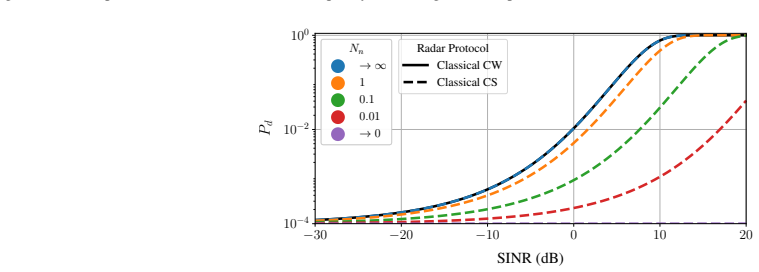
- Quantum radar protocols deliver higher detection probability than classical ones under low-power and high-noise conditions.
- The sum-rate increases while the radar sensing constraint remains satisfied, as verified by the successive convex approximation solution.
- The framework applies to scenarios where spectrum efficiency and hardware convergence are required.
Where Pith is reading between the lines
- Hardware prototypes could reveal how decoherence scales with distance and frequency in real channels.
- The same optimization structure might extend to multi-user or multi-target settings without changing the core formulation.
- Designers of future wireless systems could use the low-SINR quantum advantage to relax transmit power budgets while keeping sensing quality fixed.
Load-bearing premise
Quantum illumination radar can be embedded into base station hardware and channel models without major additional losses or decoherence that would invalidate the performance bounds.
What would settle it
A side-by-side measurement of achieved communication sum-rate and target detection probability for the quantum system versus a classical ISAC baseline, performed at low SINR in a controlled hardware testbed, would confirm or refute the reported throughput gains.
Figures




read the original abstract
Integrated sensing and communication (ISAC) is emerging as a key enabler for spectrum-efficient and hardware-converged wireless networks. However, classical radar systems within ISAC architectures face fundamental limitations under low signal power and high-noise conditions. This paper proposes a novel framework that embeds quantum illumination radar into a base station to simultaneously support full-duplex classical communication and quantum-enhanced target detection. The resulting integrated quantum sensing and classical communication (IQSCC) system is optimized via a sum-rate maximization formulation subject to radar sensing constraints. The non-convex joint optimization of transmit power and beamforming vectors is tackled using the successive convex approximation technique. Furthermore, we derive performance bounds for classical and quantum radar protocols under the statistical detection theory, highlighting the quantum advantage in low signal-to-interference-plus-noise ratio regimes. Simulation results demonstrate that the proposed IQSCC system achieves a higher communication throughput than the conventional ISAC baseline while satisfying the sensing requirement.
Editorial analysis
A structured set of objections, weighed in public.
Referee Report
Summary. The manuscript proposes an Integrated Quantum Sensing and Classical Communication (IQSCC) system embedding quantum illumination radar into a base station for simultaneous full-duplex classical communication and quantum-enhanced target detection. It formulates a sum-rate maximization problem subject to radar sensing constraints, solves the resulting non-convex joint optimization of transmit power and beamforming vectors via successive convex approximation (SCA), derives performance bounds for classical versus quantum radar protocols under statistical detection theory, and presents simulations claiming higher communication throughput than conventional ISAC baselines while meeting sensing requirements, with the quantum advantage emphasized in low-SINR regimes.
Significance. If the central claims hold after addressing the noted limitations, the work would offer a concrete optimization framework for quantum-enhanced ISAC and demonstrate potential throughput gains from quantum illumination in low-power regimes using standard tools (SCA and statistical detection bounds). The simulations supporting higher sum-rate under sensing constraints provide empirical grounding, but the overall significance depends on whether the derived quantum advantage survives realistic channel impairments.
major comments (1)
- [performance bounds derivation] The section deriving performance bounds for classical and quantum radar protocols (referenced in the abstract and used to support the low-SINR advantage): the quantum detection-probability improvement is derived under ideal entanglement preservation without explicit round-trip transmissivity loss (η) or decoherence terms in the ISAC wireless channel model. Standard quantum illumination results show this advantage vanishes for η ≲ 0.5 or imperfect idler-signal correlation; because the sensing constraint and the claim of quantum superiority in the optimization rest on these bounds, the omission is load-bearing for the central claim.
minor comments (2)
- [simulation results] The simulation results section would be strengthened by reporting the number of Monte Carlo trials, exact parameter values (e.g., specific η, decoherence rates, or SINR thresholds), and error bars or confidence intervals on the sum-rate curves.
- [system model] Notation for the beamforming vectors and power allocation variables should be introduced consistently in the system model section before their use in the SCA formulation.
Simulated Author's Rebuttal
We thank the referee for the constructive feedback on our manuscript. We address the major comment below and will revise the manuscript to strengthen the performance bounds section.
read point-by-point responses
-
Referee: The section deriving performance bounds for classical and quantum radar protocols (referenced in the abstract and used to support the low-SINR advantage): the quantum detection-probability improvement is derived under ideal entanglement preservation without explicit round-trip transmissivity loss (η) or decoherence terms in the ISAC wireless channel model. Standard quantum illumination results show this advantage vanishes for η ≲ 0.5 or imperfect idler-signal correlation; because the sensing constraint and the claim of quantum superiority in the optimization rest on these bounds, the omission is load-bearing for the central claim.
Authors: We acknowledge that the current derivation of the performance bounds assumes ideal entanglement preservation and does not explicitly include round-trip transmissivity loss η or decoherence terms. To address this limitation, we will revise the statistical detection theory analysis in the manuscript to incorporate these parameters. The updated bounds will model the effective quantum illumination channel with η and account for idler-signal correlation degradation, allowing us to re-derive the detection probability expressions and clarify the regimes where the quantum advantage holds under realistic ISAC conditions. This revision will directly support the sensing constraints in the sum-rate optimization and provide a more robust justification for the low-SINR claims. revision: yes
Circularity Check
No circularity: bounds and optimization derive from standard detection theory and SCA without reducing to self-fitted inputs or self-citations.
full rationale
The paper's central derivation uses statistical detection theory to obtain classical vs. quantum radar performance bounds and applies successive convex approximation to a standard sum-rate maximization problem subject to sensing constraints. These steps are independent of the target result; the quantum advantage in low-SINR regimes follows from the model assumptions rather than being presupposed or fitted by construction. No self-definitional loops, renamed predictions, or load-bearing self-citations appear in the described chain. The approach remains self-contained against external benchmarks.
Axiom & Free-Parameter Ledger
free parameters (1)
- Transmit power and beamforming vectors
axioms (1)
- domain assumption Quantum illumination provides detection advantage in low SINR regimes per statistical detection theory
Lean theorems connected to this paper
-
IndisputableMonolith/Cost/FunctionalEquation.leanwashburn_uniqueness_aczel unclear?
unclearRelation between the paper passage and the cited Recognition theorem.
We derive closed-form expressions for the optimal receive beamformers and utilize an iterative algorithm to solve the joint optimization problem. We derive the receiver operating characteristic (ROC) performance metrics for classical and quantum radar protocols under Gaussian noise.
-
IndisputableMonolith/Foundation/RealityFromDistinction.leanreality_from_one_distinction unclear?
unclearRelation between the paper passage and the cited Recognition theorem.
The QI radar employs entangled photon pairs generated in a TMSV state... AQI1 and AQI2 derived from correlation operator under lossy thermal channel.
What do these tags mean?
- matches
- The paper's claim is directly supported by a theorem in the formal canon.
- supports
- The theorem supports part of the paper's argument, but the paper may add assumptions or extra steps.
- extends
- The paper goes beyond the formal theorem; the theorem is a base layer rather than the whole result.
- uses
- The paper appears to rely on the theorem as machinery.
- contradicts
- The paper's claim conflicts with a theorem or certificate in the canon.
- unclear
- Pith found a possible connection, but the passage is too broad, indirect, or ambiguous to say the theorem truly supports the claim.
Reference graph
Works this paper leans on
-
[1]
Localization as a key enabler of 6G wireless systems: A comprehensive survey and an outlook,
S. E. Trevlakiset al., “Localization as a key enabler of 6G wireless systems: A comprehensive survey and an outlook,”IEEE Open J. Commun. Soc., vol. 4, pp. 2733–2801, 2023
work page 2023
-
[2]
5G networks enabling cooperative autonomous vehicle localization: A survey,
B. Zhou, Z. Liu, and H. Su, “5G networks enabling cooperative autonomous vehicle localization: A survey,”IEEE Trans. Intell. Transp. Syst., vol. 25, no. 11, pp. 15 291–15 313, Nov. 2024
work page 2024
-
[3]
Integrated sensing and communications: Recent advances and ten open challenges,
S. Luet al., “Integrated sensing and communications: Recent advances and ten open challenges,”IEEE Internet Things J., vol. 11, no. 11, pp. 19 094– 19 120, Jun. 2024
work page 2024
-
[4]
Integrated sensing and communications: Toward dual-functional wireless networks for 6G and beyond,
F. Liuet al., “Integrated sensing and communications: Toward dual-functional wireless networks for 6G and beyond,”IEEE J. Sel. Areas Commun., vol. 40, no. 6, pp. 1728–1767, Jun. 2022
work page 2022
-
[5]
Cramér-rao bound optimization for joint radar-communication beamforming,
——, “Cramér-rao bound optimization for joint radar-communication beamforming,”IEEE Trans. Signal Process., vol. 70, pp. 240–253, Dec. 2021
work page 2021
-
[6]
Full-duplex communication for ISAC: Joint beamforming and power optimization,
Z. Heet al., “Full-duplex communication for ISAC: Joint beamforming and power optimization,”IEEE J. Sel. Areas Commun., vol. 41, no. 9, pp. 2920–2936, Sep. 2023
work page 2023
-
[7]
Quantum-enhanced measurements: beating the standard quantum limit,
V . Giovannetti, S. Lloyd, and L. Maccone, “Quantum-enhanced measurements: beating the standard quantum limit,”Science, vol. 306, no. 5700, pp. 1330–1336, Nov. 2004
work page 2004
-
[8]
Enhanced sensitivity of photodetection via quantum illumination,
S. Lloyd, “Enhanced sensitivity of photodetection via quantum illumination,”Science, vol. 321, no. 5895, pp. 1463–1465, Sep. 2008
work page 2008
-
[9]
Quantum illumination with a hetero-homodyne receiver and sequential detection,
M. Reichertet al., “Quantum illumination with a hetero-homodyne receiver and sequential detection,”Phys. Rev. Appl., vol. 20, no. 1, Jul. 2023, Art. no. 014030
work page 2023
-
[10]
Microwave quantum illumination with correlation-to-displacement conversion,
J. Angelettiet al., “Microwave quantum illumination with correlation-to-displacement conversion,”Phys. Rev. Appl., vol. 20, no. 2, p. 024030, Aug. 2023
work page 2023
-
[11]
Microwave quantum illumination using a digital receiver,
S. Barzanjehet al., “Microwave quantum illumination using a digital receiver,”Sci. Adv., vol. 6, no. 19, p. eabb0451, May 2020
work page 2020
-
[12]
Quantum advantage in microwave quantum radar,
R. Assoulyet al., “Quantum advantage in microwave quantum radar,”Nature Phys., vol. 19, no. 10, pp. 1418–1422, Oct. 2023
work page 2023
-
[13]
Gaussian-state quantum-illumination receivers for target detection,
S. Guha and B. I. Erkmen, “Gaussian-state quantum-illumination receivers for target detection,”Physical Review A—Atomic, Molecular , and Optical Physics, vol. 80, no. 5, p. 052310, Nov. 2009
work page 2009
-
[14]
Quantum illumination with Gaussian states,
S.-H. Tanet al., “Quantum illumination with Gaussian states,”Phys. Rev. Lett., vol. 101, no. 25, p. 4, Dec. 2008, Art. no. 253601
work page 2008
-
[15]
Range limitations in microwave quantum radar,
G. Pavan and G. Galati, “Range limitations in microwave quantum radar,”Remote Sens., vol. 16, no. 14, p. 2543, Jul. 2024
work page 2024
-
[16]
Evaluating the detection range of microwave quantum illumination radar,
R. Weiet al., “Evaluating the detection range of microwave quantum illumination radar,”IET Radar , Sonar Navigat., vol. 17, no. 11, pp. 1664–1673, Aug. 2023
work page 2023
-
[17]
On the utility of quantum entanglement for joint communication and instantaneous detection,
Y . Yao and S. A. Jafar, “On the utility of quantum entanglement for joint communication and instantaneous detection,”IEEE Trans. Commun., pp. 1–1, 2025
work page 2025
-
[18]
Quantum integrated sensing and communication via entanglement,
Y .-C. Liuet al., “Quantum integrated sensing and communication via entanglement,”Phys. Rev. Lett., vol. 22, no. 3, p. 034051, Sep. 2024
work page 2024
-
[19]
Integrated distributed sensing and quantum communication networks,
Y . Xuet al., “Integrated distributed sensing and quantum communication networks,”Research, vol. 7, p. 0416, Aug. 2024
work page 2024
-
[20]
Joint quantum communication and sensing,
S.-Y . Wanget al., “Joint quantum communication and sensing,” inProc. IEEE Inf. Theory Workshop (ITW), Nov. 2022, pp. 506–511
work page 2022
-
[21]
Joint communication and sensing over the lossy bosonic quantum channel,
P. Munar-Vallespir and J. Nötzel, “Joint communication and sensing over the lossy bosonic quantum channel,” inProc. IEEE 10th World F orum Internet Things (WF-IoT), Nov. 2024, pp. 1–6
work page 2024
-
[22]
Joint communication and eavesdropper detection on the lossy bosonic channel,
P. Munar-Vallespir, J. Nötzel, and F. Seitz, “Joint communication and eavesdropper detection on the lossy bosonic channel,” inProc. IEEE Global Commun. Conf. (GLOBECOM), Dec. 2024, pp. 3473–3478
work page 2024
-
[23]
Engineering constraints and application regimes of quantum radar,
F. Bischeltsriederet al., “Engineering constraints and application regimes of quantum radar,”IEEE Trans. Radar Syst., vol. 2, pp. 197–214, Feb. 2024
work page 2024
-
[24]
S. P. Boyd and L. Vandenberghe,Convex Optimization. Cambridge, U.K.: Cambridge Univ. Press, 2004. 21
work page 2004
-
[25]
A. Hjørungnes,Complex-Valued Matrix Derivatives: With Applications in Signal Processing and Communications. Cambridge, U.K.: Cambridge Univ. Press, 2011
work page 2011
-
[26]
J. R. Magnus and H. Neudecker,Matrix Differential Calculus With Applications in Statistics and Econometrics. Hoboken, NJ, USA: Wiley, 1995
work page 1995
-
[27]
Receiver operating characteristics for a prototype quantum two-mode squeezing radar,
D. Luonget al., “Receiver operating characteristics for a prototype quantum two-mode squeezing radar,”IEEE Trans. Aerosp. Electron. Syst., vol. 56, no. 3, pp. 2041–2060, Jun. 2020
work page 2041
-
[28]
M. A. Richards, J. A. Scheer, and W. A. Holm,Principles of Modern Radar: Basic Principles. Raleigh, NC, USA: SciTech, 2010
work page 2010
-
[29]
S. M. Kay,Fundamentals of Statistical Signal Processing: Estimation Theory. Upper Saddle River, NJ, USA: Prentice-Hall, 1993
work page 1993
-
[30]
Code design to optimize radar detection performance under accuracy and similarity constraints,
A. De Maioet al., “Code design to optimize radar detection performance under accuracy and similarity constraints,”IEEE Trans. Signal Process., vol. 56, no. 11, pp. 5618–5629, Nov. 2008
work page 2008
-
[31]
C. Weedbrooket al., “Gaussian quantum information,”Rev. Mod. Phys., vol. 84, no. 2, pp. 621–669, May 2012
work page 2012
-
[32]
Millimeter-waves to terahertz SISO and MIMO continuous variable quantum key distribution,
M. Zhang, S. Pirandola, and K. Delfanazari, “Millimeter-waves to terahertz SISO and MIMO continuous variable quantum key distribution,”IEEE Trans. Quant. Eng., vol. 4, pp. 1–10, Apr. 2023
work page 2023
-
[33]
A. Alsaui, Y . Alghofaili, and D. Venkitesh, “Machine learning and time-series decomposition for phase extraction and symbol classification in CV-QKD,” Phys. Scr ., vol. 99, no. 7, p. 076008, Jun. 2024
work page 2024
-
[34]
Optical parametric amplification of spectrally incoherent pulses,
C. Dorrer, “Optical parametric amplification of spectrally incoherent pulses,”J. Opt. Soc. Amer . B, vol. 38, no. 3, pp. 792–804, Feb. 2021
work page 2021
-
[35]
Quantentheorie des einatomigen idealen gases. zweite abhandlung,
A. Einstein, “Quantentheorie des einatomigen idealen gases. zweite abhandlung,”Sitzungsberichte der Preussischen Akademie der Wissenschaften, Physikalisch-mathematische Klasse, pp. 3–14, Jan. 1925
work page 1925
-
[36]
Detecting a target with quantum entanglement,
G. Sorelliet al., “Detecting a target with quantum entanglement,”IEEE Aerosp. Electron. Syst. Mag., vol. 37, no. 5, pp. 68–90, Dec. 2021
work page 2021
-
[37]
The evaluation of the collision matrix,
G.-C. Wick, “The evaluation of the collision matrix,”Phys. Rev., vol. 80, no. 2, pp. 268–272, Oct. 1950
work page 1950
discussion (0)
Sign in with ORCID, Apple, or X to comment. Anyone can read and Pith papers without signing in.