A general framework for knowledge integration in machine learning for electromagnetic scattering using quasinormal modes
Pith reviewed 2026-05-18 17:59 UTC · model grok-4.3
The pith
Neural networks constrained by quasinormal modes learn resonant scattering structures while obeying energy conservation and causality.
A machine-rendered reading of the paper's core claim, the machinery that carries it, and where it could break.
Core claim
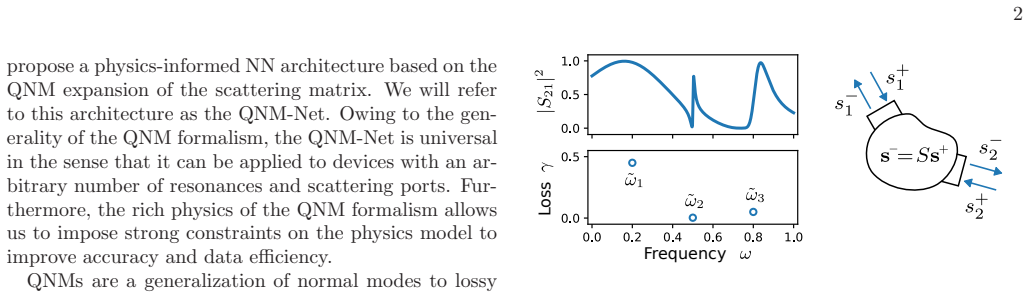
By basing the neural network architecture on the quasinormal mode expansion of the scattering matrix, the models learn the underlying resonant structure of the scattering spectrum, are guaranteed to obey energy conservation and causality, and exhibit significantly improved data efficiency for photonic-crystal slabs and all-dielectric free-form metasurfaces.
What carries the argument
The quasinormal mode expansion of the scattering matrix, which decomposes the scattering response into a sum of resonant terms that automatically satisfy physical constraints such as causality and energy conservation.
If this is right
- Models require substantially fewer training examples to achieve accurate predictions for photonic structures.
- Additional physical constraints such as losslessness or geometric symmetries can be imposed directly on the network.
- The framework extends to a broad class of electromagnetic devices due to the generality of the quasinormal mode formalism.
- Predictions remain physically valid even for inputs outside the training distribution in terms of conservation laws.
Where Pith is reading between the lines
- Similar modal decompositions could be used to inform neural networks in other wave scattering problems, such as acoustics or quantum mechanics.
- This integration of prior physics knowledge may reduce the need for large datasets in inverse design tasks for nanophotonics.
- Future work could test the framework's performance on structures with many overlapping resonances where truncation errors might appear.
Load-bearing premise
The quasinormal mode expansion must provide a sufficiently accurate and complete representation of the scattering matrix for the devices of interest, with negligible truncation error.
What would settle it
Train the network on a device with known significant truncation error in the quasinormal mode expansion and check whether the predicted scattering spectra violate energy conservation or causality when compared to full electromagnetic simulations.
Figures


read the original abstract
Neural networks have been demonstrated to be able to accelerate the modeling and inverse design of optical and electromagnetic devices by serving as fast surrogates for electromagnetic solvers. Nevertheless, such neural networks can be unreliable and normally require extreme amounts of data to train. Here it is shown that these limitations can be alleviated by constraining neural-network models using prior knowledge about the governing physics. We propose a universal physics-informed neural network framework for electromagnetic scattering based on the quasinormal mode expansion of the scattering matrix. The neural networks learn the resonant structure underlying the scattering spectrum, are guaranteed to obey energy conservation and causality, and are shown to have significantly improved data efficiency for photonic-crystal slabs and all-dielectric free-form metasurfaces. Furthermore, the framework allows additional problem-specific constraints, such as losslessness, symmetries, and number of modes, to be imposed manually when they are available. The method can be applied to a wide range of optical and electromagnetic devices owing to the generality of the quasinormal mode formalism.
Editorial analysis
A structured set of objections, weighed in public.
Referee Report
Summary. The manuscript proposes a universal physics-informed neural network framework for electromagnetic scattering based on the quasinormal mode (QNM) expansion of the scattering matrix. Neural networks learn resonant parameters while the modal structure enforces energy conservation and causality by construction; additional constraints such as losslessness or symmetries can be imposed manually. The approach is demonstrated on photonic-crystal slabs and all-dielectric free-form metasurfaces, with claims of significantly improved data efficiency.
Significance. If the central claims are substantiated, the work would provide a general, extensible route for embedding established modal physics into machine-learning surrogates for optics. This could improve model reliability and reduce data requirements for inverse design and fast modeling tasks across a range of electromagnetic devices.
major comments (2)
- [Methods (QNM expansion and truncation)] The guarantees of exact energy conservation and causality rest on the assumption that a finite QNM expansion sufficiently represents the scattering matrix for the target devices. For all-dielectric free-form metasurfaces the manuscript does not report quantitative reconstruction error (e.g., norm of the residual between the truncated and full scattering matrix) as a function of the manually chosen number of retained modes, leaving the exactness of the enforced constraints unverified.
- [Results (data-efficiency experiments)] The reported data-efficiency gains for free-form metasurfaces are presented without an accompanying ablation that isolates the contribution of the QNM constraints from possible under-resolution of the modal basis. Explicit comparison of validation error versus number of retained modes is needed to confirm that the observed improvements are not an artifact of an incomplete expansion.
minor comments (2)
- [Abstract and Introduction] The abstract and introduction would benefit from a concise statement of the precise form of the truncated QNM expansion used for the scattering matrix, including how the residual continuum is treated.
- [Figures] Figure captions should explicitly state the number of QNMs retained in each plotted comparison so that readers can assess truncation level directly.
Simulated Author's Rebuttal
We thank the referee for their constructive comments. We address each major comment below and will incorporate the suggested analyses in the revised manuscript.
read point-by-point responses
-
Referee: [Methods (QNM expansion and truncation)] The guarantees of exact energy conservation and causality rest on the assumption that a finite QNM expansion sufficiently represents the scattering matrix for the target devices. For all-dielectric free-form metasurfaces the manuscript does not report quantitative reconstruction error (e.g., norm of the residual between the truncated and full scattering matrix) as a function of the manually chosen number of retained modes, leaving the exactness of the enforced constraints unverified.
Authors: We agree that quantitative reconstruction errors are needed to verify the modal truncation. In the revised manuscript we will add the norm of the residual between the truncated and full scattering matrix as a function of the number of retained modes for the all-dielectric free-form metasurfaces, confirming that the chosen basis is sufficient for the enforced constraints. revision: yes
-
Referee: [Results (data-efficiency experiments)] The reported data-efficiency gains for free-form metasurfaces are presented without an accompanying ablation that isolates the contribution of the QNM constraints from possible under-resolution of the modal basis. Explicit comparison of validation error versus number of retained modes is needed to confirm that the observed improvements are not an artifact of an incomplete expansion.
Authors: We acknowledge the value of an explicit ablation. The revised manuscript will include validation error versus number of retained modes for the free-form metasurfaces, isolating the contribution of the QNM constraints from possible basis truncation effects and confirming that the reported data-efficiency gains are not an artifact of an incomplete expansion. revision: yes
Circularity Check
No circularity: framework applies established external QNM formalism to NN parameter learning
full rationale
The derivation chain relies on the quasinormal-mode expansion of the scattering matrix, which is an established result from prior literature in electromagnetic theory rather than a result derived or fitted within this paper. The neural network learns resonant parameters inside that pre-existing modal structure; the guarantees of energy conservation and causality follow directly from the analytic properties of the QNM expansion itself. No self-citation is load-bearing for the core constraints, no fitted input is relabeled as a prediction, and no ansatz or uniqueness claim is smuggled in via the authors' own prior work. The paper is therefore self-contained against external benchmarks and receives a zero circularity score.
Axiom & Free-Parameter Ledger
free parameters (1)
- number of retained modes
axioms (1)
- domain assumption Quasinormal modes provide a complete or sufficiently accurate expansion basis for the electromagnetic scattering matrix.
Lean theorems connected to this paper
-
IndisputableMonolith/Cost/FunctionalEquation.leanwashburn_uniqueness_aczel unclear?
unclearRelation between the paper passage and the cited Recognition theorem.
We propose a universal physics-informed neural network framework for electromagnetic scattering based on the quasinormal mode expansion of the scattering matrix... guaranteed to obey energy conservation and causality
-
IndisputableMonolith/Foundation/AlphaCoordinateFixation.leanJ_uniquely_calibrated_via_higher_derivative unclear?
unclearRelation between the paper passage and the cited Recognition theorem.
the QNM-Net requires only 2 % of the dataset... to achieve an S-MSE less than 10^{-3}
What do these tags mean?
- matches
- The paper's claim is directly supported by a theorem in the formal canon.
- supports
- The theorem supports part of the paper's argument, but the paper may add assumptions or extra steps.
- extends
- The paper goes beyond the formal theorem; the theorem is a base layer rather than the whole result.
- uses
- The paper appears to rely on the theorem as machinery.
- contradicts
- The paper's claim conflicts with a theorem or certificate in the canon.
- unclear
- Pith found a possible connection, but the passage is too broad, indirect, or ambiguous to say the theorem truly supports the claim.
Reference graph
Works this paper leans on
-
[1]
Many different versions of the expansion can be found in the literature [ 46, 47, 50, 51]. In this work, we use the form S(ω ) = eiωτ [C(ω )+ D(iω − i ˜Ω) − 1M − 1D†C(ω )]eiωτ , (3) which is approximate but specifically formulated to re- spect energy conservation even when a finite number of QNMs are included in the expansion [ 51], making it suit- able for ...
-
[2]
1 × 10− 4, which is close to the mean of the loss his- togram shown in Fig. 3(c). The histogram was evaluated on a test set separate from both validation and train- ing to avoid bias. For reference, we compare the QNM- Net to three standard fully-connected feed-forward NNs with varying numbers of trainable parameters. Similar architectures have been used ...
-
[3]
I. N. Da Silva, D. Hernane Spatti, R. Andrade Flauzino, L. H. B. Liboni, and dos Reis Alves, Artificial Neural Networks: A Practical Course (Springer, Cham, 2017)
work page 2017
-
[4]
B. Mehlig, Machine Learning with Neural Networks: An Introduction for Scientists and Engineers (Cambridge University Press, Cambridge, 2021)
work page 2021
-
[5]
R. Iten, T. Metger, H. Wilming, L. Del Rio, and R. Ren- ner, Discovering physical concepts with neural networks, Phys. Rev. Lett. 124, 010508 (2020)
work page 2020
- [6]
-
[7]
P. R. Wiecha, A. Arbouet, C. Girard, and O. L. Muskens, Deep learning in nano-photonics: Inverse design and be- yond, Photonics Res. 9, B182 (2021)
work page 2021
- [8]
- [9]
-
[10]
M. Zandehshahvar, Y. Kiarashi, M. Chen, R. Barton, and A. Adibi, Inverse design of photonic nanostructures using dimensionality reduction: Reducing the computational complexity, Opt. Lett. 46, 2634 (2021)
work page 2021
-
[11]
M. Zandehshahvar, Y. Kiarashinejad, M. Zhu, H. Maleki, T. Brown, and A. Adibi, Manifold learning for knowl- edge discovery and intelligent inverse design of pho- tonic nanostructures: Breaking the geometric complex- ity, ACS Photonics 9, 714 (2022)
work page 2022
-
[12]
N. Mohseni, T. F¨ osel, L. Guo, C. Navarrete-Benlloch, and F. Marquardt, Deep learning of quantum many-body dynamics via random driving, Quantum 6, 714 (2022)
work page 2022
-
[13]
J. Lee, D. Park, M. Lee, H. Lee, K. Park, I. Lee, and S. Ryu, Machine learning-based inverse design meth- ods considering data characteristics and design space size in materials design and manufacturing: a review, Mater. Horiz. 10, 5436 (2023)
work page 2023
-
[14]
M. Sanchez, C. Everly, and P. A. Postigo, Advances in machine learning optimization for classical and quantum photonics, J. Opt. Soc. Am. B 41, A177 (2024)
work page 2024
- [15]
-
[16]
L. Su, D. Vercruysse, J. Skarda, N. V. Sapra, J. A. Petykiewicz, and J. Vuˇ ckovi´ c, Nanophotonic inverse de- sign with SPINS: Software architecture and practical con- siderations, Appl. Phys. Rev. 7, 011407 (2020)
work page 2020
-
[17]
O. Tsilipakos, G. Perrakis, M. Farsari, and M. Kafe- saki, Polymeric optical metasurfaces by two-photon lithography: Practical designs for beam steering, in Metamaterials 2024 (2024) pp. 1–3
work page 2024
-
[18]
R. S. Hegde, Photonics inverse design: pairing deep neu - ral networks with evolutionary algorithms, IEEE J. Sel. Top. Quantum Electron. 26, 1 (2019)
work page 2019
-
[19]
S. So, T. Badloe, J. Noh, J. Bravo-Abad, and J. Rho, Deep learning enabled inverse design in nanophotonics, Nanophotonics 9, 1041 (2020)
work page 2020
-
[20]
Y. Deng, S. Ren, K. Fan, J. M. Malof, and W. J. Padilla, Neural-adjoint method for the inverse design of all- dielectric metasurfaces, Opt. Express 29, 7526 (2021)
work page 2021
-
[21]
Y. Yan, F. Li, J. Shen, M. Zhuang, Y. Gao, W. Chen, Y. Li, Z. Wu, Z. Dong, and J. Zhu, Highly intelligent forward design of metamaterials empowered by circuit-physics-driven deep learning, Laser Photonics Rev. , 2400724 (2024)
work page 2024
-
[22]
C. C. Nadell, B. Huang, J. M. Malof, and W. J. Padilla, Deep learning for accelerated all-dielectric metasurface design, Opt. Express 27, 27523 (2019)
work page 2019
- [23]
-
[24]
L. Xu, M. Rahmani, Y. Ma, D. A. Smirnova, K. Z. Kamali, F. Deng, Y. K. Chiang, L. Huang, H. Zhang, S. Gould, D. N. Neshev, and A. E. Mirosh- nichenko, Enhanced light–matter interactions in di- electric nanostructures via machine-learning approach, Adv. Photonics 2, 026003 (2020)
work page 2020
-
[25]
Y. Jing, H. Chu, B. Huang, J. Luo, W. Wang, and Y. Lai, A deep neural network for general scattering matrix, Nanophotonics 12, 2583 (2023)
work page 2023
-
[26]
A.-P. Blanchard-Dionne and O. J. F. Martin, Teaching optics to a machine learning network, Opt. Lett. 45, 2922 (2020)
work page 2020
- [27]
-
[28]
S. So, J. Mun, and J. Rho, Simultaneous In- verse Design of Materials and Structures via Deep Learning: Demonstration of Dipole Reso- nance Engineering Using Core–Shell Nanoparticles, ACS Appl. Mater. Interfaces 11, 24264 (2019)
work page 2019
-
[29]
X. Ma, Y. Ma, P. Cunha, Q. Liu, K. Kudtarkar, D. Xu, J. Wang, Y. Chen, Z. J. Wong, M. Liu, M. C. Hipwell, and S. Lan, Strategical Deep Learn- ing for Photonic Bound States in the Continuum, Laser Photonics Rev. 16, 2100658 (2022)
work page 2022
- [30]
-
[31]
W. Ma, F. Cheng, Y. Xu, Q. Wen, and Y. Liu, Probabilis- tic Representation and Inverse Design of Metamaterials 6 Based on a Deep Generative Model with Semi-Supervised Learning Strategy, Adv. Mater. 31, 1901111 (2019)
work page 2019
-
[32]
Z. Liu, D. Zhu, S. P. Rodrigues, K.-T. Lee, and W. Cai, Generative Model for the Inverse Design of Metasurfaces, Nano Lett. 18, 6570 (2018)
work page 2018
-
[33]
J. Xu, P. Xu, Z. Yang, F. Liu, L. Xu, J. Lou, B. Fang, and X. Jing, Freeform metasurface de- sign with a conditional generative adversarial network, Appl. Phys. A 130, 530 (2024)
work page 2024
-
[34]
T. Gahlmann and P. Tassin, Deep neural net- works for the prediction of the optical properties and the free-form inverse design of metamaterials, Phys. Rev. B 106, 085408 (2022)
work page 2022
- [35]
-
[36]
M. H. Tahersima, K. Kojima, T. Koike-Akino, D. Jha, B. Wang, C. Lin, and K. Parsons, Deep Neural Network Inverse Design of Integrated Photonic Power Splitters, Sci. Rep. 9, 1368 (2019)
work page 2019
-
[37]
Y. Qian, B. Ni, Z. Feng, H. Ni, X. Zhou, L. Yang, and J. Chang, Deep Learning for the Design of Random Cod- ing Metasurfaces, Plasmonics 18, 1941 (2023)
work page 1941
-
[38]
D. Liu, Y. Tan, E. Khoram, and Z. Yu, Training Deep Neural Networks for the Inverse Design of Nanophotonic Structures, ACS Photonics 5, 1365 (2018)
work page 2018
-
[39]
G. You, C. Qian, S. Tan, E. Li, and H. Chen, Driving deep-learning-based metasurface design with Kramers- Kronig relations, Phys. Rev. Appl. 22, L041002 (2024)
work page 2024
-
[40]
R. E. Collin, Field Theory of Guided Waves (Wiley- Interscience-IEEE, 1991)
work page 1991
-
[41]
J. L. Su, J. W. You, L. Chen, X. Y. Yu, Q. C. Yin, G. H. Yuan, S. Q. Huang, Q. Ma, J. N. Zhang, and T. J. Cui, MetaPhyNet: Intelligent design of large-scale metasurfaces based on physics-driven neural network, J. Phys. Photonics 6, 035010 (2024)
work page 2024
-
[42]
Z. A. Kudyshev, A. V. Kildishev, V. M. Shalaev, and A. Boltasseva, Machine learning–assisted global opti- mization of photonic devices, Nanophotonics 10, 371 (2021)
work page 2021
-
[43]
S. W. Kim, I. Kim, J. Lee, and S. Lee, Knowl- edge Integration into deep learning in dy- namical systems: An overview and taxonomy, J. Mech. Sci. Technol. 35, 1331 (2021)
work page 2021
-
[44]
G. E. Karniadakis, I. G. Kevrekidis, L. Lu, P. Perdikari s, S. Wang, and L. Yang, Physics-informed machine learn- ing, Nat. Rev. Phys. 3, 422 (2021)
work page 2021
- [45]
-
[46]
X. Ding, V. Devabhaktuni, B. Chattaraj, M. Yagoub, M. Deo, J. Xu, and Q. J. Zhang, Neural-network approaches to electromagnetic-based modeling of pas- sive components and their applications to high- frequency and high-speed nonlinear circuit optimization, IEEE Trans. Microwave Theory Tech. 52, 436 (2004)
work page 2004
-
[47]
S. Liu, F. Feng, X. Huang, M. Li, X. Li, J. Liu, W. Liu, and Q.-J. Zhang, Novel Neuro-Coupling Matrix Technique for Parametric Modeling of Microwave Filters, IEEE Microwave Wireless Technol. Lett. 34, 871 (2024)
work page 2024
-
[48]
F. Alpeggiani, N. Parappurath, E. Verhagen, and L. Kuipers, Quasinormal-Mode Expansion of the Scat- tering Matrix, Phys. Rev. X 7, 021035 (2017)
work page 2017
-
[49]
H. Zhang and O. D. Miller, Quasinormal Coupled Mode Theory (2020), arXiv:2010.08650
-
[50]
P. Lalanne, W. Yan, K. Vynck, C. Sauvan, and J.-P. Hugonin, Light Interaction with Photonic and Plasmonic Resonances, Laser Photonics Rev. 12, 1700113 (2018)
work page 2018
-
[51]
P. T. Kristensen, K. Herrmann, F. Intra- vaia, and K. Busch, Modeling electromag- netic resonators using quasinormal modes, Adv. Opt. Photonics 12, 612 (2020)
work page 2020
-
[52]
T. Weiss and E. A. Muljarov, How to calculate the pole expansion of the optical scattering matrix from the reso- nant states, Phys. Rev. B 98, 085433 (2018)
work page 2018
-
[53]
M. Benzaouia, J. D. Joannopoulos, S. G. Johnson, and A. Karalis, Quasi-normal mode theory of the scattering matrix, enforcing fundamental constraints for truncated expansions, Phys. Rev. Res. 3, 033228 (2021)
work page 2021
-
[54]
T. Gahlmann and P. Tassin, Evaluation of machine learn- ing techniques for conditional generative adversarial net - works in inverse design (2025), arXiv:2502.11934
-
[55]
Densely Connected Convolutional Networks
G. Huang, Z. Liu, L. van der Maaten, and K. Q. Weinberger, Densely Connected Convolutional Networks (2018), arXiv:1608.06993
work page internal anchor Pith review Pith/arXiv arXiv 2018
-
[56]
S. Raza, M. Hammood, N. A. F. Jaeger, and L. Chrostowski, Fabrication-aware inverse design with shape optimization for photonic integrated circuits, Opt. Lett. 50, 117 (2025)
work page 2025
-
[57]
R. P. Jenkins, S. D. Campbell, and D. H. Werner, Estab- lishing exhaustive metasurface robustness against fabrication uncertainties through deep learning, Nanophotonics 10, 4497 (2021) . Appendix A: Comparison to eigenmode simulations — Predictions made by physics-informed models operating according to the principle shown in schematic (
work page 2021
-
[58]
are ex- plainable in terms of the network-predicted physics pa- rameters, which for the QNM-Net are C(ω ), ˜ω m, dm, and τn. Based on the theoretical foundations of the QNM ex- pansion, we know that ˜ ω m correspond exactly to eigen- frequencies Maxwell’s equations ( 2). Thus, the accuracy of the learned physics can be verified by comparing the network-pre...
discussion (0)
Sign in with ORCID, Apple, or X to comment. Anyone can read and Pith papers without signing in.