REVIEW 3 major objections 5 minor 20 references
Context-Adaptive Hearing Aid Fitting Advisor through Multi-turn Multimodal LLM Conversation
T0 review · 3 major / 5 minor · reviewed 2026-08-04 · deepseek-v4-flash
Pith's one-line read CAFA claims that a conversational multi-agent LLM system, grounded in live ambient sound and the user's audiogram, can generate safe, personalized hearing-aid fitting adjustments, and that real-time sound classification specifically shorten
desk verdict Useful 4-page systems paper whose central efficiency claim still rides on a single simulated ablation; the architecture and the sound classifier are the real contributions. read the letter →
The pith
A machine-rendered reading of the paper's core claim, the machinery that carries it, and where it could break.
The reading
What carries the argument
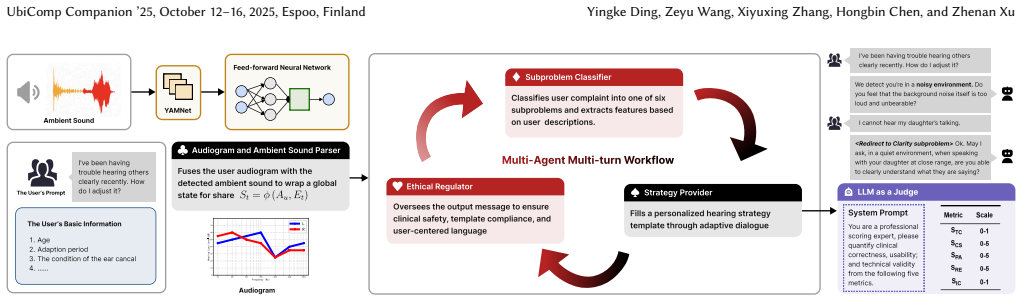
The load-bearing object is a multi-agent LLM workflow with four cooperating agents. A Context Acquisition agent (the 'Audiogram and Ambient Sound Parser') fuses the user's eight-band audiogram with the ambient-sound classifier's output into a shared state vector; a Subproblem Classifier maps the complaint to one of six fitting problems (noise, distortion, clarity, loudness, blocked ears, howl); a Strategy Provider runs a slot-filling dialogue, picking the next question by an information-gain heuristic over a strategy template's mandatory fields; and an Ethical Regulator reviews the final script and JSON parameter payload for clinical safety before an independent LLM Judge scores the output o
What would settle it
Run the pre-registered 10-participant within-subjects human study: have mild-to-moderate hearing-aid users complete fitting tasks in both CAFA and a conventional audiologist-style conversation, and measure conversational turns, task completion time, and correctness of the final settings. If CAFA does not reduce turns or time relative to the baseline, or if users reject its recommendations, the central efficiency claim fails. Separately, test the sound classifier on non-English, real-world acoustic scenes; if accuracy on conversation versus noise falls far below 91.2%, the context signal drivin
Extended reading notes
Core claim
CAFA's central claim is that a multi-agent large-language-model workflow can translate a hearing-aid user's free-text complaint, audiogram, and live ambient sound into personalized, clinically safe fitting recommendations through multi-turn dialogue. The ambient sound classifier, built by fine-tuning a lightweight feed-forward head on embeddings from a frozen pretrained audio network, reaches 91.2% accuracy on a three-class conversation/noise/quiet task, and the four agents—context parser, subproblem classifier, strategy provider, ethical regulator—are orchestrated under an independent LLM judge. On six canonical fitting problems with 130 synthetic user sessions, the judge scored the system
Load-bearing premise
The load-bearing premise is that the simulated virtual users created with a commercial LLM reliably behave like real hearing-aid users, so the measured shortening of dialogue turns (9.4 to 6.7) is a valid estimate of conversational efficiency; the authors have not yet reported human data.
Editorial extensions
If this is right
- Hearing-aid users could have routine fitting adjustments guided by a phone conversation, without a clinic visit or a remote audiologist in the loop.
- Ambient-sound context becomes a first-class input to the fitting dialogue, so recommendations reflect the user's current acoustic environment rather than a static profile.
- The modular agent pipeline is reusable: a different strategy book and classifier could adapt the same dialogue mechanism to other assistive or clinical devices.
- Because the LLM can ask clarifying questions, occasional ambient-classification errors need not produce wrong adjustments; the dialogue acts as a second safety layer.
- The measured dialogue shortening (6.7 vs 9.4 turns) suggests context-aware systems reduce user burden in iterative device configuration.
Reading between the lines
- The 9.4-to-6.7 turn reduction comes entirely from simulated users powered by a commercial LLM; whether real hearing-aid users show the same efficiency gain will only be settled by the planned 10-participant human study, so the human replication is the natural next test.
- The six-subproblem taxonomy and slot-filling strategy book could transfer to other audiology complaints (tinnitus, speech-in-noise training) with modest prompt and template changes.
- A testable extension is multilingual and non-Western acoustic data: the authors note their corpus is English-centric, so the 91.2% accuracy and conversational benefits may not hold in other soundscapes.
- The information-gain slot-selection heuristic has wider use beyond hearing aids: any diagnostic or intake conversation where an LLM must decide which missing piece of information is most valuable to ask next.
Editorial analysis
A structured set of objections, weighed in public.
Referee Report
Summary. The paper proposes CAFA, a multi-agent LLM-based hearing aid fitting advisor that combines a lightweight YAMNet-based ambient sound classifier (conversation/noise/quiet) with audiogram data and user complaints in a multi-turn dialogue. The system uses four agents (parser, subproblem classifier, strategy provider, ethical regulator) plus an independent LLM Judge, and outputs personalized hearing aid tuning commands. Evaluation consists of a 91.2% ambient sound classification accuracy, LLM Judge scores on five rubric metrics, and a synthetic ablation of 130 GPT-4o-simulated sessions in which removing the ambient-sound parser increased mean dialogue length from 6.7 to 9.4 turns. A 10-participant human user study is described as under IRB review and no human data are reported.
Significance. If the claims were fully supported, CAFA would be a useful contribution to context-aware, conversational hearing aid fitting: the modular multi-agent workflow is clearly described, the use of live ambient sound to drive dialogue is sensible, and the lightweight classifier is appropriate for on-device deployment. The paper's strengths are its concrete system architecture and the inclusion of an ablation isolating the ambient-sound parser. However, the current evidence is preliminary and largely self-referential: the main efficiency claim rests entirely on a synthetic simulator, the safety/personalization scores are produced by an LLM rubric without external validation, and the classifier accuracy lacks basic statistical detail. The significance is therefore conditional on substantially stronger evaluation or appropriately weakened claims.
major comments (3)
- [§3.3 and Abstract] The central claim that 'real-time sound classification enhances conversational efficiency' is supported only by the synthetic ablation comparing mean turns of 6.7 vs 9.4. No variance, confidence interval, significance test, or human baseline is reported. Section 3.4 explicitly concedes that 'synthetic users cannot fully represent human behavior,' and the simulator's tendency to 'repeatedly query for context' could be an artifact of its prompt-engineered slot-filling policy rather than a measured property of real hearing aid users. Please report per-condition distributions and a statistical test, or substantially temper the efficiency claim until human data (§3.1.3) are available.
- [§3.1.2 and Table 1] The LLM Judge scores (STC=0.73, SCS=4.25, SPA=3.07, SRE=4.76, SIC=0.95) are used to support the system's safety and personalization. Two licensed audiologists provided gold-standard labels in §3.1.2, but there is no evidence that the Judge's scores agree with those labels. Without inter-rater agreement (e.g., Cohen's kappa on subproblem classification or correlation on safety ratings), the evaluation is circular in the sense that the workflow is judged against the authors' own rubric with no external anchor. Please add a human-agreement analysis or clearly label these scores as internal quality-control metrics rather than validated outcome measures.
- [§3.2.1 / §2.1.1] The 91.2% classification accuracy is reported without dataset split details, number of clips per class, class balance after splitting, or confidence intervals. Section 2.1.1 states the dataset is balanced but gives no sizes or exact composition; the residual confusion between conversation and noise is described qualitatively. Without knowing how many test samples were used and how the split was performed, the reader cannot assess the reliability of the headline accuracy. Please provide the dataset size, split method, per-class results, and confidence intervals.
minor comments (5)
- [Conclusion] Typo: 'awares ambient sound' should be 'is aware of ambient sound' or 'adapts to ambient sound.'
- [Abstract] The phrase 'well-rounded conversation metrics score' is vague; consider listing the specific metrics or omitting this phrase.
- [Figure 1 caption] The caption contains a redundant '(Fig. 1)' inside itself; clean up the cross-reference.
- [§2.2.1, Eq. (1)] The information-gain heuristic divides by |S_empty|, which is constant across the arg max, so it is equivalent to selecting the highest-entropy slot. If the intended behavior is different, clarify the formula; otherwise simplify.
- [Table 1] The Readability & Empathy metric uses 'Flesch≥60 equivalence' for Chinese-language prompts, but a Flesch score is English-specific. Please describe how readability was computed for Chinese text.
Circularity Check
No significant circularity found; the system's claims rest on external components and measured ablations, not on self-referential derivation.
full rationale
The paper does not exhibit definitional circularity, fitted-input-called-prediction, or load-bearing self-citation. The ambient-sound classifier is trained on an external dataset (MS-SNSD plus self-recorded quiet samples) using YAMNet embeddings from AudioSet, and its 91.2% accuracy is a measured held-out result, not a fitted target. The LLM workflow is a modular pipeline whose components are described independently. The main efficiency claim ('removing the ambient-sound parser agent increased dialogue length from an average of 6.7 to 9.4 turns') is a direct ablation measurement, not a quantity that is equivalent to an input by construction. The LLM Judge rubric, though internally defined, is used as a post-hoc evaluation protocol rather than as a parameter fitted to the data; the template-compliance score measuring adherence to the authors' own template is a consistency check, not a derivation of the system's capability from its design. The one self-citation ([18], DreamCatcher, by two of the present authors) is used only to support the general premise that ambient-sound classification is a prerequisite for context-adaptive fitting; it is not load-bearing for any of the paper's quantitative claims. The acknowledged limitation that synthetic users 'cannot fully represent human behavior' is a validity concern about the simulation-based evaluation, not a circularity: the turn-count result is an empirical observation within that simulation, however imperfect its external validity. No equation in the paper reduces to another, and no prediction is simply a renamed input. The paper is self-contained against external benchmarks for the classifier and reports internal ablations for the conversational loop. Therefore the appropriate circularity score is 0.
Assumptions & free parameters
free parameters (3)
- Turn limit =
10
- LLM sampling temperature =
0.7
- Question-ordering heuristic =
argmax_s H(allowed(s)) / |S_empty|
assumptions (5)
- domain assumption YAMNet embeddings trained on AudioSet are a suitable feature extractor for hearing-aid ambient sound
- domain assumption The 8-band audiogram vector represents hearing loss sufficiently for fitting advice
- domain assumption LLM API outputs are stable enough for evaluation
- ad hoc to paper The LLM Judge's scores are a valid proxy for clinical correctness and safety
- ad hoc to paper Synthetic GPT-4o virtual users reproduce human dialogue behavior
Cite this review
Pith. "Pith review of Context-Adaptive Hearing Aid Fitting Advisor through Multi-turn Multimodal LLM Conversation." pith.science (2026). https://pith.science/paper/GEAE25JA
@misc{pith2026250906382,
  author       = {Pith},
  title        = {Pith review of: Context-Adaptive Hearing Aid Fitting Advisor through Multi-turn Multimodal LLM Conversation},
  year         = {2026},
  howpublished = {\url{https://pith.science/paper/GEAE25JA}},
  note         = {Machine review of arXiv:2509.06382}
}
read the original abstract
Traditional hearing aids often rely on static fittings that fail to adapt to their dynamic acoustic environments. We propose CAFA, a Context-Adaptive Fitting Advisor that provides personalized, real-time hearing aid adjustments through a multi-agent Large Language Model (LLM) workflow. CAFA combines live ambient audio, audiograms, and user feedback in a multi-turn conversational system. Ambient sound is classified into conversation, noise, or quiet with 91.2\% accuracy using a lightweight neural network based on YAMNet embeddings. This system utilizes a modular LLM workflow, comprising context acquisition, subproblem classification, strategy provision, and ethical regulation, and is overseen by an LLM Judge. The workflow translates context and feedback into precise, safe tuning commands. Evaluation confirms that real-time sound classification enhances conversational efficiency. CAFA exemplifies how agentic, multimodal AI can enable intelligent, user-centric assistive technologies.
Figures
Reference graph
Works this paper leans on
-
[1]
D. A Fabry and A. K Bhowmik. 2021. Improving speech understanding and monitoring health with hearing aids using AI and sensors. InSeminars in Hearing
work page 2021
-
[2]
J. F. Gemmeke, D. P. W. Ellis, D. Freedman, A. Jansen, W. Lawrence, R. C. Moore, M. Plakal, and M. Ritter. 2017. Audio Set: An Ontology and Human-Labeled Dataset for Audio Events. InICASSP
work page 2017
-
[3]
Google. 2019. YAMNet: A pretrained audio event classifier
work page 2019
-
[4]
D. Guo, D. Yang, H. Zhang, J. Song, R. Zhang, R. Xu, Q. Zhu, S. Ma, P. Wang, X. Bi, et al. 2025. Deepseek-r1: Incentivizing Reasoning Capability in LLMs via Reinforcement Learning.arXiv preprint arXiv:2501.12948(2025)
arXiv 2025
-
[5]
Donald Hayes. 2021. Environmental classification in hearing aids. InSeminars in Hearing, Vol. 42. 186–205
work page 2021
-
[6]
E. H. Hoydal, N. S. Jensen, R.-L. Fischer, S. Haag, and B. Taylor. 2021. AI Assistant Improves Both Wearer Outcomes and Clinical Efficiency.The Hearing Review28, 11 (2021), 20–23
work page 2021
- [7]
-
[8]
Benjamin Johansen, Michael Kai Petersen, Maciej Jan Korzepa, Jan Larsen, Niels Henrik Pontoppidan, and Jakob Eg Larsen. 2018. Personalizing the Fitting of Hearing Aids by Learning Contextual Preferences From Internet of Things Data.Computers7, 1 (2018). doi:10.3390/computers7010001
Show all 20 references
-
[9]
Jorgensen, J
E. Jorgensen, J. Xu, O. Chipara, J. Oleson, J. Galster, and Y.-H. Wu. 2023. Audi- tory environments and hearing aid feature activation among younger and older listeners in urban and rural areas.Ear Hear.44, 3 (2023), 603–618
2023
-
[10]
Y. Kim, C. Park, H. Jeong, Y. S. Chan, X. Xu, et al. 2024. MDAgents: An Adaptive Collaboration of LLMs for Medical Decision-Making. InNeurIPS. 79410–79452
2024
-
[11]
Maciej Jan Korzepa, Benjamin Johansen, Michael Kai Petersen, Jan Larsen, Jakob Eg Larsen, and Niels Henrik Pontoppidan. 2018. Learning preferences and soundscapes for augmented hearing. InProc. IUI
2018
-
[12]
LangGenius. 2025. Dify: Agentic Workflow Platform. https://github.com/ langgenius/dify. Accessed: 2025-07-10
2025
-
[13]
M. M. Lucas, J. Yang, J. K. Pomeroy, and C. C. Yang. 2024. Reasoning with LLMs for medical question answering.JAMIA31, 9 (2024), 1964–1975
2024
-
[14]
Aoxin Ni, Sara Akbarzadeh, Edward Lobarinas, and Nasser Kehtarnavaz. 2022. Personalization of hearing aid fitting via adaptive dynamic range optimization. Sensors22, 16 (2022), 6033
2022
-
[15]
Pasta, M
A. Pasta, M. K. Petersen, K. J. Jensen, N. H. Pontoppidan, J. E. Larsen, and J. H. Christensen. 2022. Measuring and modeling context-dependent preferences for hearing aid settings.User Model. User-Adapt. Interact.32, 5 (2022), 977–998
2022
-
[16]
Chandan KA Reddy, Ebrahim Beyrami, Jamie Pool, Ross Cutler, Sriram Srini- vasan, and Johannes Gehrke. 2019. A Scalable Noisy Speech Dataset and Online Subjective Test Framework.Proc. Interspeech(2019), 1816–1820
2019
-
[17]
Els Walravens, Gitte Keidser, and Louise Hickson. 2020. Consistency of hearing aid setting preference in simulated real-world environments: Implications for trainable hearing aids.Trends in Hearing24 (2020), 2331216520933392
2020
-
[18]
Z. Wang, X. Zhang, R. Yu, Y. Wang, K. Christofferson, J. Zhang, A. Mariakakis, and Y. Shi. 2024. DreamCatcher: A Wearer-aware Multi-modal Sleep Event Dataset Based on Earables in Non-restrictive Environments.Advances in Neural Information Processing Systems(2024)
2024
-
[19]
World Health Organization. 2025. Deafness and hearing loss
2025
-
[20]
H. Xie, Y. Chen, X. Xing, J. Lin, and X. Xu. 2024. PsyDT: Digital Twin of Counselor with Personalized Style.arXiv preprint arXiv:2412.13660(2024)
2024 arXiv
Reviewed August 4, 2026 · model on record in the stance chip above.
Discussion (0). Sign in to comment.