REVIEW 3 major objections 5 minor 50 references
The Shape of AGN-Driven Winds in the Seyfert Galaxy NGC 3516
T0 review · 3 major / 5 minor · reviewed 2026-08-04 · deepseek-v4-flash
Pith's one-line read AGN wind in NGC 3516 fits an edge-on bicone model
desk verdict A solid new biconical kinematic model for NGC 3516 that resolves an old ambiguity, but the abstract oversells the radiative-driving 'match' — the paper's own numbers give a factor-of-five gap. read the letter →
The pith
A machine-rendered reading of the paper's core claim, the machinery that carries it, and where it could break.
The reading
What carries the argument
The bicone model: a symmetric pair of empty cones of ionizing radiation, parameterized by position angle, inclination, inner/outer opening angles, turnover radius, maximum velocity, and maximum height. It generates projected velocity envelopes for any slit orientation, which are matched to the observed radial velocities. The radiative-driving equation v(r) = sqrt( integral [4885 L44 M / r^2 - 8.6e-3 M(r) / r^2] dr ) computes cloud trajectories balancing AGN radiation pressure against gravitational deceleration; the turnover radius where velocity peaks is compared to the kinematic turnover from the bicone model.
What would settle it
Measure the actual NLR column densities and ionization parameters (e.g., from spatially resolved [O III]/H-beta ratios or UV absorption column ratios) and obtain a longer-baseline SED-based bolometric luminosity; recompute the radiative-driving turnover. If the kinematic turnover at ~210 pc no longer falls near the model curve for any plausible force multiplier, the radiation-pressure-plus-gravity interpretation would be disfavored.
Extended reading notes
Core claim
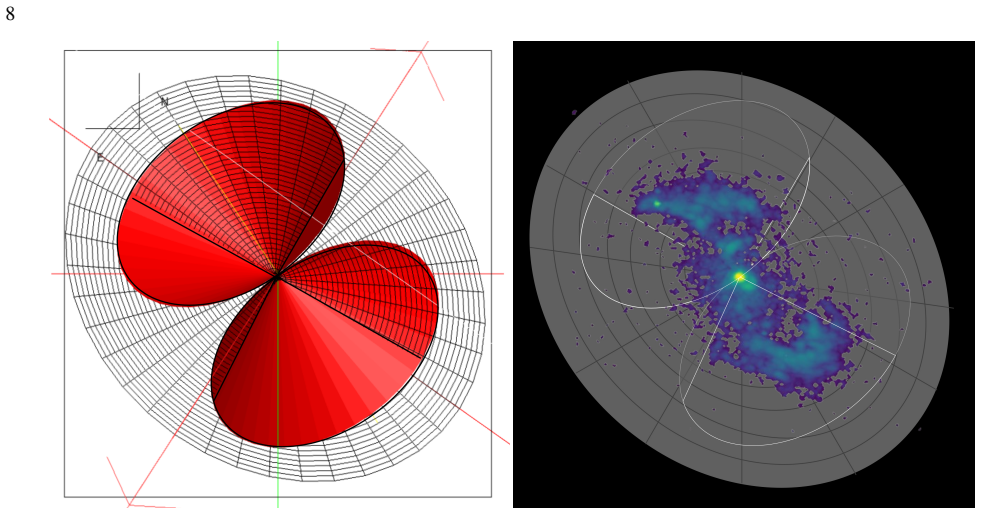
The central claim is that NGC 3516's narrow-line region contains a biconical outflow viewed along one edge. The authors fit multiple Gaussian components to H-alpha, H-beta, [N II], and [O III] lines from STIS and KOSMOS long-slit spectra at several position angles, allowing them to separate rotation from outflow. The resulting bicone model (position angle ~35 degrees, inclination ~40 degrees, opening angles 45-55 degrees, turnover radius 210 +/- 30 pc, maximum height ~750 pc, maximum velocity ~1000 km/s) reproduces the kinematic envelopes along all slits, including the confinement of high radial velocities to the nucleus. The apparent Z-shape of the [O III] emission is explained as the inter
Load-bearing premise
The radiative-driving comparison assumes a single representative force multiplier (~1000), column density, ionization parameter, and an [O III]-derived bolometric luminosity; if these adopted values are wrong, the predicted turnover and launch radii change substantially.
Editorial extensions
If this is right
- If the model is correct, NGC 3516 joins nearby Seyferts whose narrow-line region outflows are driven by AGN radiation pressure, meaning AGN luminosity directly controls sub-kiloparsec gas kinematics.
- The edge-on bicone view unifies the emission-line kinematics with the multiple UV and X-ray absorption components, showing that absorption and emission trace the same filled bicone.
- The apparent Z-shaped [O III] morphology arises from the disk-bicone intersection, so the apparent NLR shape does not directly trace the true outflow axis.
- For the adopted parameters, the outflowing clouds are launched from the inner dusty spirals 4-40 pc from the black hole, linking the wind's origin to the galactic-scale gas distribution.
Reading between the lines
- If the edge-on interpretation holds for NGC 3516, other Seyfert 1 galaxies with strong absorption systems and confusing nuclear kinematics may also be viewed along the bicone edge, changing how their outflows are deprojected and measured.
- The paper's own sensitivity range (force multiplier 500-3000) shifts the model turnover only about +/-15 pc, but a larger change in Lbol or column density could move it substantially; direct SED-based estimates of the long-term luminosity would test the radiative-driving match.
- A spatially resolved map of the NLR density and ionization parameter would allow a data-driven force multiplier rather than an assumed value; if the true turnover then no longer tracks the radiation-pressure curve, additional forces such as magnetic pressure or wind entrainment would need consideration.
Signed reviews
Editorial analysis
A structured set of objections, weighed in public.
Referee Report
Summary. The paper analyzes the NLR kinematics of the Seyfert 1 galaxy NGC 3516 using archival HST/STIS long-slit spectra and new APO/KOSMOS observations at multiple position angles. Emission lines are decomposed into multiple Gaussian components with the BEAT code, revealing high-velocity nuclear components within ~1" and a mixture of rotation and outflow out to ~7". The authors construct a biconical kinematic model viewed along one edge, with parameters listed in Table 2 (bicone PA=35°, inclination=40°, inner/outer opening angles 45°/55°, maximum velocity 1000 km/s, turnover radius 210 pc, maximum height 750 pc). They argue that the Z-shaped [O III] morphology arises from dusty gas spirals in the disk illuminated by the ionizing bicone, and that the edge-on viewing geometry explains the multiple UV/X-ray absorption components. They then compare the kinematic turnover radius to an analytic radiative-driving plus gravitational-deceleration model (Eq. 1), finding a model turnover of 40±15 pc versus the observed 210 pc, which they describe as agreement 'within a factor of ~5'; this comparison is used to conclude that radiative acceleration and gravity are the principal forces and that cloud launch radii are 4–40 pc.
Significance. If correct, the paper would resolve a long-standing kinematic degeneracy in NGC 3516 and connect the NLR emission geometry with the nuclear absorption components. The primary strengths are the new KOSMOS observations, the systematic BEAT fitting, the explicit parameter table, and the placement of the result in the context of a nine-galaxy comparison. The radiative-driving model is not circular relative to the kinematic bicone fit, because it uses independent inputs (Lbol, a stellar-mass profile, and an assumed force multiplier) rather than the fitted velocities. However, the central quantitative claim is overstated: the model and 'observed' turnover radii differ by a factor of ~5, and the observed turnover radius is a hand-tuned model parameter rather than a directly measured quantity. The adopted bolometric luminosity is also a factor of ~3 above the measured high-state value, and using the measured value would worsen the discrepancy. Thus the 'principal forces' conclusion is not yet secured by the NGC 3516 data alone.
major comments (3)
- [§5.2, Eq. (1), Fig. 8] The abstract's claim that the observed velocity turnover 'matches' the radiative-driving model is not supported by the numbers in the paper. Eq. (1) gives a model turnover radius that is independent of launch radius; with L44=3.67 and force multiplier M=1000, the model turnover is 40±15 pc, while Table 2 gives the kinematic-model turnover as 210±30 pc (the text in §5.2 says 210±20 pc). The paper itself calls this agreement 'within a factor of ~5'—a factor of 5 is not a match. Moreover, if the measured high-state Lbol=1.2×10^44 erg/s (Mehdipour et al. 2022) is adopted instead of the Heckman [O III] scaling, the predicted turnover decreases, widening the gap; the stated M=500–3000 range contributes only ±15 pc. Please either soften the 'matches' and 'principal forces' language throughout, or provide a quantitative propagation of uncertainties in Lbol, column density, ionization parameter,
- [§4.1, Table 2] The bicone parameters, including the turnover radius of 210 pc, are selected by eye to match the observed velocity envelopes. There is no residual statistic, goodness-of-fit measure, or posterior distribution. The outflow detection itself is robust (high-velocity components within 1" at multiple PAs), but the 'observed' turnover radius is a fitted model parameter without a formal uncertainty. The comparison value used in Fig. 8 therefore does not have a well-defined error bar. Please show quantitative residuals for each PA or provide a sensitivity analysis (e.g., how the model envelopes change as each parameter is varied) so that the claimed agreement can be assessed independently.
- [§5.1] The adopted bolometric luminosity Lbol=3.67×10^44 erg/s is inferred from the [O III] luminosity using the Heckman et al. (2004) scaling, and is a factor of ~3 above the 1.2×10^44 erg/s high-state continuum luminosity reported by Mehdipour et al. (2022). The manuscript justifies this as a long-term NLR average, but no light-travel time or ionization-zone model is provided, and the bolometric-correction scatter is large. Because Eq. (1) scales linearly with L44, the 40 pc model turnover is not robust; replacing Lbol with the measured high state would lower the predicted turnover by a similar factor and move NGC 3516 further from the one-to-one line in Fig. 8. This directly affects the launch-radius conclusion (4–40 pc) and the paper's placement in the luminosity-correlated trend. Please report the model turnover for a full plausible range of Lbol and discuss whether any combination of para
minor comments (5)
- [Table 2 / §5.2 / Fig. 8 caption] There are inconsistencies: Table 2 lists the turnover radius as 210±30 pc, while §5.2 says 210±20 pc; the Fig. 8 caption says the force multiplier ranges from 500 to 2000, while §5.2 says 500 to 3000. Please harmonize the quoted values.
- [§5.1] Typo: 'It's normal high state' should be 'its normal high state'.
- [§5.2] The 'observed turnover radius' is in fact the kinematic-model turnover radius from the hand-tuned bicone fit, not a direct observable. Please rephrase as 'model-inferred from the bicone fit' or similar.
- [§5.2] The discussion of the deprojection assumption and the factor-of-two overestimate of high-velocity points is important but is confined to a paragraph in §5.2. Consider moving some of this caveat to the description of Fig. 8 so that readers do not overinterpret individual deprojected points.
- [References] The citation 'M. K. Shea et al. 2025 (in preparation)' is not a citable result and should be removed or replaced with a non-anonymous description of the planned work.
Circularity Check
No circularity: the radiative-driving turnover model and the bicone kinematic fit are independent, and the factor-of-~5 discrepancy is explicit rather than hidden.
full rationale
The paper's central radiative-driving comparison is not circular. Equation (1) computes a model turnover radius from the bolometric luminosity (Lbol = 3.67e44, from the Heckman [O III] scaling), a stellar mass profile from Bentz/GALFIT fits, and an adopted force multiplier M ~ 1000. None of these inputs includes the bicone-model turnover radius of 210 pc. The model turnover (40 ± 15 pc) is therefore not forced by the kinematic fit, and the paper explicitly acknowledges that the observed turnover is 'somewhat higher' and that the two agree only 'within a factor of ~5' (§5.2). The bicone model is explicitly a fit: the authors varied the relevant parameters to match the observed velocity envelopes (§4.1), so its agreement with the kinematics is the inference itself, not a disguised circular prediction. The 'observed' turnover radius is a fitted bicone parameter rather than a direct measurement, but this is a model-comparison caveat, not a definitional equivalence. Self-citations (Das et al. 2007; Meena et al. 2021; Fischer et al. 2017) supply the physical equation and comparative context, but the equation's stated assumptions do not include the target NGC 3516 result, and the galaxy-specific inputs are external (reverberation mass, photometric decomposition, [O III] luminosity, measured velocities). I found no step where Eq. X equals Eq. Y by construction, no fitted parameter renamed as a prediction, and no load-bearing self-citation chain. The abstract's word 'matches' overstates the paper's own factor-of-5 discrepancy, but that is a calibration/interpretation concern, not circularity.
Assumptions & free parameters
free parameters (10)
- Bicone position angle =
35 deg +/- 10 deg
- Bicone inclination =
40 deg +/- 5 deg
- Inner opening angle =
45 deg +/- 5 deg
- Outer opening angle =
55 deg +/- 5 deg
- Maximum velocity =
1000 km/s +/- 150 km/s
- Turnover radius =
210 pc +/- 30 pc (Table 2; Section 5.2 says +/-20)
- Maximum bicone height =
750 pc +/- 100 pc
- Force multiplier M =
~1000
- Bolometric luminosity =
3.67e44 erg/s
- NLR cloud column density and ionization parameter =
log NH = 21.5, log U = -2.5
assumptions (7)
- domain assumption NLR outflows follow a biconical geometry aligned with the obscuring torus and AGN axis.
- domain assumption Equation (1) correctly describes radiative driving and gravitational deceleration of NLR clouds.
- domain assumption The galaxy mass profile from GALFIT Sersic fits and Bell & de Jong M/L ratios is reliable.
- domain assumption Deprojection of observed velocities assumes pure outflow along the galactic disk (Equations 5 and 6).
- domain assumption The broad emission line profile is unresolved and its shape is constant, scaled only by the PSF along the slit.
- domain assumption BEAT's Bayesian evidence correctly selects the number of significant Gaussian components.
- domain assumption The Heckman relation Lbol = 3500 L5007 holds for NGC 3516.
Cite this review
Pith. "Pith review of The Shape of AGN-Driven Winds in the Seyfert Galaxy NGC 3516." pith.science (2026). https://pith.science/paper/ID7M6OUA
@misc{pith2026250906476,
  author       = {Pith},
  title        = {Pith review of: The Shape of AGN-Driven Winds in the Seyfert Galaxy NGC 3516},
  year         = {2026},
  howpublished = {\url{https://pith.science/paper/ID7M6OUA}},
  note         = {Machine review of arXiv:2509.06476}
}
read the original abstract
Active galactic nuclei (AGN) are known to drive ionized gas into their host galaxies, which may affect the evolution of both the central supermassive black holes and their hosts. In the case of NGC 3516, a nearby Seyfert 1 galaxy, these AGN winds have historically proven difficult to disentangle from galactic rotation. Using long slit spectroscopy at multiple position angles from the Hubble Space Telescope Space Telescope Imaging Spectrograph and the Apache Point Observatory Kitt Peak Ohio State Multi Object Spectrograph, we separate these kinematic components by fitting multiple Gaussians to the H{\alpha}, N II, H{\beta}, and O III emission lines along the slits. We present a biconical outflow model that agrees well with the observed kinematics of the outflowing gas in the narrow-line region (NLR). Our results indicate that the structure of the O III emission is explained by dusty gas spirals in the galactic disk that are illuminated by the ionizing bicone, which is viewed along one edge, resulting in the complex nuclear kinematics. Our view into the bicone edge is consistent with the multiple, deep components of ionized absorption lines seen in UV and X-ray spectra of NGC 3516. The observed turnover in the velocity of the NLR clouds matches that from a simple dynamical model of radiative acceleration by the AGN and gravitational deceleration by the AGN and galaxy, indicating they are the principal forces at work on the gas clouds. Finally, the model launch radii indicate that the outflowing clouds originate primarily from the inner dusty spirals near the AGN.
Figures


Figures from the paper (5 more)



Reference graph
Works this paper leans on
-
[1]
Andrillat, Y ., & Souffrin, S. 1968, Astrophys. Lett., 1, 111 Angl´es-Alc´azar, D., Dav´e, R., Faucher-Gigu`ere, C.-A., ¨Ozel, F., &
work page 1968
-
[2]
Hopkins, P. F. 2017, MNRAS, 464, 2840, doi: 10.1093/mnras/stw2565
-
[3]
Antonucci, R. R. J., & Miller, J. S. 1985, ApJ, 297, 621, doi: 10.1086/163559
doi:10.1086/163559 1985
-
[4]
1997, ApJ, 490, 227, doi: 10.1086/304849
Arribas, S., Mediavilla, E., Garc´ıa-Lorenzo, B., & del Burgo, C. 1997, ApJ, 490, 227, doi: 10.1086/304849
-
[5]
Bell, E. F., & de Jong, R. S. 2001, ApJ, 550, 212, doi: 10.1086/319728
doi:10.1086/319728 2001
-
[6]
Bentz, M. C., & Manne-Nicholas, E. 2018, ApJ, 864, 146, doi: 10.3847/1538-4357/aad808 THESHAPE OFAGN-DRIVENWINDS IN THESEYFERTGALAXYNGC 3516 13
-
[7]
2009, ApJ, 697, 160, doi: 10.1088/0004-637X/697/1/160
Vestergaard, M. 2009, ApJ, 697, 160, doi: 10.1088/0004-637X/697/1/160
-
[8]
Boisson, C., Joly, M., Moultaka, J., Pelat, D., & Serote Roos, M. 2000, A&A, 357, 850
work page 2000
Show all 50 references
-
[9]
M., & Schaye, J
Booth, C. M., & Schaye, J. 2009, MNRAS, 398, 53, doi: 10.1111/j.1365-2966.2009.15043.x
2009
-
[10]
G., Benson, A
Bower, R. G., Benson, A. J., Malbon, R., et al. 2006, MNRAS, 370, 645, doi: 10.1111/j.1365-2966.2006.10519.x Cano-D´ıaz, M., Maiolino, R., Marconi, A., et al. 2012, A&A, 537, L8, doi: 10.1051/0004-6361/201118358
2006
-
[11]
M., Afanas’ev, V
Cherepashchuk, A. M., Afanas’ev, V . L., Zasov, A. V ., & Katkov, I. Y . 2010, Astronomy Reports, 54, 578, doi: 10.1134/S1063772910070024
2010 doi
-
[12]
1973, A&A, 22, 343
Collin-Souffrin, S., Alloin, D., & Andrillat, Y . 1973, A&A, 22, 343
1973
-
[13]
D., Kraemer, S
Couto, J. D., Kraemer, S. B., Turner, T. J., & Crenshaw, D. M. 2016, ApJ, 833, 191, doi: 10.3847/1538-4357/833/2/191
2016 doi
-
[14]
M., Kraemer, S
Crenshaw, D. M., Kraemer, S. B., Schmitt, H. R., et al. 2010, AJ, 139, 871, doi: 10.1088/0004-6256/139/3/871
2010 doi
-
[15]
M., Maran, S
Crenshaw, D. M., Maran, S. P., & Mushotzky, R. F. 1998, ApJ, 496, 797, doi: 10.1086/305428
1998 doi
-
[16]
M., Kraemer, S
Crenshaw, D. M., Kraemer, S. B., Hutchings, J. B., et al. 2000, AJ, 120, 1731, doi: 10.1086/301574
2000 doi
-
[17]
M., & Kraemer, S
Das, V ., Crenshaw, D. M., & Kraemer, S. B. 2007, ApJ, 656, 699, doi: 10.1086/510580
2007 doi
-
[18]
M., Hutchings, J
Das, V ., Crenshaw, D. M., Hutchings, J. B., et al. 2005, AJ, 130, 945, doi: 10.1086/432255 De Rosa, G., Fausnaugh, M. M., Grier, C. J., et al. 2018, ApJ, 866, 133, doi: 10.3847/1538-4357/aadd11 deVaucouleurs, G., de Vaucouleurs, A., Corwin, Herold G., J., et al. 1991, Third R...
2005 doi
-
[19]
P., Parvaresh, R., Kraemer, S
Dunn, J. P., Parvaresh, R., Kraemer, S. B., & Crenshaw, D. M. 2018, ApJ, 854, 166, doi: 10.3847/1538-4357/aaa95d
2018 doi
-
[20]
2000, ApJ, 534, 180, doi: 10.1086/308752
Edelson, R., Koratkar, A., Nandra, K., et al. 2000, ApJ, 534, 180, doi: 10.1086/308752
2000 doi
-
[21]
Fabian, A. C. 2012, ARA&A, 50, 455, doi: 10.1146/annurev-astro-081811-125521
2012 doi
-
[22]
M., Fischer, T
Falcone, J., Crenshaw, D. M., Fischer, T. C., et al. 2024, ApJ, 971, 17, doi: 10.3847/1538-4357/ad5283
2024 doi
-
[23]
S., & Mulchaey, J
Ferruit, P., Wilson, A. S., & Mulchaey, J. S. 1998, ApJ, 509, 646, doi: 10.1086/306536
1998 doi
-
[24]
C., Crenshaw, D
Fischer, T. C., Crenshaw, D. M., Kraemer, S. B., & Schmitt, H. R. 2013, ApJS, 209, 1, doi: 10.1088/0067-0049/209/1/1
2013 doi
-
[25]
Trippe, M. L. 2010, AJ, 140, 577, doi: 10.1088/0004-6256/140/2/577
2010 doi
-
[26]
C., Machuca, C., Diniz, M
Fischer, T. C., Machuca, C., Diniz, M. R., et al. 2017, ApJ, 834, 30, doi: 10.3847/1538-4357/834/1/30
2017 doi
-
[27]
C., Kraemer, S
Fischer, T. C., Kraemer, S. B., Schmitt, H. R., et al. 2018, ApJ, 856, 102, doi: 10.3847/1538-4357/aab03e
2018 doi
-
[28]
L., Crenshaw, D
Gnilka, C. L., Crenshaw, D. M., Fischer, T. C., et al. 2020, ApJ, 893, 80, doi: 10.3847/1538-4357/ab8000
2020 doi
-
[29]
W., & Gallagher, John S., I
Goad, J. W., & Gallagher, John S., I. 1987, AJ, 94, 640, doi: 10.1086/114499
1987 doi
-
[30]
R., Koratkar, A
Goad, M. R., Koratkar, A. P., Kim-Quijano, J., et al. 1999, ApJ, 524, 707, doi: 10.1086/307826
1999 doi
-
[31]
M., Kauffmann, G., Brinchmann, J., et al
Heckman, T. M., Kauffmann, G., Brinchmann, J., et al. 2004, ApJ, 613, 109, doi: 10.1086/422872 Ili´c, D., Popovi´c, L. ˇC., Burenkov, A., et al. 2023, Physics, 6, 31, doi: 10.3390/physics6010003
2004 doi
-
[32]
Keel, W. C. 1996, AJ, 111, 696, doi: 10.1086/117816
1996 doi
-
[33]
B., George, I
Kraemer, S. B., George, I. M., Crenshaw, D. M., et al. 2005, ApJ, 633, 693, doi: 10.1086/466522
2005 doi
-
[34]
B., Crenshaw, D
Kraemer, S. B., Crenshaw, D. M., Gabel, J. R., et al. 2006, ApJS, 167, 161, doi: 10.1086/508629
2006 doi
-
[35]
2003, ApJ, 598, 935, doi: 10.1086/379103
Markowitz, A., Edelson, R., & Vaughan, S. 2003, ApJ, 598, 935, doi: 10.1086/379103
2003 doi
-
[36]
M., Schmitt, H
Meena, B., Crenshaw, D. M., Schmitt, H. R., et al. 2021, ApJ, 916, 31, doi: 10.3847/1538-4357/ac0246 —. 2023, ApJ, 943, 98, doi: 10.3847/1538-4357/aca75f
2021 doi
-
[37]
A., Brenneman, L
Mehdipour, M., Kriss, G. A., Brenneman, L. W., et al. 2022, ApJ, 925, 84, doi: 10.3847/1538-4357/ac42ca
2022 doi
-
[38]
Oke, J. B. 1990, AJ, 99, 1621, doi: 10.1086/115444
1990 doi
-
[39]
L., Brotherton, M
Oknyansky, V . L., Brotherton, M. S., Tsygankov, S. S., et al. 2021, MNRAS, 505, 1029, doi: 10.1093/mnras/stab1138
2021 doi
-
[40]
M., & Kallman, T
Proga, D., Stone, J. M., & Kallman, T. R. 2000, ApJ, 543, 686, doi: 10.1086/317154 Ram´ırez, J. M., & Tombesi, F. 2012, Monthly Notices of the Royal Astronomical Society: Letters, 419, L64, doi: 10.1111/j.1745-3933.2011.01180.x
2000
-
[41]
M., et al
Revalski, M., Dashtamirova, D., Crenshaw, D. M., et al. 2018, ApJ, 867, 88, doi: 10.3847/1538-4357/aae3e6
2018 doi
-
[42]
2021, ApJ, 910, 139, doi: 10.3847/1538-4357/abdcad
Revalski, M., Meena, B., Martinez, F., et al. 2021, ApJ, 910, 139, doi: 10.3847/1538-4357/abdcad
2021 doi
-
[43]
R., Donley, J
Schmitt, H. R., Donley, J. L., Antonucci, R. R. J., et al. 2003, ApJ, 597, 768, doi: 10.1086/381224
2003 doi
- [44]
-
[45]
Seyfert, C. K. 1943, ApJ, 97, 28, doi: 10.1086/144488
1943 doi
-
[46]
I., Popovi´c, , L
Shapovalova, A. I., Popovi´c, , L. ˇC., et al. 2019, MNRAS, 485, 4790, doi: 10.1093/mnras/stz692
2019 doi
-
[47]
2019, ApJ, 881, 147, doi: 10.3847/1538-4357/ab2e72
Shin, J., Woo, J.-H., Chung, A., et al. 2019, ApJ, 881, 147, doi: 10.3847/1538-4357/ab2e72
2019 doi
-
[48]
2013, ApJ, 772, 112, doi: 10.1088/0004-637X/772/2/112
Silk, J. 2013, ApJ, 772, 112, doi: 10.1088/0004-637X/772/2/112
2013 doi
-
[49]
2005, MNRAS, 361, 776, doi: 10.1111/j.1365-2966.2005.09238.x Terzi´c, B., & Graham, A
Springel, V ., Di Matteo, T., & Hernquist, L. 2005, MNRAS, 361, 776, doi: 10.1111/j.1365-2966.2005.09238.x Terzi´c, B., & Graham, A. W. 2005, MNRAS, 362, 197, doi: 10.1111/j.1365-2966.2005.09269.x 14 Trindade Falc˜ao, A., Kraemer, S. B., Crenshaw, D. M., et al. 2022, MNRAS, 51...
2005
- [50]
Reviewed August 4, 2026 · model on record in the stance chip above.
Discussion (0). Continue with ORCID to comment.