Five Blind Men and the Internet: Towards an Understanding of Internet Traffic
Pith reviewed 2026-05-18 18:30 UTC · model grok-4.3
The pith
Traffic statistics from Internet exchange points provide a reliable proxy for overall Internet growth and behavior.
A machine-rendered reading of the paper's core claim, the machinery that carries it, and where it could break.
Core claim
By gathering publicly available traffic statistics from 472 Internet Exchange Points that together account for 87 percent of global IXP port capacity, the study measures a 49.2 percent increase in aggregate traffic over two years, identifies distinct regional diurnal cycles and sudden anomalies tied to events, and observes stable link utilization rates. Through bias analysis and verification of strong self-similarity, the work concludes that IXP traffic serves as a robust and representative indicator of broader Internet traffic volumes and usage trends.
What carries the argument
The combination of bias analysis in the IXP dataset and the observed high degree of self-similarity in traffic patterns, which together justify using IXP measurements as a stand-in for global Internet activity.
If this is right
- Global Internet traffic increased by 49.2 percent between 2023 and 2024, averaging 24.5 percent growth per year.
- Traffic patterns vary by region, with different peak times and responses to events.
- Utilization of IXP infrastructure remains stable, indicating that capacity scales in line with demand.
- The released dataset enables replicable studies of Internet dynamics over time.
Where Pith is reading between the lines
- Researchers could apply similar methods to track how emerging applications like AI services affect network load.
- Network planners might use these public metrics to anticipate where new exchange points are needed.
- Comparing IXP data with other sources could highlight the role of private peering in overall traffic distribution.
Load-bearing premise
The selected Internet Exchange Points capture a representative and unbiased sample of worldwide traffic volumes and daily usage patterns.
What would settle it
A direct comparison showing that total global Internet traffic growth differs substantially from the growth rate measured at these IXPs over the same two-year period.
Figures






read the original abstract
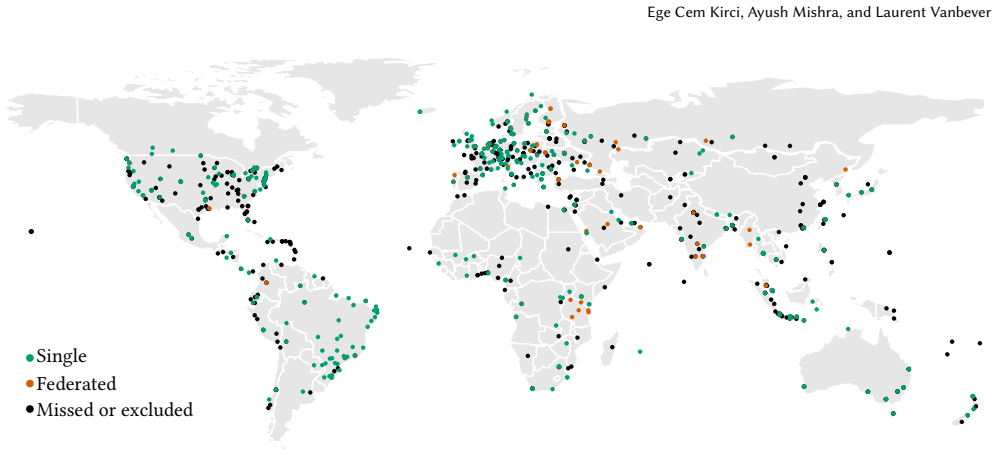
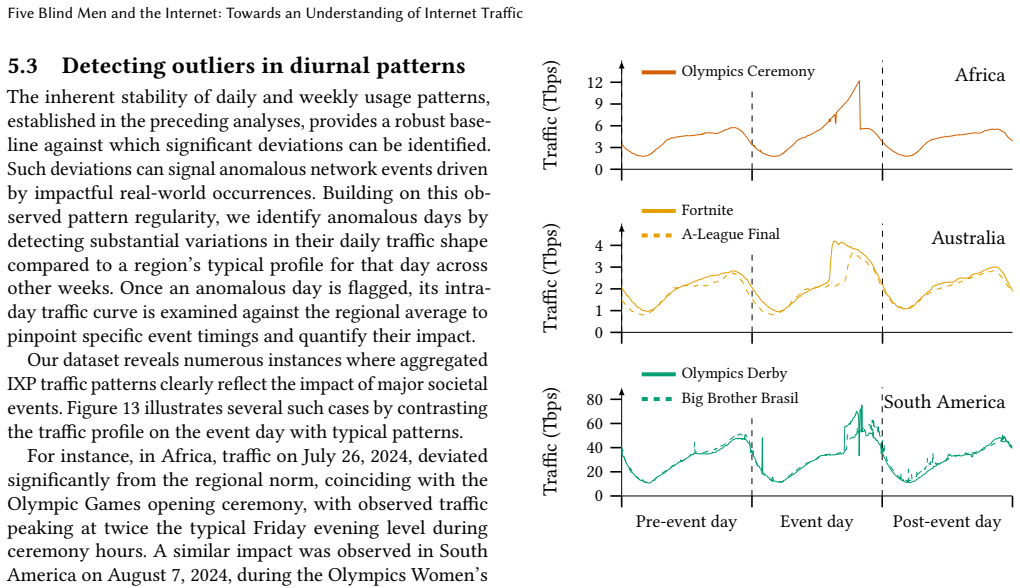
The Internet, the world's largest and most pervasive network, lacks a transparent, granular view of its traffic patterns, volumes, and growth trends, hindering the networking community's understanding of its dynamics. This paper leverages publicly available Internet Exchange Point traffic statistics to address this gap, presenting a comprehensive two-year study (2023-2024) from 472 IXPs worldwide, capturing approximately 300 Tbps of peak daily aggregate traffic by late 2024. Our analysis reveals a 49.2% global traffic increase (24.5% annualized), uncovers regionally distinct diurnal patterns and event-driven anomalies, and demonstrates stable utilization rates, reflecting predictable infrastructure scaling. By analyzing biases and confirming high self-similarity, we establish IXP traffic as a robust proxy for overall Internet growth and usage behavior. With transparent, replicable data--covering 87% of the worldwide IXP port capacity--and plans to release our dataset, this study offers a verifiable foundation for long-term Internet traffic monitoring. In particular, our findings shed light on the interplay between network design and function, providing an accessible framework for researchers and operators to explore the Internet's evolving ecosystem.
Editorial analysis
A structured set of objections, weighed in public.
Referee Report
Summary. The manuscript presents a two-year (2023-2024) analysis of publicly available traffic statistics from 472 Internet Exchange Points (IXPs) worldwide, reporting an aggregate peak of approximately 300 Tbps by late 2024 and a 49.2% global traffic increase (24.5% annualized). It identifies regionally distinct diurnal patterns, event-driven anomalies, and stable utilization rates, and after performing bias analysis and confirming high self-similarity, concludes that IXP traffic constitutes a robust proxy for overall Internet growth and usage behavior. The study covers 87% of worldwide IXP port capacity, emphasizes transparent and replicable methods, and states plans to release the underlying dataset.
Significance. If the proxy claim is substantiated, the work supplies a verifiable, publicly grounded empirical baseline for tracking Internet traffic volumes, growth trends, and usage patterns at scale. The emphasis on replicable data collection and dataset release strengthens its potential utility for the networking research community.
major comments (2)
- [§4] §4 (Bias Analysis subsection): The claim that biases have been analyzed to support the proxy conclusion requires explicit comparison to traffic that bypasses public IXPs (e.g., private peering volumes or intra-AS flows). Port-capacity coverage of 87% does not automatically imply representativeness of observed traffic volumes or patterns; if the bias quantification is limited to variation within the sampled IXPs, the central proxy argument rests on an untested assumption about completeness of the vantage point.
- [§5.1] §5.1 (Self-similarity results): The observation of high self-similarity is presented as supporting evidence for the proxy. However, self-similarity is a well-documented property of aggregate Internet traffic; demonstrating it within the IXP sample does not, by itself, establish that the unobserved remainder (private peering, content-provider backbones) exhibits the same growth rates or diurnal structure.
minor comments (2)
- [Abstract] The abstract states that biases were analyzed but does not summarize the specific statistical checks or external validation steps; adding one sentence on the method would improve clarity for readers.
- [Tables/Figures] Table or figure captions describing the 472 IXPs should explicitly note whether the 87% figure refers to port capacity or to measured traffic volume.
Simulated Author's Rebuttal
We thank the referee for their constructive and detailed feedback on our manuscript. We address each major comment point by point below, indicating where we agree and how we will revise the paper.
read point-by-point responses
-
Referee: [§4] §4 (Bias Analysis subsection): The claim that biases have been analyzed to support the proxy conclusion requires explicit comparison to traffic that bypasses public IXPs (e.g., private peering volumes or intra-AS flows). Port-capacity coverage of 87% does not automatically imply representativeness of observed traffic volumes or patterns; if the bias quantification is limited to variation within the sampled IXPs, the central proxy argument rests on an untested assumption about completeness of the vantage point.
Authors: We appreciate the referee highlighting this important limitation. Our bias analysis in §4 compared traffic statistics across IXP size, region, and peering policy to quantify variation within the sampled set. We agree that 87% port-capacity coverage does not automatically establish representativeness for traffic bypassing public IXPs. Direct empirical comparison to private peering or intra-AS flows is not feasible with publicly available data. We will revise the Bias Analysis subsection to explicitly state this scope limitation and moderate the proxy claim to apply to public IXP traffic. revision: partial
-
Referee: [§5.1] §5.1 (Self-similarity results): The observation of high self-similarity is presented as supporting evidence for the proxy. However, self-similarity is a well-documented property of aggregate Internet traffic; demonstrating it within the IXP sample does not, by itself, establish that the unobserved remainder (private peering, content-provider backbones) exhibits the same growth rates or diurnal structure.
Authors: We acknowledge that self-similarity is a well-known property of Internet traffic. In §5.1 we report high self-similarity specifically within the IXP dataset and link it to observed stability in utilization and diurnal patterns. We agree this does not by itself demonstrate identical properties in unobserved traffic segments. We will revise §5.1 and the conclusions to clarify that self-similarity supports consistency inside the sampled data rather than extending the proxy argument to private peering or backbone traffic. revision: yes
- Direct quantitative comparison to private peering volumes and intra-AS flows, as no public datasets exist for these components.
Circularity Check
No circularity: proxy claim rests on external data and empirical observations
full rationale
The paper's central derivation uses publicly available traffic statistics from 472 IXPs (covering 87% of worldwide port capacity) to analyze biases and confirm high self-similarity as an empirical finding. This supports the claim that IXP traffic serves as a proxy for overall Internet growth. No step reduces a reported result to a fitted parameter defined inside the paper, a self-citation chain, or a definitional equivalence; the analysis draws on external vantage points and standard traffic properties without tautological construction. The derivation chain is self-contained against the provided data sources.
Axiom & Free-Parameter Ledger
axioms (1)
- domain assumption Publicly reported IXP traffic statistics accurately reflect actual exchanged volumes without systematic under- or over-reporting.
Lean theorems connected to this paper
-
IndisputableMonolith/Foundation/RealityFromDistinction.leanreality_from_one_distinction unclear?
unclearRelation between the paper passage and the cited Recognition theorem.
By analyzing biases and confirming high self-similarity, we establish IXP traffic as a robust proxy for overall Internet growth and usage behavior.
What do these tags mean?
- matches
- The paper's claim is directly supported by a theorem in the formal canon.
- supports
- The theorem supports part of the paper's argument, but the paper may add assumptions or extra steps.
- extends
- The paper goes beyond the formal theorem; the theorem is a base layer rather than the whole result.
- uses
- The paper appears to rely on the theorem as machinery.
- contradicts
- The paper's claim conflicts with a theorem or certificate in the canon.
- unclear
- Pith found a possible connection, but the passage is too broad, indirect, or ambiguous to say the theorem truly supports the claim.
Reference graph
Works this paper leans on
-
[1]
Bernhard Ager, Nikolaos Chatzis, Anja Feldmann, Nadi Sarrar, Steve Uhlig, and Walter Willinger. 2012. Anatomy of a Large European IXP. InProceedings of the ACM SIGCOMM 2012 Conference on Applications, Technologies, Architectures, and Protocols for Computer Communication (Sigcomm ’12). Association for Computing Machinery, New York, NY, USA, 163–174. https:...
-
[2]
David Belson. 2023. Cloudflare 2023 Year in Review. https://blog. cloudflare.com/radar-2023-year-in-review/
work page 2023
-
[3]
David Belson. 2024. Cloudflare 2024 Year in Review. https://blog. cloudflare.com/radar-2024-year-in-review/
work page 2024
- [4]
-
[5]
Timm Böttger, Ghida Ibrahim, and Ben Vallis. 2020. How the Internet Reacted to Covid-19: A Perspective from Facebook’s Edge Network. InProceedings of the ACM Internet Measurement Conference (IMC ’20). Association for Computing Machinery, New York, NY, USA, 34–41. https://doi.org/10.1145/3419394.3423621
-
[6]
Lloyd Brown, Albert Gran Alcoz, Frank Cangialosi, Akshay Narayan, Mohammad Alizadeh, Hari Balakrishnan, Eric Friedman, Ethan Katz- Bassett, Arvind Krishnamurthy, Michael Schapira, and Scott Shenker
-
[7]
InProceedings of the ACM SIGCOMM 2024 Conference (ACM SIGCOMM ’24)
Principles for Internet Congestion Management. InProceedings of the ACM SIGCOMM 2024 Conference (ACM SIGCOMM ’24). Association for Computing Machinery, New York, NY, USA, 166–180. https: //doi.org/10.1145/3651890.3672247
-
[8]
CAIDA UCSD. 2017. CAIDA UCSD PeeringDB Dataset, 2023-01-01 – 2024-12-31. https://www.caida.org/catalog/datasets/peeringdb/
work page 2017
-
[9]
Juan Camilo Cardona Restrepo and Rade Stanojevic. 2012. IXP Traffic: A Macroscopic View. InProceedings of the 7th Latin American Net- working Conference (Lanc ’12). Association for Computing Machinery, New York, NY, USA, 1–8. https://doi.org/10.1145/2382016.2382018
- [10]
-
[11]
2020.Cisco Annual Internet Report (2018–
Cisco Systems. 2020.Cisco Annual Internet Report (2018–
work page 2020
-
[12]
White Paper. White Paper C11-741490. Cisco Systems, Inc. https://www.cisco.com/c/en/us/solutions/collateral/executive- perspectives/annual-internet-report/white-paper-c11-741490.pdf
-
[13]
Marek Denis, Yuanjun Yao, Ashley Hatch, Qin Zhang, Chiun Lin Lim, Shuqiang Zhang, Kyle Sugrue, Henry Kwok, Mikel Jimenez Fer- nandez, Petr Lapukhov, Sandeep Hebbani, Gaya Nagarajan, Omar Baldonado, Lixin Gao, and Ying Zhang. 2023. EBB: Reliable and Evolvable Express Backbone Network in Meta. InProceedings of the ACM SIGCOMM 2023 Conference (Acm Sigcomm ’2...
-
[14]
Anja Feldmann, Oliver Gasser, Franziska Lichtblau, Enric Pujol, Ing- mar Poese, Christoph Dietzel, Daniel Wagner, Matthias Wichtlhuber, Juan Tapiador, Narseo Vallina-Rodriguez, Oliver Hohlfeld, and Geor- gios Smaragdakis. 2020. The Lockdown Effect: Implications of the COVID-19 Pandemic on Internet Traffic. InProceedings of the ACM Internet Measurement Con...
-
[15]
Hadas Gold. 2020. Netflix and YouTube Are Slowing down in Europe to Keep the Internet from Breaking | CNN Business. https://www. cnn.com/2020/03/19/tech/netflix-internet-overload-eu
work page 2020
-
[16]
Grafana Labs Contributors. 2025. Grafana/Grafana: The Open-Source Platform for Monitoring and Observability. https://github.com/ grafana/grafana
work page 2025
-
[17]
INEX – Internet Neutral Exchange Association. 2025. IXP Manager — World’s Most Trusted IXP Platform. https://www.ixpmanager.org/
work page 2025
-
[18]
Craig Labovitz, Scott Iekel-Johnson, Danny McPherson, Jon Ober- heide, and Farnam Jahanian. 2010. Internet Inter-Domain Traffic. In Proceedings of the ACM SIGCOMM 2010 Conference (Sigcomm ’10). Association for Computing Machinery, New York, NY, USA, 75–86. https://doi.org/10.1145/1851182.1851194
-
[19]
Samir Marwaha. 2024. Sandvine’s 2024 Global Internet Phenom- ena Report: Global Internet Usage Continues to Grow. https: //www.applogicnetworks.com/blog/sandvines-2024-global-internet- phenomena-report-global-internet-usage-continues-to-grow
work page 2024
-
[20]
2016.IXP Technical Requirements — OIX-1 (Version 2.0)
Open-IX Association. 2016.IXP Technical Requirements — OIX-1 (Version 2.0). Standard OIX-1. Open-IX Association. https://storage.googleapis.com/website-v4_media/documents/ IXPTechnicalRequirements2016.10.19.pdf
work page 2016
-
[21]
Open-IX Association. 2025. About Us – Open-IX Association. https: //testing.oix.org/about/
work page 2025
-
[22]
PeeringDB Community. 2025. PeeringDB — the Interconnection Data- base. https://www.peeringdb.com/
work page 2025
-
[23]
Maxime Piraux, Louis Navarre, Nicolas Rybowski, Olivier Bonaven- ture, and Benoit Donnet. 2022. Revealing the Evolution of a Cloud Provider through Its Network Weather Map. InProceedings of the 22nd ACM Internet Measurement Conference (Imc ’22). Association for Computing Machinery, New York, NY, USA, 298–304. https: //doi.org/10.1145/3517745.3561462
-
[24]
Philipp Richter, Georgios Smaragdakis, Anja Feldmann, Nikolaos Chatzis, Jan Boettger, and Walter Willinger. 2014. Peering at Peer- ings: On the Role of IXP Route Servers. InProceedings of the 2014 Conference on Internet Measurement Conference (IMC ’14). Associa- tion for Computing Machinery, New York, NY, USA, 31–44. https: //doi.org/10.1145/2663716.2663757
-
[25]
Matthew Roughan, Albert Greenberg, Charles Kalmanek, Michael Rumsewicz, Jennifer Yates, and Yin Zhang. 2002. Experience in Mea- suring Backbone Traffic Variability: Models, Metrics, Measurements and Meaning. InProceedings of the 2nd ACM SIGCOMM Workshop on Internet Measurment (Imw ’02). Association for Computing Machinery, New York, NY, USA, 91–92. https:...
-
[26]
Sandvine. 2023. Sandvine’s 2023 Global Internet Phenomena Report Shows 24% Jump in Video Traffic, with Netflix Volume Overtaking YouTube. https://www.applogicnetworks.com/press- releases/sandvines-2023-global-internet-phenomena-report-shows- 24-jump-in-video-traffic-with-netflix-volume-overtaking-youtube
work page 2023
-
[27]
Tanzania Internet eXchange (TIX). 2025. TIX Traffic Statistics Portal. https://stats.tix.or.tz/
work page 2025
-
[28]
Tesseract OCR Contributors. 2024. Tesseract-Ocr/Tesseract: Tesseract Open Source OCR Engine. https://github.com/tesseract-ocr/tesseract
work page 2024
-
[29]
TimescaleDB Contributors. 2025. Timescale/Timescaledb: A Time- Series Database for High-Performance Real-Time Analytics. https: //github.com/timescale/timescaledb
work page 2025
-
[30]
Tong Yang, Jie Jiang, Peng Liu, Qun Huang, Junzhi Gong, Yang Zhou, Rui Miao, Xiaoming Li, and Steve Uhlig. 2018. Elastic Sketch: Adaptive and Fast Network-Wide Measurements. InProceedings of the 2018 Conference of the ACM Special Interest Group on Data Communication (Sigcomm ’18). Association for Computing Machinery, New York, NY, USA, 561–575. https://do...
discussion (0)
Sign in with ORCID, Apple, or X to comment. Anyone can read and Pith papers without signing in.