REVIEW 3 major objections 4 minor 43 references
Fisher entropic Fokker-Planck model of monatomic rarefied gases
T0 review · 3 major / 4 minor · reviewed 2026-08-15 · deepseek-v4-flash
Pith's one-line read The paper constructs a Fokker-Planck model of rarefied gases that simultaneously enforces Boltzmann moment matching and a Fisher-information entropy decay rate, and validates it against DSMC shock profiles.
desk verdict Promising FP scheme with a load-bearing Laplacian factor error that undermines the main entropy-decay theorem; worth refereeing but not as is. read the letter →
The pith
A machine-rendered reading of the paper's core claim, the machinery that carries it, and where it could break.
The reading
What carries the argument
The load-bearing object is the Fisher entropic constraint, a linear equality on the drift coefficients that makes the higher-order drift divergence cancel against the stabilization term in the entropy balance, leaving only $-\frac{\theta}{\tau}I(f|f_0)$. It is imposed on the drift ansatz $A = -\frac{1}{\tau}v' + \nabla_v\Phi^{(r)} - c_d\nabla_v\|v'\|_2^d$, where $\Phi^{(r)}$ is a polynomial potential built from the augmented moment set. The coefficient construction splits into two linear systems: $\hat{c} = R^{-1}(Q+G)$ for the normalized high-order coefficients and $c' = L^{-1}b$ for the moment- and entropy-constrained part; the paper proves $R$ is symmetric positive definite and uses a Schur complement argument to show $L$ is invertible for positive temperature. This split is what lets moment matching and entropy dissipation coexist in a single tractable system.
What would settle it
Compute $\Delta_{v,v}\|v'\|_2^d$ in $\mathbb{R}^3$ for $d=2k+2$ and compare it with $(2k+2)(2k+1)\|v'\|_2^{2k}$; equivalently, simulate homogeneous relaxation with FE-FP coefficients and compare the measured $dH/dt$ against $-D I(f|f_0)$. A mismatch in either test would falsify Theorem 4.1's entropy decay claim.
Extended reading notes
Core claim
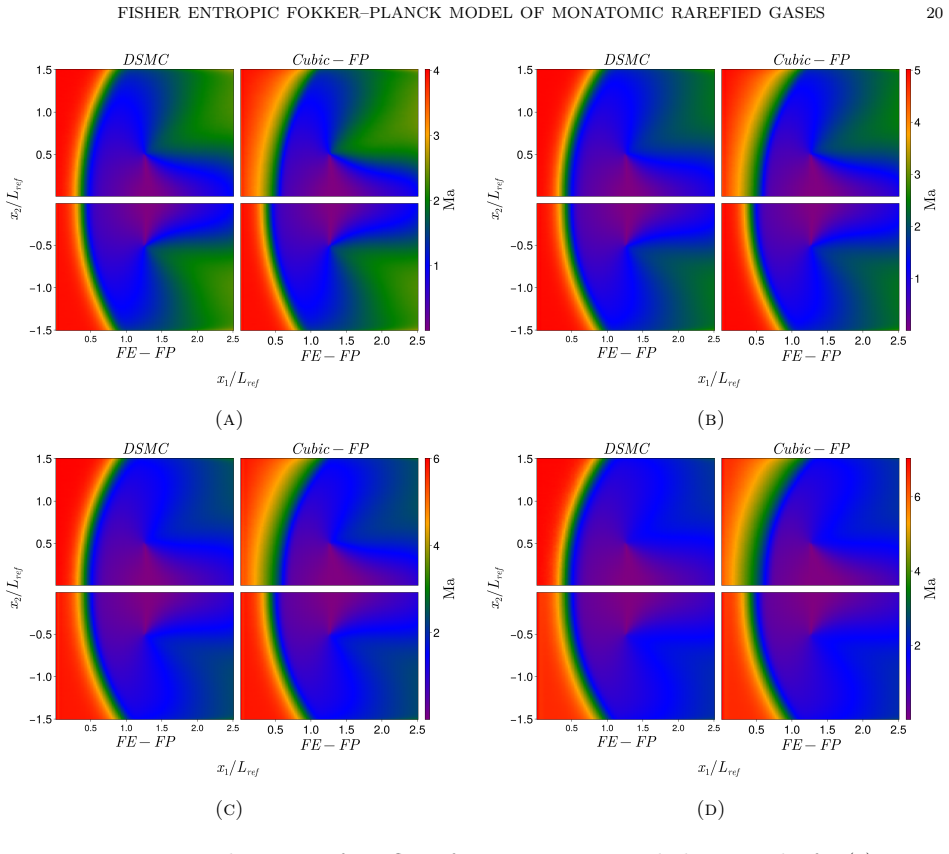
The central claim is the construction of a Fokker-Planck collision operator whose drift is the gradient of a polynomial potential plus the linear relaxation term $-v'/\tau$ and a stabilizing term $-c_d\nabla_v\|v'\|_2^d$, with diffusion fixed at $\theta/\tau$. Choosing the coefficients so that $\langle\sum_{\alpha} c_\alpha \Delta_{v,v}H_\alpha, f\rangle = (2k+2)(2k+1)c_d\langle\|v'\|_2^{2k}, f\rangle$ forces the entropy balance to collapse to $\partial H/\partial t = -D\, I(f|f_0)$, the Fisher-information decay rate. The same coefficients are required to match the Boltzmann production terms for moments up to the heat-fluxes, and the paper proves the resulting linear systems (36) and (37) have a unique solution whenever $T>0$. The time scale is fixed by matching this decay against the Boltzmann entropy decay for anisotropic Gaussian distributions, recovering $\tau = 2\mu/p$. Numerical experiments on argon flow over a plate at Mach 4, 5, 6, and 7 show FE-FP shock and temperature profiles following the DSMC reference much more closely than the cubic-drift model, especially in the downstream region.
Load-bearing premise
The entropy-decay theorem rests on a specific calculus identity for the stabilizing term; if that identity has the wrong constant in three-dimensional velocity space, the cancellation that produces the Fisher decay rate no longer goes through.
Editorial extensions
If this is right
- FP particle methods using the FE-FP operator retain DSMC-level shock accuracy while avoiding collision-frequency scaling, making near-continuum rarefied flows computationally feasible.
- Because the entropy decay rate is a well-defined functional of $f$, the model inherits quantitative trend-to-equilibrium bounds rather than only a sign condition on the entropy.
- The framework supports arbitrary moment-matching degrees of freedom, so it can be extended to higher-order closures, cascades of FP models, and a posteriori error estimation.
- Correct heat-flux relaxation restores the Prandtl number in the hydrodynamic limit, fixing the main defect of linear-drift FP models.
- The same moment-plus-entropy constrained SDE design transfers to diffusion-based generative modeling and Schrödinger bridge problems, as the paper notes.
Reading between the lines
- The constraint construction is really a recipe: pick any stabilization polynomial whose Laplacian lies in the span of the augmented test functions, and the Fisher decay rate is enforced by algebra; this suggests a general design principle for other drift ansätze.
- A testable extension is to monitor the residual between the measured entropy decay and $-D I(f|f_0)$ during shock simulations; a persistent gap would reveal where moment truncation, rather than the entropy constraint, limits accuracy.
- The same coefficient-splitting and Schur-complement technique should extend to anisotropic diffusion tensors, potentially producing entropy-stable ellipsoidal Fokker-Planck models with correct Prandtl number.
Signed reviews
Editorial analysis
A structured set of objections, weighed in public.
Referee Report
Summary. The paper introduces the Fisher Entropic Fokker-Planck (FE-FP) model for monatomic rarefied gases. The model uses a drift of the form A = -v'/tau + grad Phi - c_d grad ||v'||_2^d with a polynomial potential Phi, together with a velocity-independent diffusion D = theta/tau. The central claims are: (i) a Fisher-information-based entropy constraint (Theorem 4.1) yields the entropy decay rate partial H / partial t = -D I(f|f0); (ii) the associated linear systems for the drift coefficients admit unique solutions (Theorem 4.3); (iii) the corresponding velocity SDE is well-posed (Theorem 4.4); and (iv) the model reproduces DSMC shock profiles more accurately than the cubic-drift FP model. The paper also derives a time scale tau = 2 mu / p by matching Boltzmann entropy decay for anisotropic Gaussians. Numerical experiments on supersonic flow over a flat plate show close agreement with DSMC, and the authors provide a reproducibility link.
Significance. If the theoretical claims were correct, the FE-FP model would be a significant contribution: it would combine weak moment consistency with a controlled entropy-dissipation structure, two properties that are usually difficult to satisfy simultaneously in Fokker-Planck approximations of the Boltzmann equation. The numerical results are encouraging and the paper is clearly written, with a useful comparative study against DSMC and the cubic-drift FP model. The availability of code and data is a strength. However, the central theoretical results are not supported as written: the entropy constraint contains an incorrect Laplacian factor, the linear-system right-hand side is inconsistent with the stated constraint, and the invertibility proof of the coefficient matrix contains algebraic errors. These issues affect the foundation of the model, not merely its presentation.
major comments (3)
- [§4.2, Eq. (25)] The entropy constraint uses the factor (2k+2)(2k+1) for the Laplacian of ||v'||_2^d, but the velocity space is R^3 throughout (Sec. 2.1). In R^3, the radial Laplacian of r^d satisfies Delta r^d = d(d+1) r^{d-2} = (2k+2)(2k+3) r^{2k} for d = 2k+2. With the stated factor, the cancellation in Eq. (50) is incomplete: an uncancelled positive term 2(2k+2) c_d <||v'||_2^{2k}, f> remains. Consequently the Fisher decay (26) does not follow, and the H-theorem in the claimed form is not established.
- [§4.4, Eq. (41)] The right-hand side h[f] of the entropy row is set to -c_d <||v'||_2^{2k}, f>. However, to cancel the AHO divergence against the stabilization term in Eq. (50), the entropy constraint must enforce <sum_alpha c_alpha Delta H_alpha, f> = c_d <Delta_{v,v} ||v'||_2^d, f> = (2k+2)(2k+3) c_d <||v'||_2^{2k}, f>. Even ignoring the factor error in Eq. (25), the sign in (41) is opposite to what the proof requires. The assembled linear system therefore does not impose the Fisher entropy decay.
- [§5.2, Eqs. (52)-(55)] The proof of Theorem 4.3 contains invalid algebraic steps. The displayed identity R^{-1}_{phi phi} = <grad ||v'||_2^{2k} dot grad ||v'||_2^{2k}, f> confuses a diagonal entry of the inverse matrix with the corresponding entry of R. Moreover, the reduction of the Schur complement to -R^{-1}_{phi phi} Q_phi^2 is not valid for a general symmetric positive definite R; it holds only for special block structures, for example diagonal R. A simple 2x2 Schur-complement calculation shows that the determinant of L can vanish for admissible R and Q, so the unconditional invertibility claim is not justified by the given proof.
minor comments (4)
- [§4.4, Eq. (39)] The expression for S contains index errors: the sum over alpha,beta in the last term of Eq. (39) should involve only the appropriate index, and the subsequent expansion in Eq. (53) mixes indices inconsistently. Please correct the notation.
- [§4.3, Eq. (29)] The moment-consistency equation is written with the sum over beta in I_r^3, although the potential Phi in Eq. (20) is expanded over the augmented set I_{2k}^3. State explicitly how the phi component is subsequently incorporated via the relation c = R^{-1}(Q+G) to avoid confusion.
- [§5.3] The word 'Lyupanov' should be 'Lyapunov'.
- [References] Several references have corrupted author names and formatting artifacts (e.g., [12] 'T. Ew art', [27] 'Helf and', [31] 'R. F. Pa wula'). These should be cleaned in revision.
Circularity Check
No significant circularity; FE-FP is an explicitly constrained construction with external DSMC validation.
full rationale
The FE-FP derivation is a constructive ansatz rather than a hidden fit: the drift (21) and diffusion (12) are fixed, Theorem 4.1 states a sufficient condition (25) whose satisfaction is then imposed by solving the linear systems (36)-(37), and Eq. (26) is the designed consequence of that constraint, not an independent empirical prediction. Moment matching is likewise imposed from the outset via Eq. (14), so matching the stress and heat-flux relaxation rates is an input of the construction; the shock-structure agreement in Section 7 is checked against an independent DSMC benchmark and is therefore external validation, not a re-reading of the same fitted quantities. The time scale tau = 2mu/p is obtained in Sec. 4.5 by explicitly equating the FE-FP entropy decay to the Boltzmann decay for anisotropic Gaussians, an open calibration/closure step rather than a prediction, and its value reproduces the standard linear-FP tau. The self-citations [17], [18], and [20] motivate the Fisher-rate design and supply Boltzmann production terms, but they do not carry the proof of existence or the entropy-matching claim, and no uniqueness theorem is imported from the authors' prior work. The reader's flagged Laplacian dimension factor would, if correct, be a mathematical error in the cancellation proof of Theorem 4.1 (Eq. (50) versus (25)), not a circularity: the theorem's premise does not assume its conclusion. The paper also explicitly scopes out global well-posedness and general MKV regularity, so there is no concealed input-output equivalence. Overall the central claims are self-contained in the sense of a posed constraint-and-solve model, with the only potentially load-bearing external comparisons being numerical benchmarks.
Assumptions & free parameters
free parameters (2)
- stabilization amplitude epsilon0 =
~1e-3
- entropy relaxation time tau =
2*mu/p
assumptions (5)
- domain assumption Molecular chaos (Stosszahlansatz) holds and the Boltzmann equation describes the monatomic dilute gas.
- ad hoc to paper The FP collision operator has the form (8) with drift (21) and diffusion D=theta/tau independent of v.
- domain assumption The trend-to-equilibrium theorem (Theorem 4.2) closes the moment system for arbitrary moments.
- standard math The entropy functional H[f]=<f,log f> and Fisher information I(f|f0) are the correct decay measures.
- standard math Khasminskii's theorem applies to the frozen-coefficient velocity SDE.
Cite this review
Pith. "Pith review of Fisher entropic Fokker-Planck model of monatomic rarefied gases." pith.science (2026). https://pith.science/paper/CHFVMGEX
@misc{pith2026250906610,
  author       = {Pith},
  title        = {Pith review of: Fisher entropic Fokker-Planck model of monatomic rarefied gases},
  year         = {2026},
  howpublished = {\url{https://pith.science/paper/CHFVMGEX}},
  note         = {Machine review of arXiv:2509.06610}
}
read the original abstract
Particle-based stochastic approximations of the Boltzmann equation are popular tools for simulations of non-equilibrium gas flows, for which the Navier-Stokes-Fourier equations fail to provide accurate description. However, these numerical methods are computationally demanding, especially in the near-continuum regime, where the collisions become overwhelming. On the other hand, the Fokker-Planck kinetic models offer an efficient alternative, as the binary collisions are described by a diffusive process. Despite the intuitive advantage, rigorous and efficient Fokker-Planck approximations of the Boltzmann equation remain an open problem. On one hand, the moment projection of the Fokker-Planck operator should be consistent with that of the Boltzmann operator. On the other hand, the Fokker-Planck model should be constructed in such a way that the H-theorem is satisfied. The central aim of this study is fulfilling these two categorically different constraints, i.e. moment matching and entropy dissipation, within a flexible and tractable Fokker-Planck framework. To this end, we introduce a Fisher information-based entropic constraint and demonstrate that, with a suitable polynomial expansion of the drift term, it is possible to simultaneously achieve weak moment matching while honouring the H-theorem. We support our theoretical result by numerical experiments on the shock problem, validating our Fisher Entropic Fokker-Planck framework.
Figures

Reference graph
Works this paper leans on
-
[1]
B. Alder and T. W ainwright,Phase transition for a hard sphere system, The Journal of Chemical Physics, 27 (1957), pp. 1208–1209,https://doi.org/10.1063/1.1743957
-
[2]
E. Arkilic, M. Schmidt, and K. Breuer,Gaseous slip flow in long microchannels, Journal of Microelectrome- chanical Systems, 6 (1997), pp. 167–178,https://doi.org/10.1109/84.585795
-
[3]
A. Arnold, E. Carlen, and Q. Ju,Large-time behavior of non-symmetric Fokker-Planck type equations, Communications on Stochastic Analysis, 2 (2008),https://doi.org/10.31390/cosa.2.1.11
-
[4]
A. Arnold, P. Markowich, G. Toscani, and A. Unterreiter,On Convex Sobolev Inequalities and the Rate of Convergence to Equilibrium for Fokker-Planck Type Equations, Communications in Partial Differential Equations, 26 (2001), pp. 43–100,https://doi.org/10.1081/PDE-100002246
-
[5]
L. Basov and M. Grabe,Modeling of polyatomic gases in the kinetic Fokker-Planck method by extension of the master equation approach, AIP Conference Proceedings, 2996 (2024), p. 060004,https://doi.org/10.1063/ 5.0187658,https://doi.org/10.1063/5.0187658(accessed 2025-01-14)
-
[6]
P. L. Bhatnagar, E. P. Gross, and M. Krook,A Model for Collision Processes in Gases. I. Small Amplitude Processes in Charged and Neutral One-Component Systems, Physical Review, 94 (1954), pp. 511–525,https: //doi.org/10.1103/PhysRev.94.511, https://link.aps.org/doi/10.1103/PhysRev.94.511 (ac- cessed 2024-06-25)
-
[7]
G. A. Bird,One-Dimensional Steady Flows, in Molecular Gas Dynamics And The Direct Simulation Of Gas Flows, G. A. Bird, ed., Oxford University Press, May 1994, p. 257–315,https://doi.org/10.1093/oso/ 9780198561958.003.0012
doi:10.1093/oso/ 1994
-
[8]
Cercignani,Chapter 1 - The Boltzmann Equation and Fluid Dynamics, vol
C. Cercignani,Chapter 1 - The Boltzmann Equation and Fluid Dynamics, vol. 1 of Handbook of Mathematical Fluid Dynamics, North-Holland, 2002, pp. 1–69, https://doi.org/10.1016/S1874-5792(02)80003-9, https://www.sciencedirect.com/science/article/pii/S1874579202800039
Show all 43 references
-
[9]
Chaintron and A
L.-P. Chaintron and A. Diez,Propagation of chaos: A review of models, methods and applications. I. Models and methods, Kinetic and Related Models, 15 (2022), p. 895,https://doi.org/10.3934/krm.2022017, https://arxiv.org/abs/2203.00446
2022 arXiv
-
[10]
Chapman and T
S. Chapman and T. G. Cowling,The Mathematical Theory of Non-uniform Gases: An Account of the Kinetic Theory of Viscosity, Thermal Conduction and Diffusion in Gases, Cambridge University Press, 1990
1990
-
[11]
A. J. Chorin, O. H. Hald, and R. Kupferman,Optimal prediction and the mori–zwanzig representation of irreversible processes, Proceedings of the National Academy of Sciences, 97 (2000), pp. 2968–2973,https: //doi.org/10.1073/pnas.97.7.2968, https://www.pnas.org/doi/abs/10.1073/...
2000 doi
-
[12]
Ew art, P
T. Ew art, P. Perrier, I. Graur, and J. Méolans,Mass flow rate measurements in a microchannel, from hydrodynamic to near free molecular regimes, Journal of Fluid Mechanics, 584 (2007), pp. 337–356,https: //doi.org/10.1017/S0022112007006374
2007 doi
-
[13]
R. A. Fisher,Theory of Statistical Estimation, Mathematical Proceedings of the Cambridge Philosophical Society, 22 (1925), pp. 700–725, https://doi.org/10.1017/S0305004100009580, https://www.cambridge. org/core/journals/mathematical-proceedings-of-the-cambridge-philosophical-s...
1925 doi
-
[14]
M. H. Gorji, N. Andric, and P. Jenny,Variance reduction for fokker–planck based particle monte carlo schemes, Journal of Computational Physics, 295 (2015), pp. 644–664,https://doi.org/10.1016/j.jcp. 2015.04.008
2015 doi
-
[15]
M. H. Gorji and P. Jenny,An efficient particle Fokker–Planck algorithm for rarefied gas flows, Journal of Computational Physics, 262 (2014), pp. 325–343,https://doi.org/10.1016/j.jcp.2013.12.046, https: //www.sciencedirect.com/science/article/pii/S0021999113008541(accessed 2024-12-10)
2014 doi
-
[16]
M. H. Gorji and P. Jenny,Fokker–Planck–DSMC algorithm for simulations of rarefied gas flows, Journal of Computational Physics, 287 (2015), pp. 110–129,https://doi.org/10.1016/j.jcp.2015.01.041. FISHER ENTROPIC FOKKER–PLANCK MODEL OF MONATOMIC RAREFIED GASES 26
2015 doi
-
[17]
M. H. Gorji and M. Torrilhon,Entropic Fokker-Planck kinetic model, Journal of Computational Physics, 430 (2021), p. 110034,https://doi.org/10.1016/j.jcp.2020.110034, https://www.sciencedirect. com/science/article/pii/S0021999120308081
2021
-
[18]
M. H. Gorji, M. Torrilhon, and P. Jenny,Fokker–Planck model for computational stud- ies of monatomic rarefied gas flows, Journal of Fluid Mechanics, 680 (2011), pp. 574–601, https: //doi.org/10.1017/jfm.2011.188, https://www.cambridge.org/core/product/identifier/ S002211201100...
2011 doi
-
[19]
G. A. Gottw ald, F. Li, Y. Marzouk, and S. Reich,Stable generative modelling using schrödinger bridges, Philosophical Transactions A, 383 (2025), p. 20240332
2025
-
[20]
V. K. Gupta and M. Torrilhon,Automated Boltzmann collision integrals for moment equations, AIP Conference Proceedings, 1501 (2012), pp. 67–74,https://doi.org/10.1063/1.4769474
2012 doi
-
[21]
C. Hepp, M. Grabe, and K. Hannemann,A kinetic Fokker–Planck approach to model hard-sphere gas mixtures, Physics of Fluids, 32 (2020), p. 027103,https://doi.org/10.1063/1.5141909, https://doi.org/10. 1063/1.5141909(accessed 2025-01-14)
2020 doi
-
[22]
Jenny, M
P. Jenny, M. Torrilhon, and S. Heinz,A solution algorithm for the fluid dynamic equations based on a stochastic model for molecular motion, Journal of Computational Physics, 229 (2010), pp. 1077–1098, https://doi.org/10.1016/j.jcp.2009.10.008, https://linkinghub.elsevier. com/...
2010 doi
-
[23]
Khasminskii,Stochastic Stability of Differential Equations, vol
R. Khasminskii,Stochastic Stability of Differential Equations, vol. 66 of Stochastic Modelling and Applied Probability, Springer, Berlin, Heidelberg, 2012,https://doi.org/10.1007/978-3-642-23280-0
2012 doi
-
[24]
J. G. Kirkwood,The Statistical Mechanical Theory of Transport Processes I. General Theory, The Journal of Chemical Physics, 14 (1946), pp. 180–201,https://doi.org/10.1063/1.1724117, https://doi.org/10. 1063/1.1724117(accessed 2025-04-30)
1946 doi
-
[25]
Knudsen,Die Gesetze der Molekularströmung und der inneren Reibungsströmung der Gase durch Röhrn, Annalen der Physik, 333 (2006), pp
M. Knudsen,Die Gesetze der Molekularströmung und der inneren Reibungsströmung der Gase durch Röhrn, Annalen der Physik, 333 (2006), pp. 75–130,https://doi.org/10.1002/andp.19093330106
2006 doi
-
[26]
C.-H. Lai, Y. Takida, N. Murata, T. Uesaka, Y. Mitsufuji, and S. Ermon,FP-diffusion: Improving score-based diffusion models by enforcing the underlying score fokker-planck equation, in Proceedings of the 40th International Conference on Machine Learning, A. Krause, E. Brunskil...
2023
-
[27]
J. L. Lebowitz, H. L. Frisch, and E. Helf and,Nonequilibrium Distribution Functions in a Fluid, The Physics of Fluids, 3 (1960), pp. 325–338,https://doi.org/10.1063/1.1706037
1960 doi
-
[28]
Mathiaud and L
J. Mathiaud and L. Mieussens,A Fokker–Planck Model of the Boltzmann Equation with Correct Prandtl Number, Journal of Statistical Physics, 162 (2016), pp. 397–414,https://doi.org/10.1007/s10955-015-1404-9, https://doi.org/10.1007/s10955-015-1404-9(accessed 2025-02-01)
2016 doi
-
[29]
Mathiaud and L
J. Mathiaud and L. Mieussens,A Fokker–Planck Model of the Boltzmann Equation with Correct Prandtl Number for Polyatomic Gases, Journal of Statistical Physics, 168 (2017), pp. 1031–1055,https://doi.org/10. 1007/s10955-017-1837-4,https://doi.org/10.1007/s10955-017-1837-4(accesse...
2017 doi
-
[30]
H. P. McKean,A Class of Markov Processes Associated with Nonlinear Parabolic Equations, Proceedings of the National Academy of Sciences of the United States of America, 56 (1966), pp. 1907–1911
1966
-
[31]
R. F. Pa wula,Approximation of the Linear Boltzmann Equation by the Fokker-Planck Equation, Physical Review, 162 (1967), pp. 186–188,https://doi.org/10.1103/PhysRev.162.186, https://link.aps.org/doi/ 10.1103/PhysRev.162.186(accessed 2025-04-30)
1967 doi
-
[32]
Peng,Statistical fluid mechanics: Dynamics equations and linear response theory, Physics of Fluids, 35 (2023), p
H. Peng,Statistical fluid mechanics: Dynamics equations and linear response theory, Physics of Fluids, 35 (2023), p. 071704,https://doi.org/10.1063/5.0156582
2023 doi
-
[33]
Risken,The Fokker-Planck Equation: Methods of Solution and Applications, vol
H. Risken,The Fokker-Planck Equation: Methods of Solution and Applications, vol. 18 of Springer Series in Synergetics, Springer, Berlin, Heidelberg, 1996,https://doi.org/10.1007/978-3-642-61544-3, https: //link.springer.com/10.1007/978-3-642-61544-3(accessed 2025-04-23)
1996 doi
-
[34]
S. A. Schaaf and P. L. Chambre,H. Flow of Rarefied Gases, in Fundamentals of Gas Dynamics, Princeton University Press, Dec. 2015, ch. Fundamentals of Gas Dynamics, pp. 687–740. FISHER ENTROPIC FOKKER–PLANCK MODEL OF MONATOMIC RAREFIED GASES 27
2015
-
[35]
Schouler, Y
M. Schouler, Y. Prévereaud, and L. Mieussens,Survey of flight and numerical data of hypersonic rarefied flows encountered in earth orbit and atmospheric reentry, Progress in Aerospace Sciences, 118 (2020), p. 100638, https://doi.org/10.1016/j.paerosci.2020.100638
2020
-
[36]
C. Shen, J. F an, and C. Xie,Statistical simulation of rarefied gas flows in micro-channels, Journal of Computational Physics, 189 (2003), pp. 512–526,https://doi.org/10.1016/S0021-9991(03)00231-6
2003 doi
-
[37]
Sherman and W
J. Sherman and W. J. Morrison,Adjustment of an Inverse Matrix Corresponding to a Change in One Element of a Given Matrix, The Annals of Mathematical Statis- tics, 21 (1950), pp. 124–127, https://doi.org/10.1214/aoms/1177729893, https:// projecteuclid.org/journals/annals-of-mat...
1950
-
[38]
Toscani,H-theorem and asymptotic trend of the solution for a rarefied gas in the vacuum, Archive for Rational Mechanics and Analysis, 100 (1987), pp
G. Toscani,H-theorem and asymptotic trend of the solution for a rarefied gas in the vacuum, Archive for Rational Mechanics and Analysis, 100 (1987), pp. 1–12,https://doi.org/10.1007/BF00281245, https: //doi.org/10.1007/BF00281245(accessed 2025-07-04)
1987 doi
-
[39]
Toscani,Entropy Production and the Rate of Convergence to Equilibrium for the Fokker-Planck Equation, Quarterly of Applied Mathematics, 57 (1999), pp
G. Toscani,Entropy Production and the Rate of Convergence to Equilibrium for the Fokker-Planck Equation, Quarterly of Applied Mathematics, 57 (1999), pp. 521–541,https://www.jstor.org/stable/43638304 (accessed 2025-01-07),https://arxiv.org/abs/43638304
1999
-
[40]
Toscani and C
G. Toscani and C. Villani,Sharp Entropy Dissipation Bounds and Explicit Rate of Trend to Equilibrium for the Spatially Homogeneous Boltzmann Equation, Communications in Mathematical Physics, 203 (1999), pp. 667– 706, https://doi.org/10.1007/s002200050631, https://doi.org/10.10...
1999 doi
-
[41]
Truesdell,The Trend to Equilibrium According to the Kinetic Theory of Gases, Springer New York, New York, NY, 1984, pp
C. Truesdell,The Trend to Equilibrium According to the Kinetic Theory of Gases, Springer New York, New York, NY, 1984, pp. 451–459,https://doi.org/10.1007/978-1-4612-5206-1_27
1984 doi
-
[42]
W ang, K
Q. W ang, K. W ang, X. Wu, and Z. Gao,Numerical investigation of flow and particles contamination in reticle mini environment for extreme ultraviolet lithography, Journal of Vacuum Science & Technology B, 42 (2024), p. 052602,https://doi.org/10.1116/6.0003791
2024 doi
-
[43]
Yun,Entropy production for ellipsoidal BGK model of the Boltzmann equation, Kinetic and Related Models, 9 (Sun May 01 00:00:00 UTC 2016), pp
S.-B. Yun,Entropy production for ellipsoidal BGK model of the Boltzmann equation, Kinetic and Related Models, 9 (Sun May 01 00:00:00 UTC 2016), pp. 605–619,https://doi.org/10.3934/krm.2016009, https: //www.aimsciences.org/en/article/doi/10.3934/krm.2016009(accessed 2025-04-23)
2016 doi
Reviewed August 15, 2026 · model on record in the stance chip above.
Discussion (0). Continue with ORCID to comment.