The Parameter Report: An Orientation Guide for Data-Driven Parameterization
Pith reviewed 2026-05-18 17:50 UTC · model grok-4.3
The pith
On real-world graphs, treewidth is usually near n/10 while vertex cover is near n/2, making certain FPT algorithms much more practical than others.
A machine-rendered reading of the paper's core claim, the machinery that carries it, and where it could break.
Core claim
We measure degree-related, neighborhood-based, modulator-based parameters and treewidth on real-world graphs and observe that the treewidth tw is almost always below n/3 and often close to n/10, while the vertex cover number vc is often only slightly below n/2. This suggests that O(2^tw) algorithms are practical on real instances whereas O(2^vc) is only marginally better than brute force exponential in n.
What carries the argument
Empirical measurement of parameter values such as treewidth and vertex cover number on a set of real-world benchmark graphs to assess their typical size relative to n.
Load-bearing premise
The selected benchmark graphs from real-world applications represent the kinds of graphs that typically appear in parameterized complexity applications.
What would settle it
Finding a substantial collection of real-world graphs where the treewidth is not below n/3 on average or where vertex cover is much smaller than n/2 would challenge the observed distributions.
Figures


read the original abstract
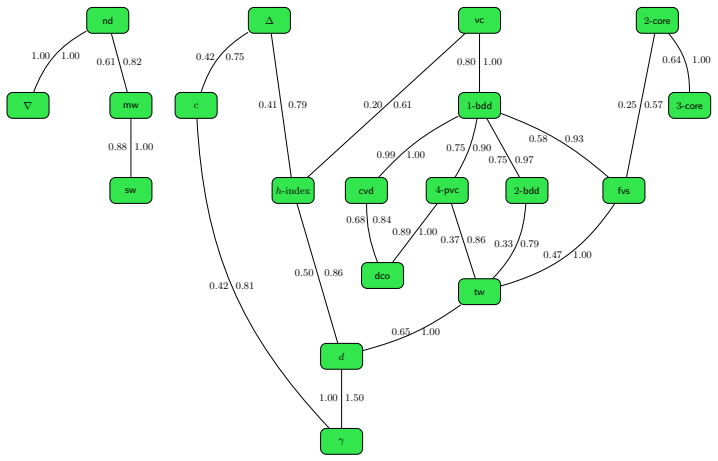
A strength of parameterized algorithmics is that each problem can be parameterized by an essentially inexhaustible set of parameters. Usually, the choice of the considered parameter is informed by the theoretical relations between parameters with the general goal of achieving FPT-algorithms for smaller and smaller parameters. However, the FPT-algorithms for smaller parameters usually have higher running times and it is unclear whether the decrease in the parameter value or the increase in the running time bound dominates in real-world data. This question cannot be answered from purely theoretical considerations and any answer requires knowledge on typical parameter values. To provide a data-driven guideline for parameterized complexity studies of graph problems, we present the first comprehensive comparison of parameter values for a set of benchmark graphs originating from real-world applications. Our study covers degree-related parameters, such as maximum degree or degeneracy, neighborhood-based parameters such as neighborhood diversity and modular-width, modulator-based parameters such as vertex cover number and feedback vertex set number, and the treewidth of the graphs. Our results may help assess the significance of FPT-running time bounds on the solvability of real-world instances. For example, the vertex cover number $vc$ of $n$-vertex graphs is often only slightly below $n/2$. Thus, a running time bound of $O(2^{vc})$ is only slightly better than a running time bound of $O(1.4^{n})$. In contrast, the treewidth $tw$ is almost always below $n/3$ and often close to $n/10$, making a running time of $O(2^{tw})$ much more practical on real-world instances. We make our implementation and full experimental data openly available. In particular, this provides the first implementations for several graph parameters such as 4-path vertex cover number and vertex integrity.
Editorial analysis
A structured set of objections, weighed in public.
Referee Report
Summary. The manuscript presents the first comprehensive empirical comparison of multiple graph parameters—including degree-related (max degree, degeneracy), neighborhood-based (neighborhood diversity, modular-width), modulator-based (vertex cover, feedback vertex set), and treewidth—on a collection of benchmark graphs drawn from real-world applications. It concludes that, on these instances, the vertex cover number vc is typically only slightly below n/2 (so that O(2^vc) is only marginally better than O(1.4^n)), while treewidth tw is almost always below n/3 and often near n/10 (making O(2^tw) far more practical). The authors release implementations and full data, including first implementations for 4-path vertex cover and vertex integrity.
Significance. If the chosen benchmarks are representative of graphs arising in parameterized-complexity applications, the study supplies concrete, data-driven orientation that purely theoretical parameter comparisons cannot provide. The open release of code and experimental data for several parameters is a clear strength that supports reproducibility and enables follow-up work.
major comments (2)
- [Experimental design / benchmark collection] Benchmark selection and experimental setup: The paper states that the graphs 'originat[e] from real-world applications' and reports distributions such as 'tw is almost always below n/3' and 'often close to n/10', yet provides no explicit sampling frame, domain coverage analysis, instance counts, size distribution, or comparison against graphs on which FPT results are typically evaluated. This directly affects the load-bearing claim that the observed ratios supply general practical guidance.
- [Results / abstract claims] Quantitative claims and statistical presentation: The abstract and results assert specific thresholds ('almost always below n/3', 'only slightly below n/2', 'often close to n/10') without reference to the underlying tables or figures that would show medians, quartiles, number of instances, or any robustness checks against graph-size variation. This makes it impossible to assess whether the headline comparisons are robust or sensitive to the particular benchmark collection.
minor comments (1)
- [Notation] Clarify notation for parameters (e.g., consistent use of vc, tw, n) across text, tables, and figures.
Simulated Author's Rebuttal
We thank the referee for the constructive feedback on our manuscript. The comments highlight opportunities to strengthen the description of our experimental design and the presentation of quantitative results. We address each major comment below and will incorporate the suggested improvements in a revised version.
read point-by-point responses
-
Referee: [Experimental design / benchmark collection] Benchmark selection and experimental setup: The paper states that the graphs 'originat[e] from real-world applications' and reports distributions such as 'tw is almost always below n/3' and 'often close to n/10', yet provides no explicit sampling frame, domain coverage analysis, instance counts, size distribution, or comparison against graphs on which FPT results are typically evaluated. This directly affects the load-bearing claim that the observed ratios supply general practical guidance.
Authors: We acknowledge that a more explicit description of the benchmark collection would improve transparency. In the revised manuscript we will add a dedicated subsection on the experimental setup. This will specify the data sources and repositories used, report the total number of instances together with their size distribution (via summary statistics and a supplementary table or figure), and include a short discussion of how the chosen graphs relate to those commonly appearing in FPT evaluation studies. The full dataset is already publicly released, enabling readers to inspect the collection directly. These additions will support the claim that the observed parameter ratios provide practical guidance for real-world instances. revision: yes
-
Referee: [Results / abstract claims] Quantitative claims and statistical presentation: The abstract and results assert specific thresholds ('almost always below n/3', 'only slightly below n/2', 'often close to n/10') without reference to the underlying tables or figures that would show medians, quartiles, number of instances, or any robustness checks against graph-size variation. This makes it impossible to assess whether the headline comparisons are robust or sensitive to the particular benchmark collection.
Authors: We agree that the quantitative statements should be more explicitly tied to the supporting data. In the revision we will insert direct references to the relevant tables and figures (including those reporting medians, quartiles, and instance counts) immediately after each headline claim in the abstract and results sections. We will also add a short robustness analysis that stratifies the parameter ratios by graph size. Because the complete experimental data are already available online, independent verification of these statistics is possible. These changes will make the presentation more verifiable without altering the reported findings. revision: yes
Circularity Check
Purely empirical measurements of graph parameters on external benchmarks
full rationale
The paper reports observed distributions of parameters (treewidth, vertex cover, etc.) computed directly on a fixed collection of real-world benchmark graphs. No derivation, prediction, or uniqueness claim reduces to a fitted quantity, self-defined input, or self-citation chain inside the paper. The representativeness assumption is an external modeling choice, not an internal loop that forces the reported ratios by construction.
Axiom & Free-Parameter Ledger
axioms (1)
- domain assumption The selected benchmark graphs originating from real-world applications are representative of the graphs encountered in typical parameterized algorithm use cases.
Lean theorems connected to this paper
-
IndisputableMonolith/Foundation/AbsoluteFloorClosure.leanreality_from_one_distinction unclear?
unclearRelation between the paper passage and the cited Recognition theorem.
We present the first comprehensive comparison of parameter values for a set of benchmark graphs originating from real-world applications... treewidth tw is almost always below n/3 and often close to n/10
-
IndisputableMonolith/Cost/FunctionalEquation.leanwashburn_uniqueness_aczel unclear?
unclearRelation between the paper passage and the cited Recognition theorem.
Klam-values... running time of 2^k
What do these tags mean?
- matches
- The paper's claim is directly supported by a theorem in the formal canon.
- supports
- The theorem supports part of the paper's argument, but the paper may add assumptions or extra steps.
- extends
- The paper goes beyond the formal theorem; the theorem is a base layer rather than the whole result.
- uses
- The paper appears to rely on the theorem as machinery.
- contradicts
- The paper's claim conflicts with a theorem or certificate in the canon.
- unclear
- Pith found a possible connection, but the passage is too broad, indirect, or ambiguous to say the theorem truly supports the claim.
Forward citations
Cited by 1 Pith paper
-
Parameterized Local Search for Vertex Cover: When only the Search Radius is Crucial
Algorithms for LS Vertex Cover achieve ℓ^{f(k)} n^{O(1)} time for ℓ equal to h-index, treewidth, modular-width, or a new modular-decomposition degree parameter, and extend to weighted d-improving swaps.
Reference graph
Works this paper leans on
-
[1]
Vineet Bafna, Piotr Berman, and Toshihiro Fujito. A 2-approximation algorithm for the undirected feedback vertex set problem.SIAM Journal on Discrete Mathematics, 12(3):289–297, 1999
work page 1999
-
[2]
Barefoot, Roger Entringer, and Henda Swart
Curtis A. Barefoot, Roger Entringer, and Henda Swart. Vulnerability in graphs–a comparative survey.Journal of Combinatorial Mathematics and Combinatorial Computing, 1(38):13–22, 1987
work page 1987
-
[3]
Nadja Betzler, Robert Bredereck, Rolf Niedermeier, and Johannes Uhlmann. On bounded-degree vertex deletion parameterized by treewidth.Discrete Applied Mathematics, 160(1-2):53–60, 2012
work page 2012
-
[4]
Boisvert, Roldan Pozo, Karin Remington, Richard F
Ronald F. Boisvert, Roldan Pozo, Karin Remington, Richard F. Barrett, and Jack J. Dongarra.Matrix Market: a web resource for test matrix collections, pages 125–137. Springer US, Boston, MA, 1997
work page 1997
-
[5]
Minimum k-path vertex cover.Discrete Applied Mathematics, 159(12):1189–1195, 2011
Bostjan Bresar, Frantisek Kardos, J´ an Katrenic, and Gabriel Semanisin. Minimum k-path vertex cover.Discrete Applied Mathematics, 159(12):1189–1195, 2011
work page 2011
-
[6]
Structural parameterizations for boxicity.Algorithmica, 74(4):1453–1472, 2016
Henning Bruhn, Morgan Chopin, Felix Joos, and Oliver Schaudt. Structural parameterizations for boxicity.Algorithmica, 74(4):1453–1472, 2016
work page 2016
-
[7]
Multivariate algorithmics for NP-hard string problems.Bulletin of the EATCS, 114, 2014
Laurent Bulteau, Falk H¨ uffner, Christian Komusiewicz, and Rolf Niedermeier. Multivariate algorithmics for NP-hard string problems.Bulletin of the EATCS, 114, 2014
work page 2014
-
[8]
Parameterized complexity of vertex colouring.Discrete Applied Mathematics, 127(3):415–429, 2003
Leizhen Cai. Parameterized complexity of vertex colouring.Discrete Applied Mathematics, 127(3):415–429, 2003
work page 2003
-
[9]
Linear time split decomposition revisited.SIAM Journal on Discrete Mathematics, 26(2):499–514, 2012
Pierre Charbit, Fabien de Montgolfier, and Mathieu Raffinot. Linear time split decomposition revisited.SIAM Journal on Discrete Mathematics, 26(2):499–514, 2012
work page 2012
-
[10]
Decomposition of directed graphs.SIAM Journal on Algebraic Discrete Methods, 3(2):214–228, 1982
William H Cunningham. Decomposition of directed graphs.SIAM Journal on Algebraic Discrete Methods, 3(2):214–228, 1982
work page 1982
-
[11]
Holger Dell, Thore Husfeldt, Bart M. P. Jansen, Petteri Kaski, Christian Ko- musiewicz, and Frances A. Rosamond. The first parameterized algorithms and computational experiments challenge. InProceedings of the 11th International Symposium on Parameterized and Exact Computation (IPEC ’16), volume 63 of LIPIcs, pages 30:1–30:9. Schloss Dagstuhl - Leibniz-Ze...
work page 2016
-
[12]
Reinhard Diestel.Graph Theory, 5th Edition, volume 173 ofGraduate Texts in Mathematics. Springer, 2016
work page 2016
-
[13]
R. P. Dilworth. A decomposition theorem for partially ordered sets.Annals of Mathematics, 51(1):161–166, 1950
work page 1950
-
[14]
Cluster vertex deletion: A parameterization between vertex cover and clique-width
Martin Doucha and Jan Kratochv´ ıl. Cluster vertex deletion: A parameterization between vertex cover and clique-width. InProceedings of the 37th International Symposium on Mathematical Foundations of Computer Science (MFCS ’12), volume 7464 ofLecture Notes in Computer Science, pages 348–359. Springer, 2012
work page 2012
-
[15]
Rodney G. Downey and Michael R. Fellows.Parameterized Complexity. Monographs in Computer Science. Springer, 1999. 24
work page 1999
-
[16]
P˚ al Grøn˚ as Drange, Markus S. Dregi, and Pim van ’t Hof. On the computational complexity of vertex integrity and component order connectivity.Algorithmica, 76(4):1181–1202, 2016
work page 2016
-
[17]
David Eppstein and Emma S. Spiro. The h-index of a graph and its application to dynamic subgraph statistics.Journal of Graph Algorithms and Applications, 16(2):543–567, 2012
work page 2012
-
[18]
Michael R. Fellows, Bart M. P. Jansen, and Frances A. Rosamond. Towards fully mul- tivariate algorithmics: Parameter ecology and the deconstruction of computational complexity.European Journal of Combinatorics, 34(3):541–566, 2013
work page 2013
-
[19]
Fellows, Daniel Lokshtanov, Neeldhara Misra, Matthias Mnich, Frances A
Michael R. Fellows, Daniel Lokshtanov, Neeldhara Misra, Matthias Mnich, Frances A. Rosamond, and Saket Saurabh. The complexity ecology of parameters: An illustra- tion using bounded max leaf number.Theory of Computing Systems, 45(4):822–848, 2009
work page 2009
-
[20]
Stefan Felsner, Vijay Raghavan, and Jeremy P. Spinrad. Recognition algorithms for orders of small width and graphs of small dilworth number.Order, 20(4):351–364, 2003
work page 2003
-
[21]
Seshadhri, Fan Wei, and Nicole Wein
Jacob Fox, Tim Roughgarden, C. Seshadhri, Fan Wei, and Nicole Wein. Finding cliques in social networks: A new distribution-free model.SIAM Journal on Computing, 49(2):448–464, 2020
work page 2020
-
[22]
Delbert R Fulkerson. Note on dilworth’s decomposition theorem for partially ordered sets.Proceedings of the American Mathematical Society, 7(4):701–702, 1956
work page 1956
-
[23]
Parameterized algo- rithms for modular-width
Jakub Gajarsk´ y, Michael Lampis, and Sebastian Ordyniak. Parameterized algo- rithms for modular-width. InProceedings of the 8th International Symposium on Parameterized and Exact Computation (IPEC ’13), volume 8246 ofLecture Notes in Computer Science, pages 163–176. Springer, 2013
work page 2013
-
[24]
Robert Ganian, Fabian Klute, and Sebastian Ordyniak. On structural parameteriza- tions of the bounded-degree vertex deletion problem.Algorithmica, 83(1):297–336, 2021
work page 2021
-
[25]
Structural parameterizations of vertex integrity
Tatsuya Gima, Tesshu Hanaka, Yasuaki Kobayashi, Ryota Murai, Hirotaka Ono, and Yota Otachi. Structural parameterizations of vertex integrity. InProceedings of the 18th International Conference and Workshops on Algorithms and Computation (WALCOM ’24), volume 14549 ofLecture Notes in Computer Science, pages 406–420. Springer, 2024
work page 2024
-
[26]
Integrity in graphs: bounds and basics
Wayne Goddard and Henda C Swart. Integrity in graphs: bounds and basics. Journal of Combinatorial Mathematics and Combinatorial Computing, 7:139–151, 1990
work page 1990
-
[27]
Golovach, Christian Komusiewicz, Dieter Kratsch, and Van Bang Le
Petr A. Golovach, Christian Komusiewicz, Dieter Kratsch, and Van Bang Le. Refined notions of parameterized enumeration kernels with applications to matching cut enumeration.Journal of Computer and System Sciences, 123:76–102, 2022
work page 2022
-
[28]
Gurobi Optimizer Reference Manual, 2023
Gurobi Optimization, LLC. Gurobi Optimizer Reference Manual, 2023
work page 2023
-
[29]
Aric Hagberg, Pieter J. Swart, and Daniel Schult. Exploring network structure, dynamics, and function using networkx. InProceedings of the 7th Python in Science Conference, 2008. 25
work page 2008
-
[30]
Rudolf Halin.S-functions for graphs.Journal of Geometry, 8:171–186, 1976
work page 1976
-
[31]
David G. Harris and N. S. Narayanaswamy. A faster algorithm for vertex cover parameterized by solution size. InProceedings of the 41st International Symposium on Theoretical Aspects of Computer Science (STACS ’24), volume 289 ofLIPIcs, pages 40:1–40:18. Schloss Dagstuhl - Leibniz-Zentrum f¨ ur Informatik, 2024
work page 2024
-
[32]
On structural parameterizations for the 2-club problem.Discrete Applied Mathematics, 185:79–92, 2015
Sepp Hartung, Christian Komusiewicz, Andr´ e Nichterlein, and Ondrej Such´ y. On structural parameterizations for the 2-club problem.Discrete Applied Mathematics, 185:79–92, 2015
work page 2015
-
[33]
Falk H¨ uffner, Christian Komusiewicz, Hannes Moser, and Rolf Niedermeier. Fixed- parameter algorithms for cluster vertex deletion.Theory of Computing Systems, 47(1):196–217, 2010
work page 2010
-
[34]
Linear-time kernelization for feedback vertex set
Yoichi Iwata. Linear-time kernelization for feedback vertex set. InProceedings of the 44th International Colloquium on Automata, Languages, and Programming (ICALP ’17), volume 80 ofLIPIcs, pages 68:1–68:14. Schloss Dagstuhl - Leibniz- Zentrum f¨ ur Informatik, 2017
work page 2017
-
[35]
Yoichi Iwata and Yusuke Kobayashi. Improved analysis of highest-degree branching for feedback vertex set.Algorithmica, 83(8):2503–2520, 2021
work page 2021
-
[36]
Half-integrality, LP- branching, and FPT algorithms.SIAM Journal on Computing, 45(4):1377–1411, 2016
Yoichi Iwata, Magnus Wahlstr¨ om, and Yuichi Yoshida. Half-integrality, LP- branching, and FPT algorithms.SIAM Journal on Computing, 45(4):1377–1411, 2016
work page 2016
-
[37]
Bart M. P. Jansen.The power of data reduction: Kernels for fundamental graph problems. PhD thesis, Utrecht University, 2013
work page 2013
-
[38]
Bart M. P. Jansen and Stefan Kratsch. On polynomial kernels for structural parameterizations of odd cycle transversal. InProceedings of the 6th International Symposium on Parameterized and Exact Computation (IPEC ’11), volume 7112 of Lecture Notes in Computer Science, pages 132–144. Springer, 2011
work page 2011
-
[39]
Multivariate algorithmics for finding cohesive subnetworks
Christian Komusiewicz. Multivariate algorithmics for finding cohesive subnetworks. Algorithms, 9(1):21, 2016
work page 2016
-
[40]
Christian Komusiewicz, Falk H¨ uffner, Hannes Moser, and Rolf Niedermeier. Isolation concepts for efficiently enumerating dense subgraphs.Theoretical Computer Science, 410(38-40):3640–3654, 2009
work page 2009
-
[41]
Parameterized local search for vertex cover: When only the search radius is crucial
Christian Komusiewicz and Nils Morawietz. Parameterized local search for vertex cover: When only the search radius is crucial. InProceedings of the 17th International Symposium on Parameterized and Exact Computation (IPEC ’22), volume 249 of LIPIcs, pages 20:1–20:18. Schloss Dagstuhl - Leibniz-Zentrum f¨ ur Informatik, 2022
work page 2022
-
[42]
Christian Komusiewicz, Nils Morawietz, Frank Sommer, and Luca Pascal Staus. Code, data and experimental results for ”The parameter report: An orientation guide for data-driven parameterization”, 2025. Zenodo, https://doi.org/10.5281/ zenodo.17053998
work page 2025
-
[43]
New races in parameterized algo- rithmics
Christian Komusiewicz and Rolf Niedermeier. New races in parameterized algo- rithmics. InProceedings of the 37th International Symposium on Mathematical Foundations of Computer Science (MFCS ’12), volume 7464 ofLecture Notes in Computer Science, pages 19–30. Springer, 2012. 26
work page 2012
-
[44]
The PACE 2020 parameterized algorithms and computational experiments challenge: Treedepth
Lukasz Kowalik, Marcin Mucha, Wojciech Nadara, Marcin Pilipczuk, Manuel Sorge, and Piotr Wygocki. The PACE 2020 parameterized algorithms and computational experiments challenge: Treedepth. InProceedings of the 15th International Sympo- sium on Parameterized and Exact Computation (IPEC ’20), volume 180 ofLIPIcs, pages 37:1–37:18. Schloss Dagstuhl - Leibniz...
work page 2020
-
[45]
KONECT: the Koblenz network collection
J´ erˆ ome Kunegis. KONECT: the Koblenz network collection. InProceedings of the 22nd International World Wide Web Conference (WWW ’13), pages 1343–1350. International World Wide Web Conferences Steering Committee / ACM, 2013
work page 2013
-
[46]
Algorithmic meta-theorems for restrictions of treewidth.Algorith- mica, 64(1):19–37, 2012
Michael Lampis. Algorithmic meta-theorems for restrictions of treewidth.Algorith- mica, 64(1):19–37, 2012
work page 2012
-
[47]
SNAP Datasets: Stanford large network dataset collection.http://snap.stanford.edu/data, June 2014
Jure Leskovec and Andrej Krevl. SNAP Datasets: Stanford large network dataset collection.http://snap.stanford.edu/data, June 2014
work page 2014
-
[48]
Jason Li and Jesper Nederlof. Detecting feedback vertex sets of sizekinO ⋆(2.7k) time.ACM Transactions on Algorithms, 18(4):34:1–34:26, 2022
work page 2022
-
[49]
Don R. Lick and Arthur T. White. k-Degenerate graphs.Canadian Journal of Mathematics, 22(5):1082–1096, 1970
work page 1970
-
[50]
James Nastos and Yong Gao. Bounded search tree algorithms for parametrized cograph deletion: Efficient branching rules by exploiting structures of special graph classes.Discrete Mathematics, Algorithms and Applications, 4(01):1250008, 2012
work page 2012
-
[51]
Jaroslav Nesetril and Patrice Ossona de Mendez. Tree-depth, subgraph coloring and homomorphism bounds.European Journal of Combinatorics, 27(6):1022–1041, 2006
work page 2006
-
[52]
Neil Robertson and Paul D. Seymour. Graph minors. II. algorithmic aspects of tree-width.Journal of Algorithms, 7(3):309–322, 1986
work page 1986
-
[53]
Ryan A. Rossi and Nesreen K. Ahmed. The network data repository with interactive graph analytics and visualization. InProceedings of the Twenty-Ninth AAAI Conference on Artificial Intelligence (AAAI ’15), pages 4292–4293. AAAI Press, 2015
work page 2015
-
[54]
Stephen B. Seidman. Network structure and minimum degree.Social networks, 5(3):269–287, 1983
work page 1983
-
[55]
The graph parameter hierarchy, 2019
Manuel Sorge and Mathias Weller. The graph parameter hierarchy, 2019. https: //manyu.pro/assets/parameter-hierarchy.pdf
work page 2019
-
[56]
A contraction-recursive algorithm for treewidth
Hisao Tamaki. A contraction-recursive algorithm for treewidth. InProceedings of the 18th International Symposium on Parameterized and Exact Computation (IPEC ’23), volume 285 ofLIPIcs, pages 34:1–34:15. Schloss Dagstuhl - Leibniz-Zentrum f¨ ur Informatik, 2023
work page 2023
-
[57]
Corneil, Michel Habib, and Christophe Paul
Marc Tedder, Derek G. Corneil, Michel Habib, and Christophe Paul. Simpler linear- time modular decomposition via recursive factorizing permutations. InProceedings of the 35th International Colloquium on Automata, Languages and Programming (ICALP ’08), volume 5125 ofLecture Notes in Computer Science, pages 634–645. Springer, 2008
work page 2008
-
[58]
Bachelor’s thesis, TU Berlin, 2022
Duc Long Tran.Expanding the Graph Parameter Hierarchy. Bachelor’s thesis, TU Berlin, 2022. 27
work page 2022
-
[59]
PACE solver description: Bute-plus: A bottom-up exact solver for treedepth
James Trimble. PACE solver description: Bute-plus: A bottom-up exact solver for treedepth. InProceedings of the 15th International Symposium on Parameterized and Exact Computation (IPEC ’20), volume 180 ofLIPIcs, pages 34:1–34:4. Schloss Dagstuhl - Leibniz-Zentrum f¨ ur Informatik, 2020
work page 2020
-
[60]
Ren´ e van Bevern, Artem M. Kirilin, Daniel A. Skachkov, Pavel V. Smirnov, and Oxana Yu. Tsidulko. Serial and parallel kernelization of multiple hitting set param- eterized by the dilworth number, implemented on the GPU.Journal of Computer and System Sciences, 139:103479, 2024. 28 A Instance Properties Table 7: Sizes and some additional parameter values f...
work page 2024
discussion (0)
Sign in with ORCID, Apple, or X to comment. Anyone can read and Pith papers without signing in.