REVIEW 4 major objections 4 minor 1 cited by
An Agentic AI Workflow to Simplify Parameter Estimation of Complex Differential Equation Systems
T0 review · 4 major / 4 minor · reviewed 2026-08-04 · deepseek-v4-flash
Pith's one-line read An agentic workflow can turn a lightweight XML problem spec and a partially filled Python skeleton into a validated, differentiable, compiled parameter-estimation pipeline, recovering stiff ODE parameters to well under one percent and yield
desk verdict A plausible engineering tool with clean simulated-data demos, but the load-bearing LLM auto-correction claim rests on two anecdotes and the reproducibility link is missing. read the letter →
The pith
A machine-rendered reading of the paper's core claim, the machinery that carries it, and where it could break.
The reading
What carries the argument
The key machinery is the agentic correction loop feeding a two-stage optimizer. The agent consumes the XML problem spec and user-filled Python skeleton, generates a validation report, separates critical errors from warnings, and iteratively rewrites the input files until no critical errors remain or the iteration budget is exhausted. The validated functions are then converted to pure, just-in-time-compilable callables with parallelization primitives; the pipeline runs particle swarm optimization—a zero-order global search—followed by a gradient-based refinement in which derivatives of the loss with respect to parameters are computed by reverse-mode automatic differentiation through the ODE i
What would settle it
Give the workflow a Robertson implementation with one deliberate semantic error—for example, swap the rate constants for the second and third reactions in the ODE—and observe whether the agent's validation report flags it before fitting. If the agent passes the corrupted model and the optimizer returns a low-loss fit to wrong parameters, the central claim about automatic code validation is not supported.
Extended reading notes
Core claim
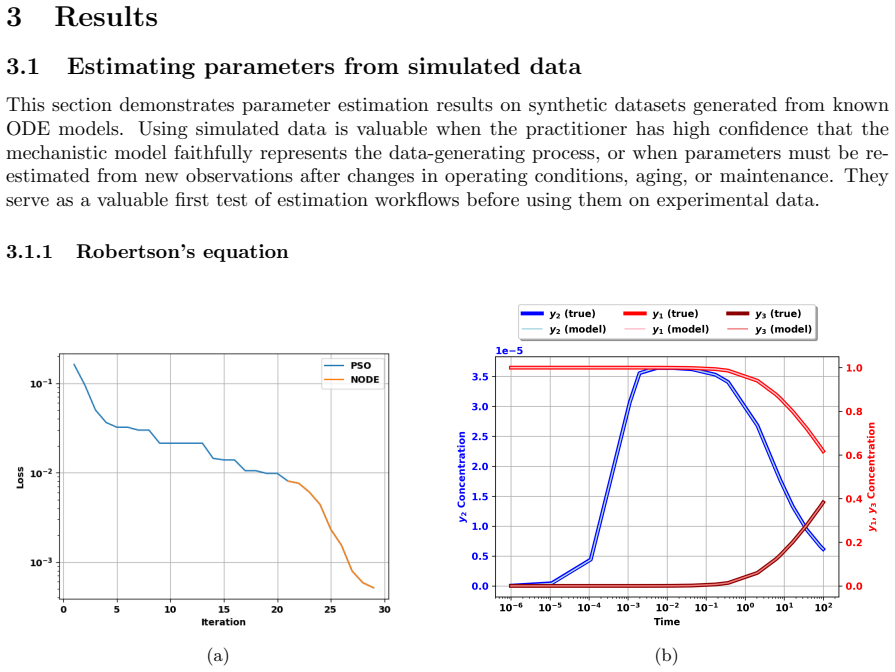
The central claim is that the agentic AI workflow makes advanced ODE calibration accessible: a user with domain knowledge but little automatic-differentiation or optimization expertise can specify the problem in a human-readable XML template, fill in skeleton Python functions for the ODE, loss, and quantities of interest, and the system will validate the setup, auto-correct critical errors, generate differentiable just-in-time-compiled code with parallelization primitives, and run a two-stage optimization to estimate parameters. The paper demonstrates this by recovering known parameters from simulated stiff data—Robertson's kinetics and the Van der Pol oscillator—and by fitting approximate m
Load-bearing premise
The load-bearing premise is that the LLM agent, working with a bounded correction loop and no formal verification, can reliably find and fix errors in a user's ODE setup without silently replacing a valid model with a wrong one.
Editorial extensions
If this is right
- Users with domain knowledge but no automatic-differentiation or optimizer expertise can go from an XML spec to a calibrated stiff ODE model in one run, so the bottleneck shifts from setup to modeling choices.
- The auto-validation step could be reused as a general check for ill-posed optimization setups: shape mismatches, unused parameters, and infeasible bounds get caught before expensive solves.
- For experimental datasets, the workflow yields baseline mechanistic models—such as a Bouc–Wen hysteresis model or an Arrhenius thermal-runaway model—that users can refine with domain-specific ranges or constraints.
- Because the agent reports and applies corrections, the pipeline becomes a reproducible record: the final XML, corrected code, and optimization traces constitute an auditable history of the calibration.
- The two-stage PSO-then-gradient recipe becomes a reusable template for similar inverse problems beyond the four systems demonstrated.
Reading between the lines
- A systematic seeded-error benchmark across several ODE families would test the paper's auto-correction claim; the two worked examples do not establish a false-correction rate.
- The workflow's separation of a human-readable spec from the AD implementation suggests the same orchestration could be retargeted to other automatic-differentiation backends or extended to PDE-constrained estimation, which the paper itself flags as future work.
- For safety-relevant applications such as battery thermal-runaway models, users would likely want to review the agent's auto-corrections before trusting the fitted parameters, since no formal verification step is present.
- The two-stage recipe could be stress-tested on higher-dimensional or weakly identifiable parameter spaces where global search cost grows.
Editorial analysis
A structured set of objections, weighed in public.
Referee Report
Summary. The paper proposes a three-step agentic workflow for ODE parameter estimation: (I) the user supplies an XML problem specification and a Python code skeleton; (II) an LLM agent cross-checks the XML and code, reports critical errors and warnings, and auto-corrects the inputs in a bounded loop; (III) the corrected code is translated to JAX, compiled, parallelized, and calibrated by a two-stage global-then-local optimizer (PSO followed by gradient-based refinement). The workflow is demonstrated on synthetic stiff ODE problems (Robertson kinetics and Van der Pol oscillator), where known parameters are recovered accurately, and on two experimental datasets (piezoelectric hysteresis and battery thermal runaway), where qualitatively plausible fits are obtained. The main claimed contributions are reduced setup burden, AD-native and jit-compiled execution, automated validation/correction of user input, and an open-source release.
Significance. If the claims are substantiated, this is a useful contribution: it lowers the barrier for domain scientists to use differentiable programming, parallel compilation, and global-plus-local optimization for ODE calibration. The simulated-data results are the strongest part: the Robertson parameters are recovered to roughly 0.1–0.3% error and the Van der Pol μ to about 0.05% error, and the discussion correctly flags the sensitivity of reverse-mode derivatives to ODE solver tolerances. The experimental fits are plausible but are presented without uncertainty quantification or comparison to alternative methods. The distinctive novel component is the agentic auto-correction loop, but the evidence for its reliability is only anecdotal, which is the main gap between the paper's claims and what is demonstrated.
major comments (4)
- [§2.2, Appendix A.3, Discussion point 3] The workflow's central automation claim—that the agent reliably cross-checks and auto-corrects user code (Introduction feature 3)—is supported only by two anecdotal correction loops in Appendix A.3, both on the same problems that are later used in the results. No systematic evidence is given for the agent's detection rate, false-correction rate, failure modes, or behavior across varied user inputs. Because the correction loop is an LLM with a bounded number of iterations and no formal verification, a silent mis-correction could alter the intended ODE model and still pass the consistency re-check, yielding precisely fitted parameters for the wrong equations. The Discussion statement that the agentic workflow is 'highly effective' in correcting user errors therefore overstates the evidence. The paper should either add a systematic bug-injection evaluation (measuring detection success, fals
- [§3 and Appendix A.1, Eq. (14)] The numerical results cannot be fully reproduced or independently assessed because several key algorithmic choices are not reported. Specifically, the PSO constants c1, c2, w, swarm size, and number of iterations are not given; the ODE solver and tolerances used for the forward solve and for backpropagation are not specified; and the loss weights λ1 and λ2 in Eq. (14) are not reported. Since the abstract and feature 4 claim reproducibility, these settings should be listed in the text, a table, or a machine-readable configuration file.
- [§3.1 and §3.2] All results are based on single runs. No repeated runs with different random seeds, no error bars on the estimated parameters, and no statistical comparison against standard parameter-estimation baselines are provided. This matters because PSO is stochastic and the two-stage scheme may converge to different optima in different runs. At minimum, the paper should report repeated-run variability for the synthetic recoveries and, ideally, compare against a simpler baseline (e.g., scipy least_squares or a direct multi-start gradient method). The experimental fits are currently evaluated visually, which is not sufficient to support the claim that the workflow reliably produces 'good representations' of the data.
- [§3.2.1, Table 3] For the piezoelectric example, the fitted parameters β = 0 and γ ≈ 2.26e-9 make the Bouc–Wen state h essentially proportional to the voltage, so the identified model is a linear time-invariant filter rather than a hysteresis model. The 'hysteresis loop' in Fig. 7c then reflects only dynamic lag, not rate-independent hysteresis. The text acknowledges this, but as presented the example does not demonstrate hysteresis identification. The authors should either constrain β to be nonzero (and report the consequences) or relabel the demonstration as a linear-dynamics calibration benchmark.
minor comments (4)
- [§2.1] Typos and grammar issues: 'creats' should be 'creates', 'defintions' should be 'definitions'. Similar mechanical errors occur elsewhere and should be fixed in a copyedit pass.
- [Throughout] The formatting of the GitHub link appears broken in the text ('the/githubGitHub link'). Please ensure all URLs are rendered correctly.
- [Appendix A.1] The constants c1, c2, r1, r2, and w in Eq. (18) are not defined. Even a brief description of typical values or how they were chosen would help.
- [Figure 1] Figure 1 is labeled as '(a)' but appears to be a standalone figure. Please adjust the caption and labels for consistency with the other figures.
Circularity Check
No significant circularity: benchmark recoveries are genuine inverse problems and experimental fits use standard externally specified models.
full rationale
The paper's core contribution is a workflow, not a derived scientific law. For the Robertson and Van der Pol benchmarks, the optimizer minimizes a data-mismatch loss against simulated data generated from known parameter values; the reported parameter estimates are the outcome of that optimization and are compared with the true generative values as an independent check. The loss functions are not defined in terms of the fitted parameters, so there is no self-definitional reduction. The experimental sections fit standard Bouc-Wen and Arrhenius models to external data (Ha et al., Schöberl et al.), and the estimated parameters are outputs, not inputs. Self-citations [2], [10], [32] provide context, comparison, or standard model forms, but the equations are stated explicitly in the paper and the workflow's correctness is not justified by a self-citation chain. The only weakness is evidential: the claim in Discussion point 3 that the agent is 'highly effective in correcting user errors' is supported only by two anecdotal corrections in Appendix A.3. That is an unsupported empirical claim about reliability, not a circular derivation, and cannot be scored as circularity under the rules requiring an exhibited reduction by construction.
Assumptions & free parameters
free parameters (5)
- PSO hyperparameters (c1, c2, w, swarm size, iterations) =
not stated in the manuscript
- Loss weights lambda_1 and lambda_2 for the battery thermal runaway model =
not stated
- ODE solver tolerances and time-stepping settings =
not stated; described as user-tunable
- Agentic loop parameters (maximum number of correction iterations) =
1 iteration in the shown examples
- Bouc-Wen shape parameter n and mass m_p =
n = 1, m_p = 0.1
assumptions (3)
- domain assumption The LLM-based agent can correctly convert user Python skeletons into semantically equivalent JAX code and reliably detect semantic errors in ODE definitions and loss functions.
- domain assumption The two-stage PSO plus L-BFGS strategy converges to a good parameter estimate for stiff and multimodal ODE fitting problems.
- domain assumption Diffrax-based differentiable ODE integration with reverse-mode AD gives correct gradients for the problems considered.
Cite this review
Pith. "Pith review of An Agentic AI Workflow to Simplify Parameter Estimation of Complex Differential Equation Systems." pith.science (2026). https://pith.science/paper/LQ5746NI
@misc{pith2026250907283,
  author       = {Pith},
  title        = {Pith review of: An Agentic AI Workflow to Simplify Parameter Estimation of Complex Differential Equation Systems},
  year         = {2026},
  howpublished = {\url{https://pith.science/paper/LQ5746NI}},
  note         = {Machine review of arXiv:2509.07283}
}
read the original abstract
Parameter identification for mechanistic Ordinary Differential Equation (ODE) models underpins prediction and control in several applications, yet remains a manual and labor-intensive process: datasets are noisy and partial, models can be stiff and complex, and differentiable implementations demand framework expertise. An agentic AI workflow is presented that converts a lightweight, human-readable specification into a compiled, parallel, and differentiable model calibration pipeline. Users supply an XML description of the problem and fill in a Python code skeleton; the agent automatically validates consistency between problem definition and code, and auto-corrects pathologies in the input deck. It transforms Python callables into pure JAX functions for efficient just-in-time compilation and parallelization. The system then orchestrates a two-stage search comprising global exploration of the parameter space followed by gradient-based refinement. The result is an AD-native, reproducible workflow that lowers the barrier to advanced calibration while preserving expert control. An open-source implementation with a documented API and examples is released, enabling rapid movement from problem statement to interpretable ODE models with minimal effort.
Figures


Figures from the paper (7 more)



Forward citations
Cited by 1 Pith paper
-
ATHENA: Agentic Team for Hierarchical Evolutionary Numerical Algorithms
ATHENA introduces an agentic team framework that autonomously manages the end-to-end computational research lifecycle via a knowledge-driven HENA loop to achieve validation errors of 10^{-14} in scientific computing a...
Reference graph
Works this paper leans on
-
[1]
Manh-Kien Tran, Andre DaCosta, Anosh Mevawalla, Satyam Panchal, and Michael Fowler. Com- parative study of equivalent circuit models performance in four common lithium-ion batteries: Lfp, nmc, lmo, nca.Batteries, 7(3):51, 2021
work page 2021
-
[2]
Saakaar Bhatnagar, Andrew Comerford, Zelu Xu, Simone Reitano, Luigi Scrimieri, Luca Giuliano, and Araz Banaeizadeh. A layered swarm optimization method for fitting battery thermal runaway models to accelerating rate calorimetry data.Journal of The Electrochemical Society, 2024
work page 2024
-
[3]
Marco Mehl, William J Pitz, Charles K Westbrook, and Henry J Curran. Kinetic modeling of gasoline surrogate components and mixtures under engine conditions.Proceedings of the Com- bustion Institute, 33(1):193–200, 2011
work page 2011
-
[4]
Jan G Verwer. Gauss–seidel iteration for stiff odes from chemical kinetics.SIAM Journal on Scientific Computing, 15(5):1243–1250, 1994
work page 1994
-
[5]
Stefano Giampiccolo, Federico Reali, Anna Fochesato, Giovanni Iacca, and Luca Marchetti. Ro- bust parameter estimation and identifiability analysis with hybrid neural ordinary differential equations in computational biology.NPJ Systems Biology and Applications, 10(1):139, 2024
work page 2024
-
[6]
Fem-simulation of laminar flame propagation
B Michaelis and B Rogg. Fem-simulation of laminar flame propagation. i: Two-dimensional flames. Journal of computational physics, 196(2):417–447, 2004
work page 2004
-
[7]
Paul T Coman, Eric C Darcy, Christian T Veje, and Ralph E White. Modelling li-ion cell thermal runaway triggered by an internal short circuit device using an efficiency factor and arrhenius formulations.Journal of The Electrochemical Society, 164(4):A587, 2017
work page 2017
-
[8]
Yu Wang, Dongsheng Ren, Xuning Feng, Li Wang, and Minggao Ouyang. Thermal kinetics comparison of delithiated li [nixcoymn1-xy] o2 cathodes.Journal of Power Sources, 514:230582, 2021
work page 2021
Show all 39 references
-
[9]
Model-based thermal runaway prediction of lithium-ion batteries from kinetics analysis of cell components.Applied energy, 228:633–644, 2018
Dongsheng Ren, Xiang Liu, Xuning Feng, Languang Lu, Minggao Ouyang, Jianqiu Li, and Xiang- ming He. Model-based thermal runaway prediction of lithium-ion batteries from kinetics analysis of cell components.Applied energy, 228:633–644, 2018. 12
2018
-
[10]
Chemical reaction neural networks for fitting accelerating rate calorimetry data.Journal of Power Sources, 628:235834, 2025
Saakaar Bhatnagar, Andrew Comerford, Zelu Xu, Davide Berti Polato, Araz Banaeizadeh, and Alessandro Ferraris. Chemical reaction neural networks for fitting accelerating rate calorimetry data.Journal of Power Sources, 628:235834, 2025
2025
-
[11]
Identification of parameters for equivalent circuit model of li-ion battery cell with population based optimization algorithms.Ain Shams Engineering Journal, 15(3):102481, 2024
Yu-Shan Cheng. Identification of parameters for equivalent circuit model of li-ion battery cell with population based optimization algorithms.Ain Shams Engineering Journal, 15(3):102481, 2024
2024
-
[12]
Electrochemical model parameter iden- tification of a lithium-ion battery using particle swarm optimization method.Journal of Power Sources, 307:86–97, 2016
Md Ashiqur Rahman, Sohel Anwar, and Afshin Izadian. Electrochemical model parameter iden- tification of a lithium-ion battery using particle swarm optimization method.Journal of Power Sources, 307:86–97, 2016
2016
-
[13]
Hysteretic tuned mass damper with bumpers for seismic protection: Modeling, identification, and shaking table tests.Journal of Sound and Vibration, 597:118816, 2025
Vinay Yadav Janga, Pranath Kumar Gourishetty, Biagio Carboni, Giuseppe Quaranta, and Walter Lacarbonara. Hysteretic tuned mass damper with bumpers for seismic protection: Modeling, identification, and shaking table tests.Journal of Sound and Vibration, 597:118816, 2025
2025
-
[14]
Jih-Lian Ha, Ying-Shieh Kung, Rong-Fong Fung, and Shao-Chien Hsien. A comparison of fitness functions for the identification of a piezoelectric hysteretic actuator based on the real-coded genetic algorithm.Sensors and Actuators A: Physical, 132(2):643–650, 2006
2006
-
[15]
A physics-informed neural network approach to parameter estimation of lithium-ion battery electro- chemical model.Journal of Power Sources, 621:235271, 2024
Jingrong Wang, Qiao Peng, Jinhao Meng, Tianqi Liu, Jichang Peng, and Remus Teodorescu. A physics-informed neural network approach to parameter estimation of lithium-ion battery electro- chemical model.Journal of Power Sources, 621:235271, 2024
2024
-
[16]
A physics-informed neural networks framework for model parameter identification of beam-like structures.Mechanical Systems and Signal Processing, 224:112189, 2025
Rafael de O Teloli, Roberta Tittarelli, Ma¨ el Bigot, Lucas Coelho, Emmanuel Ramasso, Patrice Le Moal, and Morvan Ouisse. A physics-informed neural networks framework for model parameter identification of beam-like structures.Mechanical Systems and Signal Processing, 224:112189, 2025
2025
-
[17]
The findability of microkinetic parameters by heterogeneous chemical reaction neural networks (hcrnns).Chemical Engineering Journal, 510:161460, 2025
Hannes Stagge and Robert G¨ uttel. The findability of microkinetic parameters by heterogeneous chemical reaction neural networks (hcrnns).Chemical Engineering Journal, 510:161460, 2025
2025
-
[18]
Accommodating physical reaction schemes in dsc cathode thermal stability analysis using chemical reaction neural networks.Journal of Power Sources, 581:233443, 2023
Benjamin C Koenig, Peng Zhao, and Sili Deng. Accommodating physical reaction schemes in dsc cathode thermal stability analysis using chemical reaction neural networks.Journal of Power Sources, 581:233443, 2023
2023
-
[19]
On neural differential equations.arXiv preprint arXiv:2202.02435, 2022
Patrick Kidger. On neural differential equations.arXiv preprint arXiv:2202.02435, 2022
2022 arXiv
-
[20]
Chatgpt for programming numerical methods.Journal of Machine Learning for Modeling and Computing, 4(2), 2023
Ali Kashefi and Tapan Mukerji. Chatgpt for programming numerical methods.Journal of Machine Learning for Modeling and Computing, 4(2), 2023
2023
-
[21]
Fine-tuning a large language model for automating com- putational fluid dynamics simulations.Theoretical and Applied Mechanics Letters, page 100594, 2025
Zhehao Dong, Zhen Lu, and Yue Yang. Fine-tuning a large language model for automating com- putational fluid dynamics simulations.Theoretical and Applied Mechanics Letters, page 100594, 2025
2025
-
[22]
Openfoamgpt: A retrieval-augmented large language model (llm) agent for openfoam-based computational fluid dynamics.Physics of Fluids, 37(3), 2025
Sandeep Pandey, Ran Xu, Wenkang Wang, and Xu Chu. Openfoamgpt: A retrieval-augmented large language model (llm) agent for openfoam-based computational fluid dynamics.Physics of Fluids, 37(3), 2025
2025
-
[23]
Ai agents in engineering design: a multi-agent framework for aesthetic and aerodynamic car design.arXiv preprint arXiv:2503.23315, 2025
Mohamed Elrefaie, Janet Qian, Raina Wu, Qian Chen, Angela Dai, and Faez Ahmed. Ai agents in engineering design: a multi-agent framework for aesthetic and aerodynamic car design.arXiv preprint arXiv:2503.23315, 2025
2025
-
[24]
From concept to manufacturing: Evaluating vision-language models for engineering design.Artificial Intelligence Review, 58(9):288, 2025
Cyril Picard, Kristen M Edwards, Anna C Doris, Brandon Man, Giorgio Giannone, Md Ferdous Alam, and Faez Ahmed. From concept to manufacturing: Evaluating vision-language models for engineering design.Artificial Intelligence Review, 58(9):288, 2025
2025
-
[25]
How an ai-enabled software product development life cycle will fuel innovation.https://www
Chandra Gnanasambandam, Martin Harrysson, Rikki Singh, and Aditi Chawla. How an ai-enabled software product development life cycle will fuel innovation.https://www. mckinsey.com/industries/technology-media-and-telecommunications/our-insights/ how-an-ai-enabled-software-product...
2025
-
[26]
Robertson’s example for stiff differential equations.Arizona State Univer- sity, Technical report, 1996
Matthias K Gobbert. Robertson’s example for stiff differential equations.Arizona State Univer- sity, Technical report, 1996
1996
-
[27]
Stiff-pinn: Physics-informed neural network for stiff chemical kinetics.The Journal of Physical Chemistry A, 125(36):8098–8106, 2021
Weiqi Ji, Weilun Qiu, Zhiyu Shi, Shaowu Pan, and Sili Deng. Stiff-pinn: Physics-informed neural network for stiff chemical kinetics.The Journal of Physical Chemistry A, 125(36):8098–8106, 2021
2021
-
[28]
Accelerating simulation of stiff nonlinear systems using continuous-time echo state networks.arXiv preprint arXiv:2010.04004, 2020
Ranjan Anantharaman, Yingbo Ma, Shashi Gowda, Chris Laughman, Viral Shah, Alan Edelman, and Chris Rackauckas. Accelerating simulation of stiff nonlinear systems using continuous-time echo state networks.arXiv preprint arXiv:2010.04004, 2020
2010 arXiv
-
[29]
Analysis of an experimental technique for determining van der pol parameters of a transistor oscillator.IEEE transactions on microwave theory and techniques, 46(7):914–922, 1998
Kuang Yi Chen, Paul D Biernacki, A Lahrichi, and Alan Mickelson. Analysis of an experimental technique for determining van der pol parameters of a transistor oscillator.IEEE transactions on microwave theory and techniques, 46(7):914–922, 1998
1998
-
[30]
Yanli Wang, Xianghong Li, and Yongjun Shen. Study on mechanical vibration control of limit cycle oscillations in the van der pol oscillator by means of nonlinear energy sink.Journal of Vibration Engineering & Technologies, 12(1):811–819, 2024
2024
-
[31]
Thermal runaway characterization of cylindrical lithium-ion and sodium-ion batteries with various sizes and energy contents.Journal of Power Sources, 648:237240, 2025
Jan Sch¨ oberl, Sebastian Ohneseit, Stefan Schaeffler, Dominic F¨ orstermann, Linus Grahl, Andreas Jossen, Carlos Ziebert, and Markus Lienkamp. Thermal runaway characterization of cylindrical lithium-ion and sodium-ion batteries with various sizes and energy contents.Journal o...
2025
-
[32]
Experimental and simulation-based characterization of thermal runaway in lithium-ion batteries using altair simlab®
Luca Giuliano, Luigi Scrimieri, Simone Reitano, Davide Berti Polato, Alessandro Ferraris, An- drew Comerford, and Saakaar Bhatnagar. Experimental and simulation-based characterization of thermal runaway in lithium-ion batteries using altair simlab®. Technical report, SAE Techn...
2025
-
[33]
Chris Rackauckas. The numerical analysis of differentiable simulation: Auto- matic differentiation can be incorrect.https://www.stochasticlifestyle.com/ the-numerical-analysis-of-differentiable-simulation-automatic-differentiation-can-be-incorrect/, April 2025. Stochastic Life...
2025
-
[34]
Maziar Raissi, Paris Perdikaris, and George E Karniadakis. Physics-informed neural networks: A deep learning framework for solving forward and inverse problems involving nonlinear partial differential equations.Journal of Computational physics, 378:686–707, 2019
2019
-
[35]
Φ flow (PhiFlow): Differentiable simulations for pytorch, tensorflow and jax
Philipp Holl and Nils Thuerey. Φ flow (PhiFlow): Differentiable simulations for pytorch, tensorflow and jax. InInternational Conference on Machine Learning. PMLR, 2024
2024
-
[36]
Particle swarm optimization
James Kennedy and Russell Eberhart. Particle swarm optimization. InProceedings of ICNN’95- international conference on neural networks, volume 4, pages 1942–1948. ieee, 1995
1942
-
[37]
Neural ordinary differential equations.Advances in neural information processing systems, 31, 2018
Ricky TQ Chen, Yulia Rubanova, Jesse Bettencourt, and David K Duvenaud. Neural ordinary differential equations.Advances in neural information processing systems, 31, 2018
2018
-
[38]
Autonomous kinetic modeling of biomass pyrolysis using chemical reaction neural networks.Combustion and Flame, 240:111992, 2022
Weiqi Ji, Franz Richter, Michael J Gollner, and Sili Deng. Autonomous kinetic modeling of biomass pyrolysis using chemical reaction neural networks.Combustion and Flame, 240:111992, 2022
2022
-
[39]
Jax md: a framework for differentiable physics
Samuel Schoenholz and Ekin Dogus Cubuk. Jax md: a framework for differentiable physics. Advances in Neural Information Processing Systems, 33:11428–11441, 2020. A Appendix A.1 Particle Swarm Optimization (PSO) Particle Swarm Optimization [36] is a zero-order optimization metho...
2020
Reviewed August 4, 2026 · model on record in the stance chip above.
Discussion (0). Sign in to comment.