REVIEW 3 major objections 7 minor 98 references
TEGRA: A Flexible & Scalable NextGen Mobile Core
T0 review · 3 major / 7 minor · reviewed 2026-08-04 · deepseek-v4-flash
Pith's one-line read TEGRA shows a 3GPP service-based mobile core can match a consolidated monolithic core's latency while preserving microservice flexibility.
desk verdict A well-engineered SBA 5G core with real speedups over Aether/free5GC/Open5GS, but the headline 'matches CoreKube' claim rests on an invented baseline that should not survive as stated. read the letter →
The pith
A machine-rendered reading of the paper's core claim, the machinery that carries it, and where it could break.
The reading
What carries the argument
The design rests on four microservice patterns: Gateway (separate SCTP and PFCP termination services that proxy into the core), Long-Running (stateful services like AMF, SMF, NRF that keep a soft per-UE cache), Ephemeral (stateless services like UDM, PCF that transform messages without local state), and Storage (persistent databases for UE and service state). These are carried by two mechanisms: UELB, a client-side load balancer that pins each UE to one service instance based on the UE identifier, and DRSM, a distributed publish-subscribe state-sharing service that keeps instances aware of each other's load, instance count, and allocated ID/IP blocks. The soft-state caching is what reduces s
What would settle it
On the same three-server edge cloud, implement the missing Service Request, PDU session, and UPF support in CoreKube and measure end-to-end control-plane latency at 256 UEs for Registration, PDU establishment, and Service Request; if the completed CoreKube's actual latencies are materially below TEGRA's, the paper's central parity claim fails.
Extended reading notes
Core claim
TEGRA is a high-performance, flexible, scalable, and resilient SBA-based 5G core that avoids reverting to NFV-style consolidation. Its core discovery is that the mobile core's position at the network edge, handling bidirectional asynchronous control events from both UEs and the Internet, allows cloud-native techniques to be re-designed: per-UE soft state cached inside service instances with asynchronous persistence to storage, UE-based sticky load balancing so both directions of a UE's traffic hit the same instance, and a distributed resource-sharing mechanism (DRSM) that shares load and allocation state without a central scheduler. The paper reports end-to-end control-plane latency improvem
Load-bearing premise
The claim that TEGRA matches CoreKube's performance rests on a projected ~CoreKube baseline built by estimating missing lines of code and scaling measured latency on a 2.2 GHz CPU; if that projection is inaccurate, the parity claim is unsupported.
Editorial extensions
If this is right
- If TEGRA's central claim holds, operators can horizontally autoscale individual control-plane services like AMF and SMF without losing consistency, because UE-sticky routing keeps bidirectional messages on the same instance.
- The soft-state approach implies steady-state control-plane latency can be close to stateful in-memory processing, while failure recovery still works by pulling the latest committed state from storage, so resilience does not have to come from sacrificing performance.
- Adding a new service or event in TEGRA reduces to a single-line configuration change plus CI/CD deployment, versus about 1,700 lines and full recompilation in a consolidated core, which would sharply lower the cost of introducing new 5G features.
- The paper's results suggest that consolidation-based cores such as CoreKube are not the only way to meet latency targets; a disaggregated SBA core can stay within control-plane latency budgets at hundreds of UEs and in real traces at tens of thousands of UEs.
Reading between the lines
- The headline parity with CoreKube is not a direct measurement: the paper constructs a projected ~CoreKube baseline by estimating missing lines of code and scaling measured latency on a 2.2 GHz CPU, so actual parity with a completed CoreKube remains to be demonstrated.
- The four design patterns and UE-sticky routing could generalize beyond cellular cores to other stateful edge services that receive asynchronous events from both clients and the network, such as IoT gateways or real-time session brokers.
- Because the evaluation uses one operator's week-long control-plane trace and a custom emulator, the scalability claims are tied to that workload; testing with other operators' traces and with higher UE churn would show how much of the speedup is workload-specific.
- TEGRA's microservice decomposition may make hardware acceleration easier: the authors point toward offloading hot services onto SmartNICs, a direction not evaluated in this paper but a natural next test.
Signed reviews
Editorial analysis
A structured set of objections, weighed in public.
Referee Report
Summary. The paper argues that service-based architecture (SBA) mobile cores need not sacrifice flexibility for performance and scalability. It presents TEGRA, a Go-based SBA 5G core built by modifying Aether modules and adding gateway microservices, UE-based sticky load balancing, soft-state per-UE caching, a distributed publish/subscribe state-sharing mechanism (DRSM), and horizontal autoscaling. The evaluation on a three-server Proxmox/Kubernetes edge cloud compares TEGRA with Aether, free5GC, Open5GS, Magma, and CoreKube across Registration, PDU Session Establishment, and Service Request, using both synthetic and operator-derived real traces. The paper claims TEGRA is 20x/11x/1.75x faster than free5GC/Open5GS/Aether, matches the state-of-the-art CoreKube while retaining flexibility, and requires orders of magnitude fewer lines of code to extend.
Significance. If the central claims hold, the paper would provide a valuable counterexample to the prevailing assumption that disaggregated SBA cores must trade flexibility for latency. The evaluation is extensive: it includes multiple baselines, three control-plane events, scaling from 32 to 256 UEs, real traces, autoscaling microbenchmarks, state-cache ablation, and failure injection. The design patterns and the soft-state/sticky-load-balancing combination are concrete and plausibly generalizable. However, the headline claim that TEGRA 'matches CoreKube' rests on the authors' constructed ~CoreKube baseline rather than on a measured complete CoreKube implementation. That projection is not reproducible from the information given, and it is load-bearing for the paper's main 'no tradeoff' thesis. The other contributions remain credible, but the parity result needs either rigorous justification or removal from the central claims.
major comments (3)
- [§6.1.2, Figure 7, Abstract] The claim that TEGRA 'matches CoreKube' is supported only by the authors' ~CoreKube construction. Section 6.1.2 estimates missing CoreKube functionality as 67%, 71%, and 733% additional LoCs based on Open5GS, and states that the authors 'project the associated runtime overhead by scaling CoreKube's measured latency ... using a 2.2 GHz CPU.' No formula or empirical relationship connects LoC percentages to latency, and for Service Request CoreKube has no measured latency to scale. The ~CoreKube bars in Figure 7 are therefore non-reproducible. Because the Abstract and Section 6.2 use 'matches CoreKube' as evidence that flexibility does not cost performance, this is a load-bearing issue. Please either present raw CoreKube as a separate measured baseline and remove/qualify the parity claim, or provide a validated overhead model (e.g., per-function profiling) with explicit assumptions, sensiti
- [§6.1.3, Table 1] Table 1 labels TEGRA as 'fully 3GPP-compliant' and 'operational,' but the evaluation exercises only Registration, PDU Session Establishment, and Service Request, all via the custom gNBSimRT emulator. No conformance or interoperability tests are reported for other mandatory 3GPP procedures, such as handover, deregistration, AN release, or paging under load. The compliance claim is stronger than the presented evidence. Either add conformance evidence from a recognized test suite or narrow the claim to 'supports the evaluated procedures in a 3GPP-compliant manner.'
- [§6.2, Abstract] The abstract's headline '20x, 11x, and 1.75x faster than free5GC, Open5GS, and Aether' is not reconciled with Section 6.2, which explicitly reports only 'up to 1.74x speedup for Registration, 1.5x for PDU session establishment, and 1.75x for Service Request at 256 UEs compared to Aether.' The 20x and 11x numbers presumably come from comparisons with free5GC and Open5GS, but the body does not derive them. Please state the event, UE count, and baseline for each number, and ensure the abstract's claims match the presented data.
minor comments (7)
- [§6.2] Typo: 'looses' should be 'loses.'
- [§4.1.2] Typo: 'central schedular' should be 'central scheduler.'
- [Abstract] Formatting: 'TEGRAoptimizes performance' lacks a space; similar spacing issues appear elsewhere.
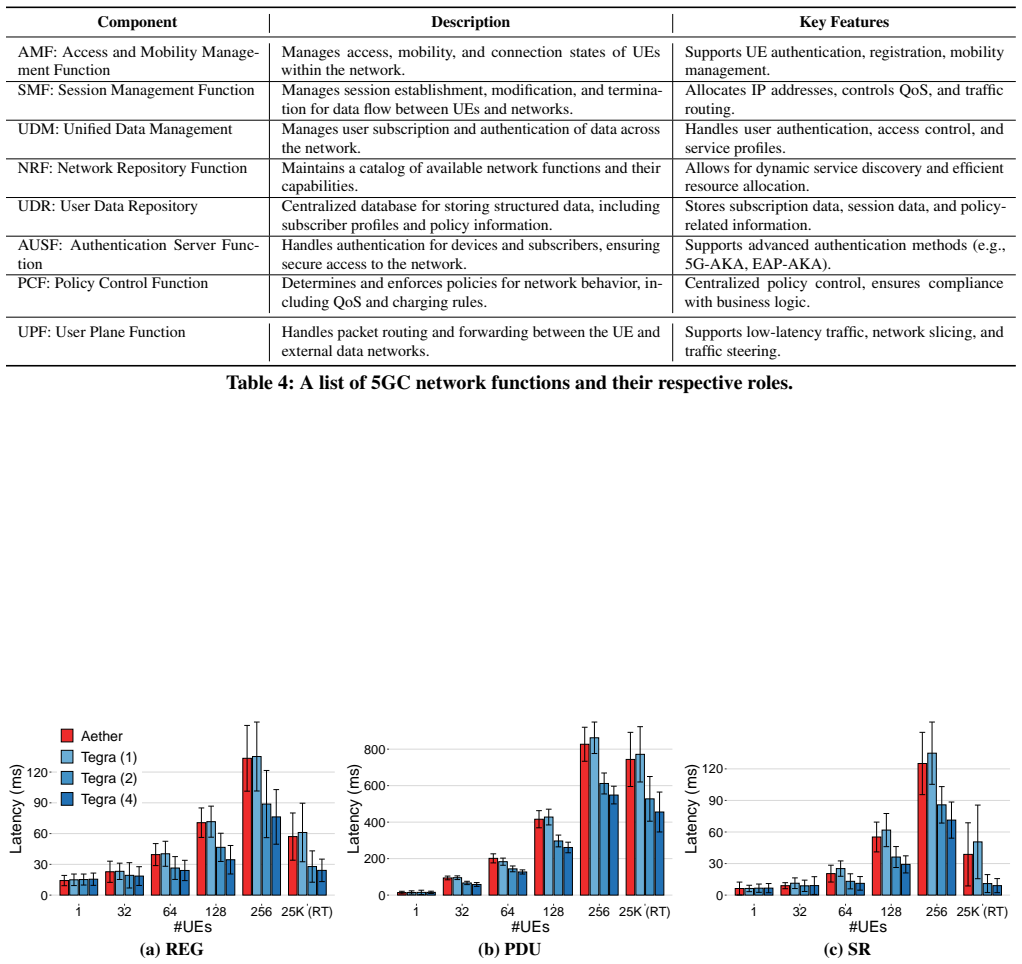
- [Figure 7] The figure is hard to parse from the text: panel labels, baseline indication, and the distinction between measured and projected bars should be stated in the caption. It would help to include absolute latencies and confidence intervals, not only speedups.
- [§6.3.5] The sentence 'Adding a new service (i.e., NRF)' is confusing because TEGRA already includes NRF. Clarify whether the experiment is adding a new NRF instance or a different service, and how the single-line config change is counted.
- [§2, §6.1.2] CoreKube's missing functionality is described slightly differently in the footnote (downstream PFCP support) and in §6.1.2 (SR and UPF support). Please harmonize the descriptions.
- [§6.1.1] gNBSimRT is built for this paper but no artifact release is mentioned. Please state whether the emulator and trace will be made available, since this affects reproducibility of the evaluation.
Circularity Check
No circularity: TEGRA's speedups are measured against external baselines; the ~CoreKube projection is an unverified model but not a circular reduction.
full rationale
The paper's central claim is an empirical one: TEGRA, built by modifying Aether, is measured against Aether, free5GC, Open5GS, Magma, and CoreKube using the gNBSimRT emulator and a real trace. No parameter is fitted to TEGRA's own latency numbers, and no equation defines TEGRA's performance in terms of the baseline results. The only author-supplied inputs are the workload generator and trace (Sec. 6.1.1; ref [64]); these are not used to derive the speedups, so they do not make the result circular. The most arguable concern is Section 6.1.2, where the authors explicitly state CoreKube is incomplete and construct an augmented '~CoreKube' baseline by scaling CoreKube's measured latency with estimated LoC percentages (67%, 71%, 733%). This is a limitation: the paper itself notes 'we project the associated runtime overhead,' and no formula connects LoC percentages to latency, especially for SR where CoreKube has no measured latency. But this is a reproducibility/correctness weakness of the parity claim, not a circularity: TEGRA's measured improvements do not reduce by construction to the ~CoreKube estimate, and the main comparisons to Aether/free5GC/Open5GS are external and independent.
Assumptions & free parameters
free parameters (1)
- CoreKube completion overhead model =
67% (REG), 71% (PDU), 733% (SR) additional LoCs; latency scaled by 2.2 GHz CPU
assumptions (3)
- domain assumption gNBSimRT and the single-operator trace [64] faithfully represent real 5G control-plane workloads
- ad hoc to paper Open5GS implementations provide a valid estimate of missing CoreKube functionality and runtime overhead
- domain assumption Equal CPU allocation across cores under test is a fair comparison basis
Cite this review
Pith. "Pith review of TEGRA: A Flexible & Scalable NextGen Mobile Core." pith.science (2026). https://pith.science/paper/U3RHQ7BD
@misc{pith2026250907410,
  author       = {Pith},
  title        = {Pith review of: TEGRA: A Flexible & Scalable NextGen Mobile Core},
  year         = {2026},
  howpublished = {\url{https://pith.science/paper/U3RHQ7BD}},
  note         = {Machine review of arXiv:2509.07410}
}
read the original abstract
To support emerging mobile use cases (e.g., AR/VR, autonomous driving, and massive IoT), next-generation mobile cores for 5G and 6G are being re-architected as service-based architectures (SBAs) running on both private and public clouds. However, current performance optimization strategies for scaling these cores still revert to traditional NFV-based techniques, such as consolidating functions into rigid, monolithic deployments on dedicated servers. This raises a critical question: Is there an inherent tradeoff between flexibility and scalability in an SBA-based mobile core, where improving performance (and resiliency) inevitably comes at the cost of one or the other? To explore this question, we introduce resilient SBA microservices design patterns and state-management strategies, and propose TEGRA -- a high-performance, flexible, and scalable SBA-based mobile core. By leveraging the mobile core's unique position in the end-to-end internet ecosystem (i.e., at the last-mile edge), TEGRA optimizes performance without compromising adaptability. Our evaluation demonstrates that TEGRA achieves significantly lower latencies, processing requests 20x, 11x, and 1.75x faster than traditional SBA core implementations -- free5GC, Open5GS, and Aether, respectively -- all while matching the performance of state-of-the-art cores (e.g., CoreKube) while retaining flexibility. Furthermore, it reduces the complexity of deploying new features, requiring orders of magnitude fewer lines of code (LoCs) compared to existing cores.
Figures


Figures from the paper (7 more)


Reference graph
Works this paper leans on
-
[1]
https://www.mong odb.com/docs/manual/core/write-operations-atomi city/
MongoDB: Atomicity and Transactions. https://www.mong odb.com/docs/manual/core/write-operations-atomi city/. Last accessed: 03/2025
2025
-
[2]
https://www.mongodb.com/ basics/change-streams
MongoDB: Change Streams. https://www.mongodb.com/ basics/change-streams. Last accessed: 03/2025
2025
-
[3]
https://www.mongodb.com/docs/manual/tutorial/exp ire-data/
MongoDB: Expire Data from Collections by Setting TTL. https://www.mongodb.com/docs/manual/tutorial/exp ire-data/. Last accessed: 03/2025
2025
-
[4]
https://www.etsi .org/deliver/etsi_ts/123500_123599/123501/15.03
System Architecture for the 5G System. https://www.etsi .org/deliver/etsi_ts/123500_123599/123501/15.03. 00_60/ts_123501v150300p.pdf. Last accessed: 03/2025
2025
-
[5]
https://www.etsi.org/del iver/etsi_ts/123500_123599/123502/15.02.00_60/ts _123502v150200p.pdf
Procedures for the 5G System. https://www.etsi.org/del iver/etsi_ts/123500_123599/123502/15.02.00_60/ts _123502v150200p.pdf. Last accessed: 03/2025
2025
-
[6]
https://portal.3gpp.org/desktopm odules/Specifications/SpecificationDetails.aspx? specificationId=3341
3GPP TR 29.501. https://portal.3gpp.org/desktopm odules/Specifications/SpecificationDetails.aspx? specificationId=3341. Last accessed: 03/2025
2025
-
[7]
https://www.3gpp .org/ftp/Specs/archive/24_series/24.501/24501-j 11.zip
System Architecture for the 5G System. https://www.3gpp .org/ftp/Specs/archive/24_series/24.501/24501-j 11.zip. Last accessed: 03/2025
2025
-
[8]
https://5g.systemsap proach.org
Private 5G: A Systems Approach. https://5g.systemsap proach.org. Last accessed: 03/2025
2025
Show all 98 references
-
[9]
Charac- terization and Prediction of Mobile-App Traffic Using Markov Modeling.IEEE Transactions on Network and Service Man- agement, 2021
Giuseppe Aceto, Giampaolo Bovenzi, Domenico Ciuonzo, An- tonio Montieri, Valerio Persico, and Antonio Pescapé. Charac- terization and Prediction of Mobile-App Traffic Using Markov Modeling.IEEE Transactions on Network and Service Man- agement, 2021
2021
-
[10]
https://opennetworking .org/news-and-events/press-releases/onfs-leadi ng-private-5g-connected-edge-platform-aether-n ow-released-to-open-source/
ONF’s Leading Private 5G Connected Edge Platform Aether™ Now Released to Open Source. https://opennetworking .org/news-and-events/press-releases/onfs-leadi ng-private-5g-connected-edge-platform-aether-n ow-released-to-open-source/. Last accessed: 03/2025
2025
-
[11]
https://opennetworking.org/sd-cor e/
Aether SD-Core. https://opennetworking.org/sd-cor e/. Last accessed: 03/2025
2025
-
[12]
A Low Latency and Consistent Cellular Control Plane
Mukhtiar Ahmad, Syed Usman Jafri, Azam Ikram, Wasiq Noor Ahmad Qasmi, Muhammad Ali Nawazish, Zartash Afzal Uzmi, and Zafar Ayyub Qazi. A Low Latency and Consistent Cellular Control Plane. InACM SIGCOMM, 2020
2020
-
[13]
Load Balance in Data Center SDN Networks.In- ternational Journal of Electrical and Computer Engineering (IJECE), 2018
Tariq Emad Ali, Ameer Hussein Morad, and Mohammed A Abdala. Load Balance in Data Center SDN Networks.In- ternational Journal of Electrical and Computer Engineering (IJECE), 2018
2018
-
[14]
P. C. Amogh, Goutham Veeramachaneni, Anil Kumar Rangisetti, Bheemarjuna Reddy Tamma, and A. Antony Franklin. A Cloud Native Solution for Dynamic Auto Scaling of MME in LTE. InPIMRC 2017, 2017
2017
-
[15]
DMME: A Distributed LTE Mobility Management Entity.Bell Lab
Xueli An, Fabio Pianese, Indra Widjaja, and Utku Günay Acer. DMME: A Distributed LTE Mobility Management Entity.Bell Lab. Tech. J., 2012
2012
-
[16]
Faucet: Deploying SDN in the Enterprise.Communications of the ACM, 2016
Josh Bailey and Stephen Stuart. Faucet: Deploying SDN in the Enterprise.Communications of the ACM, 2016
2016
-
[17]
Scal- ing the LTE Control-Plane for Future Mobile Access
Arijit Banerjee, Rajesh Mahindra, Karthik Sundaresan, Sneha Kasera, Kobus Van der Merwe, and Sampath Rangarajan. Scal- ing the LTE Control-Plane for Future Mobile Access. In CoNEXT, 2015
2015
-
[18]
A Virtual SDN-Enabled LTE EPC Architecture: A Case Study for S-/P-gateways Func- tions
Arsany Basta, Wolfgang Kellerer, Marco Hoffmann, Klaus Hoffmann, and Ernst-Dieter Schmidt. A Virtual SDN-Enabled LTE EPC Architecture: A Case Study for S-/P-gateways Func- tions. InIEEE SDN4FNS, 2013
2013
-
[19]
Service-based Architecture for 5g Core Net- works.Huawei White Paper, 1, 2017
Gabrial Brown. Service-based Architecture for 5g Core Net- works.Huawei White Paper, 1, 2017
2017
-
[20]
Prototyping and Load Balancing the Service Based Architecture of 5G Core using NFV
Tulja Vamshi Kiran Buyakar, Harsh Agarwal, Bheemar- juna Reddy Tamma, and Antony A Franklin. Prototyping and Load Balancing the Service Based Architecture of 5G Core using NFV. InIEEE NetSoft, 2019
2019
-
[21]
Research on 5GC Cloud-Native Deployment Mechanism Based on Cloud-Edge Collaboration
Yijun Cao, Peng Lv, Xiaojie Zhou, Yuting Wu, Shuo Quan, Zeya Zhu, and Shen Gao. Research on 5GC Cloud-Native Deployment Mechanism Based on Cloud-Edge Collaboration. InIEEE Conference on Telecommunications, Optics and Com- puter Science (TOCS), 2022
2022
-
[22]
λ-nic: Interactive Serverless Compute on Program- mable Smartnics
Sean Choi, Muhammad Shahbaz, Balaji Prabhakar, and Mendel Rosenblum. λ-nic: Interactive Serverless Compute on Program- mable Smartnics. In2020 IEEE 40th International Conference on Distributed Computing Systems (ICDCS), 2020
2020
-
[23]
https://www.cisco.com/c/en/us/td/docs/wireless/u cc/smf/2023-01/config-and-admin/b_ucc-5g-smf-c onfig-and-admin-guide_2023-01/m_5g-smf-overview
Cisco - Ultra Cloud Core 5G Session Management Function. https://www.cisco.com/c/en/us/td/docs/wireless/u cc/smf/2023-01/config-and-admin/b_ucc-5g-smf-c onfig-and-admin-guide_2023-01/m_5g-smf-overview. html/. Last accessed: 03/2025
2023
-
[24]
https://github.com/andrewferguson/corekube 5g-worker/tree/fd91920d927e9185b68d34a28e0257b5b c31cce8
Corekube Worker Component Repository – Part of Corekube Repo. https://github.com/andrewferguson/corekube 5g-worker/tree/fd91920d927e9185b68d34a28e0257b5b c31cce8. Last accessed: 03/2025
2025
-
[25]
https://github.c om/andrewferguson/corekube5g-worker/blob/main/so urce/nas_pdu_session_establishment_request.c#L7
nas-pdu-session-establishment-request.c. https://github.c om/andrewferguson/corekube5g-worker/blob/main/so urce/nas_pdu_session_establishment_request.c#L7 . Last accessed: 03/2025
2025
-
[26]
Adap- tive Microservice Scaling for Elastic Applications.IEEE Inter- net of Things Journal, 2020
Nathan Cruz Coulson, Stelios Sotiriadis, and Nik Bessis. Adap- tive Microservice Scaling for Elastic Applications.IEEE Inter- net of Things Journal, 2020
2020
-
[27]
PacificClouds: A Flexible MicroServices Based Archi- tecture for Interoperability in Multi-Cloud Environments
Juliana Oliveira de Carvalho, Fernando AM Trinta, and Dario Vieira. PacificClouds: A Flexible MicroServices Based Archi- tecture for Interoperability in Multi-Cloud Environments. In Closer, 2018
2018
-
[28]
From Monolithic Architecture to Mi- croservices Architecture
Lorenzo De Lauretis. From Monolithic Architecture to Mi- croservices Architecture. InIEEE International Symposium on Software Reliability Engineering Workshops (ISSREW), 2019
2019
-
[29]
https://blog.3 g4g.co.uk/2024/07/disaggregation-of-5g-core-cor e-network.html?m=1
Disaggregation of 5G Core (5GC) Networ. https://blog.3 g4g.co.uk/2024/07/disaggregation-of-5g-core-cor e-network.html?m=1. Last accessed: 03/2025
2024
-
[30]
https://www
SMF - Downlink Notification Management. https://www. techtrained.com/network-function-session-manag ement-function-smf-in-5g-core-network-5g-syste m-5gs/. Last accessed: 03/2025
2025
-
[31]
Last accessed: 03/2025
DPDK.https://www.dpdk.org/. Last accessed: 03/2025
2025
-
[32]
https://www.envoyproxy.io/
Envoy. https://www.envoyproxy.io/ . Last accessed: 03/2025
2025
-
[33]
https://www
Ericsson - Evolve Your Core Network for 5G. https://www. ericsson.com/en/core-network/5g-core. Last accessed: 03/2025
2025
-
[34]
Back to the future: N-Versioning of Microservices
Antonio M Espinoza, Riley Wood, Stephanie Forrest, and Mo- hit Tiwari. Back to the future: N-Versioning of Microservices. In2022 52nd Annual IEEE/IFIP International Conference on Dependable Systems and Networks (DSN), 2022
2022
-
[35]
Last accessed: 03/2025
Why Do We Need 5G? https://www.etsi.org/technol ogies/5G. Last accessed: 03/2025
2025
-
[36]
The Road to SDN: An Intellectual History of Programmable Networks
Nick Feamster, Jennifer Rexford, and Ellen Zegura. The Road to SDN: An Intellectual History of Programmable Networks. ACM SIGCOMM, 2014
2014
-
[37]
Corekube: An efficient, autoscaling and resilient mobile core system
Andrew E Ferguson, Jon Larrea, and Mahesh K Marina. Corekube: An efficient, autoscaling and resilient mobile core system. InThe 29th Annual International Conference On Mobile Computing And Networking, 2023
2023
-
[38]
Last accessed: 03/2025
What is Free5GC? https://www.free5gc.org . Last accessed: 03/2025
2025
-
[39]
Load Balancing in a Campus Network using Software Defined Networking
Ashkan Ghaffarinejad and Violet R Syrotiuk. Load Balancing in a Campus Network using Software Defined Networking. In GENI Research and Educational Experiment Workshop, 2014
2014
-
[40]
https://github.com/omec-proje ct/gnbsim
Omec - Gnbsim Repo. https://github.com/omec-proje ct/gnbsim. Last accessed: 03/2025
2025
-
[41]
https: //go.dev
Build Simple, Secure, Scalable Systems with Go. https: //go.dev. Last accessed: 03/2025
2025
-
[42]
Microservice Architectures for Scalability, Agility and Reliability in E- commerce
Wilhelm Hasselbring and Guido Steinacker. Microservice Architectures for Scalability, Agility and Reliability in E- commerce. InIEEE International Conference on Software Architecture Workshops (ICSAW), 2017
2017
-
[43]
NFV: State of the Art, Challenges, and Imple- mentation in Next Generation Mobile Networks (vEPC).IEEE network, 2014
Hassan Hawilo, Abdallah Shami, Maysam Mirahmadi, and Rasool Asal. NFV: State of the Art, Challenges, and Imple- mentation in Next Generation Mobile Networks (vEPC).IEEE network, 2014
2014
-
[44]
Automated Provisioning of Cloud-Native Network Functions in Multi-Cloud Environments
Shiku Hirai, Takuya Tojo, Saburo Seto, and Seisho Yasukawa. Automated Provisioning of Cloud-Native Network Functions in Multi-Cloud Environments. InIEEE NetSoft, 2020
2020
-
[45]
https://www.itu.int/en/ITU-R/stu dy-groups/rsg5/rwp5d/imt-2020/Documents/S01-1_R equirements%20for%20IMT-2020_Rev.pdf , 2020
Minimum Technical Performance Requirements for IMT-2020 Radio Interface(s). https://www.itu.int/en/ITU-R/stu dy-groups/rsg5/rwp5d/imt-2020/Documents/S01-1_R equirements%20for%20IMT-2020_Rev.pdf , 2020. Last accessed: 03/2025
2020
-
[46]
https://www.intel.com/content/www/us/en/wireless -network/5g-overview.html
Intel - From Cloud to Network to Edge: 5G Is Powered by Intel. https://www.intel.com/content/www/us/en/wireless -network/5g-overview.html. Last accessed: 03/2025
2025
-
[47]
Last accessed: 03/2025
ISTIO.https://istio.io/. Last accessed: 03/2025
2025
-
[48]
Vivek Jain, Hao-Tse Chu, Shixiong Qi, Chia-An Lee, Hung- Cheng Chang, Cheng-Ying Hsieh, K. K. Ramakrishnan, and Jyh-Cheng Chen. L25GC: A Low Latency 5G Core Network Based on High-Performance NFV Platforms. InACM SIG- COMM, 2022
2022
-
[49]
Network Characterization and Perceptual Evaluation of Skype Mobile Videos
Shraboni Jana, Amit Pande, An Jack Chan, and Prasant Moha- patra. Network Characterization and Perceptual Evaluation of Skype Mobile Videos. InICCCN 2013, 2013
2013
-
[50]
Exploiting Interoperable Microservices in Web Objects Enabled Internet of Things
Muhammad Aslam Jarwar, Sajjad Ali, Muhammad Golam Kib- ria, Sunil Kumar, and Ilyoung Chong. Exploiting Interoperable Microservices in Web Objects Enabled Internet of Things. In International Conference on Ubiquitous and Future Networks (ICUFN), 2017
2017
-
[51]
Urllc and embb in 5g industrial iot: A survey
Benish Sharfeen Khan, Sobia Jangsher, Ashfaq Ahmed, and Arafat Al-Dweik. Urllc and embb in 5g industrial iot: A survey. IEEE Open Journal of the Communications Society, 2022
2022
-
[52]
https://github.com/prometheus-ope rator/kube-prometheus
Kube-Prometheus. https://github.com/prometheus-ope rator/kube-prometheus. Last accessed: 03/2025
2025
-
[53]
https://kubernetes.io/docs /home/
Kubernetes Documentation. https://kubernetes.io/docs /home/. Last accessed: 03/2025
2025
-
[54]
https://kubernetes.io/docs/con cepts/services-networking/service/
Kubernetes Services. https://kubernetes.io/docs/con cepts/services-networking/service/ . Last accessed: 03/2025
2025
-
[55]
SW AN: An SDN based Campus WLAN Framework
Tao Lei, Zhaoming Lu, Xiangming Wen, Xing Zhao, and Luhan Wang. SW AN: An SDN based Campus WLAN Framework. In International Conference on Wireless Communications, Vehic- ular Technology, Information Theory and Aerospace & Elec- tronic Systems (VITAE), 2014
2014
-
[56]
A Control- Plane Perspective on Reducing Data Access Latency in LTE Networks
Yuanjie Li, Zengwen Yuan, and Chunyi Peng. A Control- Plane Perspective on Reducing Data Access Latency in LTE Networks. InMobiCom, 2017
2017
-
[57]
Evaluat- ing Nfv-Enabled Network Slicing for 5G Core
Chia-Wei Liao, Fuchun Joseph Lin, and Yoichi Sato. Evaluat- ing Nfv-Enabled Network Slicing for 5G Core. InAPNOMS, 2020
2020
-
[58]
https://linkerd.io/
LINKERD. https://linkerd.io/. Last accessed: 03/2025
2025
-
[59]
A P4-based 5G User Plane Function
Robert MacDavid, Carmelo Cascone, Pingping Lin, Badhrinath Padmanabhan, Ajay Thakur, Larry Peterson, Jennifer Rexford, and Oguz Sunay. A P4-based 5G User Plane Function. InPro- ceedings of the ACM SIGCOMM Symposium on SDN Research (SOSR), 2021
2021
-
[60]
PhD thesis, Indian Institute of Technology Hyderabad, 2020
A Madhura.Dynamic Resource Allocation for Addressing Performance Interference in NFV-based Systems. PhD thesis, Indian Institute of Technology Hyderabad, 2020
2020
-
[61]
https://magmac ore.org
A Modern Mobile Core Network Solution. https://magmac ore.org. Last accessed: 03/2025
2025
-
[62]
https: //www.itu.int/en/ITU-R/study-groups/rsg5/rwp5d/i mt-2020/Documents/060R1e.pdf
IMT - International Mobile Telecommunications. https: //www.itu.int/en/ITU-R/study-groups/rsg5/rwp5d/i mt-2020/Documents/060R1e.pdf. Last accessed: 03/2025
2020
-
[63]
Security in Microservices Architectures.Proce- dia Computer Science, 2021
Nuno Mateus-Coelho, Manuela Cruz-Cunha, and Luis Gon- zaga Ferreira. Security in Microservices Architectures.Proce- dia Computer Science, 2021
2021
-
[64]
Modeling and Generating Control-Plane Traffic for Cellular Networks
Jiayi Meng, Jingqi Huang, Y Charlie Hu, Yaron Koral, Xiaojun Lin, Muhammad Shahbaz, and Abhigyan Sharma. Modeling and Generating Control-Plane Traffic for Cellular Networks. InACM IMC, 2023
2023
-
[65]
https://patents.google.com/patent/WO2011141154A1 /en
Method for Handling Failure of a MME in a LTE/EPC Network. https://patents.google.com/patent/WO2011141154A1 /en. Last accessed: 03/2025
2025
-
[66]
CleanG—Improving the Architecture and Protocols for Future Cellular Networks with NFV.IEEE/ACM Transactions on Networking, 2020
Ali Mohammadkhan, KK Ramakrishnan, and Vivek A Jain. CleanG—Improving the Architecture and Protocols for Future Cellular Networks with NFV.IEEE/ACM Transactions on Networking, 2020
2020
-
[67]
Vasudevan Nagendra, Arani Bhattacharya, Anshul Gandhi, and Samir R. Das. MMLite: A Scalable and Resource Efficient Control Plane for Next Generation Cellular Packet Core. In SOSR, 2019
2019
-
[68]
A Variegated Look at 5G in the Wild: Performance, Power, and QoE Implications
Arvind Narayanan, Xumiao Zhang, Ruiyang Zhu, Ahmad Has- san, Shuowei Jin, Xiao Zhu, Xiaoxuan Zhang, Denis Rybkin, Zhengxuan Yang, Zhuoqing Morley Mao, Feng Qian, and Zhi- Li Zhang. A Variegated Look at 5G in the Wild: Performance, Power, and QoE Implications. InACM SIGCOMM, 2021
2021
-
[69]
Cloud-Native Functions
How to Converse in Cloud: Deploying NFV vs. Cloud-Native Functions. https://blog.equinix.com/blog/2020/11/ 12/how-to-converse-in-cloud-deploying-nfv-vs-c loud-native-functions/. Last accessed: 03/2025
2020
-
[70]
SDN/NFV-Based Mobile Packet Core Net- work Architectures: A Survey.IEEE Communications Surveys & Tutorials, 2017
Van-Giang Nguyen, Anna Brunstrom, Karl-Johan Grinnemo, and Javid Taheri. SDN/NFV-Based Mobile Packet Core Net- work Architectures: A Survey.IEEE Communications Surveys & Tutorials, 2017
2017
-
[71]
https://www.nokia.com/netw orks/core-networks/cloud-packet-core/?did=d0000 0000608&gclid=EAIaIQobChMIzujAiZ39_AIV4o1bCh22aQ iLEAAYASAAEgIpYvD_BwE
Cloud Packet Core (CPC). https://www.nokia.com/netw orks/core-networks/cloud-packet-core/?did=d0000 0000608&gclid=EAIaIQobChMIzujAiZ39_AIV4o1bCh22aQ iLEAAYASAAEgIpYvD_BwE. Last accessed: 03/2025
2025
-
[72]
https://www.nokia.com/ networks/core-networks/cloud-mobility-manager/
Nokia - Cloud mobility manager. https://www.nokia.com/ networks/core-networks/cloud-mobility-manager/ . Last accessed: 03/2025
2025
-
[73]
https://open5gs.org/open5gs/docs/guide/01-quick start//
Open5GS - Open Source implementation of 5G Core and EPC. https://open5gs.org/open5gs/docs/guide/01-quick start//. Last accessed: 03/2025
2025
-
[74]
https://openai rinterface.org/oai-5g-core-network-project/
5G CORE NETWORK - OpenAirInterface. https://openai rinterface.org/oai-5g-core-network-project/ . Last accessed: 03/2025
2025
-
[75]
https://opentelemetry.io
OpenTelemetry. https://opentelemetry.io . Last ac- cessed: 03/2025
2025
-
[76]
Experimental Characterization of Mobile IoT Application La- tency.IEEE Internet of Things Journal (IoT-J), 2017
Carlos Pereira, António Pinto, Duarte Ferreira, and Ana Aguiar. Experimental Characterization of Mobile IoT Application La- tency.IEEE Internet of Things Journal (IoT-J), 2017
2017
-
[77]
Democratizing the Network Edge.ACM SIGCOMM, 2019
Larry Peterson, Tom Anderson, Sachin Katti, Nick McKeown, Guru Parulkar, Jennifer Rexford, Mahadev Satyanarayanan, Oguz Sunay, and Amin Vahdat. Democratizing the Network Edge.ACM SIGCOMM, 2019
2019
-
[78]
https://www.proxmox.co m/en/proxmox-ve
Proxmox Virtual Environment. https://www.proxmox.co m/en/proxmox-ve. Last accessed: 03/2025
2025
-
[79]
A High Performance Packet Core for Next Generation Cellular Networks
Zafar Ayyub Qazi, Melvin Walls, Aurojit Panda, Vyas Sekar, Sylvia Ratnasamy, and Scott Shenker. A High Performance Packet Core for Next Generation Cellular Networks. InACM SIGCOMM, 2017
2017
-
[80]
Automa- tion of Microservices Application Deployment Made Easy by Rundeck and Kubernetes
Harika Rajavaram, Vineet Rajula, and B Thangaraju. Automa- tion of Microservices Application Deployment Made Easy by Rundeck and Kubernetes. InIEEE ICONECCT, 2019
2019
-
[81]
Last accessed: 03/2025
Redis.https://redis.io/. Last accessed: 03/2025
2025
-
[82]
Packt Publishing Ltd, 2019
Gigi Sayfan.Hands-On Microservices with Kubernetes: Build, Deploy, and Manage Scalable Microservices on Kubernetes. Packt Publishing Ltd, 2019
2019
-
[83]
TurboEPC: Leveraging Dataplane Programmability to Accelerate the Mobile Packet Core
Rinku Shah, Vikas Kumar, Mythili Vutukuru, and Purushottam Kulkarni. TurboEPC: Leveraging Dataplane Programmability to Accelerate the Mobile Packet Core. InSOSR, 2020
2020
-
[84]
Performance Issues and Solutions in SDN-based Data Center: a Survey.The Journal of Supercomputing, 2020
Alireza Shirmarz and Ali Ghaffari. Performance Issues and Solutions in SDN-based Data Center: a Survey.The Journal of Supercomputing, 2020
2020
-
[85]
https://www
5G SA Option 2 Implementation Guide Line. https://www. gsma.com/futurenetworks/wp-content/uploads/2020/ 06/5G-SA-Option-2-ImplementationGuideline-v1.3. pdf. Last accessed: 03/2025
2020
-
[86]
Automatic reliability testing for cluster man- agement controllers
Xudong Sun, Wenqing Luo, Jiawei Tyler Gu, Aishwarya Gane- san, Ramnatthan Alagappan, Michael Gasch, Lalith Suresh, and Tianyin Xu. Automatic reliability testing for cluster man- agement controllers. InOSDI, 2022
2022
-
[87]
An Advanced Devops Environment for Microservice-based Applications
Stefan Throner, Heiko Hütter, Niklas Sänger, Michael Schnei- der, Simon Hanselmann, Patrick Petrovic, and Sebastian Abeck. An Advanced Devops Environment for Microservice-based Applications. InIEEE International Conference on Service- Oriented System Engineering (SOSE), 2021
2021
-
[88]
https://www.intel.com/content/www/ us/en/products/details/network-io/intelligent-f abric-processors/tofino.html
Intel® Tofino™. https://www.intel.com/content/www/ us/en/products/details/network-io/intelligent-f abric-processors/tofino.html. Last accessed: 03/2025
2025
-
[89]
https://www
How To Escape Vendor Lock Ins In 4G 5G. https://www. telecomreview.com/articles/reports-and-coverag e/4688-how-to-escape-vendor-lock-ins-in-4g-5g . Last accessed: 03/2025
2025
-
[90]
A Zero Touch Emulation Framework for Network Slicing Management in a 5G Core Testbed
Shwetha Vittal, Sourav Sarkar, PS Prashanth, and Antony A Franklin. A Zero Touch Emulation Framework for Network Slicing Management in a 5G Core Testbed. InInternational Conference on Network and Service Management (CNSM), 2021
2021
-
[91]
https://www.junipe r.net/documentation/en_US/junos-space-apps/netw ork-director3.7/topics/concept/vxlan-evpn-overl ay-understanding.html
VXLAN—EVPN Overlay Overview. https://www.junipe r.net/documentation/en_US/junos-space-apps/netw ork-director3.7/topics/concept/vxlan-evpn-overl ay-understanding.html. Last accessed: 03/2025
2025
-
[92]
https://co mmunity.fs.com/blog/evpn-vxlan-how-to-use-it-i n-data-center.html
EVPN-VXLAN: How to Use It in Data Center. https://co mmunity.fs.com/blog/evpn-vxlan-how-to-use-it-i n-data-center.html. Last accessed: 03/2025
2025
-
[93]
Un- derstanding Operational 5G: A First Measurement Study on Its Coverage, Performance and Energy Consumption
Dongzhu Xu, Anfu Zhou, Xinyu Zhang, Guixian Wang, Xi Liu, Congkai An, Yiming Shi, Liang Liu, and Huadong Ma. Un- derstanding Operational 5G: A First Measurement Study on Its Coverage, Performance and Energy Consumption. InACM SIGCOMM, 2020
2020
-
[94]
Cellular Data Network Infrastructure Characterization and Implication on Mobile Content Placement
Qiang Xu, Junxian Huang, Zhaoguang Wang, Feng Qian, Alexandre Gerber, and Zhuoqing Morley Mao. Cellular Data Network Infrastructure Characterization and Implication on Mobile Content Placement. InSIGMETRICS, 2011
2011
-
[95]
Architecture Interoperability and Repeatability with Microservices: An Industry Perspective
Eric Yuan. Architecture Interoperability and Repeatability with Microservices: An Industry Perspective. InIEEE/ACM 2nd International Workshop on Establishing the Community-Wide Infrastructure for Architecture-Based Software Engineering (ECASE), 2019
2019
-
[96]
Understand- ing 5G Performance for Real-World Services: A Content Provider’s Perspective
Xinjie Yuan, Mingzhou Wu, Zhi Wang, Yifei Zhu, Ming Ma, Junjian Guo, Zhi-Li Zhang, and Wenwu Zhu. Understand- ing 5G Performance for Real-World Services: A Content Provider’s Perspective. InACM SIGCOMM, 2022
2022
-
[97]
Performance Evaluation of Candidate Proto- col Stack for Service-based Interfaces in 5G Core Network
Cheng Zhang, Xiangming Wen, Luhan Wang, Zhaoming Lu, and Lu Ma. Performance Evaluation of Candidate Proto- col Stack for Service-based Interfaces in 5G Core Network. InIEEE International Conference on Communications Work- shops (ICC Workshops), 2018
2018
-
[98]
High- Performance UPF Design Based on DPDK
Haoran Zhang, Zikang Chen, and Yang Yuan. High- Performance UPF Design Based on DPDK. InIEEE Inter- national Conference on Communication Technology (ICCT), 2021. A Key 5GC Network Functions In the context of 5G, the Mobile Core is transforming into a collection of disaggregate...
2021
Reviewed August 4, 2026 · model on record in the stance chip above.
Discussion (0). Continue with ORCID to comment.